
Sometimes life inspires storytime! I was planning to take a two week vacation to visit family in Arizona and do some sightseeing as well, so the week before I was to be off, storytime was all about the Southwest! It was fun to do some learning before the trip as well as incorporate things I love about the region, such as the animals and plants that live there. I also wanted to highlight the fact that Native peoples have lived there continuously, as well as it once being a part of Mexico, so there are many wonderful traditions and stories from the region, and they are told in many languages. I had trouble finding a book that was short and simple enough to share from a Native perspective, but I tried to offer some of the longer options on my take-home reading list.
This was also my last outdoor in-person storytime of the season, though I picked up virtual programming again when I returned home in November. It was really nice to be able to offer outdoor programs, but the weather was turning colder and more unpredictable as far as the rain and wet.
You can see the virtual program that does not include the full books read aloud here.


Early Literacy Tip: The American Southwest has been (and still is) the home of Native American nations for centuries including the Lakota, Navajo, Hopi and many other nations. It was also once a part of a Spanish territory, and then Mexico, before becoming part of the United States. This means a rich collection of stories about the Southwest exists in English, Spanish, and Native languages. Your child can build good speaking and listening skills and habits when they listen and talk to people who are fluent in any language.
Source: Adapted from this Storytime Starter document from the Madison Public Library (WI)
Welcome Song: We Clap and Sing Hello
Welcome Song: Hello, Friends
(tune of Goodnight, Ladies)
Hello, friends! Hello, friends!
Hello, friends, it’s time to say hello!
Hello, [name 1], hello, [name 2]!
Hello, [name 3], it’s time to say hello!
(ASL motions: salute for “hello,” then take the index fingers on each hand and you link them together as though they are hugging each other back and forth for “friends”)
Source: Glenside Public Library District
I handed out shaker eggs at the beginning of storytime and we used them for several songs. For this one, we wiggled our eggs, rolled them (rolled our arms), and made a big circle in front of us.
Warm-Up Rhyme: We Wiggle and Stop
(Use the ASL sign for the word “stop” – one hand “chops” across the opposite hand)
We wiggle and we wiggle and we STOP
We wiggle and we wiggle and we STOP
We wiggle and we wiggle and we wiggle and we wiggle
And we wiggle and we wiggle and we STOP
(Try other motions such as jump, twirl, stretch)
Source: Jbrary
Anytime a rhyme uses “left” and “right,” I make a point of telling the crowd to “mirror me” and I do the opposite.
Fingerplay: Two Desert Tortoises
(tune of Two Little Blackbirds)
Two desert tortoises walking at night
One turns left, the other turns right
Come back tortoises, don’t go away
Come back here, it’s time to play
Source: Brevard County Libraries (FL)
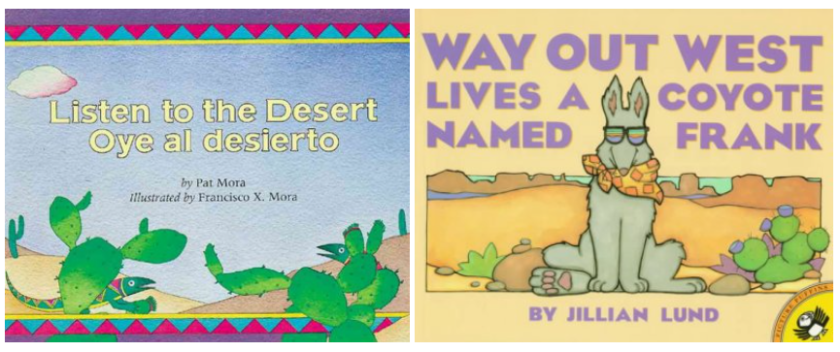
This storytime took place at the tail end of Hispanic Heritage Month, so I mentioned that both Pat Mora and Francisco X. Mora are of Mexican heritage. I read the title in English and Spanish, and mentioned that the book is bilingual, but that I’d only be reading the text in English today.
Read: Listen to the Desert/Oye al desierto by Pat Mora & Francisco X. Mora

Shaker Rhyme: Mr. Rattlesnake
I wish that I could rattle and shake
Just like Mister Rattlesnake!
Wiggle, wiggle, wiggle,
And shake, shake, shake
Just like Mister Rattlesnake!
Source: MCLS Kids Wiki
I kind of shoehorned this song to be a “shaker” song. Kids could hop like a rabbit, or make their egg shaker “jump.” For the coyote verse, the shaker could be the moon we howled at. The cactus verse didn’t really incorporate it, though!
Shaker Song: In the Desert
(tune of Wheels on the Bus)
The jackrabbit in the desert can hop like this,
Hop like this, hop like this
The jackrabbit in the desert can hop like this,
All night long!
Additional verses:
The coyotes in the desert can howl…
The rattlesnakes in the desert can rattle…
The saguaro in the desert can stand like this…
Source: Literary Hoots
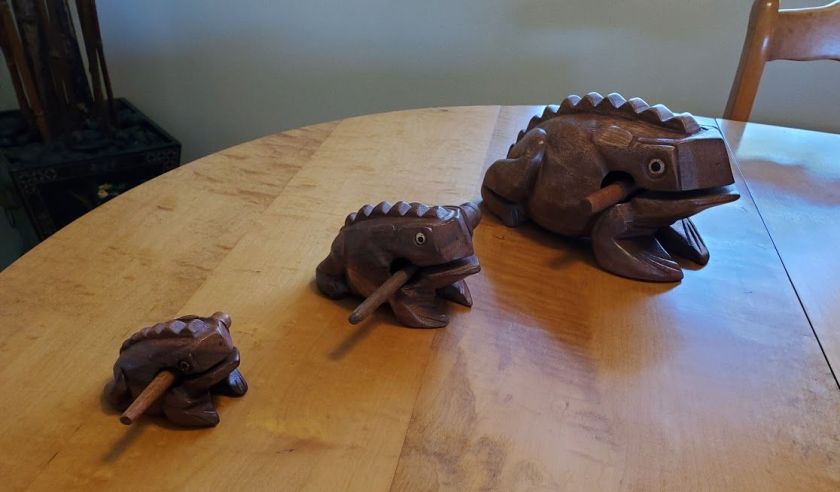
I really enjoy using my frog rasp instruments with a song written by a fellow librarian and posted on Storytime Underground – Three Frogs in a Bog. I rewrote it so I could have some desert toads! I used the rasps, but encouraged the kids to use their shakers.
Shaker Song: Three Toads
There was a big toad (shake, shake)
Lived in a cactus by the road (shake, shake)
He hopped in the desert (shake, shake)
Croaked his hellos (shake, shake)
Big toad (shake, shake)
By a big road (shake, shake)
Croaked a big hello (shake, shake)
(repeat for middle-sized and little frogs)
And then one day (shake, shake, shake)
The toads got together (shake, shake, shake)
Hopped in the desert (shake, shake, shake)
In the hot dusty weather (shake, shake, shake)
Three toads (shake, shake, shake)
Three friends (shake, shake, shake)
The end! (shake, shake, shake)
Source: adapted by Ms. Emily from Ada Moreau Demlow
Shaker Collecting Song: If You Have a Red Egg
(tune of Do You Know the Muffin Man)
If you have a red egg, a red egg, a red egg
If you have a red egg, please bring it up here!
Repeat with other colors of eggs.
Source: adapted from this ALSC Blog post
Breathing Break: Soup Breathing
Since the weather was turning colder, I brought back our soup breathing visualization. I asked the kids to imagine they were holding a bowl of their very favorite soup, and asked what kind they liked. Then with their hands cupped in front of them, we slowly breathed in the delicious aroma of their very favorite soup through their noses, then slowly and gently breathed out through their mouths to cool off this hot soup. We repeated about 5 times. Afterward, I let them know that this exercise always makes me feel good and more grounded, and they could always get out their bowl of soup if they need help calming down or feeling more connected to their bodies.
Source: Lucky Little Learners
One more repeated activity. This has always been a favorite song!
Action Song: Zoom, Zoom, Zoom!
Zoom, zoom, zoom, we’re going to the moon!
(hands scrape past each other rhythmically)
Zoom, zoom, zoom, we’re going to the moon!
If you want to take a trip (fingers walk up arm)
Climb aboard my rocket ship!
Zoom, zoom, zoom, we’re going to the moon!
In 5, 4, 3, 2, 1, BLASTOFF! (crouch, then jump!)
Source: Jbrary
The main reason I chose this one is that it was short and showed some different animals. I wish there were more short titles on this topic!
Read: Way Out West Lives a Coyote Named Frank by Jillian Lund

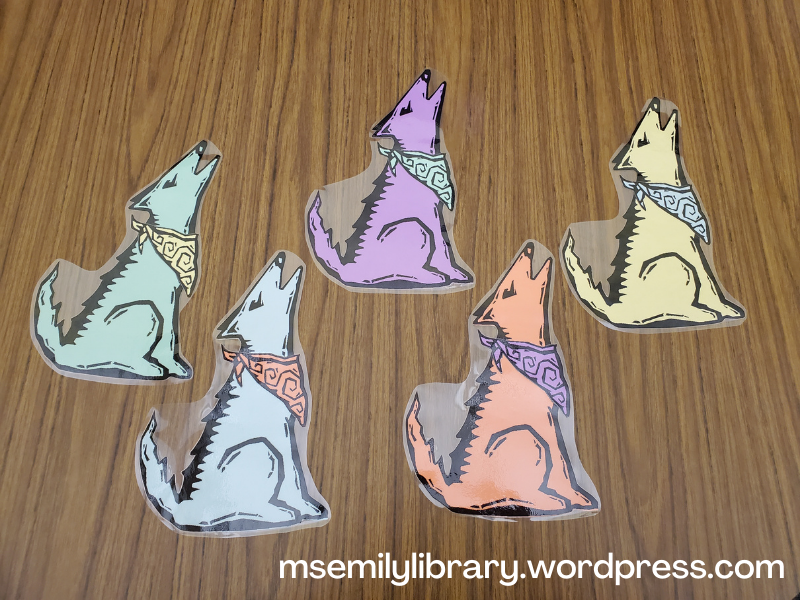
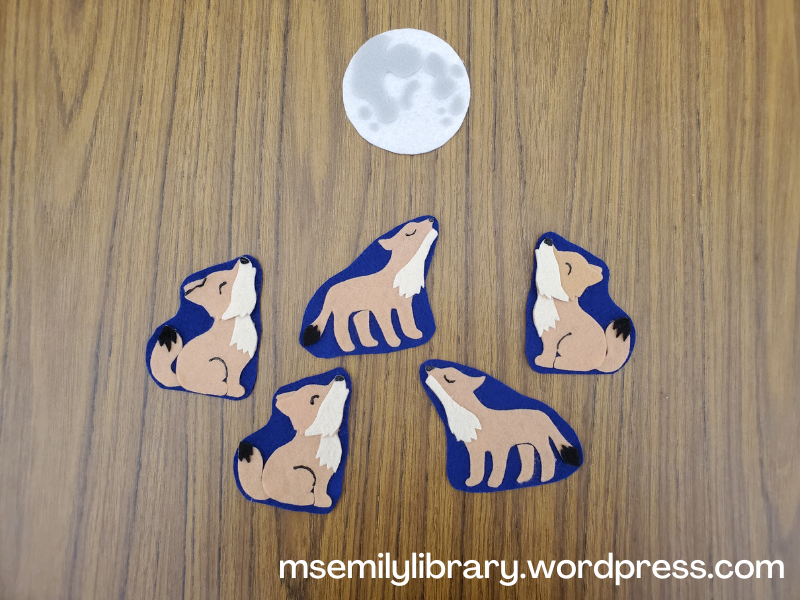
I *love* this song. It has a great tune and everyone likes howling and snoring! I had fun making a flannel for this one, but generally flannels are too small for the outdoor crowd. Instead, I used a larger template from Nancy Stewart to make bigger coyotes that stuck with magnets to my book cart. The tune I learned is slightly different from Nancy’s original, which a librarian friend Rebecca taught me. You can hear it in the video link above.
Counting/Flannel Song: Five Coyotes
Five coyotes, sittin’ on a hill
Just sittin’ and a howlin’ at the moon
Aahh-ooo!
One coyote had his fill
So he went to sleep and snoozed
Snore!
(Count down)
Source: adapted by Rebecca Ballard from Nancy Stewart
For the regular-sized flannel, I had plans to make them double-sided, with the reverse showing the coyotes curled up and sleeping, but ran out of time. Someday I’ll add that! I also did my best to make the moon look realistic, with craters in the right place. 🙂
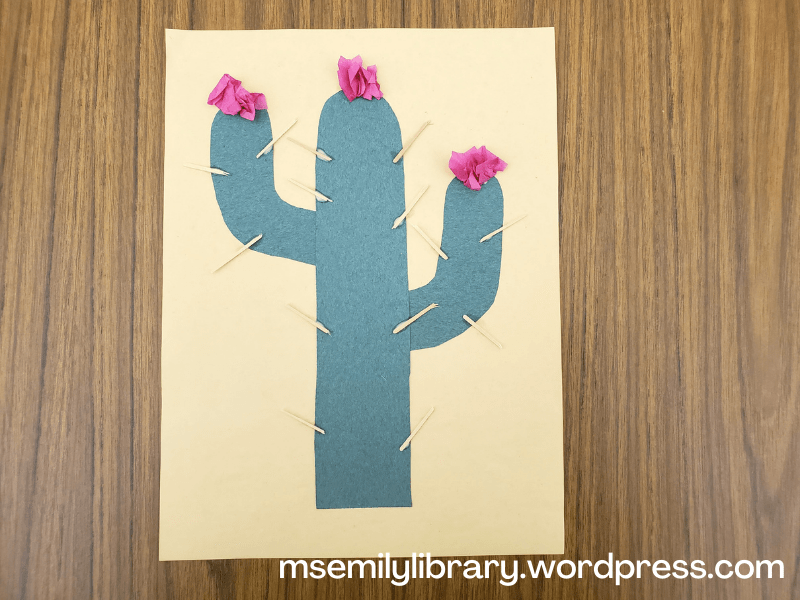
Craft: Saguaro Cactus
Inspired by Literary Hoots, this was an easy yet really attractive craft, with some nice 3D elements. Cactus trunks and arms can be cut from construction paper, and the kids can glue them down however they like. I snapped toothpicks in half to make spines they could glue on, and picked out some magenta tissue paper squares they could crumple and glue to the tops. (I learned later that saguaro blooms are white/yellow – oops.)
I also booktalked these alternative titles during the permanent YouTube video.
Big Moon Tortilla by Joy Cowley & Dyanne Strongbow
Fry Bread: A Native American Family Story by Kevin Noble Maillard & Juana Martinez-Neal
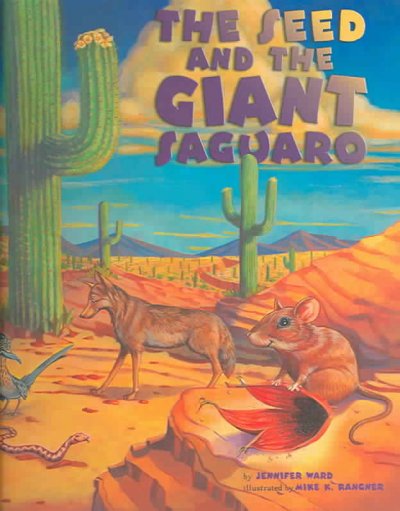
The Seed and the Giant Saguaro by Jennifer Ward & Mike K. Rangner
She’ll Be Coming ‘Round the Mountain by Jonathan Emmett & Deborah Allwright



Goodbye Song: See You Later, Alligator
(tune of Clementine)
See you later, alligator (wave with one hand, then the other)
In a while, crocodile (open and shut arms like a croc’s mouth)
Give a hug, ladybug (hug yourself or a loved one)
Blow a kiss, jellyfish! MWAH! (move hand like a jellyfish then blow a kiss!)
Source: King County Library System
Closing Rhyme: Tickle the Stars
This storytime was presented in-person and virtually on 10/12/21.
Storytime Handout:


 Storytime with Ms. Emily Library
One thought on “Family Storytime: The American Southwest”