Hello, readers. I am realizing that my new part time schedule with more programming responsibilities is reducing my ability to blog as much. I am still juggling and hopefully it will all settle sooner rather than later. In the meantime I’ll continue plugging away at my back log of themes.
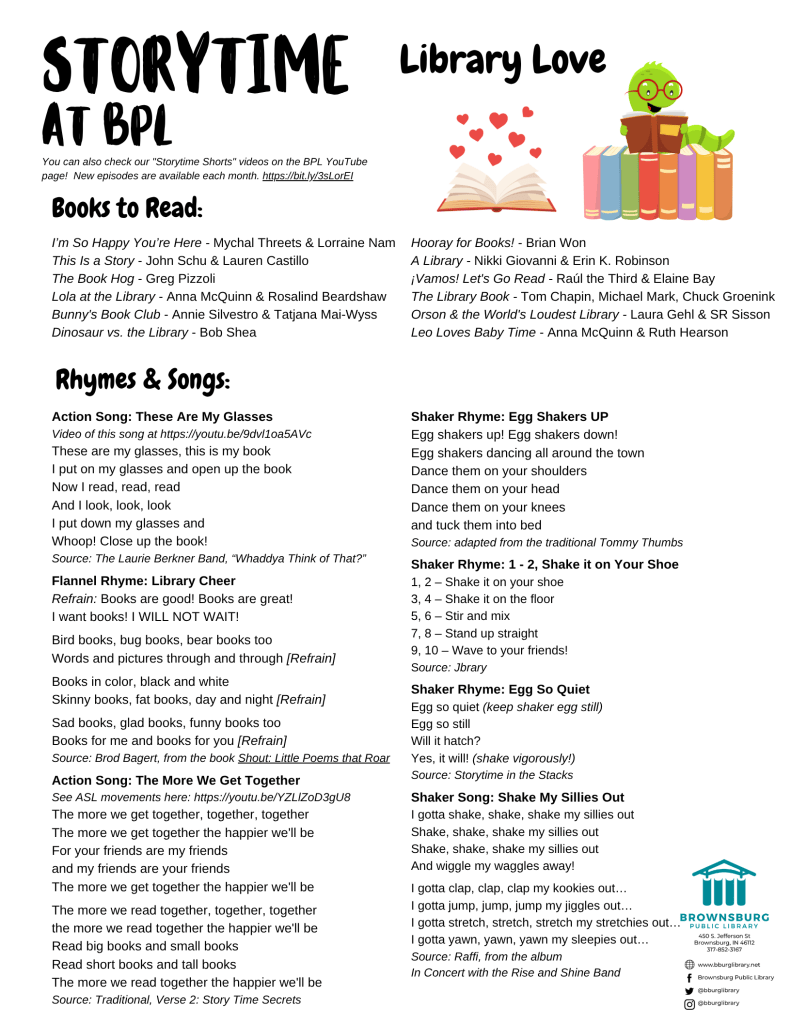
I haven’t done a books and reading theme for a while, so I thought I’d celebrate ALA’s Library Card Sign Up Month in September with a “Library Love” theme. I discovered The Library Cheer on The Librarian Is on the Loose blog, and had a lot of fun creating my own flannelboard version of it. All in all, it was a plan that went very smoothly for me!
Early Development Tip: When you enjoy a book, let your children know that you like it and why. Sharing your enjoyment gives them a positive attitude toward books. This positive attitude will influence them when they get to school and learn to read. Let your child choose books and tell you why they like them. –from The Early Literacy Kit: A Handbook and Tip Cards by Betsy Diamant-Cohen & Saroj Ghoting
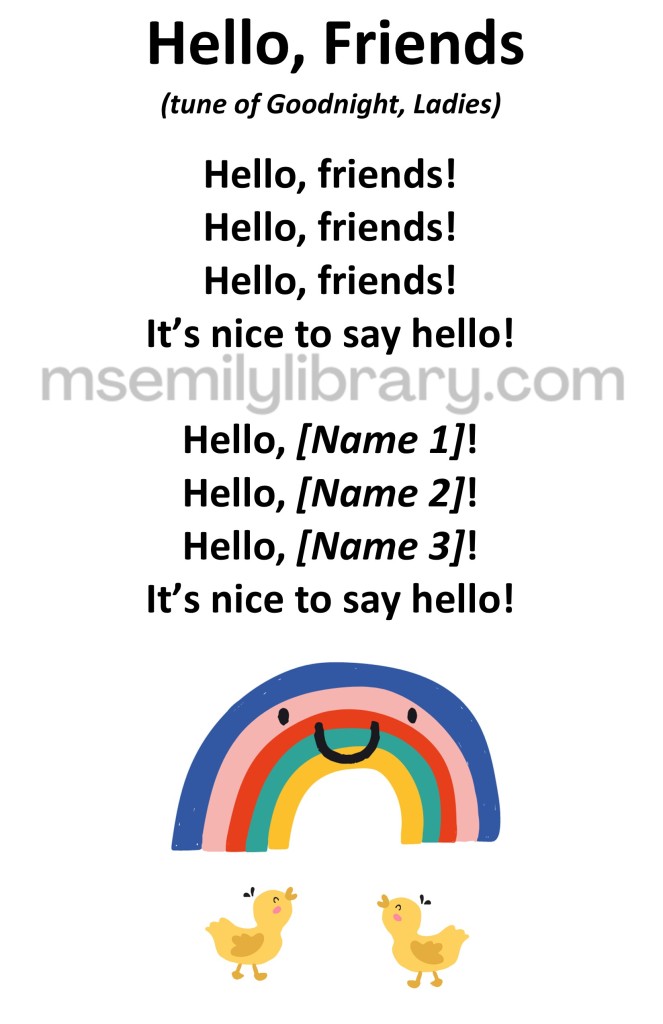
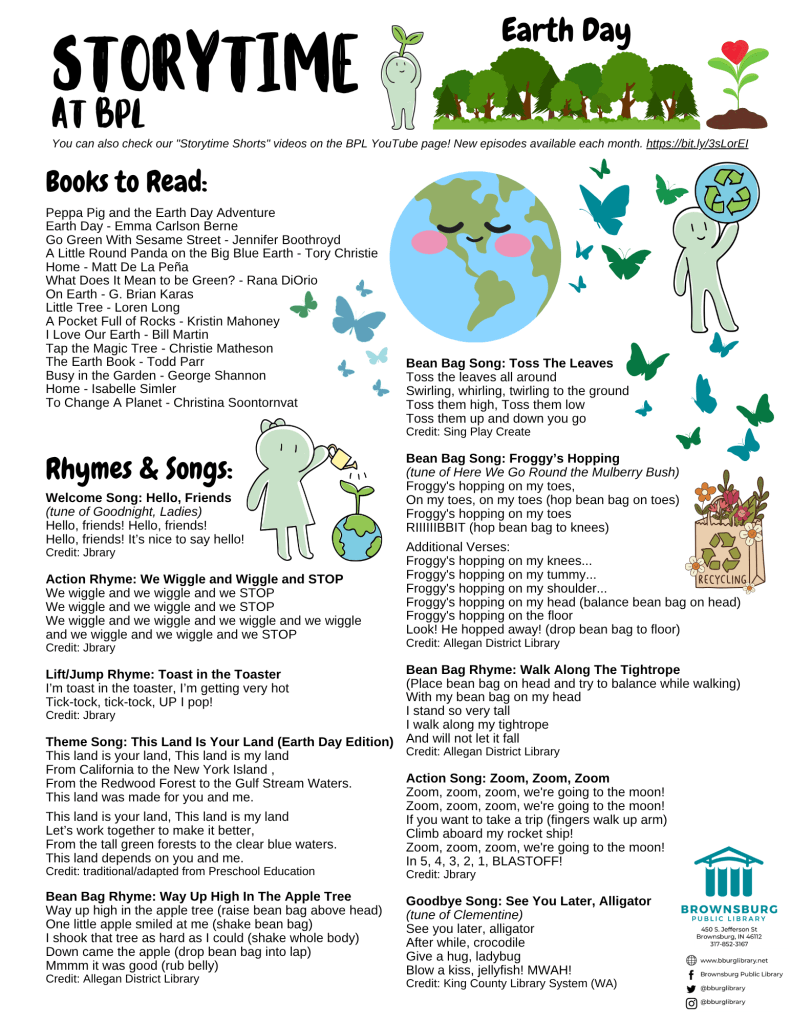
Welcome Song: Hello, Friends*†
Warm Up Song: Wake Up, Feet* This is a repeated song that everyone seems to enjoy. I always begin and end with feet and tummies, but find two other body parts to wiggle in the middle. I rotate between elbows, cheeks, hips, noses, arms, chins, thighs, heads, shoulders, ears, knees, and fingers.
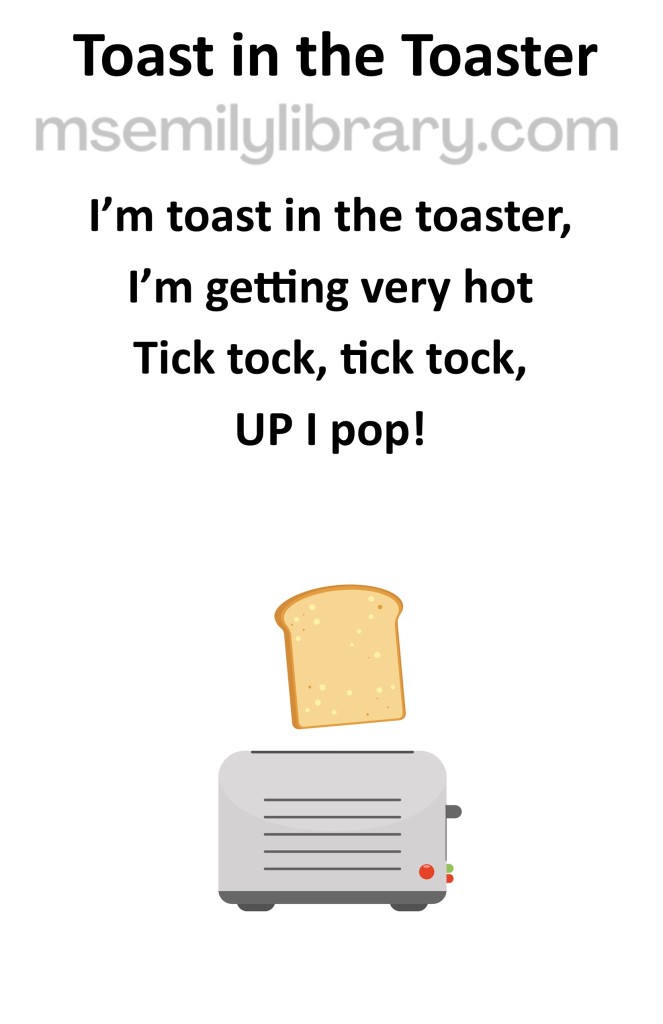
Lifting Rhyme: Toast in the Toaster*
Intro: September is Library Card Sign Up Month and I thought it would be fun to celebrate libraries, books, and reading in our storytime today. If you and your grownup don’t have a card and would like one, let’s talk during play time!
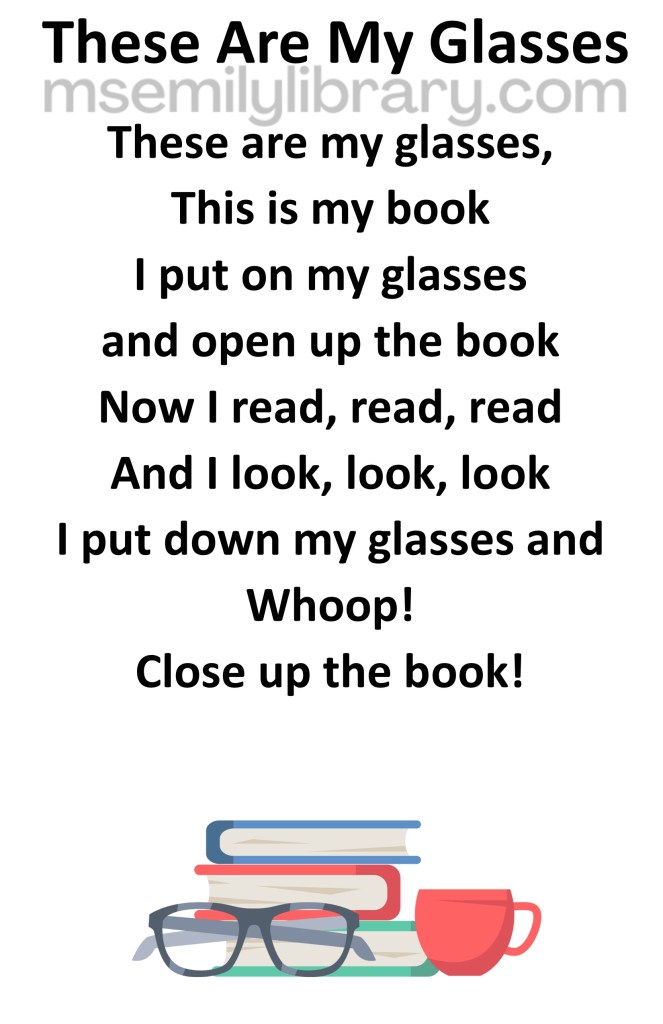
Here’s a song about a person who wears glasses when they read We practice putting our glasses on and off, and opening and closing our books before we start. Action Song: These Are My Glasses These are my glasses, this is my book I put on my glasses and open up the book Now I read, read, read And I look, look, look I put down my glasses and Whoop! Close up the book! Source: The Laurie Berkner Band, “Whaddya Think of That?”
Transition: If You’re Ready for a Story*
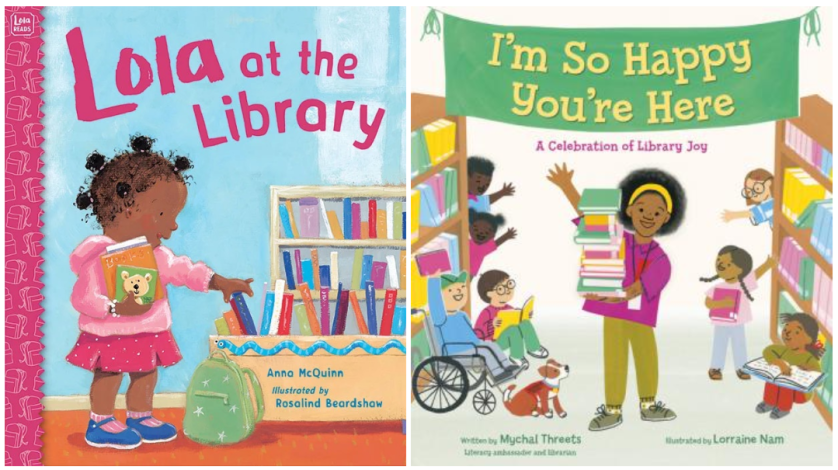
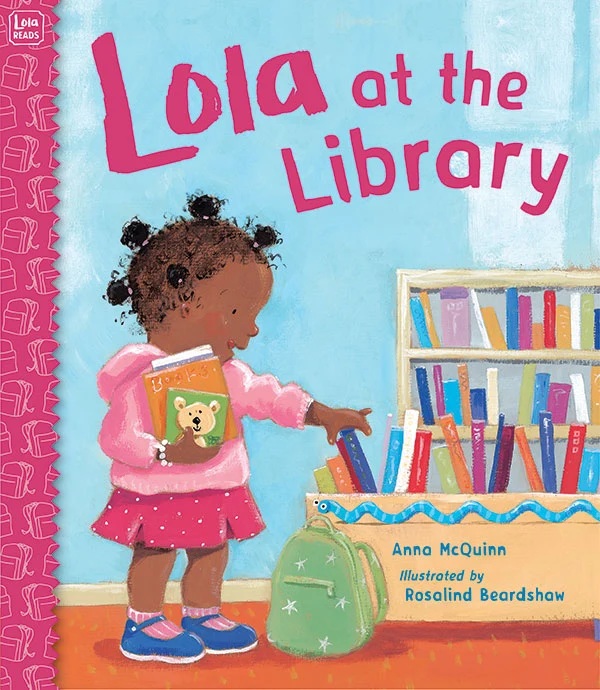
Lola is a great story to introduce library use as well as storytime! I change some details in the story to better fit my library’s policies (our loan period is three weeks rather than two, for example). We don’t have a cafe, so I skipped that page spread, too. When I read a page, I relate it to our experience. “Wow, TODAY is Tuesday!” “Did anyone walk to the library? Did you ride in a car? Did anyone get here another way?” It was a good way to keep the book engaging and the audience interested. Read: Lola at the Library by Anna McQuinn & Rosalind Beardshaw
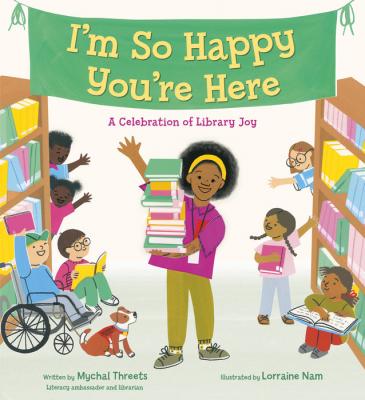
A new title with a lot of enthusiasm from Library Advocate and social media star Threets. Sweet but I liked the more specific details in Lola. Backup Read: I’m So Happy You’re Here by Mychal Threets & Lorraine Nam
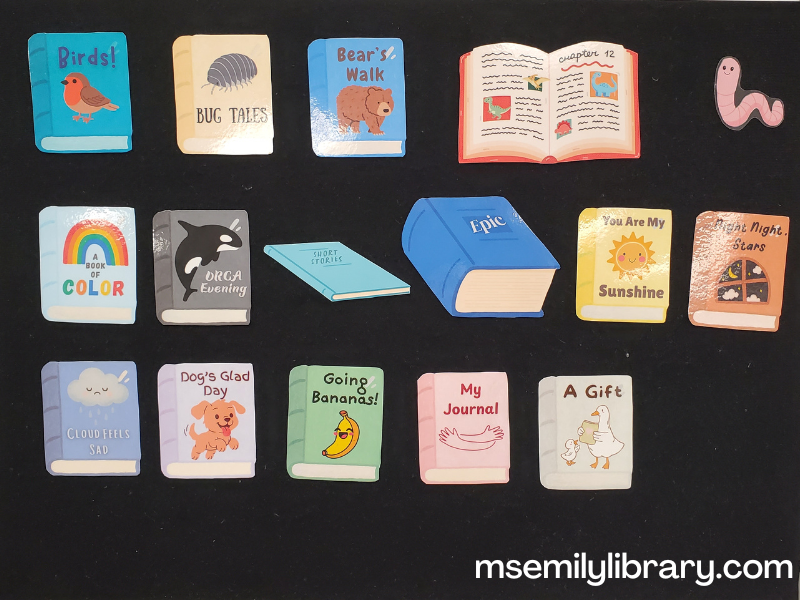
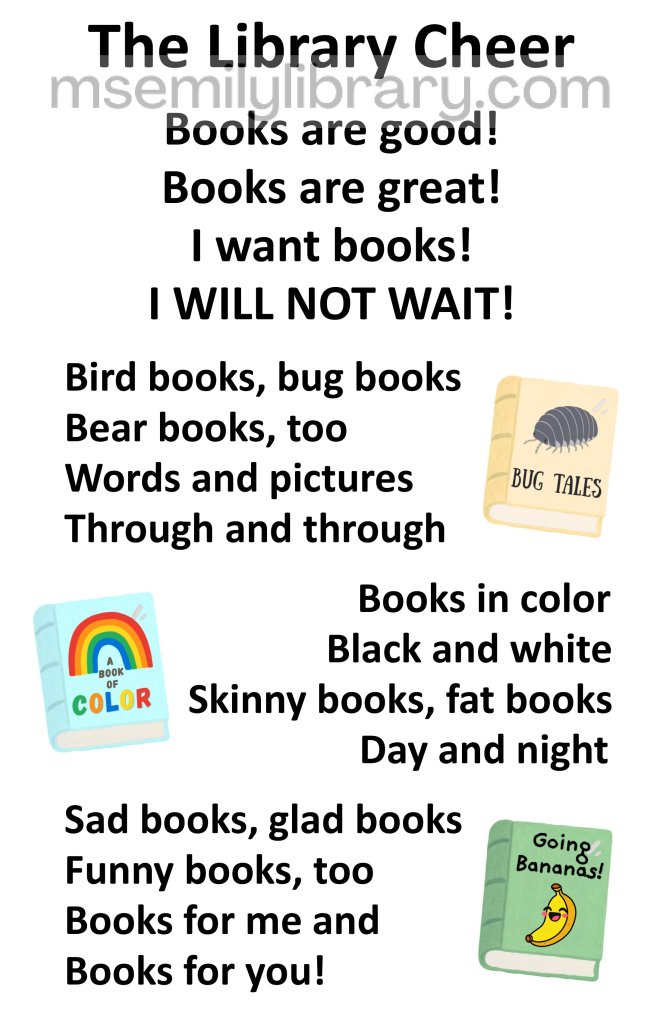
The library is full of great books – it makes me want to cheer! I had so much fun designing my book covers for this flannel! It was very helpful to have the handful in my hand and ready to put up as we did the rhyme – I consider not dropping any a win! For the refrain, we did a pat, pat, clap rhythm. Download a copy of the flannel at the link below. Flannel Rhyme: Library Cheer Refrain: Books are good! Books are great! I want books! I WILL NOT WAIT!
Bird books, bug books, bear books too Words and pictures through and through [Refrain]
Books in color, black and white Skinny books, fat books, day and night [Refrain]
Sad books, glad books, funny books too Books for me and books for you [Refrain] Source: Brod Bagert, from the book Shout: Little Poems that Roar via Librarian on the Loose
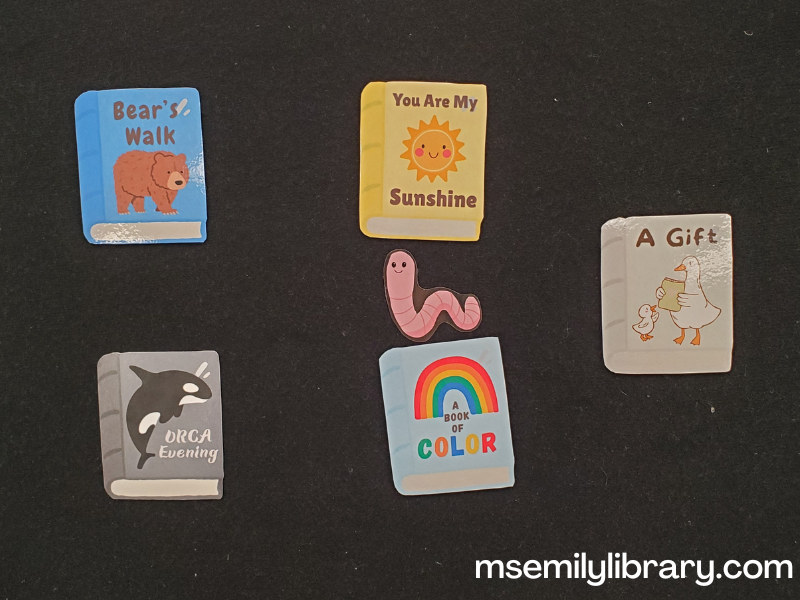
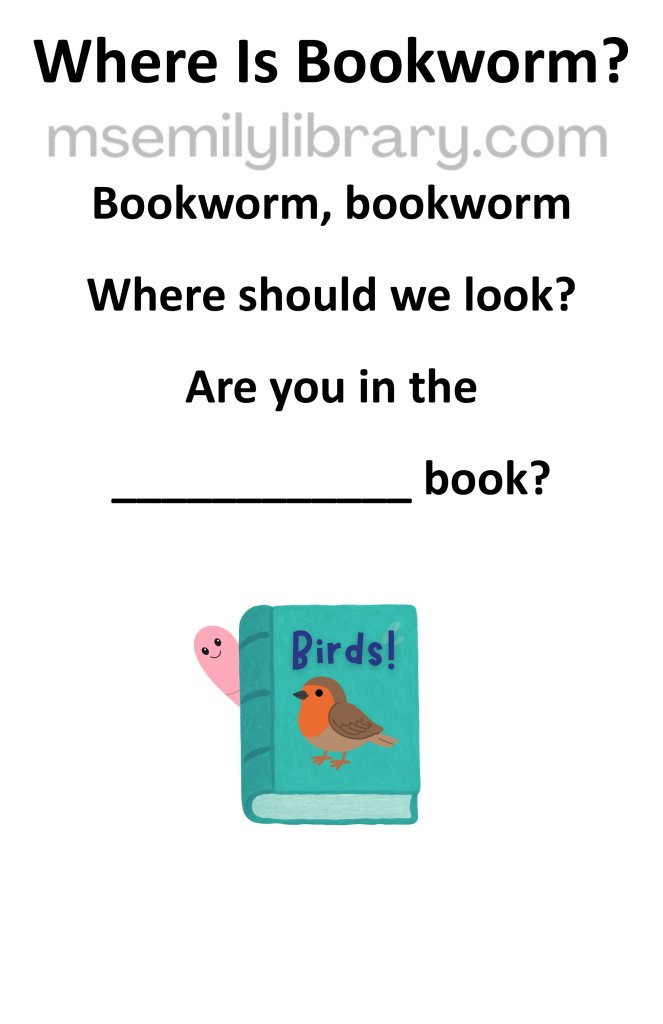
Look at all these books! Lets choose our five favorites for a game with my friend Bookworm. I took suggestions from the group so we weren’t so overwhelmed with choices for the hide and seek game. Instead of calling them the x color book, we went with “bird book” or “banana book” as a description. Flannel Game: Where Is Bookworm? Bookworm, bookworm, where should we look? Are you in the ___ book? Source: Storybook Stephanie
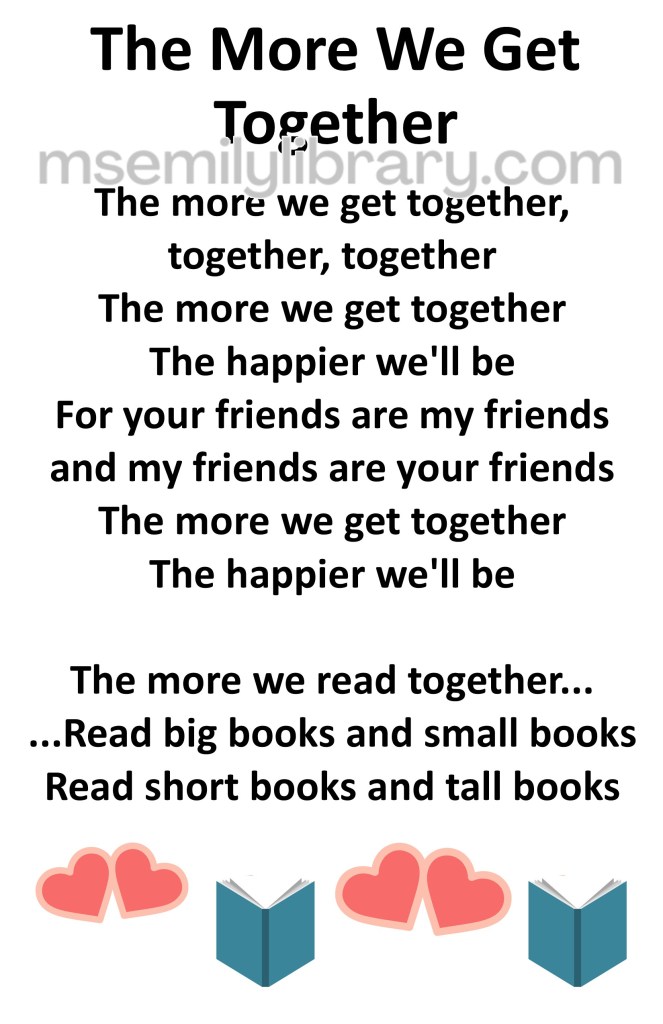
I love reading! And I love being with you. Let’s sing. We go over the ASL signs before getting started. Action Song: The More We Get Together See ASL movements here: https://youtu.be/YZLlZoD3gU8 The more we get together, together, together The more we get together the happier we’ll be For your friends are my friends and my friends are your friends The more we get together the happier we’ll be
The more we read together, together, together the more we read together the happier we’ll be Read big books and small books Read short books and tall books The more we read together the happier we’ll be Source: Traditional, Verse 2: Story Time Secrets
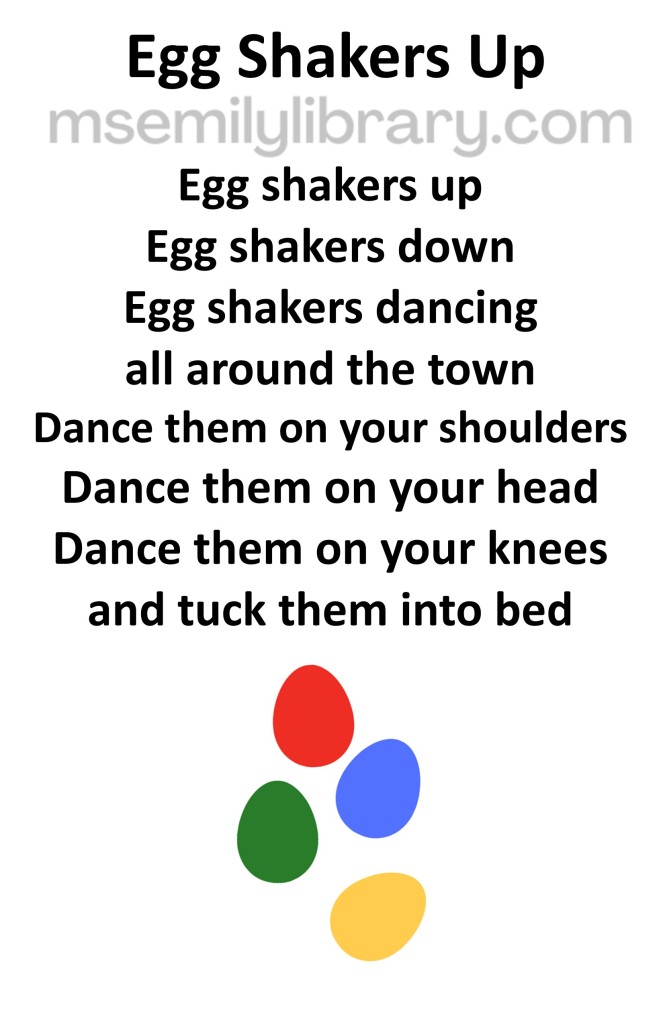
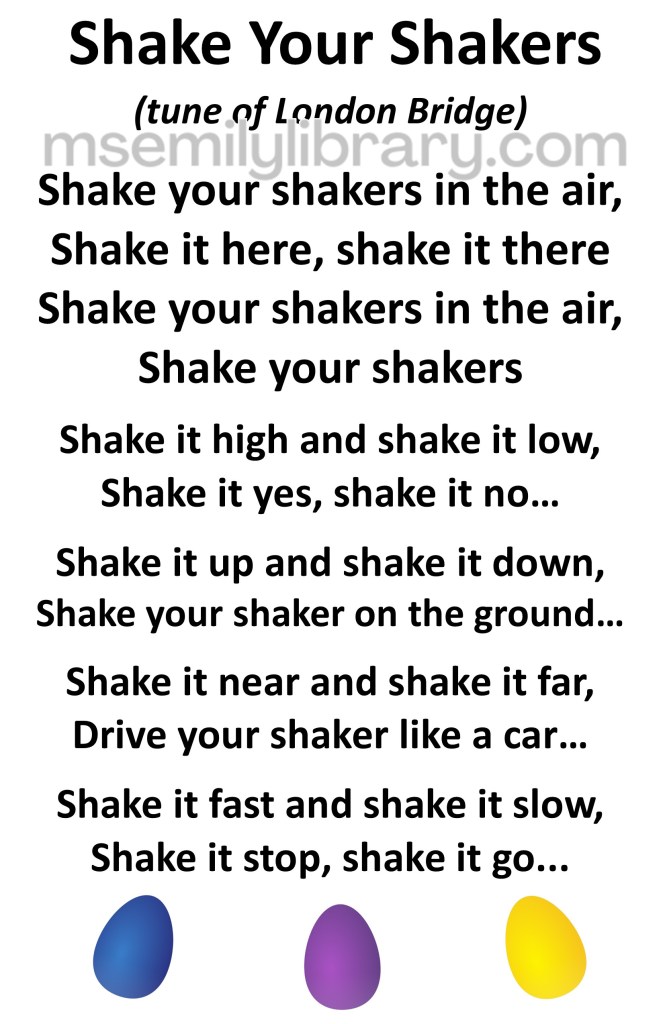
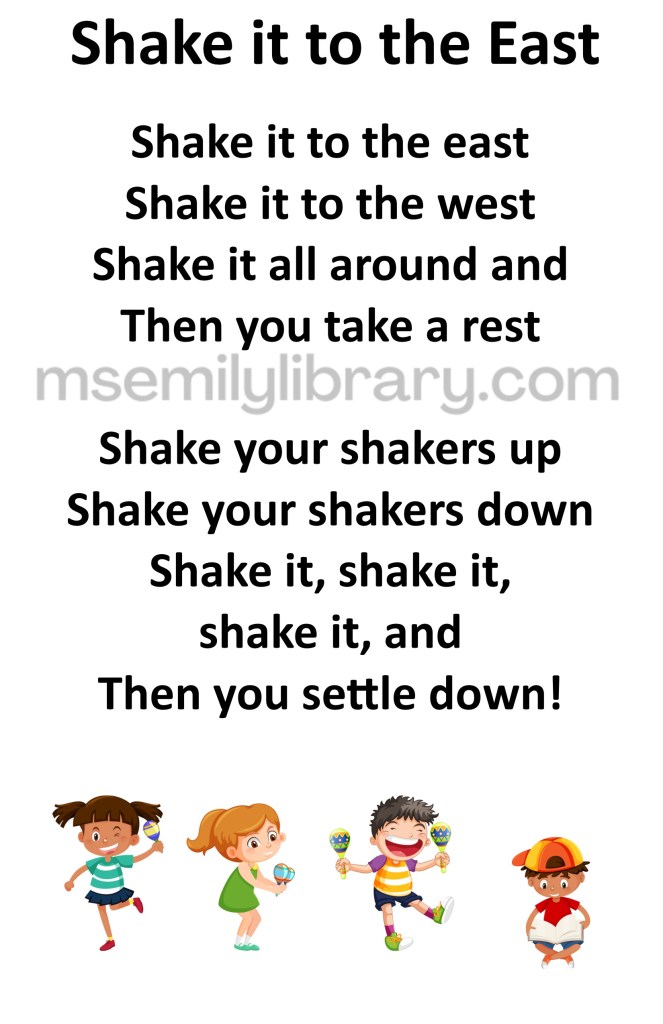
One of my favorite things to do at the library (other than reading) is playing in storytime – this week let’s play with our shaky eggs! So not a ton that actually is themed to books and reading, but I’ve found that the group really doesn’t care, especially when it’s our props. They’re just happy to play with them. Shaker Rhyme: Egg Shakers UP Egg shakers up! Egg shakers down! Egg shakers dancing all around the town Dance them on your shoulders Dance them on your head Dance them on your knees and tuck them into bed Source: adapted from the traditional Tommy Thumbs
Shaker Rhyme: 1 – 2, Shake it on Your Shoe 1, 2 – Shake it on your shoe 3, 4 – Shake it on the floor 5, 6 – Stir and mix 7, 8 – Stand up straight 9, 10 – Wave to your friends! Source: Jbrary
This one starts with a very quiet egg. Can you make your egg quiet? Shaker Rhyme: Egg So Quiet Egg so quiet (keep shaker egg still) Egg so still Will it hatch? Yes, it will! (shake vigorously!) Source: Storytime in the Stacks
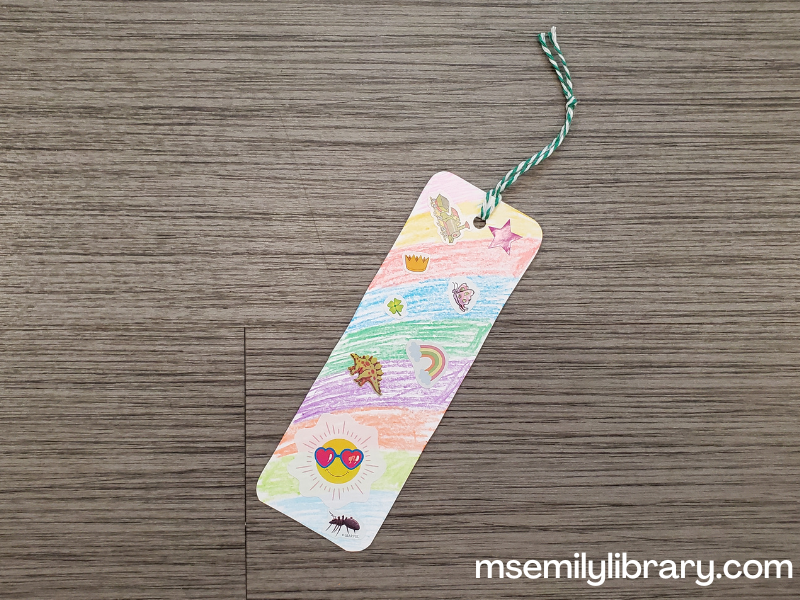
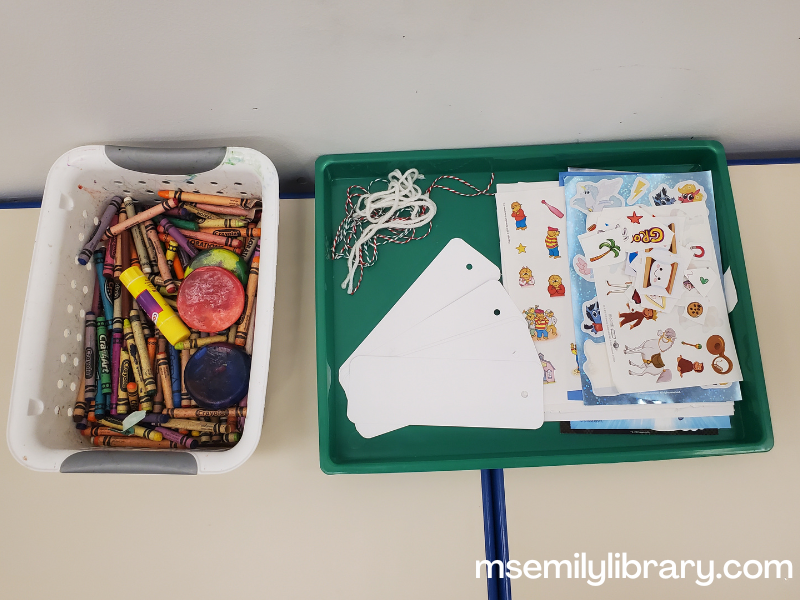
Craft: Bookmarks This was a super simple craft and used one of those craft supplies that we have a huge tub of (stickers) that hardly ever get used up. Every novelty book that has a sticker page in it tech services cuts out and adds to our tub, so there was a wide variety of different kinds to choose from. That plus crayons on cardstock bookmarks. I also provided some yarn/twine in a hole punch if they wanted it.Everyone’s bookmark looked different!
And I remembered to take a picture of the setup, too!
Play Time The toddlers have two laundry baskets of baby toys – rattles and cars, sorters and stackers, toy phones and spinners. For the older kids, I have foam blocks, soft food toys, puzzles, and a few other items that are a little more sophisticated than the baby toys. For Family Time, I gauge the overall age of the group and put out what seems right for them. We play for 5-10 minutes at the most, then I ring the bell and ask the kids to help me clean up. I think the clean up bit is good practice for them!
Goodbye Song: See You Later Alligator*
Other books I had available for families to browse (and may work for you on this theme) This Is a Story – John Schu & Lauren Castillo The Book Hog – Greg Pizzoli Bunny’s Book Club – Annie Silvestro & Tatjana Mai-Wyss Dinosaur vs. the Library – Bob Shea Hooray for Books! – Brian Won A Library – Nikki Giovanni & Erin K. Robinson ¡Vamos! Let’s Go Read – Raúl the Third & Elaine Bay The Library Book – Tom Chapin, Michael Mark, Chuck Groenink Orson & the World’s Loudest Library – Laura Gehl & SR Sisson Leo Loves Baby Time – Anna McQuinn & Ruth Hearson
This storytime was presented in-person on 9/8 & 9/9/26.
Who doesn’t like ice cream? No one in my storytime sessions, that’s for sure. We had an enthusiastic bunch for this sweet theme. August was a great time for me to do it, since it’s still summery but since our Summer Reading Program was over I didn’t need to tie it to the overall SRP theme.
As usual, I planned more than I had time for, so I cut my two flannel rhymes, but I will include them here for you. This storytime week I also did my monthly Stories and Stations evening program for ages 0-5, which is a shortened version of my daytime program with the addition of stations. It was fun to come up with an ice cream sensory bin, and of course, I had to do a little “research” at our local ice cream shop!
Early Development Tip: Scientific studies have shown that children develop best when they have a strong, positive relationship with a nurturing adult. This helps not only their physical development but their intellectual development as well. Hugs and kisses can be just as important as flash cards in getting a child ready for success in school. –from The Early Literacy Kit: A Handbook and Tip Cards by Betsy Diamant-Cohen & Saroj Ghoting
Welcome Song: Hello, Friends*†‡
Warm Up Song: Wake Up, Feet* This is a repeated song that everyone seems to enjoy. I always begin and end with feet and tummies, but find two other body parts to wiggle in the middle. I rotate between elbows, cheeks, hips, noses, arms, chins, thighs, heads, shoulders, ears, knees, and fingers.
Lifting Rhyme: Toast in the Toaster*‡
Intro: Summertime is a great time for a sweet, cold treat – ice cream! What’s YOUR favorite flavor?
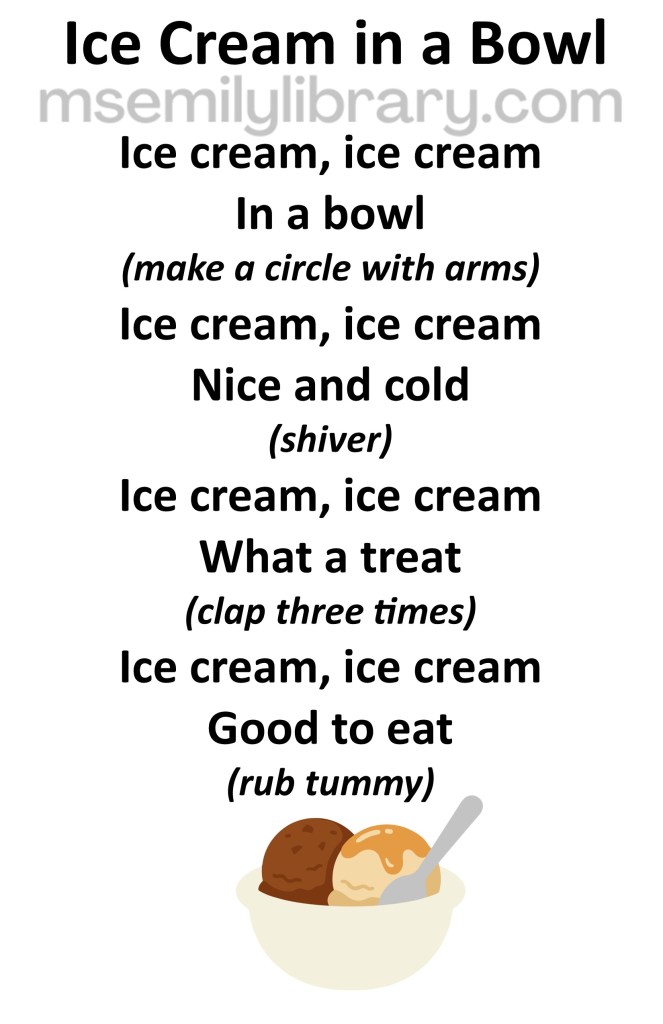
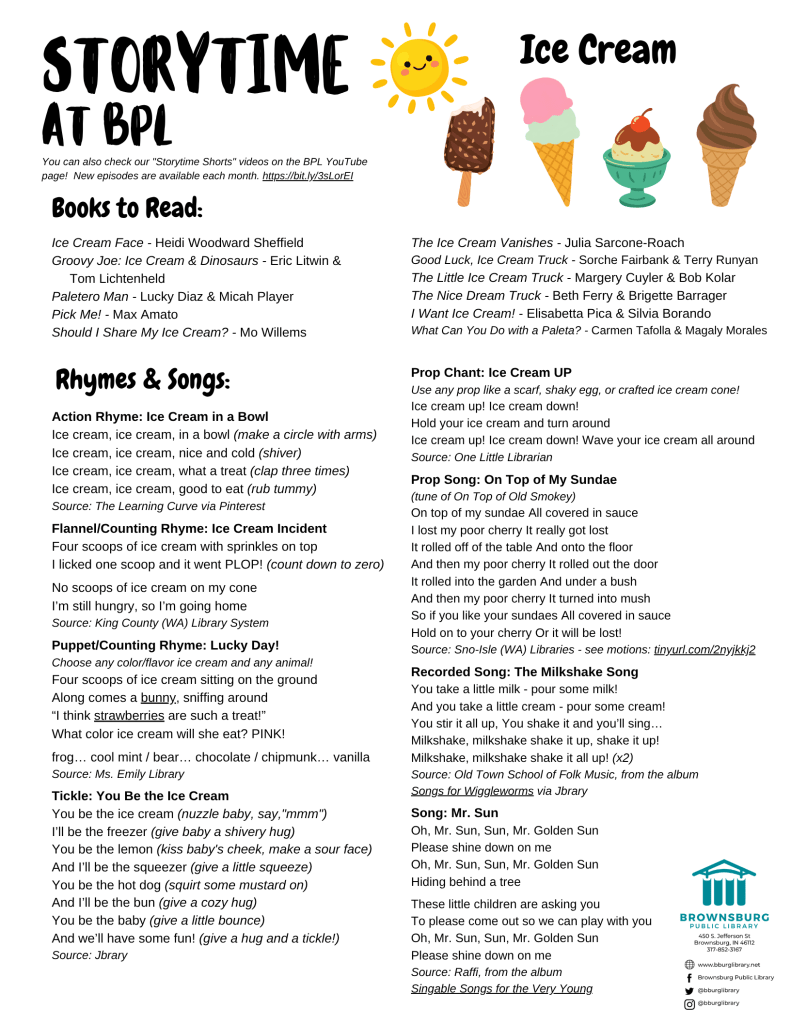
Let’s do a little rhyme about ice cream in a bowl. Can you make a bowl shape with your arms? [Most of them used both arms to make a circle in front of them.] Wow, that’s a big bowl – you must be hungry for ice cream! Action Rhyme: Ice Cream in a Bowl‡ Ice cream, ice cream, in a bowl (make a circle with arms) Ice cream, ice cream, nice and cold (shiver) Ice cream, ice cream, what a treat (clap three times) Ice cream, ice cream, good to eat (rub tummy) Source: The Learning Curve via Pinterest
Transition: If You’re Ready for a Story*‡
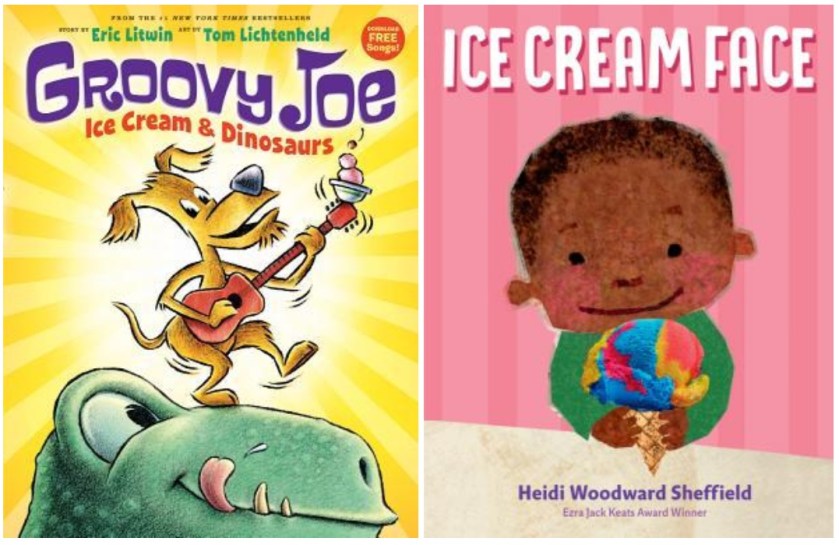
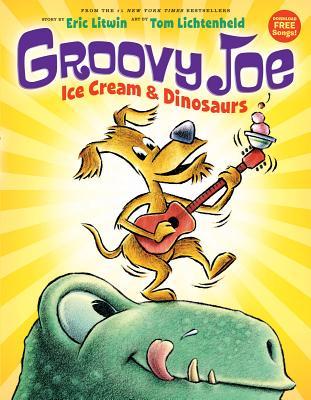
My coworker and I presented this title several weeks ago at our library’s end-of-summer ice cream social, and we decided to do it again for storytime! She came in as my guest and did most of the reading, and I did a lot of the “reactions” like the dino growls and played my ukulele during the song bits. We based our rendition on the book trailer music, and I used the chords A and E7 back and forth (sorry, no official song sheet!) It was so fun, and we had everyone singing and dancing by the end. Read: Groovy Joe: Ice Cream & Dinosaurs by Eric Litwin & Tom Lichtenheld‡
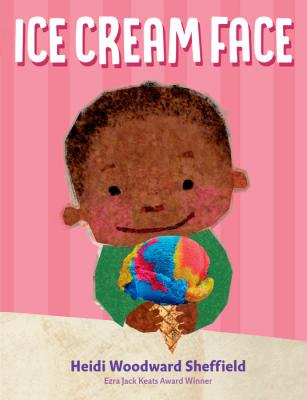
A very sweet book with a cool collage illustration style with cut out photographs mixed with the art. It has a lot of opportunities for making “emotion” faces and talking about our feelings. Backup Read: Ice Cream Face by Heidi Woodward Sheffield
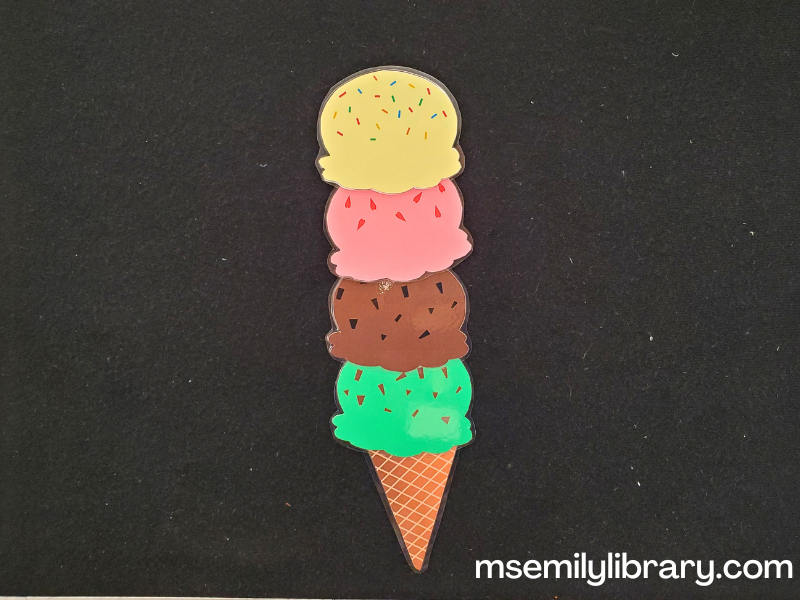
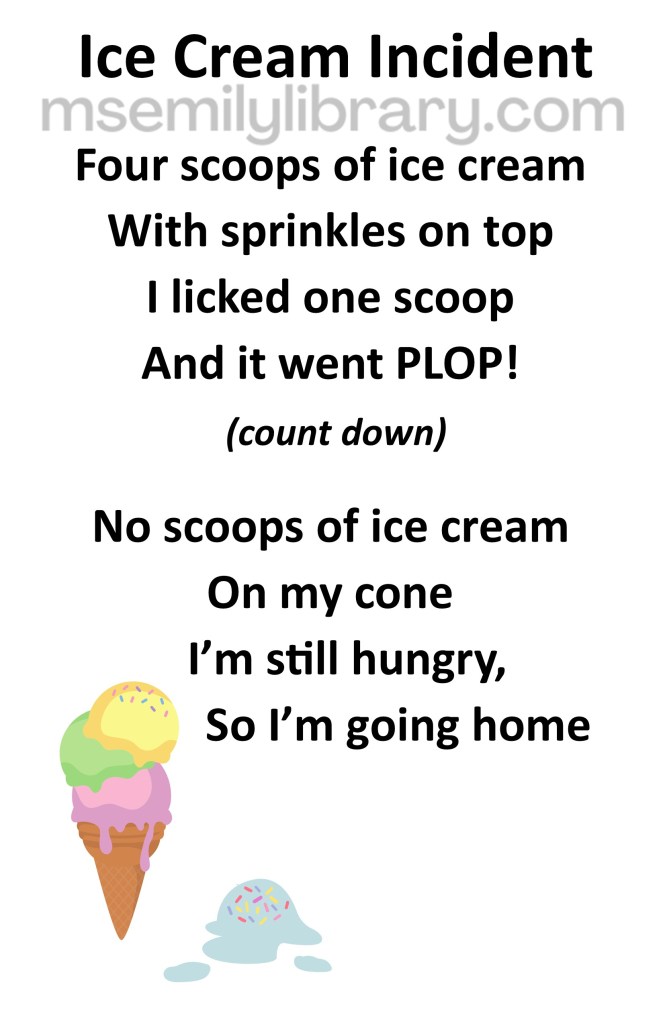
I went to the ice cream shop and I got all my favorites on a cone! How many scoops of ice cream did I get? I did this one the first session and almost ran out of time at the end, so I scrapped it the second and third times. It is cute, though, and gives some opportunity to talk about ice cream flavors and colors. I start with four scoops since five seems like an extreme amount of ice cream! Flannel printout from Literary Hoots. Flannel/Counting Rhyme: Ice Cream Incident Four scoops of ice cream with sprinkles on top I licked one scoop and it went PLOP! (count down to zero)
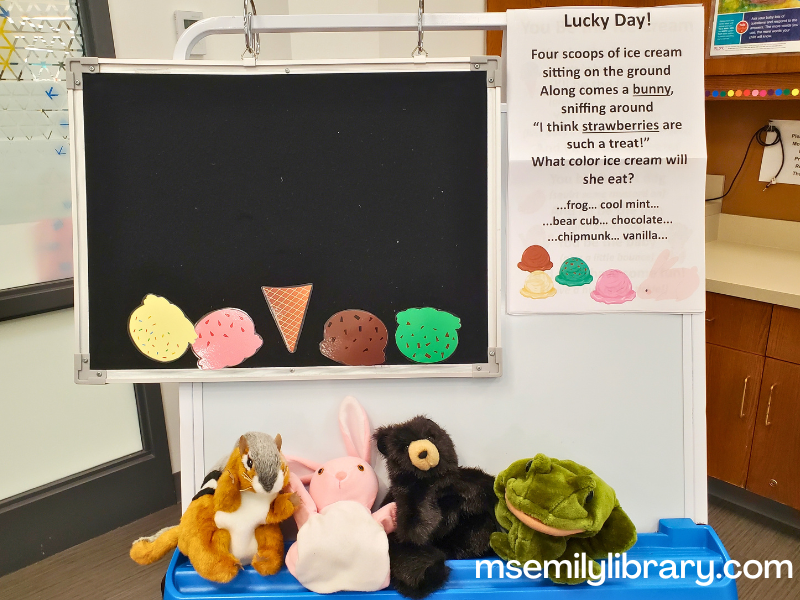
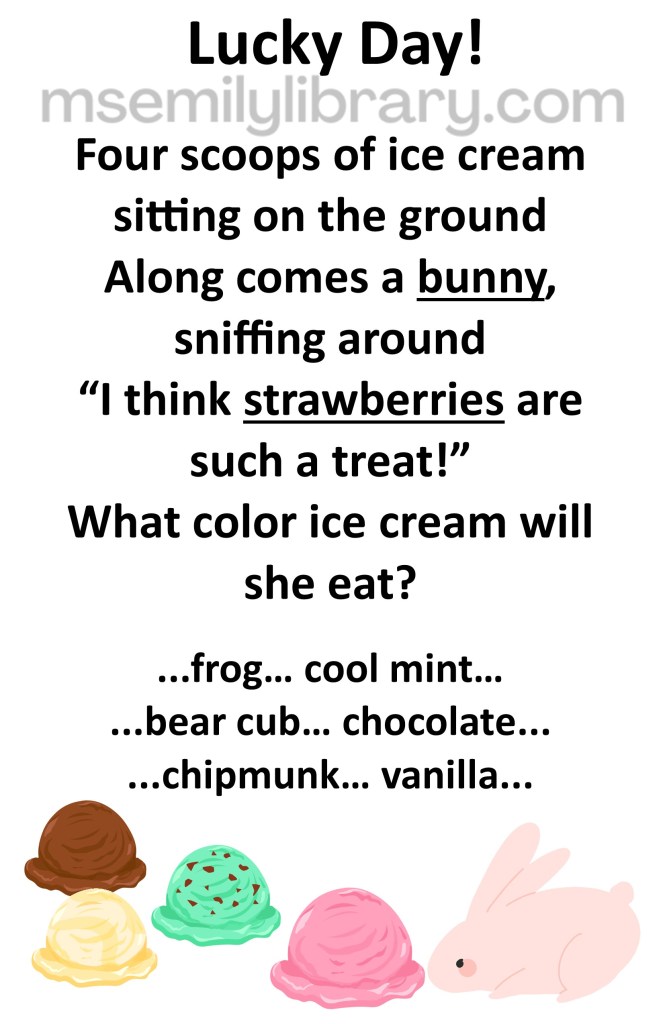
Who is this? Bunny might like some ice cream, too! I was thinking about all this ice cream that sadly fell on the ground, and thought that maybe some animals would be super happy to find a treat like that. I picked out four animal puppets and kind of matched their color to the color of ice cream they eat, though you could definitely use any animal. There’s also that element of matching a color with a flavor for more conversation opportunities. Again, I was worried about time, so didn’t actually do this one, unfortunately. Puppet/Counting Rhyme: Lucky Day! Four scoops of ice cream sitting on the ground Along comes a bunny, sniffing around “I think strawberries are such a treat!” What color ice cream will she eat? PINK!
additional verses: frog… cool mint / bear… chocolate / chipmunk… vanilla Source: original (Ms. Emily Library)
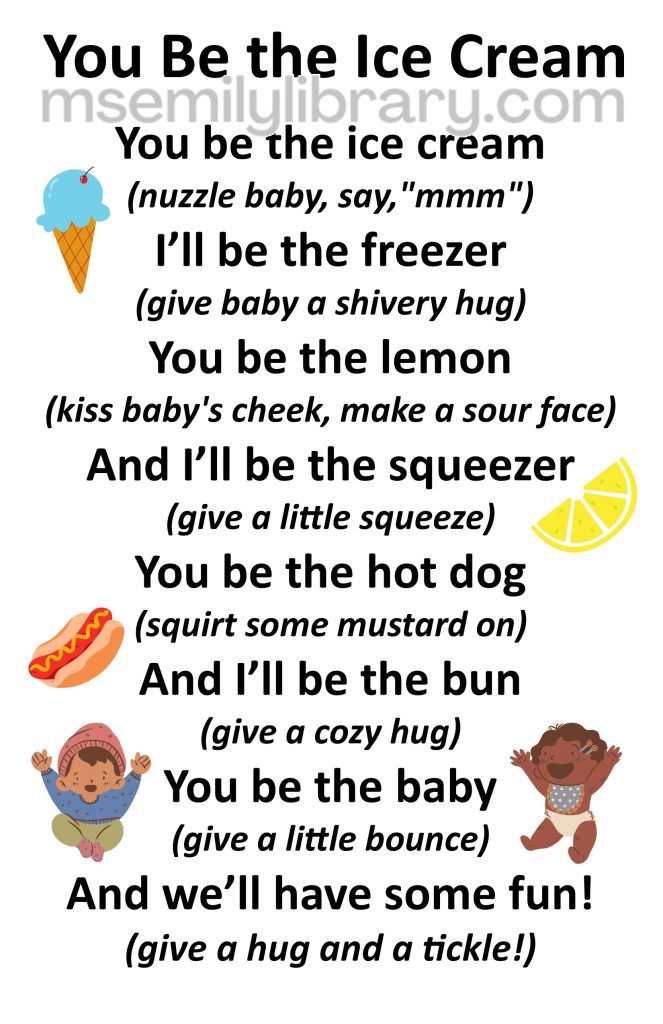
This was a good time to say this week’s early literacy tip. Tickle: You Be the Ice Cream You be the ice cream (nuzzle baby, say, “mmm”) I’ll be the freezer (give baby a shivery hug) You be the lemon (kiss baby’s cheek, make a sour face) And I’ll be the squeezer (give a little squeeze) You be the hot dog (squirt some mustard on) And I’ll be the bun (give a cozy hug) You be the baby (give a little bounce) And we’ll have some fun! (give a hug and a tickle!) Source: Jbrary
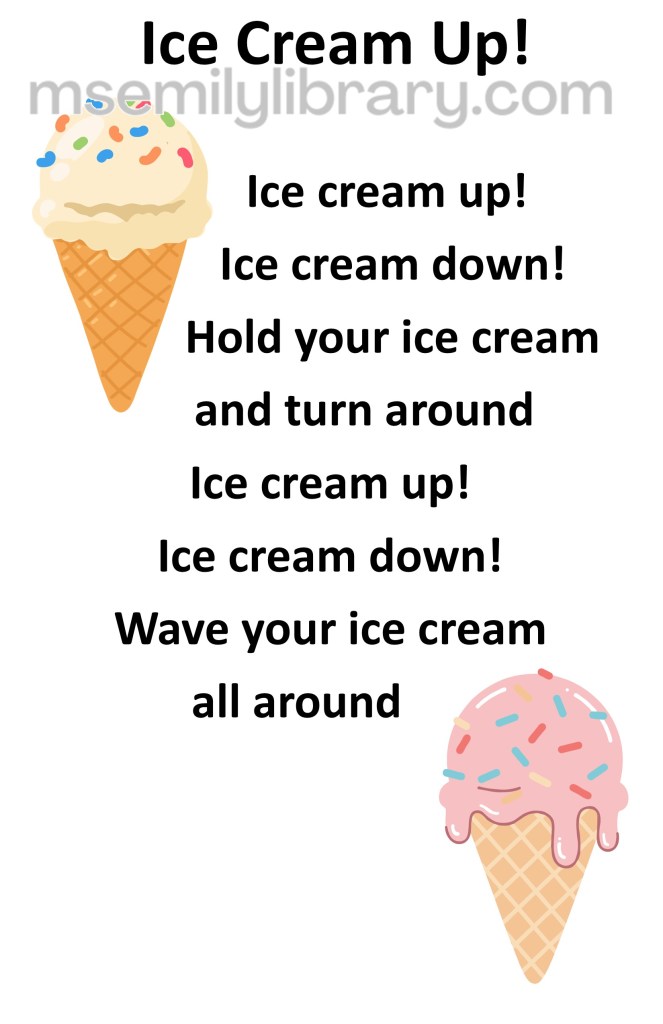
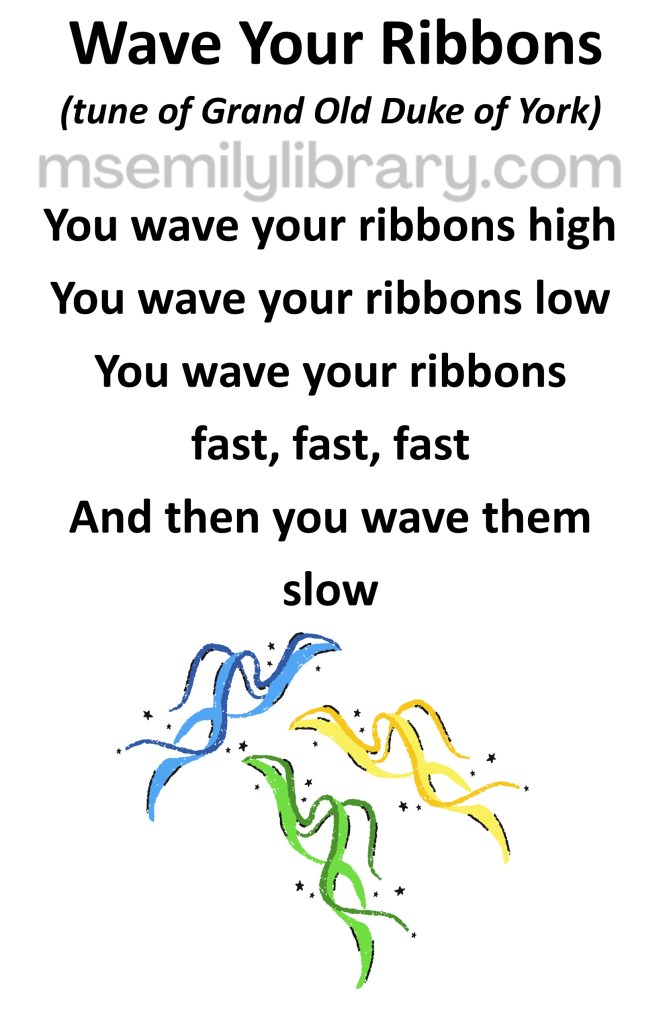
Time to get our ribbons out! Can you pretend your ribbons are ice cream cones? I chose ribbons this week because that’s what the librarian used in the video for On Top of My Sundae. I explained a little by saying you can pretend your ice cream is a bit melty and dripping. For this rhyme, I changed the last line from “put your ice cream on the ground” since no one wants their ice cream on the ground! Ribbon Chant: Ice Cream UP‡ Ice cream up! Ice cream down! Hold your ice cream and turn around Ice cream up! Ice cream down! Wave your ice cream all around Source: One Little Librarian via Librionyian
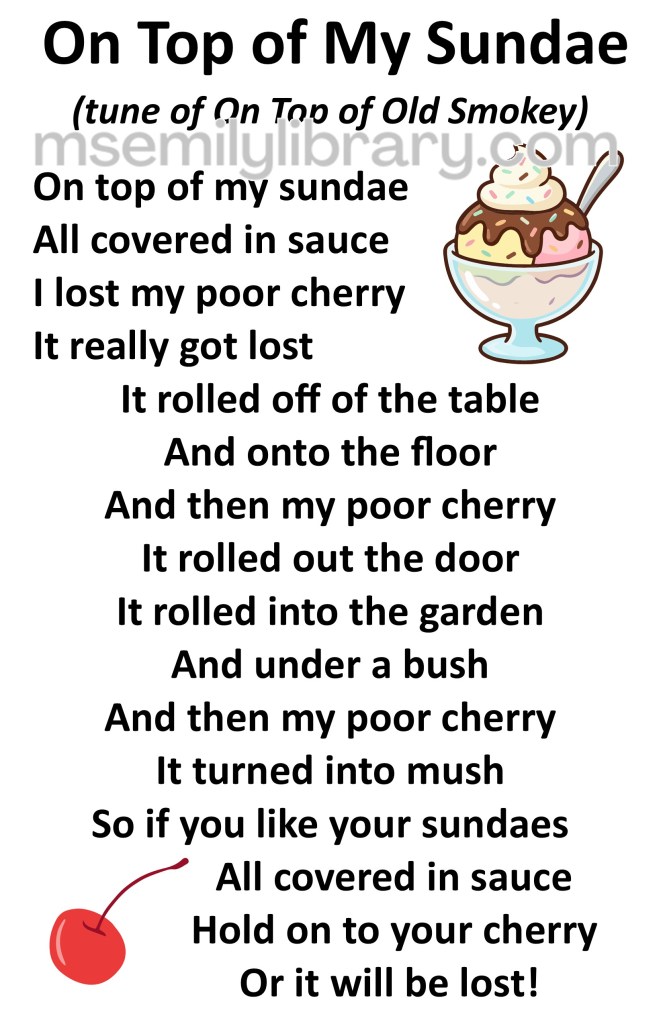
An ice cream sundae can be a fancy treat – it has sauce like hot fudge or caramel, maybe some nuts or sprinkles, whipped cream, and – a cherry on top! But what happened here? Ribbon Song: On Top of My Sundae‡ (tune of On Top of Old Smokey) On top of my sundae All covered in sauce I lost my poor cherry It really got lost It rolled off of the table And onto the floor And then my poor cherry It rolled out the door It rolled into the garden And under a bush And then my poor cherry It turned into mush So if you like your sundaes All covered in sauce Hold on to your cherry Or it will be lost! Source: Sno-Isle (WA) Libraries
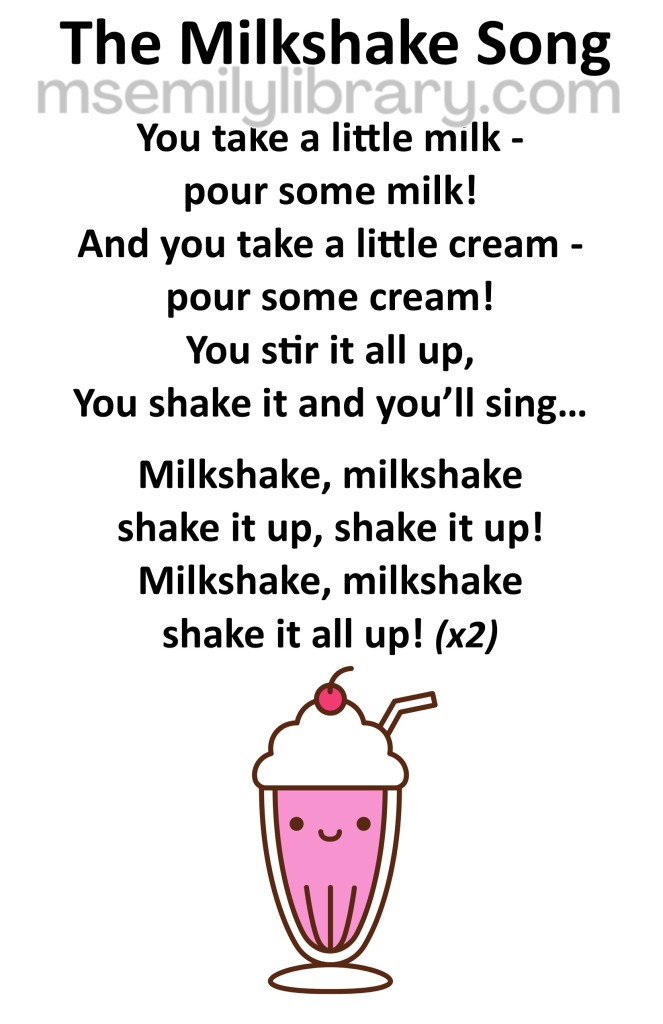
To make a milkshake, you mix milk with cream – ice cream! Ribbon Song: The Milkshake Song‡ You take a little milk – pour some milk! And you take a little cream – pour some cream! You stir it all up, You shake it and you’ll sing… Milkshake, milkshake shake it up, shake it up! Milkshake, milkshake shake it all up! Milkshake, milkshake shake it up, shake it up! Milkshake, milkshake shake it all up! Source: Old Town School of Folk Music, from the album Songs for Wiggleworms via Jbrary
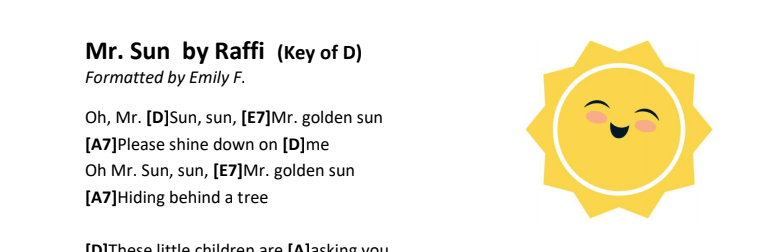
I think the best way to enjoy ice cream is outside on a nice sunny day. Ukulele/Ribbon Song: Mr. Sun‡ Oh, Mr. Sun, Sun, Mr. Golden Sun Please shine down on me Oh, Mr. Sun, Sun, Mr. Golden Sun Hiding behind a tree These little children are asking you To please come out so we can play with you Oh, Mr. Sun, Sun, Mr. Golden Sun Please shine down on me Source: Raffi, from the album Singable Songs for the Very Young
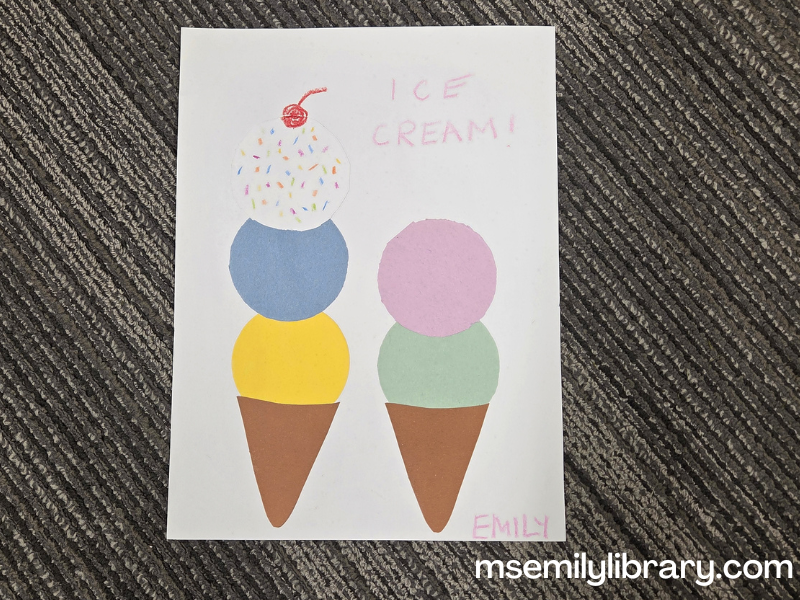
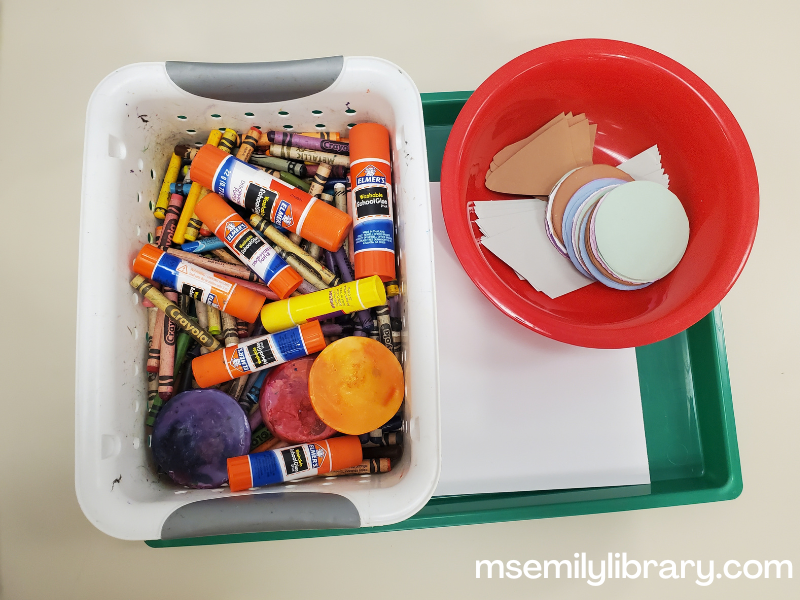
Craft: Ice Cream Scene I die cut circles in pastel colored construction paper and also cut brown cones and gray bowls. Kids could construct their ideal ice cream, adding extras like cherries or sprinkles with crayons.
And I remembered to take a picture of the setup, too!
Play Time The toddlers have two laundry baskets of baby toys – rattles and cars, sorters and stackers, toy phones and spinners. For the older kids, I have foam blocks, soft food toys, puzzles, and a few other items that are a little more sophisticated than the baby toys. For Family Time, I gauge the overall age of the group and put out what seems right for them. We play for 5-10 minutes at the most, then I ring the bell and ask the kids to help me clean up. I think the clean up bit is good practice for them!
Goodbye Song: See You Later Alligator*‡
‡ For our evening Stories and Stations version of this program, we did only the activities above with a double dagger ‡ (instead of Wake Up Feet, we do Wiggle and Wiggle and Stop). After collecting our ribbons and before Zoom, Zoom, Zoom, we released to stations! I put out toys and puzzles on the rug, and set stations up at the tables around the outside of the room.
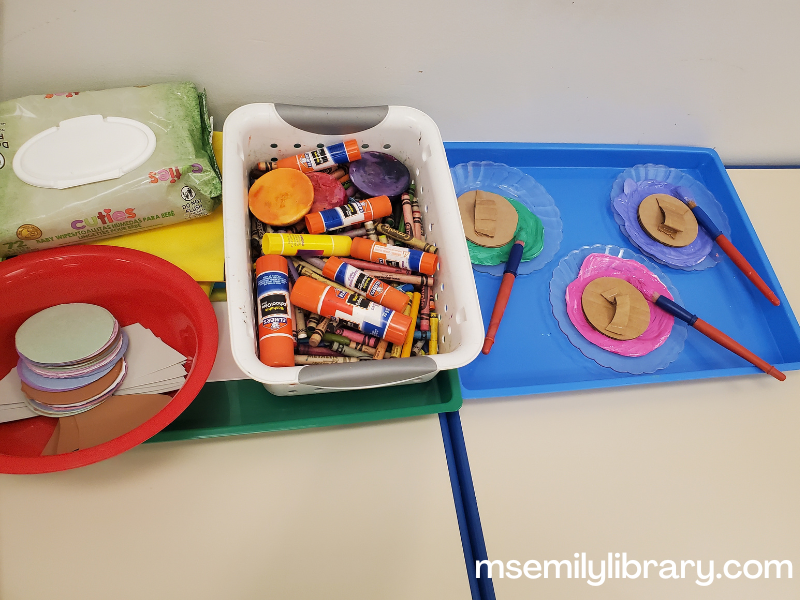
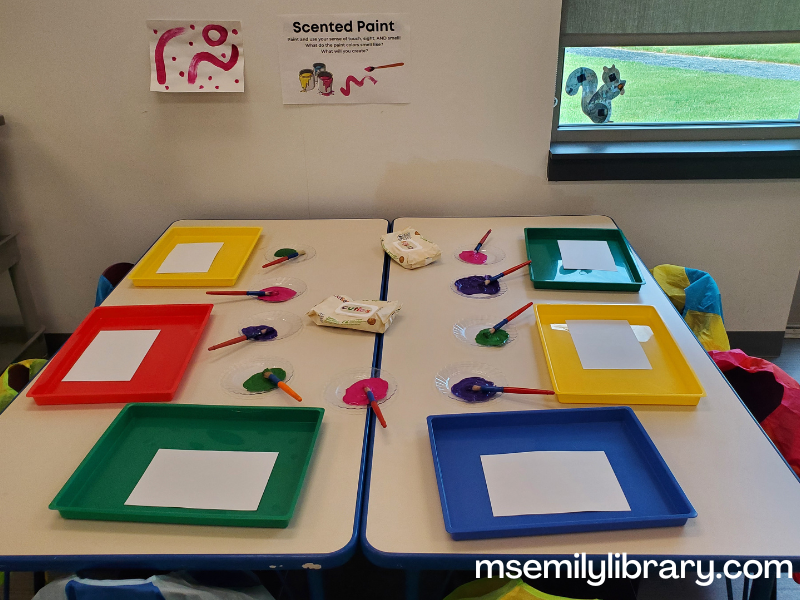
Art Station: Ice Cream Scene – plus paint! I went a little more involved with this art station, adding paint and cardboard paint stamps to the supplies. I think the older kids enjoyed the ability to use different art supplies. I made the cardboard stamps by die-cutting some cardboard circles and adding a little handle. This craft was inspired by The Artful Parent.
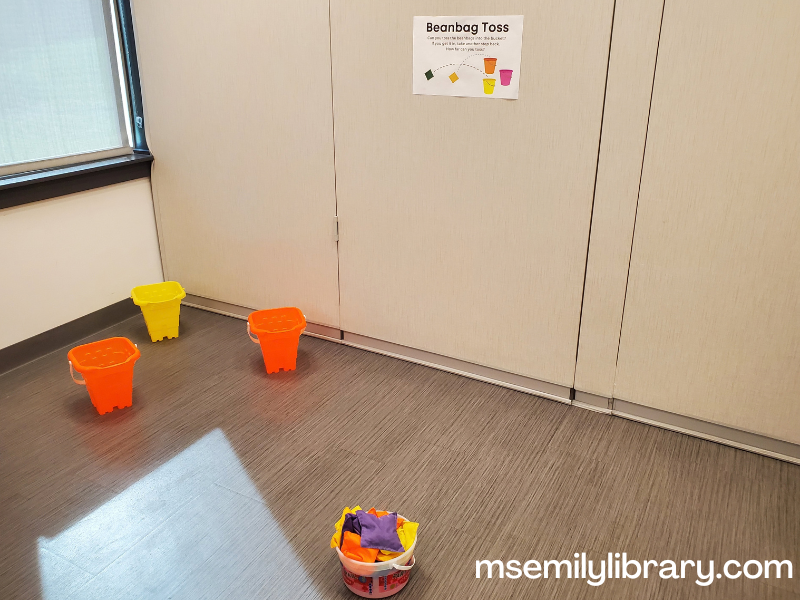
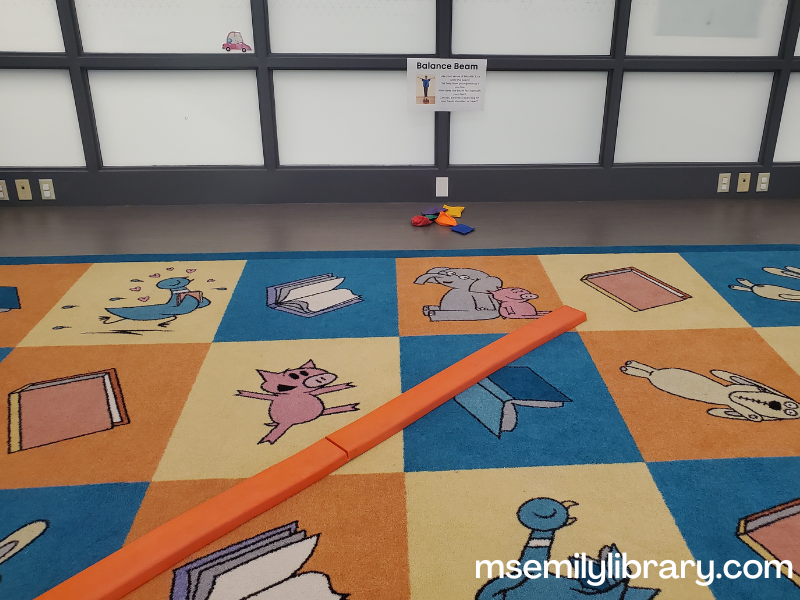
Gross Motor Station: Beanbag Toss Not themed, but an additional fun station. Though I noticed only when setting up that our bean bags are kept in an old ice cream tub!
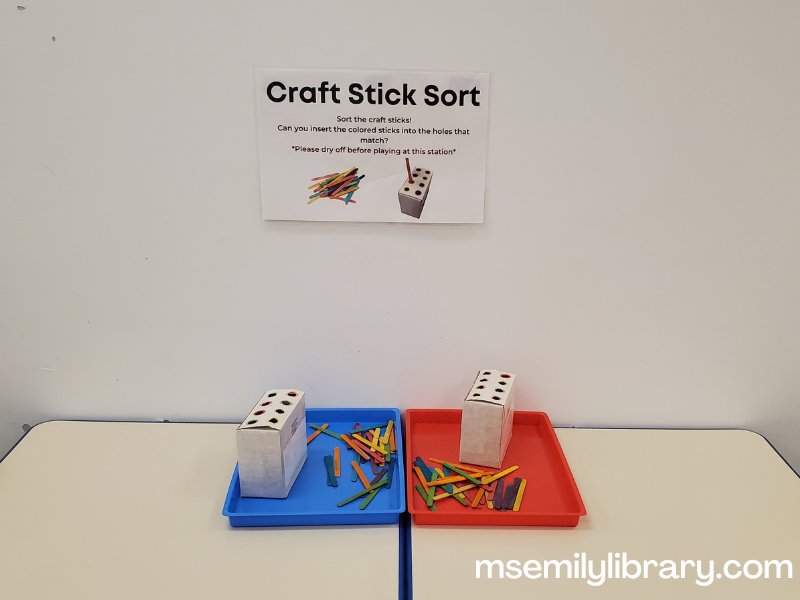
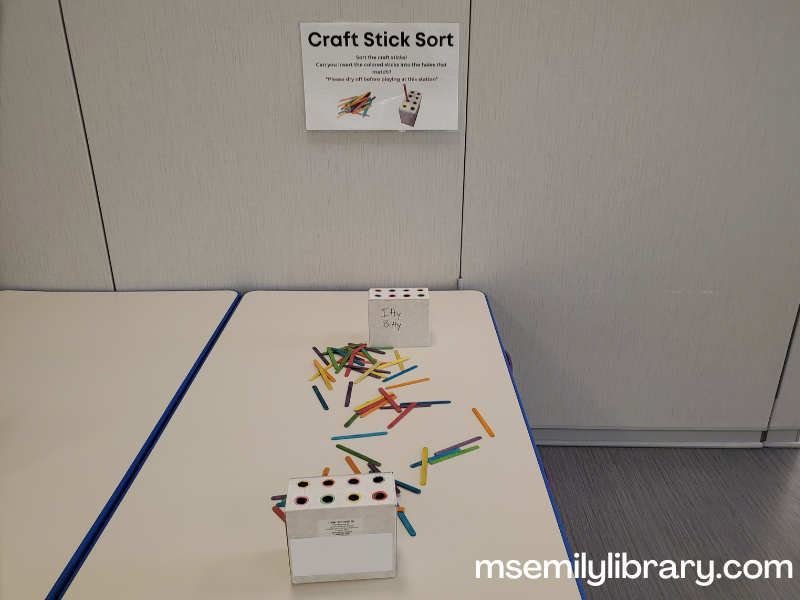
Fine Motor Station: Craft Stick Sort Another unthemed station that I’ve used many times!
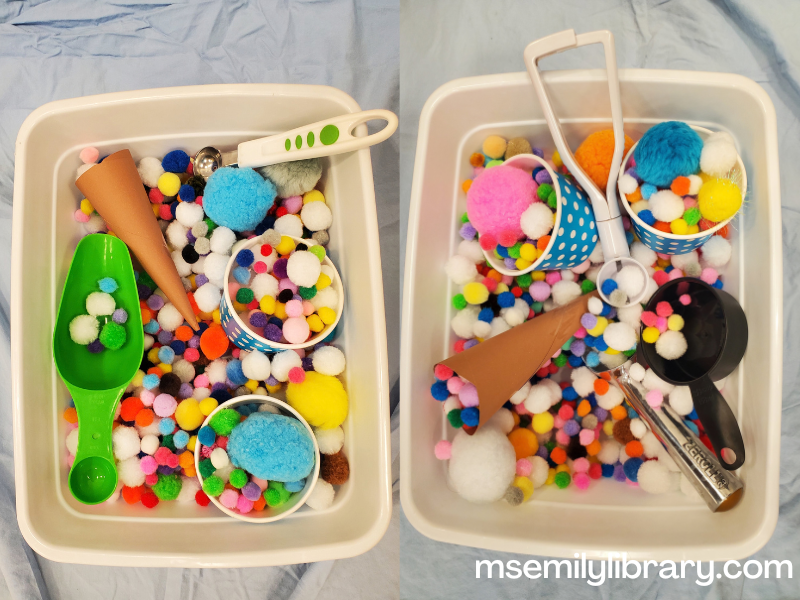
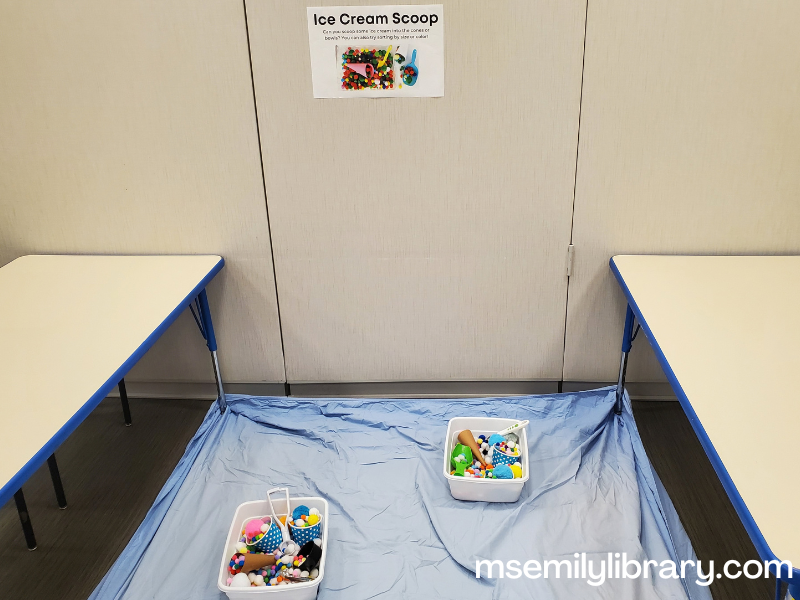
Sensory Station: Pom Pom Ice Cream Sensory Bins Definitely themed, and a lot of fun to create! I scavenged all our pom poms from the library craft supply, and added paper ice cream cones, ice cream cups (donated by our local ice cream shop, where I did some additional “research,”) ice cream scoops and a couple measuring cups.
Toys and Puzzles Our regular baby toys and puzzles, as well as soft food, babies in a basket, and lacing cards came out as another option for play. I didn’t capture a picture of this one.
After 20 minutes of free station time, I ring our bell to gather everyone again in the storytime room. Everyone helps put away the toys and puzzles before we end with our last two songs.
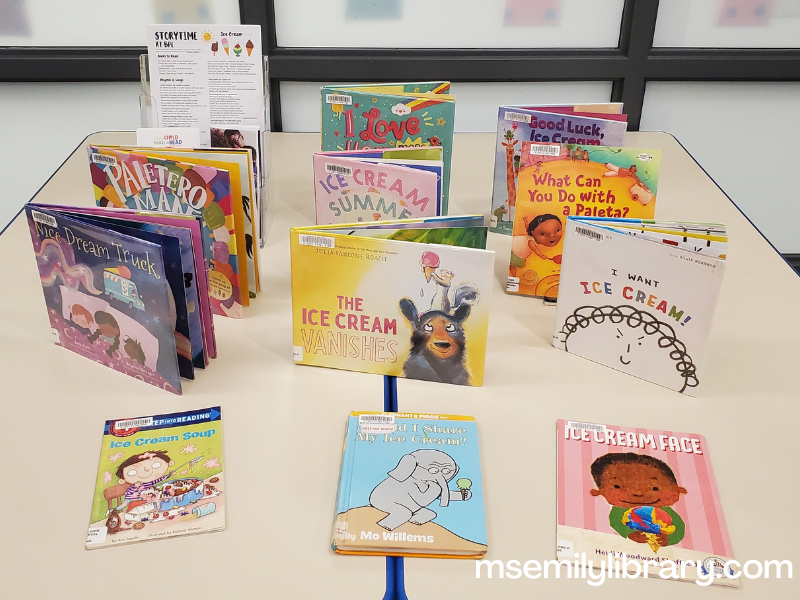
Other books I had available for families to browse (and may work for you on this theme) Paletero Man – Lucky Diaz & Micah Player Pick Me! – Max Amato Should I Share My Ice Cream? – Mo Willems The Ice Cream Vanishes – Julia Sarcone-Roach Good Luck, Ice Cream Truck – Sorche Fairbank & Terry Runyan The Little Ice Cream Truck – Margery Cuyler & Bob Kolar The Nice Dream Truck – Beth Ferry & Brigette Barrager I Want Ice Cream! – Elisabetta Pica & Silvia Borando What Can You Do with a Paleta? – Carmen Tafolla & Magaly Morales
This storytime was presented in-person on 8/25, 8/26, & 8/27/26.
Garbage trucks was a super-fun theme! I was inspired by the book Every Monday Mabel by Jashar Awan, which was one of the nominees for my state’s early literacy book award, the Firefly. It didn’t end up being the winner, but it was definitely my daughter’s favorite of the bunch. It’s an excellent storytime title, with lots of great noises and opportunities for exciting reading.
In order to not do 10 repetitive rhymes and songs only about trucks, I also threw in a couple of trash-adjacent activities, so we did a Litter Bug rhyme and a really fantastic song by Nancy Stewart about raccoons. And using beanbags to represent trash was a nice way to break out a prop we don’t often get to play with.
Early Development Tip: Naming and categorizing things can be fun for children of all ages. Help children make sense of their world by grouping things that go together, such as items of similar colors, shapes, or items like knives, forks, and spoons at a table. –from The Early Literacy Kit: A Handbook and Tip Cards by Betsy Diamant-Cohen & Saroj Ghoting
Welcome Song: Hello, Friends*
Warm Up Song: Wake Up, Feet* This is a repeated song that everyone seems to enjoy. I always begin and end with feet and tummies, but find two other body parts to wiggle in the middle. I rotate between elbows, cheeks, hips, noses, arms, chins, thighs, heads, shoulders, ears, knees, and fingers.
Lifting Rhyme: Toast in the Toaster*
Intro: Once a week, something really exciting happens at my house. The garbage truck comes! Does anyone like to watch for the garbage truck? It might be stinky, but it’s so exciting to see it lift up the garbage can and dump our trash! I’m so happy that we have garbage trucks to take away our trash, so let’s celebrate them!
In some places, garbage collectors work all night and line up in the morning to empty their trucks at the landfill. I rewrote this rhyme pretty completely, but the original was found in a document from a fellow Indiana library where I found several of my rhymes for this theme: Carmel Clay Public Library. The fact that it didn’t rhyme drove me crazy, but I also wanted to introduce the word landfill in addition to dump as it’s a bit more accurate and modern. Fingerplay: Morning at the Landfill Down at the landfill, right around nine See the garbage trucks waiting in line (show ten fingers) See them lift the garbage: Dump, dump, dump (bend fingers) Now they roll away with a bang and a bump (roll arms, clap) One rolls down MY street, engine a’roar (vroom!) To fill ‘er up again and gather more (ASL for more) Source: Ms Emily Library
Transition: If You’re Ready for a Story*
Mabel is such a great character – she is determined, she is persistent, and she is enthusiastic about her interests! Every group loved hearing her story. Awan is quickly becoming one of my go-to authors! Read: Every Monday Mabel by Jashar Awan
A much older title, but a good back up. I like a repeated phrase to encourage participation. Backup Read: Trashy Town by Andrea Zimmerman, David Clemesha, & Dan Yaccarino
Can YOU pretend to be a garbage truck? Another one I changed a bit to make the rhyme scheme be closer to the original tune. I also explained what the hopper and cab were before we started, and demoed opening our hopper (bringing a bent arm up from our side) and driving in our cab (the other hand holding a steering wheel). At the end we tipped over the hopper side VERY similarly to a teapot! Action Song: I’m a Little Garbage Truck (tune of I’m a Little Teapot) I’m a little garbage truck, trash is what I grab Here is my hopper, Here is my cab When I get all filled up, the dump is on my route Just tip me over and dump the garbage out Source: adapted from Carmel Clay (IN) Public Library
It takes a lot of trucks to haul the garbage for a whole town! How many are here? I had this one ready, but didn’t end up using it to cut down on my time. I’m finding that my 1s & 2s have a shorter attention span and do better when we end slightly earlier and have more time for play.Download a copy of the garbage trucks here. (also includes Garbage Clean Up graphics) Counting Rhyme: Five Little Garbage Trucks Five little garbage trucks painted green Picking up trash to keep the town clean They work and they work until they fill up Now one of the garbage trucks drives to the dump! Back up: Beep! Beep! Beep! (count down) Source: Carmel Clay (IN) Public Library
Action Song: The Wheels on the (Garbage) Truck (tune of The Wheels on the Bus) The wheels on the truck go round and round Round and round, Round and round The wheels on the truck go round and round All through the town
Additional verses: The horn on the truck goes honk, honk, honk… The loader on the truck goes up and down… The reverse on the truck goes, beep, beep, beep… The driver of the truck says, “Job well done”.. Source: Carmel Clay (IN) Public Library
There’s an animal who lives in cities and is very resourceful, finding food wherever they can – even in your garbage! This was a total hit. I actually bought the Folkmanis raccoon in a trash can puppet on eBay just for this program, and I think it was money well spent. Check out Nancy’s page (link below in the Source) to see a video of her performing the song in a preschool. It is magic! I’m planning to repeat this song with the puppet for an upcoming Nocturnal Animals program in October. Puppet Song: I’m A Raccoon I’m a raccoon, I’m a raccoon, Ramblin’ around in the night I’m a raccoon, I’m a raccoon, you can see me if the moon is bright I’ve got rings on my tail, a mask on my eyes If you see me at night you might be surprised Oh I’m a raccoon, I’m a raccoon, ramblin’ around in the night
I’m a raccoon, I’m a raccoon, you better cover up your trash I’m a raccoon, I’m a raccoon, If you don’t I’m gonna steal your stash I’ve got rings on my tail, a mask on my eyes If you see me at night you might be surprised Oh I’m a raccoon, I’m a raccoon, I ramblin’ around in the night Source: Nancy Stewart
Isn’t he adorable?
Garbage trucks haul away our trash, but it’s up to us to make sure the trash gets into the bins and not on the ground. If no one used a trash can, our streets and parks would be full of trash. I walked around while tossing beanbags out of a bucket while reciting this one. The eyes got a bit wide at first – what’s she doing?! Then they all helped me pick up the “trash.” It was a fun way to pass out our prop! Beanbag Song: Litter Bug (tune of Itsy Bitsy Spider) Once there was a litter bug Who went from town to town Throwing out his garbage That landed on the ground The garbage grew so high That when he turned around The litter bug got buried And could not make a sound! EEK! Source: Yogibrarian
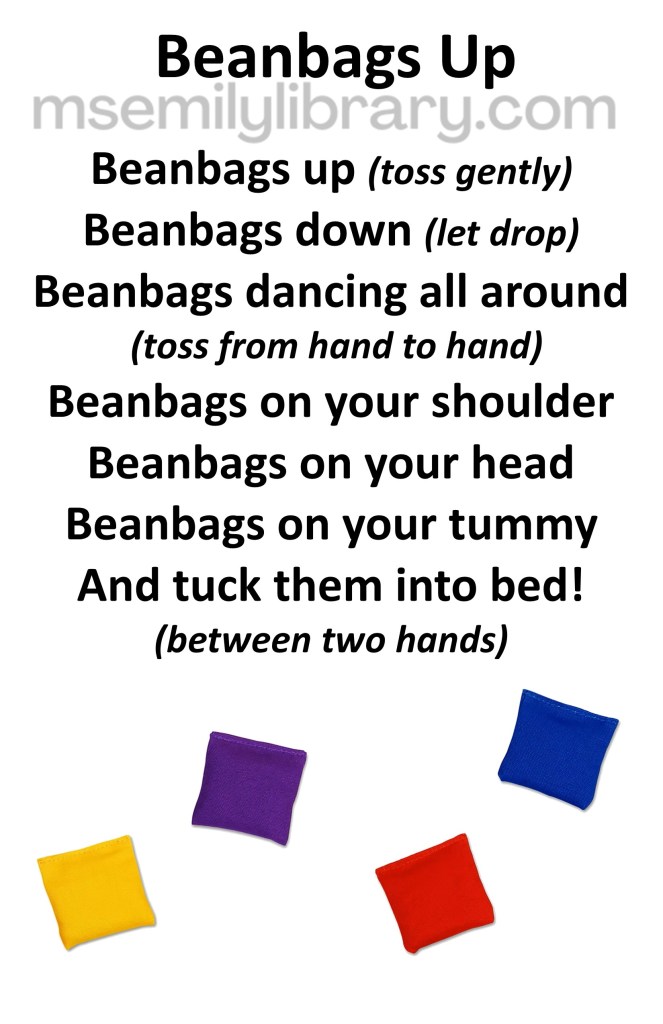
Just a little generic bean bag rhyme to give them some different things to do with the bag. Beanbag Rhyme: Beanbags Up Beanbags up (toss gently) Beanbags down (let drop) Beanbags dancing all around (toss from hand to hand) Beanbags on your shoulder, Beanbags on your head Beanbags on your tummy And tuck them into bed! (between hands) Source: adapted from the traditional Tommy Thumbs
Time to clean up! Can you help me match the beanbag color to the right garbage truck? I created four color-coordinated garbage trucks in Canva to print and laminate, then attached them to four bowls with jumbo craft sticks to gather up the beanbags. It was a bit chaotic when I announced this, with all the kids rushing up to put their beanbags in the bowls, so I just read the rhyme over the chaos. Next time I would have us all read the rhyme together before putting the bowls out for them to put their bags in.Download a copy of the garbage trucks here. (also includes Five Garbage Trucks graphics) Beanbag Rhyme: Garbage Clean Up Garbage trucks, garbage trucks Cleaning up the town Do you see any garbage lying around? Pick up the trash and match it to a truck Soon the whole town will be all cleaned up Source: Miss Sarah’s Storytime
Action Song: Zoom, Zoom, Zoom!*
Craft: Garbage Truck I think this is the third time I’ve done this craft, but perhaps the first time I’ve blogged about it. I use a coloring sheet of a garbage truck that I’d saved years ago and provided multi-colored tissue paper squares and liquid glue, as well as crayons. After coloring their truck, they could crumple up the tissue squares and glue them to the truck to look like garbage. The tissue grasping and crumpling is great fine motor practice, and everyone always thinks the 3D art is really cool.
And I remembered to take a picture of the setup, too!
Play Time The toddlers have two laundry baskets of baby toys – rattles and cars, sorters and stackers, toy phones and spinners. For the older kids, I have foam blocks, soft food toys, puzzles, and a few other items that are a little more sophisticated than the baby toys. For Family Time, I gauge the overall age of the group and put out what seems right for them. We play for 5-10 minutes at the most, then I ring the bell and ask the kids to help me clean up. I think the clean up bit is good practice for them!
Goodbye Song: See You Later Alligator*
Other books I had available for families to browse (and may work for you on this theme) I Stink! – Kate & Jim McMullan King of the Dump – Tim Wynne-Jones & Scot Ritchie I’m Trying to Love Garbage – Bethany Barton Garbage Trucks on the Go – Beth Bence Reinke Revenge of the Raccoons – Vivek Shraya & Juliana Neufeld Hooray for Garbage Collectors – Tessa Kenan I Am Picky – Kristen Tracy & Erin Kraan Kitty – Rebecca Jordan-Glum The Duck Is Stuck! – Dana Regan & Berta Maluenda Construction Site: Garbage Crew to the Rescue! – Sherri Duskey Rinker & AG Ford
This storytime was presented in-person on 8/18 & 8/19/26.
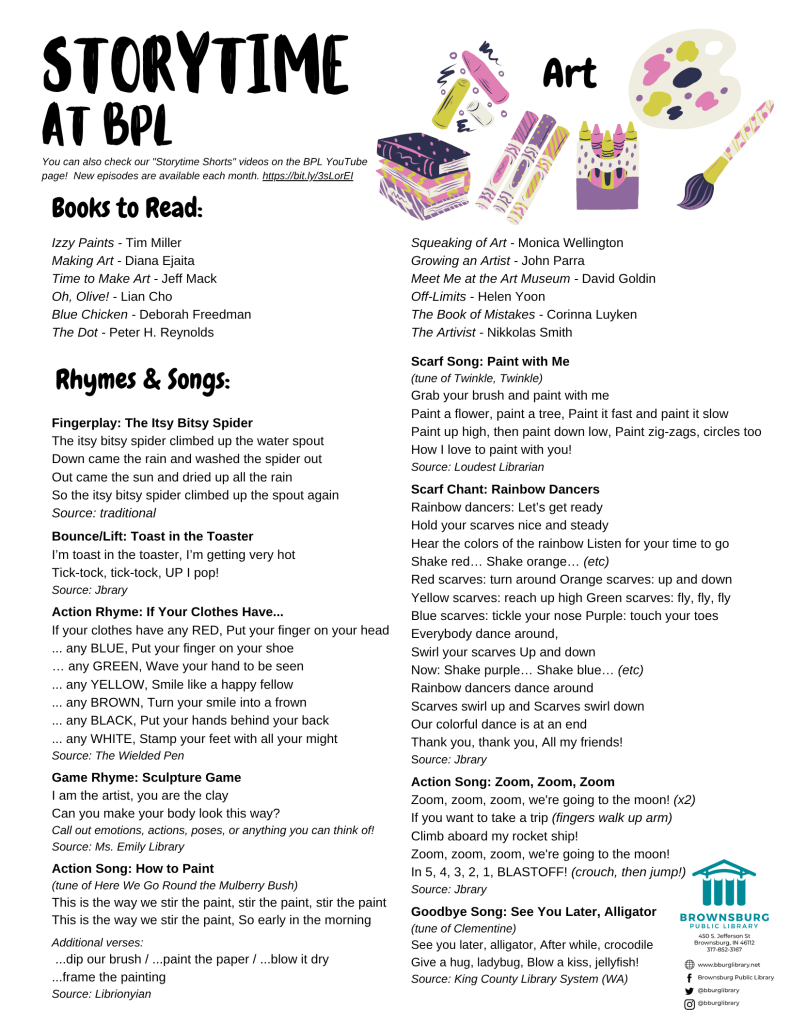
We are back to our regular indoor storytimes for the fall season, with a few changes. I’ll spare casual readers all the details if you are only interested in the theme activities – feel free to skip the next paragraph! I am surprised that I’ve never done a general Art theme before. It’s definitely broad – art can be so many practices – but I did focus mostly on visual art. We talked about drawing, painting, and I even came up with an activity for sculpture. In my intro and the early literacy aside, I tried to emphasize to grownups that the process of making art is more important than the end product, especially for little ones.
If you are interested in the changes to storytime at my specific library: since April, when our longtime preschool programmer retired, we have been doing our Stories & Stations programs for ages 0-5 with one full time and one part time programmer. This fall, the two of us have once again split our programs into more specific age groups and are taking different ages. As the part timer, I’m doing three programs per week – a baby program for 0-12 months and two sessions of a toddler program for one- and two-year-olds. My full time colleague is doing four – two for 2s & 3s and two for 4s & 5s. We are both doing one extra per month (hers on a weekend and mine on an evening).We simplified the names of these programs, so it’s very apparent who each program is for. My baby program is called “Pre-Walker Storytime” and the toddler program is “1s & 2s” Storytime. Hers are “2s & 3s Storytime” and “4s & 5s Storytime.” Yes, it’s not cute or creative, but it is practical, and I think it works better for families than trying to figure out what “Teddy Bear Storytime” is (formerly 2-3.5 year olds.) We removed the 3.5 age barrier. A caregiver is required for all of these programs except for the 4s & 5s, which is intended to be kids attending independently (with a caregiver staying in the library) to practice school readiness. We are also planning our own separate themes rather than alternating planning weeks and sharing themes among all the under 5s.
I am noticing that moving from programming for a wider age range (up to 5 since April, and up to 3.5 before that) to an entirely younger audience may take a bit of tweaking on my part! It’s always a learning process and I find that once I get into a groove something changes and I need to readjust. I enjoy the challenge and appreciate the families that are so understanding while I figure it out.
Early Development Tip: Art engages children’s senses in open-ended play and develops cognitive, social, emotional and sensory skills. Art is a cooperative learning experience that provides pleasure, challenge, and a sense of mastery. Grownups, resist the urge to do crafts for your child, let them explore art materials however they like, and especially in these younger years focus on the process of art and not what the end product looks like. -adapted from Yogibrarian
Welcome Song: Hello, Friends*
Warm Up Song: Wake Up, Feet* This is a repeated song that everyone seems to enjoy. I always begin and end with feet and tummies, but find two other body parts to wiggle in the middle. I rotate between elbows, cheeks, hips, noses, arms, chins, thighs, heads, shoulders, ears, knees, and fingers.
Lifting Rhyme: Toast in the Toaster*
Intro: Today we are talking about art! Art is something that everyone can do! Everyone has imagination and creativity inside you, and art is a way you can explore your thoughts, feelings, and ideas. Sometimes we get caught up in thinking that art needs to look a certain way, but I think that art is important no matter how it looks and the PROCESS of doing art is something that’s good for every person, especially little ones.
An artist needs their fingers to be loose and limber. Let’s warm up our fingers with one of nature’s artists: the spider, with her beautiful, intricate web. Grownups – fingerplays like these also help develop your child’s hand and finger strength and fine motor skills, which help them with writing later on. Fingerplay: The Itsy Bitsy Spider The itsy bitsy spider climbed up the water spout Down came the rain and washed the spider out Out came the sun and dried up all the rain So the itsy bitsy spider climbed up the spout again Source: traditional
Transition: If You’re Ready for a Story*
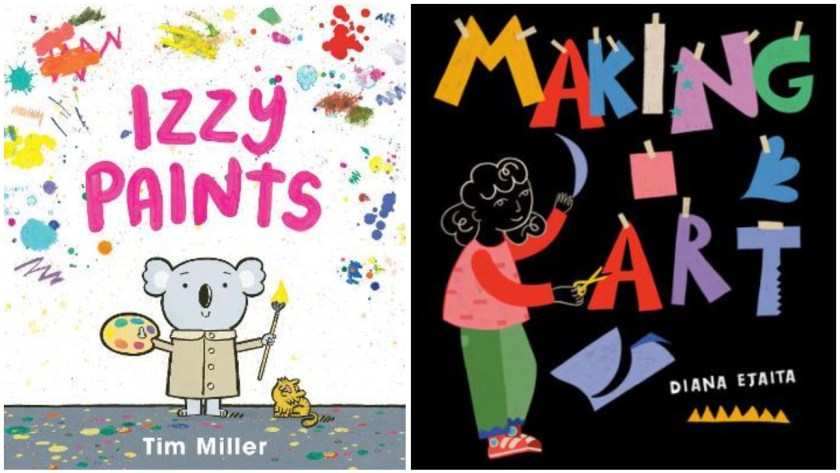
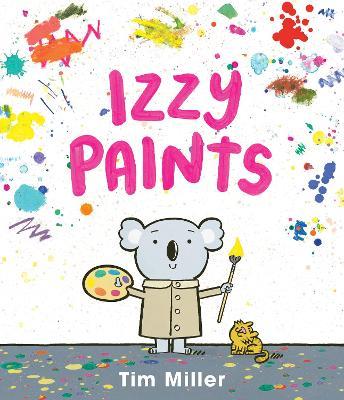
I like how simple this one is, and how it connects seeing art in a museum with making your own art, as well as feeling blocked! I’ve also used this title in our Storywalk in the past. Read: Izzy Paints by Tim Miller
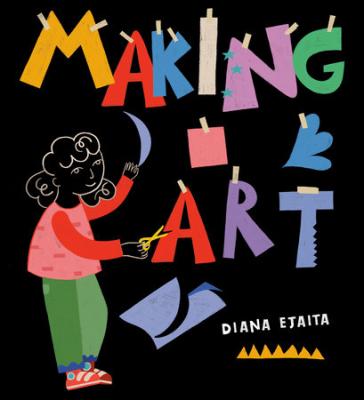
This is such a beautiful book, and the text about how our art is informed by feelings and vice versa is an important reminder to people of all ages. I thought, though, that the artwork was a bit more metaphorical than my littlest ones could appreciate. Backup Read: Making Art by Diana Ejaita
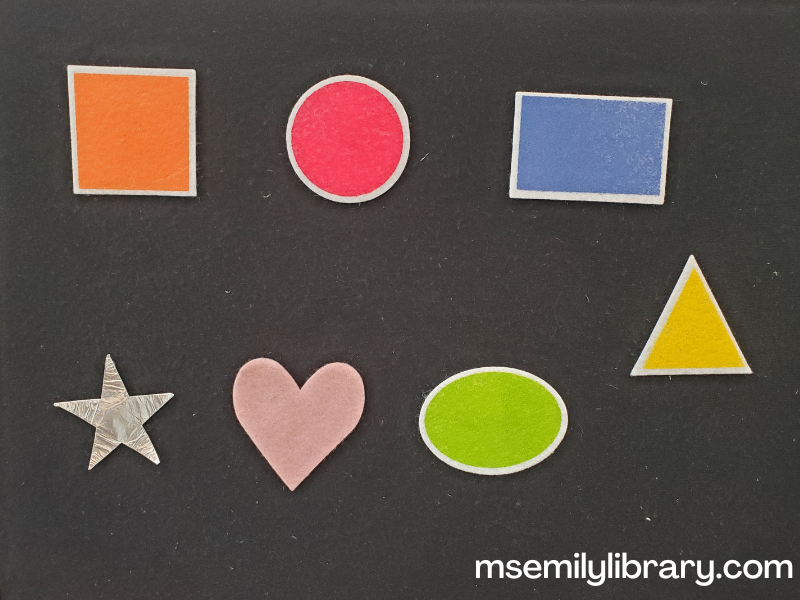
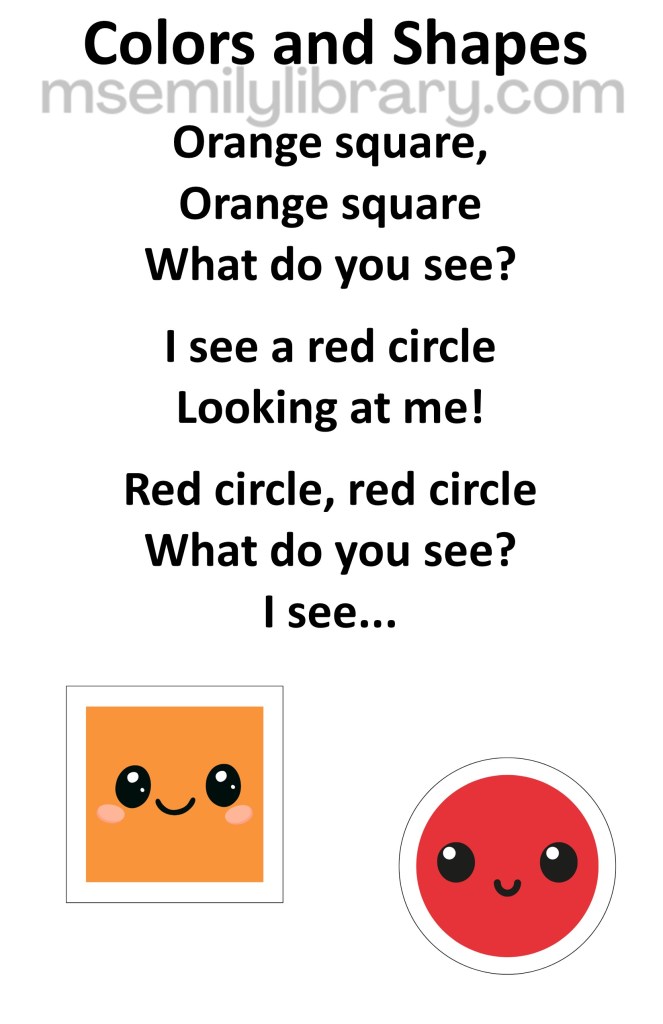
Visual art is made up of colors and shapes! This is a simple rhyme based in the Brown Bear, Brown Bear format. I used a set of shape flannels we purchased from Oriental Trading, and added a heart and a star from other flannel sets. Flannel Rhyme: Colors & Shapes Orange square, orange square What do you see? I see a red circle looking at me!
Red circle, red circle What do you see? I see… Source: adapted from Sunflower Storytime (no longer online)
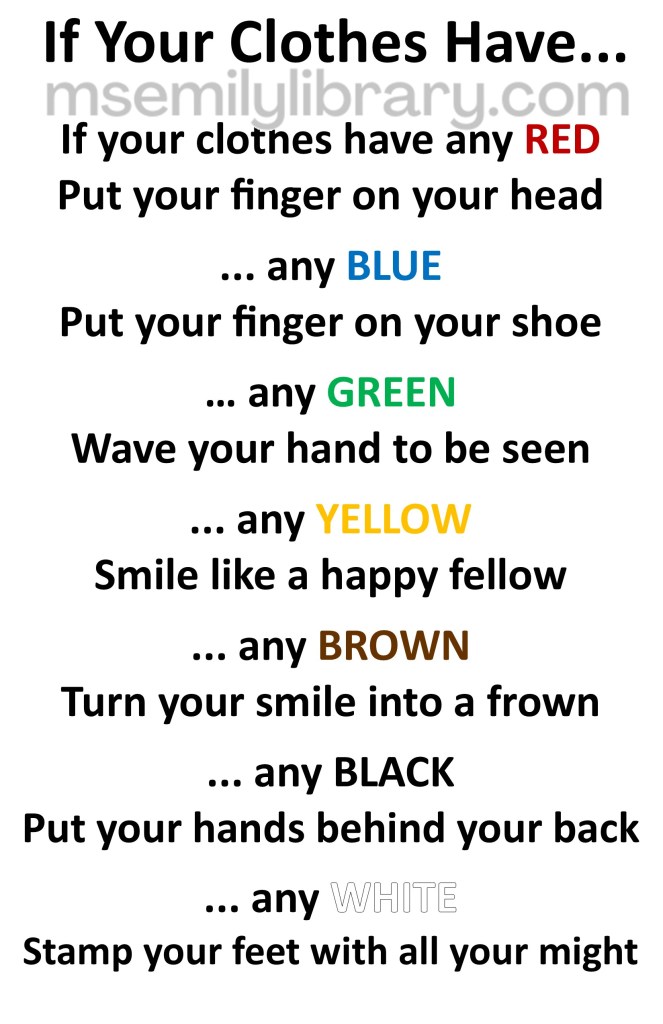
Take a look at your clothes today. What colors did you wear? This actually prompted a good amount of adult/child discussion, which is always great! I’d done this in the past to the tune of the Muffin Man, and I’ve also heard it done to the tune of If You’re Happy and You Know It, but that many verses for all the colors just goes too long for my group. This simple rhyme with one line per color is a good alternative. Action Rhyme: If Your Clothes Have… If your clothes have any RED, Put your finger on your head … any BLUE, Put your finger on your shoe … any GREEN, Wave your hand to be seen … any YELLOW, Smile like a happy fellow … any BROWN, Turn your smile into a frown … any BLACK, Put your hands behind your back … any WHITE, Stamp your feet with all your might Source: The Wielded Pen
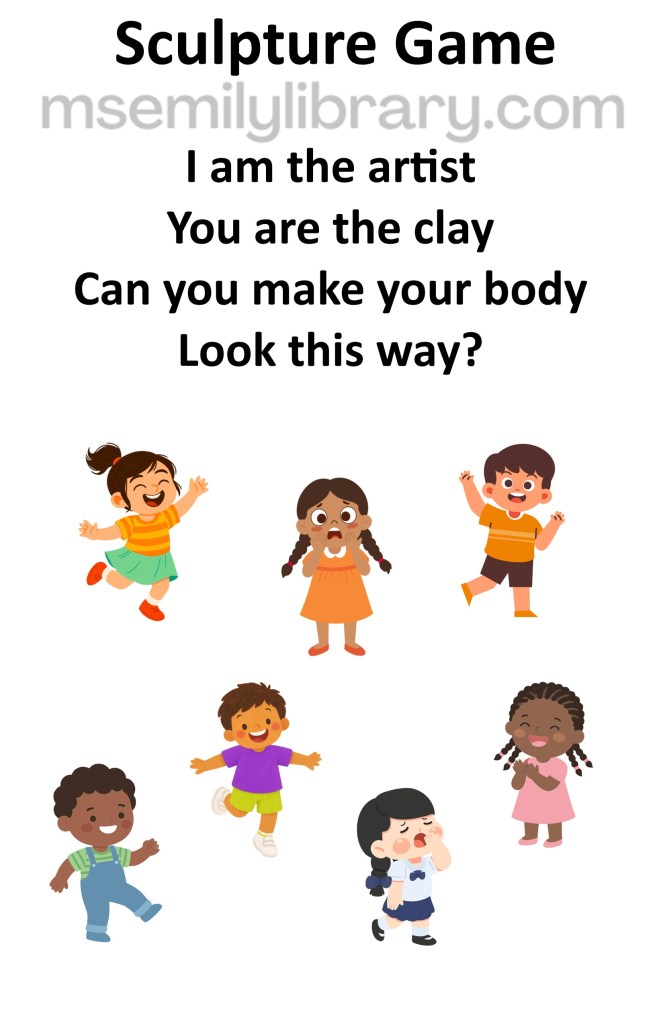
An artist can use lots of things to make art. How about sculptors? Can we play the sculpture game? I wanted to talk about at least one other kind of art rather than 2D visual arts, so I made up a little rhyme to do a sculpture game. I am no good at thinking things up on the fly, so I made myself a list of poses/emotions to choose from. I did a few for each group. At some point I reminded them that a sculpture doesn’t move, so even though I said “like you’re dancing,” you have to convey that while not actually dancing! I could see this being a really fun game with preschoolers, but it maybe didn’t quite land as I’d hoped with the littles. Game Rhyme: Sculpture Game I am the artist You are the clay Can you make your body Look this way? Call out emotions, actions, poses, or anything you can think of! My examples: Excited – like you’re playing a sport – like you’re dancing – like you’re scared – like you saw something cute – as big as you can be – as small as you can be – like an explorer– like you’re tired – like you’re proud Source: original
Let’s paint a picture! There are a lot of steps from start to finish. Action Song: How to Paint (tune of Here We Go Round the Mulberry Bush) This is the way we stir the paint, Stir the paint, stir the paint This is the way we stir the paint So early in the morning
Additional verses: …dip our brush …paint the paper …blow it dry …frame the painting Source: Librionyian
Time to get out our scarves! Can you pretend your scarf is a paintbrush? We started by practicing some painting with our scarves. Scarf Play: Painting Practice Paint: Long straight lines on your leg Circles on your knees Dots on your tummy Curls on your head Zigzags in the air in front of you A rainbow Lines on floor Your 1st initial The moon A tumbleweed (big wild scribble!) Source: Librionyian
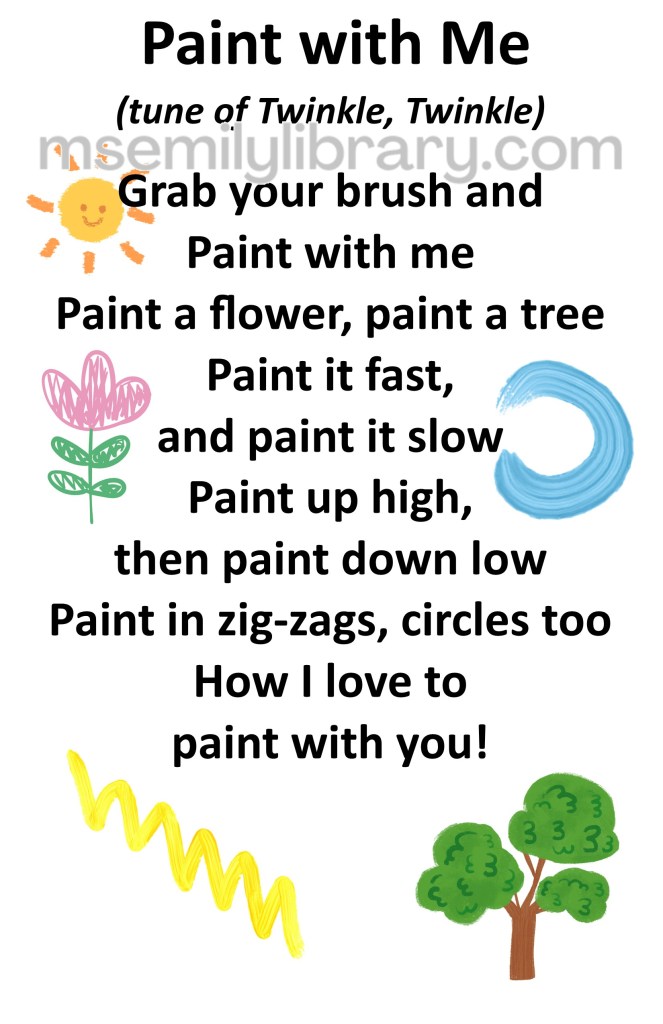
Scarf Song: Paint with Me (tune of Twinkle, Twinkle) Grab your brush and paint with me Paint a flower, paint a tree Paint it fast and paint it slow Paint up high, then paint down low Paint zig-zags, circles too How I love to paint with you! Source: Loudest Librarian
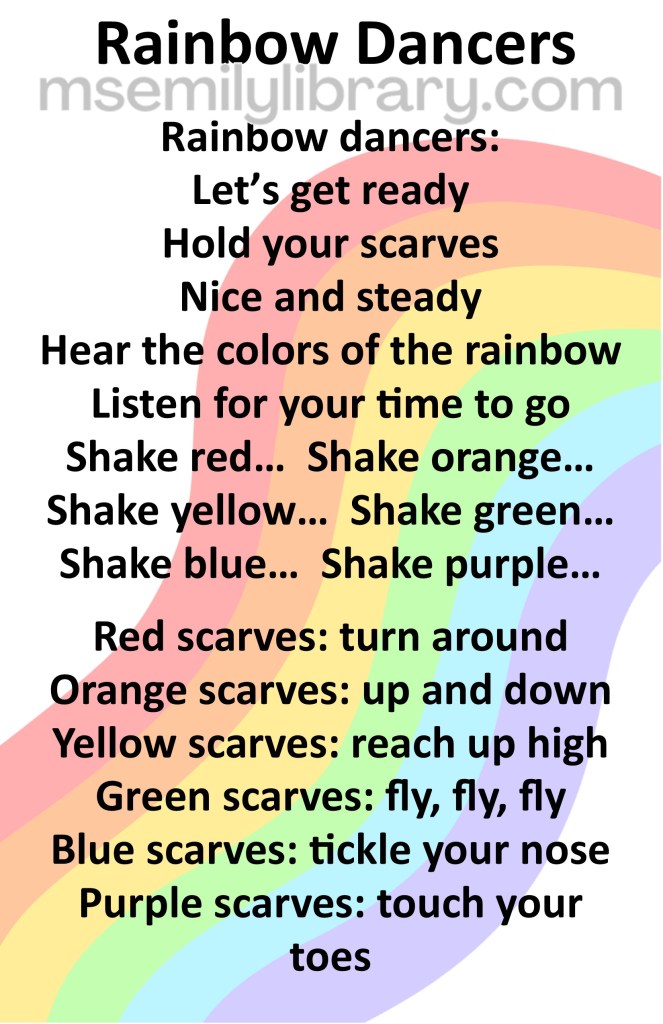
Let’s dance our rainbow scarves. Can you listen for your colors? Okay, so most of my kiddos are too little to both know what colors they have and wait to do a motion during their color. But it’s fun anyway. Note that the rhyme sheet is two pages long, though the preview below shows just the first page. Click the thumbnail to download the full PDF. Scarf Rhyme: Rainbow Dancers Rainbow dancers: Let’s get ready Hold your scarves nice and steady Hear the colors of the rainbow Listen for your time to go Shake red… Shake orange… Shake yellow… Shake green… Shake blue… Shake purple! Red scarves: turn around Orange scarves: up and down Yellow scarves: reach up high Green scarves: fly, fly, fly Blue scarves: tickle your nose Purple: touch your toes Everybody dance around, Swirl your scarves Up and down Now: Shake purple… Shake blue… Shake green… Shake yellow… Shake orange… Shake red! Rainbow dancers dance around Scarves swirl up and Scarves swirl down Our colorful dance is at an end Thank you, thank you, All my friends! Source: Jbrary
Action Song: Zoom, Zoom, Zoom!*
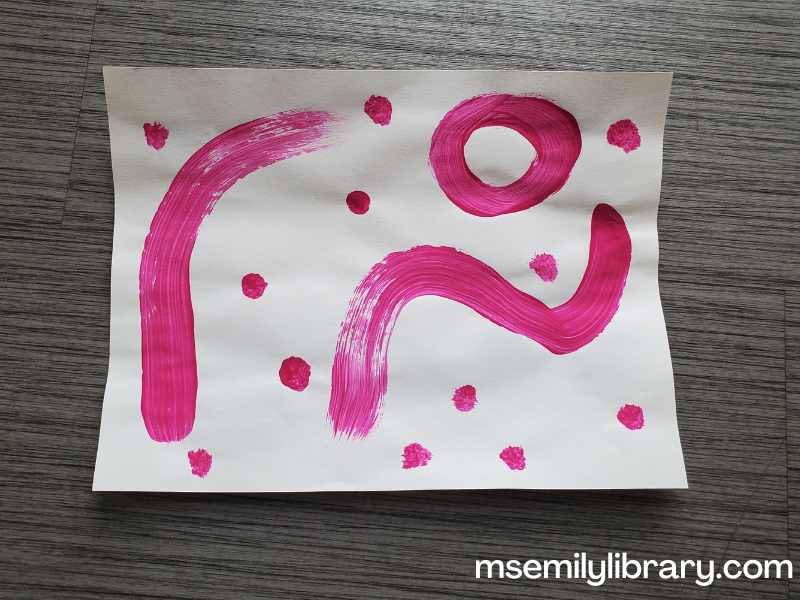
Craft: Watercolor or Dot Painting Art We didn’t have any specific craft to do, I just put out some watercolor palettes and our dot markers with white construction paper and let the kids do whatever they wanted! I didn’t catch any pictures of finished products, but the kids spent a longer time span at the craft tables this week than they usually do.
Play Time The toddlers have two laundry baskets of baby toys – rattles and cars, sorters and stackers, toy phones and spinners. For the older kids, I have foam blocks, soft food toys, puzzles, and a few other items that are a little more sophisticated than the baby toys. For Family Time, I gauge the overall age of the group and put out what seems right for them. We play for 5-10 minutes at the most, then I ring the bell and ask the kids to help me clean up. I think the clean up bit is good practice for them!
Goodbye Song: See You Later Alligator*
Other books I had available for families to browse (and may work for you on this theme) Time to Make Art – Jeff Mack Oh, Olive! – Lian Cho Blue Chicken – Deborah Freedman The Dot – Peter H. Reynolds Squeaking of Art – Monica Wellington Growing an Artist – John Parra Meet Me at the Art Museum – David Goldin Off-Limits – Helen Yoon The Artivist – Nikkolas Smith Rima and the Painter – Leila Boukarim & Melissa Iwai The Book of Mistakes – Corinna Luyken If You Find a Leaf – Aimée Sicuro Anonymouse – Vikki VanSickle & Anna Pirolli
This storytime was presented in-person on 8/11 & 8/12/26.
Welcome back, readers! I hope you have had a wonderful summer. I personally love summer at the library – even if it is busy and sometimes exhausting. I love seeing how much our families love being here, the excitement of the littles, and the appreciation of grownups for giving them something fun to do.
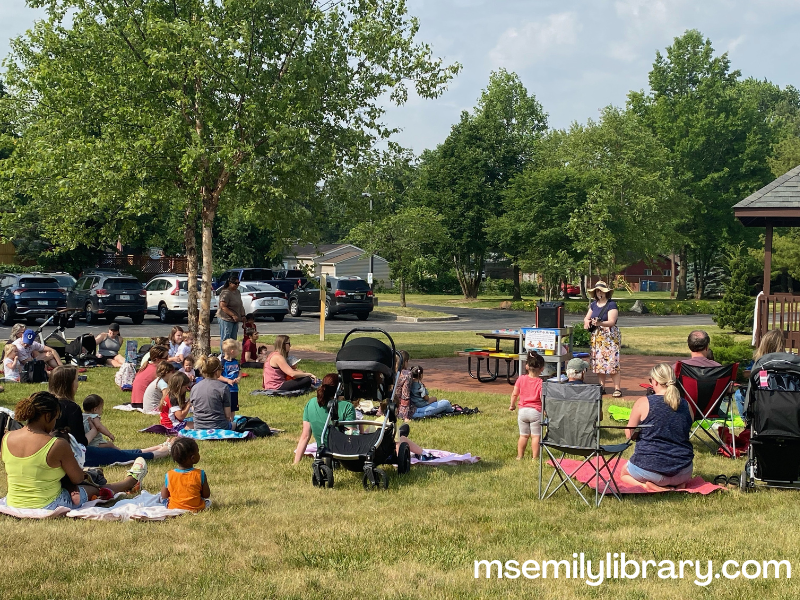
Our library generally uses the theme and graphics from the Collaborative Summer Library Program, or CSLP, a national initiative that helps libraries plan summer programming. This year’s theme was “Unearth a Story,” and we used some of the weekly theme ideas from the CSLP manual and used them mainly to choose a weekly book and rhyme for our outdoor storytime with sensory stations. I do have an indoor backup option when the weather is bad, but this year I only had to do that once, thankfully. When we are outside we have plenty of space, so I’m happy to take all comers, but if we’re indoors I do need to conform to fire code, so I ask for registration but make a note that if the weather is good anyone can come even if the program is “full.”
For each session, we spend about 15-20 minutes of storytime rhymes, songs, and a book, including parachute play, then 20 minutes of free play at various sensory stations. We end with bubbles and a goodbye song. Stations are a really great way to promote socializing, practice skills like sharing and being gentle, and allow for unstructured play, which science tells us is so important to learning and development.
If you’ve been following the blog for a while, much of this may be familiar, but I did add some new stations or different spins on old stations this year. You can see previous summer program write-ups here.
I don’t think any of my colleagues took photos of the group this year, so here’s one from a previous year.
Repeating Weekly Plan Each week, the structure of the storytime was the same, with only two parts that changed depending on the theme: a themed rhyme and the book. (Stations changed weekly.) All the other songs and rhymes were the same:
Welcome Song: Hello, Friends (tune of Goodnight, Ladies) Hello, friends! Hello, friends! Hello, friends, it’s time to say hello! Hello, [name 1], hello, [name 2]! Hello, [name 3], it’s time to say hello! (repeat as needed) (ASL motions: salute for “hello,” then take the index fingers on each hand and you link them together as though they are hugging each other back and forth for “friends”) Source: Glenside Public Library District
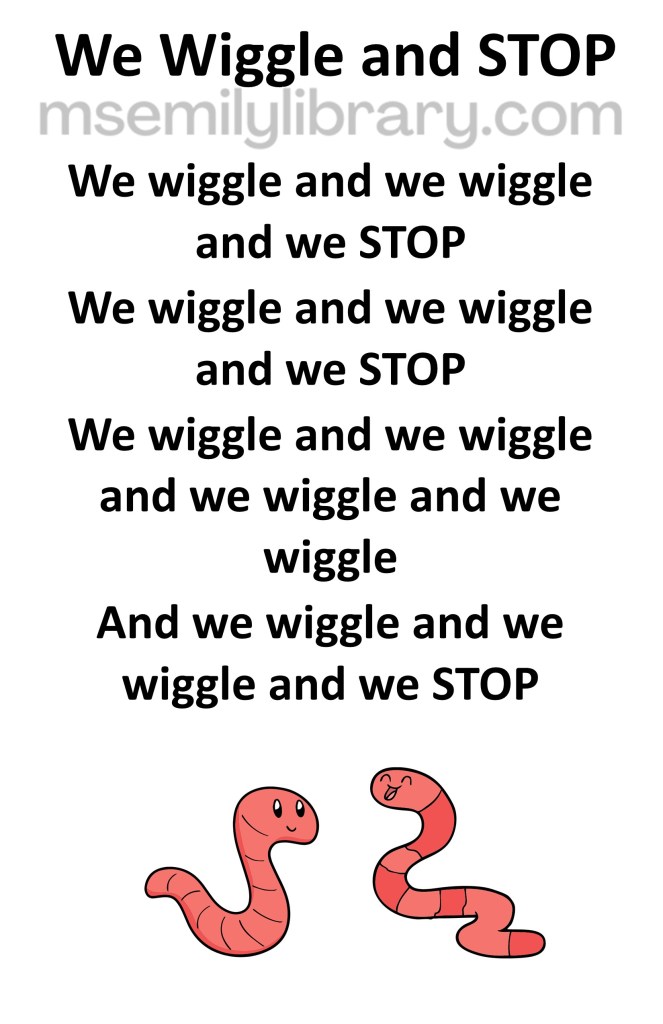
Warm-Up Rhyme: We Wiggle and Stop (Use the ASL sign for the word “stop” – one hand “chops” across the opposite hand) We wiggle and we wiggle and we STOP We wiggle and we wiggle and we STOP We wiggle and we wiggle and we wiggle and we wiggle And we wiggle and we wiggle and we STOP (We wiggled every week, but then added 2 more motions. Motions we did throughout the summer: stomp, twirl, jump, climb, run, stretch, march, tiptoe, wave, sway, roll [arms,] hug) Source: Jbrary
Intro: Our theme this summer is Unearth a Story. That means we are digging down to find some amazing things. Short intro to the weekly theme (see below)
Themed Song/Rhyme (see below)
Transition Song: If You’re Ready for a Story (tune of If You’re Happy and You Know It) If you’re ready for a story, clap your hands (clap, clap) If you’re ready for a story, clap your hands (clap, clap) If you’re ready for a story, if you’re ready for a story, If you’re ready for a story, clap your hands (clap, clap) Source: Miss Keithia (my predecessor)
Themed Book(see below)
Parachute! It’s time to get out our parachute and see what kind of fun we can unearth! We have two different parachutes – one is a smaller (maybe 8′?) that I use indoors on occasion (and we used as an art station as you’ll see below in the Repeated Stations section), but the one I use outdoors is much bigger – maybe 20′ in diameter.
Let’s start by doing some digging. As I mentioned in this post, these three parachute activities just came to me last March as I was starting to plan summer reading. The trick to this one is remembering which direction your voice is supposed to go, especially if you are used to singing the original. I figured out that “First level” should be the same note as the word “dig” in the last line above it, “Dig along with me!”I usually did this one twice, the first time finding something ordinary (a pebble, acorn, worm, etc) and the second time finding a dinosaur bone, which leads into the next song. Parachute Song: Let’s Go Digging (tune of Let’s go Riding on an Elevator) Let’s go digging deep in the earth, in the earth, in the earth Let’s go digging deep in the earth, dig along with me! [Let’s pretend this is the ground level and dig down!] (start with chute high and high voice) First level, second level, third level, fourth level, fifth level… (voice goes down) [Oh, look! I found a fossil!/buried treasure/worm/dino bone] And up, up, up, up, up! (voice goes up) Source: piggyback lyrics by Ms. Emily Library
Dinosaur fossils can be found underground. Can you pretend to be a dinosaur? Can you be a MARCHING dinosaur? This was a favorite – I even had adults singing along with me. I always did this one three times. The first time we marched. Then I said, “Can you pretend to be a tiny dinosaur, trying to sneak past a big T-Rex? Let’s be quiet and TIPTOE!” The third time I said, “Oh, no, the T-Rex saw us! Now we have to RUN!” and did it very fast. At the end I’d say, “Whew! We got away!” I wasn’t sure how well they could “make the parachute flat” but honestly they did pretty great! Parachute Song: We Are the Dinosaurs We are the dinosaurs, marching, marching (wave chute in steady beat) We are the dinosaurs, whaddaya think of that? We are the dinosaurs, marching, marching We are the dinosaurs we make the earth flat (pull parachute back to make flat) (tiptoeing, jumping, running, etc) Source: Laurie Berkner, from the album Whaddaya Think of That?
Breathing Break Whew, I am out of breath from all that running! I’m ready for a breathing break. Let’s take a big breath in and lift the parachute up, then breathe out and lower it. We’ll repeat a few times.
At this point the kids are usually darting under the parachute, so I go with it! Okay, if grown-ups can grab the edges of the parachute, kids can go underneath if they want (if you prefer to just watch from the outside, that’s always fine!) Let’s start by waving low and slow. Another rhyme that somehow came to me in the middle of the night! It worked very well – the grownups quickly caught on to when to raise and lower the ‘chute. The kids loved that last line when the parachute comes down on top of them! We did it twice each week. Parachute Rhyme: I’m a Worm I’m a worm and I’m wiggling so slow (wave low, slowly) I help to make the flowers grow (raise parachute high on “grow”) But when I see a bird I wiggle quickly down (wave and lower chute quickly) Where I can wiggle and play underground! (wave low to ground) Source: original (Ms. Emily Library)
Okay, grown ups – for our last parachute song we’re going to let the parachute fly – so let go at the very end after we count down and I say “FLY.” Parachute Song: Parachute Fly (tune of Skip to my Lou) (kids go under the parachute and adults raise and lower) Up, up, up it goes, Down, down, down so low Raise our parachute to the sky Count to 3 and watch it fly Spoken: Up on one… Down on two… Up on three… and FLY! (adults let go and leader pulls ‘chute in to themselves) Source: Gymboree
Release to Stations This year I had I had nine stations each week, which involve a mixture of dry, wet, and art/creativity stations. We spend about 20 minutes before I ring the bell to call everyone back to the grassy area. See more detail below.
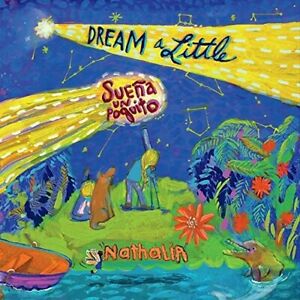
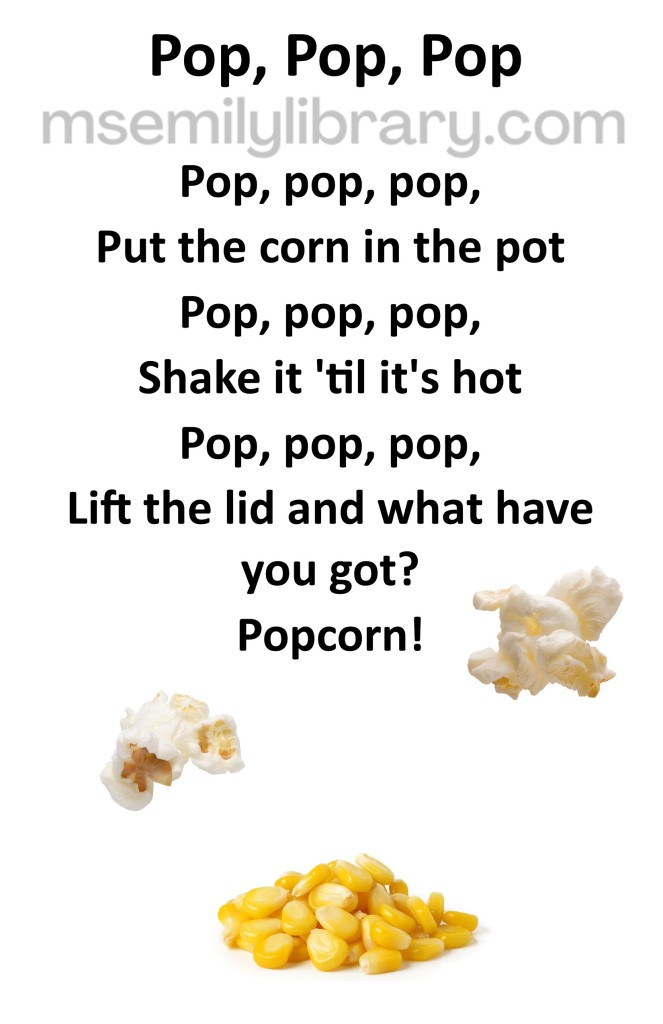
Everybody loves bubbles! The trick to doing bubbles outside is to figure out which way the wind is blowing and get upwind of your group! Recorded Bubble Song: Pop, Pop, Pop by Nathalia From the album “Dream a Little,” available on Spotify
Goodbye Song: See You Later, Alligator (tune of Clementine) See you later, alligator (wave with one hand, then the other) In a while, crocodile (open and shut arms like a croc’s mouth) Give a hug, ladybug (hug yourself or a loved one) Blow a kiss, jellyfish! MWAH! (move hand like a jellyfish then blow a kiss!) Source: King County Library System
Repeated Stations There are a few stations that I use every single week. They are easy but popular, and I like having a mix of familiar and novel stations. You can see stations for the individual weeks below, but these were available all summer.
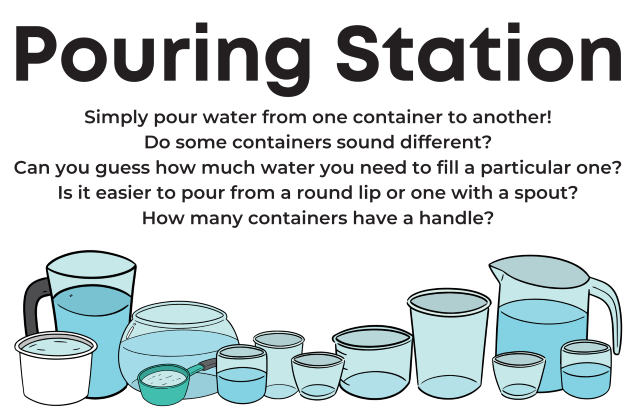
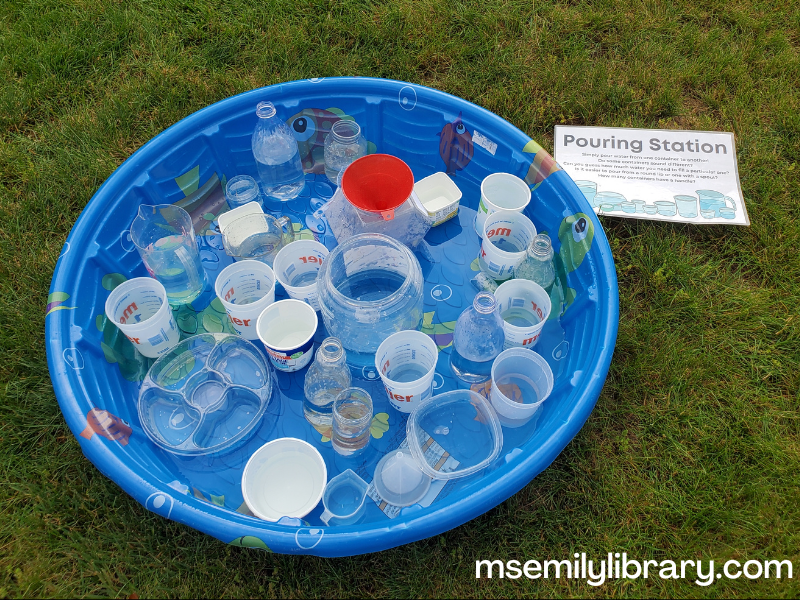
Pouring Station So simple, so easy, yet so compelling! I a few years ago, I asked coworkers to collect clean plastic recyclables with wide openings and visited Goodwill for some additional pitchers. We had measuring cups and funnels in our materials, as well as a hard plastic baby pool, which is the perfect container. I fill the pool with the plastic bins and fill them randomly with water, plus some extra in the pool. Original idea from Busy Toddler.
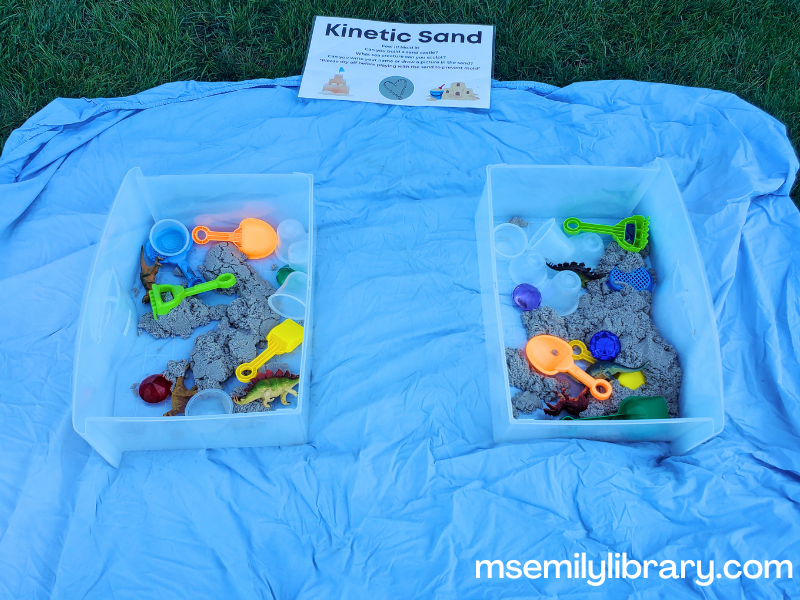
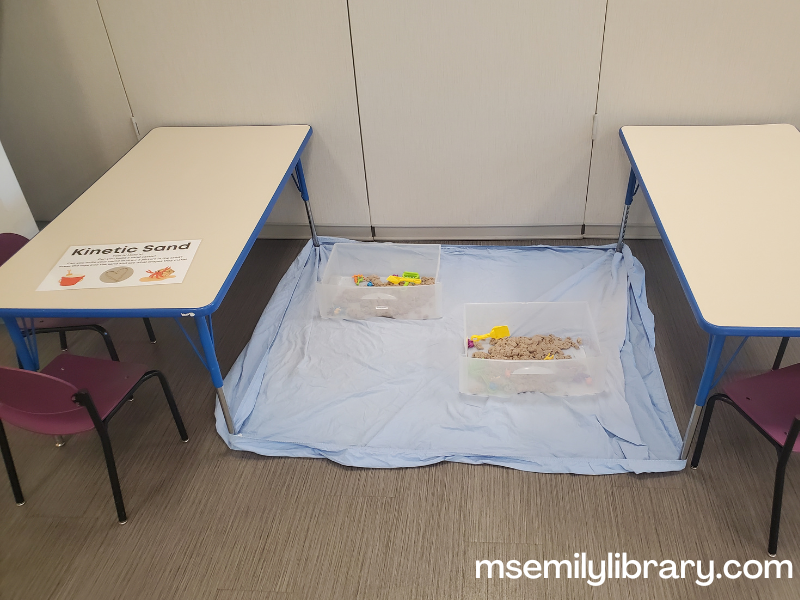
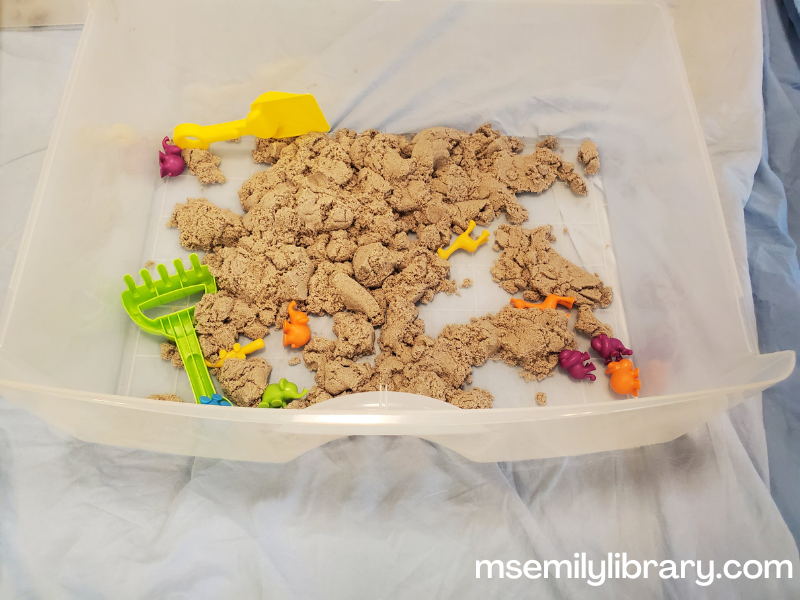
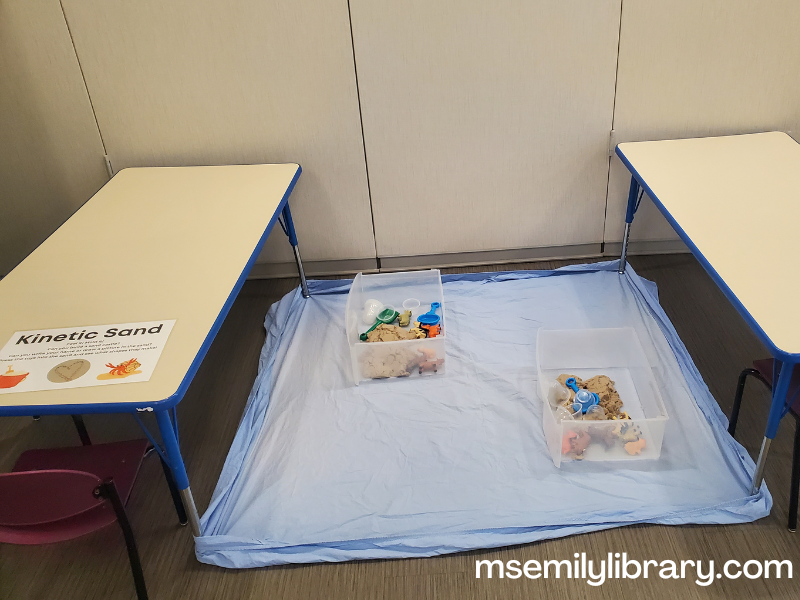
Kinetic Sand I have a few kids who go to this station every week and stay there the whole time! I have two big clear plastic bins (which are actually drawers from an old storage bin, kinetic sand, and recycled fruit cup containers that had fun shapes and plastic shovels. This year we added some other fun things in different weeks – the plastic dinos from week one’s art station, worms, jewels, plastic gold coins, etc. I kept a sheet underneath this station to catch any stray sand that escapes the bins. Because the sand is not taste-safe, I do warn the caregivers that if their kiddo is still exploring with their mouth, they may want to skip this station.
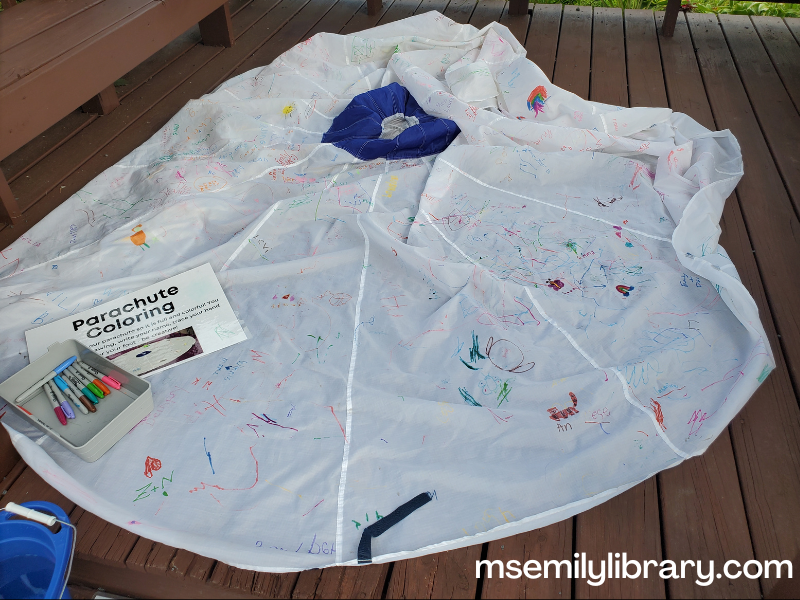
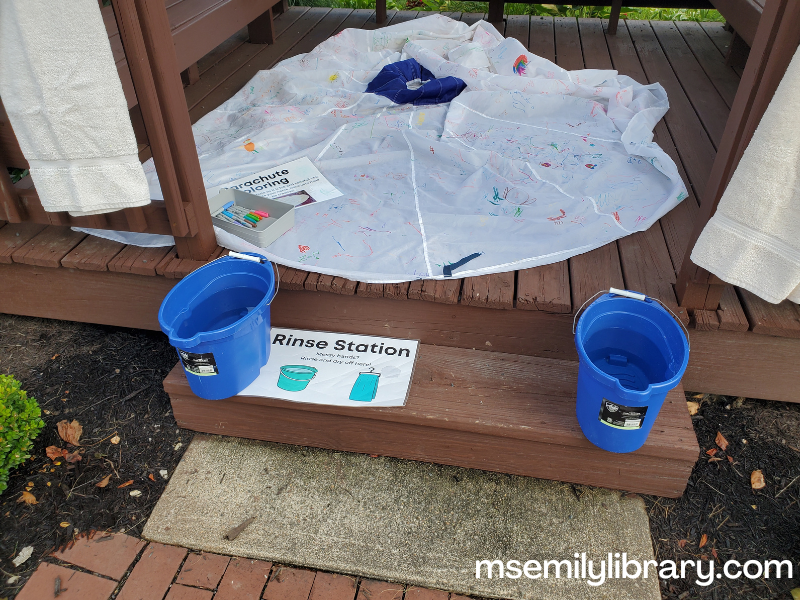
Color the Parachute My library has an interesting smaller parachute (maybe 8 foot diameter?) that came plain white and was advertised as “decorate it yourself!” When I inherited it, there were a small scattering of names from who knows how long ago and the rest was depressingly empty. In the last few summers I was determined to fill it up. I laid it out each week and set it as a station inside the gazebo, with a small handful of permanent markers. I’m happy to say that it looks MUCH better now, and it’s super fun for me to look at the names and remember kids who have aged out of my programs. There’s still plenty of space to draw and write, so I imagine I’ll be using this as a station for at least a few more years.
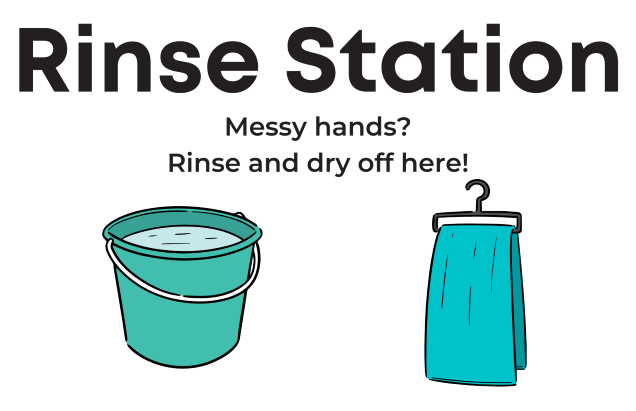
Rinse Station Okay, so this isn’t really a “station” where kids come to play, but it was a creative-by-necessity solution for me doing messy art outside where there wasn’t access to a sink to wash hands. I just got two buckets (I think they were from the car wash area in Walmart!), fill them with water and put dry towels nearby. I don’t have to worry about going through tons of wet wipes or paper towels, it’s an easy way to soak my paint-messy art materials at the end of the program, and it’s just a simple solution.
Intro: This week we’re talking about dinosaurs! We know about dinosaurs because people have *unearthed* their bones.
I varied whether I did the themed song or the book first, just depending on what made the most sense to me.
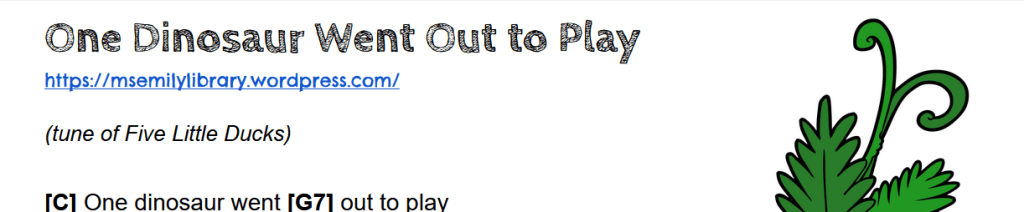
Themed Ukulele Song: One Dinosaur Went Out to Play (tune of Five Little Ducks) One dinosaur went out to play By a giant fern one day She had such enormous fun That she called for another dinosaur to come: Oh, Diiiiiiiiiinosaur! (slap hands on thighs)
(count up to 5) Last line: …That they played until the day was done! Credit: Mel’s Desk
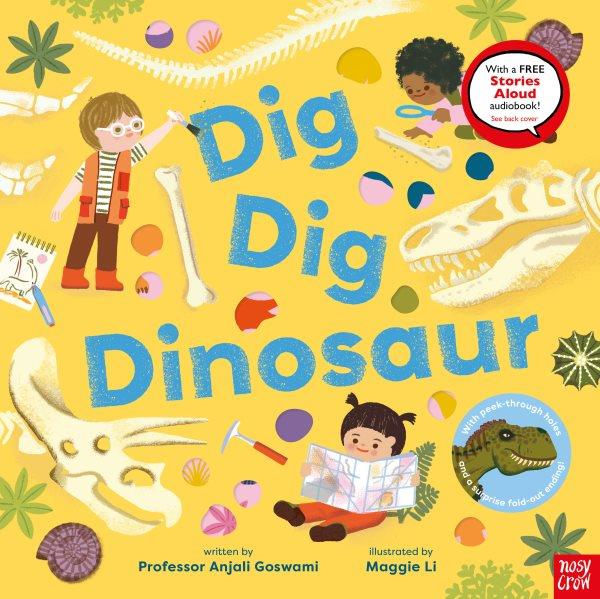
Themed Read: Dig, Dig, Dinosaur by Anjali Goswami & Maggie Li. I love that this is written by an actual paleontologist, and the big flaps and die cuts make it really exciting. I asked everyone to get out their shovels and “dig, dig, dig” when I read that part.
Week 1 Stations I don’t feel the need to theme every station to every week, but if there’s a way to add a little of the themed flair in, I am all for it. That was an easy thing to do with a dinosaur theme! So our art station and movement station were dino themed, and I threw in an extra dinosaur dry sorting station I had made in the past.
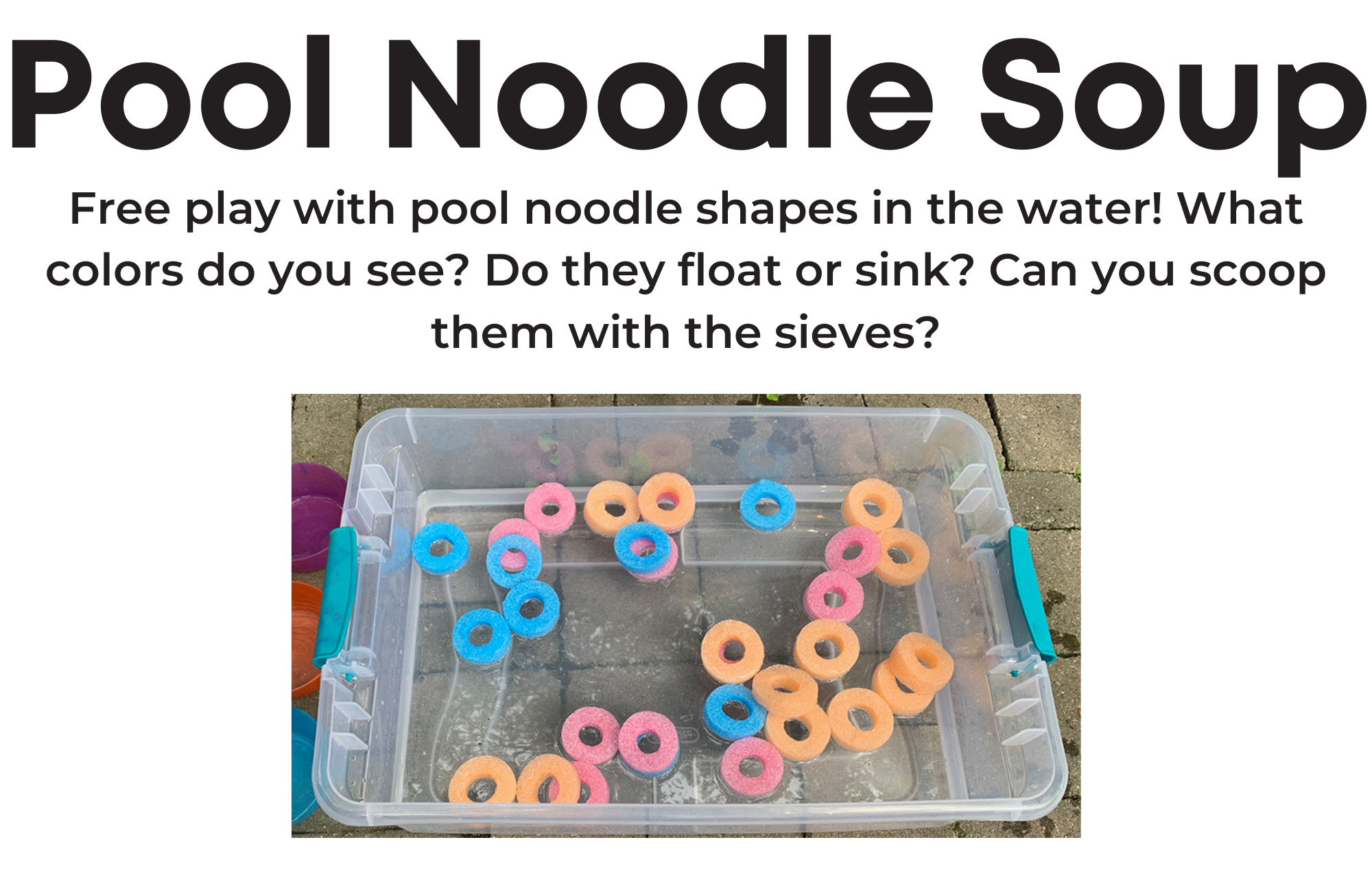
Pool Noodle Soup (Wet) I cut sections of pool noodles and used them in different ways, starting with this wet station. (The dry station shows up week 2.) I two identical plastic containers and added water, the noodles, some ladles and slotted spoons. Original idea (and photo on the sign) from Happy Toddler Playtime.
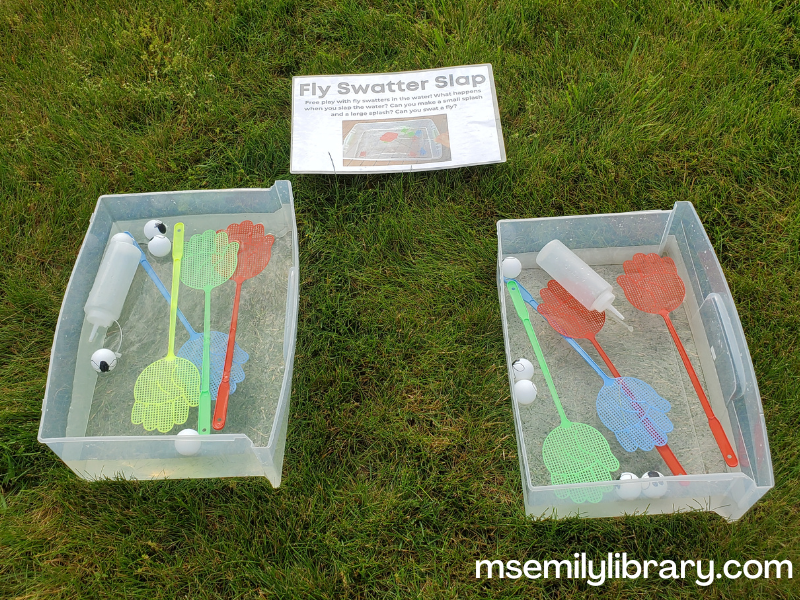
Fly Swatter Slap(Wet) Again, using my materials in different ways by using flyswatters in both wet and dry stations on different weeks. The wet station included the (clean) swatters and ping pong balls that I drew flies on plus some squeeze bottles, and uses two drawers from a plastic bin container. The swatters were hand-shaped and different colors. Original idea (and photo on the sign) from My Bored Toddler.
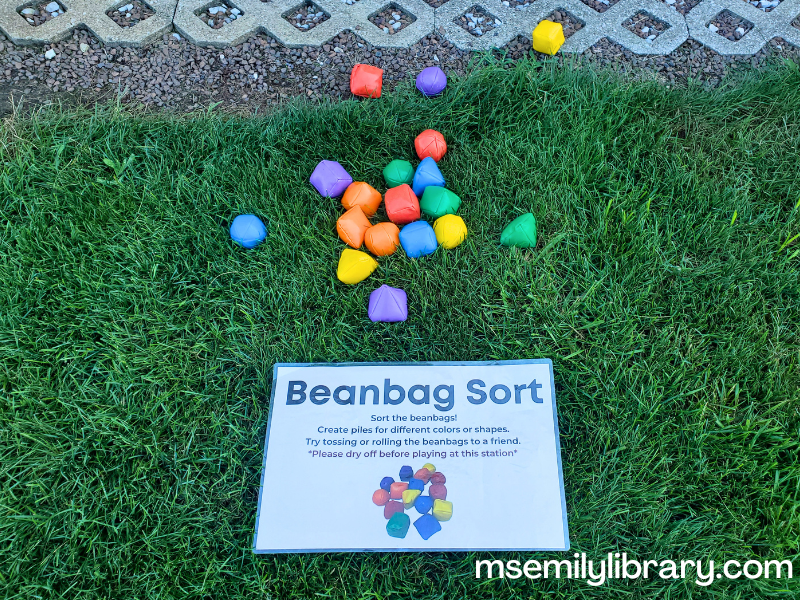
Beanbag Sort (Dry) We have these beanbags from Lakeshore Learning that are different colors and shapes. They’re a super easy station where kids can play and sort with them in several ways.
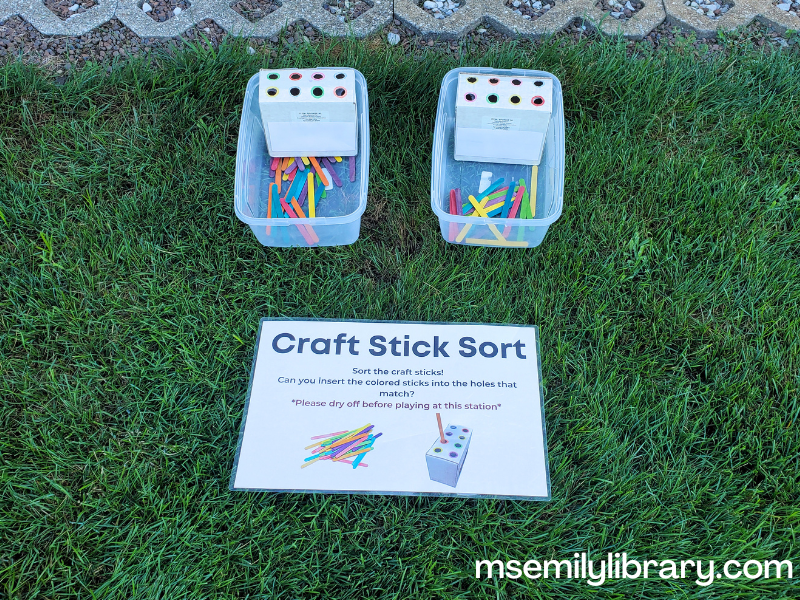
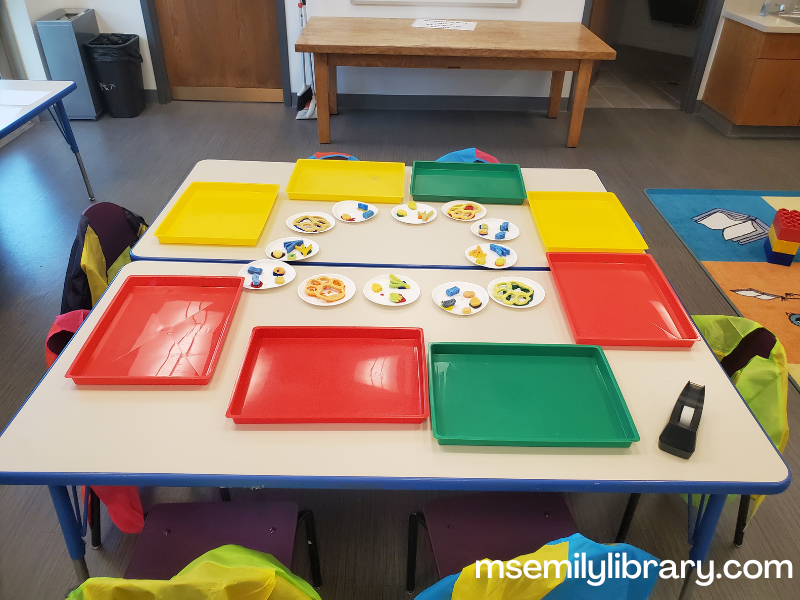
Craft Stick Sort (Dry) I made these a few years ago – I noticed I had these boxes of dot painters that have small holes already in the top. I colored a ring around each hole a different rainbow color and added colored craft sticks for a fine motor and color identification station. The colored rings are getting a little faded so next year I’ll have to re-color them! I put them in the small plastic bins I store the kinetic sand in so they don’t get wet in the dewy grass or lost too easily.
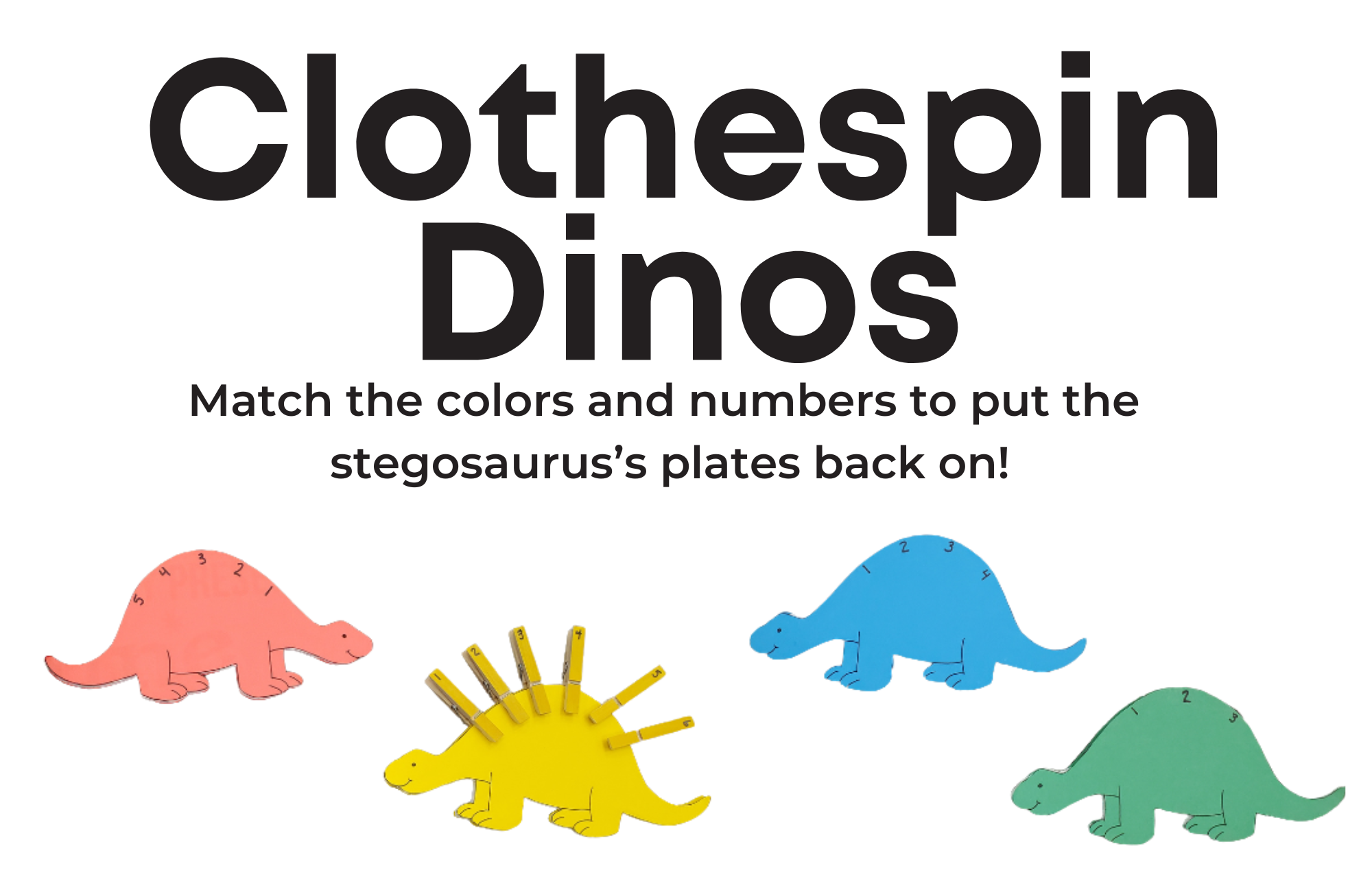
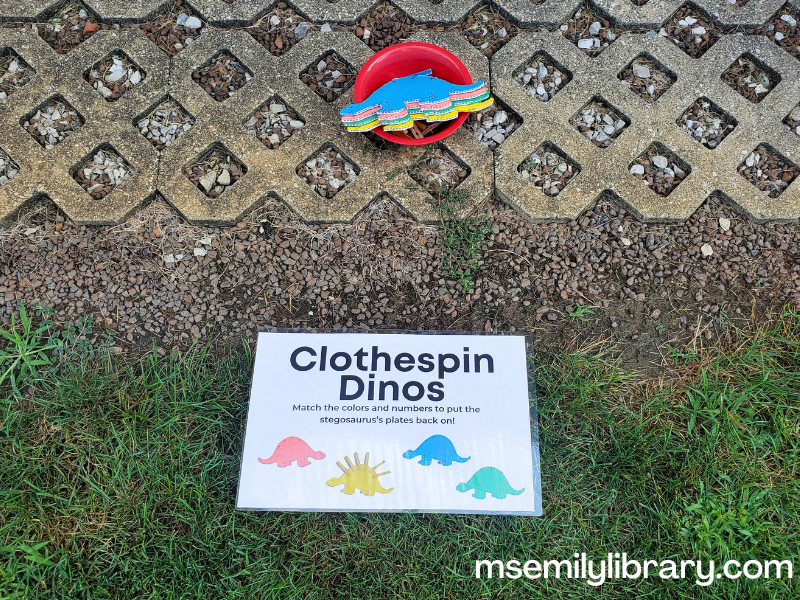
Clothespin Dinos (Dry) This is another station that I had made several years ago, and seemed perfect to add to a dino themed week. Kids match the numbered and colored clothespins to the correct stegosaurus and work on their grip strength at the same time. I talk more about making these at this post from 2022. Download a template for the Clothespin Stegosaurus here!
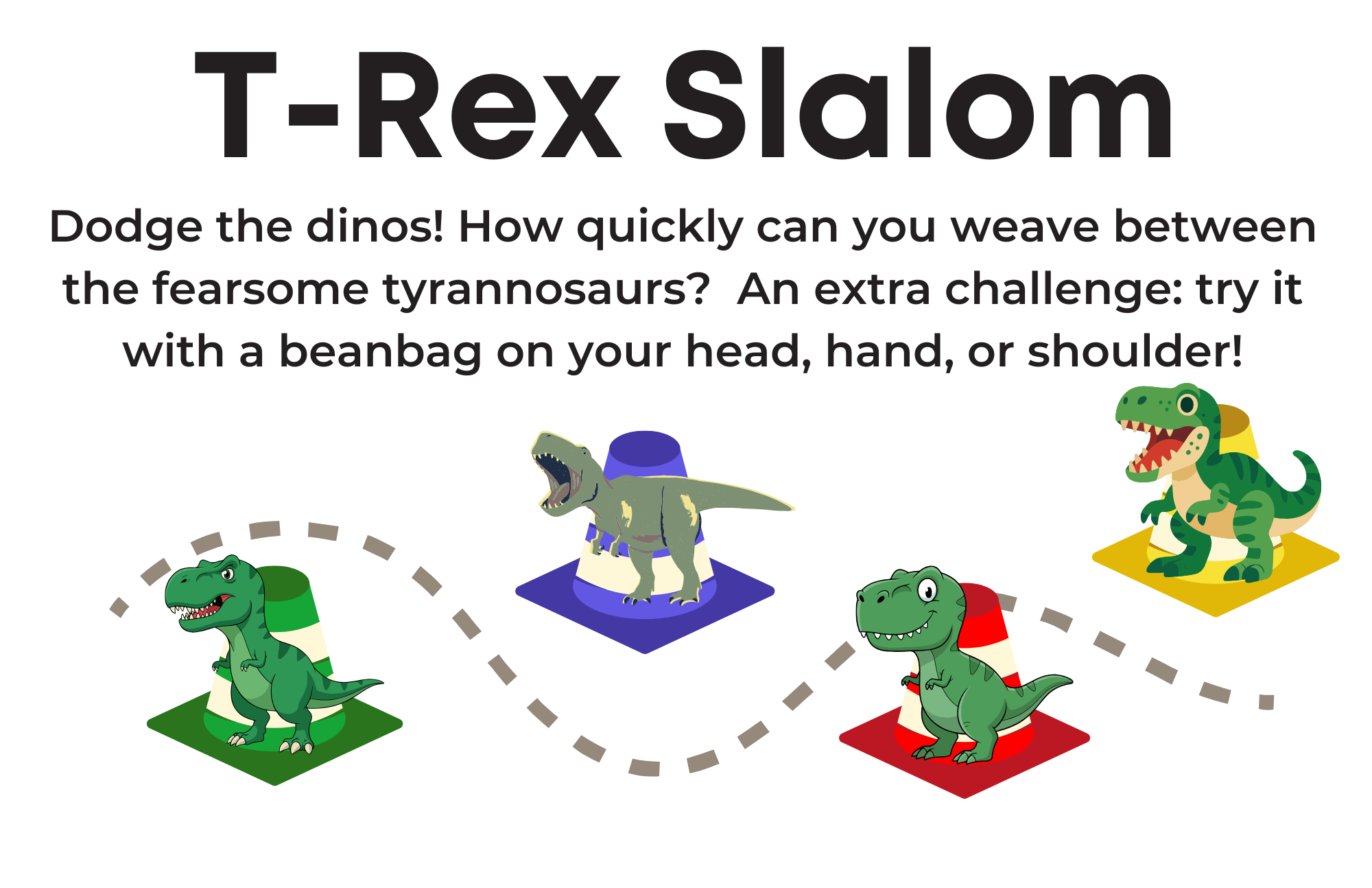
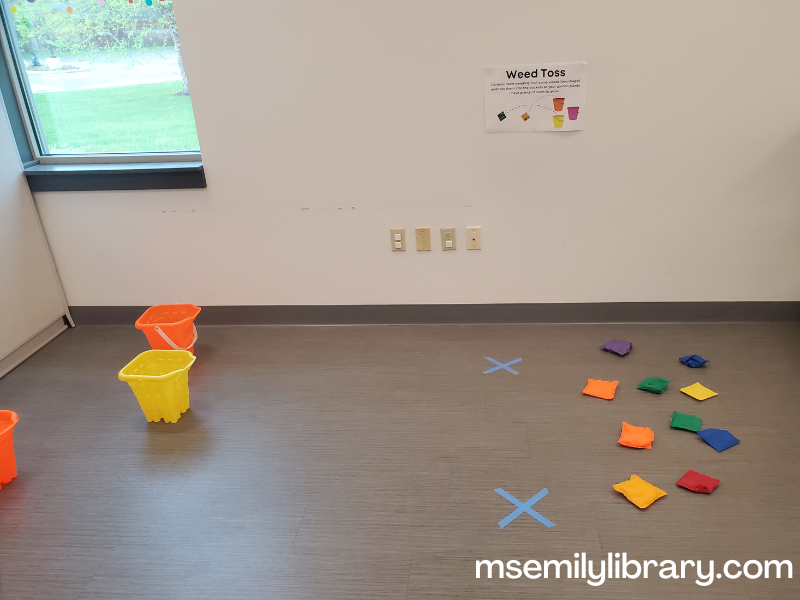
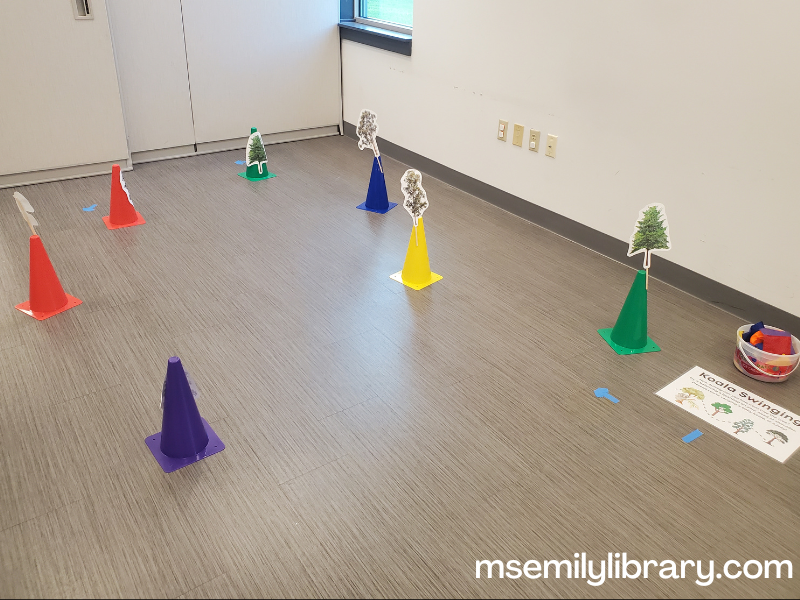
T-Rex Slalom (Dry, Movement) This year I decided to add a movement station each week. This was an easy one to make with our athletic cones. I printed some T-Rex graphics and laminated them, then taped them to the sides of the cones and provided some beanbags for an extra challenge. The cones are pretty close in the picture – they got spread out a little more when we started.
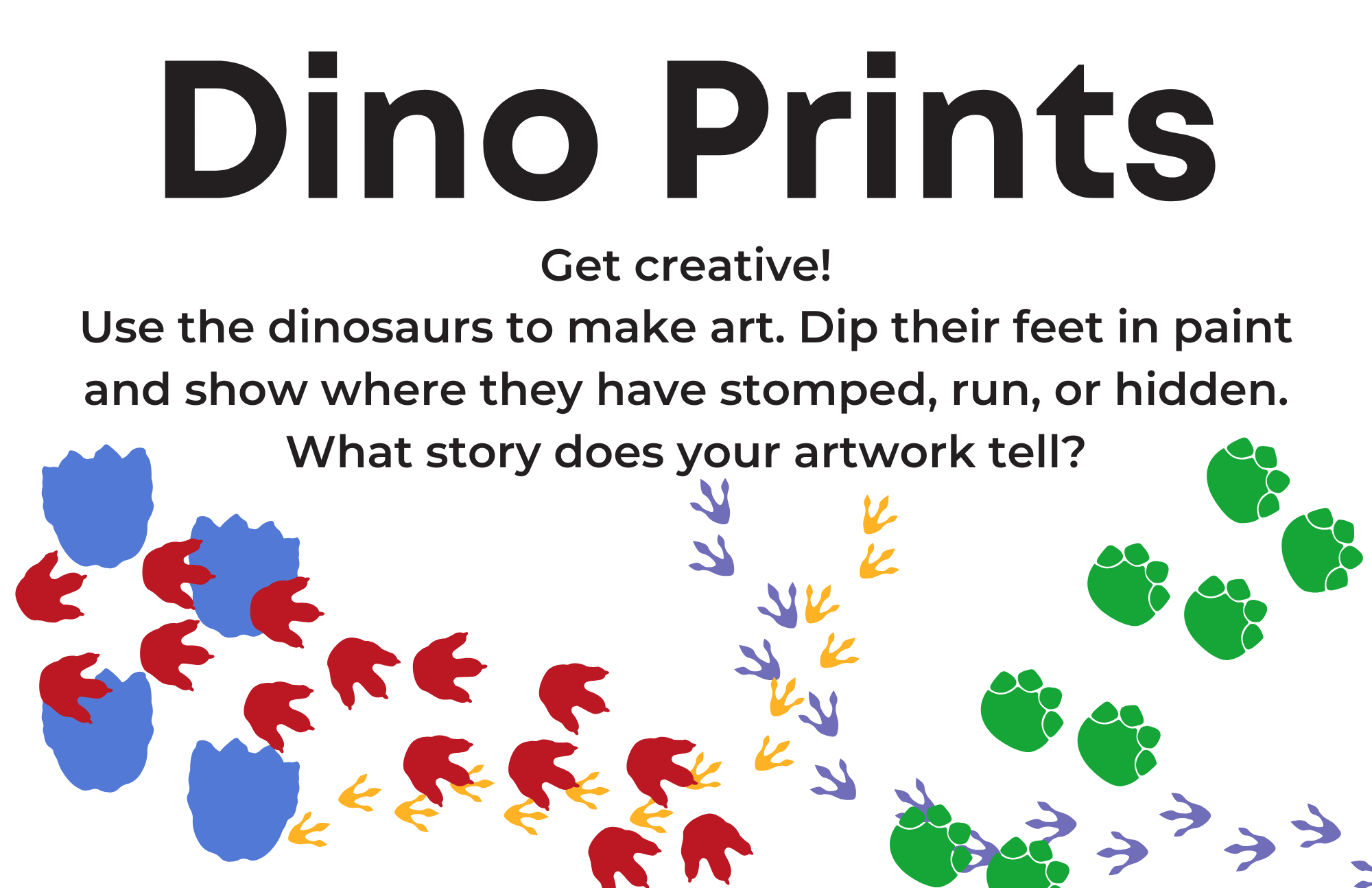
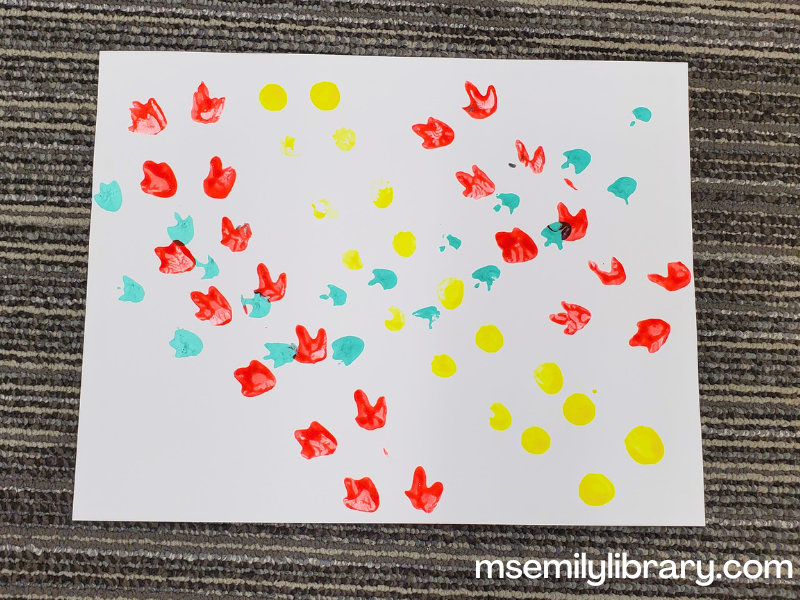
Dino Prints (Art) I can’t believe I didn’t get a setup picture of this one! We purchased a set of plastic dinosaurs and used them several times throughout the summer for various stations, but this was the first one. I added fun neon tempera paint to some containers (cleaned out Lean Cuisine trays are a great size and shape for dipping paint crafts!) and set the dinos out. I did have my sample that I created for a virtual storytime, so there’s a photo of that. The dinosaur feet weren’t completely flat, so it was a bit more difficult to get a good print than I had expected, but it didn’t seem to matter much to our participants.
Intro: This week we’re talking about buried treasure. Have you ever imagined following a treasure map and finding something shiny buried deep and hidden away?
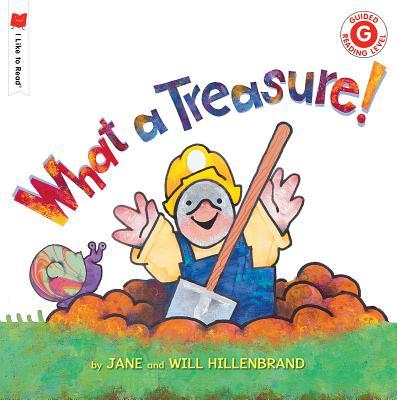
This was a cute one, although the commentary by the brother felt a little awkward to me. Themed Read: What a Treasure! by Jane & Will Hillenbrand
Are you ready to do our own treasure hunt? Themed Rhyme: Going on a Treasure Hunt We’re going on a treasure hunt! (call and response first 3 lines) I’ve got my shovel I’m not scared Uh-oh, look at that tall, wavy grass We can’t go over it We can’t go under it We have to go through it Swish, swish, swish, swish
(additional verses) Uh-oh, look at the big, wide river… Splash, splash, splash, splash Uh-oh, look at all that mud… squish, squish, squish, squish Uh-oh, Look at that deep, dark, cave! Creep, creep, creep, creep
Look, there’s the treasure chest!, It’s full of treasure! Hooray!! Uh-oh, what’s that sound? It’s a pirate!! Run!!! Quick, back through the cave! Creep, creep, creep, creep Run through the mud! Squish, squish, squish, squish Swim the river! Splash, splash, splash, splash Run through the grass! Swish, swish, swish, swish Run through our yard! Up the stairs, Into the house, Close the door Whew! We’re safe, That was a close one. Let’s not go treasure hunting anymore Source: The Kiboomers
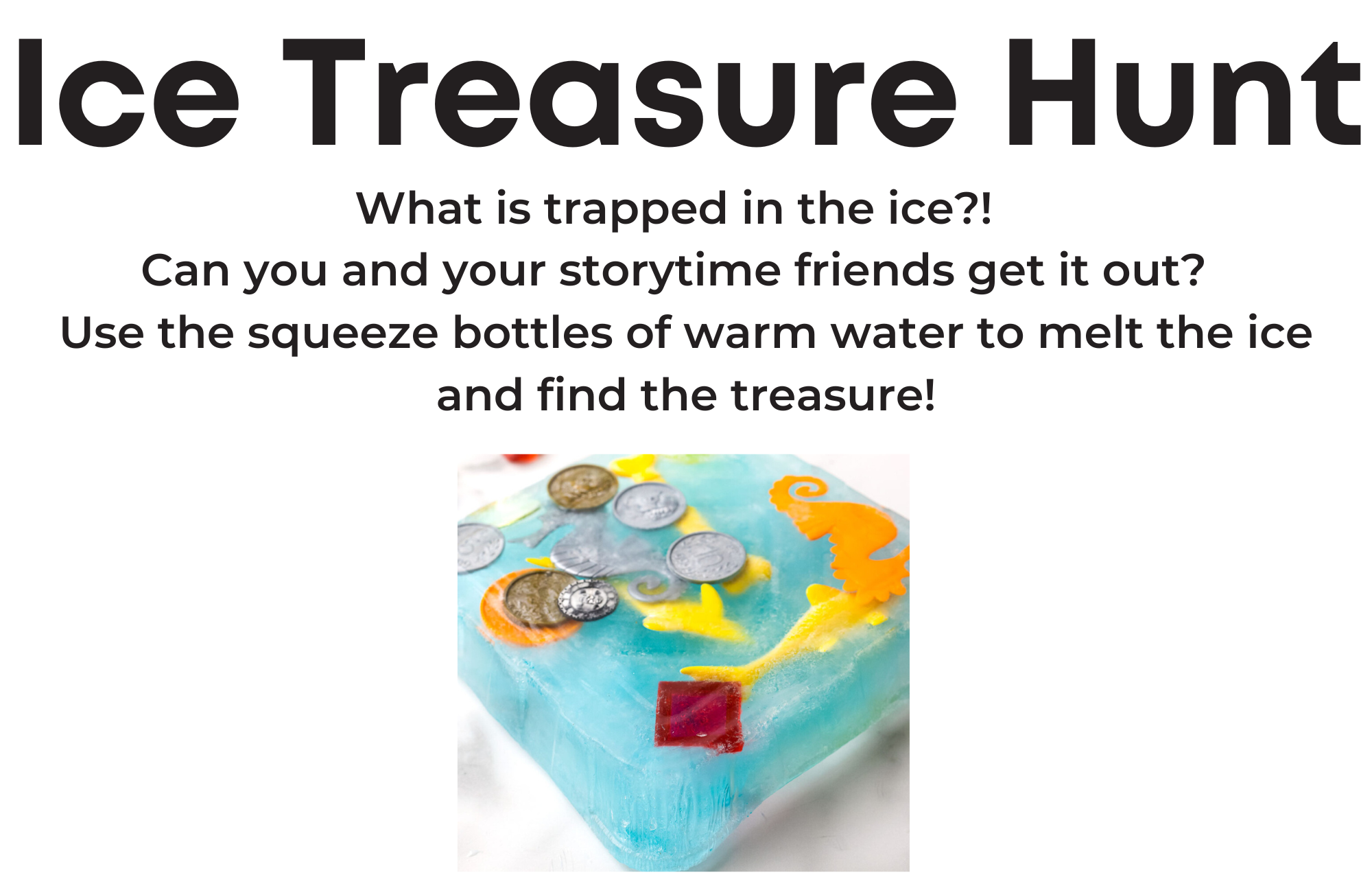
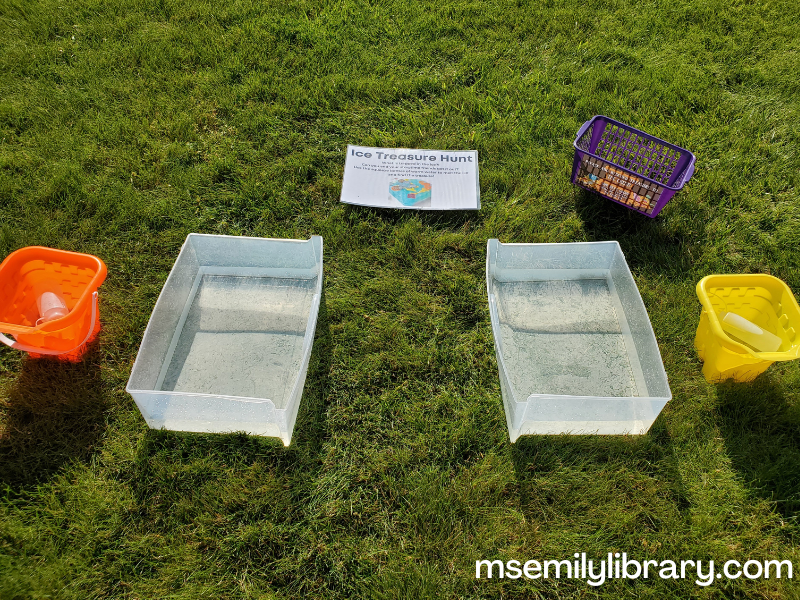
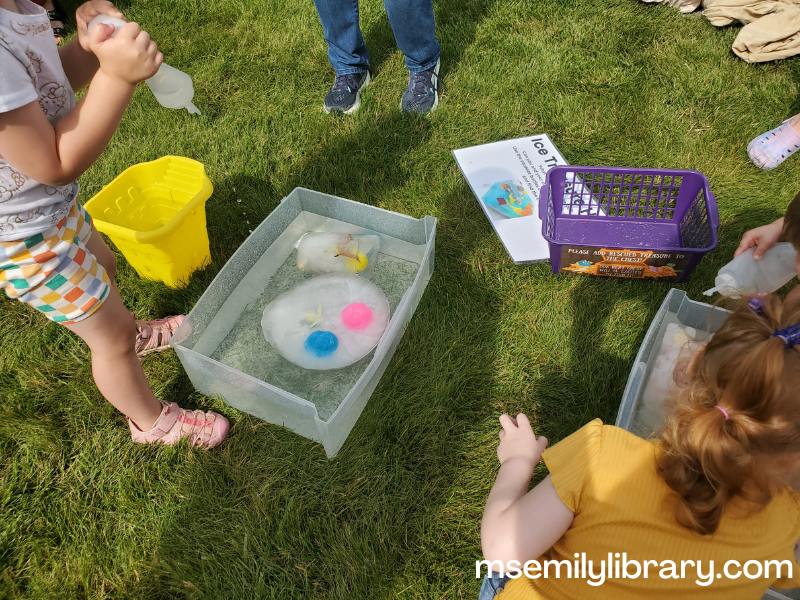
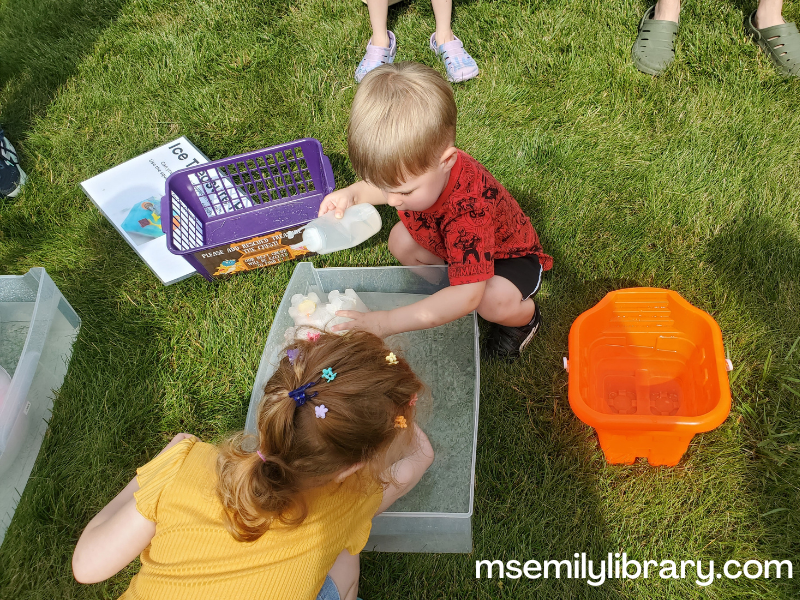
Ice Treasure Hunt (Wet) I did a version of this in 2023but it feels like it worked out better this time. Instead of using a quart-sized container, I used some sandcastle buckets we have, layering a few treasures at a time and adding water to make a big block of treasure-filled ice. The containers had a good amount of texture along the sides so it was harder for the layers of ice to detach and float to the top of any new water layer. There were also some large Halloween candy bowls that I used as well, which were harder to keep the layers from floating, but we managed it somehow. We had two days of this station, so we made four ice blocks total. Inside were fake gold coins, medium sized seashells, some of our dinosaur figurines from week 1, large plastic diving gems, large 2″ pompoms, and river rocks. I filled the big drawer bins with just a few inches of water from the hose, then provided the orange buckets (sans ice) and squeeze bottles filled with water as hot as I could get it from the tap. When we released to stations 20 minutes into the program, the water was warm but not too warm, and I put the ice blocks in the bins from a cooler. The kids really worked diligently to get the treasure out, and the blocks were big enough that there was still ice left at the end of the program! I realized that the treasure was kind of fun stuff, but I didn’t want kids to be taking it home, so I put out a basket nearby with a sign as our “Treasure Chest.” The sign asked kids to collect the treasure in the chest to save for the next group. I found the photos for the sign at Kids Activity Zone. The first photo shows the bins with just water – I kept the ice blocks in a cooler until it was station time. But I was able to snap a couple of pictures of the kids playing!
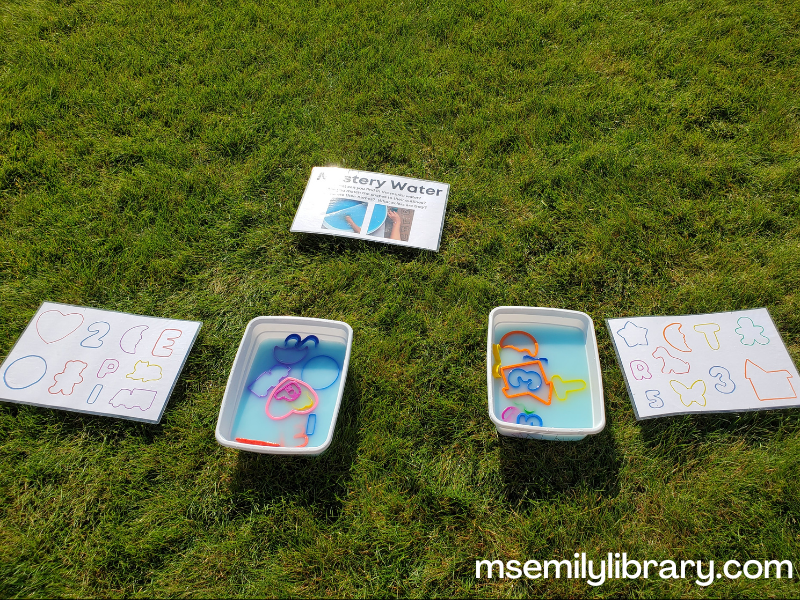
Mystery Water (Wet) Inspired by this Pinterest pin from bright_little_brains, I used some plastic cookie cutters we had in storage, traced their shapes on a large sheet of paper, and laminated. The water was mixed with a few tablespoons of cornstarch and several drops of food coloring to make the water murky. I also added some of my toy pirate gold to each bin. Unfortunately, the cookie cutters weren’t very heavy and kind of floated to the top, but it wasn’t a disaster and the kids enjoyed the activity anyway.
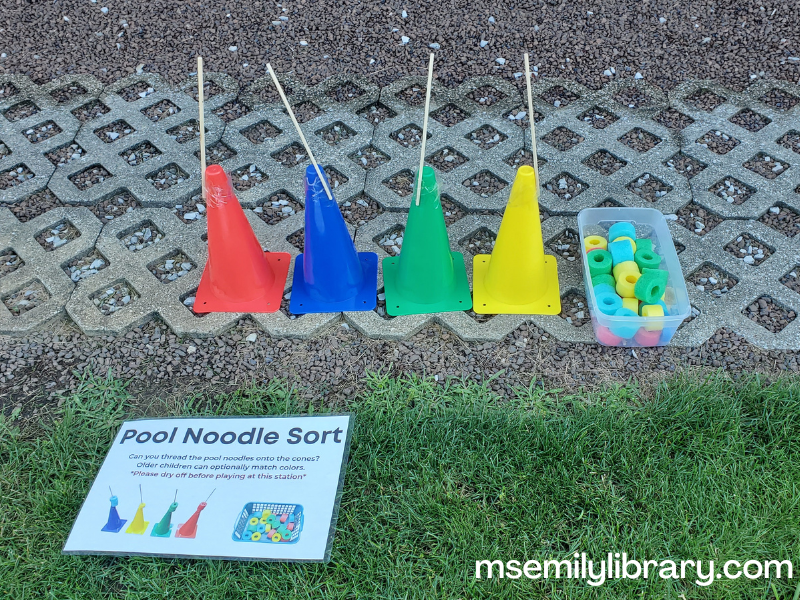
Pool Noodle Sort (Dry) Using the pool noodle slices (from Pool Noodle Soup), I taped a dowel rod to four small plastic cones in red, green, yellow, and blue. Kids could then thread the colored noodles on to the cones. Original idea from this Pin (no blog).
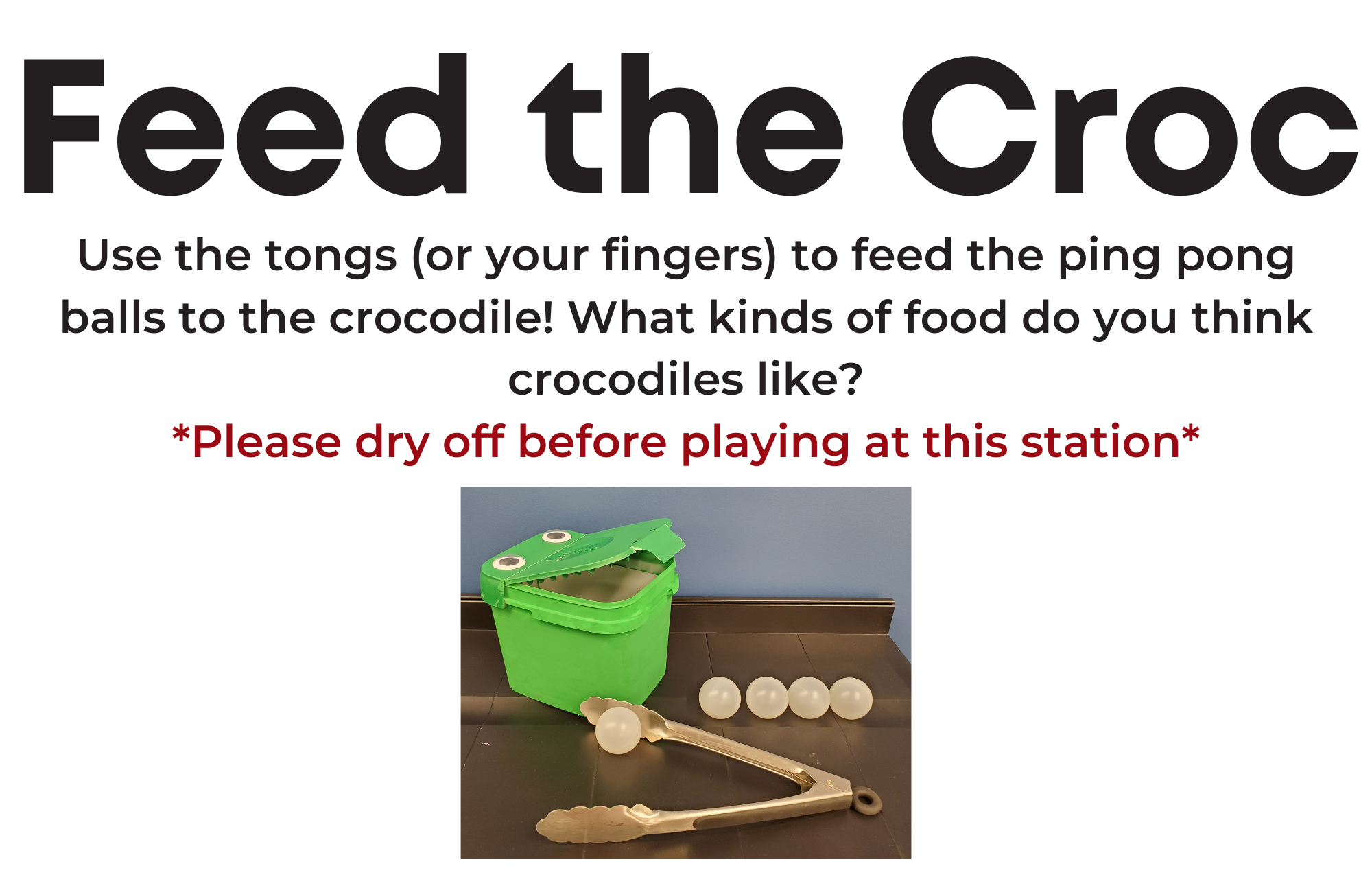
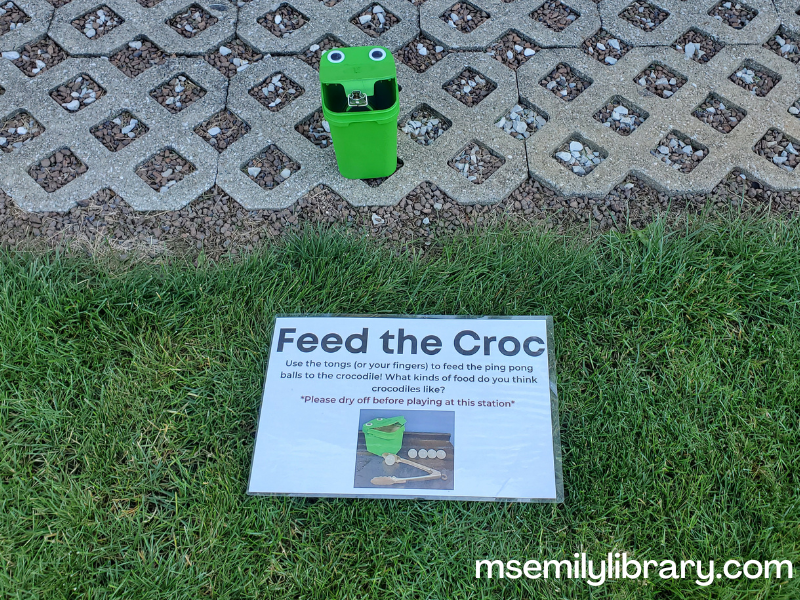
Feed the Croc (Dry) I’d made one of these a couple years ago but it somehow got used and broken in the meantime. My kind coworker then made me two replacement crocodiles! With a few metal tongs at Goodwill and ping pong balls, it’s a cute fine motor station. Nom, nom, nom! Original idea from Mama OT.
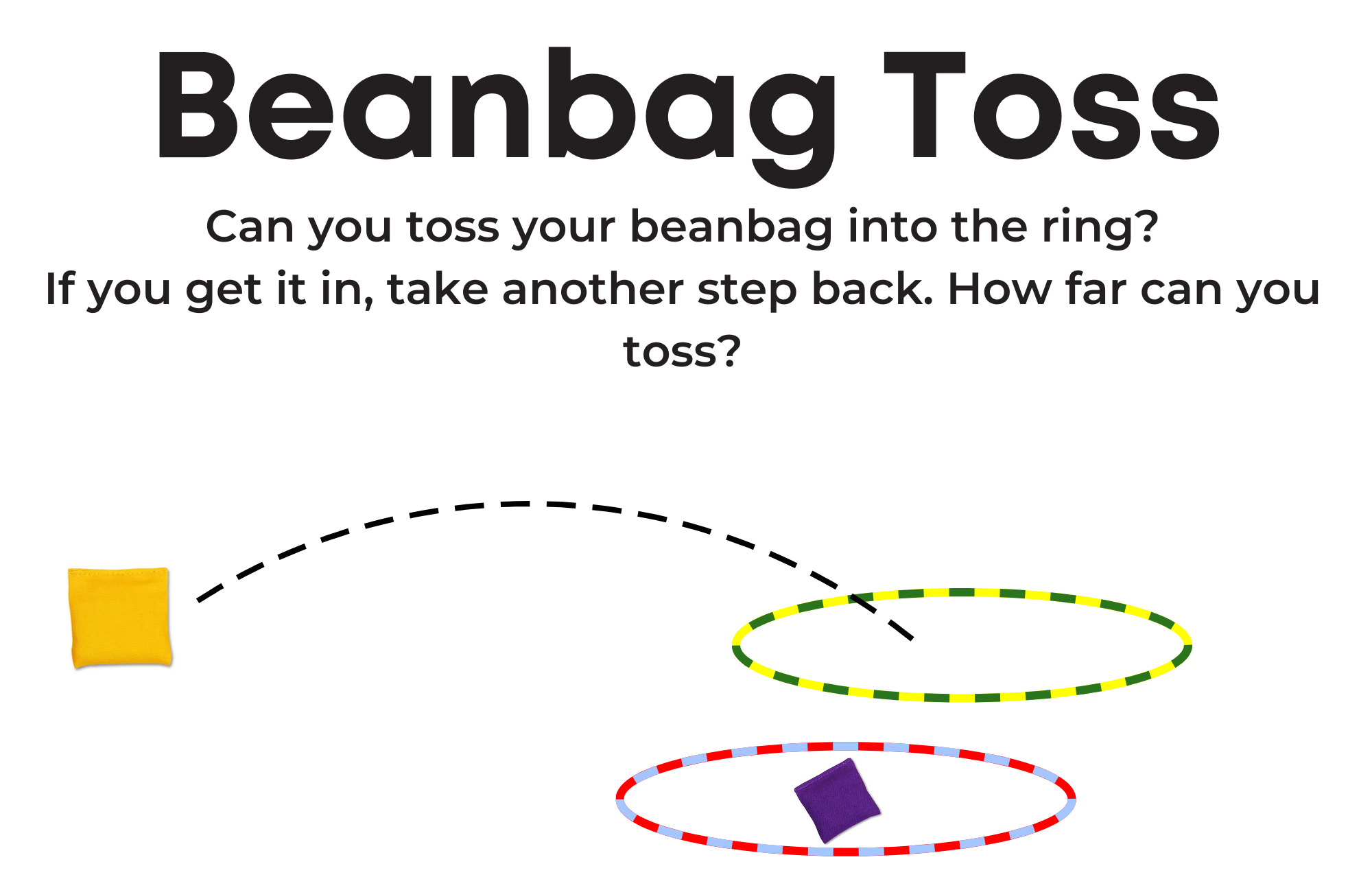
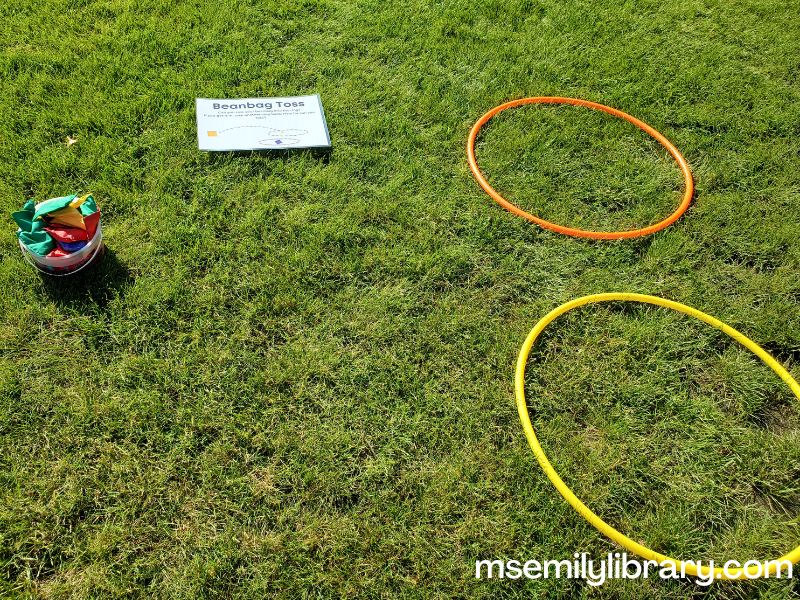
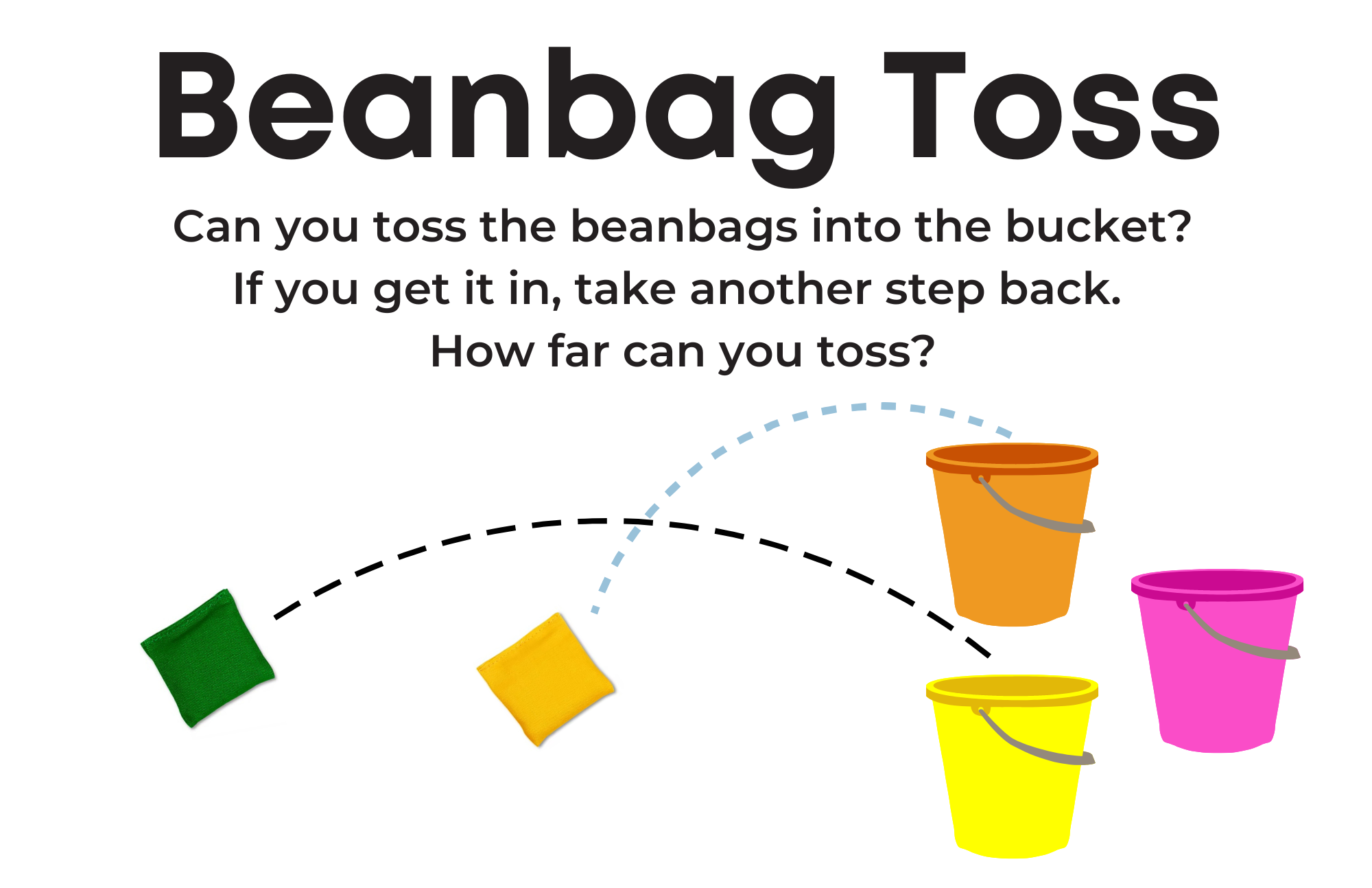
Beanbag Toss (with hula hoops) (Dry/Movement) A simple beanbag toss for this week’s movement station – I used square beanbags and two hula hoops.
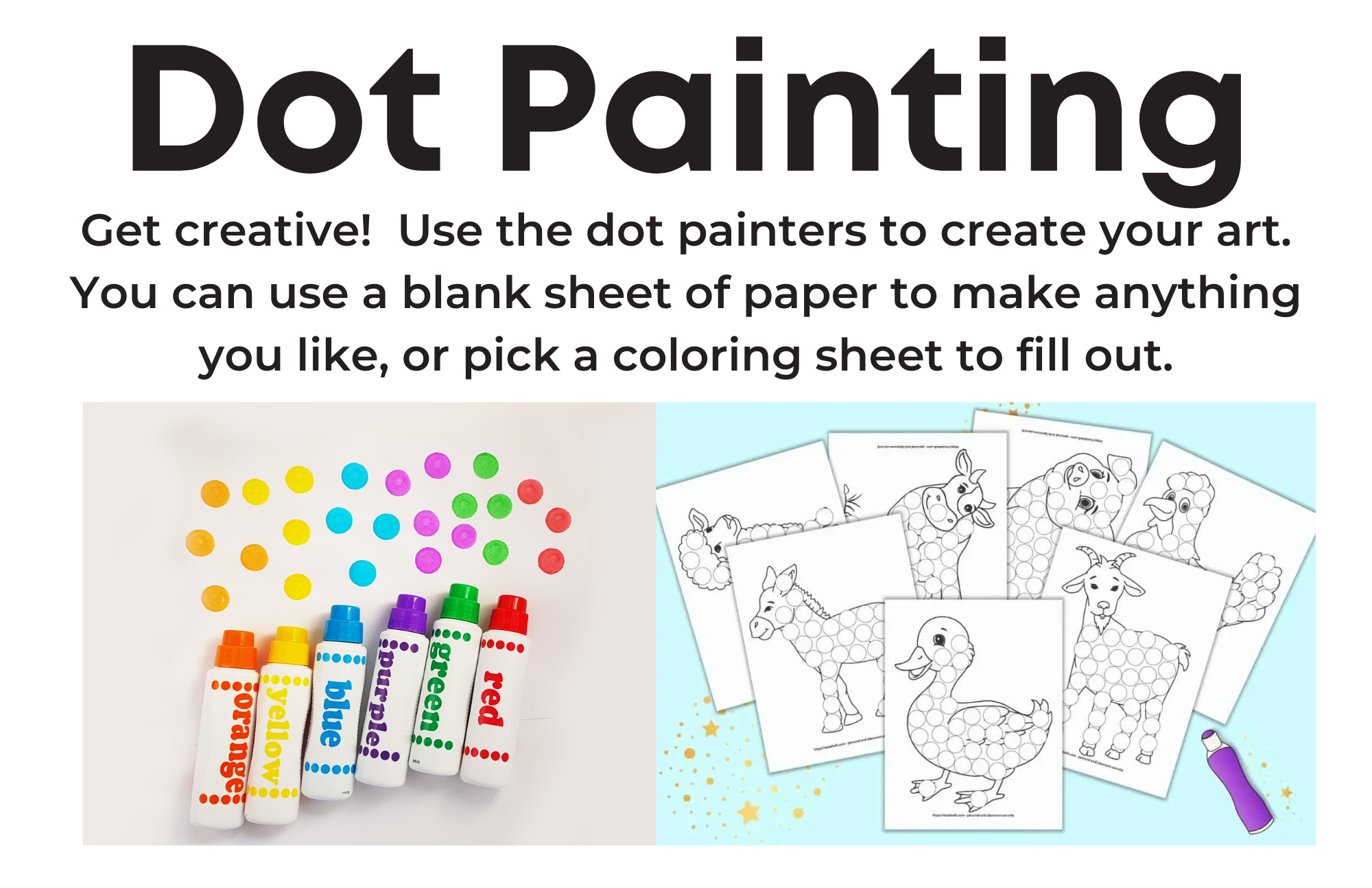
Dot Painting (Art) Using our stash of dot painting markers, I created dot coloring sheets that had to do with our themes – a pig in mud, treasure chests, sand castle, treasure map, and some dinosaurs. Did you know you can make any traditional coloring sheet a dot sheet just by adding circles? I do it in Canva and it’s pretty easy. I keep the dots at about .5″ to .75″ in diameter and just add them to big areas. It works better with pages with big open spots rather than lots of detail.
Intro: This week we’re talking about worms! Worms are a little wiggly and slimy, but they are so cool! They help keep the dirt loose and full of nutrients so plants can grow.
The original on this one has Wiggly going back into a pocket and going to sleep, but since we’re talking about unearthing I had him go back down to the ground. Themed Rhyme: Wiggly Worm Wiggly is a wee worm who wiggles everywhere Can you keep your eyes on it as it wiggles here and there? Wiggly starts down at my toes And wiggles all the way up to my nose! It wiggles back down without a peep Digs a hole and goes to sleep Source: King County (WA) Library System
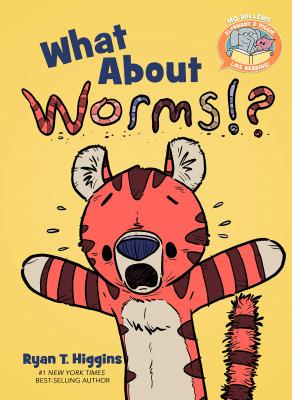
I got a good number of laughs at this one, but it felt like it was mostly from grownups. It might be a better choice for the preschool set. My backup is the very sweet How to Say Hello to a Worm by Kari Percival, and I think it may have been a better choice. Themed Read: What About Worms!? by Ryan T. Higgins
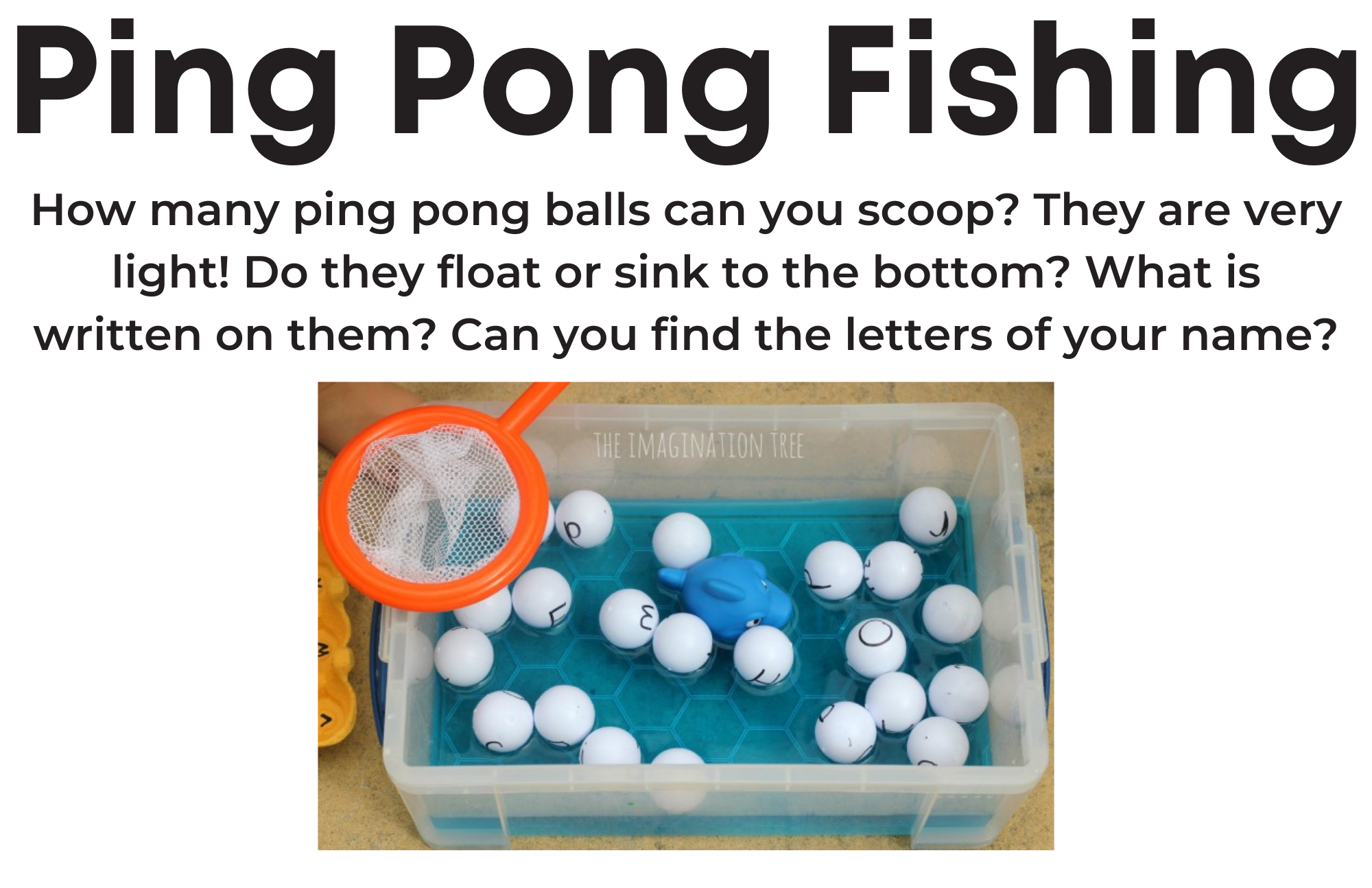
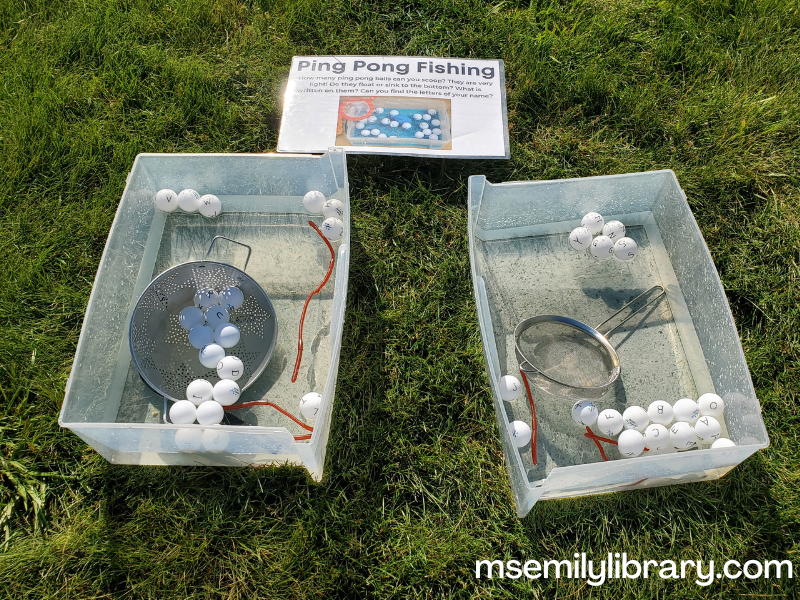
Ping Pong/ Worm Fishing (Wet) This was basically a station I’d done before, Ping Pong Fishing, but with fake fishing lure worms added in. I didn’t even change the sign. I had written the alphabet on ping pong balls and used them, the worms, and colanders, sieves, and slotted spoons in the bin. Original idea (and photo on the sign) from the Imagination Tree.
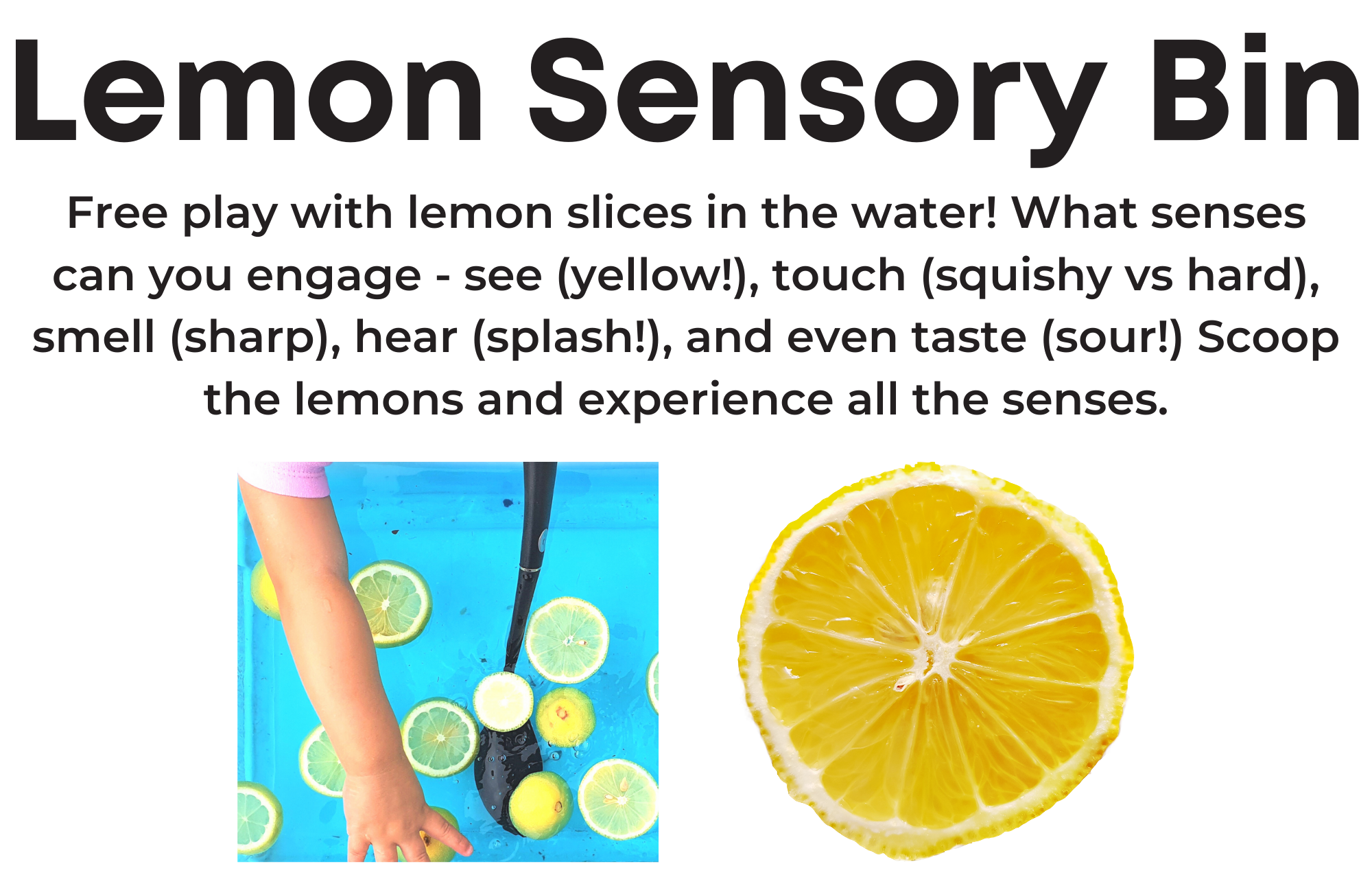
Lemon Sensory Bin (Wet) Mm, this is always one of my favorite stations! It’s super easy and smells so good. I bought a bag of lemons and we divided them among our sessions, which ended up being about 1.5 lemons per day. We cut them up into slices and added them to a bin with water along with ladles. I did announce that there was a lemon bin before breaking for stations just in case there was an allergy issue, but no one had a problem. Original idea (and photo on the sign) from Taming Little Monsters.
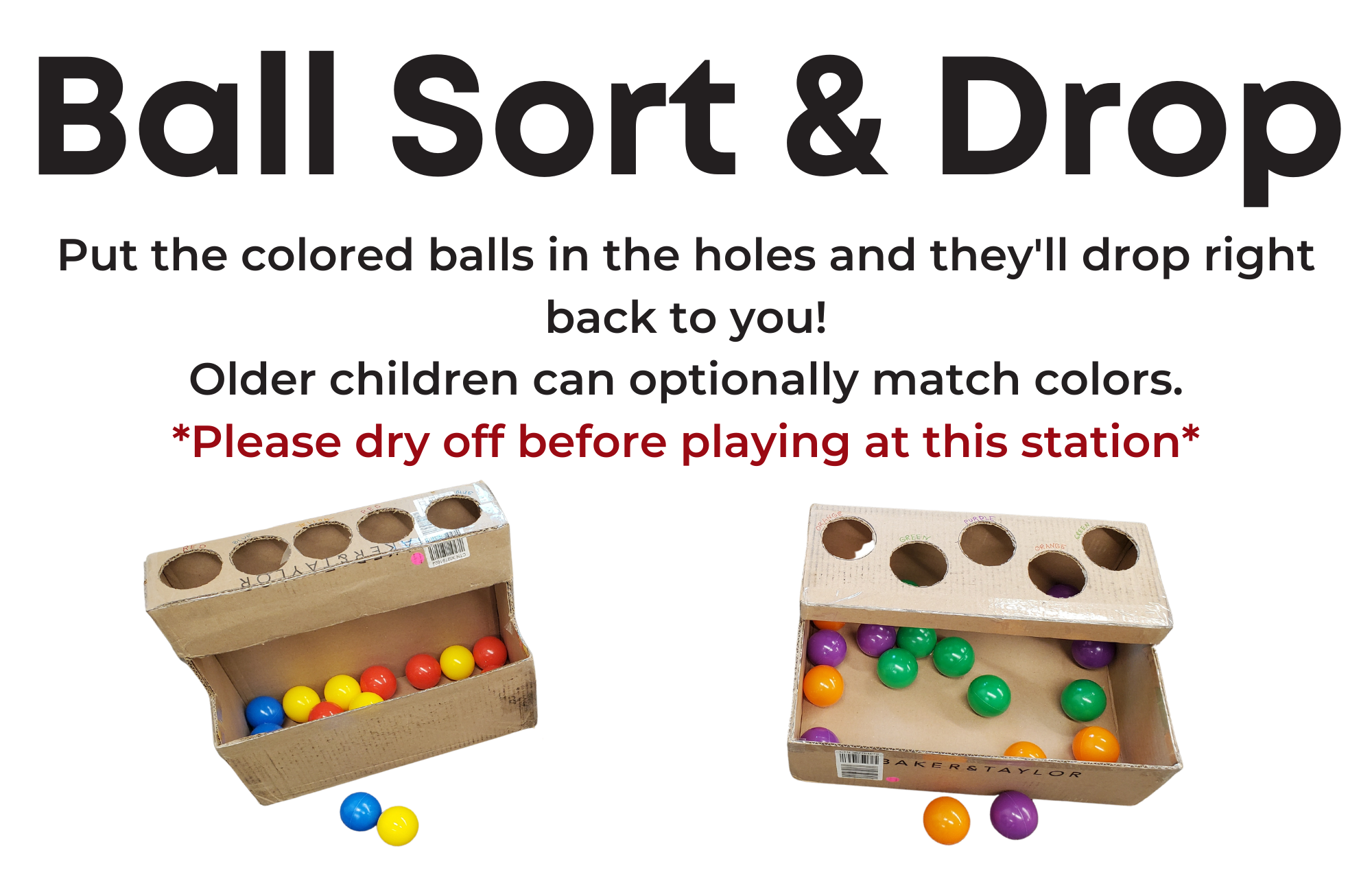
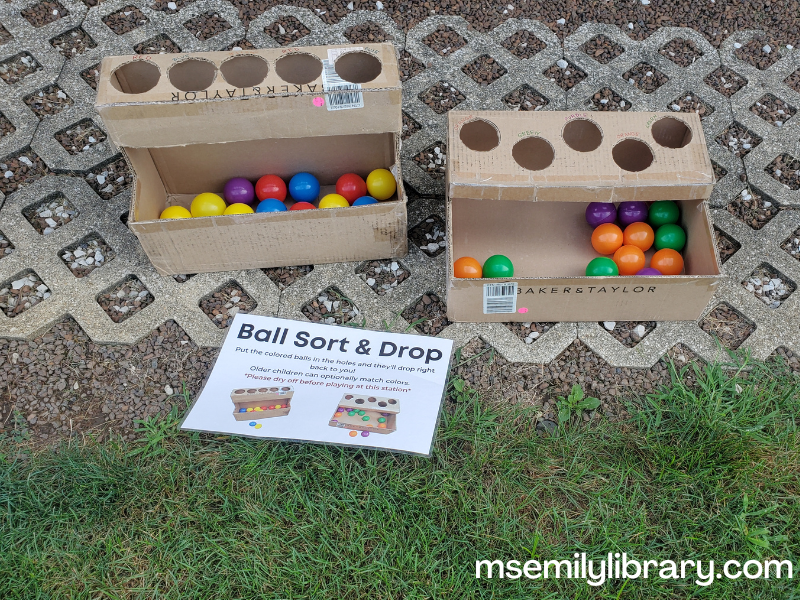
Colored Ball Sort (Dry) This ball sort and drop was made a few years ago with Baker & Taylor boxes (RIP), but oriented different ways so one was tall and skinny and one was low and squat. I had purchased ball pit balls and supplied different colors to each box. Original idea from Taming Little Monsters.
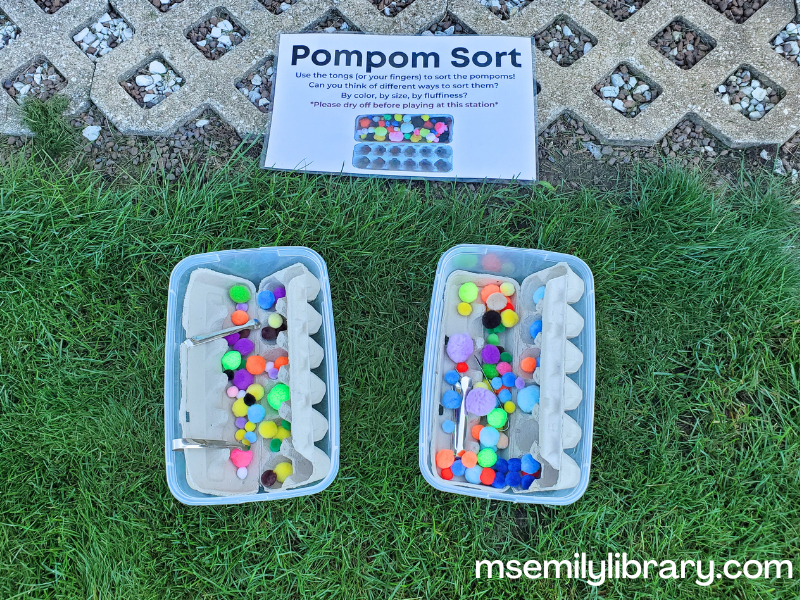
Pompom Sort (Dry) An easy station – I just saved a couple of egg cartons, then poured a handful or two of different colored/sized pompoms into them and provided small metal ice tongs. After a couple of years, my egg cartons are starting to get a little raggedy, so I’ll plan to replace them next year! Original idea from Laughing Kids Learn.
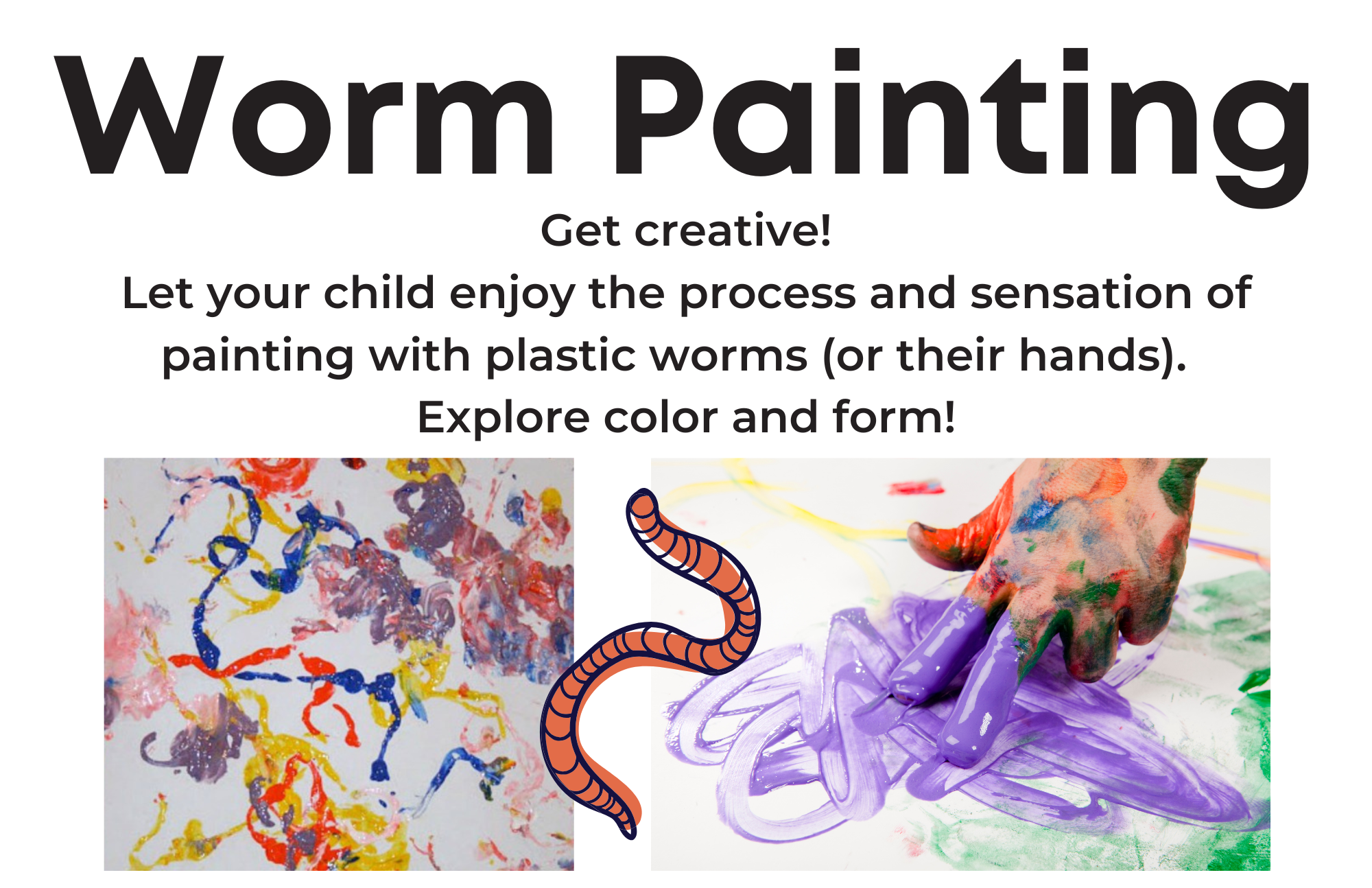
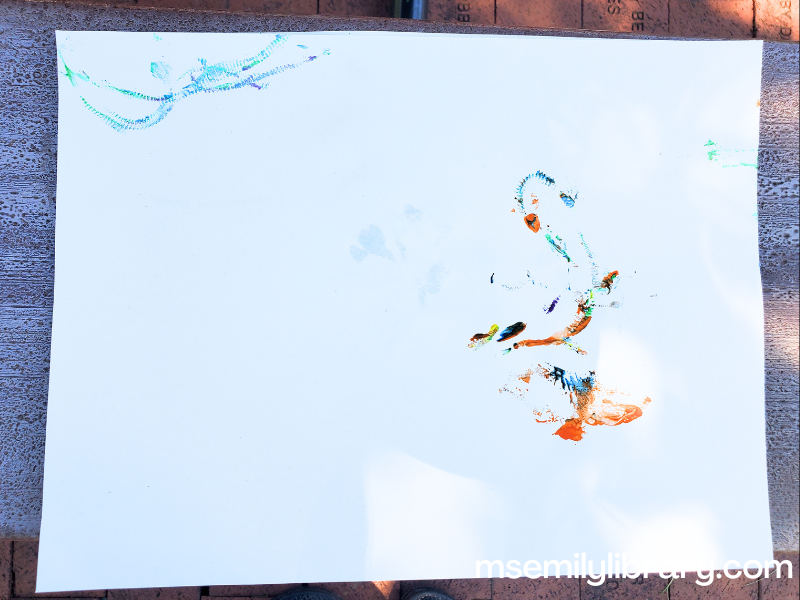
Worm Art Finger Painting (Art) I knew I wanted to do worm art, so used some of the fake fishing lure worms from the worm fishing (there were plenty in a pack) and provided finger paints for process art. I think the way the worm rings showed up in the artwork was really very cool. I saw quite a few blogs who were doing something similar, but none of them had pictures that conveyed what I wanted when I was creating the sign, so I found a nice photo of spaghetti painting from The Imagination Tree that worked really well.
This was a left behind page, but it’s so cool how you can see the worm rings!
Intro: So far we’ve talked about very BIG things and very SMALL things, Dinosaurs and worms. But wait, not all dinosaurs were BIG!
Themed Read: Tiny Dino by Deborah Freedman I didn’t read the “facts” that went along with the story, but very briefly explained them if they weren’t self evident.
I’ve known this rhyme for a very long time, but it always stopped at “yes, yes, yes, no, no, no.” But sometime before summer I saw a woman on Instagram doing the rhyme with her baby (which I definitely need to incorporate into Book Babies) and she had a whole other verse! I added it on here and we enjoyed especially the great big hug. Action Rhyme: This is Big, Big, Big (extended version) This is big, big, big (hold arms out to side) This is small, small, small (cup hands together) This is short, short, short (flat hand lowers) This is tall, tall, tall (flat hand reaches up) This is fast, fast, fast (circle fists quickly) This is slow, slow, slow (circle fists slowly) This is yes, yes, yes (nod head) This is no, no, no (shake head)
This is up, up, up (reach up) This is down, down, down (reach down) This is square, square, square (trace a square in the air) This is round, round, round (trace a circle) This is left, left, left (shake left hand) This is right, right, right (shake right hand) This is great big hug and hold on tight (hug self or grownup) Source: Mel’s Desk, 2nd half adapted from IG happybabbler
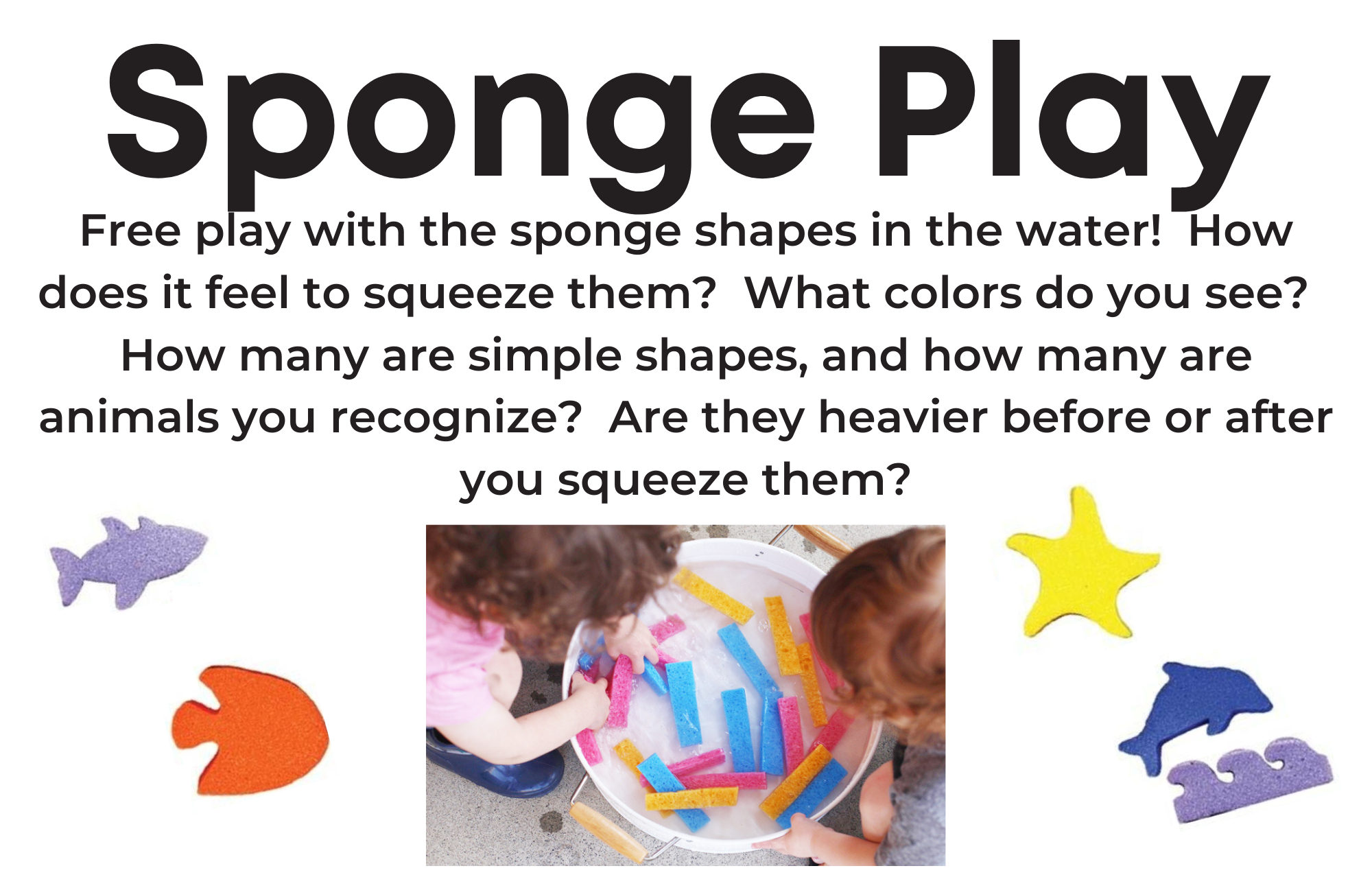
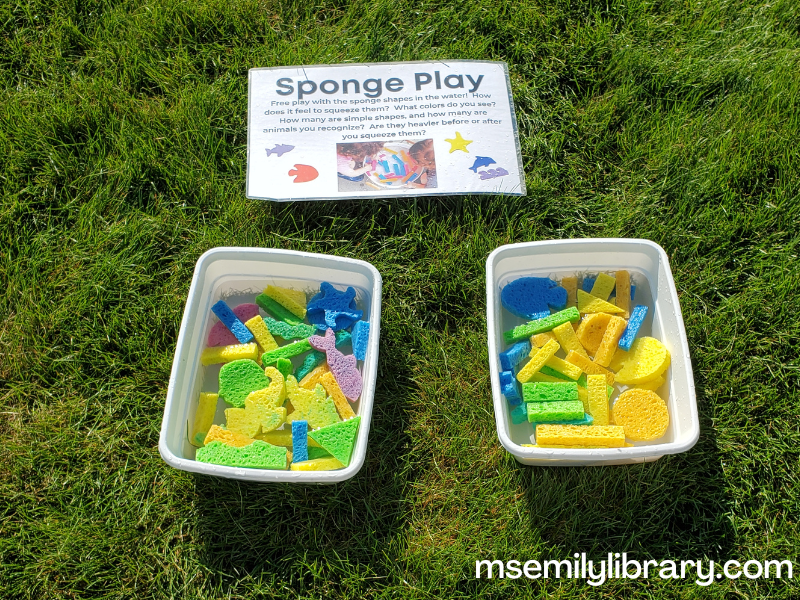
Sponge Play (Wet) Another repeat from years past, but very simple and popular with the littlest ones. I have some simple shapes like rectangles, squares, triangles, and circles, but there are also some ocean animals in there since I made them when the SRP theme was “Oceans of Possibility.” Original idea (and photo on the sign) from Little Lifelong Learners.
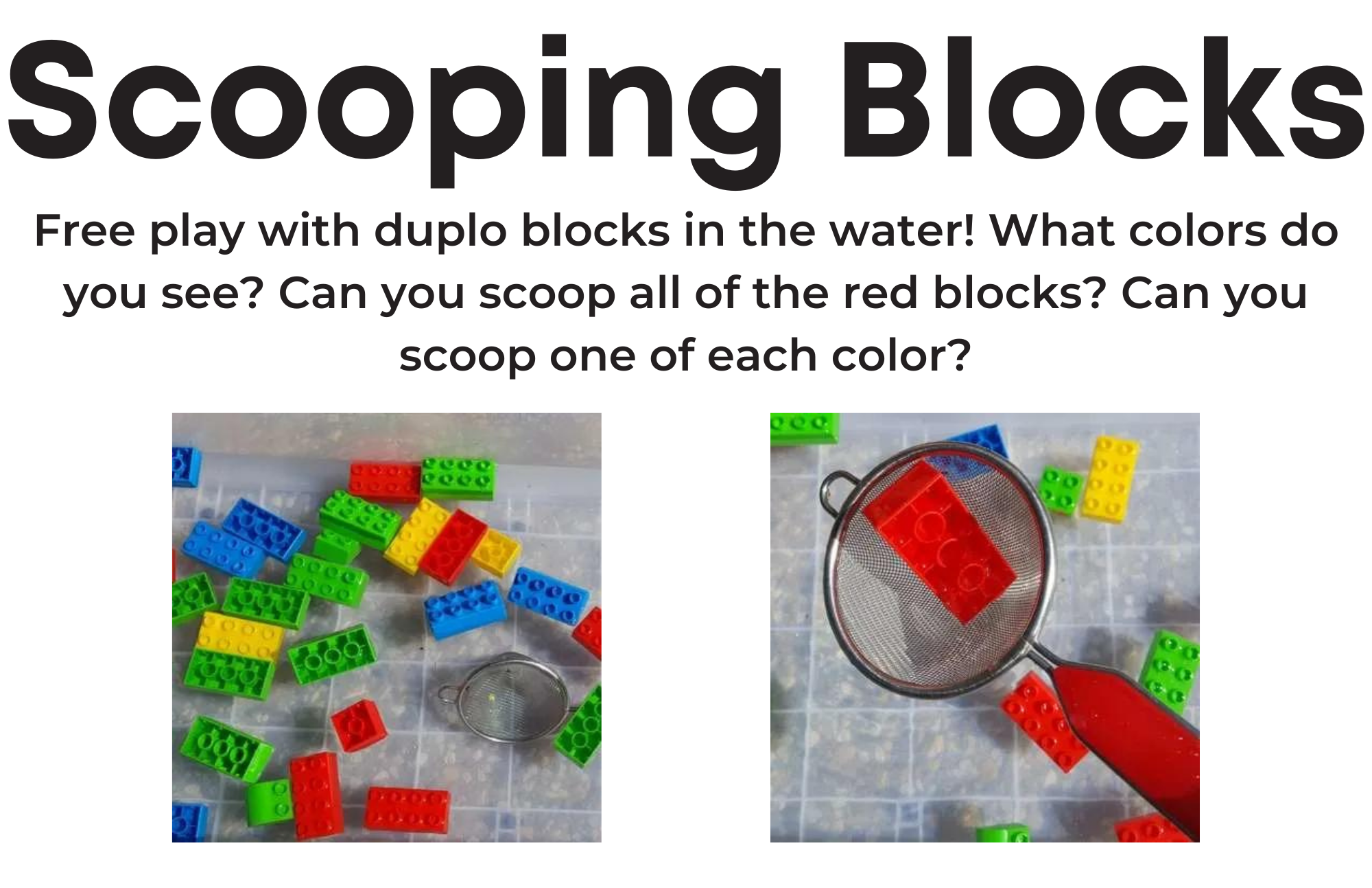
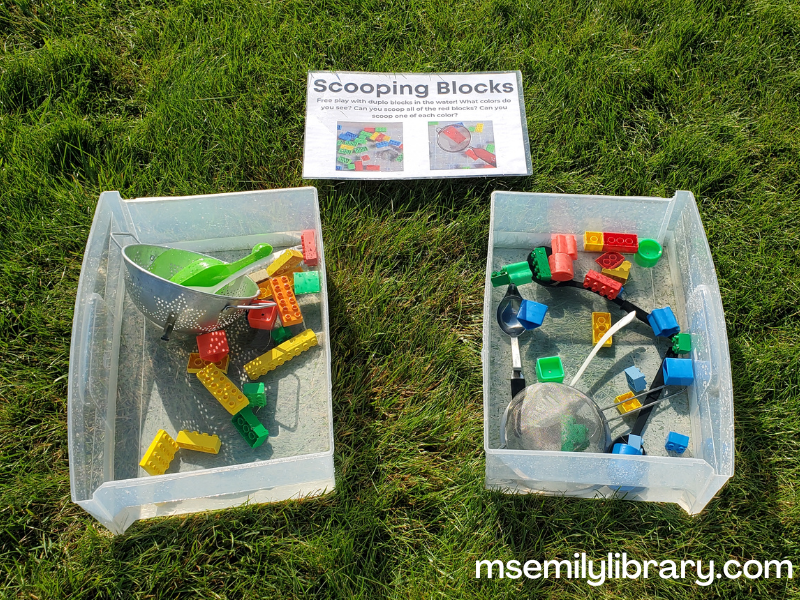
Scooping Blocks (Wet) Lego Duplos plus water and scoopers! This one was fun for its obvious purpose, but added bonus: some kids actually took the Duplos out of the water and put them together! We had all the Duplos already, and I added some of the sorting blocks from our baby toys to the mix, as well as ladles, colanders, and sieves. Original idea (and photo on the sign) from My Bored Toddler.
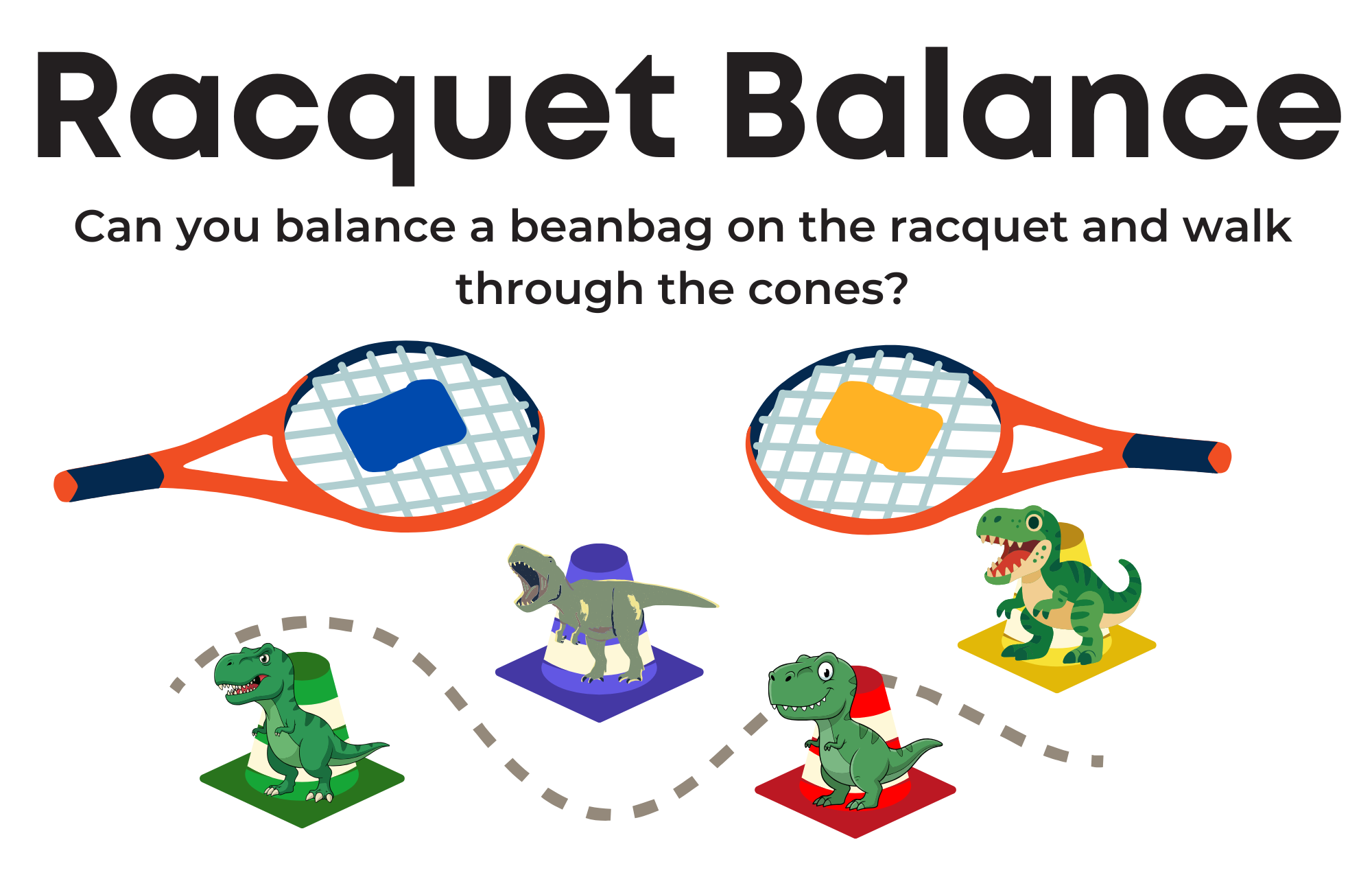
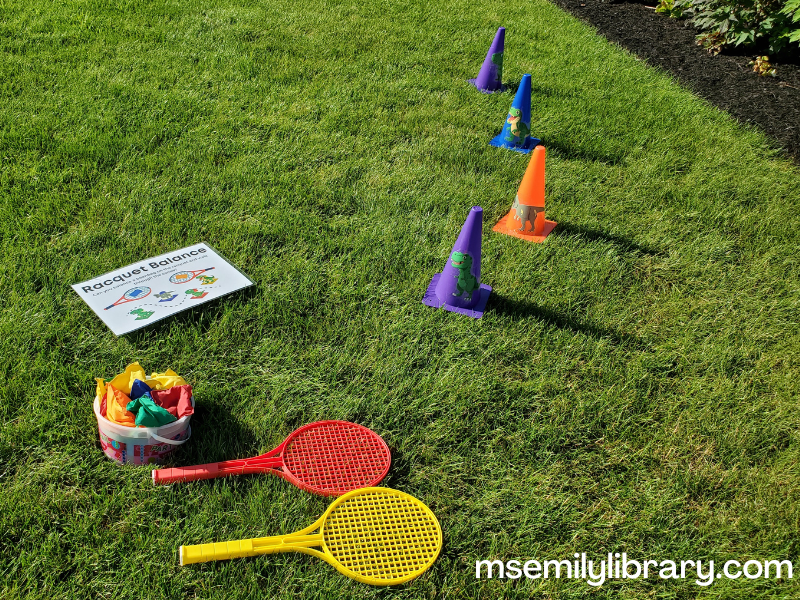
Racquet Balance (Dry/Movement) This actually turned out to be one of the most popular of the movement stations, primarily with older siblings who enjoyed flipping the square beanbags like pancakes. We got most of our athletic equipment from a grant from the Young Athletes of the Special Olympics, and it’s been really nice to have. I reused the T-Rex cones, too.
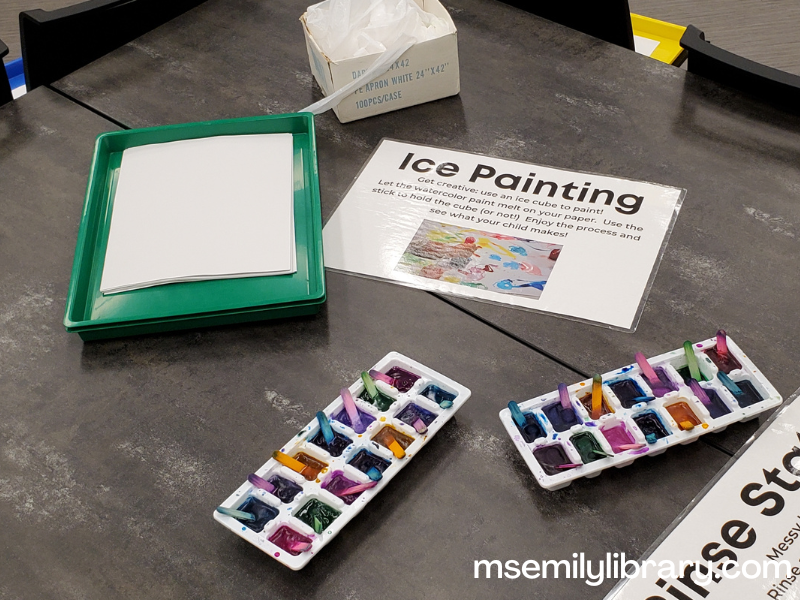
Ice Painting (Art) Again, somehow I missed getting a picture of this one. But it’s always got a wow factor, and I get questions from multiple adults on how I made the ice cubes. I use liquid watercolors – 5-6 drops per cube filled the rest of the way with water. Small craft sticks make a handle, and I keep the ice cube trays in a cooler in the shade until we’re ready for stations, then get them out to use. They do melt a bit as the program goes, but you actually want that to get the paint going. Photo shared here was from 2023, on a day that we were indoors. Original idea (and photo on the sign) from ARTventurers.
Intro: This week we’re talking about the earth itself – in other words, DIRT! Dirt can be very fun to play with. Have you ever made a mud pie?
Themed Action Chant: Make a Mud Pie Make a mud pie in the mud, mud, mud (pat lap) Digging… (digging motion downward) Scooping… (scoop hands upward) Patting (pat hands in air) It’s so much fun! (hands out, emphasizing)
[Where else should we make a mud pie? How about our head!? Scoop together some mud…] Make a mud pie on your head, head, head… (pat head) Digging… Scooping… Patting… It’s so much fun! (repeat: toes, tum) Source: Tacoma Public Library
I thought this one would go over better than it did – maybe it was just a touch too long? I liked that it talked about a lot of the topics from the previous few weeks, including treasure and worms! Themed Read: Roy Digs Dirtby David Shannon
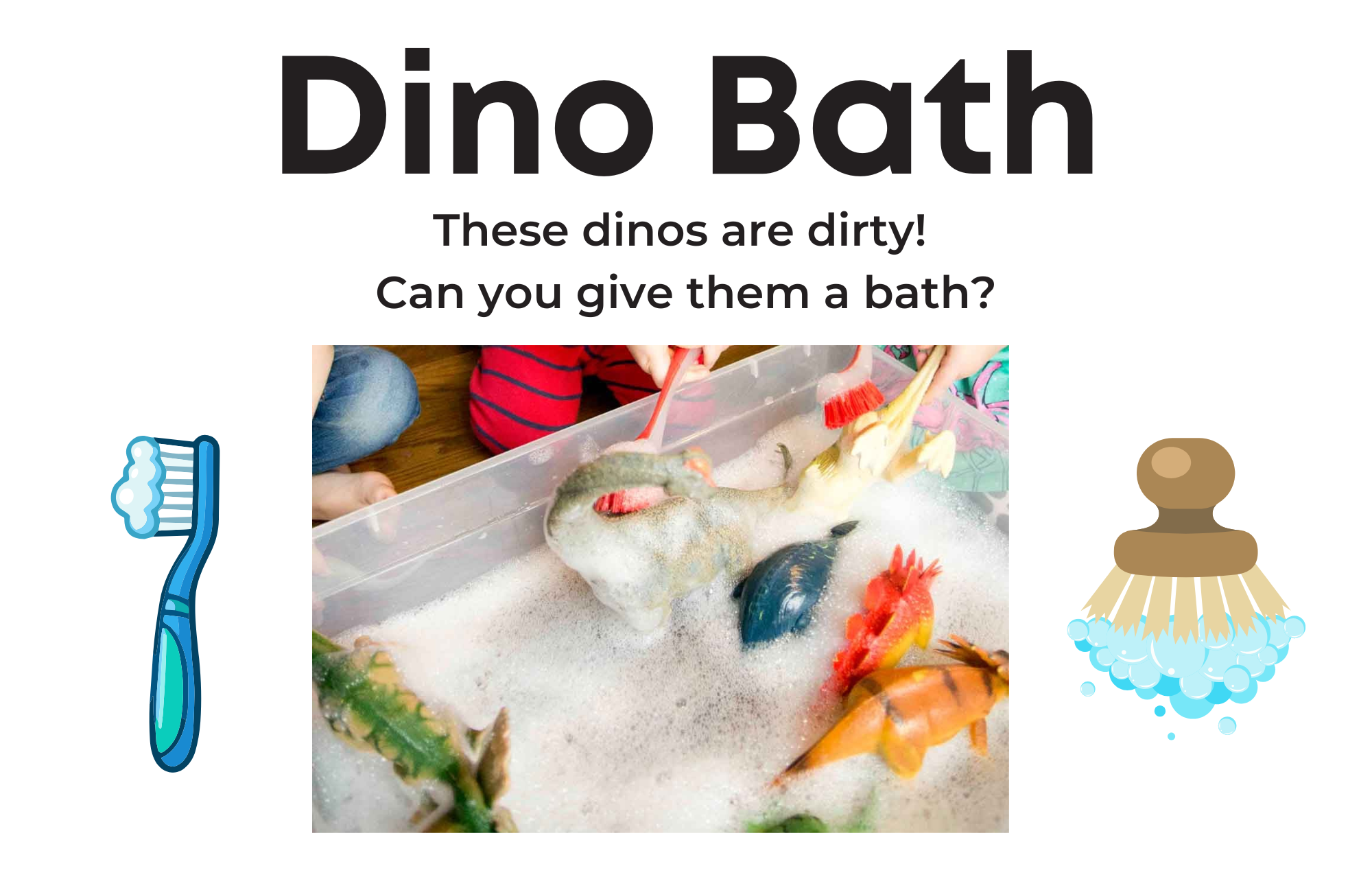
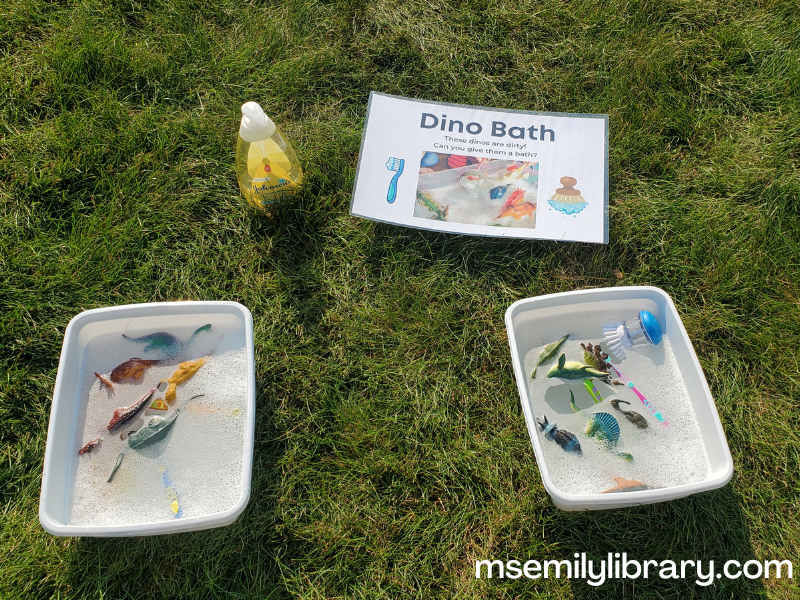
Dino Bath (Wet) My first year doing outdoor stations I did an animal washing station, which included two bins of dirt and two bins of clean water with soap in it. I didn’t want to just dig dirt from outside and I didn’t want potting soil with fertilizer in it, so I bought this coconut coir which really didn’t work very well – the water didn’t absorb and it never really made “mud,” which was my intention. This year I wanted to do dino washing, but was trying to think my way around the issues I had the first time around. Then I saw this post from Busy Toddler and they framed it as a Dino Bath, which eliminated the need for the mud and solved all my problems. I had everything I needed: dino figures, no tears baby shampoo, kid toothbrushes and dish scrubbers. The baby shampoo bottle is included in the photo for the blog, but I put it away during the program.
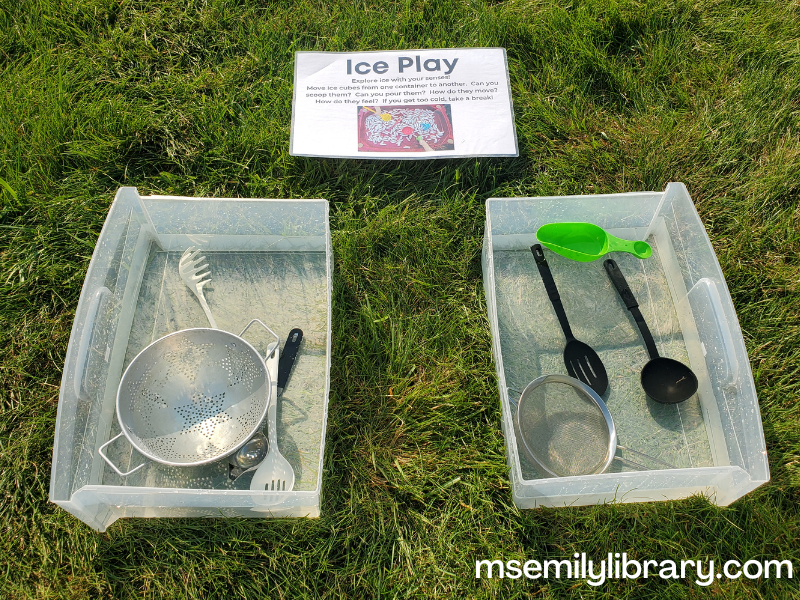
Ice Play (Wet) Another repeat from years past. I bought a large bag of ice each morning before my program and kept it in a cooler, adding it to the bins JUST before they were played in (so there’s no ice shown in the photos I took before the program). Ladles, colanders, and sieves were added for handling the ice. I reminded everyone to take a break if their fingers started to get too cold. Original idea (and photo on the sign) from Busy Toddler.
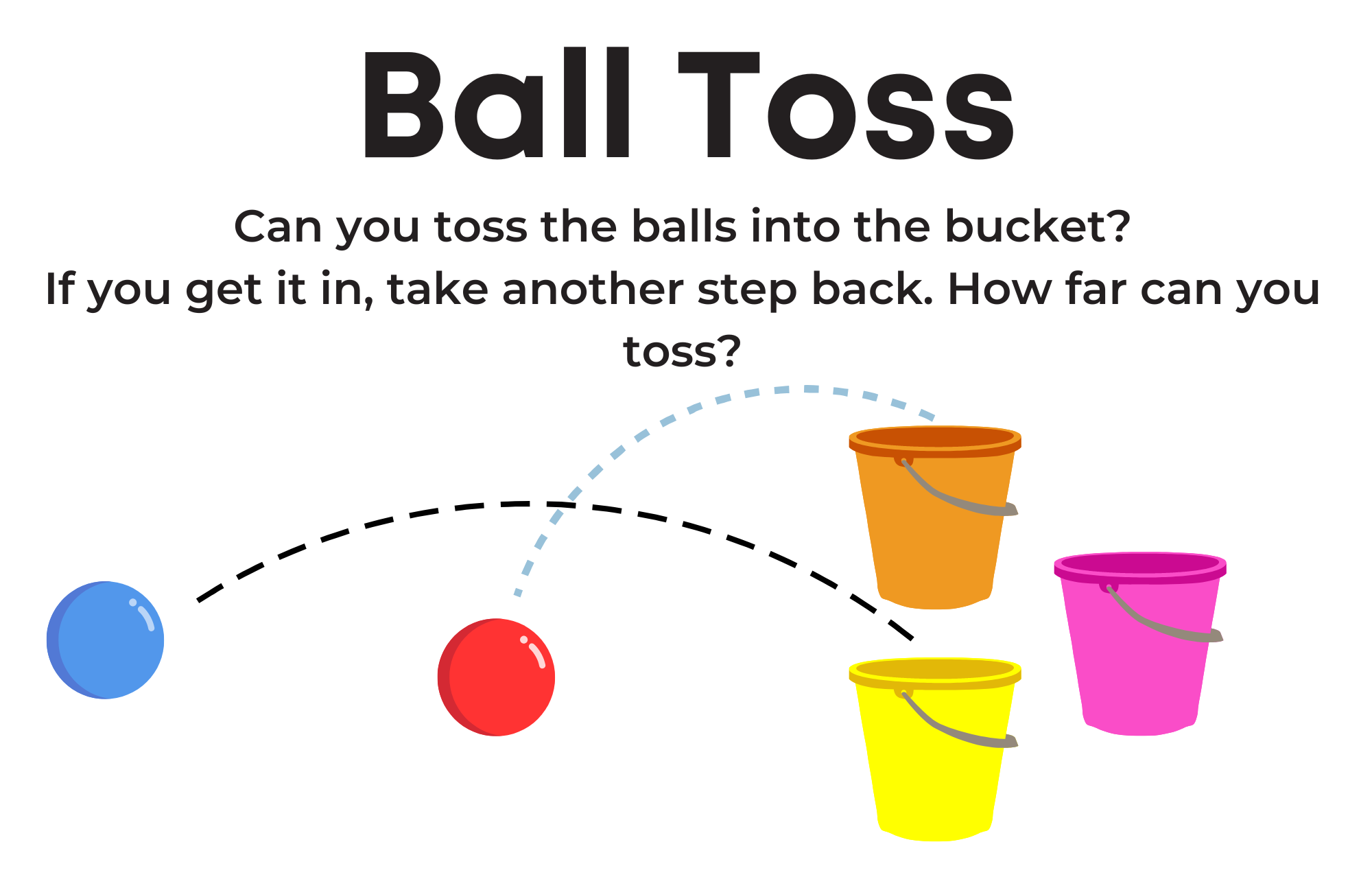
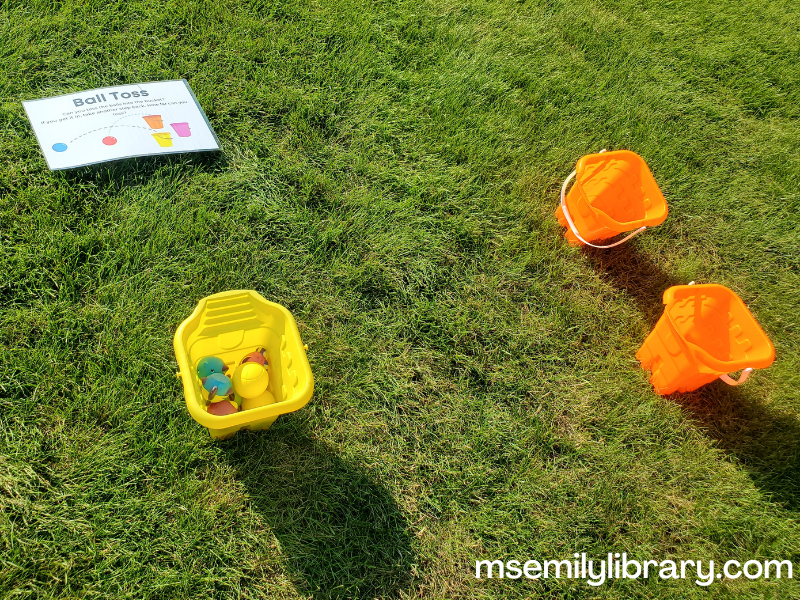
Ball Toss (Dry/Movement) We had two semi-soft balls in our athletic equipment, but I was hoping to have some more, so I added some round fish squirter bath toys that we had in our prize stash from many years ago. Add buckets and you’ve got an easy movement station.
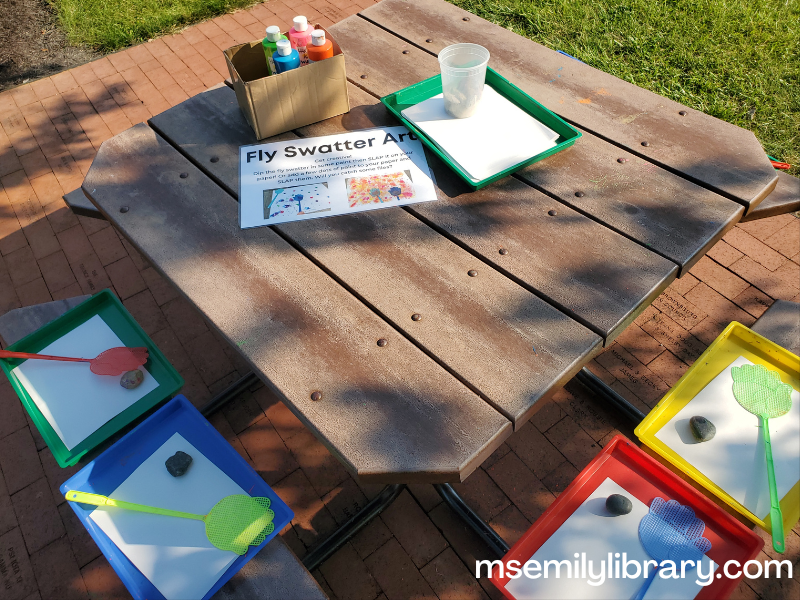
Fly Swatter Painting (Art) A messy but very fun art project, using (re-using) supplies from other stations. Kids wielded fly swatters to slap at paint, making some very interesting abstract art. I think the best method turned out to be adding some dots of paint to the paper, then letting the kids aim for them, rather than trying to spread paint on the swatter. I’m grateful for good weather all that week, since this is very much an outdoor activity. Original idea (and photo on the sign) from Play Teach Repeat.
Intro: This week we’re talking about stories of the past, which can take some digging to find. Have you ever heard a story from your parents or grandparents about what life was like when they were little kids?
Here’s a silly rhyme about a grandma and a grandpa – they both wear glasses and hats! I really emphasize grandpa’s glasses and hat being BIG and use a low growly voice, and of course we do loud snores. Action Rhyme: Here are Grandma’s Glasses Here are grandma’s glasses (make circles around eyes) And here is Grandma’s hat, (fold hands on top of head) Here’s the way she folds her hands (fold hands) And puts them on her lap. (place hands in lap)
Here are Grandpa’s glasses, (make BIGGER circles around eyes) Here is Grandpa’s hat, (make BIG hands on top of head) Here’s the way he folds his arms (fold arms) And has a little nap. (pretend to sleep/snore) Source: Storytime Secrets
Such a beautiful book. I got a lot of smiles for this one. Themed Read: Alma and How She Got Her Name by Juana Martinez-Neal
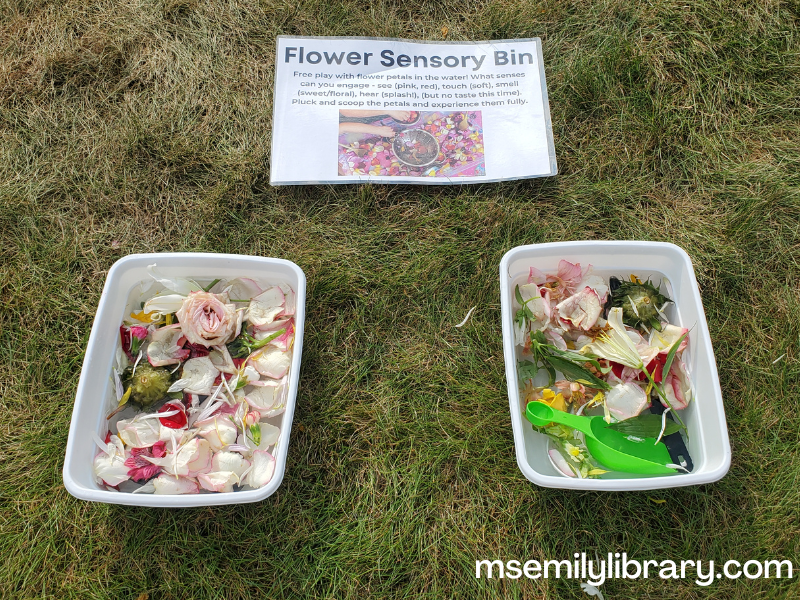
Flower Sensory Bin (Wet) To stock this bin, we ask our local Kroger florist for donations of flowers and greenery that are past their prime and may be destined for the trash. This year, they gave us a whole pail full of cuttings, with lots of variety, including roses, mums, carnations, and even a sunflower. A true sensory feast!
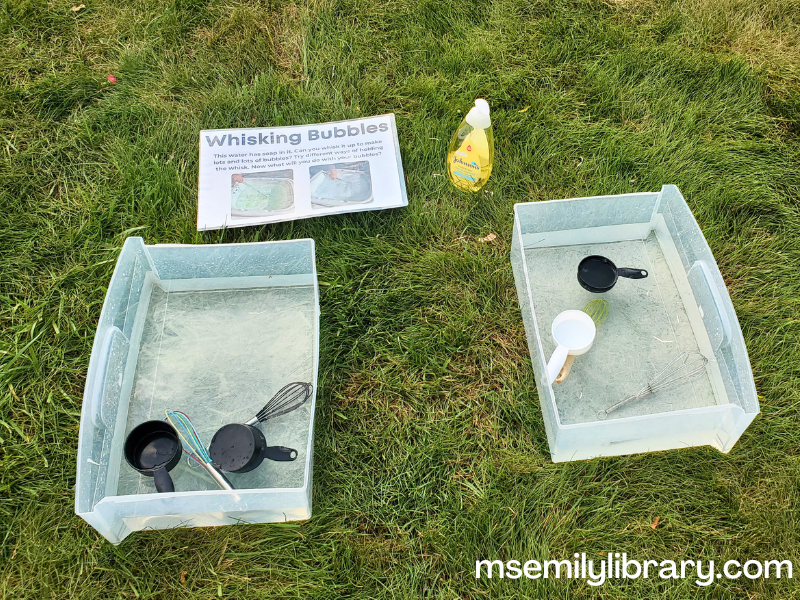
Whisking Bubbles (Wet) Using our trusty no-tears baby shampoo once again, this was a simple set up with water, soap, whisks, and a few measuring cups for scooping. I love the way this one smells. I included the shampoo bottle in the photo for this blog, but did not have it out during the program.
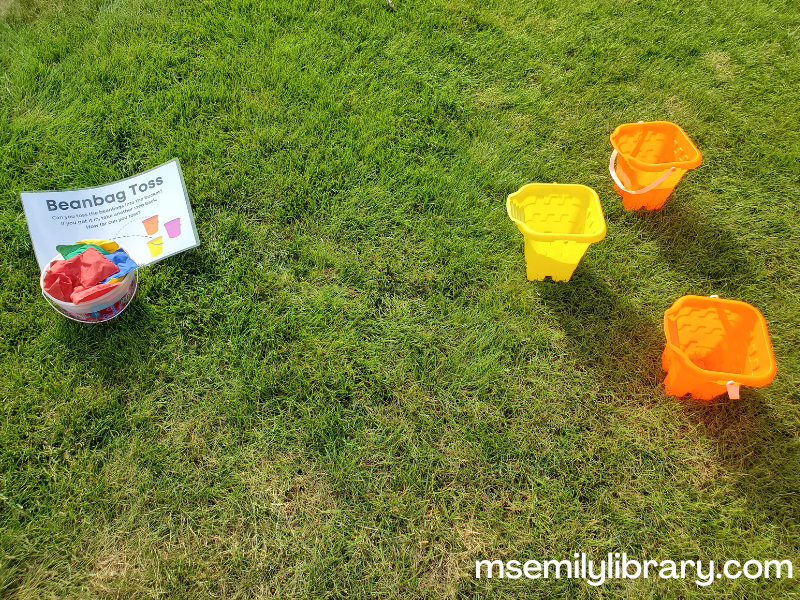
Beanbag Toss with Buckets (Dry/Movement) We did a beanbag toss in week two, but switched to bucket targets instead of hula hoops this time around. (In week two, the buckets were being used for the Ice Treasure Hunt.)
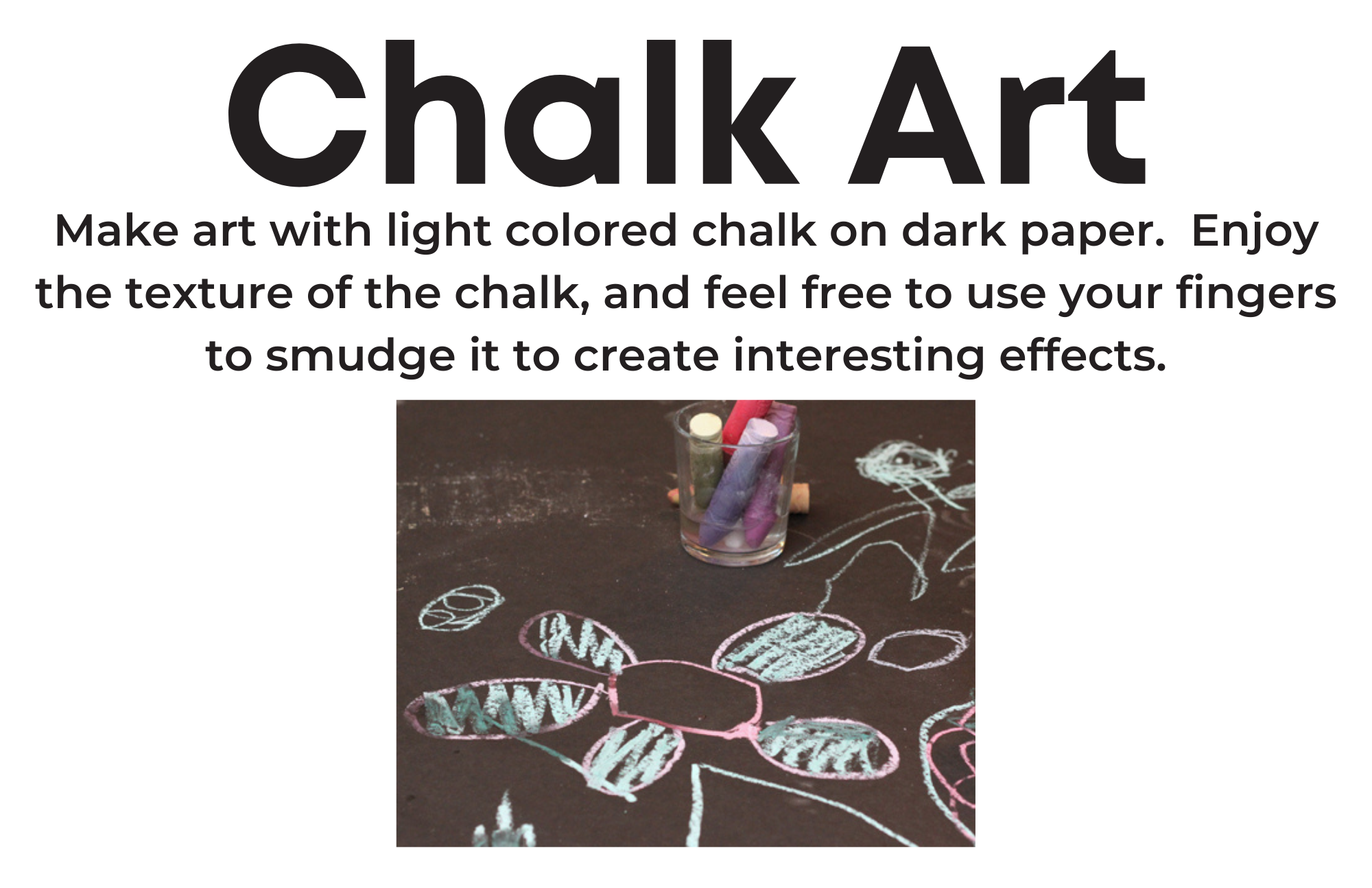
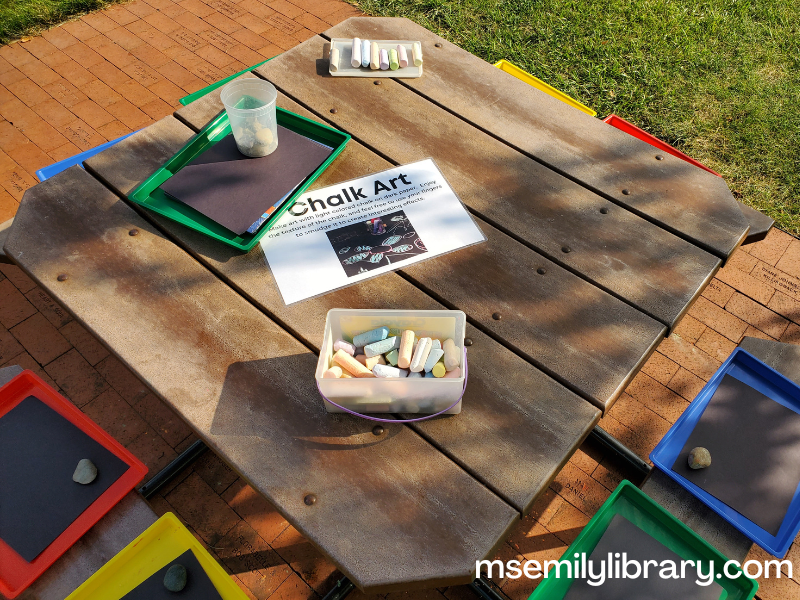
Chalk Art (Art) Because the area where we do outdoor storytime has bricks laid down instead of concrete, we can’t really do chalk art on the ground (if we did, that’s totally what I’d do here!). Instead, I provide black construction paper with the sidewalk chalk and let them be creative!
I took a few extra photos this year, to help give a sense of our space and layout. If you ever have questions about any outdoor storytime or sensory stations, feel free to ask!
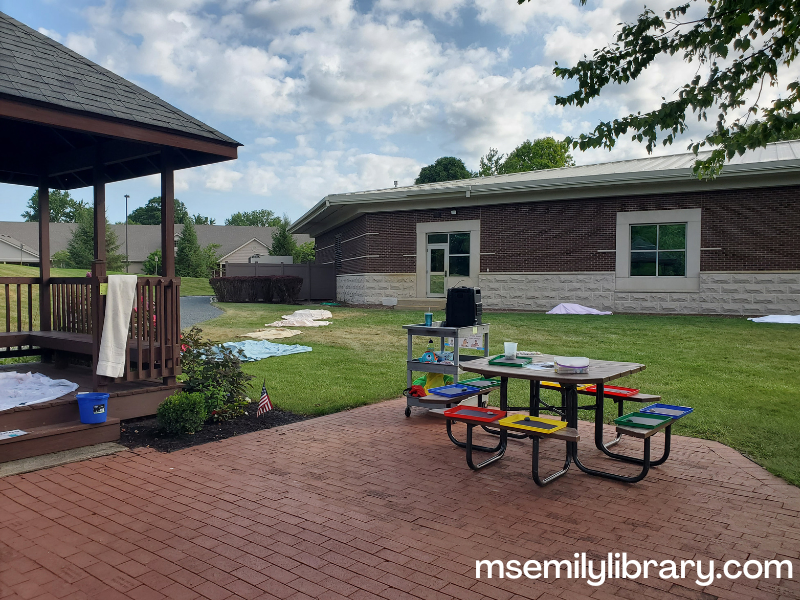
A wide angle of our space, showing the gazebo to the left, picnic table to the right on bricked area, with a large grassy area beyond, with sheet-covered stations along the left and across the back near the library building in the background.
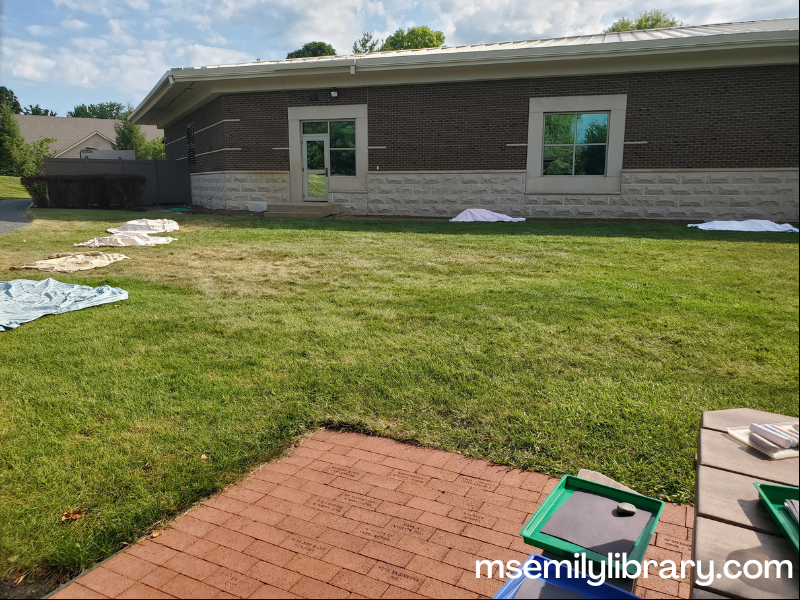
Another shot of the stations covered in sheets, and the wide grassy area where families can lay their blankets or camp chairs, as well as where we do our parachute activities.
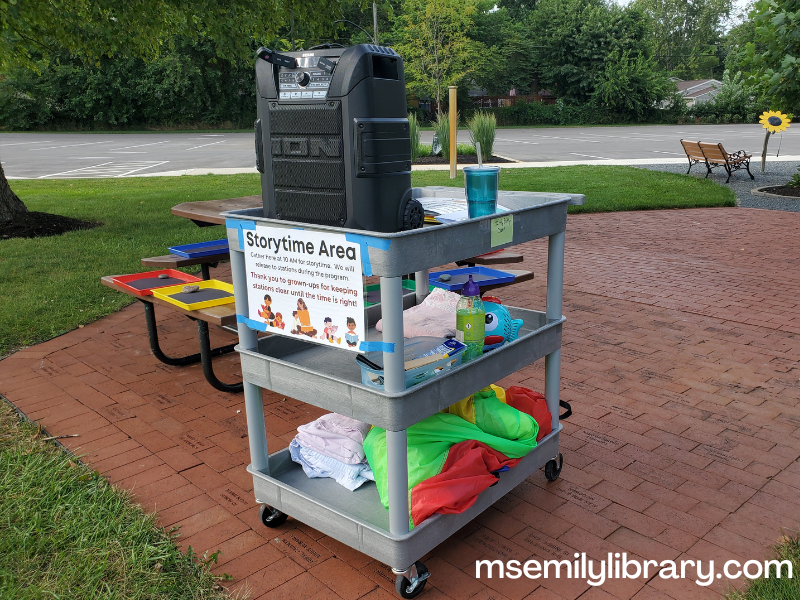
The storytime cart, showing the large parachute and extra sheets on the bottom shelf, a basket of small items (sunscreen, extra batteries, pencil, bell, tissues, etc), a bottle of bubble solution, fish-shaped bubble machine, and extra towel on the second shelf, and the personal PA speaker, water cup, books, and storytime plan on the top.
Back to indoor storytimes next week – upcoming themes include Art, Garbage Trucks, Ice Cream, and more!
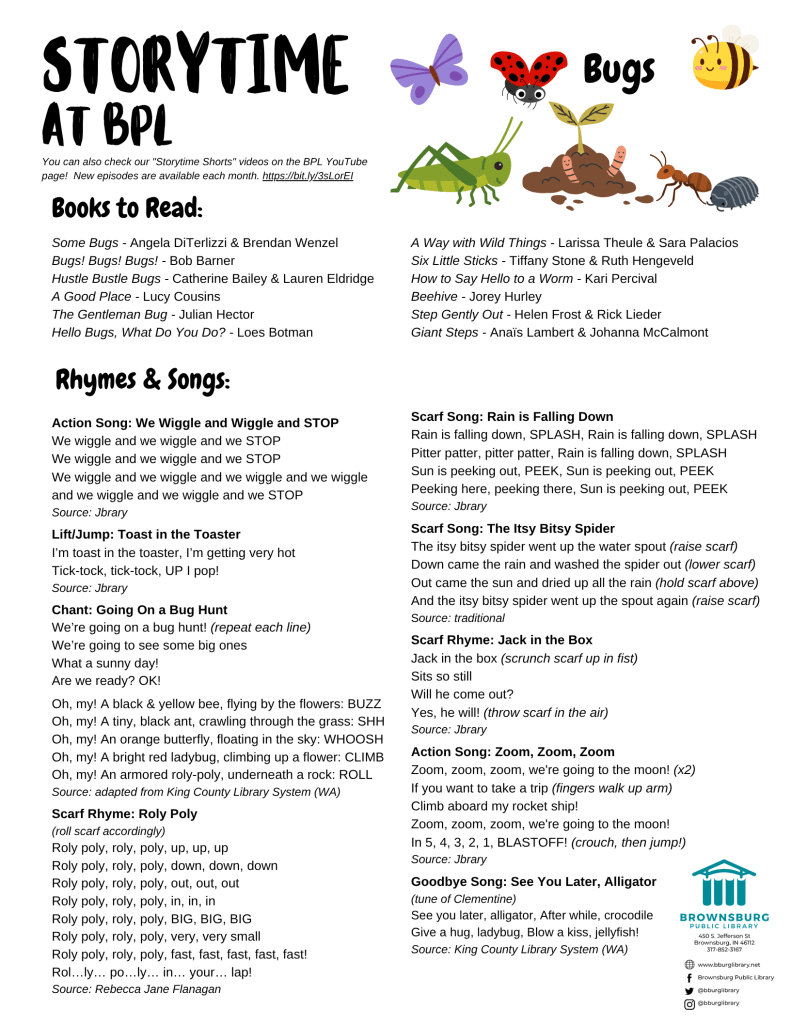
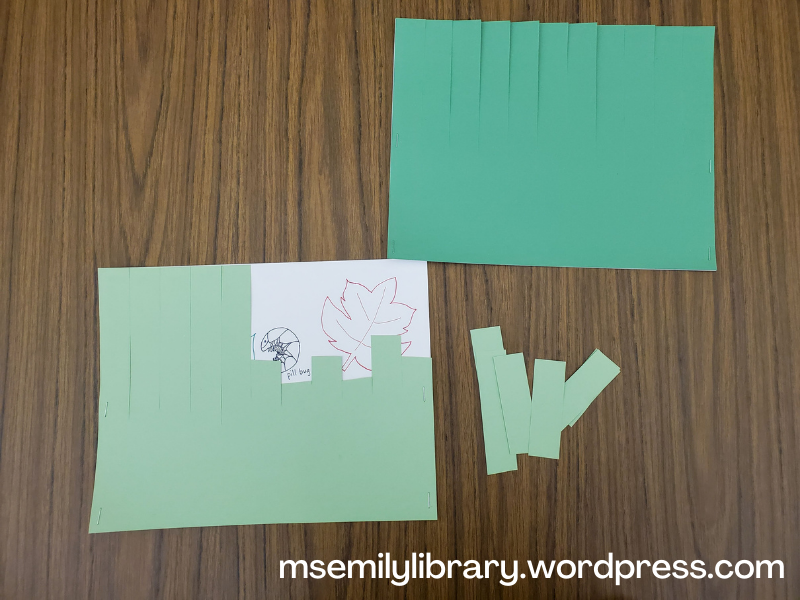
Bugs is such a fun theme – there are so many kinds of bugs and so many ways to think about presenting a program on them! Even though “bugs” is not a scientific category, I like using it as it can include all kinds of creepy-crawlies including insects, arachnids, worms, snails, and even terrestrial crustaceans (AKA roly poly pill bugs!) My colleague planned this one, and I love the different ways she incorporated bugs in the stations. We used one of my flannels, Going on a Bug Hunt, which is a really nice activity that spans the age ranges that we’re seeing.
This was our last storytime of May, and our last indoor Stories & Stations* for the foreseeable future. In June and July we will be doing Stories & Stations outside, and when we return in August we may have a new staff member and possible rethinking of how and what we offer 0-5 year old kiddos in our community. I generally don’t blog over the summer months, so you probably won’t see me again until August – I hope everyone has a great summer! And one last note – if you are someone who maintains your library’s Storywalk, I’ve added quite a few new titles in the last month or so – submissions and ones I’ve done. These include a fun BUG one (Bug in a Bog by Jonathan Fenske) and our newest for the SRP theme Unearth a Story – Sam and Dave Dig a Hole by Mac Barnett & Jon Klassen.
*We are doing a new format for our storytimes in a transition period of personnel change and calling it Stories & Stations (you can read the whole saga of the whys and hows at this post.)
Early Development Tip: When you enjoy a book, let your child know that you like it and why. Sharing your enjoyment gives them a positive attitude toward books. This positive attitude carries over when they get to school and start learning to read. Let your child choose their books and tell you why they like them. –from The Early Literacy Kit: A Handbook and Tip Cards by Betsy Diamant-Cohen & Saroj Ghoting
Welcome Song: Hello, Friends* Even with a larger number of kids, I still go around and sing this with everyone’s name. The kids really do love it, and it helps me learn names and storytime participants to learn each others’ names.
Lifting Rhyme: Toast in the Toaster* Okay, this one *seems* to be better for younger kids, but all I have to do is encourage the older kids to jump as high as they can at the end and it is instantly perfect for a 5 year old, too. I always give the option for a lap bounce and lift as well.
Intro: Our planet is home to millions of different kinds of bugs, each with their own special “job.” Some help pollinate the flowers (like bees & butterflies). Others like to eat old leaves and turn it into fresh soil (like worms & beetles). And many bugs are food for other animals (like birds & anteaters)! Whether they crawl, hop, or fly, every bug plays a vital role in keeping our environment healthy and vibrant. Let’s read about some bugs!
Transition: If You’re Ready for a Story*
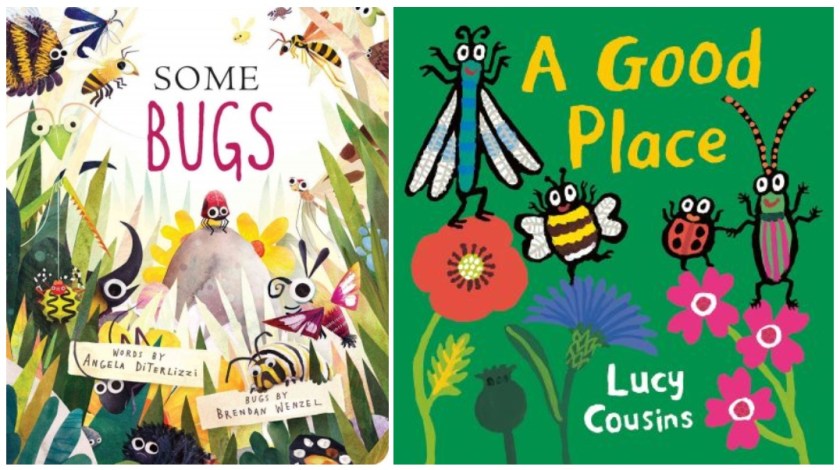
Straight into our book this week! This is such a perfect book, as it showcases so many bugs and the things they do, with a really short text that’s great for all ages. Read: Some Bugs by Angela DiTerlizzi & Brendan Wenzel
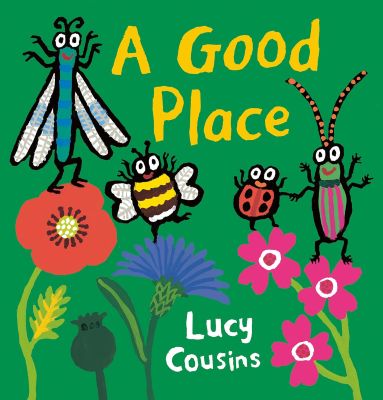
A great backup with Cousins’ signature bright, bold colors. Backup Read: A Good Place by Lucy Cousins
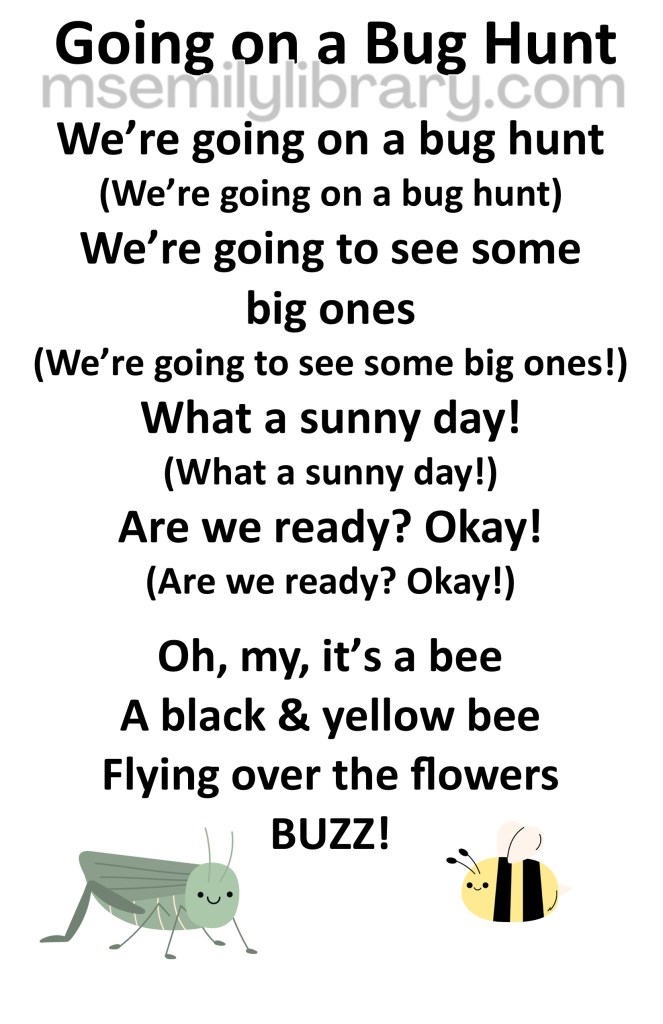
So let’s go on our own bug hunt! Similar to Going on a Bear Hunt, but without the “Can’t go over it…” parts. Each time we get out a new flannel piece, they get excited! Then we do a little motion or sound to go with each. I only ended up doing bee, butterfly, ladybug, ant, and roly poly (who curls up when you flip him over). Flannel/Rhythm Chant: Going on a Bug Hunt Pat lap in rhythm and repeat between each bug: We’re going on a bug hunt! (We’re going on a bug hunt!) We’re going to see some big ones. (We’re going to see some big ones.) What a sunny day! (What a sunny day!) Are we ready? OK! (Are we ready? OK!)
Oh, my! A bee! A black & yellow bee, Flying over the flowers. BUZZ Oh, my! An ant! A tiny, black ant, Crawling through the grass. SHH Oh, my! A grasshopper! A big, green grasshopper, Hopping around the tree. BOING Oh, my! A butterfly! A pretty, orange butterfly, Floating in the sky. WHOOSH Oh, my! A spider! A big black spider, Creeping on the tree. CREEP Oh, my! A ladybug! A bright red ladybug, climbing up a flower. CLIMB Oh, my! A roly-poly! A gray, armored roly-poly, hiding under a rock. ROLL Source: adapted from Small Town Story Time Lady Blog
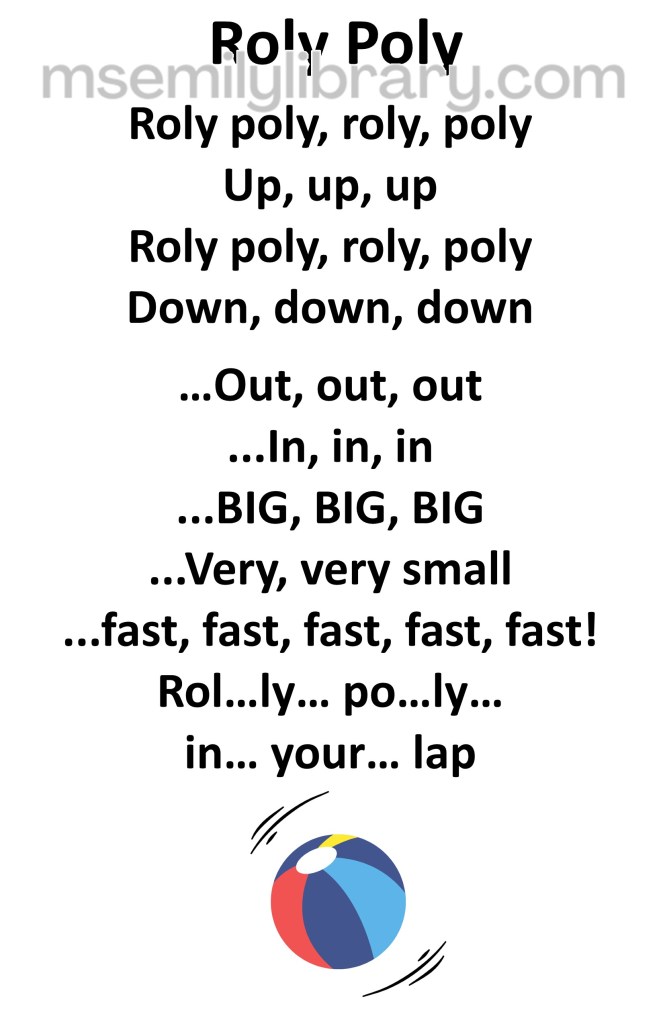
Let’s get out our scarves! Can we roll our scarves like a roly poly pill bug? Time for props! Scarf Rhyme: Roly Poly (roll scarf accordingly) Roly poly, roly, poly, up, up, up Roly poly, roly, poly, down, down, down Roly poly, roly, poly, out, out, out Roly poly, roly, poly, in, in, in Roly poly, roly, poly, BIG, BIG, BIG Roly poly, roly, poly, very, very small Roly poly, roly, poly, fast, fast, fast, fast, fast! Rol…ly… po…ly… in… your… lap! Source: Rebecca Jane Flanagan
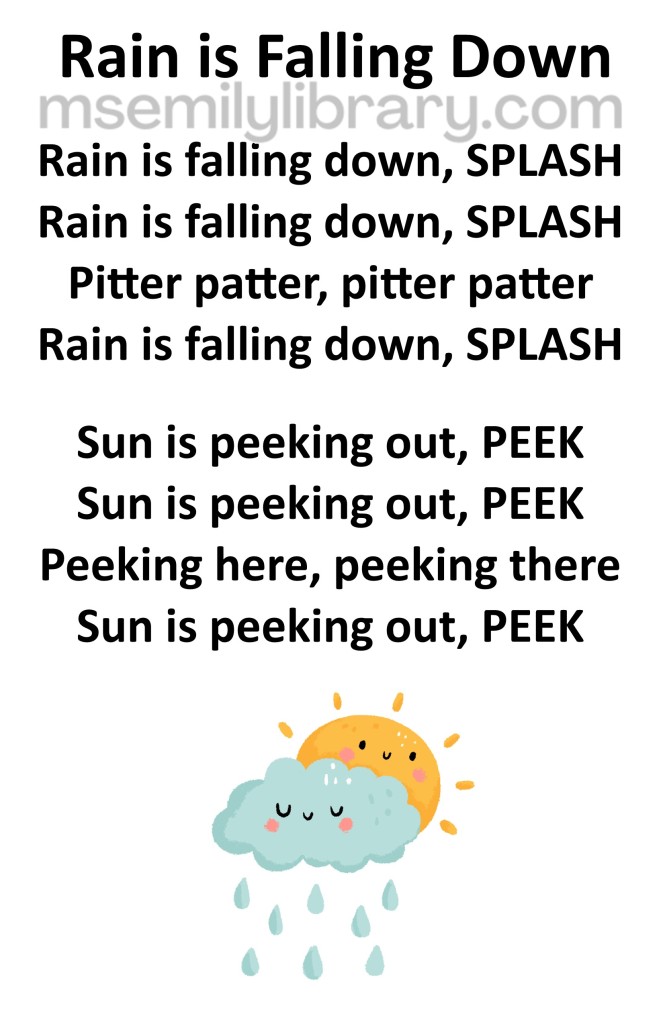
Bugs have to pay attention to the weather, too. Scarf Song: Rain Is Falling Down Rain is falling down (flutter scarf down) – SPLASH! (sweep scarf to the side) Rain is falling down – SPLASH! Pitter patter pitter patter (wave scarf up and down quickly) Rain is falling down – SPLASH!
Sun is peeking out – PEEK! (hide behind scarf, then peek) Sun is peeking out – PEEK! Peeking here, peeking there, Sun is peeking out – PEEK! Source: Jbrary
Here’s a song about a spider who goes UP and DOWN. Can you make your scarf into a spider? This was pretty easy to convert to a scarf song – we gripped our scarves in the middle to simulate a spider, climbed her up the spout, then the scarf becomes the rain falling. I held both ends above my head to make the sun before making a spider again. Scarf Song: The Itsy Bitsy Spider The itsy bitsy spider climbed up the water spout Down came the rain and washed the spider out Up came the sun and dried up all the rain So the itsy bitsy spider climbed up the spout again Source: traditional
Can you scrunch up your scarf in your hands and get small? We’re going to start this rhyme very quietly! Pretend to be a jumping spider! Scarf Rhyme: Jack in the Box Jack in the box (scrunch scarf up in fist) Sits so still Will he come out? Yes, he will! (throw scarf in the air) Source: Jbrary
After collecting our props, we released to stations! I let everyone know that I’d put out toys and puzzles in the current room, so they could stay if they wanted, and opened the door to the other room for everyone else to go to stations. I’m noticing that some of the youngest kiddos are staying to just play with toys the whole time and not bothering with stations, which is totally fine.
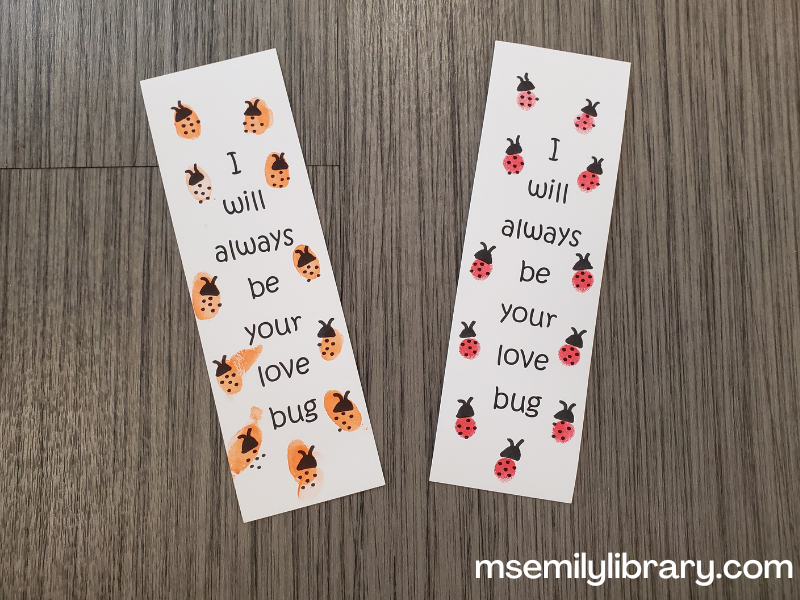
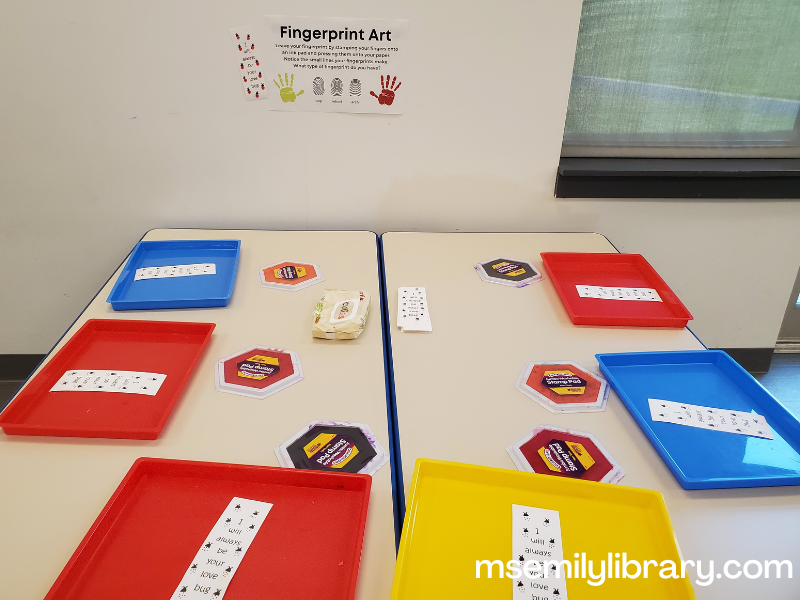
Art Station: Fingerprint Ladybug Bookmark My colleague Ali created this, drawing all of the little bugs! She said it was okay to share the template, which you can download here! Kids could stamp their fingerprints to make the ladybug bodies. We put out just a couple of colors – red, orange, and purple. Such a cute and simple craft!
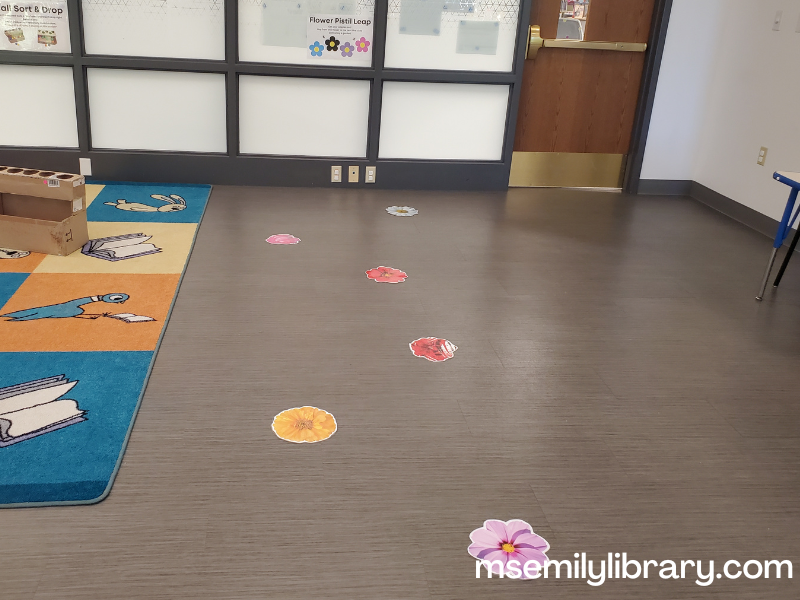
Gross Motor Stations: Flower Pistil Leap We encouraged kids to buzz like a bee or flit like a butterfly from one flower to another for this simple station. Photographs of flower blooms were laminated and stuck to the floor with painter’s tape.
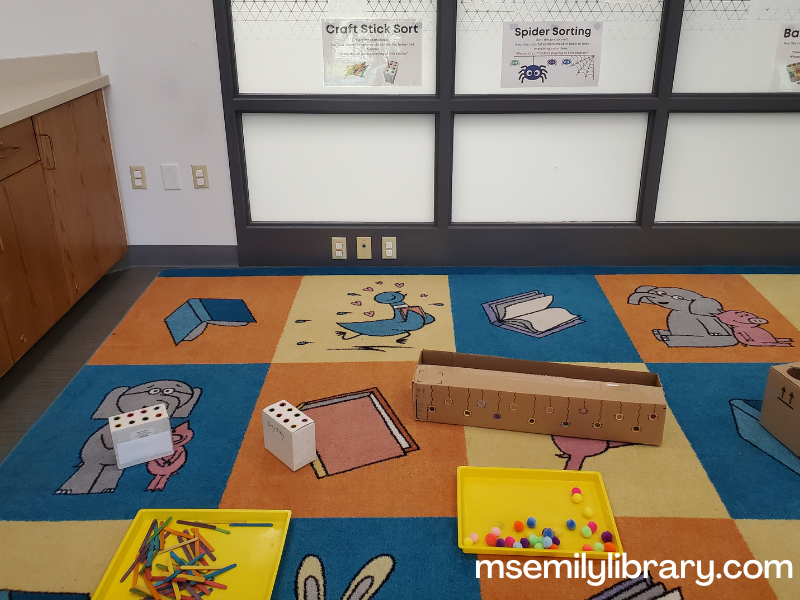
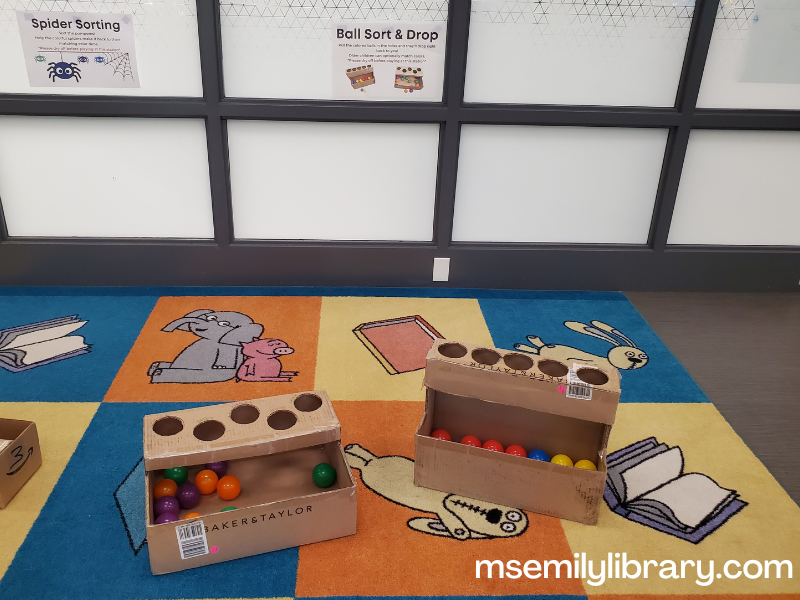
Fine Motor Station: Sorting Stations We put out several sorting stations on the rug for multiple kids to enjoy at once. One was a repeat from last week – the craft stick sort. There’s also a ball sort and drop that I have used for several summers past (made with Baker and Taylor boxes, RIP). The instructions I used to make them are from the Taming Little Monsters blog. Then Ali created a spider sorting box – it’s long and skinny and she drew adorable spiders coming down. Each spider body is a hole outlined in a color, and we provided pom poms to put through the holes.
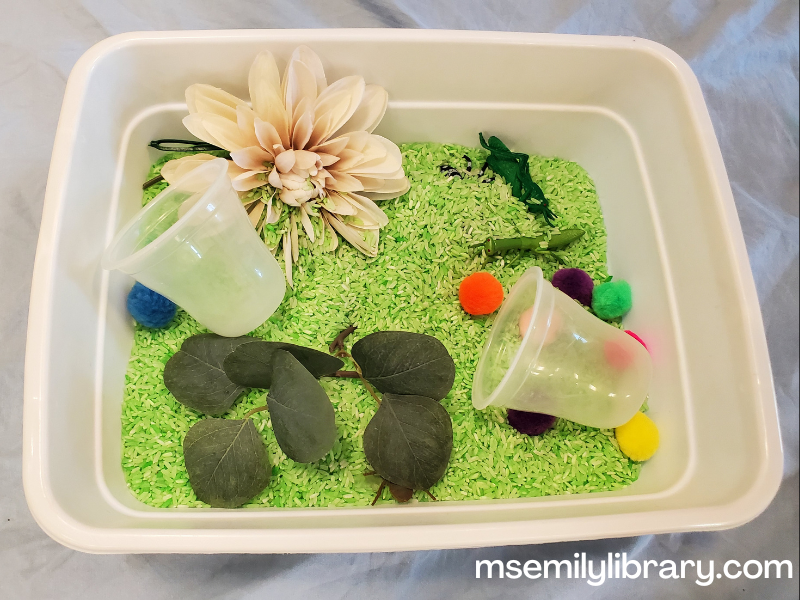
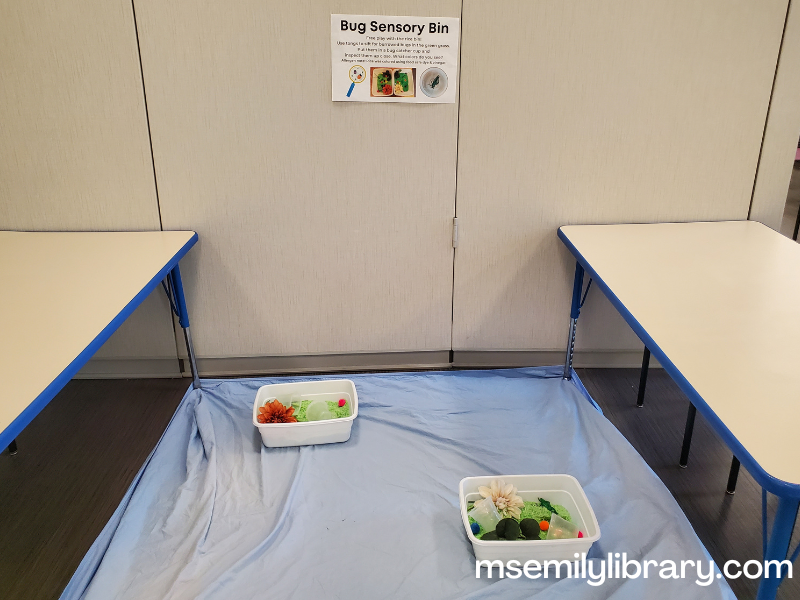
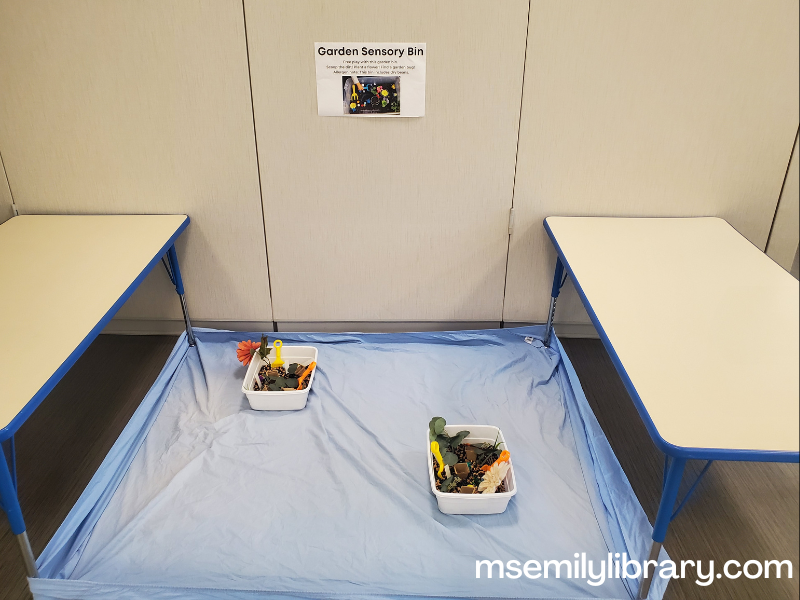
Sensory Station 1: Bug Sensory Bins Another fun sensory bin, this time with uncooked rice colored green, with various plastic bugs, pom poms, fake flowers and foliage, and collecting/viewing cups to capture the critters!
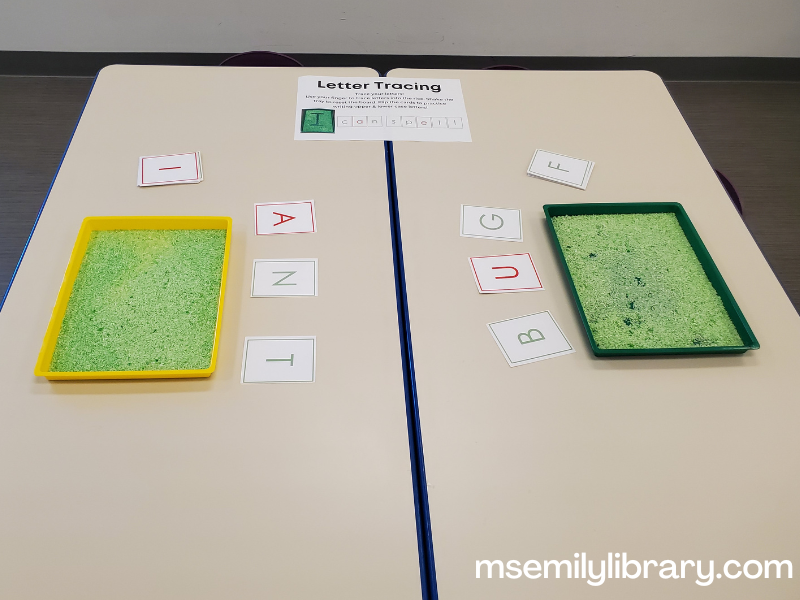
Sensory Station 2: We also put the colored rice in shallow messy trays with letter cards to encourage finger tracing for the older kiddos. I pulled out the letters A N T and B U G to get them started and set the rest of the letter cards to the side.
Toys and Puzzles Our regular baby toys and puzzles, as well as soft food, babies in a basket, and lacing cards came out as another option for play. I didn’t capture a picture of this one.
After 20 minutes of free station time, I ring our bell to gather everyone again in the storytime room. Everyone helps put away the toys and puzzles before we end with our last two songs.
Action Song: Zoom, Zoom, Zoom!*
Goodbye Song: See You Later Alligator*
Other books I had available for families to browse (and may work for you on this theme) Bugs! Bugs! Bugs! – Bob Barner Hustle Bustle Bugs – Catherine Bailey & Lauren Eldridge The Gentleman Bug – Julian Hector Hello Bugs, What Do You Do? – Loes Botman A Way with Wild Things – Larissa Theule & Sara Palacios Six Little Sticks – Tiffany Stone & Ruth Hengeveld How to Say Hello to a Worm – Kari Percival Beehive – Jorey Hurley Step Gently Out – Helen Frost & Rick Lieder Giant Steps – Anaïs Lambert & Johanna McCalmont Bug in a Bog – Jonathan Fenske Becoming Charley – Kelly DiPucchio & Loveis Wise Holey Moley – Lois Ehlert Du iz tak? – Carson Ellis Bugs on the Move – Charlotte Guillain The Honeybee – Kirsten Hall & Isabelle Arsenault A Closer Look – Mary McCarthy One Million Insects – Isabel Thomas & Lou Baker-Smith
This storytime was presented in-person on 5/13 & 5/14/26.
I’ve never done a five senses storytime before, but doing it as a storytime with stations* was a perfect way to explore this concept! I had a lot of fun creating each of the stations, and they seemed to go over well.
*We are doing a new format for our storytimes in a transition period of personnel change and calling it Stories & Stations (you can read the whole saga of the whys and hows at this post.)
Early Development Tip: You can encourage healthy brain development by helping your child explore their five senses. Talk with your child and see, hear, feel, smell, and listen to what is around you together. This will give them lots of new vocabulary to use to describe their world! –North Olympic (WA) Library System
Welcome Song: Hello, Friends* Even with a larger number of kids, I still go around and sing this with everyone’s name. The kids really do love it, and it helps me learn names and storytime participants to learn each others’ names.
Warm Up Song: Wiggle and Wiggle and STOP* This week I did “pat” (lap) and “clap” in addition to Wiggle.
Lifting Rhyme: Toast in the Toaster* Okay, this one *seems* to be better for younger kids, but all I have to do is encourage the older kids to jump as high as they can at the end and it is instantly perfect for a 5 year old, too. I always give the option for a lap bounce and lift as well.
Intro: Most people have five different ways to experience the world around us – we call them our senses! Our five senses help us to [put up flannel pieces] see with our eyes, to smell with our nose, to hear with our ears, to taste with our tongue, and to feel or touch – we can feel with our whole body, but when we want to feel something usually we will reach out our hands to touch it. (That’s why I used a hand here [flannel]). See the flannel below, and download a copy of the senses labels here.
Okay, let’s limber up all of our senses. This is such a silly one! The kids loved the tongue calisthenics, so even though I felt silly doing it, seeing them giggle was worth it! Themed Action Rhyme: Five Senses Stretch Rub your hands to get some feeling Stretch your ears to make sure you’re hearing Sniff, sniff to test your smell [what do you smell?] Sniff, sniff to test your smell [do you smell anything else?] Blink, blink to test your sight [How many fingers am I holding up?] Blink, blink to test your sight [NOW how many?] Lastly, it’s time for some tongue push-ups! Ready… Stick your tongue out! Up down—up down! Now left right—left right! Round and round! Source: Teeny Tiny Library
Can we can identify what senses we would use for these things? This was a great idea that I saw on The Lion is a Bookworm’s blog. You can essentially use any random flannels you have in your collection, which I did. I tried to choose at least one that incorporated all the senses (food items) and some that *excluded* at least one sense. So, you can’t smell or taste the sun, you probably wouldn’t want to taste your dog, you can’t see the wind – at least not the wind itself! So, you’d put up an item, then go through the senses: Can you see it? Can you hear it? Can you smell it? Can you touch it? Can you taste it? I love that this is a great activity to stimulate conversation and critical thinking. You can download my template for the senses words and symbols here! Themed Flannel Game: Five Senses Flannel Source: The Lion is a Bookworm
Transition: If You’re Ready for a Story*
A nonfiction title that’s simple and full of colorful photographs of real objects. This was a good one, but a little bit long. I noticed some kiddos getting antsy toward the end. Read: Cold, Crunchy, Colorful: Using Our Senses by Jane Brocket
I really love this book. It was a backup as I was thinking that the illustrations may be a little more difficult to see in a big group, but I kind of wish I had just gone for it. Backup Read: Hello Ocean/Hola mar by Pam Muñoz Ryan & Mark Astrella
A second back up. I liked how this one connected the five senses with mindfulness practice. Backup Read: Here: I Can Be Mindful by Ally Condie & Jaime Kim
Let’s get out our shaker eggs! Okay, how can you make your shaker SOUND? Time for props! We did the full song for this one, with all the verses. “Drive your shaker like a car” is my favorite line! Shaker Song: Shake Your Shakers (tune of London Bridge) Shake your shakers in the air, Shake it here, shake it there Shake your shakers in the air, Shake your shakers
additional verses: Shake it high and shake it low, shake it yes, shake it no… Shake it up and shake it down, shake your shaker on the ground… Shake it near and shake it far, drive your shaker like a car… Shake it fast and shake it slow, shake it stop, shake it go… Source: Jbrary
Mmm, a snack I love to TASTE is popcorn Shaker Rhyme: Pop, Pop, Pop Pop, pop, pop, Put the corn in the pot Pop, pop, pop, Shake it ’til it’s hot Pop, pop, pop, Lift the lid and what have you got? Popcorn! Source: Jbrary
Shaker Song: Shake it to the East Shake it to the east, Shake it to the west Shake it all around and Then you take a rest Shake your shakers up Shake your shakers down Shake it, shake it, shake it, and Then you settle down! Source: Jbrary
Can we pretend we are making a tasty milkshake? How would yours smell? Taste like? Look like? Sound like? Feel? Shaker Song: The Milkshake Song You take a little milk – pour some milk! And you take a little cream – pour some cream! You stir it all up, You shake it and you’ll sing… Milkshake, milkshake shake it up, shake it up! Milkshake, milkshake shake it all up! Milkshake, milkshake shake it up, shake it up! Milkshake, milkshake shake it all up! Source: Old Town School of Folk Music, from the album Songs for Wiggleworms via Jbrary
After collecting our props, we released to stations! I let everyone know that I’d put out toys and puzzles in the current room, so they could stay if they wanted, and opened the door to the other room for everyone else to go to stations. I’m noticing that some of the youngest kiddos are staying to just play with toys the whole time and not bothering with stations, which is totally fine.
Art Station: Scented Paint I saw this idea at Play to Learn Preschool. She used baking extracts to make her paint scented, but that seemed a little expensive. I found these “super strength flavorings” intended for candy making that came in small containers, so I opted for them. They worked okay, but our tempera paint had its own fairly strong paint smell. I think that when the paint dried the scent was a little bit stronger, but honestly, it wasn’t as super strong as I’d hoped. I did stick to only three colors/scents so they weren’t overwhelming. The scents that came in the three pack were grape, strawberry, and watermelon. I paired grape with purple, strawberry with pink, and watermelon with green. It was a nice simple art station for free expression, even if the scents weren’t very strong. [You can see the squirrel from the scavenger hunt (see below) on the window here, too!]
Gross Motor Stations: Balance Beam We have a rubber balance beam that we got from a Special Olympics Young Athlete’s grant. I’ve been starting to use the equipment as movement stations (you’ll see more of that in my summer programming), but it’s really nice to be able to use. For this station, I encouraged kids to use their sense of feeling and “sense of balance” to walk the balance beam, and if they wanted an extra challenge, they could do it while balancing a beanbag on their body somewhere. [You can see another scavenger hunt item (see below) – a pink car – in this picture, too!]
Fine Motor Station: Craft Stick Sort Kids could use their SIGHT to match the color of craft stick to the color coded hole in the box. This is a station I have used for summer for many years, and an easy add to this setup.
Sensory Stations: Five Senses Stations This was the biggest part of the station set up and required the most pre-program prep. I had a separate station for each of the five senses. Inspiration for this drew heavily from this post on The Lion is a Bookworm blog.
See Station For sight I created a scavenger hunt using random flannels from my collection. I put them up around the room with painter’s tape and they stayed up just fine for about a week. There were a few difficult-to-find ones, but I tried to make them pretty findable for littles. I chose ten items – Pete the Cat, a Lois Ehlert squirrel, a pink owl, a soccer ball, a pink car driven by a bunny, a red tractor, an orange stegosaurus, a purple elephant, a mint green fish, and a rainbow popsicle.
Hear Station For hearing I put various items in paper bags and stapled them closed. The kids could shake the bags to guess what was inside. These included coins, jingle bells, cotton balls, Lego pieces, popcorn kernels, and rubber bands. I wrote what the answer was on the bottom of the bag.
Smell Station For smelling I used various scented items on a cotton ball in a small condiment cup for sniffing. These were vanilla extract, almond extract, coffee grounds, and lemon, cinnamon, and spearmint essential oils. I wrote what they were on masking tape labels on the bottom of each cup.
Taste Station For taste I wanted to provide something to actually taste, but I didn’t want to give anyone with allergies any trouble. Per The Lion is a Bookworm blog, I used table salt, Country Time lemonade mix, and granulated sugar to represent salty, sour, and sweet! I got the smallest paper tasting cups I could find (1/2 oz) and just put a few granules in each one. I marked them 1, 2, and 3 and had a post it on the back of the sign holder to show adults what was in each. I set up this station on the counter next to our sink and also provided some disposable cups in case someone wanted to rinse out a taste! [You can see a little bit of Pete the Cat from the scavenger hunt in this photo.]
Touch Station For the touch station, I just gathered a bunch of items with different textures! It was fun to choose. I tried finding things that were natural as well as synthetic. You could do LOTS with this one. The items I ended up with were: a dust mop head, a natural sponge, cardboard with the corrugation exposed and ridged craft paper (similar but different feels), a smooth polished rock and a rough rock, a feather, a bit of tree bark, cotton balls, a small branch with needles from a pine tree, and a sprig of a juniper bush.
Toys and Puzzles Our regular baby toys and puzzles, as well as soft food, babies in a basket, and lacing cards came out as another option for play. I didn’t capture a picture of this one.
After 20 minutes of free station time, I ring our bell to gather everyone again in the storytime room. Everyone helps put away the toys and puzzles before we end with our last two songs.
Action Song: Zoom, Zoom, Zoom!*
Goodbye Song: See You Later Alligator*
Other books I had available for families to browse (and may work for you on this theme) Five for a Little One – Chris Raschka I Hear a Pickle – Rachel Isadora My Ocean Is Blue – Darren Lebeuf & Ashley Barron A Sense of Red – Kate Riggs & Eleonora Pace Baby Loves the Five Senses – Ruth Spiro & Irene Chan Have You Ever Seen a Flower? – Shawn Harris Stop and Smell the Cookies – Gibson Frazier & Micah Player I Hear the Snow, I Smell the Sea – Janice Milusich & Chris Raschka All Food Is Good Food – Molli Jackson Ehlert & Fanny Liem Listen – Holly M. McGhee & Pascal Lemaître Taking the Long Way Home – Jake Hope & Brian Fitzgerald Brown Bear, Brown Bear, What Do You See? – Bill Martin, Jr. & Eric Carle
April 22 is Earth Day! Here is our Stories & Stations* storytime, planned by my wonderful colleague (we alternate planning weeks.) There were a few activities that were planned but for time reasons weren’t ready, so we made adaptations. It was a good reminder that our families like the experience of storytime, and they roll with us on our themes, but all the theming is really more for our ease of planning and not really something our 2- and 3-year-olds care about. It’s okay to repeat activities. It’s okay to go off-theme. Everything we do should be to promote early literacy and associate the library and books with fun, and all the rest is icing!
This week’s prop was beanbags, which I don’t use often enough in my regular storytimes! It was really great to see everyone shaking, tossing, and balancing their beanbags and having a really fun time with them.
*We are doing a new format for our storytimes in a transition period of personnel change and calling it Stories & Stations (you can read the whole saga of the whys and hows at this post.)
Early Development Tip: Moving to music, dancing, swaying, running, and jumping help young children feel rhythm and begin to understand how their bodies work. Such movements also help them gain muscle control and improve their balance, which all contributes to your child’s gross motor development. –from The Early Literacy Kit: A Handbook and Tip Cards by Betsy Diamant-Cohen & Saroj Ghoting
Welcome Song: Hello, Friends* Even with a larger number of kids, I still go around and sing this with everyone’s name. The kids really do love it, and it helps me learn names and storytime participants to learn each others’ names.
Warm Up Song: Wiggle and Wiggle and STOP* This week I did “Stomp” and “Roll” (arms) in addition to Wiggle.
Lifting Rhyme: Toast in the Toaster* Okay, this one *seems* to be better for younger kids, but all I have to do is encourage the older kids to jump as high as they can at the end and it is instantly perfect for a 5 year old, too. I always give the option for a lap bounce and lift as well.
Intro: Today is a very special day called Earth Day! Our Earth gives us so many wonderful gifts: the air we breathe, the water we drink, and the crunchy apples we eat for a snack. Today people all over the world are on a mission to be kind to our Earth. We might check the ground for “lost” trash, or turn off the lights when we’re not home – there are lots of actions we can take to help keep our world clean, green, and beautiful.
Let’s start with a story about things we can do to help the Earth. Sometimes it just makes more sense to start with our book and then go to the themed activity. Transition: If You’re Ready for a Story*
Even though this is a board book, it is a relatively large format one, so it still works for reading to a group. It’s cute and age appropriate, although I always skip the page about eating less meat that shows a barnyard scene. It just feels a little too omnivore-shaming – I don’t disagree with the sentiment, but I wish the illustration featured a plate full of vegetables instead. Read: Change Starts with Us by Sophie Beer
I read this title for my evening program, and it worked okay. Some of the points made feel just a little too simplified. Read: The Earth Book by Todd Parr
Here’s an old song about loving our Earth. Someone wrote a new verse for Earth Day – let’s sing them both together! Ukulele Song: This Land Is Your Land (Earth Day Edition) This land is your land, This land is my land From California to the New York Island From the Redwood Forest to the Gulf Stream Waters This land was made for you and me
This land is your land, This land is my land Let’s work together to make it better From the tall green forests to the clear blue waters This land depends on you and me Source: Woodie Guthrie, Earth Day verse from Santa Clarita Public Library
Let’s get out some beanbags! Let’s see, can you gently toss your beanbag and catch it? Okay, can you let your beanbag drop to the ground? How about tossing it from one hand to the other – if you can’t toss, then try just moving it from hand to hand. Okay, you are ready for our first beanbag rhyme! I’ve adapted the traditional Tommy Thumbs rhyme for different uses – like for egg shakers and scarves. It also works for beanbags, but the motions are a little bit different since they are especially fun to toss and drop. Beanbag Rhyme: Beanbags Up Beanbags up (toss gently) Beanbags down (let drop) Beanbags dancing all around (toss from hand to hand) Beanbags on your shoulder Beanbags on your head Beanbags on your tummy And tuck them into bed! (between two hands) Source: adapted from the traditional Tommy Thumbs
Earth Day is a great time to celebrate all the animals of the planet. How about the frog? Can you pretend your beanbag is a frog? We start by bouncing our “frogs” on our toes – at the end, I made my frog jump extra high on the “Ribbit!” Then you can move to any other body parts. Beanbag Song: Froggy’s Hopping (tune of Round the Mulberry Bush) Froggy’s hopping on my toes On my toes, on my toes Froggy’s hopping on my toes… RIIIIIIBBIT! Source: Allegan District (MI) Library
Mmm, the earth provides so many delicious things to eat! Can you pretend your beanbag is an apple now? Beanbag Rhyme: Way Up High in the Apple Tree Way up high in the apple tree (beanbags/fists up) Two red apples smiled at me (wiggle apples) I shook that tree as hard as I could (shaking motion) Down came the apples… (beanbags/fists fall) And mmm, they were good! (rub tummy) Source: traditional
Okay, it’s beanbag hard mode now! Can you balance your beanbag on your head?! If that’s too difficult, you can try balancing it on your hand, instead. Beanbag Rhyme: Walk Along the Tightrope With my bean bag on my head I stand so very tall I walk along my tightrope And will not let it fall Source: Allegan District (MI) Library
After collecting our props, we released to stations! I let everyone know that I’d put out toys and puzzles in the current room, so they could stay if they wanted, and opened the door to the other room for everyone else to go to stations. I’m noticing that some of the youngest kiddos are staying to just play with toys the whole time and not bothering with stations, which is totally fine.
Art Station: Fingerprint Stamped Flowers I think originally we were planning to use actual flowers on the stamp pad, but that seemed too fragile for a bunch of kids to cycle through. So instead, we made flowers using our own fingerprints! We have these large stamp pads that are perfect for this sort of craft. This was a nice one since it didn’t require a lot of clean up (like the paint crafts from the last few weeks!)
Gross Motor Stations: Walk the Plank I think this was originally going to be a different activity, but we just grabbed a sign from a previous program (Oceans of Possibilities) and taped a line on the floor. Kids still enjoyed it!
Gross Motor Station 2: Animal Habitat Building Another borrow, this time from the Baby Animals program a few weeks ago. We got out our big blocks (like Legos, but much bigger!) to build habitats for some of our animal puppets. I love how the kids can be so creative in what they build with fairly limited materials.
Fine Motor Station 1: Seed Sorting & Cut the Grass This was a re-use of two stations from the Garden program. It’s always good to have several activities available!
Sensory Station: Kinetic Sand Another quick one from the past is kinetic sand – and it’s always a hit. We had some little colorful animal figurines that were hidden in the sand.
Toys and Puzzles Our regular baby toys and puzzles, as well as soft food, babies in a basket, and lacing cards came out as another option for play. I didn’t capture a picture of this one.
After 20 minutes of free station time, I ring our bell to gather everyone again in the storytime room. Everyone helps put away the toys and puzzles before we end with our last two songs.
Action Song: Zoom, Zoom, Zoom!*
Goodbye Song: See You Later Alligator*
Other books I had available for families to browse (and may work for you on this theme) To Change A Planet – Christina Soontornvat & Rahele Jomepour Bell Thank You, Earth – April Pulley Sayre The Earth Book – Todd Parr My Friend Earth – Patricia MacLachlan & Francesca Sanna Stand Up! Speak Up! – Andrew Joyner We Are Water Protectors – Carole Lindstrom & Michaela Goade Milk and Juice – Meredith Crandall Brown Sea Bear: A Journey for Survival – Lindsay Moore What a Wonderful World – Bob Thiele, George David Weiss & Tim Hopgood The Old Boat – Jarrett Pumphrey & Jerome Pumphrey Lights Out – Marsha Diane Arnold & Susan Reagan Earth Day – Emma Carlson Berne & Mike Bundad Go Green With Sesame Street – Jennifer Boothroyd & Mary Lindeen A Little Round Panda on the Big Blue Earth – Tory Christie & Luciana Navarro Powell Home – Matt De La Peña & Loren Long What Does It Mean to be Green? – Rana DiOrio & Addy Rivera Sonda On Earth – G. Brian Karas A Pocket Full of Rocks – Kristin Mahoney & E.B. Goodale I Love Our Earth – Bill Martin Jr, Michael Sampson, Dan Lipow Home – Isabelle Simler
This storytime was presented in-person on 4/22 & 4/23/26.
This week we celebrated spring with a gardening theme! We are doing a new format for our storytimes in a transition period of personnel change and calling it Stories & Stations (you can read the whole saga of the whys and hows at my last post.)
I had worked with a community member earlier in the year to do a one-off all-ages drop-in evening program about gardens, so I reused some of those activities in the planning for this, and added a few others. Gardens and gardening is a fun theme – you can talk about flowers, vegetables, bugs, dirt, weather, the earth, and the environment – so many possibilities!
Early Development Tip: Helping children hear the smaller sounds in words, the syllables, by clapping them out is one way to develop their phonological awareness. Children can hear the syllables more easily than each individual sound in words. –from The Early Literacy Kit: A Handbook and Tip Cards by Betsy Diamant-Cohen & Saroj Ghoting
Welcome Song: Hello, Friends* Even with a larger number of kids, I still go around and sing this with everyone’s name. The kids really do love it, and it helps me learn names and storytime participants to learn each others’ names.
Warm Up Song: Wiggle and Wiggle and STOP* This week I went with garden themed actions so in addition to wiggling, we also did “dig” and “pick” – digging was a little frenetic, which is fun, but for “pick” I said that we’re picking some delicate berries, so we were very fastidious! Spinning the actions in different ways (do it slowly! Make your voice quieter! Pick as high up on the berry bush as you can!) is a great way to give this song some dynamics.
Lifting Rhyme: Toast in the Toaster* Okay, this one *seems* to be better for younger kids, but all I have to do is encourage the older kids to jump as high as they can at the end and it is instantly perfect for a 5 year old, too. I always give the option for a lap bounce and lift as well.
Intro: Today we’re talking about gardens and gardening. It’s fun to grow plants and this is the time of year we see little plants start to grow. In a garden, you can grow flowers or vegetables or fruit. Do any of you have a garden at home?
A garden can attract a lot of wildlife! Let’s see who else is enjoying our veggies! I made this flannel set awhile ago, it’s always nice to get more use out of them. For time, I only did the frog, crow, mouse, and worm. Guessing Game: Something In My Garden There’s something in my garden, Now, what can it be? There’s something in my garden,That I can’t really see. I hear its funny sound…. RIBBIT – RIBBIT – RIBBIT A … FROG is what I found! RIBBIT – RIBBIT – RIBBIT
Repeat with other animals found in a garden. Ribbit – Frog – bugs from a lettuce plant Thump – Rabbit – nibbling a carrot Squeak – Mouse – tasting a blackberry Caw – Crow – pecking at some corn Buzz – Bee – gathering pollen from a flower Wiggle – Worm – chewing an old leaf Flutter – Butterfly – sipping nectar from a hyacinth Source: Storytime Katie
Let’s play a game with some gardening words. We are listening for the syllables that make up the words – a syllable has the smaller sounds in words. I planned to do garden, flower, worm, vegetable, but was running behind so we only did garden and vegetable! Word Game: Super Duper Super duper, 1 – 2 – 3 Can you say this word with me? Say it! Clap it! Pat it! Tap it! Whisper it! Shout it! Practice words and separate the syllables for great early learning! Source: Betsy Diamant-Cohen & Saroj Ghoting
Transition: If You’re Ready for a Story*
This is an oldie but a goodie, and I make it interactive by telling the group to either stand up or raise their arms when I say UP, crouch or touch the floor when I say DOWN, and either spin their bodies or their arms when I say ALL AROUND. Read: Up, Down, and Around by Katherine Ayres & Nadine B Westcott
Another awesome title for my backup – I love the illustrations so much, especially that cool worm with his knee sock, sneaker, and hat. Read: Goodnight, Veggies by Diana Murray & Zachariah OHora
Let’s get out our ribbons! I know a song about a little teapot, do you? I was thinking about gardening, and something we use in the garden also has a handle and a spout – a watering can! So let’s be watering cans to help our gardens grow. We go straight to our props after the book! This week was our wrist ribbons. There’s no need to theme these prop activities, but if I can find some kind of thread, I can’t help myself. I kind of balled up the ribbons in my hand until the last line and let them be the “water” coming out. I am sure someone else could change the “steamed up” line to be more like a watering can, but I never got there. UPDATE: Miss Liz from the Bethel Library in CT sent me her PERFECT words to replace the “steamed up” line. Thank you, Miss Liz! I’ve updated the rhyme sheet. Ribbon Song: I’m a Little Water Can I’m a little water can short and stout Here is my handle, here is my spout When I get all steamed up then I shout: When it’s time to water then I shout: “Tip me over and pour me out!” Source: adapted from the traditional, with help from Miss Liz from the Bethel Library (CT)
I usually do this one as a shaker song, but it works just as well with scarves or ribbons. Ribbon Song: Wave Your Ribbons High (tune of Grand Old Duke of York) You wave your ribbons high You wave your ribbons low You wave your ribbons fast, fast, fast And then you wave them slow Source: Harris County (TX) Public Library
A garden needs pollinators like bees and butterflies! This one was originally a beanbag rhyme. It works really well with ribbons or scarves, too! For the last line, we threw our ribbons up in the air and caught them. Ribbon Rhyme: Butterfly, Butterfly Butterfly, butterfly in the sky Flap your wings and up you fly Back and forth to and fro Up, up, up and… Away you go! Source: Evansville-Vanderburgh Co (IN) Public Library
King County shows the first two lines as a chorus repeated between every other two lines, but for time I just did it straight through. The tune I did was something akin to Going to Kentucky (which I think sounds like some traditional clapping/jump rope songs like Miss Lucy had a baby…) Ribbon Song: I Have a Little Streamer I have a little streamer, I wave it in the air I wave it over here and I wave it over there It can be a flag waving way up high It can be a sailing ship slowly floating by It can be a carousel going round and round It can be a shooting star falling to the ground It can be a branch swaying in the breeze It can be a flying kite caught up in the trees Source: King Co (WA) Library System
After collecting our props, we released to stations! I let everyone know that I’d put out toys and puzzles in the current room, so they could stay if they wanted, and opened the door to the other room for everyone else to go to stations. I’m noticing that some of the youngest kiddos are staying to just play with toys the whole time and not bothering with stations, which is totally fine.
Art Station: Garden Process Art We cut the tops off brussels sprouts and celery into sticks to do some paint stamping, and also had brown paint and brushes and dried beans for kids to create their gardens however they liked. I was inspired by this post by Buggy and Buddy.
Gross Motor Stations: Weed Toss & Garden Yoga This is just a beanbag toss game with a sign to help kids imagine their beanbags are weeds in the garden that need to be pulled and tossed into the bucket. I also had a poster with “Garden Yoga Poses” over by the rug, but I didn’t see anyone doing them and I forgot to get a picture. The free printable poster is from Childhood 101.
Fine Motor Station 1: Seed Sorting Someone put this container on the free table in our break room – it was originally for tea, and has six compartments in a box with a hinged lid. It was perfect for this! I printed some labels and added some dried seeds from our seed library and beans from the sensory bins. There were tongs for older kids to practice, but anyone could sort the seeds using their fingers, too.
Fine Motor Station 2: Match the Seed to the Plant I did some extra stations since I had these activities leftover from the previous program. This was a set of cards that show a plant and a seed that could be matched. The cards are a free printable from Preschool Powol Packets. I did modify the cards: cards said something like “sunflowers” and “sunflower seeds” which felt too easy. I kept the label on the plant but removed it from the seeds.
Fine Motor Station 3: Cut/Tear the Grass I’ve used this activity before, and it’s a fun one. We put out safety scissors for the older kids, but younger ones can tear. It works on lots of developmental skills, including crossing the midline as well as pincer grip/scissor manipulation. Plus it’s fun to see what is hidden! I taped a few of the sheets to the edge of the table so they were vertical, but put the others down flat for varying ways to interact.Download a printable PDF of the artwork here!
Sensory Station: Garden Sensory Bins I made these for that earlier program (mentioned in the intro, above) and I knew we had a garden theme planned, so I’d saved everything, making this a really easy station! The “dirt” was made of a mix of dried black beans and pinto beans (giving it a look of potting mix with perlite in it) and added various “garden” things like shovels, fake flowers and foliage, plastic bugs and critters like frogs and salamanders, little seed starter peat pots, pom poms. Like last week’s kinetic sand station, I put this one on a fitted sheet held down by two tables to make cleanup easier.
Toys and Puzzles Our regular baby toys and puzzles, as well as soft food, babies in a basket, and lacing cards came out as another option for play. I didn’t capture a picture of this one.
After 20 minutes of free station time, I ring our bell to gather everyone again in the storytime room. Everyone helps put away the toys and puzzles before we end with our last two songs.
Action Song: Zoom, Zoom, Zoom!*
Goodbye Song: See You Later Alligator*
Other books I had available for families to browse (and may work for you on this theme) Miguel’s Community Garden – JaNay Brown-Wood & Samara Hardy Lola Plants a Garden – Anna McQuinn & Rosalind Beardshaw Here Are the Seeds – JaNay Brown-Wood & Olivia Amoah How to Say Hello to a Worm – Kari Percival No Nibbling! – Beth Ferry & AN Kang Prunella – Beth Ferry & Claire Keane Flower Garden – Eve Bunting & Kathryn Hewitt My Garden – Kevin Henkes Planting a Rainbow – Lois Ehlert Jayden’s Impossible Garden – Mélina Mangal & Ken Daley Up in the Garden and Down in the Dirt – Kate Messner & Christopher Silas Neal Everything Grows in Jiddo’s Garden – Jenan A. Matari & Aya Ghanameh The Hidden Rainbow – Christie Matheson Uncle John’s City Garden – Bernette G. Ford & Frank Morrison No, No, Gnome! – Ashlyn Anstee See Marcus Grow – Marcus Bridgewater & Reggie Brown
This storytime was presented in-person on 4/15/26.
My library is in a transition time. Our longtime and beloved preschool programmer just retired after more than 40 years! We won’t be hiring her replacement for several months, so we are doing some creative programming solutions. Rather than splitting age groups for Itty Bitty (0-3.5) and Preschool (3.5-6) ages as we have up until now, my Itty Bitty colleague and I are increasing our capacity and offering storytime for ages 0-5 until the end of summer. To streamline and make it relevant to that wider age range, we changed our format to “Stories & Stations,” using my summer programming formula as a basis. We’ll be indoors in April and May, and outdoors (as weather permits) in June and July.
So, what does that mean? Instead of a 45 minute storytime (which included a craft and playtime), we are doing just 15-20 minutes of traditional storytime activities and then doing 20 minutes of exploring various stations in a more free-form way. That helps with breaking up a bigger group. We are fortunate to have two children’s storytime rooms that adjoin and have a temporary wall and pass-through door. That gives us a lot of flexibility. We ultimately decided to keep the wall closed and keep the storytime portion in one room and the stations in the other, opening the door when we are ready to release to stations.
We also decided to go “light” on our themes – really only having one or two truly themed songs/rhymes during the storytime portion and a themed book, then moving to props and songs that work well for them regardless of whether they’re on theme or not. I realize a lot of libraries do this already!
For the stations portion, we planned four stations in the second room: art, gross motor, fine motor, and sensory. Then we put out our baby toys and wooden puzzles in the storytime room as another station. This spread out the group enough that everyone got a chance to try different things and not feel crowded doing it.
Our first session was around Easter, so we chose “baby animals” as the theme. It was my colleague’s turn to do the planning, and we have both enjoyed how easy it is to put together a plan with this new template. Baby animals was a cute and fun theme (and one I’ve never done before), and the plan worked well for our older newcomers as well as our tried-and-true itty bitties. We had to do some tweaking on timing, but stations were all received well and everyone seemed to have a good time.
Early Development Tip: Musical activities stimulate the auditory cortex and language centers in the brain. When children listen to and create rhythms, they’re engaging the same brain processes needed for decoding language. –My Little Conservatory
Welcome Song: Hello, Friends* Even with a larger number of kids, I still go around and sing this with everyone’s name. The kids really do love it, and it helps me learn names and storytime participants to learn each others’ names.
Warm Up Song: Wiggle and Wiggle and STOP* I’ve used this as my warm-up song every summer for a few years! We decided with the broader age range to put “Wake Up Feet” on hold as it skews a bit younger. Wiggle and STOP is one everyone enjoys! I realized after re-watching the Jbrary video that I’ve morphed into a different tune. One of these days I’ll record my version. I have been doing “Wiggle” and two other verses/actions that change each week. Some options are jump, twirl, run, splash, hop, swim, stretch, stomp, wave, sway, march, lean, roll [arms,] hug, but you can really use any action here!
Lifting Rhyme: Toast in the Toaster* Okay, this one *seems* to be better for younger kids, but all I have to do is encourage the older kids to jump as high as they can at the end and it is instantly perfect for a 5 year old, too. I always give the option for a lap bounce and lift as well.
Intro: Spring is here, and this is the time of year that many animals will have their babies! Did you know that most animals have a special name we use for their babies? Who knows what a baby cat is called? A kitten! A baby owl is called an owlet, and he likes to stay in the nest until he’s ready to fly. A tiny kangaroo is a joey, and when she travels, she sits in her mama’s pouch. And a baby goat is called a kid (just like you!) Learning their names helps us understand how every big animal started out small.
Let’s see if you can guess the names of these animals. My colleague had both some printed photographs of baby animals and she also made a flannel that highlighted the babies in their natural habitats. We talked about the photos and then she had a very cute guessing game rhyme for the habitats. I unfortunately forgot about the rhymes and didn’t have them printed out, so I just showed the animals and asked them to guess the baby names – which were not easy! It was good to have a few stumpers – I think everyone learned something! Rabbit was maybe the most surprising. I noted that we sometimes call a baby rabbit a bunny, but that’s really just a nickname. Rabbit babies are actually called kits! The flannel she made for this was really beautiful, too. Flannel Game: Guess that Animal My baby is called a tadpole. I have four legs that help me jump. I like to live near ponds and rivers. I say “ribbit”. What am I? A frog!
My baby is called a kit. I have four legs. I like to eat carrots. I am small and fast. What am I? A rabbit!
My baby is called a calf. I have four legs. I have a trunk that I use to grab my food. I am big and gray. What am I? An elephant!
My baby is called a pup. I live in the ocean. I have fins and a tail. I’m a carnivore. I like to eat meat. What am I? A shark! Source: Ms Ali
What if we had a whole farm of baby animals? I think we ended up doing 3 or 4 verses total.The phrasing was a little awkward, but it almost made it even more silly fun! Themed Song: Old MacDonald Had a Baby Farm Old MacDonald had a baby farm, E-I-E-I-O! And on that farm he had a puppy, E-I-E-I-O! With a woof, woof here And a woof, woof there Here a woof, there a woof, Everywhere a woof, woof! Old MacDonald had a baby farm, E-I-E-I-O!
This title would be a little long for the youngest group, but with a mixed group it seemed to work okay. Read: I was Born a Baby by Meg Fleming & Brandon James Scott
A neat back up – the photographs are pretty cool, and there were some very unusual babies, like porcupettes. It also has a built-in interactive element with all the movement! Read: Animals Move by Jane Whittingham
Let’s get our scarves out now. Baby animals love to play! Can we roly poly our scarves like a baby puppy likes to roll in the grass? We go straight to our props! There’s no need to theme these, but if I can find some kind of thread, I’ll make it! My coworker did this one like Jbrary does, to the tune of Frere Jacques, but I do it more as a chant like I saw in a video from storyteller Rebecca Jane Flanagan. Scarf Rhyme: Roly Poly (roll scarf accordingly) Roly poly, roly, poly, up, up, up Roly poly, roly, poly, down, down, down Roly poly, roly, poly, out, out, out Roly poly, roly, poly, in, in, in Roly poly, roly, poly, BIG, BIG, BIG Roly poly, roly, poly, very, very small Roly poly, roly, poly, fast, fast, fast, fast, fast! Rol…ly… po…ly… in… your… lap! Source: Rebecca Jane Flanagan
Let’s have a snack. Ms. Ali says that before it becomes popcorn, we have baby kernels! Scarf Song: Popcorn Kernels (tune of Frère Jacques) Popcorn kernels, popcorn kernels (wave scarves overhead) In the pot, in the pot (bunch up scarf in your fist) Shake them, shake them, shake them! Shake them, shake them, shake them! (shake) ‘Til they POP! ‘Til they POP! (toss scarves up into the air) Source: Jbrary
Can you scrunch up your scarf in your hands and get small? We’re going to start this rhyme very quietly! Scarf Rhyme: Jack in the Box Jack in the box (scrunch scarf up in fist) Sits so still Will he come out? Yes, he will! (throw scarf in the air) Source: Jbrary
We had one more scarf song ready but I was out of time at this point, so I skipped it! Scarf Song: Fish In The Sea (tune of Wheels on the Bus) Fish in the sea go swish, swish, swish, swish, swish, swish, swish, swish, swish Fish in the sea go swish, swish, swish All day long
additional verses: Dolphins in the sea swim round and round Waves on the sea go up and down Source: Jbrary
Now we released to stations! I asked littles to come first, then the older kids, then I got out the toys and put them up in the storytime room for those who wanted to play right away.
Art Station: Sponge Paw Print Painting My colleague cut out different kinds of animal prints from sponges, including birds, elephants, lizard/dino, humans, and die cut dog paws. We had art smocks and just let everyone make whatever they wanted from the sponge prints.
Gross Motor Station: Koala Swing We have some small athletic cones, so this was basically a slalom, which turned into a Koala swing! Kids could grab a beanbag to be their koala joey and safely swing them from “tree” to “tree.”
Fine Motor Station: Habitat Building So this went through a bit of an evolution – I think the original idea was to make habitats with smaller materials, but it got changed to using our big blocks (like Legos, but much bigger!) to build habitats for some of our animal puppets. It was a very popular station, even if it was a little less “fine motor” skills. We are happy to be flexible and use the materials we have!
Sensory Station: Animals on Vacation (Kinetic Sand) Ha, so we didn’t feel like we really needed to theme every station, but this was just too good. We got out our kinetic sand from summers past and added our plastic farm animals for fun. Another very popular station.
Toys and Puzzles Our regular baby toys and puzzles, as well as soft food, babies in a basket, and lacing cards came out as another option for play. I didn’t capture a picture of this one.
After 20 minutes of free station time, I ring our bell to gather everyone again in the storytime room. Everyone helps put away the toys and puzzles before we end with our last two songs.
Action Song: Zoom, Zoom, Zoom!*
Goodbye Song: See You Later Alligator*
Other books I had available for families to browse (and may work for you on this theme) Little Blue Truck’s Springtime – Alice Schertle & Jill McElmurry Close Your Eyes: A Book of Sleepiness – Lori Haskins Houran & Sydney Hanson Five Fuzzy Chicks – Diana Murray & Sydney Hanson Pouch – David Ezra Stein Puppies – Julie Murray Baby Penguins Love Their Mama – Melissa Guion Does a Kangaroo Have a Mother, Too? – Eric Carle Hello, Baby! – Mem Fox & Steve Jenkins Kitty’s Cuddles – Jane Cabrera Baby Animals Moving – Suzi Eszterhas Hello, Baby! I’m Your Mom – Eve Bunting & Jui Ishida In Between – April Pulley Sayre The Little Lamb – Phoebe Dunn Loon Baby – Molly Beth Griffin & Anne Hunter Peep Leap – Elizabeth Verdick & John Bendall-Brunello Sweetest Kulu – Celina Kalluk & Alexandria Neonakis