
I wanted to showcase Latinx and Hispanic authors and illustrators for this storytime, as well as some historic and important Hispanic Americans. After all, authors and illustrators are MY rock-stars and their contributions are found in storytime throughout the year. They deserve some recognition, too!
I was a French major in college, and never took Spanish (I wish I had!) I think if we were doing in-person programming and/or I was a little more savvy with technology, I would have invited a Spanish-speaking friend to co-present with me. As it was, I listened very closely to native speaker videos for the songs and rhymes and did my best. I was nervous, so I tried to address that as a teachable moment, too. I explained that I wasn’t an expert, but it’s fun to learn a new language and that I knew that my storytime friends would be understanding if I made a mistake. I asked them to take a couple big breaths with me, and let them know that I felt better afterward. Hopefully, modelling what to do when you’re nervous will be helpful to a little one!
For the songs, I made myself a sheet with the phonetic pronunciations and practiced, practiced, practiced. You can download my sheet if it is helpful to you. It’s not written out in any standard or consistent way, just what worked for me. Some words I knew and didn’t need to spell phonetically (que=kay). I also had to make some notations regarding syllable breakouts and stresses and for Los pollitos dicen where the tune went up so I could remember the melody. Pretty me-specific, but it may be a start if you need help with these. The videos I used were really great – especially the YouTuber UkeleCanta. I believe she is Chilean and as such she pronounces her ll with a j sound instead of a y. I just went with it. But check out her videos for the great songs, energy, and even ukulele tutorials!
One last thought. I am always trying to be aware of my biases and the limits of my worldview. I realized after doing this storytime that all of my comments and asides were directed toward single-language English-speaking families, and I didn’t even think about Spanish-speaking or bilingual families as I was commenting. That was a mistake and a serious one. I will keep working to change my own habits and be the inclusive and welcoming librarian and person I aspire to be.
You can see the virtual program that does not include the full books read aloud here.


Early Literacy Tip: Studies show that children raised in bilingual environments develop core cognitive skills like decision-making and problem-solving — before they even speak. If you aren’t already bilingual, that’s okay! You can still expose your child to different languages. As long as you expose them to foreign words in a consistent way with the same context, they’ll reap the benefits. Read more: https://bigthink.com/laurie-vazquez/the-sooner-you-expose-a-baby-to-a-second-language-the-smarter-theyll-be
Welcome Song: We Clap and Sing Hello
Song: La linda manita (The Beautiful Little Hand)
La linda manita (flip hand back and forth throughout song)
que tiene el bebé
qué linda, qué bella
qué preciosa es
Credit: traditional, watch: https://youtu.be/OWAunlWlMUI
In our first book, we’ll be talking about opposites. Let’s practice with this rhyme.
Rhyme: This is Big, Big, Big
This is big, big, big (hold arms out to side)
This is small, small, small (cup hands together)
This is short, short, short (flat hand lowers)
This is tall, tall, tall (flat hand reaches up)
This is fast, fast, fast (circle fists quickly)
This is slow, slow, slow (circle fists slowly)
This is yes, yes, yes (nod head)
This is no, no, no (shake head)
Credit: Mel’s Desk
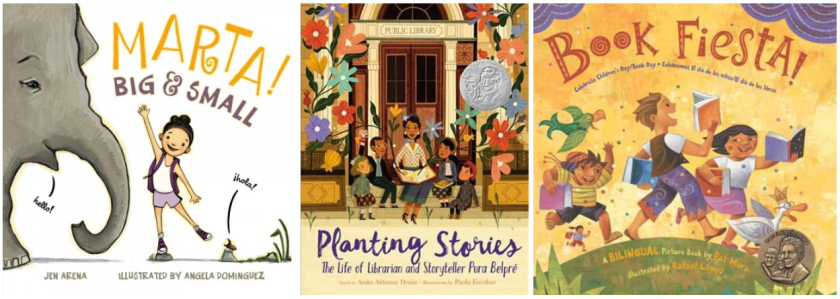
In this book, Marta discovers she is both big and small, slow and fast, loud and quiet. How can that be?!
Read: Marta Big & Small by Jen Arena & Angela Dominguez
“What was big in that book? The elephant! What was small? The bug! In this traditional song from Mexico, a big elephant balances on a spiderweb. What do you think will happen? We’ll be counting to 5 in Spanish. Will you count with me?” I reused my flannel for 5 elephants in the bathtub and made a spiderweb from pipe cleaners. It didn’t stick too well to the flannelboard, but I was able to hook it over the edge and that worked! I also realized after a practice run that I really needed to learn the colors of my elephants in Spanish!
Counting Song: Un elefante (An Elephant)
Un elefante se balanceaba,
sobre la tela de una araña, (swing 1 finger back and forth)
como veía que resistía, (veía=point at eye, resistía=flex muscles)
fue a buscar a otro elefante! (cup hands at mouth)
Oh, elefante!
Dos elefantes se balanceaban, sobre la tela de una araña, (swing 2 fingers)
como veían que resistía, fueron a buscar otro elefante.
Oh, elefante!
Tres elefantes se balanceaban, sobre la tela de una araña,
como veían que resistía, fueron a buscar otro elefante.
Oh, elefante!
Cuatro elefantes se balanceaban, sobre la tela de una araña,
como veían que resistía, fueron a buscar otro elefante.
Oh, elefante!
Cinco elefantes se balanceaban, sobre la tela de una araña,
la telaraña se debilitó, (shake hands/body)
¡y todo al suelo se cayó! (hands fall like elephants!)
Credit: traditional, watch: https://youtu.be/I0IW4101ew0

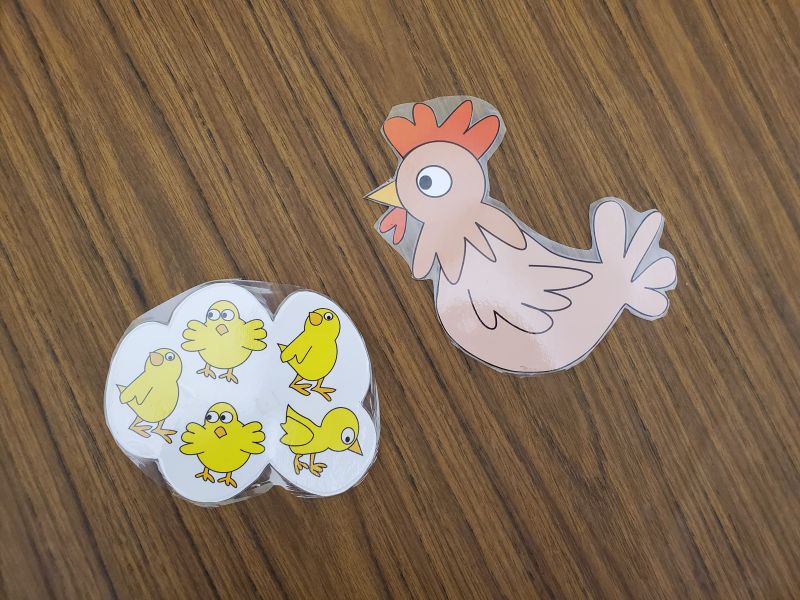
Another song about animals. These little chicks say “pio!” in Spanish! They have lost their mother, and they’re cold and hungry! But their mother is very good, so she finds food for them, corn and wheat, and tucks them all under her wing so they are cozy. BUT – these silly little chicks do the same thing the next day! This “flannel” is from the printable made by Sunflower Storytime for the rhyme Ten Fluffy Chickens.
Song: Los pollitos dicen (The Chicks Say…)
Los pollitos dicen, pío, pío, pío
cuando tienen hambre, cuando tienen frío (hambre=rub belly, frío=rub shoulders)
La gallina busca, el maíz y el trigo
les da la comida, y les presta abrigo
Bajo sus dos alas, acurrucaditos,
duermen los pollitos hasta el otro día (duermen=lay head on hands, sleepy)
Pío, pío, pío dicen los pollitos
cuando tienen hambre, cuando tienen frío
Credit: traditional, watch: https://youtu.be/a7zUbmjUtDM
Pura Belpré was a librarian, author and storyteller, and is one of my heroes! She worked hard to make sure that the kids who came to her library had books in their own language and stories from their homelands.
Read: Planting Stories: The Life of Librarian and Storyteller Pura Belpré by Anika Aldamuy Denise & Paola Escobar
Did you notice that the book compared stories to seeds, and Pura did a lot of story planting? Let’s do a rhyme about seeds growing up.
Rhyme: Be A Seed
Be a seed, small and round
Sprout, sprout, sprout up from the ground.
Shake your leaves for all to see
Stretch your arms up, you’re a tree!
Credit: Jbrary
I also loved Pura’s story about the beautiful cockroach Martina and the gallant mouse Perez. It reminded me of this fun rhyme about a mouse.
Clapping Rhyme: Little Clapping Mouse
(clap for each *)
Behind the tree * *
And under the house * *
There lived a teeny * *
Tiny mouse * *
She loved to sing * *
She loved to tap * *
But most of all * *
She loved to clap * *
She clapped all night * *
She clapped all day * *
She clapped to frighten * *
The cat away! * * * * * * * *
Credit: Jbrary
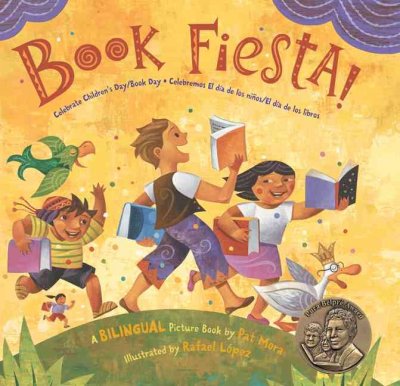
In Mexico, el día de los niños (Children’s Day) is celebrated in April. Bilingual children’s author Pat Mora decided to bring that festival to the United States, and to tie it to love of books, so created el dia do los libros (Book Day). This is the book she wrote to celebrate that.
Read: Book Fiesta! by Pat Mora & Rafael López
When I celebrate, I like music and dancing! This song is about how our bodies can make music. (translate song)
Action Song: Mi cuerpo hace música (My Body Makes Music)
Mi cuerpo, mi cuerpo hace música
Mi cuerpo, mi cuerpo hace música
Mis manos hacen (clap,clap, clap)
Mis pies hacen (stomp, stomp, stomp)
Mi boca hace: la, la, la!
Mi cuerpo hace: cha, cha, cha!
Credit: Sol y Canto, from the album El Doble de Amigos. Watch with motions at Jbrary
Bilingual Lullaby: Yo te amo (I Love You)
Yo te amo, yo te amo
All day long I’ll sing this little song to you.
Yo te amo, yo te amo
Darling, I love you!
Credit: Jbrary
Craft: Tissue Paper Flowers
In Mexico there is a tradition of making crafts with tissue paper. Behind me you can see papel picado, an ancient craft that goes all the way back to the Aztec. You’ll also see big colorful paper flowers as decorations at celebrations, and that’s what our craft is this week. I used the instructions from the Inspired By Family blog.
I also booktalked these alternative titles.
Just Ask! by Sonia Sotomayor & Rafael López
Viva Frida by Yuyi Morales
Los Gatos Black on Halloween by Marisa Montes & Yuyi Morales
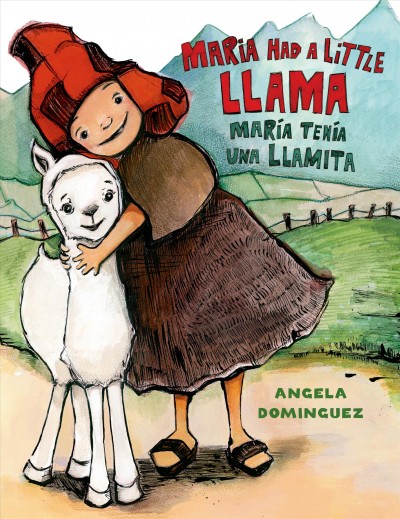
Maria Had a Little Llama / María tenía una llamita by Angela Dominguez


Closing Rhyme: Tickle the Stars
This storytime was presented virtually on 10/13/20.
Storytime Handout:


 Storytime with Ms. Emily Library
3 thoughts on “Preschool Storytime: Hispanic Heritage Month”