STEM Storytime: Windy Days

Every so often it’s nice to mix things up a little! This week, I went back to a training I’d attended in 2019 about incorporating STEM into storytimes, created by the Franklin Institute, a science museum in Philadelphia. They put together a packet of material called “Leap into Science” and made it available for free! This focused on plans for a preschool, elementary, and family program that incorporated literacy/storytime with the science of wind. Since then, there have been two other topics, Light & Shadow and Balance. You can find the free materials, including training videos and the full PDF curricula, at http://leap.fi.edu/resources.

In the past, I had presented this to a slightly older audience, more preschool age, as well as a separate program for families with all ages of child, and basically followed the outline in the curriculum for these programs. With my current group of kids up to age 3.5, I simplified, and ran the program as a half-storytime, half-science-station situation. It worked well, and I think my kids enjoyed the novelty and the hands-on elements.

Early Literacy Tip: You can encourage scientific thinking by asking children to observe, ask questions, make predictions, test their ideas, and learn from repeated attempts. These practices strengthen critical thinking skills that are essential in both science and literacy learning. Focusing on the process of science rather than a specific product or outcome frees children and to explore and take risks.

Welcome Song: Hello, Friends* (TT) (TB) (FT)**

Warm Up Song: Wake Up, Feet* (TT) (TB) (FT)
This is a repeated song that everyone seems to enjoy. I always begin and end with feet and tummies, but find two other body parts to wiggle in the middle. This week it was knees & fingers.

Lifting Rhyme: Toast in the Toaster* (TT) (FT)

Rhyme: This is Big, Big, Big* (TB)

Intro: A few years ago I had the opportunity to do a training on incorporating STEM into storytime. The science part of today’s storytime was developed by the Franklin Institute, a science museum in Philadelphia. Our goal today is to have fun exploring the wind and to feel like scientists. So KIDS get to be scientists- explore and ask questions, make predictions, and test and explore possible answers. Caregivers –your job today is to help your scientists.  Ask them open ended questions, give them help if they need it, but allow your kiddos to take the lead!

Science Talk: Breeze Vs. Gust (TT) (TB) (FT)
We had a discussion about what they already know about wind, and introduced the vocabulary of “breeze” vs. “gust.”
Have you ever been outside on a windy day?
How did it feel?
What did you see?
Let’s make our own wind! – hold your hand in front of your face and blow into it – 3, 2, 1, GO!
What did you notice?  How did it feel?
Who made a soft, gentle wind?  What did that feel like? A soft, gentle wind is called a breeze.
Who made a strong, hard wind?  What did you notice? A strong, hard wind is called a gust.
Okay, everyone blow a breeze – gentle. 
Now everyone blow a gust – strong.
Stand up – let’s see what kind of wind we can make with this. I used a large plastic tub lid to wave a gentle breeze at the group.
How did that feel?  What did you see?
Look at clothes and hair as I do it again.
Predicting – if I wave a strong gust toward you, how will it feel different?

Transition: If You’re Ready for a Story* (TT) (TB) (FT)

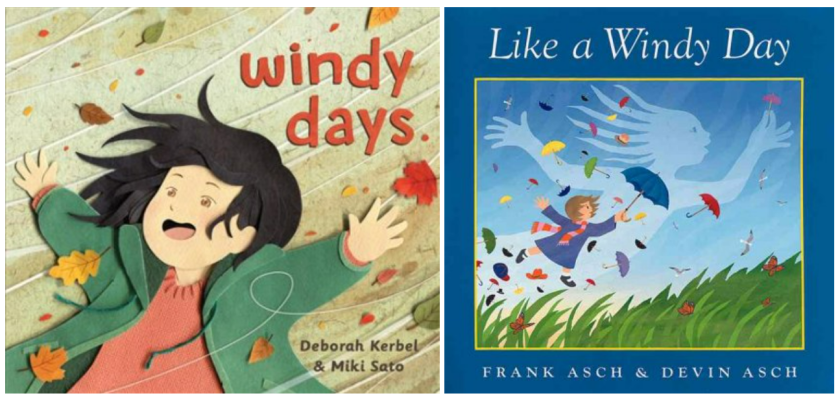
As I introduced both books, I asked if the group could tell it’s supposed to be windy, and what clues on the cover let them know.
Read: Like a Windy Day by Frank Asch & Devin Asch (TT)
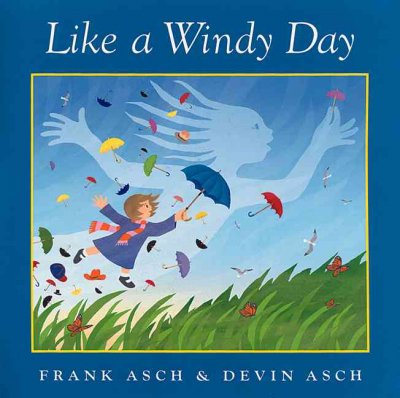
book cover of "Like a Windy Day"

This one is great since it uses the language of breeze and gust. And the illustrations are gorgeous.
Read: Windy Days by Deborah Kerbel & Miki Sato (TB) (FT)

Book cover of "windy Days"

We handed out scarves for our rhymes.
Scarf Rhyme: Wind, Oh Wind (TT) (TB) (FT)
Wind, oh wind, Oh wind I say
What are you blowing away today?
Scarves, scarves, scarves, I say
I am blowing the scarves away, today
What else might the wind blow? Leaves, hats…?
Source: King County (WA) Library System

Scarf Rhyme: Windmills (TT) (TB) (FT)
The wind blows high (wave scarves/hands high)
And the wind blows low (wave scarves low)
Round and round the windmills go (roll arms or wave scarf in a circle)
Sometimes fast, and sometimes slow (roll fast, then slow)
And that is how the wind blows (wave scarf/hands)
Source: Adventures in Storytime

Scarf Rhyme: I See the Wind (TT)
(mime the object with scarves)
I see the wind when the leaves dance by
I see the wind when the clothes wave “Hi!”
I see the wind when the trees bend low
I see the wind when the flags all blow
I see the wind when the kites fly high
I see the wind when the clouds float by
I see the wind when it blows my hair
I see the wind ‘most everywhere!
Source: Mild-Mannered Librarian

Scarf Song: Noisy Wind (TT) (TB) (FT)
(tune of The Farmer in the Dell)
I like the noisy wind, I like the noisy wind
It roars and mutters and shakes the shutters
I like the noisy wind!

I like the noisy wind, I like the noisy wind
It flaps the flag and rustles my bag
I like the noisy wind!
Source: Mild-Mannered Librarian

Science Stations
After doing a few songs and rhymes, we brought our scarves back to put away, and I explained the stations. My Toddler Time group doesn’t usually do a craft, so they had the first three stations only, but Teddy Bears and Family Time also included making wind detectors.

Station 1: Leaf Blower (TT) (TB) (FT)
Fabric leaves, foam leaves, flat paper, and crumpled paper were available to move using a paper fan, a folded fan, squeeze bottles, and fish squirter bath toys. I also provided a yardstick in case they wanted to measure how far their leaves blew.

Station 2: What Moves? (TT) (TB) (FT)
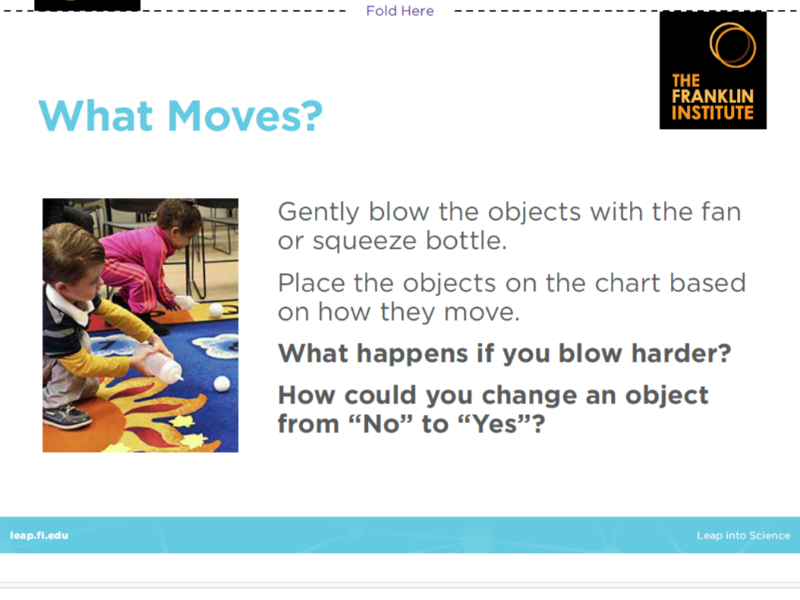
Using the same tools (paper fan, folded fan, squeeze bottles and fish squirters), kids could test different objects and sort them into “easy to move” and “hard to move” bins. I collected random objects such as plastic eggs, tissues, pompoms, cotton balls, feathers, and fabric leaves for the “easy to move” items, and rocks, large 2″ buttons, binder clips, plastic turtles, clothespins, little bottles of bubble solution, and trees and signs from our train set for the “hard to move” items.

Station 3: Race the Wind (TT) (TB) (FT)
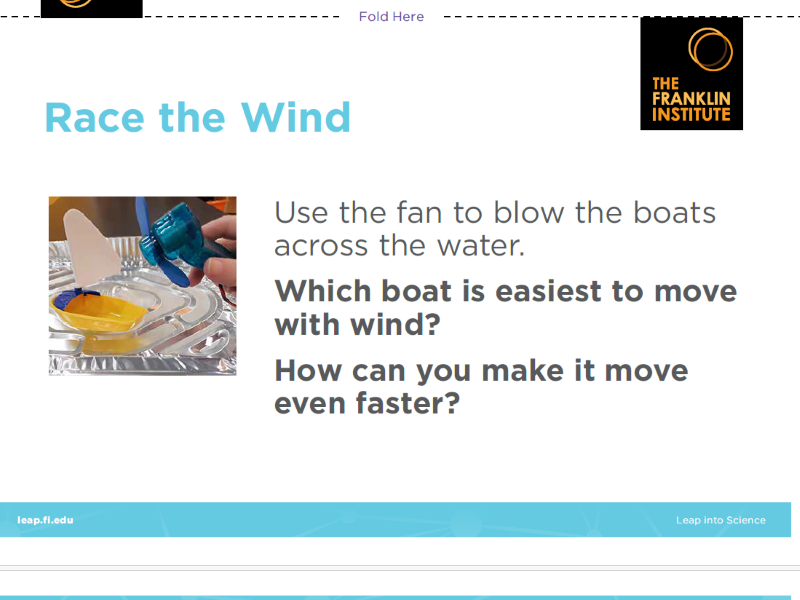
Boats with different kinds of sails float in a plastic tub of water. Handheld battery powered fans were available to test them out (not pictured). This was a science experiment on my part – I originally made boats with household sponges (which I’d seen instructions for online), but unfortunately my boats just instantly absorbed water and sank. I guess there are different densities of sponge and mine just didn’t work. Instead, I used these small plastic yogurt containers that I had a large stash of. After taping the mast and sail to the front, I had to counterbalance them with coins taped to the other side. It was a bit of a nail-biter to figure it all out, but in the end, the boats worked well for our station. Definitely reinforces the fact that programmers need to try it out before putting it out for the kids!

Station 4: Flying Colors (TB) (FT)
This station acted as our craft, and the idea is to make something that detects a breeze and a gust in different ways. The example I made and was featured in the curriculum is a craft stick with a feather, crepe paper streamer, and piece of yarn. The idea being that maybe only the feather will move in a very light breeze, and the heavier yarn may only move in a strong gust. For older kids, I may not have created an example, letting them be creative and test different designs, but our group only had a limited amount of time and I wanted them to leave with a finished wind detector. There was a larger fan with variable speeds available for them to test their creations.

Science Debrief:
How did you move things with wind today?
How did you make a breeze?  A gust?
Did anything happen that surprised you?
How did you feel like a scientist today?  When did you make a guess about something and test it?  Was there a time when you tried something over and over?  Did you have fun?
Thank you for doing great work as scientists.  In the next few weeks – remember to keep your scientist hats on and notice and observe how objects move in the wind outside or at home.

Action Song: Zoom, Zoom, Zoom!* (TT) (TB) (FT)

Play Time
The toddlers have two laundry baskets of baby toys – rattles and cars, sorters and stackers, toy phones and spinners. For the older kids, I have foam blocks, soft food toys, puzzles, and a few other items that are a little more sophisticated than the baby toys. For Family Time, I gauge the overall age of the group and put out what seems right for them. We play for 5-10 minutes at the most, then I ring the bell and ask the kids to help me clean up. I think the clean up bit is good practice for them!

Goodbye Song: See You Later Alligator* (TT) (TB) (FT)

Goodbye Rhyme: Tickle the Stars* (TT) (TB) (FT)

Other books I had available for families to browse (and may work for you on this theme)
Kite Day – Will Hillenbrand
The Wind Blew – Pat Hutchins
Gusts and Gales – Josepha Sherman & Omarr Wesley
Kate, Who Tamed the Wind – Liz Garton Scanlon & Lee White
I Am the Wind – Michael Karg & Sophie Diao
Wild Is the Wind – Grahame Baker-Smith
Windblown – Édouard Manceau
The Windy Day – G. Brian Karas
Someone Bigger – Jonathan Emmett & Adrian Reynolds

This storytime was presented in-person on 10/9, 10/10, & 10/11/23.

Storytime Handout:

handout with suggested books, rhymes and songs, questions to encourage your scientist, and try it at home: bathtime sponge sailboats.

*Lyrics to these songs can be found on the Repeated Songs & Rhymes page.

**These symbols indicate the program sessions I used the activities for:
(TT) Toddler Time, ages 1-2
(TB) Teddy Bears, ages 2-3.5
(FT) Family Time, ages 0-3.5

Storytime: Autumn

This week we dove into the new fall season with an autumn theme, even if the temperatures were still in the 80s! I highlighted a little nonfiction as well as our picture books, and we had lots of fun with our parachute and some fabric fall leaves. Leaves were a throughline, but we also touched on apples, pumpkins, and rainy autumn weather.

I’m starting to lean toward having the same plan for all three of my age groups, rather than planning several songs and rhymes that are different. I might drop one or more activities for the younger or a more wiggly group or perhaps include one counting song for the older group, but in general I’ve been keeping to the same plan and that’s been working well for now. I can always adjust as needed!

See other versions of this theme from 2020 and 2025.

Early Literacy Tip: Factual books are a great way to expand children’s knowledge about the world, especially when you can see and experience something in their world, like the changing of the seasons. You can read the whole book or choose certain pages your child might be interested in. In fact, it’s perfectly okay to read only parts of any book, or to just focus on the pictures. You can adapt the experience to your child’s interest and attention span. The important thing is to make reading together a positive experience.

Welcome Song: Hello, Friends* (TT) (TB) (FT)**

Warm Up Song: Wake Up, Feet* (TT) (TB) (FT)
This is a repeated song that everyone seems to enjoy. I always begin and end with feet and tummies, but find two other body parts to wiggle in the middle. This week it was knees & fingers.

Lifting Rhyme: Toast in the Toaster* (TT) (FT)

Rhyme: This is Big, Big, Big* (TB) (FT)

Intro: Oh, the air is turning crisp (kind of), the days are getting shorter, and the leaves are starting to change colors. We’ve just changed to a new season – autumn, or fall! Have you ever wondered why the leaves turn colors? Here’s an explanation I found in an informational book called Why Is it Fall? by Sara L. Latta. I read the two-page spread about why leaves turn colors, then mention our early literacy tip for the day.

book cover for Why Is it Fall?

I have used this rhyme from Mel’s Desk for many programs, and have even adapted it for a winter theme. It’s very simple but cozy and comforting. My flannel was made using Mel’s photo as a template.
Flannel Rhyme: Blue is the Sky (TT) (TB) (FT)
Blue is the sky, Yellow is the sun
Silver are the stars, When the day is done
Orange is the leaf, Brown is the tree
Red is the apple, For you and me
Source: Mel’s Desk

flannel showing the parts of the rhyme. A sky-blue blob, a yellow sun, stars covered with aluminum foil to be silver, an orange leaf, a brown tree with bare branches, glued to a light tan piece of felt, and a red apple with a small green leaf at the stem.

Transition: If You’re Ready for a Story* (TT) (TB) (FT)

Mouse’s First books seem to to be tailor made for the toddler set.
Read: Mouse’s First Fall by Lauren Thompson & Buket Erdogan (TT)

book cover for Mouse's First Fall

This one touches on several different aspects of fall, and I love that the frisky squirrels were a callback to our theme from two weeks ago. The page where all of a sudden everything is orange and yellow and red has a lot of great dramatic potential!
Read: In the Middle of Fall by Kevin Henkes & Laura Dronzek (TB) (FT)

book cover for In the Middle of Fall

I think my kiddos like any iteration of Wheels on the Bus, ever.
Action Song: The Leaves on the Trees (TT) (TB) (FT)
(tune of Wheels on the Bus)
The leaves on the trees turn orange and red, (flip hands)
Orange and red, orange and red
The leaves on the trees turn orange and red,
All around the trees

The leaves on the trees come twirling down… (twirl fingers downward)
The leaves on the ground go swish, swish, swish… (flick hands back and forth)
People in the yard go rake, rake, rake… (scoop hands inward)
The kids in the yard go jump, jump, jump… (jump!)
Source: Jbrary

This one got cut for time, but I included it on our handout and have had good luck with it for other sessions.
Action Song: Pumpkin, Pumpkin
(tune of Twinkle Twinkle)
Pumpkin, pumpkin on the ground (touch the ground)
How’d you get so big and round? (make a big circle)
Once you were a seed so small (pinch fingers together)
Now you are a great big ball (make a big circle overhead)
Pumpkin, pumpkin on the ground (touch the ground)
How’d you get so big and round? (make a big circle)
Source: Storytime Katie

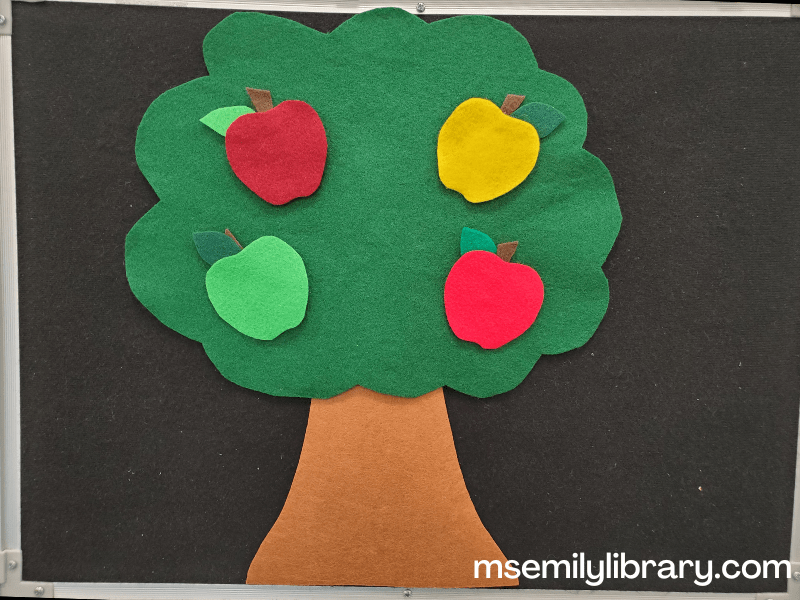
Tired of “Way Up High in the Apple Tree?” Here’s another apple tree rhyme to try, courtesy of Storytime in the Stacks. She has a really great “Math Talk” video on her page, talking through how to share four apples fairly. I highly recommend watching. I did a simplified version with my groups. I also changed “Four Red Apples” to “Four Juicy Apples” since my flannel apples were different colors.
Flannel Rhyme: Four Juicy Apples (TT) (TB) (FT)
Four juicy apples growing in a tree
Two for you and two for me! (hold up two fingers on each hand)
Help me shake the tree just so, (make a shaking motion)
And all the apples will fall below!
Source: Storytime in the Stacks

Flannel showing a large simple tree with green foliage and four large apples of different colors: dark red, yellow, light green, and light red.

At this point we got out the parachute! We did this rhyme twice, getting low and high with the ‘chute, and waving it gently in the breeze. The second time, I dropped a bunch of fabric leaves on the parachute at the last line, and launched into Autumn Leaves Are Falling Down right away.
Scarf Rhyme: Once I Was a Seed (TT) (TB) (FT)
Once I was a seed and I was small, small, small (crouch low)
I grew into a tree and now I’m tall, tall, tall! (stand up and stretch out arms like branches)
My branches sway in the breeze so soft (sway and wave hands/’chute like a leaf)
And when it’s autumn, all my leaves fall off! (lower ‘chute)
Source: Storytime in the Stacks

Parachute Song: Autumn Leaves Are Falling Down (TT) (TB) (FT)
(tune of London Bridge)
Autumn leaves are falling down, falling down, falling down
Autumn leaves are falling down
All around the town
Source: King County (WA) Library System

Almost the same title as the previous song, but a different tune and feel. We slowed it down for this one and did “slowly” and “quietly” before doing “loudly” and changing our “shh” to a “whoosh!”
Parachute Song: Leaves are Falling Down (TT) (TB) (FT)
Leaves are falling down – shh! (slowly lower the parachute)
Leaves are falling down – shh!
Slowly, slowly, very slowly
Leaves are falling down
(try other ways of falling – quickly, quietly, loudly!)
Source: Library Village

At this point in the program they were just enjoying waving the parachute up and down with the leaves on top, so I just said this rhyme, not expecting us to change motions or anything during it.
Rhyme: Autumn Winds
Autumn winds begin to blow
Colored leaves fall fast and slow
Whirling, twirling, all around
Until at last they touch the ground
Source: Library Village

A parachute on a purple rug, with autumn colored fabric leaves scattered on top.

I next invited adults to hold the parachute while the kids got underneath. Another thing that can come with autumn is rain and storms. Let’s get under the umbrella!
Action/Parachute Song: Come Under My Umbrella (TT) (TB) (FT)
(tune of Did You Ever See a Lassie?)
Come under my umbrella, umbrella, umbrella (move parachute up and down)
Come under my umbrella, it’s starting to rain
With thunder and lightning, and lightning and thunder (wiggle ‘chute more strongly)
Come under my umbrella, it’s starting to rain
Source: traditional

This is a great way to put the parachute away. I ask for only grownups to hold on, and then let them know they are letting go at the end. Once the parachute was whisked away, I asked the kids to help me pick up all the fabric leaves that were scattered about.
Parachute Song: Parachute Fly (TT) (TB) (FT)
(tune of Skip to my Lou)
(kids go under the parachute and adults raise and lower)

Up, up, up it goes,
Down, down, down so low
Raise our parachute to the sky
Count to 3 and watch it fly
Spoken:
Up on one…
Down on two…
Up on three…
and FLY! (adults let go and leader pulls ‘chute in to themselves)
Source: Gymboree

Action Song: Zoom, Zoom, Zoom!* (TT) (TB) (FT)

Craft: Leaf Rubbing (TB) (FT)
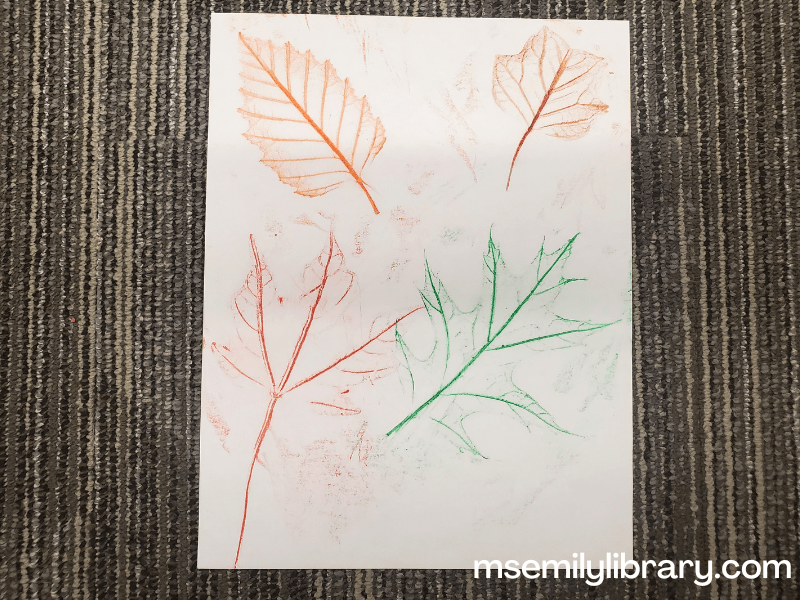
Back to basics! I went on a nature walk and found leaves of different species, with different shapes and even tried varying the colors that they were, including a few green leaves. I hadn’t done this craft since I was a child, so a few tips: make sure you pick leaves that are not completely dried out – they need to still be supple. That might mean plucking them from low branches instead of finding them on the ground. They also dry out really fast! We did great on the first day, but there were some crunchy ones the second day. I unwrapped the labels from leaf-colored crayons: red, orange, yellow, brown, and green, and demonstrated for everyone. Not all the adults knew what to do. The leaf goes UNDER the paper, and you need to use the FLAT side of the crayon. But the rubbings themselves are like magic – you see the delicate veins and outline come through the paper and it’s amazing.

leaf rubbings on a white sheet of paper, showing an orange beech leaf, a brown tulip tree leaf, a red maple leaf, and a green oak leaf.

Play Time
The toddlers have two laundry baskets of baby toys – rattles and cars, sorters and stackers, toy phones and spinners. For the older kids, I have foam blocks, soft food toys, puzzles, and a few other items that are a little more sophisticated than the baby toys. For Family Time, I gauge the overall age of the group and put out what seems right for them. We play for 5-10 minutes at the most, then I ring the bell and ask the kids to help me clean up. I think the clean up bit is good practice for them!

Goodbye Song: See You Later Alligator* (TT) (TB) (FT)

Goodbye Rhyme: Tickle the Stars* (TT) (TB) (FT)

Other books I had available for families to browse (and may work for you on this theme)
On a Gold-Blooming Day – Buffy Silverman
Leaf Man – Lois Ehlert
Leaves – David Ezra Stein
Goodbye Summer, Hello Autumn – Kenard Pak
Autumn Babies – Kathryn O. Galbraith & Adela Pons
We’re Going on a Leaf Hunt – Steve Metzger & Miki Sakamoto
The Very Last Leaf – Stef Wade & Jennifer Davison
Fletcher and the Falling Leaves – Julia Rawlinson & Tiphanie Beeke
Wonderfall – Michael Hall

This storytime was presented in-person on 9/25, 9/26, & 9/27/23.

Storytime Handout:

handout with suggested books, rhyme and song lyrics

*Lyrics to these songs can be found on the Repeated Songs & Rhymes page.

**These symbols indicate the program sessions I used the activities for:
(TT) Toddler Time, ages 1-2
(TB) Teddy Bears, ages 2-3.5
(FT) Family Time, ages 0-3.5
Storytime: La música (Hispanic Heritage Month)

September 15-October 15 is Hispanic Heritage month, and I enjoy taking that opportunity to highlight Latine authors, illustrators, and Spanish language songs and rhymes. I am extremely fortunate to have several regular storytime families who speak Spanish, and who helped suggest some new songs for us to do, and who helped me read the Spanish portions of the two bilingual books we read. I was a French major in college, but have always enjoyed learning a little Spanish here and there. This past year, I got a little more systematic about it and have been doing Spanish lessons on a language learning app consistently. It’s been great to learn more, and I love having some new songs and rhymes to share. I had chosen the theme of “La música” several months ago, not really exploring books yet, but wanting a theme I knew could go with a lot of my songs. It was a very loose theme!

See other versions of this theme from 2020 and 2022.

Early Literacy Tip: Studies show that children raised in bilingual environments develop core cognitive skills like decision-making and problem-solving — before they even speak. If you aren’t already bilingual, that’s okay! You can still expose your child to different languages and cultures. As long as you expose them to foreign words in a consistent way with the same context, they’ll reap the benefits.

Welcome Song: Hello, Friends* (TT) (TB) (FT)**

Warm Up Song: Wake Up, Feet* (TT) (TB) (FT)
This is a repeated song that everyone seems to enjoy. I always begin and end with feet and tummies, but find two other body parts to wiggle in the middle. This week it was shoulders and ears.

Lifting Rhyme: Toast in the Toaster* (TT) (FT)

Rhyme: This is Big, Big, Big* (TB) (FT)

Intro: Hispanic Heritage Month just started, and runs from September 15 – October 15. Hispanic means Spanish-speaking. Today we are going to celebrate Spanish and Spanish-speakers, and the contributions they make, including authors who write in both English and Spanish, & illustrators from Spanish-speaking countries.

This is a sweet and simple song that is good to get us started. I ask the kids to take a good look at their hand and admire it – what a pretty hand it is! We do this twice, switching hands on the second repetition.
Song: La linda manita (TT) (TB) (FT)
La linda manita (flip hand back and forth)
que tiene el bebé
qué linda, qué bella
qué preciosa es
Source: traditional, watch: https://youtu.be/OWAunlWlMUI

Transition: If You’re Ready for a Story* (TT) (TB) (FT)

I had a Spanish-speaking volunteer for two of my three sessions. For the first session, I went with the “music” theme and this reinterpretation of Mary Had a Little Lamb. I read the English and she read the Spanish.
Read: Maria Had a Little Llama / María tenía una llamita by Angela Dominguez (TT)

book cover for Maria Had a Little Llama / María tenía una llamita

My second session volunteer was the one who was my primary helper. She suggested songs and this book specifically. It’s a little longer than Maria, which is why I chose a different one for the first/younger session. I pointed out that this was written by the musical group 123 Andrés, and that the book was based on a song they could look up.
Read: Hola amigo! / Hello, Friend by 123 Andrés & Sara Palacios (TB)

Book Cover for Hello, Friend/Hola, Amigo

Alas, though I did put out a email call for anyone signed up in my third session, no one felt comfortable volunteering to read. I chose this book because the majority is in English, with Spanish words sprinkled throughout, which I felt I could handle on my own.
Read: Sonrisas for Baby by Jen Arena & Blanca Gómez (FT)

Book cover for Sonrisas For Baby

Let’s bring out the music that’s in our bodies!
Action Song: Mi cuerpo hace música (TT) (TB) (FT)
Mi cuerpo, mi cuerpo hace música
Mis manos hacen (clap,clap, clap)
Mis pies hacen (stomp, stomp, stomp)
Mi boca hace: la, la, la! (point at mouth)
Mi cuerpo hace: cha, cha, cha! (dance)
Source: Sol y Canto, from the album El Doble de Amigos. Watch with motions at Jbrary

This was a new one to me, which was suggested by my volunteer. I found lots of videos of it, many of them the strange robotic animated children’s song ones that have taken over YouTube in the last few years. I finally found the one linked below on Mama Lisa’s World, which is a great resource for international music. I love that it’s a home video showing a family doing the song, which sounded natural, so that’s how I learned the tune.
Here’s a circle song, similar to Ring Around the Rosie. I explained the song lyric translation. At the end we fall down and go to sleep! I encouraged grownups to make a circle with their little one (like in the video) rather than trying to wrangle everyone into a big circle.
Circle Song: A la rueda, rueda (TT) (TB) (FT)
(walk in a circle, and fall down and pretend to sleep at the end!)
A la rueda, rueda, De pan y canela
Dame un besito, Y vete para la escuela
Spoken: Si no quieres ir, Acuéstate a dormir!
To the wheel, wheel, of bread and cinnamon
Give me a kiss, and go to school
If you don’t want to go, Lay down to sleep!

Source: traditional, watch here: https://www.mamalisa.com/?t=es&p=2792

Confession: I am not a big fan of this song, in any language. I know the kids like it, though, so we did it in English first and then in Spanish.
Action Song: Cabeza y hombros, rodillas y pies (TT) (TB) (FT)
(Head, Shoulders, Knees, & Toes)
Cabeza y hombros, rodillas y pies (rodillas y pies)
Ojos, orejas, boca y nariz
Cabeza y hombros, rodillas y pies (rodillas y pies)
Source: traditional

This was another suggestion from my volunteer. I showed the video for one session, and I think it would have gone better just singing. It runs a bit long, with lots of instrumental breaks, and the group got restless. I ended up skipping it for the last two sessions.
Action/Body Song: Con tu dedito (TT)
Con tu dedito, con tu dedito, con tu dedito: tap, tap, tap!
Ponlo hacia arriba,
Ponlo hacia abajo,
Ponlo en tu cabeza
Continue moving your finger and tapping different parts of your body. Try:
Nariz = Nose
Mentón = Chin
Brazo = Arm
Pierna = Leg
Pie = Foot
Source: Canta con Jess

We then got out shakers. We have regular shaker eggs that we use regularly, but I noticed we also have some maraca style shakers with a handle, clear bowl and multicolored pieces inside which I’d never used before. OMG, they are LOUD. So loud. It was difficult to hear myself think, much less sing. I nixed them for the last session.
Shaker Practice: Shake Your Shaker High (TT) (TB)
(tune of Grand Old Duke of York)
You shake your shaker high
You shake your shaker low
You shake your shaker fast, fast, fast
And then you shake it slow!
Source: Harris County (TX) Public Library

This one I heard about from another library at a conference this year. I showed the video, and encouraged them to dance with their shakers (for the group that had them).
Body Song: Baila, baila (TB) (FT)
Cuando un amigo baila, baila, baila, baila!
Pies = Feet
Rodillas = Knees
Caderas = Hips
Manos = Hands
Cabeza = Head
Source: Baila, Baila

And we ended with bubbles. This is the bubble song I use every session in the summer, so my groups were familiar with it.
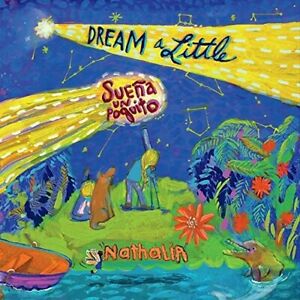
Recorded Song: Pop, Pop, Pop (TT) (TB) (FT)
by Nathalia From the album “Dream a Little”

Album cover for Dream a Little/Sueña un poquito from Nathalia.

Action Song: Zoom, Zoom, Zoom!* (TT) (TB) (FT)

Craft: Papel picado Craft (TB) (FT)
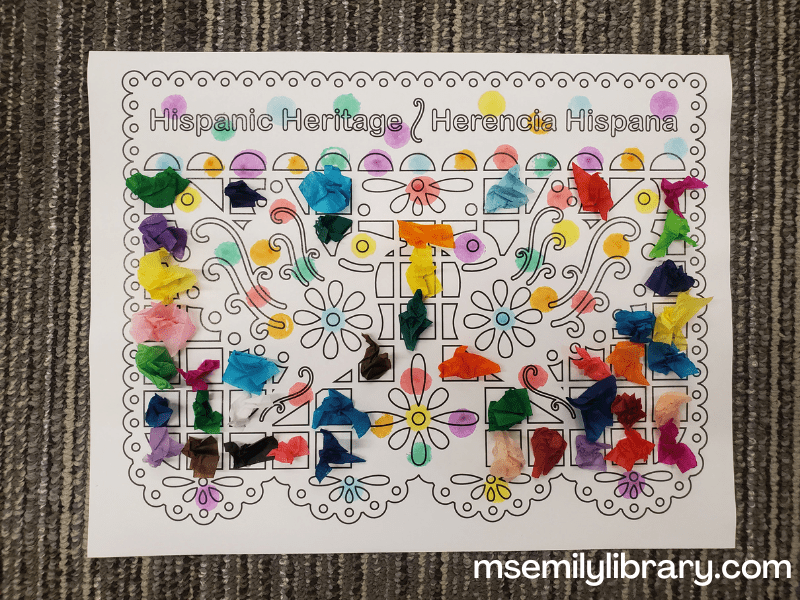
I’ve seen instructions on how to make simplified papel picado, but that’s still too advanced for my group. Instead, I printed out papel picado coloring sheets from the Greenville (SC) County Library and provided dot markers and tissue paper squares to decorate them with. It was a hit! In both sessions, I had kids working on their craft for much longer than they usually do, even after I’d gotten the toy bins out! I had saved coloring sheets from a previous year from Greenville, which I’m not seeing on their website. I’ve uploaded them here for you to use.

Craft of a papel picado banner, saying "Hispanic Heritage/Herencia Hispana" at the top, and showing two birds flying, among decorative flower, square, and lacy shapes. It's decorated with colored dots and multicolored scrunched up tissue paper squares.

Play Time
The toddlers have two laundry baskets of baby toys – rattles and cars, sorters and stackers, toy phones and spinners. For the older kids, I have foam blocks, soft food toys, puzzles, and a few other items that are a little more sophisticated than the baby toys. For Family Time, I gauge the overall age of the group and put out what seems right for them. We play for 5-10 minutes at the most, then I ring the bell and ask the kids to help me clean up. I think the clean up bit is good practice for them!

Goodbye Song: See You Later Alligator* (TT) (TB) (FT)

Goodbye Rhyme: Tickle the Stars* (TT) (TB) (FT)

Other books I had available for families to browse (and may work for you on this theme)
Fiesta Babies – Carmen Tafolla & Amy Có rdova
Los pollitos dicen / The Baby Chicks Are Singing – Ashley Wolff
Marta! Big & Small – Jen Arena & Angela Dominguez
Gracias / Thanks – Pat Mora & John Parra
My Name is Celia / Me llamo Celia – Monica Brown & Rafael López
A Song of Frutas – Margarita Engle & Sara Palacios
Paletero Man – Lucky Diaz & Micah Player
Brrrum, brrrum, brrrum / Zoom, Zoom, Zoom – Annie Kubler
Eso es mio / That’s Mine – Sumana Seeboruth & Ashleigh Corrin
Nosotros Means Us – Paloma Valdivia
Téo’s Tutu – Maryann Jacob Macias & Alea Marley
Just Ask! – Sonia Sotomayor & Rafael López
¡Pío Peep! Traditional Spanish Nursery Rhymes – Alma Flor Ada, F. Isabel Campoy, Alice Schertle, & Viví Escrivá

This storytime was presented in-person on 9/18, 9/19, & 9/20/23.

Storytime Handout:

Handout with suggested books, rhyme and song lyrics.

*Lyrics to these songs can be found on the Repeated Songs & Rhymes page.

**These symbols indicate the program sessions I used the activities for:
(TT) Toddler Time, ages 1-2
(TB) Teddy Bears, ages 2-3.5
(FT) Family Time, ages 0-3.5
Storytime: Squirrels

Squirrels don’t hibernate, so we see them year-round, but they always seem a little autumnal to me thematically. Probably because that’s when the acorns are ripe and they’re collecting and burying them to prepare for winter. I have a Scaredy Squirrel puppet (based on the books by Mélanie Watt) who I use year-round to demonstrate lap bounces and tickles. He was super excited that we’re finally doing a program on squirrels, and helped out even more than usual this week!

See another version of this theme from 2020.

Early Literacy Tip: Stories can be a great springboard to learning. Reading a story like The Busy Little Squirrel and then finding more information about squirrels and trees in nonfiction titles is a great way to support curiosity, learn new vocabulary and general knowledge, and encourage a love of learning.

Welcome Song: Hello, Friends* (TT) (TB) (FT)**

Warm Up Song: Wake Up, Feet* (TT) (TB) (FT)
This is a repeated song that everyone seems to enjoy. I always begin and end with feet and tummies, but find two other body parts to wiggle in the middle. This week it was thighs and heads.

Lifting Rhyme: Toast in the Toaster* (TT) (FT)

Rhyme: This is Big, Big, Big* (TB) (FT)

Intro: Today we’re talking about squirrels – Scaredy Squirrel is SO EXCITED that we are finally talking about squirrels! Do you ever see squirrels in your neighborhood? What is their favorite food? They have some special abilities – they climb, have a versatile tail, and know how to hide and find acorns.

Squirrels especially love big oak trees, who produce acorns. Let’s pretend to be a big oak tree.
Fingerplay: Be a Seed (TT) (TB) (FT)
Be a seed, small and round (make a fist -we also crouch low)
Sprout, sprout, sprout up from the ground (open fingers – and stand if crouched)
Shake your leaves for all to see (shake hands and body)
Stretch your arms up, you’re a tree! (raise arms high)
Source: Jbrary

Fingerplay: This Little Squirrel (TT) (FT)
(wiggle each finger in turn)
This little squirrel said, “Let’s run and play!”
This little squirrel said, “I want some acorns today!”
This little squirrel said, “Acorns are good”
This little squirrel said, “Yes, my favorite food”
This little squirrel said, “Come climb this tree” (run fingers up other arm)
And crack these acorns: one, two, three! (clap three times)
Source: Sunflower Storytime (no longer linkable)

Transition: If You’re Ready for a Story* (TT) (TB) (FT)

Perfect for little ones, this features some different animals and animal noises, a repeated phrase, and a little twist at the end.
Read: The Busy Little Squirrel by Nancy Tafuri (TT) (FT)

book cover for the busy little squirrel.

April Pulley Sayre was the queen of nonfiction that doesn’t seem like nonfiction.
Read: Squirrels Leap, Squirrels Sleep by April Pulley Sayre & Steve Jenkins (TB)

book cover  for squirrels leap, squirrels sleep

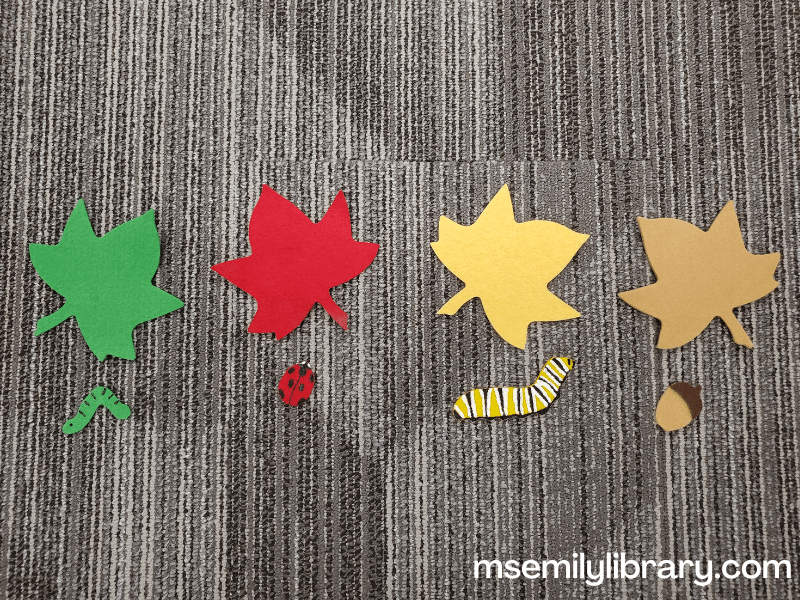
This was a really great flannel that I borrowed from AnnMarie Kolakowski from the Pasadena Public Library blog. Her picture didn’t show anything for the green leaf, so I made a little inchworm to hide behind mine. I really appreciated that she talked about some of the skills this flannel addresses: identifying color names, rhyming words, and left-to-right prereading focus. I was only going to do it for the younger group but it went over so well I ended up using it in all three sessions. Of course, the “little squirrel” in question was our Scaredy Squirrel puppet, not pictured.
Flannel: Little Squirrel (TT) (TB) (FT)
Little squirrel, little squirrel time to eat!
Which leaf is hiding your favorite treat?
Source: Pasadena Public Library blog

flannel showing four leaves with color coordinated items that were hidden behind them: a green leaf and green inchworm, a red leaf and ladybug, a yellow leaf and a yellow/white/black striped monarch caterpillar, and a brown leaf with an acorn

After Scaredy Squirrel devoured the little acorn from the previous flannel, I asked if he was still hungry. After a big nod yes, I asked the group to see if they can find more acorns in our room. I had brought in and hidden real acorns from my yard for them to bring to Scaredy. He ate some, and he saved the rest in his log (made from an old oatmeal canister.) This was a great activity to get everyone up and moving around. Even the shyer kids came up to give Scaredy the acorns they had found!
Activity: Acorn Gathering (TT) (TB) (FT)

"log" made of a cardboard oatmeal container, with woodgrain drawn on, sitting next to two real acorns

We handed out scarves and did several songs with them, starting with this warm-up.
Scarf Song: We Wave Our Scarves Together (TT) (TB) (FT)
(tune of For He’s a Jolly Good Fellow)
We wave our scarves together
Because it’s fun to do!

We wave them up high
We wave them down low
We wave them in the middle
Because it’s fun to do!
Source: Jbrary

Scarf Song: Great Big Oak Tree (TT) (FT)
(tune of Frère Jacques)
Great big oak tree, Great big oak tree (hold arms out)
Home to squirrels, Home to squirrels
Moving your branches, When the wind blows (sway arms)
Acorns fall! Acorns fall! (drop scarf)
Source: adapted from Pasadena (CA) Public Library blog (original was apples)

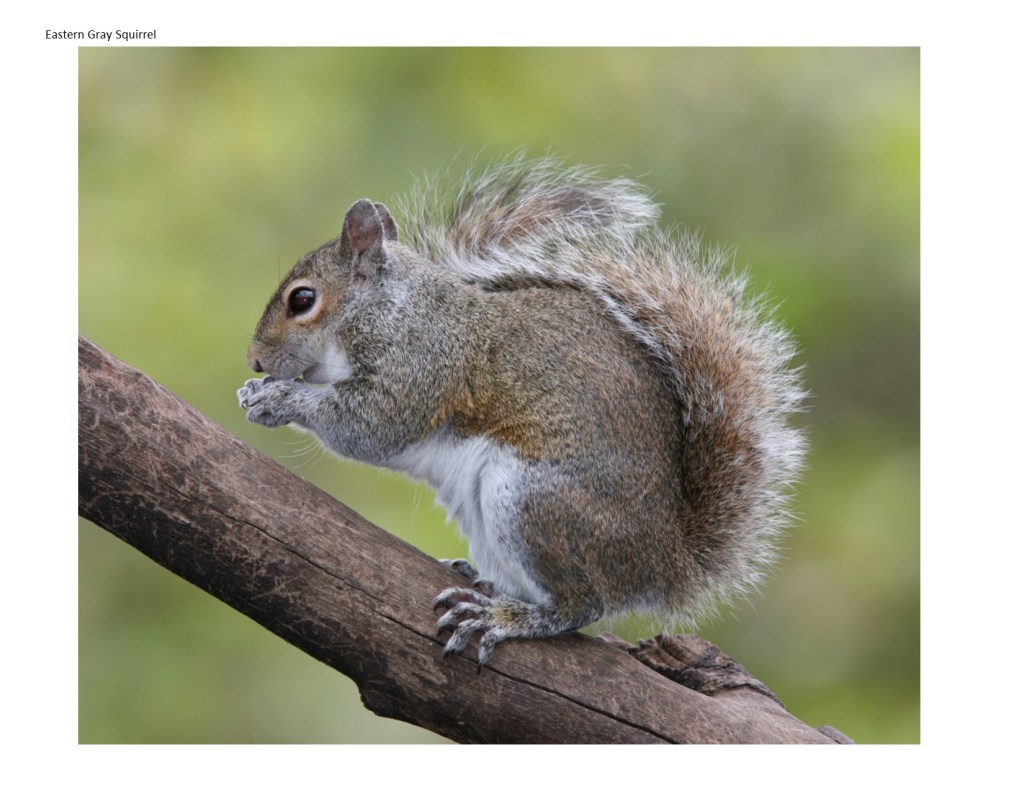
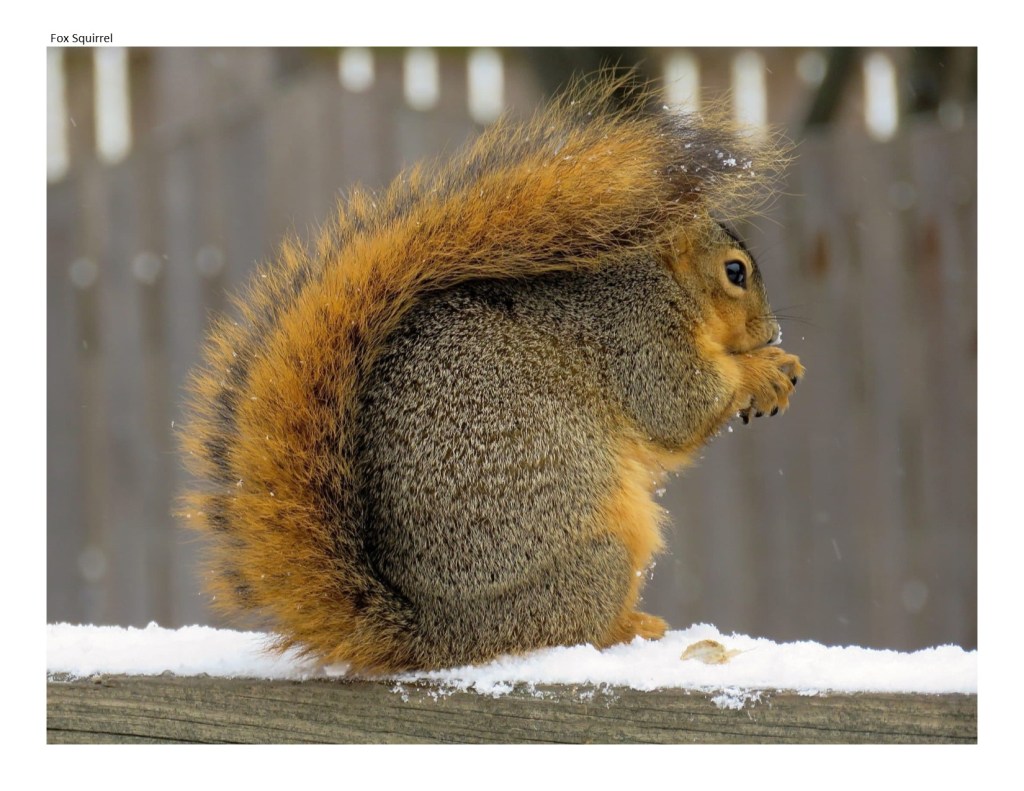
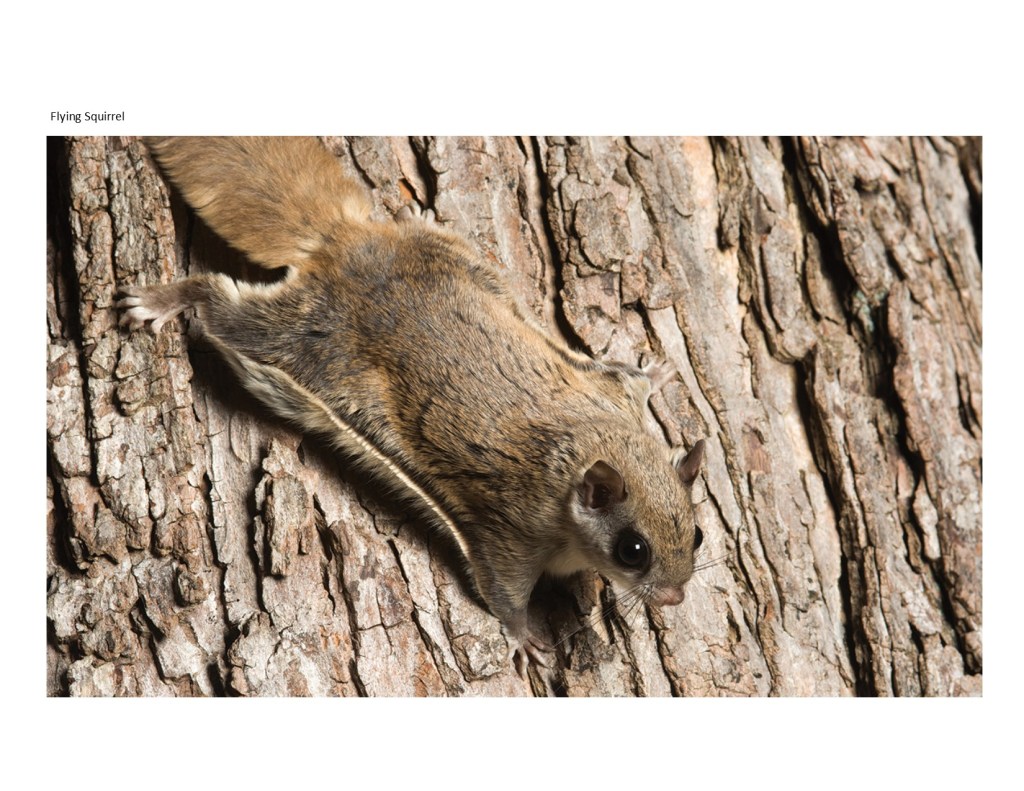
I showed the group photos of the squirrel species that might live in our area, and we shook their bushy tails!
Action Rhyme: Gray Squirrel, Gray Squirrel (TT) (TB) (FT)
Gray squirrel, gray squirrel, shake your bushy tail
Wrinkle up your funny nose…
Hold a nut between your toes…
Gray squirrel, gray squirrel, shake your bushy tail
(repeat for other squirrels: fox, red, flying, or other colors!)
Source: Jbrary

We ended up running out of time for this one, so didn’t get to it for any of the sessions.
Scarf Song: Frisky Squirrel
(tune of the Grand Old Duke of York)
Oh, the frisky little squirrel
She gathers nuts and seeds
She hides them for the winter months
So she’ll have all she needs

Oh, up-up-up she goes
And down-down-down she comes
She runs around,
goes up and down
Her work is never done
Source: Storytime Secrets

Action Song: Zoom, Zoom, Zoom!* (TT) (TB) (FT)

Craft: Fork Painted Squirrel (TB) (FT)
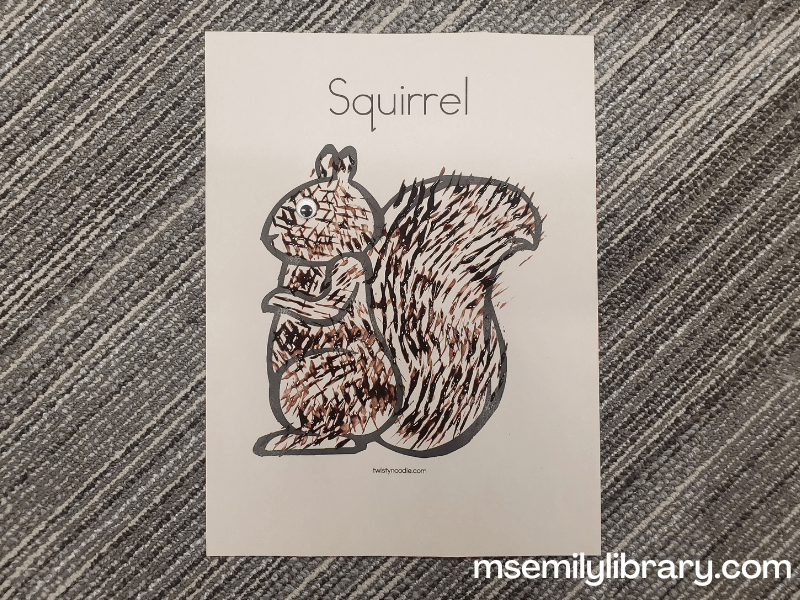
This one was kind of a mix of two inspirations – Glued to My Crafts did a squirrel but only fork painted the tail. I wasn’t crazy about the squirrel template there, either. I also saw a cuter squirrel base that Crafting Cherubs Blog did with tissue paper, so combined the two ideas. I printed the squirrel template from Crafting Cherubs (originally from Twisty Noodle) on light gray construction paper and provided brown paint, plastic forks, and a googly eye. It was fun and as simple as the kids wanted to make it.

coloring page of a squirrel with brown fur painted on with a fork.

Play Time
The toddlers have two laundry baskets of baby toys – rattles and cars, sorters and stackers, toy phones and spinners. For the older kids, I have foam blocks, soft food toys, puzzles, and a few other items that are a little more sophisticated than the baby toys. For Family Time, I gauge the overall age of the group and put out what seems right for them. We play for 5-10 minutes at the most, then I ring the bell and ask the kids to help me clean up. I think the clean up bit is good practice for them!

Goodbye Song: See You Later Alligator* (TT) (TB) (FT)

Goodbye Rhyme: Tickle the Stars* (TT) (TB) (FT)

Other books I had available for families to browse (and may work for you on this theme)
The Leaf Thief – Alice Hemming & Nicola Slater
Girl Versus Squirrel – Hayley Barrett & Renée Andriani
Nuts to You! – Lois Ehlert
Squirrel’s Family Tree – Beth Ferry & A.N. Kang
Scaredy Squirrel Has a Birthday Party – Mélanie Watt
Who Stole the Hazelnuts? – Marcus Pfister & David Henry Wilson
This Is a Taco! – Andrew Cangelose & Josh Shipley
Cyril and Pat – Emily Gravett
The Tale of Squirrel Nutkin – Beatrix Potter

This storytime was presented in-person on 9/11, 9/12, & 9/13/23.

Storytime Handout:

handout with suggested books, rhyme and song lyrics

*Lyrics to these songs can be found on the Repeated Songs & Rhymes page.

**These symbols indicate the program sessions I used the activities for:
(TT) Toddler Time, ages 1-2
(TB) Teddy Bears, ages 2-3.5
(FT) Family Time, ages 0-3.5

Storytime: Bears & Berries

Late summer is prime berry season, so it was time to dust off and revamp this Bears & Berries theme again. Maybe it was just my family, but I remember when my younger siblings were picky eaters and had “opinions” about common fruits like apples, oranges, and bananas, they would *always* eat berries. Mom would buy pints and pints of berries just to get some fruit into them. So I always associate berries as the “fruits everyone loves” although that may not be entirely accurate. In any event, the kids in storytime seemed enthusiastic about berries, so that’s good enough for me.

Early Literacy Tip: Fingerplays like “Two Little Black Bears” can strengthen fine motor skills children will need to write later on. Try making fingerplays a part of your daily routine, such as at bedtime.

Welcome Song: Hello, Friends* (TT) (TB) (FT)**

Warm Up Song: Wake Up, Feet* (TT) (TB) (FT)
This is a repeated song that everyone seems to enjoy. I always begin and end with feet and tummies, but find two other body parts to wiggle in the middle. This week it was arms & chins.

Lifting Rhyme: Toast in the Toaster* (TT) (FT)

Rhyme: This is Big, Big, Big* (TB) (FT)

Intro: Today we’re talking about Bears and some of the things they like to eat. Things like berries! And honey! Do you like berries?

Fingerplay: Two Little Black Bears (TT) (TB) (FT)
(style of Two Little Blackbirds)
Two little black bears eating strawberries
One named Michael and one named Mary
Run away Michael! Run away Mary!
Come back Michael, Come back Mary

Two little black bears digging in the snow
One named Fast and One named Slow…
Two little black bears feeling very proud
One named Quiet and One named Loud…
Source: verse 1: Storytime in the Stacks; 2 & 3: Jbrary

Transition: If You’re Ready for a Story* (TT) (TB) (FT)

Part of the very popular Karma Wilson Bear series, this one features berries on multiple pages, so is a good fit. Nice and short with predictive rhyming text, too.
Read: Bear Sees Colors by Karma Wilson & Jane Chapman (TT) (FT)

book cover for bear sees colors.

Okay, so this book does not mention berries at all. But I found it while prepping for this program and LOVED the silly illustrations and rhythmic text. I thought my older toddler class would enjoy it, and forgive me for not including berries!
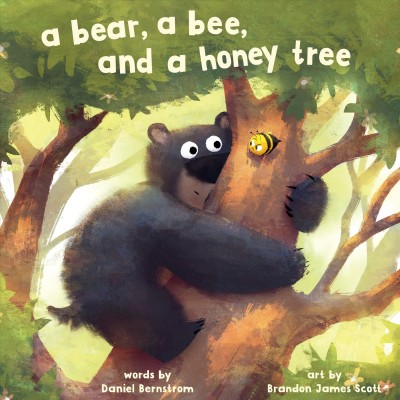
Read: A Bear, a Bee, and a Honey Tree by Daniel Bernstrom & Brandon James Scott (TB)

book cover for a bear, a bee, and a honey tree.

Tickle Rhyme: Bears Eat Honey (TT) (TB) (FT)
Bears eat honey
They think it’s yummy,
In their tummy
But…
the bees don’t think it’s funny!
(Buzz, buzz, buzz!)
Source: Storytime Katie

I was inspired by a rhyme about a bear playing with colored balls on the Verona Storytime blog, but rewrote the rhyme so our bear was searching for different kinds of berries. I used my Folkmanis baby bear puppet and the berries from the Jamberry set.
Flannel Game: Hungry Bear (TT) (FT)
Black bear is hungry
She wants something sweet
She’s searching for a RASPBERRY treat!
Is this the raspberry?
Source: original

realistic black bear cub puppet with 5 printed/laminated pictures of berries - a blackberry, gooseberry, raspberry, strawberry, and blueberry.

Booktalk: Jamberry by Bruce Degan (TB)
My library actually doesn’t own a copy of this book, so I didn’t read it. It didn’t make sense to do the Jamberry rhyme out of nowhere, though, so I ILLed a copy and booktalked the book, highlighting the pages where they are on the canoe.

book cover for Jamberry

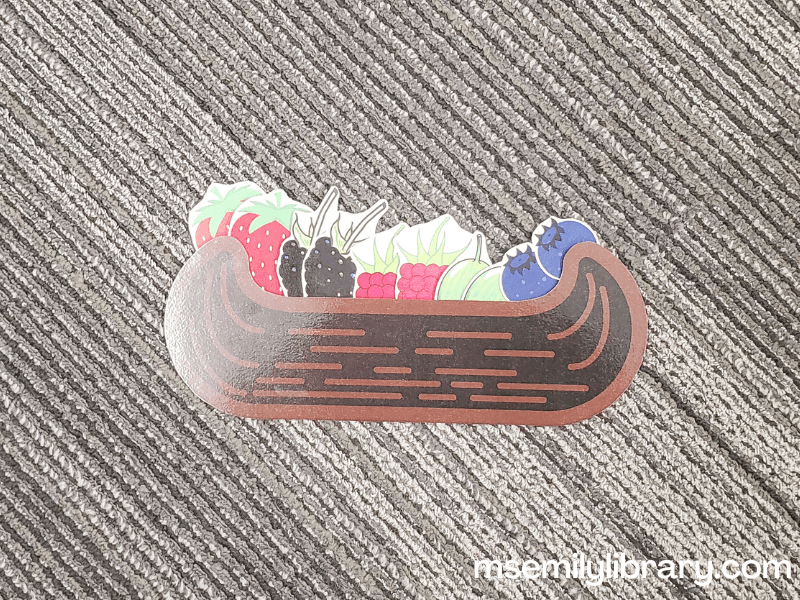
I created this flannel using graphics in Canva. I think originally the set inspired by Jbrary only had five berries, but since we were counting up to ten, I made two of each kind of berry.
Flannel Chant: Jamberry Rhyme (TB)
Under the bridge And over the dam
Looking for berries, Berries for jam!
1 berry, 2 berries, Pick me a strawberry
(repeat, count up to 10, changing berries)
Source: Jbrary

laminated flannelboard set with a stylized brown canoe holding two strawberries, two blackberries, two raspberries, two gooseberries, and two blueberries.

Stretch Rhyme: Pick Berries High (TT) (TB) (FT)
(style of Pease Porridge Hot)
Pick berries high, Pick berries low
Pick berries on the bush, Nine in a row
1-2-3-4-5-6-7-8-9 (clap 9x)
Some like them red, (gesture to one side)
Some like them blue (gesture to the other side)
Here’s one for me- yum! (pretend to eat)
And here’s one for you! (offer hand)
Source: Story Book Stephanie

I’ve never successfully gotten my room full of toddlers to get into a circle, so we just walked in place. Many grownups did a lift for the “pop” instead of doing the jump, with many giggles.
Action Song: Pop Goes the Berry (TT) (TB) (FT)
(tune of Pop Goes the Weasel)
(walk or dance in circle)

All around the strawberry fields
We picked some juicy berries
We brought them home
And washed them off,
Pop! Goes the berry! (jump up)
Other verses: blueberry, blackberry, gooseberry, raspberry
Source: Jbrary

I didn’t end up using this one for time, but love the idea of using your knees as the mountain, as in the inspirational video from Intellidance. Bear would certainly be going over the mountain to find berries, right?
Action Song: The Bear Went Over the Mountain
Oh, the bear went over the mountain,
the bear went over the mountain
To see what he could see
But all that he could see
All that he could see
Was the other side of the mountain
The other side of the mountain
Was all that he could see!
(repeat with the bear going around, under, or jumping over the mountain)
Source: traditional, motions inspired by Intellidance

A favorite rendition of this traditional song.
Recorded/Action Song: Teddy Bear, Teddy Bear (TT)
Teddy bear, teddy bear, Turn around
Teddy bear, teddy bear, Touch the ground
Teddy bear, teddy bear, Wave up high
Teddy bear, teddy bear, Wink one eye
Teddy bear, teddy bear, Bend your knees
Teddy bear, teddy bear, Flap in the breeze
Teddy bear, teddy bear, Climb up to bed
Teddy bear, teddy bear, Rest your head!
Source: Jazzy Ash, from the album Good Foot

For my two older classes, I made simple bear puppets with a die cut and craft stick to give out to use with the next two songs (that they got to take home with them.)
Puppet Rhyme: My Bear (TB) (FT)
(use a bear puppet or teddy bear to act out the rhyme)
My bear is looking all around
My bear is sniffing at the ground
My bear is looking at my toes
My bear can kiss me on the nose
My bear can whisper in my ear
What is that? Can you hear?
My bear can hide right behind me
But wherever I go, my bear can find me
Source: Verona (WI) Story Time

bear puppet - brown construction paper die cut teddy bear silhouette taped on to a wooden craft stick.

Ukulele/Puppet Song: Baby Bear Waltz (TB) (FT)
1, 2, 3, 1, 2, 3, Waltzing with bears
1, 2, 3, 1, 2, 3, Dance ‘round the chairs
1, 2, 3, 1, 2, 3, That’s what we’ll do
1, 2, 3, 1, 2, 3, Waltzing with you
1, 2, 3, 1, 2, 3, Waltz round the room,
1, 2, 3, 1, 2, 3, Dance ‘round the moon,
1, 2, 3, 1, 2, 3, Glide past the stars
1, 2, 3, 1, 2, 3, Waltzing to Mars
Source: Kathy Reid-Naiman, from the album Say Hello to the Morning

Download a ukulele songsheet for Baby Bear Waltz!

Thumbnail of ukulele songsheet

Action Song: Zoom, Zoom, Zoom!* (TT) (TB) (FT)

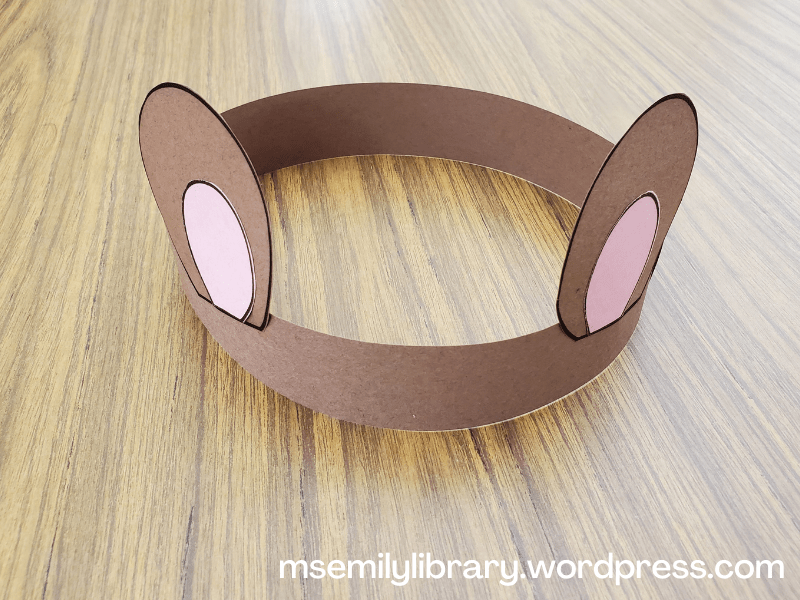
Craft: Bear Ears Headband (TB) (FT)
Simple, simple craft that allows for lots of dramatic play.

picture of bear ears headband - brown construction paper band with brown bear ears (and pink inner ear) glued on.

Play Time
The toddlers have two laundry baskets of baby toys – rattles and cars, sorters and stackers, toy phones and spinners. For the older kids, I have foam blocks, soft food toys, puzzles, and a few other items that are a little more sophisticated than the baby toys. For Family Time, I gauge the overall age of the group and put out what seems right for them. We play for 5-10 minutes at the most, then I ring the bell and ask the kids to help me clean up. I think the clean up bit is good practice for them!

Goodbye Song: See You Later Alligator* (TT) (TB) (FT)

Goodbye Rhyme: Tickle the Stars* (TT) (TB) (FT)

Other books I had available for families to browse (and may work for you on this theme)
Blueberries for Sal – Robert McCloskey
Eat Like a Bear –
April Pulley Sayre & Steve Jenkins
The Little Mouse, the Red Ripe Strawberry, and the Big Hungry Bear –
Don & Audrey Wood
Wild Berries –
Julie Flett
Berry Song –
Michaela Goade
Blueberry Cake –
Sarah Dillard
Old Bear –
Kevin Henkes
Bumpety, Dunkety, Thumpety-Thump –
KL Going & Simone Shin
Find Fergus –
Mike Boldt

This storytime was presented in-person on 8/28, 8/29, & 8/30/23.

Storytime Handout:

Handout with suggested books, rhymes, and song lyrics.

*Lyrics to these songs can be found on the Repeated Songs & Rhymes page.

**These symbols indicate the program sessions I used the activities for:
(TT) Toddler Time, ages 1-2
(TB) Teddy Bears, ages 2-3.5
(FT) Family Time, ages 0-3.5

Storytime: Country Life

Following up on last week’s “City Life” storytime, this time we went to the country! My library is in a suburban area, so it’s possible the kids here have some familiarity with rural or urban areas, or none at all. In either case, it’s good to explore our world with books!

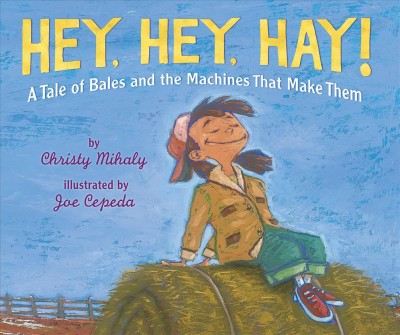
It is very easy to plan a “Farm” storytime – there are plenty of books and rhymes and songs about farm animals. But I really wanted to reflect what it’s like for PEOPLE living in the country, and from a modern standpoint, at that. It’s much harder to find books featuring non-stereotypical Farmer and Farmer’s Wife-type books. However, there are some excellent newer ones out there. I was really happy to see the book, Frances in the Country by Liz Garton Scanlon & Sean Qualls, featuring a BIPOC child visiting her cousins in the country. And C is for Country by Lil Nas X & Theodore Taylor III is another fun modern title. And though we did sing Old MacDonald, hopefully we got a little broader sense of what actually living in the country is like.

See another take on this theme from 2020 here.

Early Literacy Tip: Learning shapes and practicing manipulating them as we do in our tractor craft this week is an important early literacy skill. A child who is able to distinguish between shapes is better equipped to notice the differences in shapes of letters. This helps not only with reading but also with writing.

Welcome Song: Hello, Friends* (TT) (TB) (FT)**

Warm Up Song: Wake Up, Feet* (TT) (TB) (FT)
This is a repeated song that everyone seems to enjoy. I always begin and end with feet and tummies, but find two other body parts to wiggle in the middle. This week it was hips & noses.

Lifting Rhyme: Toast in the Toaster* (TT) (FT)

Rhyme: This is Big, Big, Big* (TB) (FT)

Intro: What does it mean to live in the country? There are fewer people on more land, it’s farther from cities and towns. Living in the country might mean there are farms, but it could also mean living in mountains, forests, even deserts. Even if you don’t live on a farm, a lot of people have the space to have a nice big garden in the country

Remember our elevator song from last week?  Here’s a version about the country!
Lifting Song: The Country Song (TT) (TB) (FT)
Oh, the country is great and the country is grand!
There are not a lot of buildings on a whole lot of land
And we live way out by the forest and the trees
We grow a lot of vegetables and maybe keep some bees
We put the seeds in the earth, we take the vegetables out
And we dance and shout!
Source: Jbrary

Bees are really important – they help pollinate the plants that give us food, as well as making honey.
Tickle Rhyme: Here Is the Beehive (TT) (TB) (FT)
Here is the the beehive (show fist)
But where are the bees?
Hidden away where nobody sees
Watch and you’ll see them come out of the hive
1, 2, 3, 4, 5… (show fingers)
They’re alive!
Buzz buzz buzz! (tickle)
Source: Jbrary

Transition: If You’re Ready for a Story* (TT) (TB) (FT)

This was the shorter of my two books, but I still paperclipped one set of pages to shorten! Parents were very skeptical about putting vinegar in a drink as described in the switchel recipe. I love that this one shows a mother and daughter doing the farm work.
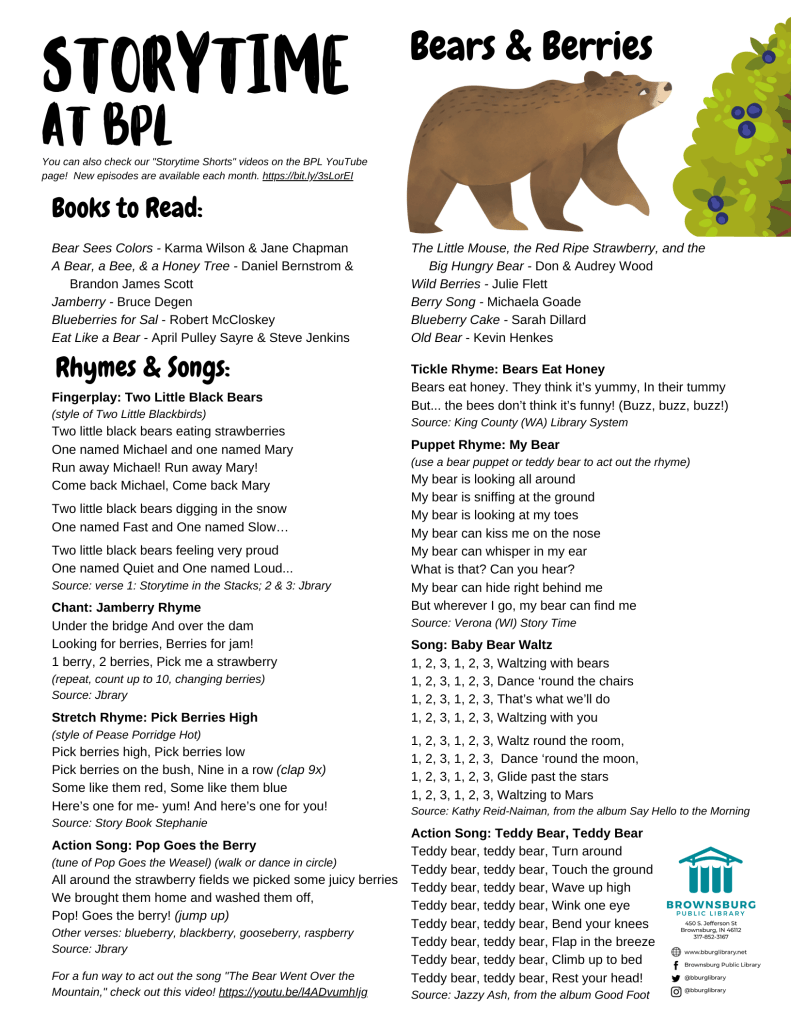
Read: Hey, Hey, Hay! A Tale of Bales and the Machines that Make Them by Christy Mihaly & Joe Cepeda (TT) (FT)

Book Cover for Hey, Hey, Hay!

Read: Frances in the Country by Liz Garton Scanlon & Sean Qualls (TB)

Book cover for Frances in the Country

I made up these lyrics for the last time I did the Country Life theme. This time I left out the “taking a break” verse for time. Riding on a tractor looks like fun, but also hard work!
Bounce: Bumpin’ Up & Down in My Little Green Tractor (TT) (TB) (FT)
(bounce child, then lift, hug, or lean on the last line)
Bumpin’ up and down in my little green tractor
Over the fields we go!

Additional verses:
Mowin’ down the grass in my little green tractor…
(bounce or “steer” tractor)
Takin’ a break for cake and switchel…
(bounce or pretend to eat & drink)
Baling up the hay in my little green tractor…
(bounce or roll arms)
Source: adapted from the traditional

We got out scarves and did some songs. You see a lot of corn being grown in the country. Did you know that our state, Indiana, is the second largest producer of POPcorn in the US?
Scarf Song: Popcorn Kernels (TT) (TB) (FT)
(tune of Frère Jacques)
Popcorn kernels, popcorn kernels (wave scarves overhead)
In the pot, in the pot (bunch up scarf in your fist)
Shake them, shake them, shake them! (shake)
Shake them, shake them, shake them!
‘Til they POP! ‘Til they POP! (toss scarves up into the air)
Source: Jbrary

If you live in the country, you might have room for a big garden!
Scarf Song: Picked a Strawberry (TT) (TB) (FT)
(tune of Clementine)
Picked a strawberry, picked a strawberry
That was growing in the sun
Then I washed it, and I ate it
And I picked another one
Repeat with other foods: apple, grape, tomato, blueberry, etc
Source: Jbrary

We can also grow some apples!
Scarf Rhyme: Way Up High in the Apple Tree (TT) (TB) (FT)
Way up high in the apple tree, (pull scarf up through hand)
I saw two apples looking at me (make fists w/ scarf in one)
I shook that tree as hard as I could (shaking motion)
Down came the apples, (drop scarf)
and mmmm, they were good! (rub tummy)
Source: traditional

Everyone loves puppets! I made the barn for a farm storytime recently and I get some really rapt toddlers for this one!
Puppet Song: Old MacDonald had a Farm (TT) (TB) (FT)
Old MacDonald had a farm, E – I – E – I – O!
And on that farm he had a dog, E – I – E – I – O!
With a woof, woof here, & a woof, woof there
Here a woof, there a woof,
everywhere a woof, woof!
Old MacDonald had a farm, E – I – E – I – O!
How many other farm animals can you think of?
Source: traditional

Action Song: Zoom, Zoom, Zoom!* (TT) (TB) (FT)

Craft: Shape Tractor (TB) (FT)
Using some basic shapes, we made a tractor hauling hay in a trailer. My library had some yellow cotton balls in the craft closet, but white would work just as well.

Craft showing a green tractor with a red trailer attached, with three yellow cotton balls atop the trailer. Tractor and trailer are made from rectangles, and black circles are used as wheels.

Play Time
The toddlers have two laundry baskets of baby toys – rattles and cars, sorters and stackers, toy phones and spinners. For the older kids, I have foam blocks, soft food toys, puzzles, and a few other items that are a little more sophisticated than the baby toys. For Family Time, I gauge the overall age of the group and put out what seems right for them. We play for 5-10 minutes at the most, then I ring the bell and ask the kids to help me clean up. I think the clean up bit is good practice for them!

Goodbye Song: See You Later Alligator* (TT) (TB) (FT)

Goodbye Rhyme: Tickle the Stars* (TT) (TB) (FT)

Other books I had available for families to browse (and may work for you on this theme)
Green on Green – Dianne White & Felicita Sala
The Old Truck – Jarrett Pumphrey & Jerome Pumphrey
Birdsong – Julie Flett
Farmhouse – Sophie Blackall
Summer Sun Risin’ – W. Nikola-Lisa & Don Tate
Everything Is Different at Nonna’s House – Caron Lee Cohen & Hiroe Nakata
City Dog, Country Frog – Mo Willems & Jon J. Muth
C Is for Country – Lil Nas X & Theodore Taylor III
Early One Morning – Mem Fox & Christine Davenier

This storytime was presented in-person on 8/15, 8/16, & 8/21/23.

Storytime Handout:

Handout including book suggestions and rhyme/song lyrics.

*Lyrics to these songs can be found on the Repeated Songs & Rhymes page.

**These symbols indicate the program sessions I used the activities for:
(TT) Toddler Time, ages 1-2
(TB) Teddy Bears, ages 2-3.5
(FT) Family Time, ages 0-3.5

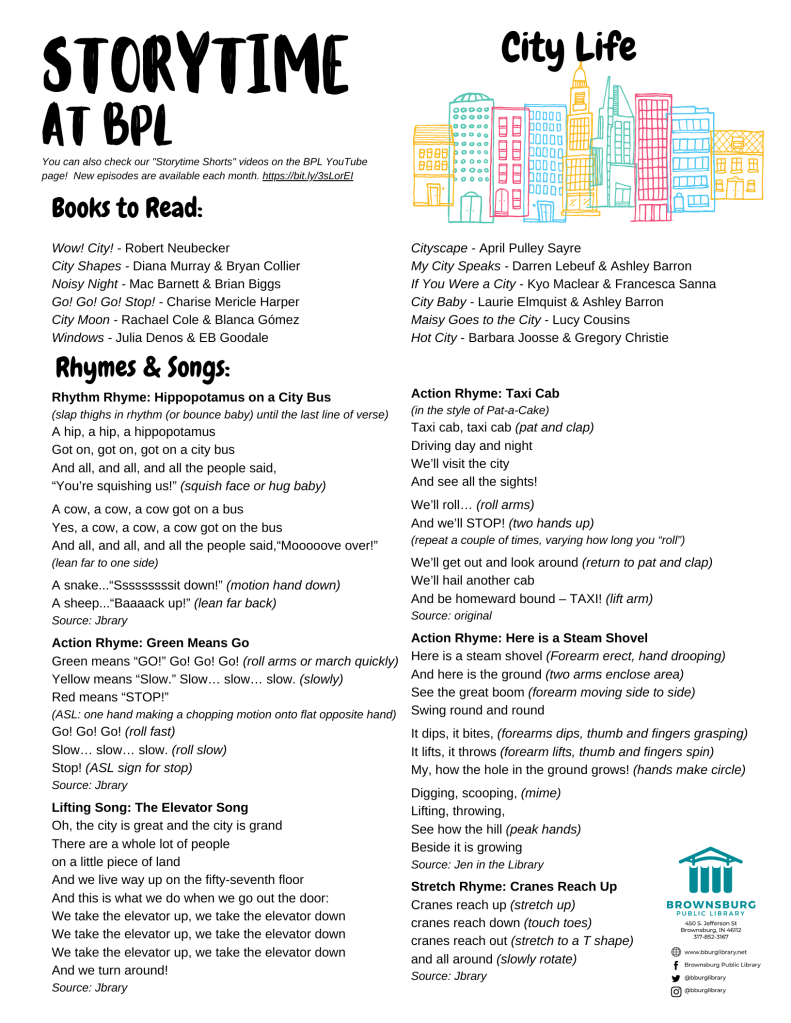
Storytime: City Life

I am still reusing, revamping, and retooling storytime themes that I first presented at a previous library. I do have a slightly different age group (skewing younger) and my outlines tend to have more extension activities and fewer books, so none have been exactly the same as what came before.

I opened up our “fall” season (August – December) with sessions on City Life and Country Life. There are great books concentrating on both, and I’d noticed some newer and different titles that my old library didn’t have. I also still do a virtual program – “Storytime Shorts” that highlights three extension activities, three books, a craft idea, and an early literacy tip. A previous episode was on transportation and used three of my go-to city rhymes and songs. To offer three fresh ones, I was inspired to write a new rhyme about taxi cabs, patterned after Pat-a-Cake. It isn’t something that comes naturally to me, but it was fun to play around with the words and rhythm and rhyme to find a poem that flows. And it worked well in practice! That was exciting to see the kids giggling while we “roll… and STOP!”

Early Literacy Tip: Rhymes like The Hippopotamus on the City Bus call attention to the fact that “hip” is just one part of the bigger word “hippopotamus.” Also, when we complete the verses for cow, sheep, and snake, we show how familiar animal sounds can be found in other words that we regularly use. Recognizing and playing with the smaller sounds in words is called phonological awareness. Researchers have recognized this as a critical pre-reading skill that helps kids sound out words when they begin to learn how to read.

Welcome Song: Hello, Friends* (TT) (TB) (FT)**

Warm Up Song: Wake Up, Feet* (TT) (TB) (FT)
This is a repeated song that everyone seems to enjoy. I always begin and end with feet and tummies, but find two other body parts to wiggle in the middle. This week it was elbows & cheeks.

Lifting Rhyme: Toast in the Toaster* (TT) (FT)

Rhyme: This is Big, Big, Big* (TB) (FT)

Intro: This week and next week, we’ll be talking about city life and country life. Some of us might know what that’s like, but I live in a place that’s kind of in between a big city and the country, and you might, too. Our town is very solidly “suburban.”

Rhythm Rhyme: Hippopotamus on a City Bus (TT) (TB) (FT)
(slap thighs rhythmically until the last line of each verse)
A hip, a hip, a hippopotamus
Got on, got on, got on a city bus
And all, and all, and all the people said,
“You’re squishing us!” (squish face or hug baby)

Additional verses:
A cow, a cow, a cow got on a bus
Yes, a cow, a cow, a cow got on the bus
And all, and all, and all the people said,“Mooooove over!”
(lean far to one side)
A snake…“Sssssssssit down!” (motion hand down)
A sheep…“Baaaack up!” (lean far back)
Source: Jbrary

Transition: If You’re Ready for a Story* (TT) (TB) (FT)

The text on this one is super simple, and the illustrations really give a lot to look at and talk about. I didn’t show every page, but it is an easy one to skip around.
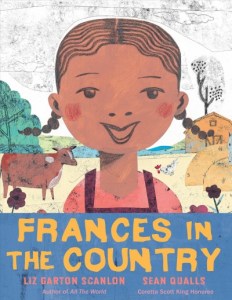
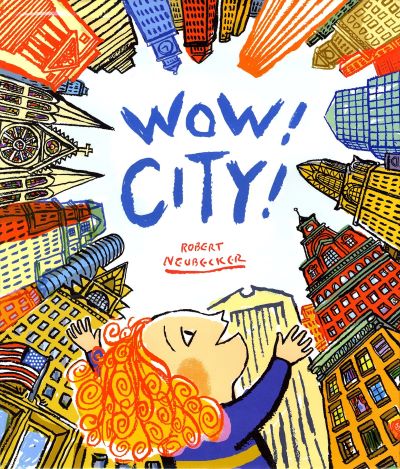
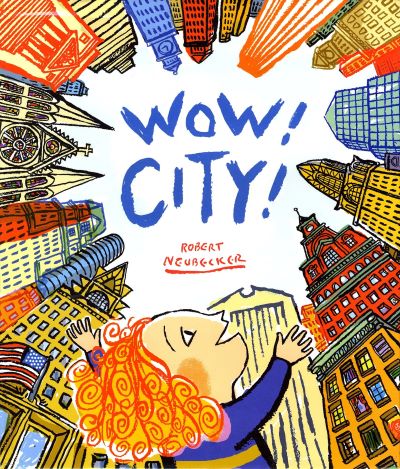
Read: Wow! City! by Robert Neubecker (TT)

I probably should have done Wow! City! for the Family Time group – they lost interest about halfway through, but they were a younger group.
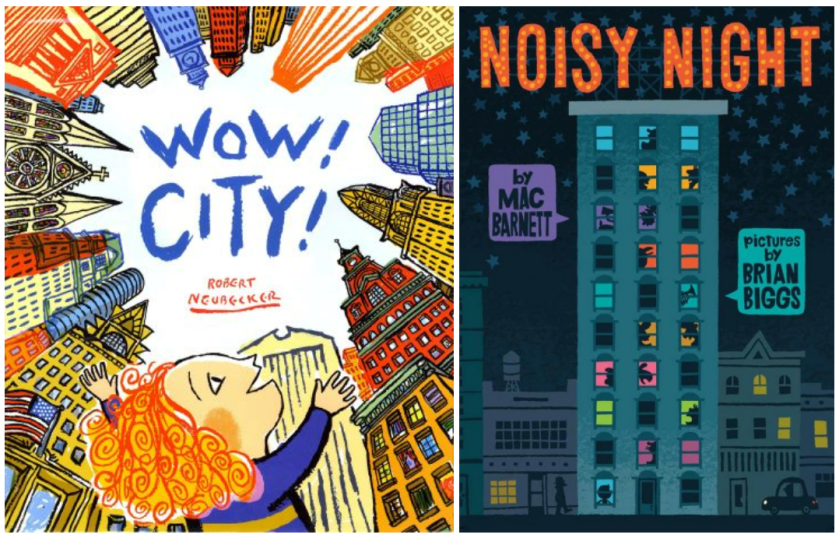
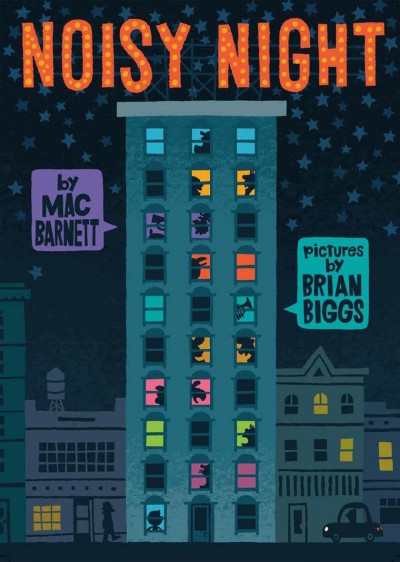
Read: Noisy Night by Mac Barnett & Brian Biggs (TB) (FT)

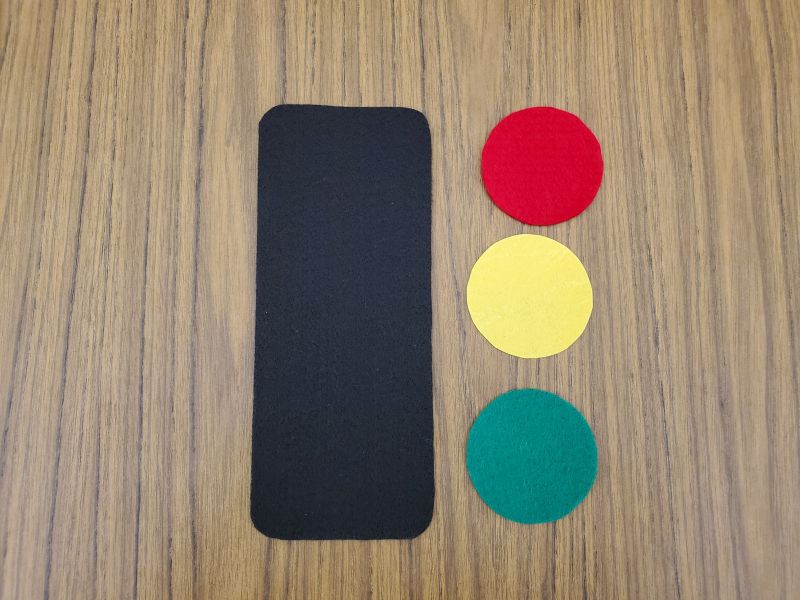
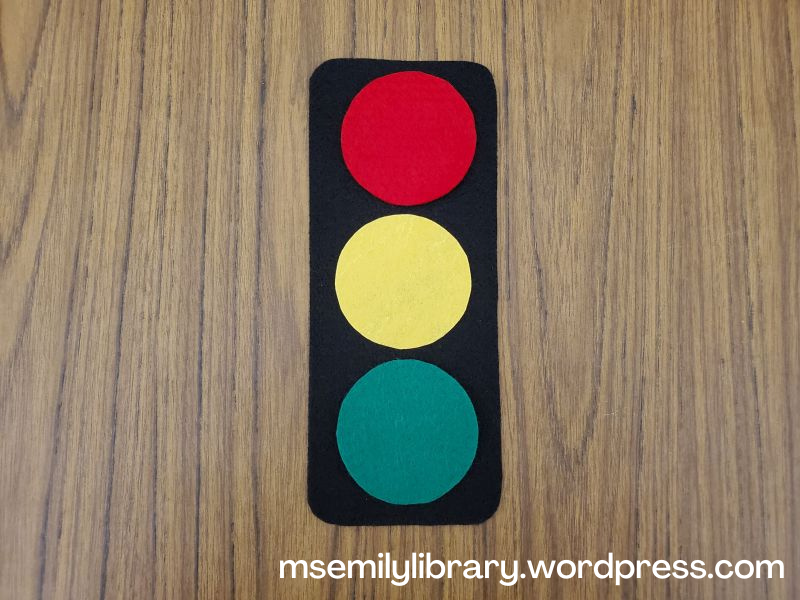
What shapes are these? Black rectangle, green circle, yellow circle, red circle – it’s a stoplight! There are stoplights everywhere, but there are LOTS in a city where there are many vehicles and traffic.
Flannel Rhyme: Green Means Go (TT)
Green means “GO!” Go! Go! Go! (roll arms quickly)
Yellow means “Slow.” Slow… slow… slow. (roll arms slowly)
Red means “STOP!” (ASL sign for stop: one hand making a chopping motion onto flat opposite hand)
Go! Go! Go! (roll fast)
Slow… slow… slow… (roll slow)
STOP! (ASL sign for stop)
Source: Jbrary

For Toddler Time, I did this song after Cranes Reach Up, but for the other two sessions, it followed directly after the Noisy Night book. Where do people live in the city? Many live in tall apartment buildings. Have you been in a tall building and taken a ride in an elevator?
Lifting Song: The Elevator Song (TT) (TB) (FT)
Oh, the city is great and the city is grand
There are a whole lot of people on a little piece of land
And we live way up on the fifty-seventh floor
And this is what we do when we go out the door:
We take the elevator up, we take the elevator down
And we turn around!
Source: Jbrary

Here’s the new one! We break out of the clap and pat to roll and STOP in traffic for a bit – really vary the length of time to roll for the most fun. Then we return to pat and clap when we reach our sightseeing destination and yell out that “TAXI!” at the end.
If you go visit a city, you might use a taxi cab to get around.
Action Rhyme: Taxi Cab (TT) (TB) (FT)
(in the style of Pat-a-Cake)
Taxi cab, taxi cab driving day and night (pat and clap)
We’ll visit the city and see all the sights!
We’ll roll… (roll arms)
And we’ll STOP! (two hands up)
(repeat a couple of times, varying how long you “roll”)
We’ll get out and look around (return to pat and clap)
We’ll hail another cab and be homeward bound – TAXI! (lift arm)
Source: original

In the city, it’s very busy, and the city is always growing and changing. Sometimes old buildings are torn down and new buildings are constructed. Here’s a stretch about the tall, tall crane that helps build them!
Stretch Rhyme: Cranes Reach Up (TT) (TB) (FT)
Cranes reach up
Cranes reach down
Cranes reach out
And all around
Source: Jbrary

One more construction rhyme.
Action Rhyme: Here is a Steam Shovel (TB)
Here is a steam shovel (Forearm erect, hand drooping)
And here is the ground (two arms enclose area)
See the great boom (forearm moving side to side)
Swing round and round
It dips, it bites, (forearms dips, thumb and fingers grasping)
It lifts, it throws (forearm lifts, thumb and fingers spin)
My, how the hole in the ground grows! (hands make circle)
Digging, scooping, (mime)
Lifting, throwing,
See how the hill (peak hands)
Beside it is growing
Source: Jen in the Library

No matter where you live, everyone likes to go outside and play. Even though cities can be full of buildings and streets, they also have public parks where people can go to enjoy some nature. Let’s sing a song about playing outside.
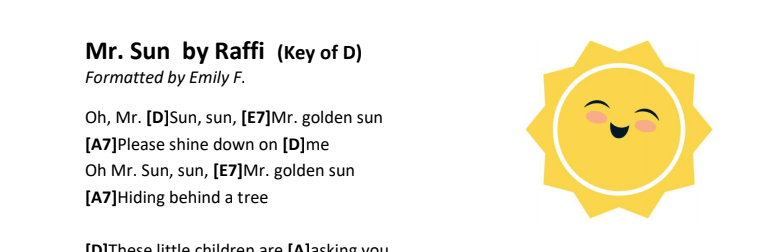
Ukulele Song: Mr. Sun (TT) (TB) (FT)
Oh, Mr. Sun, Sun, Mr. Golden Sun
Please shine down on me
Oh, Mr. Sun, Sun, Mr. Golden Sun
Hiding behind a tree

These little children are asking you
To please come out so we can play with you

Oh, Mr. Sun, Sun, Mr. Golden Sun
Please shine down on me
Source: Raffi (from the album Singable Songs for the Very Young)

Get a downloadable ukulele songsheet for “Mr. Sun” here!

thumbnail of Mr. Sun ukulele songsheet

Action Song: Zoom, Zoom, Zoom!* (TT) (TB) (FT)

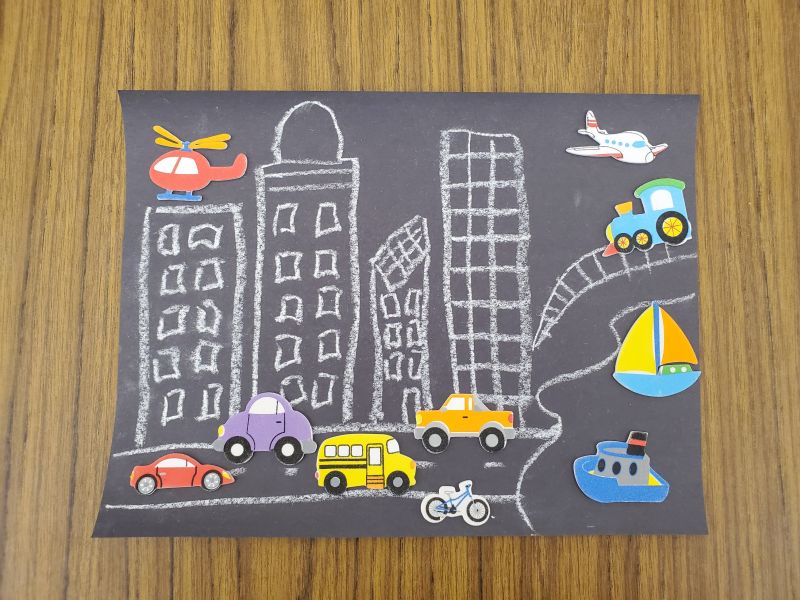
Craft: Cityscape (TB) (FT)
Draw a city with white chalk on black construction paper, then decorate with vehicle foam stickers. I used ALL my stickers on mine!
Source: Sunflower Storytime

Play Time
The toddlers have two laundry baskets of baby toys – rattles and cars, sorters and stackers, toy phones and spinners. For the older kids, I have foam blocks, soft food toys, puzzles, and a few other items that are a little more sophisticated than the baby toys. For Family Time, I gauge the overall age of the group and put out what seems right for them. We play for 5-10 minutes at the most, then I ring the bell and ask the kids to help me clean up. I think the clean up bit is good practice for them!

Goodbye Song: See You Later Alligator* (TT) (TB) (FT)

Goodbye Rhyme: Tickle the Stars* (TT) (TB) (FT)

Other books I had available for families to browse (and may work for you on this theme)
City Shapes – Diana Murray & Bryan Collier
Go! Go! Go! Stop! – Charise Mericle Harper
City Moon – Rachael Cole & Blanca Gómez
Windows – Julia Denos & EB Goodale
Cityscape – April Pulley Sayre
My City Speaks – Darren Lebeuf & Ashley Barron
If You Were a City – Kyo Maclear & Francesca Sanna
City Baby – Laurie Elmquist & Ashley Barron
Maisy Goes to the City – Lucy Cousins
Hot City – Barbara Joosse & Gregory Christie

This storytime was presented in-person on 8/7, 8/8, & 8/9/23.

Storytime Handout:

*Lyrics to these songs can be found on the Repeated Songs & Rhymes page.

**These symbols indicate the program sessions I used the activities for:
(TT) Toddler Time, ages 1-2
(TB) Teddy Bears, ages 2-3.5
(FT) Family Time, ages 0-3.5

Summer Storytimes: All Together Now, Part II

Summer is a great time to break out of the storytime structure I find myself in during the rest of the year. There’s nothing wrong with having structure, of course, but I find it invigorating to mix it up and feel free to try new things and be experimental during a set time of year.

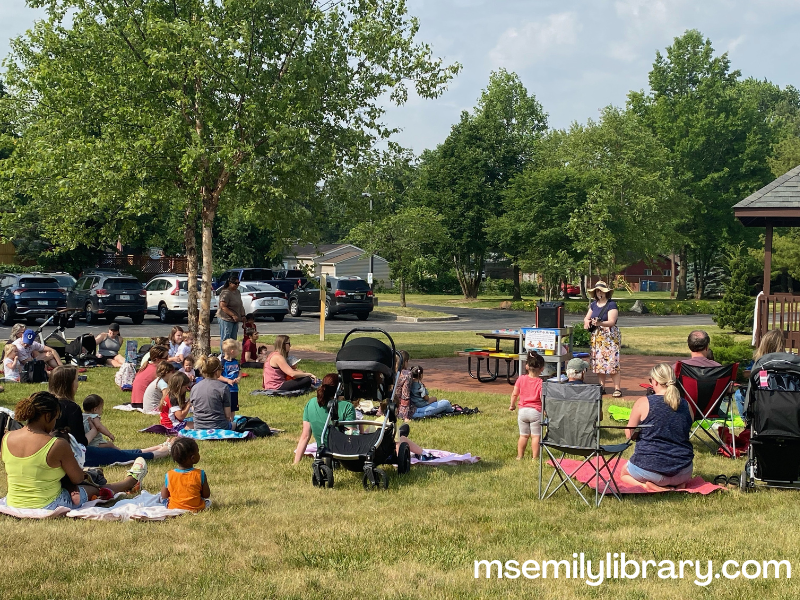
In the summer, I offer outdoor programs for kids ages 0-3.5 and their caregivers. We spend about 15-20 minutes doing songs, rhymes, books, and extension activities, and then take about 20 minutes at free-play sensory stations that engage kids and caregivers to talk, socialize and practice social skills, engage in science and age-appropriate STEM inquiries, flex creative muscles, and have lots of fun, associating the library with positive feelings. This post will detail these stations.

You can read more about the Storytime half of the summer sessions here, Summer Storytimes: All Together Now, Part I.

Each week I had eight stations that families could wander through. There was no requirement that they had to go to each station or change stations at any certain time, or at all. They chose their path and self-regulated. Some stations were available every single week, some rotated, and some were unique and only appeared during one week. They fell into “wet,” “dry,” and “art” categories. I used old sheets to cover the stations so they wouldn’t be too tempting during the storytime portion of the program, and that worked well.

I also had a backup plan for when the weather or air quality was too poor to be outside. This was the summer of the Canadian wildfires, so there were several days that were not rainy, but smoke and particulates in the air made it unsafe to be outside – especially for the very young and for senior citizens (and many of my caregivers are grandparents in that category!) If we weren’t outside, I had reserved our two largest and adjoining meeting rooms, where I was able to set up both an area for stories and songs and the parachute on one side and stations on the other, so thankfully we didn’t miss out on any activities. If I remembered to take pictures indoors and out, I included both below to give a sense of layout.

The Plan: Stations

Wet Stations

This is a big draw – everyone likes playing in water! Outdoors, I used a hose and outdoor water supply to easily fill my tubs with water and could just pour it all out at the end of the session. Indoors, I hauled buckets from our janitor’s closet and possibly filled everything just a little bit less than I would outside. I used old flannel sheets underneath to absorb spills and make them easier to clean up. The meeting room has an emergency exit door that opens to some landscaping so all the water got dumped there at the end.

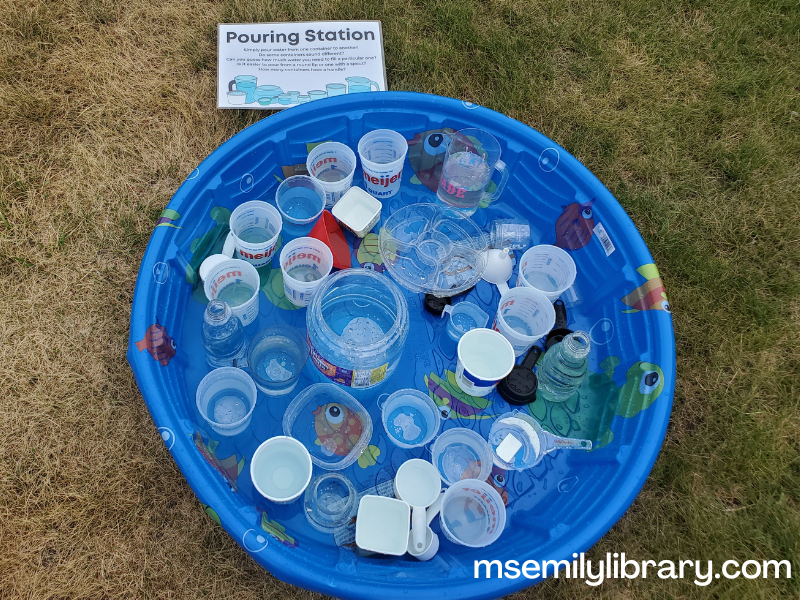
Pouring Station (all weeks)
This is a repeat from last year, so I had all of the materials for this one already. It’s also an easy one to set up, so it’s my anchor wet station: we had it out every week. Last year I asked coworkers to collect clean plastic recyclables with wide openings for this station and visited Goodwill for some additional pitchers. We had measuring cups and funnels in our materials, as well as a baby pool, which is the perfect container. I fill the pool with the plastic bins and fill them randomly with water. Original idea from Busy Toddler.

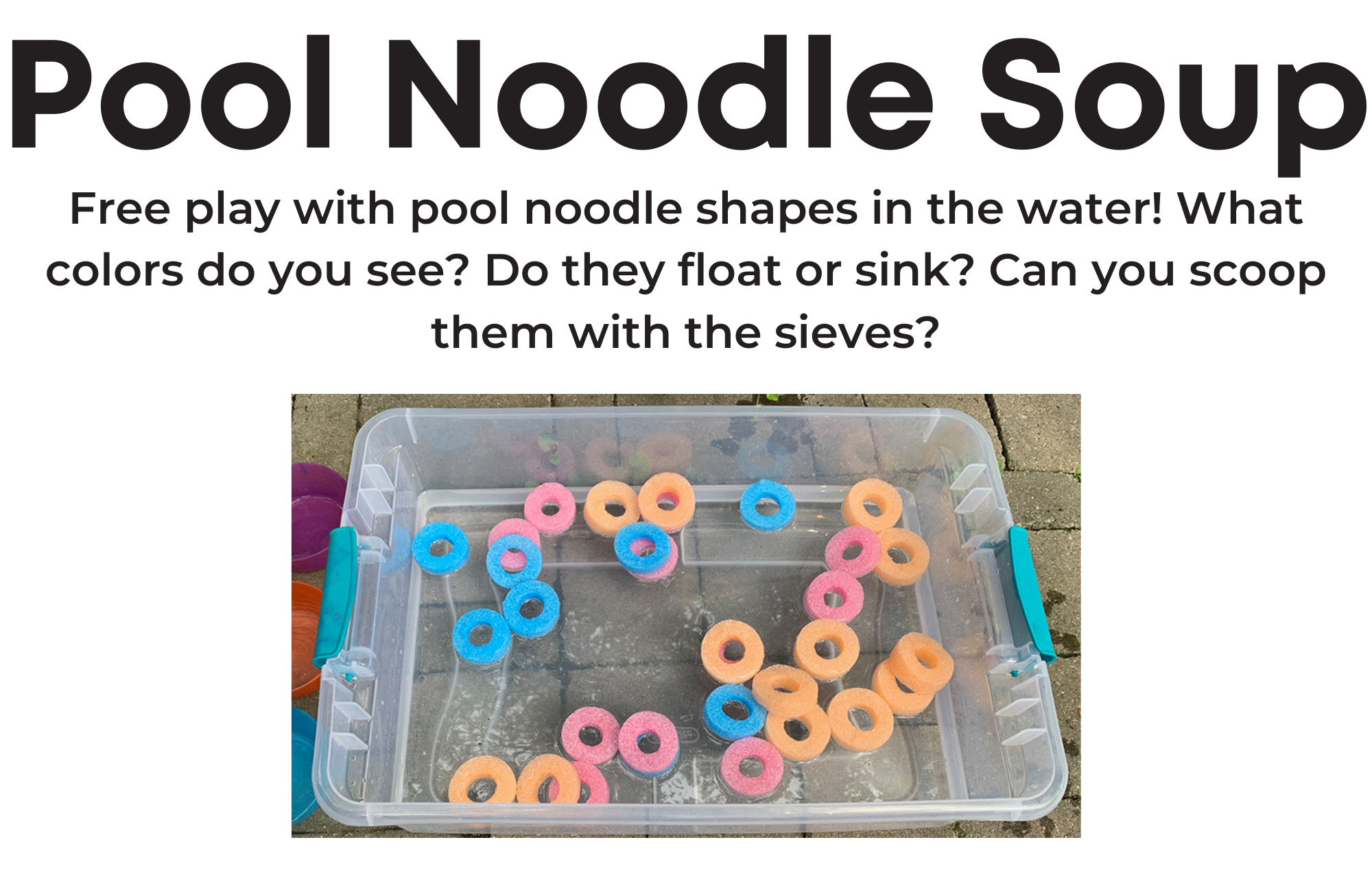
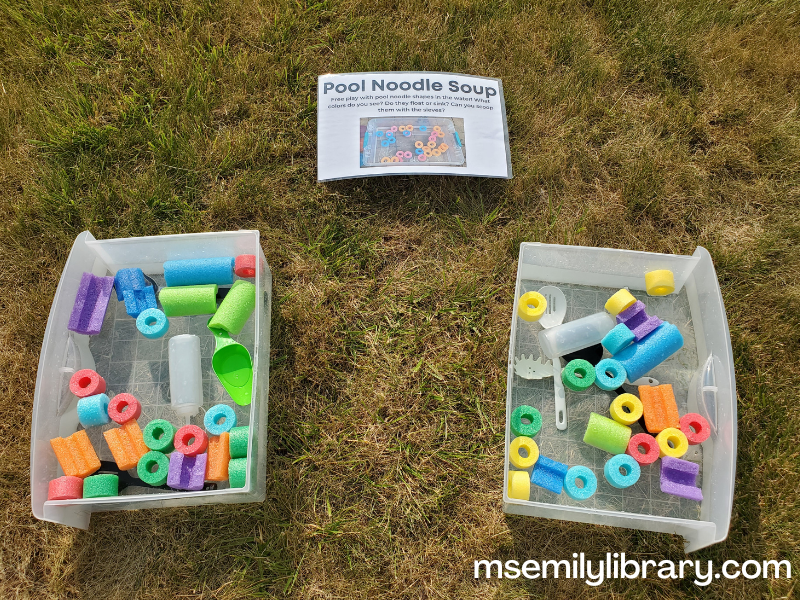
Pool Noodle Soup (Weeks 1 & 4)
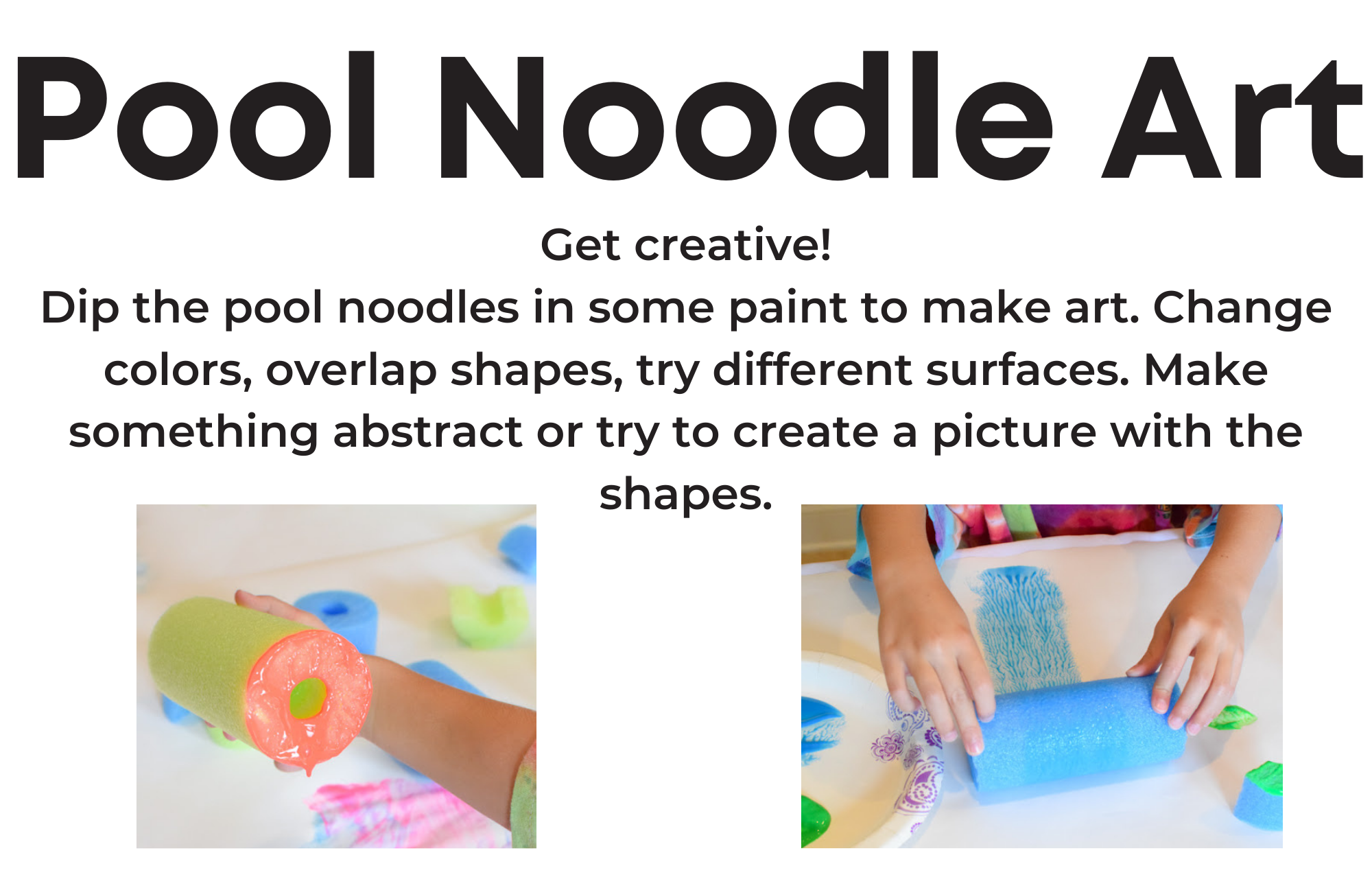
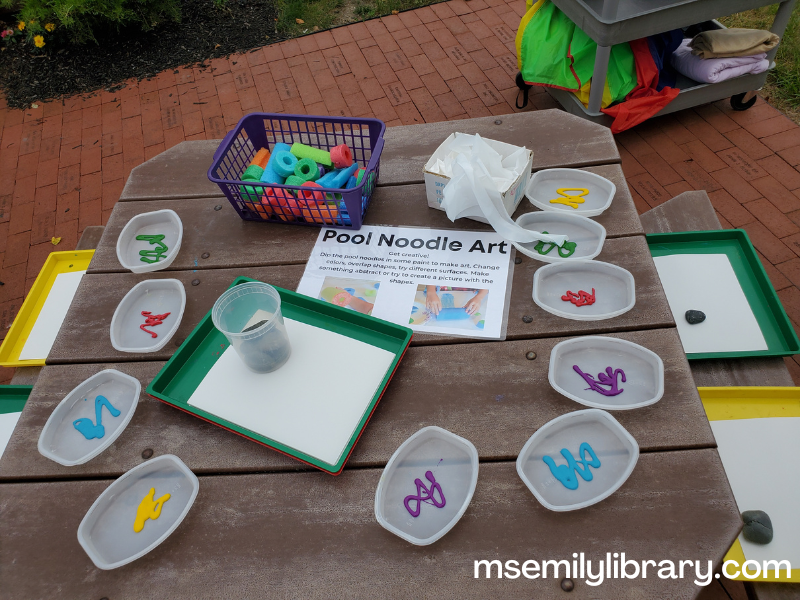
I cut sections of pool noodles and used them in three different ways, starting with this wet station. (You’ll see them below as a dry station and an art supply, too.) I used two drawers from a plastic storage bin as my containers, and added water, the noodles, some ladles and slotted spoons, and some squeeze bottles. Original idea (and photo on the sign) from Happy Toddler Playtime.

Fly Swatter Slap (Weeks 1 & 7)
Again, I maximized my materials by using flyswatters in both wet and dry stations on different weeks. The wet station included the (new, clean) swatters and ping pong balls that I drew flies on. I found the plastic containers at Goodwill and they are a little bit smaller than the drawers used above. The swatters were hand-shaped and different colors. Original idea (and photo on the sign) from My Bored Toddler.

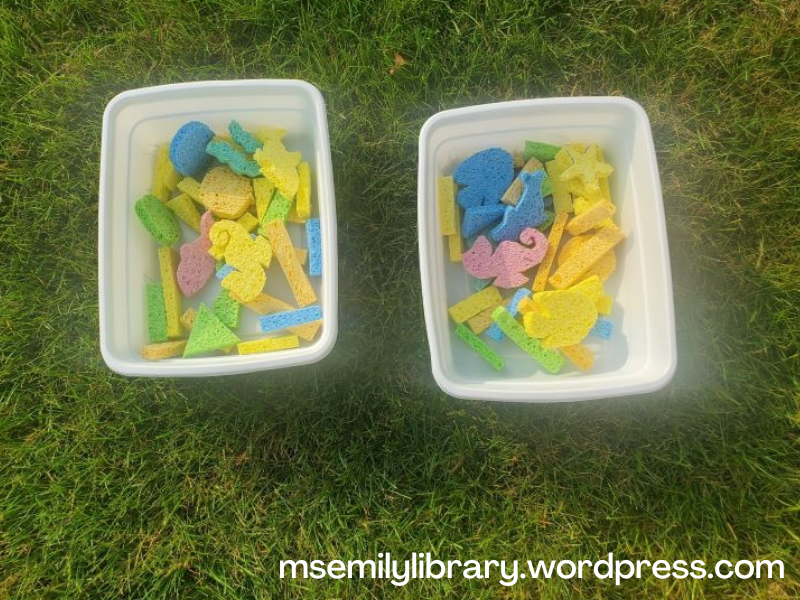
Sponge Play (Weeks 2 & 7)
This was another repeat from last year, but one that’s especially great for the youngest of my age group. When it was out it was usually surrounded by the “baby brigade!” The shapes were ocean animals since last year’s theme was “Oceans of Possibility” but they were just as happy with the simple shapes. Original idea (and photo on the sign) from Little Lifelong Learners.

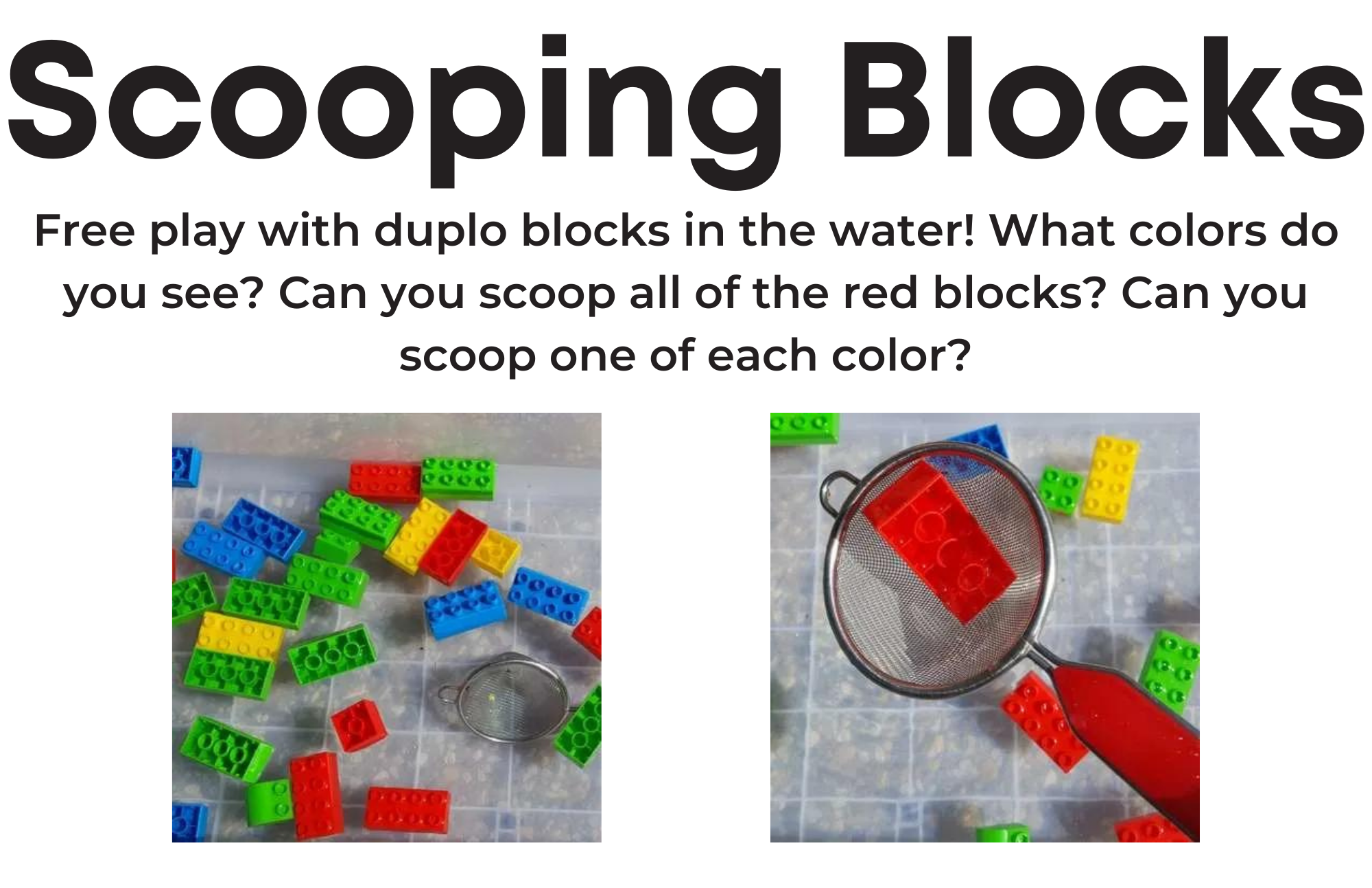
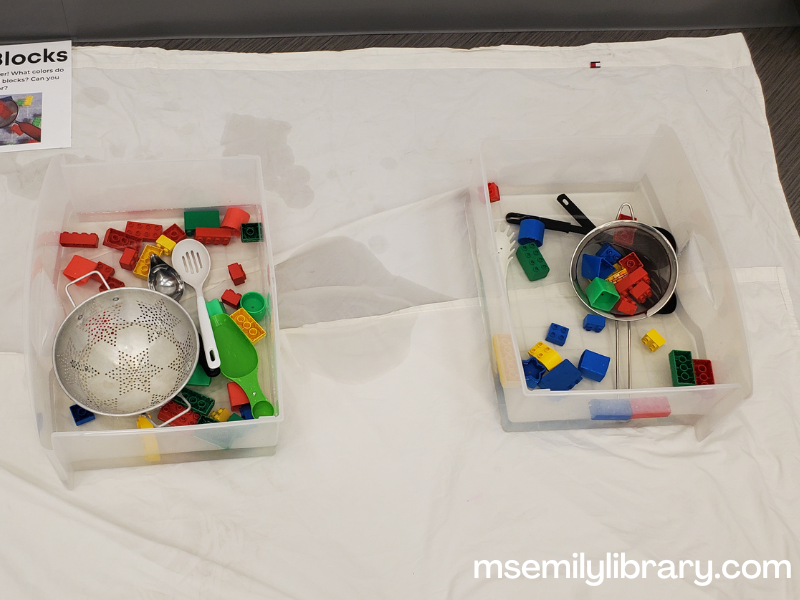
Scooping Blocks (Weeks 2 & 5)
Lego Duplos plus water and scoopers! This one was fun for its obvious purpose, but added bonus: some kids actually took the Duplos out of the water and put them together! We had all the Duplos already, and I added some of the sorting blocks from our baby toys to the mix, as well as ladles, colanders, and sieves from Goodwill. Original idea (and photo on the sign) from My Bored Toddler.

Mystery Water (Week 3)
Another repeat from last year – I originally saw this as on Pinterest as a reel, and was intrigued. Cornstarch and a little food coloring are added to water to turn it murky, and kids can search for items in the water to match up with a finding guide. We had a bunch of colorful plastic cookie cutters in storage that were perfect for this, so I traced them on a separate sheet for the kids to match up. They weren’t as solid and heavy as the original poster’s, so they tended to float a little, unfortunately, but it didn’t really matter. Original idea (and photo on the sign) from bright_little_brains.

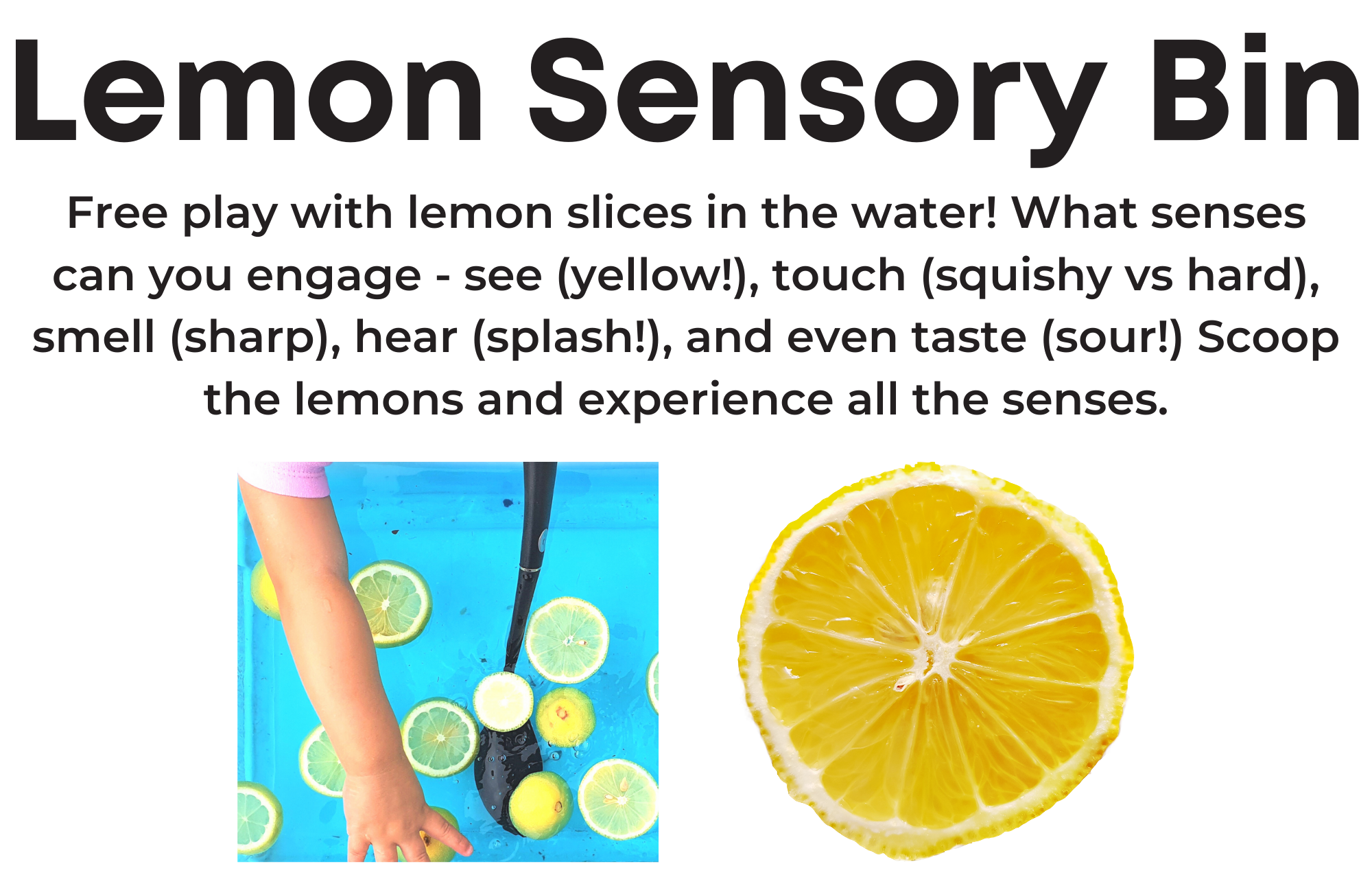
Lemon Sensory Bin (Week 3)
Mm, this was one of my favorite stations! It was super easy and smelled so good. I bought a bag of lemons and divided them among my three sessions. That was maybe 2-3 lemons per day? Cut them up into slices and added them to a bin of water along with ladles. I did announce that there was a lemon bin before breaking for stations just in case there was an allergy issue, but no one had a problem. Original idea (and photo on the sign) from Taming Little Monsters.

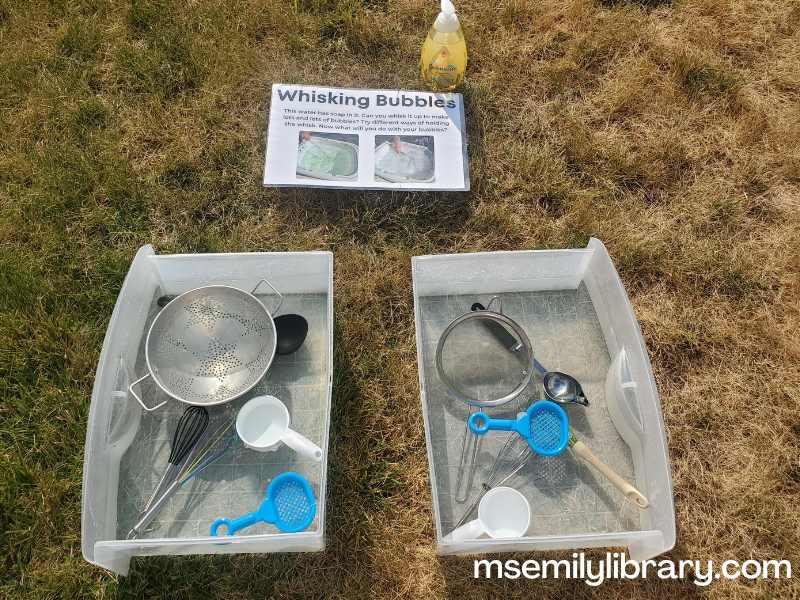
Whisking Bubbles (Week 4)
Kids could whisk up some bubbles and then use colanders and sieves to play with the result at this station. At first I just thought I would get some dishwashing soap, but then I started thinking about soap in eyes and mouths. I ended up buying some body soap formulated for babies (tear-free) and that worked perfectly. I looked for actual baby bubble bath, but couldn’t find it in store, so was a little worried about how sudsy it would get, but it ended up being just fine. And I’m so glad I went that route – I remember one of the babies did a nose-dive into the bin at one point and, indeed, there were no tears! I added the soap at the beginning and left the water undisturbed so that the kids could create all the bubbles themselves. Original idea (and photo on the sign) from The Empowered Educator.

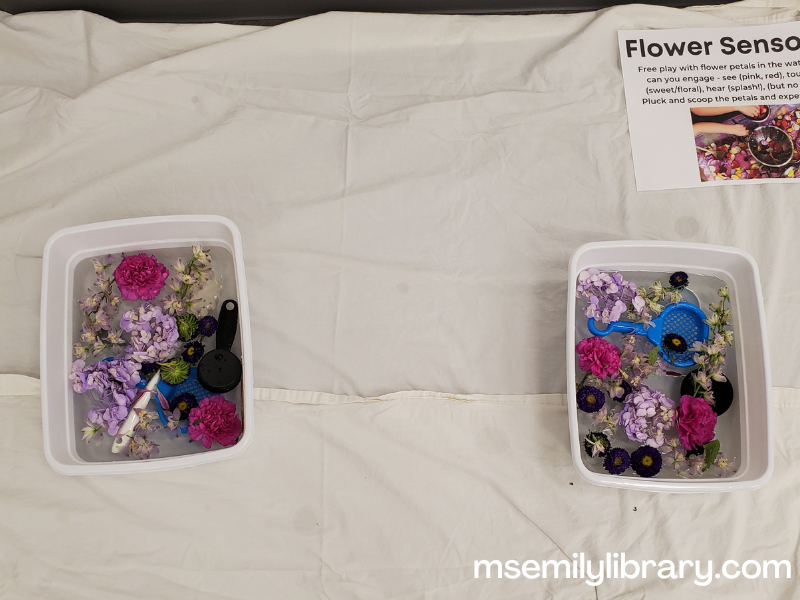
Flower Sensory Bin (Week 5)
I called our local Kroger florist and asked if they would donate flowers that were past their prime, so I was able to put this bin together without the cost of the flowers! It was also interesting to see the variety that was available on the two days I picked them up. One day I got a bouquet with several kinds of flowers that filled my two little bins, and the other day all that was available were colored daisies. Both were appreciated, and grown-ups commented on the pleasant scent and the novelty of the experience. I also got an action shot (with permission from the participants) on this one, since I wanted to include it in my thank you note to the florist. Original idea (and photo on the sign) from Learning and Exploring Through Play.

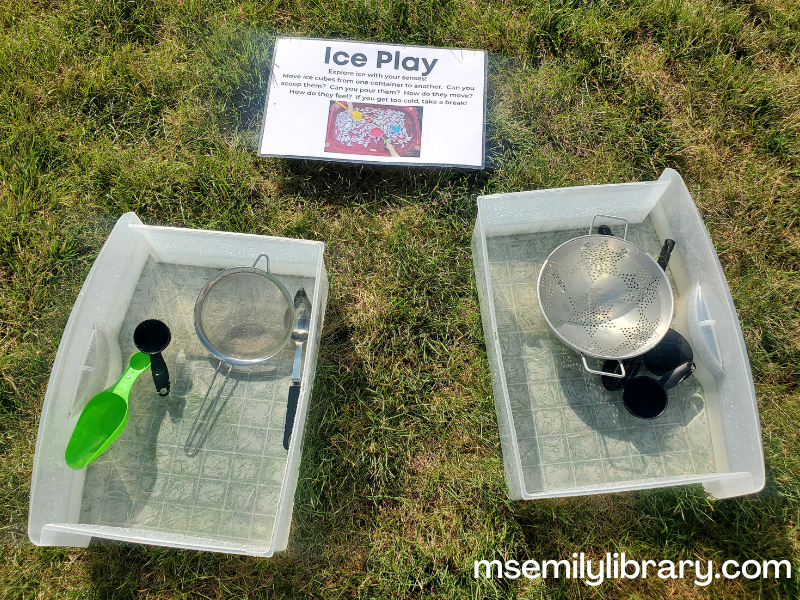
Ice Play (Week 6)
Another repeat from last year. I bought a large bag of ice each morning before my program and kept it in a cooler, adding it to the bins JUST before they were played in (so there’s no ice shown in the photos I took before the program). Ladles, colanders, and sieves were added for handling the ice. It was good weather for it – HOT – so the ice was mostly melted by the end of the station play time, but it was just enough. I reminded everyone to take a break if their fingers started to get too cold. Original idea (and photo on the sign) from Busy Toddler.

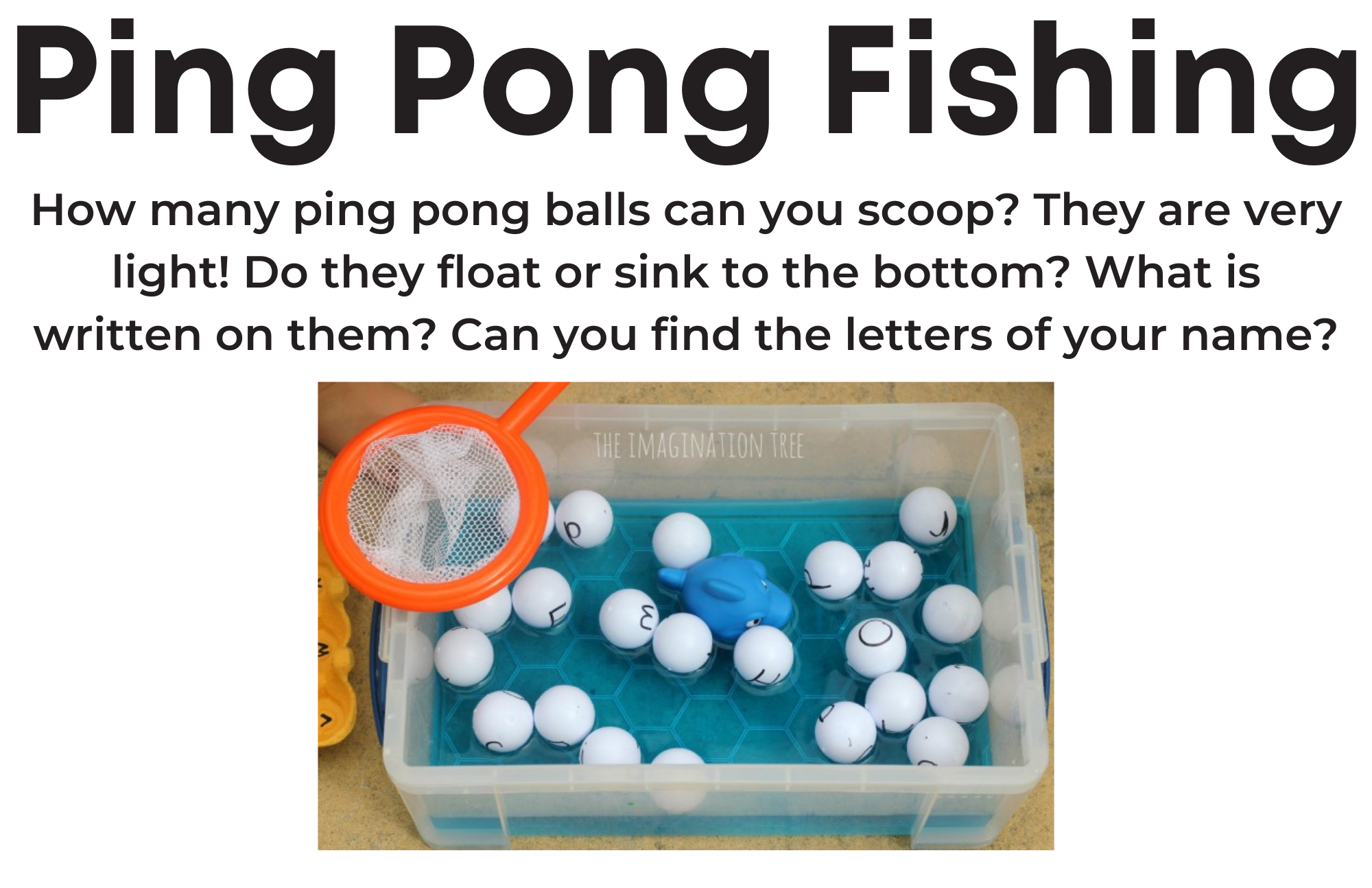
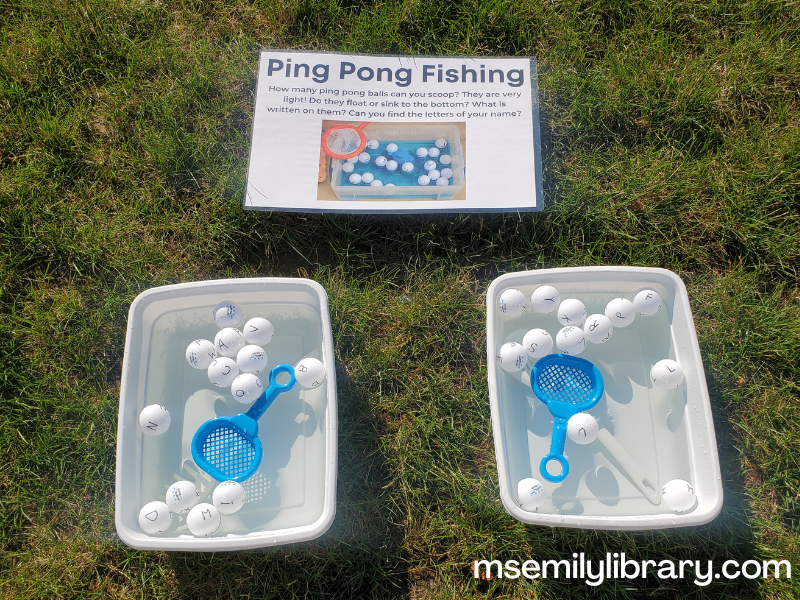
Ping Pong Fishing (Week 6)
I put the alphabet on ping pong balls and added them with scoopers into the bin. Adding the letters to all four sides of 26 balls took the most time! I think I added the housefly balls from the fly swatter slap station the second and third day, but they aren’t pictured. Original idea (and photo on the sign) from the Imagination Tree.

Dry Stations

There were a few families that didn’t want to get wet, so I was sure to offer three dry stations each week as well. Many of these gave practice in sorting various items by color, shape, or texture.

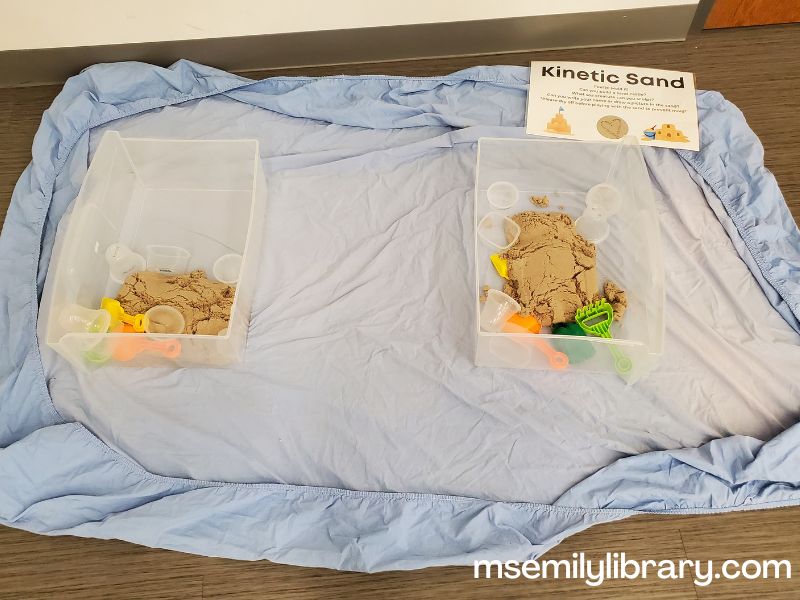
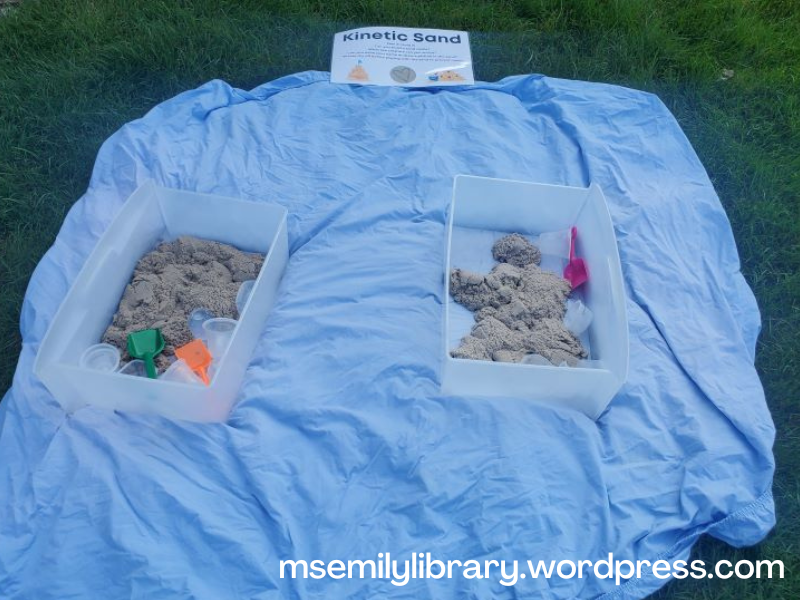
Kinetic Sand (all weeks)
Along with the Pouring Station above, this was the only station that was available all summer long. I had the supplies from last year, which included the kinetic sand itself as well as recycled fruit cup containers that had fun shapes and plastic shovels. I kept a sheet underneath this station to catch any stray sand that escapes the bins. Because the sand is not taste-safe, I do warn the caregivers that if their kiddo is still exploring with their mouth, they may want to skip this station.

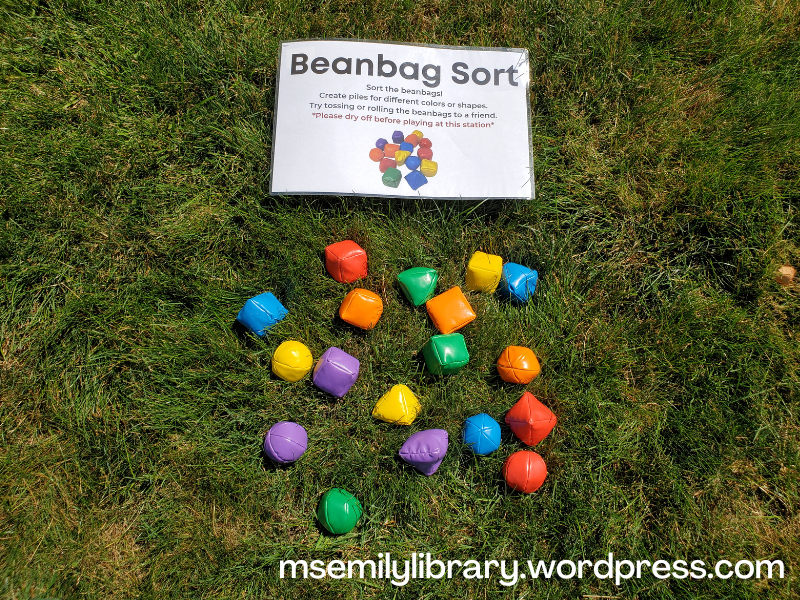
Beanbag Sort (Weeks 1, 4, & 7)
We had these beanbags from Lakeshore Learning that are different colors and shapes. They’re a super easy station where kids can play and sort with them in several ways.

Craft Stick Sort (Weeks 1, 4, & 7)
Another repeat from last year that was already “done.” I noticed in my storage bin that I had these boxes of dot painters that have small holes already in the top. I colored a ring around each hole a different rainbow color and added colored craft sticks for a fine motor and color identification station.

Pool Noodle Sort (Weeks 2 & 5)
A new station this year, but one I’ll repeat. Using the pool noodle slices (from Pool Noodle Soup), I taped a dowel rod to four small plastic cones in red, green, yellow, and blue. Kids could then thread the colored noodles on to the cones. Original idea from this Pin (no blog).

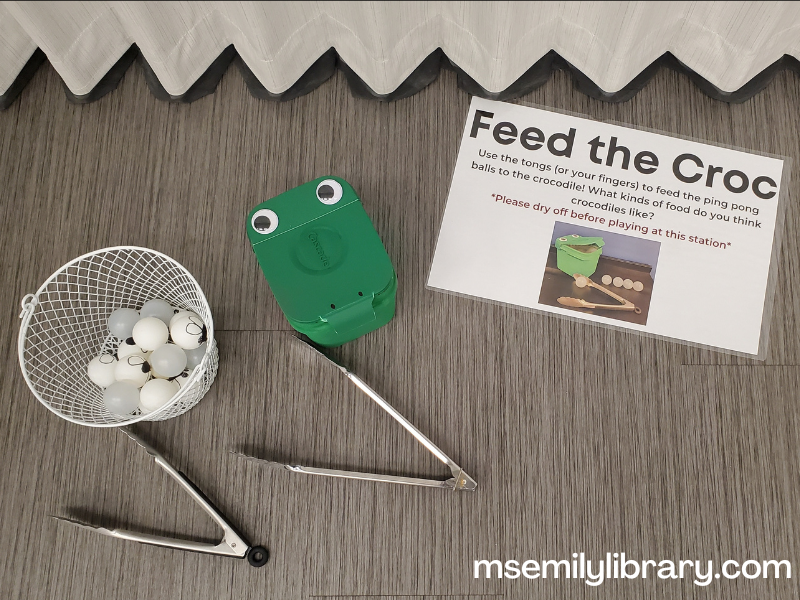
Feed the Croc (Weeks 2 & 5)
Saw this and thought it was very cute, and actually had the container from last year that someone had given to me. I painted it so that the whole thing is green and the label was covered up, added the big googly eyes and made little nostril markings. I found a few metal tongs at Goodwill and added the ping pong balls. Nom, nom, nom! Original idea from Mama OT.

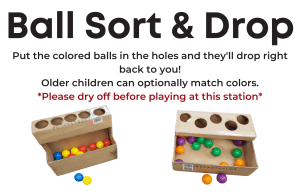
Colored Ball Sort and Drop (Weeks 3 & 6)
Two more repeats from last year. This ball sort and drop was made with Baker & Taylor boxes, but oriented them different ways so one was tall and skinny and one was low and squat. I had purchased ball pit balls and supplied different colors to each box. Photos from last year, which had weird blurs, sorry. Original idea from Taming Little Monsters.

Pompom Sort (Weeks 3 & 6)
A really easy station to put together: I just saved a couple of egg cartons, then poured a handful or two of different colored/sized pompoms into them. The plastic tongs I provided last year were all broken in use, so I bought some metal ice tongs for this year. (And again, weird blur). Original idea from Laughing Kids Learn.

Art Stations

With the exception of Coloring the Parachute, the art stations were all unique, and all were simple process-focused art with different media. To help with mess, I set up a “Rinse Station” near the art every week which consisted of two buckets of water and two old bath towels for washing up as needed.

Rinse Station sign:
"Messy hands? Rinse and dry off here!"

Color the Parachute (all weeks)
My library has an interesting smaller parachute (maybe 8 foot diameter?) that is plain white and was advertised as “decorate it yourself!” When I inherited it, there were a small scattering of names from who knows how long ago and the rest was depressingly empty. This summer I was determined to fill it up. I laid it out each week and set it as a station inside the gazebo, with a small handful of permanent markers. I’m happy to say that it looks MUCH better now, though it could still use a lot more personalization to fill up empty spaces. I offered some different ideas as the weeks went on as to what to add, like a favorite animal or insect. The first time we were indoors I offered it as a station, but cleaning up realized there was permanent marker on our relatively new flooring. To keep my director from going nuts, I decided not to put it out indoors anymore. 🙂 You can see the rinse station in the photo as well.

Shape Prints (Week 1)
Using shape sorter blocks that we already had in our baby toy collection, kids could dip them in paint and stamp the shapes onto white construction paper. I use old recycled Lean Cuisine trays to hold the paint – they are a perfect size. Sadly, I missed getting any pictures of this station! Original idea (and photo on the sign) from Nanny Gunna.

Dot Painting (Week 2)
I originally had a different craft planned for week 2, but it was rainy that week and we were indoors the first two days. Dot painting is very easy and not as messy as slapping paint with flyswatters (see week 6 below), so the switch was made. The library has a supply of dot paint markers and I printed out some animal dot coloring sheets. Simple and still fun. I get a lot of these sheets, including the ones pictured, from The Artisan Life.

Pool Noodle Art (Week 3)
The pool noodles make another appearance! Trays of tempera paint and white construction paper are available with the noodles for any kind of art a child wishes to make. I had a few extra pieces of noodles that had been split lengthwise as well as sliced, to make half-circle shapes in addition to the full circles. Original idea (and photo on the sign) from What Can We Do With Paper and Glue.

Ice Painting (Week 4)
This is honestly very simple, but I always get a lot of comments from grown-ups about how cool it is and how they might be able to do it at home. (I LOVE hearing that they’ll adapt what we do at the library at home!) I add small craft sticks to an ice cube tray and put in a little liquid watercolor paint and fill the rest with water. I think it could easily be done with food coloring if you don’t have liquid watercolors, though. I keep the ice cube trays in a cooler in the shade until we’re ready for stations, then get them out to use. They do melt, but usually there’s a bit of ice left by the end of the program. And my groups were quite tidy, so I was able to just refreeze the trays each day and there was plenty of “paint” available for three sessions. Original idea (and photo on the sign) from ARTventurers.

Finger Painting (Week 5)
A classic and super-simple activity – construction paper in our messy trays with finger paints in trays. I actually had several kids who didn’t like the sensory messiness of it, so some of them creatively used the rocks that are there to keep papers from flying away to spread the paint around. I’m not sure of the source of the photo on the sign, I think it’s a stock photo from Canva.

Fly Swatter Art (Week 6)
A messy but very fun art project, using (re-using) supplies from other stations. Kids wielded fly swatters to slap at paint, making some very interesting abstract art. I think the best method turned out to be adding some dots of paint to the paper, then letting the kids aim for them, rather than trying to spread paint on the swatter. I’m grateful for good weather all that week, since this is very much an outdoor activity. Original idea (and photo on the sign) from Play Teach Repeat.

Chalk Art (Week 7)
Another very simple process art project, using black construction paper and sidewalk chalk. It was nice to end the summer with an art station that didn’t involve paint – this librarian was very tired by that point!

Wow, thanks for making it to the end of this very long post. I hope you found some good ideas and jumping-off points for out-of-the-box programming!

Summer Storytimes: All Together Now, Part I

Welcome back to the blog! My library’s Summer Reading Program is officially over, and I am deep into planning the fall. Summer is so busy that I take a break from blogging, but it was a great season, and I’d love to share it with you. I implemented all I learned in the last couple of years doing outdoor programming, and I think it was the best yet, despite worse weather and air quality this year (boo.)

Our library generally uses the theme and graphics from the Collaborative Summer Library Program, or CSLP, a national initiative that helps libraries plan summer programming. This year’s theme was “All Together Now,” with an emphasis on kindness and community. I focused on a different aspect of this each week for seven weeks in June and July. My program themes then were Community, We Work Together, Kindness, Family, Animal Helpers, and Helping Hands. More detail on how these were interpreted below. I also simplified the usual age requirements that I normally have for my indoor programs through the rest of the year. (So, instead of a Toddler Time for 1-2 year olds on Mondays and a Teddy Bear time for 2-3.5s on Tuesdays, I offered Family Time for 0-3.5 Monday, Tuesday, and Wednesday.) Siblings are always welcome, and I don’t have a limit to the number of families who can participate, so the programs are open to all.

For each session, we had about 15-20 minutes of storytime rhymes, songs, and a book, then 20 minutes of free play at various sensory stations. We end with bubbles and a goodbye song. Stations are a really great way to promote socializing, practice skills like sharing and being gentle, and allow for unstructured play, which science tells us is so important to learning and development. I added a section of parachute songs weekly, too, which was a treat for everyone. It was easy to do thematically – “A parachute is hard to have fun with by yourself. You need some friends and have to work ‘all together!'”

I also am all about simplicity and repetition over the summer. I have a lot of moving parts, set up and tear down to deal with, so I don’t change a lot in the storytime part and plan everything ahead so I am purely in “execute” mode rather than worrying about planning or learning songs. I changed one song and the book each week, and had a mixture of weekly, rotating, and unique stations. Since so much was the same, I’ll write up the whole summer in two posts: this first one focusing on the storytime half, and the second post focusing on all of the hands-on stations!

And, in addition to being back from hiatus, I finally bit the bullet and bought a domain name and WordPress subscription. Welcome to the ad-free Storytime with Ms. Emily Library experience! Please let me know if anything is wonky or links not working correctly in the transition.

The Plan: Storytime Portion

Welcome Song: Hello, Friends
(tune of Goodnight, Ladies)
Hello, friends! Hello, friends!
Hello, friends, it’s time to say hello!
Hello, [name 1], hello, [name 2]!
Hello, [name 3], it’s time to say hello! (repeat as needed)
(ASL motions: salute for “hello,” then take the index fingers on each hand and you link them together as though they are hugging each other back and forth for “friends”)
Source: Glenside Public Library District

Warm-Up Rhyme: We Wiggle and Stop
(Use the ASL sign for the word “stop” – one hand “chops” across the opposite hand)
We wiggle and we wiggle and we STOP
We wiggle and we wiggle and we wiggle and we wiggle
And we wiggle and we wiggle and we STOP
(We wiggled every week, but then added 2 more motions. Motions we did throughout the summer: jump, twirl, run, splash, hop, swim, stretch, stomp, wave, sway, march, lean, roll [arms,] hug)
Source: Jbrary

Intro: Our summer reading program is “All Together Now” and it is all about how wonderful things can happen when we work together. Short intro to the weekly theme (see below)

Themed Song (see below)

Transition Song: If You’re Ready for a Story
(tune of If You’re Happy and You Know It)
If you’re ready for a story, clap your hands (clap, clap)
If you’re ready for a story, if you’re ready for a story,
If you’re ready for a story, clap your hands (clap, clap)
Source: Miss Keithia (my predecessor)

Themed Book (see below)

Parachute! A parachute is really hard to have fun with all by yourself. We need friends, and we need to work together!

Parachute Song: Let’s Go Riding in an Elevator
Let’s go riding in an elevator, Elevator, elevator (parachute up and down)
Let’s go riding in an elevator, Ride along with me!
First floor, Second floor, Third floor, Fourth floor, Fifth floor… (shake parachute low, and get progressively higher)
And down, down, down, down, down! (lower parachute)
Source: Jbrary

I remind everyone to start rowing very gently, then after the first verse, say, “Oh, the wind is picking up, can we row more firmly?” and before the third verse, “Oh, no, there’s a storm! Row as strongly as you can!”
Parachute Song: Row Your Boat (3 verses)
Row, row, row your boat
Gently/Firmly/Strongly down the stream
Merrily, merrily, merrily, merrily
Life is but a dream
(Wave the parachute gently, then firmly, then wildly!)
Source: traditional

Breathing Break
Whew, all that rowing got me out of breath! I’m ready for a breathing break. Let’s take a big breath in and lift the parachute up, then breathe out and lower it. We’ll repeat a few times.

Most people know the first verse, but the second verse is probably newer and much less well known. It was a fun way to get us “up” from falling down. We did this one twice, walking in one direction and then the other.
Parachute Song: Ring Around the Rosie
(walk in a circle with parachute)
Ring around the rosie,
Pocket full of posies
Ashes, ashes,
We all fall down! (fall and stay seated)

Cows are in the meadow, (crouching by the ‘chute)
Eating buttercups
Thunder, lightning, (shake the parachute)
we all stand up! (stand)
Source: traditional

It actually took a few weeks for the adults to “get” this one. Repetition is good for them, too. 🙂
Parachute Song: Parachute Fly
(tune of Skip to my Lou)
(kids go under the parachute and adults raise and lower)

Up, up, up it goes,
Down, down, down so low
Raise our parachute to the sky
Count to 3 and watch it fly
Spoken:
Up on one…
Down on two…
Up on three…
and FLY! (adults let go and leader pulls ‘chute in to themselves)
Source: Gymboree

Release to Stations
I have eight stations each week, which involve a mixture of dry, wet, and art/creativity stations. We spend about 20 minutes before I ring the bell to call everyone back to the grassy area. We’ll go into further detail on these in the next blog post.

Everybody loves bubbles! The trick to doing bubbles outside, I’m finding, is to figure out which way the wind is blowing and get upwind of your group!
Recorded Bubble Song: Pop, Pop, Pop by Nathalia
From the album “Dream a Little,” available on Spotify

CD album cover for Nathalia's Dream a Little

Goodbye Song: See You Later, Alligator
(tune of Clementine)
See you later, alligator (wave with one hand, then the other)
In a while, crocodile (open and shut arms like a croc’s mouth)
Give a hug, ladybug (hug yourself or a loved one)
Blow a kiss, jellyfish! MWAH! (move hand like a jellyfish then blow a kiss!)
Source: King County Library System

Weekly Themes

Week 1: Friends 6/6, 6/7/23

Intro: Friends are the people who we love to play and hang out with, and who help us out when we need it. I love making new friends!

Themed Song: All Together Now I played this one on my ukulele, and asked the group to participate by doing the “response” part of the “all together now” chorus. If you don’t want to sing this one, play the original recording by the Beatles or the cover by Caspar Babypants.
I got the chord sheet from Jim’s Ukulele Songbook. It’s a great resource since he’s got a lot of functionality built into the site and among other things you can change the key of any of the songs and print sheets very easily. I prefer to play and sing this one in the key of G.

Themed Read: Who Has Wiggle Waggle Toes? by Vicky Shiefman & Francesca Chessa This is a story of friends having fun together. Can you join in?

Week 2: Community 6/12, 6/13, 6/14/23

Intro: We live in a community of people, and the people in our community help each other. Some people have jobs that let them help others every day.

I played this one on my ukulele and took suggestions from the group. I prompted them by asking, “who helps us when we’re feeling sick?” if there was a lull.
Themed Song: Community Helpers Song
(tune of Farmer in the Dell)
The teachers teach the kids
Heigh-ho, they help us so
The teachers teach the kids

Choose 3-5 verses!
The firefighters put out the fires….
The crossing guards help us cross…
The librarians find us books….
The dentists check our teeth…
The doctors keep us well…
The farmers grow our food…
The mail carriers deliver the mail…
Custodians keep us clean…

Click for a ukulele songsheet for “Farmer in the Dell”

I encouraged the group to give a cheer for every page to keep interest up.
Themed Read: Cheer: A Book to Celebrate Community by Uncle Ian Aurora & Natalia Moore

Week 3: We Work Together 6/19, 6/20, 6/21/23

Intro: Working together really makes things go smoother.

Instead of the ukulele this week, we did the ASL motions.
Themed Song: The More We Get Together
The more we get together, together, together
The more we get together, The happier we’ll be
For your friends are my friends, and my friends are your friends
The more we get together, The happier we’ll be

The more we read together… (ASL for read)
We’ll read big books and small books
Read short books and tall books…

The more we work together the stronger we’ll be… (ASL for work)
Source: traditional, ASL for verse one

Themed Read: Blocks by Irene Dickson

Week 4: Kindness 6/26, 6/27, 6/28/23

Intro: One important way to work together is to show kindness. Being kind means thinking of others and doing what you can to be a good neighbor.

The root of all kindness, I believe, is love. Here’s a traditional song your grownups might remember from their childhoods!
Themed Song: Skinnamarink
Skinnamarinky-dinky-dink, Skinnamarinky-doo, I love you!
I love you in the morning, and in the afternoon
I love you in the evening, underneath the moon
Skinnamarinky-dinky-dink, Skinnamarinky-doo, I love you!
Source: traditional, motions from Jbrary

Themed Read: How Kind! by Mary Murphy

Week 5: Family 7/3, 7/5/23

Intro: We can start working together with the people who are closest to us – our families! Who are the people in your family?

Here’s a song for all the people in our families – listen carefully! I included some different iterations to try to be as inclusive as possible. To keep things from getting too long, I sometimes combined (grandma and grandpa). Pairing it with a silly action (and telling grown-ups that they count, too) increases the fun.
Themed Song: If You Have a Brother
(tune of Do You Know the Muffin Man)
If you have a brother
A half-brother, a step-brother
If you have a foster-brother
Please stand up!
Repeat with other family members: sister, mommy, daddy, cousin, aunt, uncle, grandpa, grandma, etc. Ask for suggestions!
Pair with other silly actions: raise your hand, stick out your tongue, wiggle your foot, jump up and down, pat your head, etc.

Source: Abby the Librarian (though I changed the tune)

Themed Read: The Family Book by Todd Parr

Week 6: Animal Helpers 7/10, 7/11, 7/12/23

Intro: Does anyone have a pet at home? Did you know that some animals have important jobs, helping their humans? Some animals help humans who need them to get around or keep them safe. Some animals help soothe people who are lonely or need an animal to help them calm down. Today we are celebrating these animal helpers.

I talked briefly about different helper animals and what they do – including miniature horses, who can be used for the visually impaired! Cats and bunnies are generally therapy animals. I used puppets for each, and asked what sound each one made – including the rabbit! “You’re right, rabbits are quiet! But they can be helpful by being snuggly!”
Themed Song: Animal Helpers Song
(tune of The Wheels on the Bus)
The dog helps his owner with a woof, woof, woof
Woof, woof, woof
Woof, woof, woof
The dog helps his owner with a woof woof
All day long!

The cat helps her owner with a meow, meow, meow…
The horse helps their owner with a neigh, neigh, neigh…
The bunny helps her owner with a snuggle, snuggle, snuggle…
Source: adapted from the traditional

So, I kind of realized after planning that this dog was not a working dog but a pet – the vest threw me off. It still seemed like the best option as far as length. If you know a better option, please let me know in the commets!
Themed Read: Best Day Ever! by Marilyn Singer & Leah Nixon

Week 7: Helping Hands 7/17, 7/18, 7/19/23

Intro: Who likes to be a helper? What are some ways you might help at home? Putting toys away, set the table, put laundry in the hamper, play with a younger sibling, etc.

Since we use this tune for our transitional song, which comes right after this one, I saved the “clap” action for that one and went right into it. I also played ukulele for this one!
Themed Song: If You’re Helpful and You Know It
(tune of If You’re Happy and You Know It)
If you’re helpful and you know it, stomp your feet
If you’re helpful and you know it and you really want to show it
If you’re helpful and you know it, stomp your feet

If you’re friendly and you know it, peekaboo…
If you’re thoughtful and you know it, shout hooray…
Then go right into “If you’re ready for a story, clap your hands”
Source: adapted from the traditional

Get a downloadable ukulele songsheet here!

thumbnail for ukulele songsheet

Themed Read: Kindness Makes Us Strong by Sophie Beer

Tune in to the next post to learn more about all the sensory stations – like the Fly Swatter Slap, Pool Noodle Sort, Ping Pong Fishing, Mystery Water, Feed the Croc, and more!

Storytime: Let’s Picnic

One last May storytime to blog!

Going on a Picnic was actually my very first theme for storytimes I did on my own in a brand new position at a new library. I wasn’t blogging at that time, of course. I revisited it last month, updating some of the activities.

Early Literacy Tip: Singing games where we do motions as a group (like “Picnic in the Park”) encourage social responsiveness. These activities also help your child learn to feel comfortable in a group setting. When your child begins school, such positive associations will help them adjust to being part of a class.

Welcome Song: Hello, Friends* (TT) (TB) (FT)**

Warm Up Song: Wake Up, Feet* (TT) (TB) (FT)
This is a repeated song that everyone seems to enjoy. I always begin and end with feet and tummies, but find two other body parts to wiggle in the middle. This week it was knees and fingers.

Lifting Rhyme: Toast in the Toaster* (TT) (FT)

Rhyme: This is Big, Big, Big* (FT)

Intro: As we get closer to summertime, I start thinking about some of the fun things we can do outside. One of those is to have a picnic! A picnic is a meal you eat outside. You might do other things like fly a kite, play ball, even take a nap!

I had a bag of flannel picnic pieces that I made a couple years ago for Five Hungry Ants (below), and Raffi’s song, Going on a Picnic, both of which mention certain foods. I think I added a couple of other items to fill it out. After the first session, I learned to do groups of things, not individual pieces for each verse! “Let’s pack some fruits and vegetables! How about dessert?” It just shortened the song to fit my audience’s attention span. The foods stayed up while we read our book, then the ants came!
Rhythm Rhyme: Pack a Lunch (TT) (TB) (FT)
(slap knees in rhythm to the rhyme)
Going on a picnic
Gotta pack a lunch
What should we bring to
Munch, munch, munch?
Let’s bring….
(how many picnic items can you think of?)

Optional last verse:
Ready for a picnic,
Ready with a lunch,
Now we’re ready to
munch, munch, munch!
Source: King County (WA) Library System

Felt board with various picnic foods, including a peanut butter and jelly sandwich, slice of watermelon, red apple, bowl of salad with carrots and tomatoes, glass of lemonade, slice of cake on a plate, chocolate chip cookie, and salt and pepper shakers.

Transition: If You’re Ready for a Story* (TT) (TB) (FT)

This one was okay. I’m not a huge fan of the Mouse books, but it did feature things I was going to talk about like watermelon and ants.
Read: Mouse’s First Summer by Lauren Thompson & Buket Erdogan (TT)

mouse's first summer book cover

This is such a funny and silly book, but also takes a little explaining for the littlest ones to get what’s going on. The adults were chuckling and smiling the whole way through, though, and even the littles seemed to really like the pictures.
Read: Pignic by Matt Phelan (TB) (FT)

Pignic book cover

For time, I only added four ants. It’s not a bad idea to start your counting songs and rhymes at numbers other than five on occasion. I believe the original source said she tosses the ants behind her after the big sneeze, and that has always gotten a lot of giggles for me. 🙂
We packed our lunch, and now it’s time to eat it! But we’re not the only ones who are hungry. Look who is coming to our picnic!
Counting Rhyme: Five Hungry Ants (TB) (FT)
Five hungry ants, marching in a line
They come upon a picnic, where they could dine
They marched into the salad
They marched into the cake
They marched into the pepper
Oh-uh! That was a mistake! AH-CHOOOOOO! (remove an ant!)
Four hungry ants…
(Continue to count down)
Source: Miss Mary Liberry blog

Same felt board as above, but with five black ants with small googly eyes and pipe cleaner antennae added to the top.

I modified the fruit just slightly from the Jbrary version, but it might be fun to brainstorm fruits and fit them into the structure of the song with your group (probably better with an older group).
Oh, good, the ants are gone! Let’s dig in. One thing that’s tasty at a picnic is a fruit salad!
Action Song: Fruit Salad (TT) (TB) (FT)
(tune of Frère Jacques)
Watermelon, watermelon (big circle with hands)
Strawberry, strawberry (chop with hands on each syllable)
Ba-a-a-a-nana, Ba-a-a-a-nana, (swing arms down, rocking)
Fruit salad, fruit salad! (dance it out!)

Pomegranate, pomegranate (pinch fingers)
Clementine, clementine (hold hands together then open)
Pi-i-i-i-neapple, pi-i-i-i-neapple (peak fingers & move around)
Fruit salad, fruit salad! (dance it out!)
Source: Jbrary

A good one to have in the back pocket, but I didn’t end up using it for time reasons. In the past, I encourage the room to really hit the “Boom Boom Boom” hard – A) because it’s fun and B) because at that point in the song I need a big breath!
Oh, no! The ants are back!
Song: The Ants Go Marching
The ants go marching one by one, hurrah! Hurrah!
The ants go marching one by one,
The little one stops to suck his thumb,
And they all go marching down, to the ground, to get out of the rain.
Boom, Boom, Boom!
(count up)
…two by two, tie his shoe…three by three, climb a tree…four by four, shut the door…five by five, take a dive
Source: traditional

I pretty much did as Michael Rosen does in this video, but encouraged the group to repeat the first four lines as call and response. Once again, as my sessions continued, I shortened to fit our attention. Three obstacles (grass, river, and mud) plus the cave seemed just about right. You can download my reminder sheet here. When we found the bear, I put on my Folkmanis baby bear puppet, which they loved!
It can be fun to play some games when you are on a picnic. Can we pretend to go hunting for a bear?
Retelling/Chant: We’re Going on a Bear Hunt by Michael Rosen & Helen Oxenbury (TT) (TB) (FT)
We’re going on a bear hunt (We’re going on a bear hunt)
We’re gonna catch a big one! (We’re gonna catch a big one!)
What a beautiful day! (What a beautiful day!)
We’re not scared! (We’re not scared!)
Oh, no! GRASS – Long, wavy grass
We can’t go OVER it, We can’t go UNDER it
We have to go THROUGH it
Swish, swish, swish, swish!
Repeat, going through a River, Mud, a Forest, s Storm, a Cave, finding the bear, and then running back through everything to home.
Source: traditional, as performed by Michael Rosen

I saw the first verse on a library blog, and decided to write some more verses to give the whole story of a day at a picnic. It was fun to come up with the rhymes, and figure out some action to go with each one just like She’ll Be Comin’ Round the Mountain.
Ukulele/Action Song: Picnic in the Park (TB) (FT)
(tune of She’ll Be Comin’ Round the Mountain)
Oh, we’ll all go on a picnic in the park (let’s go!) (come here motion)
Oh, we’ll all go on a picnic in the park (let’s go!)
Bring some lunch and bring a ball,
There’ll be so much fun for all
Yes, we’ll all go on a picnic in the park (let’s go!)

Oh, we’ll eat some chips and sandwiches outside (yum, yum)… (rub tummy)
Fruit salad and lemonade
Taste so good out in the shade…

We’ll play a game of tag or hide and seek (ready or not!)… (cup hands around mouth)
Run around, lickety split
I’ll tag you and then you’re it…

Oh, the sky is getting darker, will it rain? (drip drop)… (wiggle fingers down)
Thunder rumbles, then grumbles more
Pack our stuff before it pours…

(slowly)
I’m glad we had a picnic in the park (yawn)… (cover mouth)
We ran around and ate our lunch
Had some fun, all right a bunch…
Source: verse one by Rhyming Reasor (found on the picture of the handout, not in the text of the blog post),
remaining verses are original

Get a downloadable ukulele songsheet for “Picnic in the Park” here!

thumbnail for picnic in the park songsheet

Action Song: Zoom, Zoom, Zoom!* (TT) (TB) (FT)

Craft: Watermelon on a Stick (TB) (FT)
I made a point of letting them know that watermelon is one of my favorite fruits when we added it to the felt board. (Purportedly my word for it as a toddler was “Oh, Boy” since that’s what everybody said when it came out!) So our craft this week was to make paper plate watermelon slices on a stick! Color the plate, fold, and staple (hint – most staplers will staple through a craft stick!) Add some seed shapes and you’re done!

Picture of watermelon craft - paper plate colored pink in the middle and green around the edge, folded in half and stapled to a large craft stick. Black paper seeds are glued on.

Play Time
The toddlers have two laundry baskets of baby toys – rattles and cars, sorters and stackers, toy phones and spinners. For the older kids, I have foam blocks, soft food toys, puzzles, and a few other items that are a little more sophisticated than the baby toys. For Family Time, I gauge the overall age of the group and put out what seems right for them. We play for 5-10 minutes at the most, then I ring the bell and ask the kids to help me clean up. I think the clean up bit is good practice for them!

Goodbye Song: See You Later Alligator* (TT) (TB) (FT)

Goodbye Rhyme: Tickle the Stars* (TT) (TB) (FT)

Other books I had available for families to browse (and may work for you on this theme)
Truck, Truck, Goose! – Tammi Sauer & Zoe Waring
This Is the Way a Baby Rides – Susan Meyers & Hiroe Nakata
Pie Is for Sharing – Stephanie Parsley Ledyard & Jason Chin
Max and Marla Are Having a Picnic – Alexandra Boiger
Click, Clack, Quackity-Quack – Doreen Cronin & Betsy Lewin
The Watermelon Seed – Greg Pizzoli
In Our Backyard Garden – Eileen Spinelli & Marcy Ramsey
I Really Want a Bigger Piece! – Harriet Ziefert & Travis Foster
Bugs! Bugs! Bugs! – Bob Barner

This storytime was presented in-person on 5/15, 5/16, & 5/17/23.

Storytime Handout:

handout with book suggestions, rhyme and song lyrics.

*Lyrics to these songs can be found on the Repeated Songs & Rhymes page.

**These symbols indicate the program sessions I used the activities for:
(TT) Toddler Time, ages 1-2
(TB) Teddy Bears, ages 2-3.5
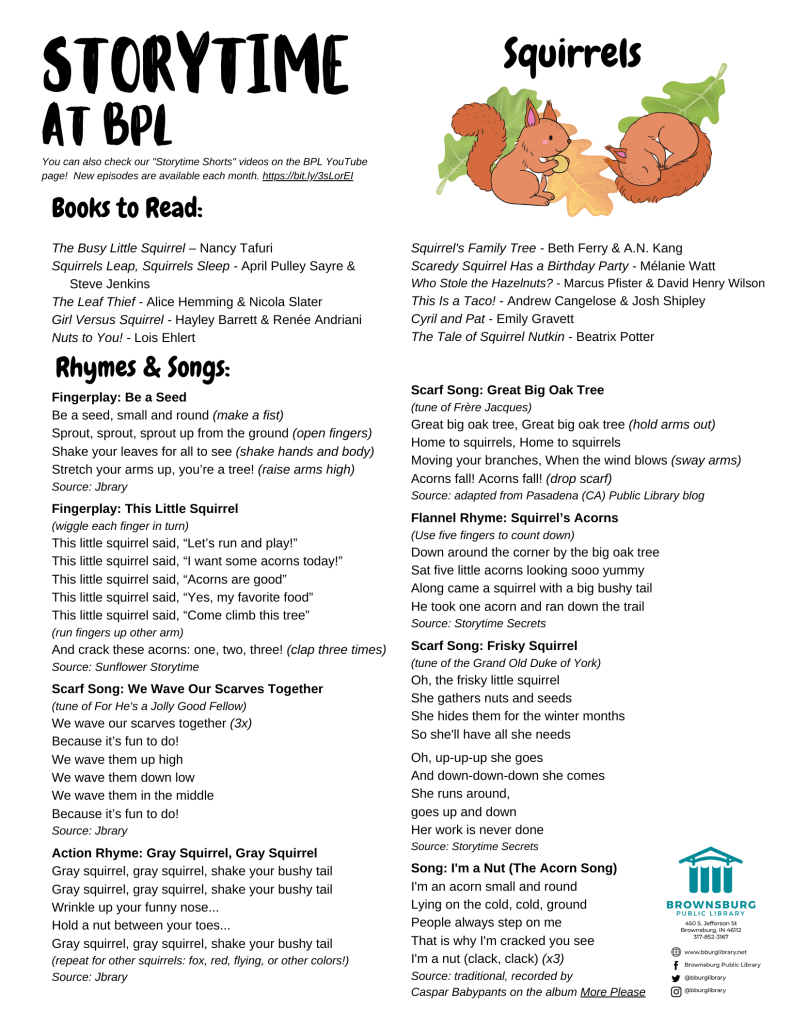
(FT) Family Time, ages 0-3.5