Summer Storytimes: Adventure Begins at Your Library

Hello, again, readers! I hope you have had a wonderful summer, full of adventures and fun. We certainly did here at the library. I love summer, and everything it means at the library. Sometimes our negative feelings about summer reading as library staff can be in front of mind – it’s a lot of work, we’re out of our routines, we have a lot more people to manage with their needs and quirks and behaviors – it’s easy to get burnt out. But I love the summer reading season and I keep in mind that all that extra work, all that foot traffic and so on means that our library is an important part of our community. That means a lot in these uncertain days. And the smiles and appreciation of our patrons of all ages give me a lift every single day. So, fellow librarians, I hope you were able to take care of yourselves AND enjoy the vibrant chaos.
Our library generally uses the theme and graphics from the Collaborative Summer Library Program, or CSLP, a national initiative that helps libraries plan summer programming. This year’s theme was “Adventure Begins at Your Library.” Adventure is a broad theme! I used many of the weekly theme ideas from the CSLP manual and applied them to the framework I’ve been honing in the last couple of years: an outdoor storytime with sensory stations. It’s a big hit and I saw great numbers. All summer, I offered Family Time for ages 0-3.5 Monday, Tuesday, and Wednesday, with siblings welcome. As an organization we have also been working toward more weekend and evening programs, so there were a couple of those sprinkled in as well this year. I do have an indoor backup option when the weather is bad, so I still do registration and am limited by that, but it’s a bigger room than I usually use, so space isn’t generally an issue.

For each session, we had about 15-20 minutes of storytime rhymes, songs, and a book, including parachute play, then 20 minutes of free play at various sensory stations. We end with bubbles and a goodbye song. Stations are a really great way to promote socializing, practice skills like sharing and being gentle, and allow for unstructured play, which science tells us is so important to learning and development.

I only did one new station this year (in week 2, see below), the rest were all repeats from the last couple of years, which you can read about in depth at this blog post.
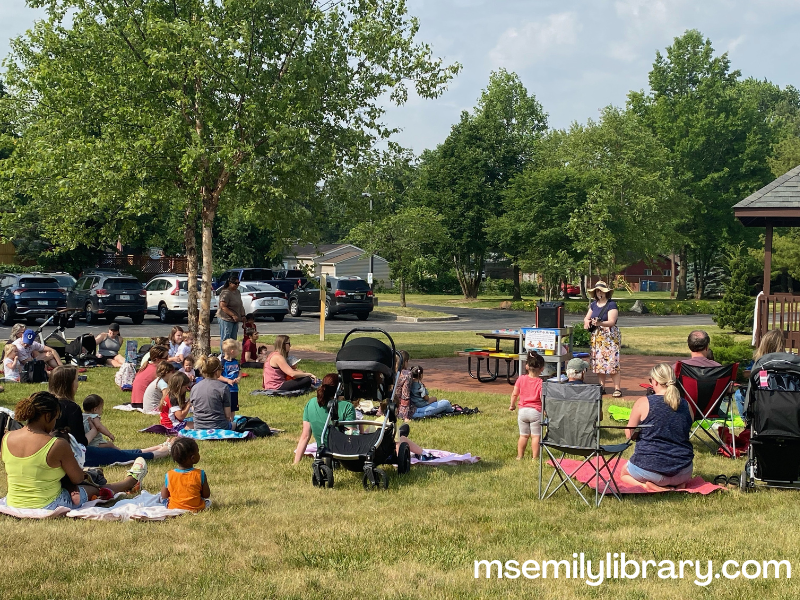
Photo showing the backs of families on a grassy yard on blankets and camp chairs. Emily is at the front (farthest in the picture) holding a ukulele.
I don’t think I took any photos this year, so here’s one from last year – same set-up!

I just learned how to set up anchor links, so click for the overall or specific themed activities!
Repeating Weekly Plan
Week 1: Travel Adventures
Week 2: Adventures Close to Home
Week 3: Adventures in Imagination
Week 4: Animal Adventures
Week 5: Adventures at Sea
Week 6: Adventures in Reading
Week 7: Adventures in the Dark
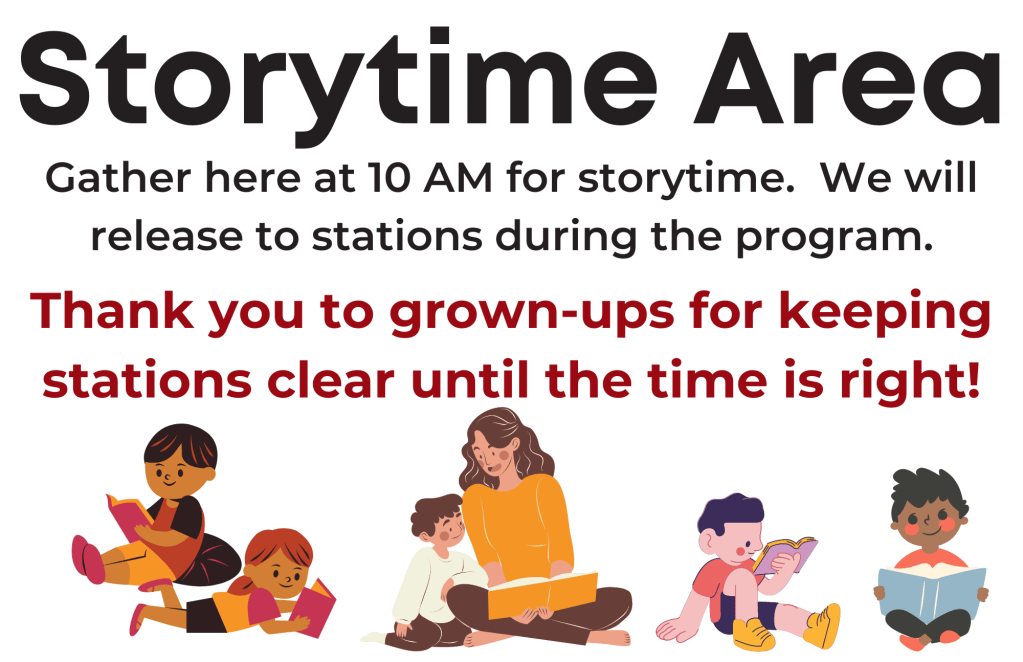
Sign showing "Storytime Area. Gather here at 10 AM for storytime. We will release to stations during the program. Thank you to grown-ups for keeping stations clear until the time is right" with graphics of various children sitting and reading.

Repeating Weekly Plan
Each week, the structure of the storytime was the same, with only three parts that changed depending on the theme: a themed song, a book, and one fresh parachute song. (Stations also changed weekly.) All the other songs and rhymes were the same:

Welcome Song: Hello, Friends
(tune of Goodnight, Ladies)
Hello, friends! Hello, friends!
Hello, friends, it’s time to say hello!
Hello, [name 1], hello, [name 2]!
Hello, [name 3], it’s time to say hello! (repeat as needed)
(ASL motions: salute for “hello,” then take the index fingers on each hand and you link them together as though they are hugging each other back and forth for “friends”)
Source: Glenside Public Library District

Warm-Up Rhyme: We Wiggle and Stop
(Use the ASL sign for the word “stop” – one hand “chops” across the opposite hand)
We wiggle and we wiggle and we STOP
We wiggle and we wiggle and we wiggle and we wiggle
And we wiggle and we wiggle and we STOP
(We wiggled every week, but then added 2 more motions. Motions we did throughout the summer: jump, twirl, run, splash, hop, swim, stretch, stomp, wave, sway, march, lean, roll [arms,] hug)
Source: Jbrary

Intro: Our theme this summer is Adventure Begins at Your Library. Are you ready to go on an adventure? Short intro to the weekly theme (see below)

Themed Song (see below)

Transition Song: If You’re Ready for a Story
(tune of If You’re Happy and You Know It)
If you’re ready for a story, clap your hands (clap, clap)
If you’re ready for a story, if you’re ready for a story,
If you’re ready for a story, clap your hands (clap, clap)
Source: Miss Keithia (my predecessor)

Themed Book (see below)

Parachute! What sorts of adventures can we have with our parachute?

Let’s head out on our adventure. Our road is going to start out very smooth. Can we wave the parachute slowly and gently?
Parachute: A Smooth Road
A smooth road! (repeat x4) (slowly, and gently)
[Uh, oh! Our road has turned a little bumpy! Can we wave the parachute medium-fast?]
A bumpy road! (x4) (a little faster)
[Oh, no! The road has gotten very rough!]
A rough road! (x4) (frantic waving of the parachute ensues!)
Oh, no! A hole! (lift the parachute up high and then down)
Source: Jbrary

Rotating Parachute Song (see below)

Breathing Break
Whew, I am out of breath! I’m ready for a breathing break. Let’s take a big breath in and lift the parachute up, then breathe out and lower it. We’ll repeat a few times.

At this point the kids are usually darting under the parachute, so I go with it!
Okay, if grown-ups can grab the edges of the parachute, kids can go underneath if they want (if you prefer to just watch from the outside, that’s always fine!)
This was originally intended to be a song where we walk around in a circle, but with the age of the kids, grown ups generally wanted to stay kind of close to where their kid was and not walk around. So we just waved up and down until the very end, where we pulled the parachute down (briefly) around the kids underneath. I also originally intended to do a second verse where we stood up, but I didn’t think it was a good idea for the kids to be trapped under the parachute for the length of a verse, so I never did it. It’s included here in case you were curious!
Parachute Song: Merry Go Round
(tune similar to Mulberry Bush, see link below for a recording)
The merry go round goes round and round (walk in a circle with parachute or wave it up and down)
The children laugh and laugh and laugh
So many were on the merry go round
The merry go round collapsed! (fall to the ground or bring parachute down)

(stand up verse)
Fishies in the ocean (stay crouched/fallen)
Fishies in the sea
We all jump up with a
1 2 3! (stand up)
Source: Read Sing Play

Okay, grown ups – for our last parachute song we’re going to let the parachute fly – so let go at the very end after we count down and I say “FLY.”
Parachute Song: Parachute Fly
(tune of Skip to my Lou)
(kids go under the parachute and adults raise and lower)

Up, up, up it goes,
Down, down, down so low
Raise our parachute to the sky
Count to 3 and watch it fly
Spoken:
Up on one…
Down on two…
Up on three…
and FLY! (adults let go and leader pulls ‘chute in to themselves)
Source: Gymboree

Release to Stations
I have eight stations each week, which involve a mixture of dry, wet, and art/creativity stations. We spend about 20 minutes before I ring the bell to call everyone back to the grassy area. See more detail here.

Everybody loves bubbles! The trick to doing bubbles outside is to figure out which way the wind is blowing and get upwind of your group!
Recorded Bubble Song: Pop, Pop, Pop by Nathalia
From the album “Dream a Little,” available on Spotify
CD album cover for Nathalia's Dream a Little

Goodbye Song: See You Later, Alligator
(tune of Clementine)
See you later, alligator (wave with one hand, then the other)
In a while, crocodile (open and shut arms like a croc’s mouth)
Give a hug, ladybug (hug yourself or a loved one)
Blow a kiss, jellyfish! MWAH! (move hand like a jellyfish then blow a kiss!)
Source: King County Library System

(back to contents)

Weekly Themes

Week 1: Travel Adventures 6/4, 6/5/24

Intro: This week we’re talking about travel adventures. Sometimes you think the adventure will happen when you reach your destination, but adventures can happen on the way, too!

I varied whether I did the themed song or the book first, just depending on what made the most sense to me.

Themed Read: Go, Go, Go! by Bob Barner There are lots of ways of going on an adventure!
This is a very simple book – a beginning reader – but I had the group do a noise and motion for each kind of vehicle, which made it very interactive.
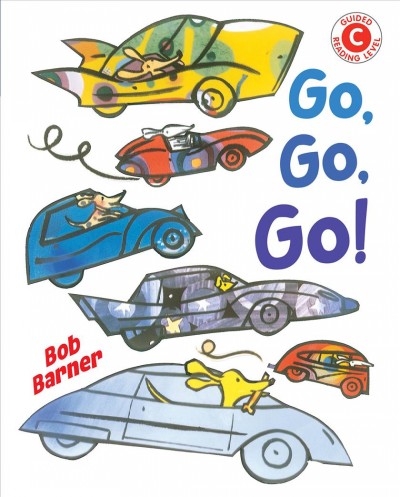
book cover of go go go

Let’s get our own adventures underway!
Themed Song: Row, Row, Row Your Boat/Car/Plane/Bus
Row, row, row your boat (row arms)
Gently down the stream
Merrily, merrily, merrily, merrily
Life is but a dream!

Additional verses:
Drive, drive, drive your car (steering wheel arms)
Gently down the street…Life is but a treat

Fly, fly, fly your plane (airplane arms)
Gently in the sky…Watch the clouds go by

Drive, drive, drive your bus (big wide steering wheel)
Gently down the way
Stop to let some people out
To ride another day
Source: Grandview Heights Public Library
(this is the source I had in my notes, but I’m not finding a link now)

Parachute Song: The Wheels on the Bus
I used the verses that worked well with the parachute:
Wheels: we just flapped the parachute
Horn: We held the parachute taut and “beeped” our hand on it
Wipers: we swished the parachute from side to side
People: again, flapped the parachute up and down
Source: traditional

Week 1 Stations: (details here)
Pouring Station
Pool Noodle Soup
Fly Swatter Slap
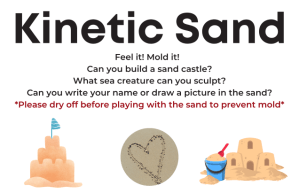
Kinetic Sand
Sort Beanbags
Sort Craft Sticks
Color the Parachute
Ice Painting

(back to contents)

Week 2: Adventures Close to Home 6/10, 6/11, 6/12/24

Intro: This week we’re talking about adventures close to home. You can have an adventure in your backyard or close to home – camping, exploring, and more!

This is a fantastic book with a lot of opportunity for interaction. Whenever we said “Roll, roll, little pea” they joined and rolled their arms. They called out the animals on each page and we made their noise. Great storytime book.
This story is about a little pea who finds adventure wherever it rolls
Themed Read: Roll, Roll, Little Pea by Cécile Bergame & Magali Attiogbé

book cover of roll roll little pea

Let’s do a fingerplay about five plump peas.
Themed Rhyme: Five Plump Peas
Five plump peas in a peapod pressed (make a fist and cover with the other hand)
One grew, two grew, and so did all the rest (raise all fingers on first hand one by one)
they grew, and they grew, and they grew, and never stopped (hands get wide)
They grew SO BIG that the peapod… POPPED! (hands spread wide, then CLAP!)
Source: Jbrary

Since eyes, ears, mouth, and nose are all in the same place, I changed that line. We did this three times, getting faster!
Parachute Song: Head, Shoulders, Knees, and Toes
(move parachute to correct height)
Head, shoulders knees and toes, knees and toes
Wave the parachute up and down
Head, shoulders knees and toes, knees and toes (repeat, faster)
Source: traditional

Week 2 Stations: (details here)
Pouring Station
Lemon Sensory Bin
Mystery Water
Kinetic Sand
Pool Noodle Sort
Feed the Croc
Color the Parachute
Spray Silhouettes

New Station: Spray Silhouettes!
I used liquid watercolors in spray bottles and provided a myriad of shapes to create negative image artwork. Some of the shapes were plastic food, big puzzle pieces, the shapes from a baby toy sorter, and duplos. Basically anything I could find that could lay mostly flat and be okay getting wet. It was important to set the spray bottles to “mist” instead of “stream,” and we still had kids who just saturated the paper, but it’s all about the process and not the product! Idea and photo on the sign from Picklebums.

(back to contents)

Week 3: Adventures in Imagination 6/17, 6/18, 6/19, 6/20/24

Intro: This week we’re talking about adventures in imagination. When we imagine, we can make adventures anywhere with anything.

To start, we all pretended we had a stick. Then we did some kind of action for each imagined use as we read.
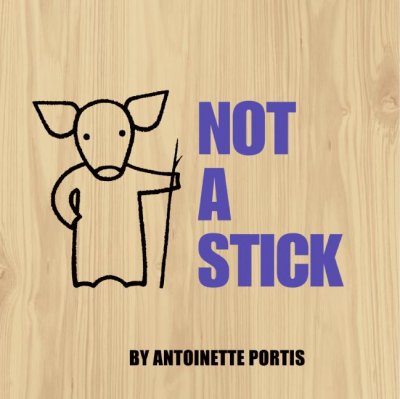
Themed Read: Not a Stick by Antoinette Portis

book cover of not a stick

Let’s put our imagination hats on and get some practice.
Themed Rhyme: Can You Pretend?
Let’s hear you roar like a lion
Let’s see you jump like a frog
Let’s see you snap your jaws like a crocodile
Let’s hear you howl like a hound dog
Pretend you’re an elephant with a big, looooong, trunk
Pretend you’re a monkey
Let’s see you jump, jump, jump
And now you’re a mouse
Just let me see
How very, very quiet you can be
Source: YouthScope

Teddy Bear is going on an adventure – up and down a hill with LOTS of friends.
Parachute Song: Funny Teddy Bear
(tune of Grand Old Duke of York)
Funny teddy bear
Bear had a thousand friends
Bear marched them up to the top of the hill and
Marched them down again
And when you’re up you’re up
And when you’re down you’re down
And when you’re only halfway up you’re neither up nor down
Source: Storytime Katie via ALSC Blog

Week 3 Stations: (details here)
Pouring Station
Sponge Play
Scooping Blocks
Kinetic Sand
Colored Ball Sort
Pompom Sort
Color the Parachute
Fly Swatter Painting

(back to contents)

Week 4: Animal Adventures 6/23, 6/24, 6/25, 6/26/24

Intro: This week we’re talking about animal adventures. Can you imagine going to see amazing animals in the wild?

Themed Read: It’s a Tiger! by David Larochelle & Jeremy Tankard
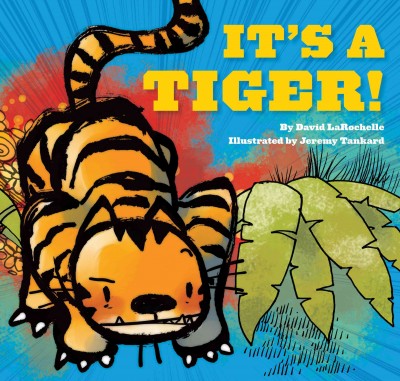
book cover of it's a tiger

Can you imagine being a tiger? A SLEEPING tiger?!
Themed Song: Sleeping Tigers
(tune of Sleeping Bunnies)
See the fearsome tigers sleeping till it’s nearly noon
Shall we wake them with a merry tune
Oh so still! Are they ill?
Wake up, wake up, wake up sleeping tigers!
Wake up tigers and roar, roar, roar
(repeat, second time: pounce, pounce, pounce)!
Source: adapted from the traditional

Even tiny animals might go on an adventure.
Parachute: Itsy Bitsy Spider
(move parachute up and down as indicated in lyrics)
The itsy bitsy spider climbed up the water spout
Down came the rain and washed the spider out
Up came the sun and dried up all the rain
So the itsy bitsy spider climbed up the spout again
Source: traditional

Week 4 Stations: (details here)
Pouring Station
Pool Noodle Soup
Whisking Bubbles
Kinetic Sand
Beanbag Sort
Craft Stick Sort
Color the Parachute
Shape Sorter Stamping

(back to contents)

Week 5: Adventures at Sea 7/1, 7/2, 7/3/24

Intro: This week we’re going out to sea – get your lifejackets on!

I tried this book at the first session as a “sing aloud” but it just did not go over well, even with several pages clipped to shorten it. I ditched it for the other two sessions.
Themed Read: Port Side Pirates by Oscar Seaworthy & Debbie Harter (Monday only)
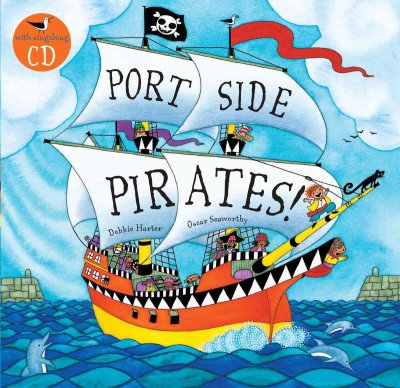
book cover of port side pirates

This one worked much better – we did some kind of motion or noise for each page to make it interactive. I wish the book itself was bigger and the illustrations were more vibrant, though.
Themed Read: Sheep on a Ship by Nancy Shaw & Margot Apple (Tuesday and Wednesday)
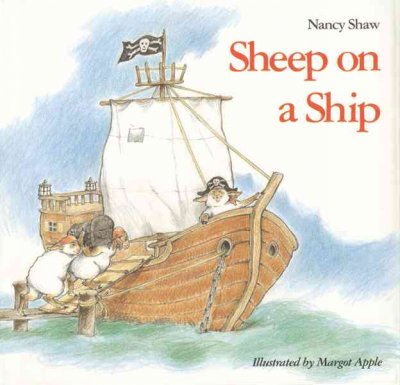
book cover of Sheep on a Ship

When the ocean gets rough, that’s an adventure!
Themed Song: The Ocean Song
(tune of The Elevator Song)
Oh, the ocean is great and the ocean is grand!
There are lots of big ships but very little land
And we sleep down deep in a hammock near the floor
And this is what we do when we go out to shore:
(ready?) We… ride… the…
waves going up, we ride the waves going down
we ride the waves going up, we ride the waves going down
And we turn… a-… round!
Source: Jbrary

I remind everyone to start rowing very gently, then after the first verse, say, “Oh, the wind is picking up, can we row more firmly?” and before the third verse, “Oh, no, there’s a storm! Row as strongly as you can!”
Parachute: Row Your Boat 
(repeat 3 times)
Row, row, row your boat
Gently/Firmly/Strongly down the stream
Merrily, merrily, merrily, merrily
Life is but a dream
(Wave the parachute gently, then firmly, then wildly!)
Source: traditional

Week 5 Stations: (details here)
Pouring Station
Ping Pong Fishing
Ice Play
Kinetic Sand
Pool Noodle Sort
Feed the Croc
Color the Parachute
Dot Painting

(back to contents)

Week 6: Adventures in Reading 7/8, 7/9, 7/10/24

Intro: This week we’re celebrating books, and all the adventures we can have in them!

Here’s a song about someone who wears glasses getting ready to read.
I’ve found that if I set this one up right, it’s very fun, and if I don’t, it’s a little awkward. We practice making glasses, putting them on and taking them off. Then we make a book and practice opening and closing it (several times!) THEN we sing.
Themed Song: These Are My Glasses 
These are my glasses, this is my book
I put on my glasses and open up the book
Now I read, read, read
And I look, look, look
I put down my glasses and
Whoop! Close up the book!
Source: “Whaddaya Think of That?” by the Laurie Berkner Band

I’ve used this book for years in outreach and for library tours, so I was a little disappointed that it didn’t go over quite as well with the toddler set as the preschoolers. A good reminder that developmental age matters! Another good option for this week would have been Hooray for Books! by Brian Won, but I wasn’t able to get it last minute. The parents enjoyed the jokes, but the kids got antsy.
Themed Read: Book! Book! Book! by Deborah Bruss & Tiphanie Beeke

book cover of book book book

Teddy Bear is going on an adventure – up and down a hill with LOTS of friends.
Parachute Song: Funny Teddy Bear
(tune of Grand Old Duke of York)
Funny teddy bear
Bear had a thousand friends
Bear marched them up to the top of the hill and
Marched them down again
And when you’re up you’re up
And when you’re down you’re down
And when you’re only halfway up you’re neither up nor down
Source: Storytime Katie via ALSC Blog

Week 6 Stations: (details here)
Pouring Station
Flower Sensory Bin
Scooping Blocks
Kinetic Sand
Colored Ball Sort
Pompom Sort
Color the Parachute
Finger Painting

(back to contents)

Week 7: Adventures in the Dark 7/14, 7/15, 7/16, 7/17, 7/18/24

Intro: This week is about adventures you might have after dark. Have you ever taken a walk with your family after sunset in your neighborhood? Or maybe gone outside to chase fireflies after dark? I love fireflies. Did you know that the Indiana State Insect is the firefly?

Let’s do a rhyme about some fireflies. Can you make your hands “blink” like a firefly light? (Open and close fingers)
Themed Song: Two Little Fireflies
(like Two Little Blackbirds)
Two little fireflies, Blinking in the sky (open and close hands)
One blinked low, And one blinked high
Fly away low, Fly away high
Come back low, Come back high

Other options, choose 2 or 3 more:
…Blinking in the grass…one blinked slow And one blinked fast…
…blinking by the car. . .1 blinked near, one blinked far…
…blinking by a gate… 1 flew wobbly and the other flew straight…
…blinking by the lilies, 1 was serious, the other was silly…
Source: adapted from the traditional

I love doing this one. It’s so silly. And thanks to a librarian friend, I can do the song with my ukulele, which always captures the group’s attention.
Themed Read: Let’s Sing a Lullaby with the Brave Cowboy by Jan Thomas

Get a copy of the sheet music here!
Listen to the song on the Jan Thomas website!

book cover of let's sing a lullaby with the brave cowboy

In honor of our brave cowboy, let’s sing the Itsy Bitsy Spider!
Parachute: Itsy Bitsy Spider
(move parachute up and down as indicated in lyrics)
The itsy bitsy spider climbed up the water spout
Down came the rain and washed the spider out
Up came the sun and dried up all the rain
So the itsy bitsy spider climbed up the spout again
Source: traditional

Week 7 Stations: (details here)
Pouring Station
Sponge Play
Fly Swatter Slap
Kinetic Sand
Beanbag Sort
Craft Stick Sort
Color the Parachute
Chalk Art

(back to contents)

Back to our regular indoor storytimes next week – upcoming themes include Sports, Alphabet, Counting, Shapes, and more!
Adventure Storywalk Resources

At my library, the month of May is generally spent in frenzied preparation for our Summer Reading Program, which usually starts the first week of June. This year has been no different. I did only one week of storytimes and spent the rest of the month prepping for the busy summer season. I may take a bit of a break in blogging over summer, it just depends on how much time there is! If you’re curious about how I do my summer programming, you can see a write up of last year here and here. I’ve tweaked it a bit for this year, but many of the stations are the same.

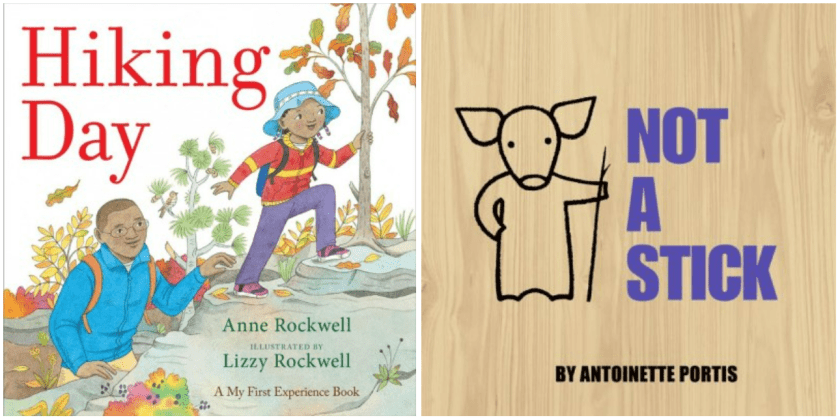
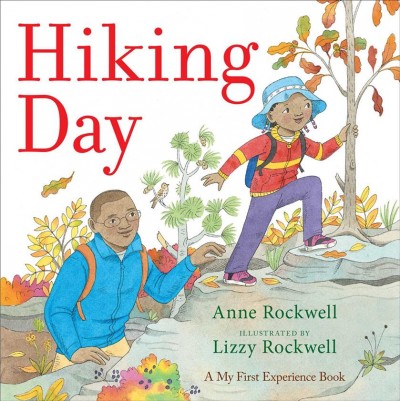
One of my duties year-round is taking care of one of my library’s two Storywalk paths. My coworker who usually does the other one was out on leave, so I had two to change this time! We are using the CSLP summer reading theme, “Adventure Begins at Your Library,” so I chose two books that go with that, focusing on Adventures in the Great Outdoors, and Adventures in Imagination. So one was Hiking Day by Anne and Lizzy Rockwell and the other Not A Stick by Antoinette Portis.

I change the stories quarterly, and I include interactive asides for each post that help engage readers in the early literacy practices (Read, Write, Play, Sing, Talk) as well as occasional counting, movement, and social-emotional reflections.

It takes some time to come up with these asides, and at some point I thought, why reinvent the wheel? If other librarians are also doing this, why not pool our resources and share? So, the Storywalk Resources page was born!

Check out the page to see what books have already been shared. If you’re looking for some last-minute books to go with the national theme, there are several options, including the ones I just uploaded, plus The Hike by Alison Farrell, A Way with Wild Things by Larissa Theule & Sara Palacios, or We’re Going on a Lion Hunt by David Axtell. Take a look and see what you think!

If you have worked on literacy and engagement asides for your Storywalk, please consider sharing your work by filling out the form HERE. Thank you!

Summer Storytimes: All Together Now, Part II

Summer is a great time to break out of the storytime structure I find myself in during the rest of the year. There’s nothing wrong with having structure, of course, but I find it invigorating to mix it up and feel free to try new things and be experimental during a set time of year.

In the summer, I offer outdoor programs for kids ages 0-3.5 and their caregivers. We spend about 15-20 minutes doing songs, rhymes, books, and extension activities, and then take about 20 minutes at free-play sensory stations that engage kids and caregivers to talk, socialize and practice social skills, engage in science and age-appropriate STEM inquiries, flex creative muscles, and have lots of fun, associating the library with positive feelings. This post will detail these stations.

You can read more about the Storytime half of the summer sessions here, Summer Storytimes: All Together Now, Part I.

Each week I had eight stations that families could wander through. There was no requirement that they had to go to each station or change stations at any certain time, or at all. They chose their path and self-regulated. Some stations were available every single week, some rotated, and some were unique and only appeared during one week. They fell into “wet,” “dry,” and “art” categories. I used old sheets to cover the stations so they wouldn’t be too tempting during the storytime portion of the program, and that worked well.

I also had a backup plan for when the weather or air quality was too poor to be outside. This was the summer of the Canadian wildfires, so there were several days that were not rainy, but smoke and particulates in the air made it unsafe to be outside – especially for the very young and for senior citizens (and many of my caregivers are grandparents in that category!) If we weren’t outside, I had reserved our two largest and adjoining meeting rooms, where I was able to set up both an area for stories and songs and the parachute on one side and stations on the other, so thankfully we didn’t miss out on any activities. If I remembered to take pictures indoors and out, I included both below to give a sense of layout.

The Plan: Stations

Wet Stations

This is a big draw – everyone likes playing in water! Outdoors, I used a hose and outdoor water supply to easily fill my tubs with water and could just pour it all out at the end of the session. Indoors, I hauled buckets from our janitor’s closet and possibly filled everything just a little bit less than I would outside. I used old flannel sheets underneath to absorb spills and make them easier to clean up. The meeting room has an emergency exit door that opens to some landscaping so all the water got dumped there at the end.

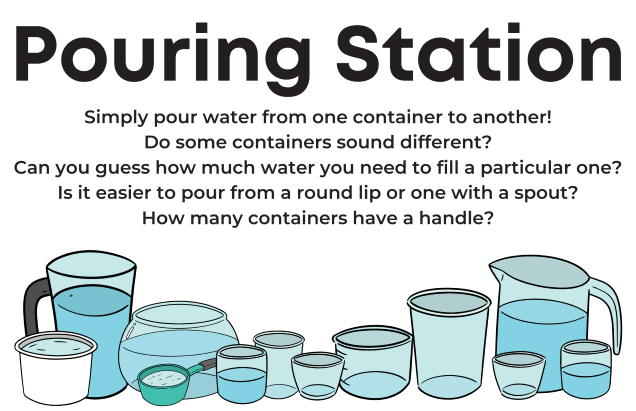
Pouring Station (all weeks)
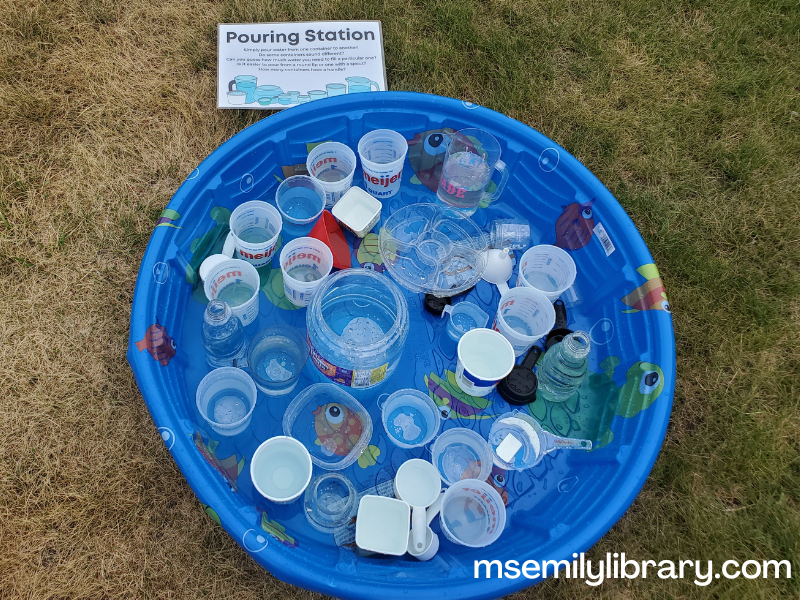
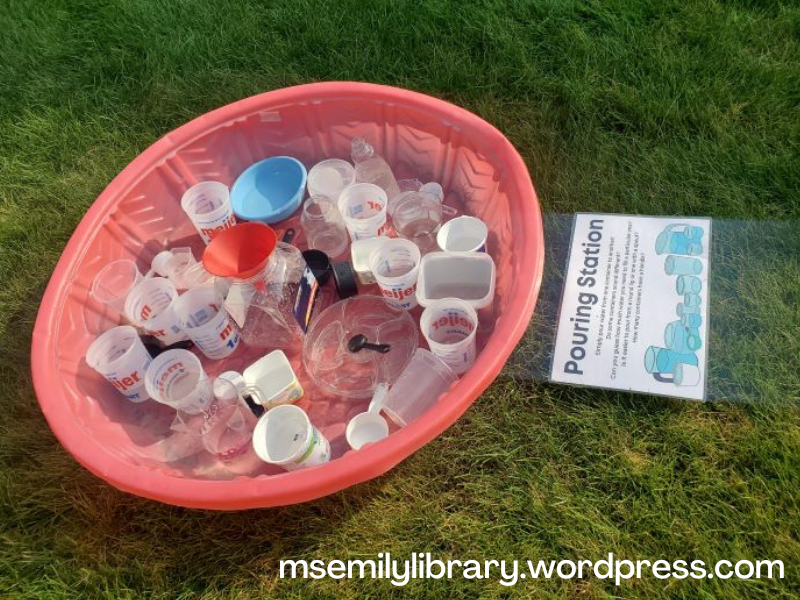
This is a repeat from last year, so I had all of the materials for this one already. It’s also an easy one to set up, so it’s my anchor wet station: we had it out every week. Last year I asked coworkers to collect clean plastic recyclables with wide openings for this station and visited Goodwill for some additional pitchers. We had measuring cups and funnels in our materials, as well as a baby pool, which is the perfect container. I fill the pool with the plastic bins and fill them randomly with water. Original idea from Busy Toddler.

Pool Noodle Soup (Weeks 1 & 4)
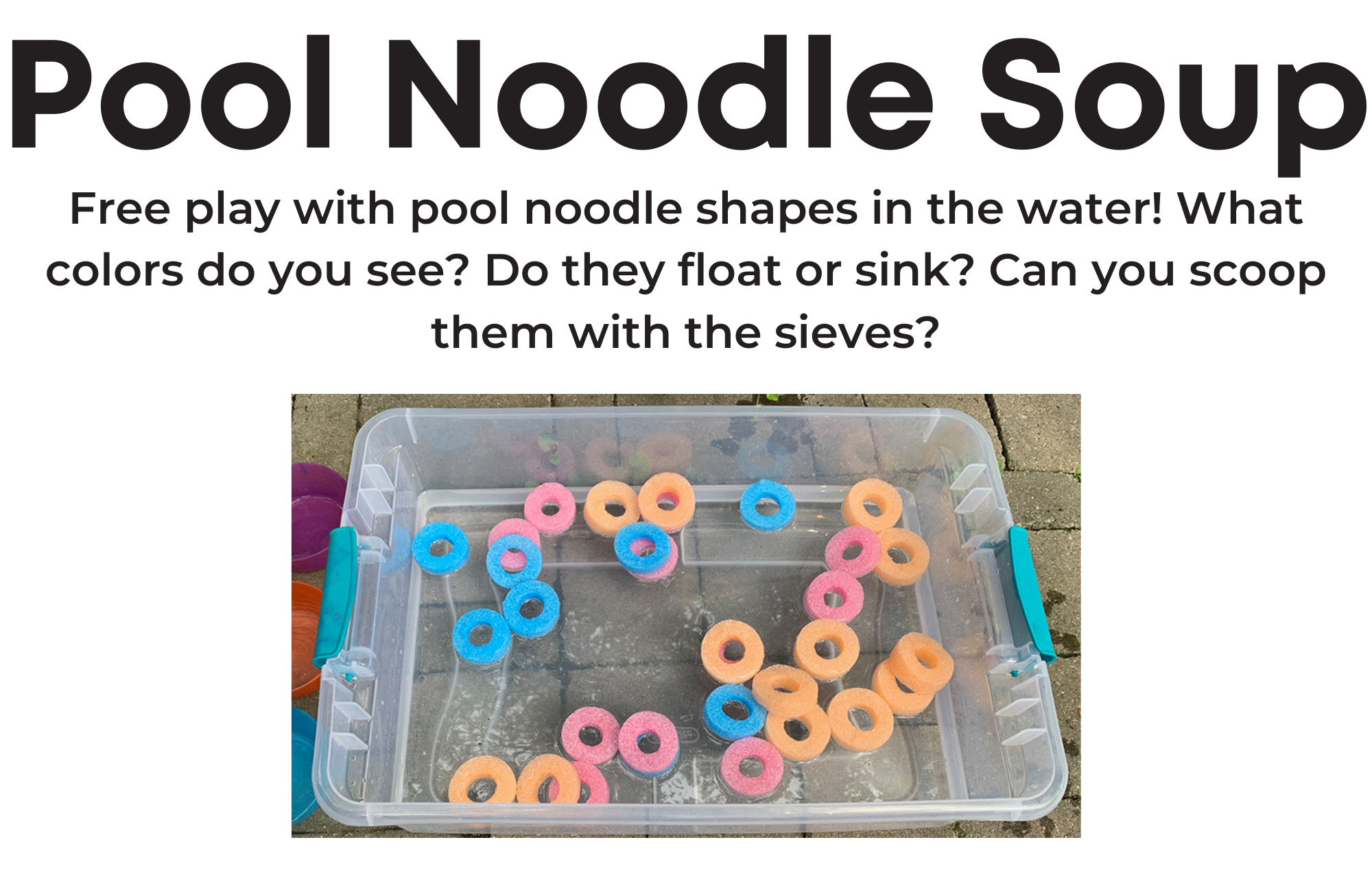
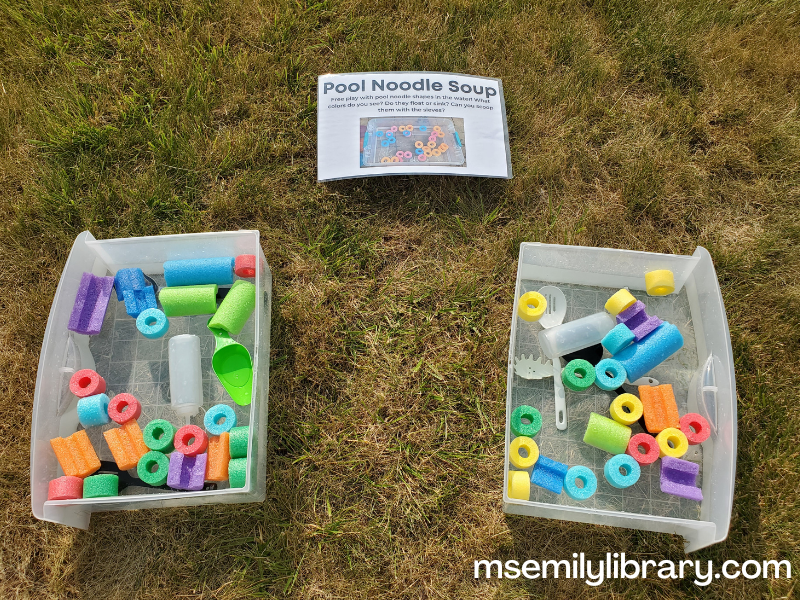
I cut sections of pool noodles and used them in three different ways, starting with this wet station. (You’ll see them below as a dry station and an art supply, too.) I used two drawers from a plastic storage bin as my containers, and added water, the noodles, some ladles and slotted spoons, and some squeeze bottles. Original idea (and photo on the sign) from Happy Toddler Playtime.

Fly Swatter Slap (Weeks 1 & 7)
Again, I maximized my materials by using flyswatters in both wet and dry stations on different weeks. The wet station included the (new, clean) swatters and ping pong balls that I drew flies on. I found the plastic containers at Goodwill and they are a little bit smaller than the drawers used above. The swatters were hand-shaped and different colors. Original idea (and photo on the sign) from My Bored Toddler.

Sponge Play (Weeks 2 & 7)
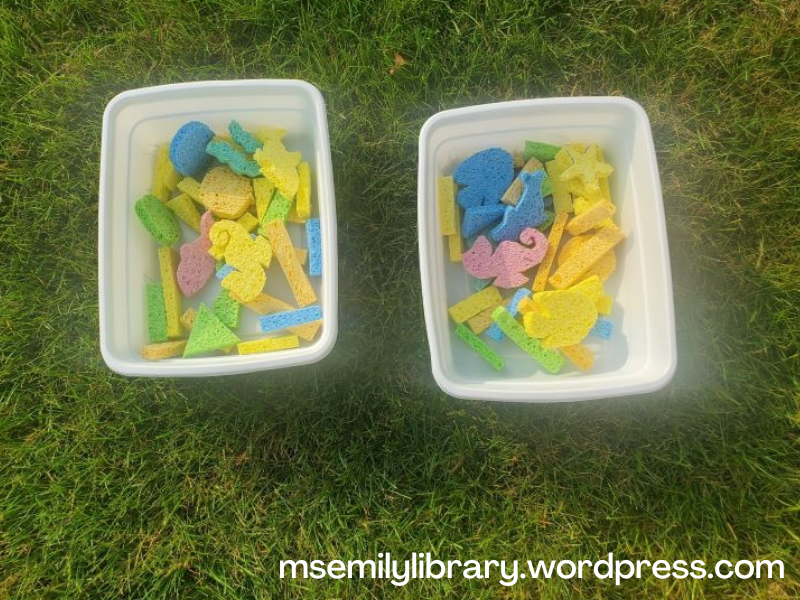
This was another repeat from last year, but one that’s especially great for the youngest of my age group. When it was out it was usually surrounded by the “baby brigade!” The shapes were ocean animals since last year’s theme was “Oceans of Possibility” but they were just as happy with the simple shapes. Original idea (and photo on the sign) from Little Lifelong Learners.

Scooping Blocks (Weeks 2 & 5)
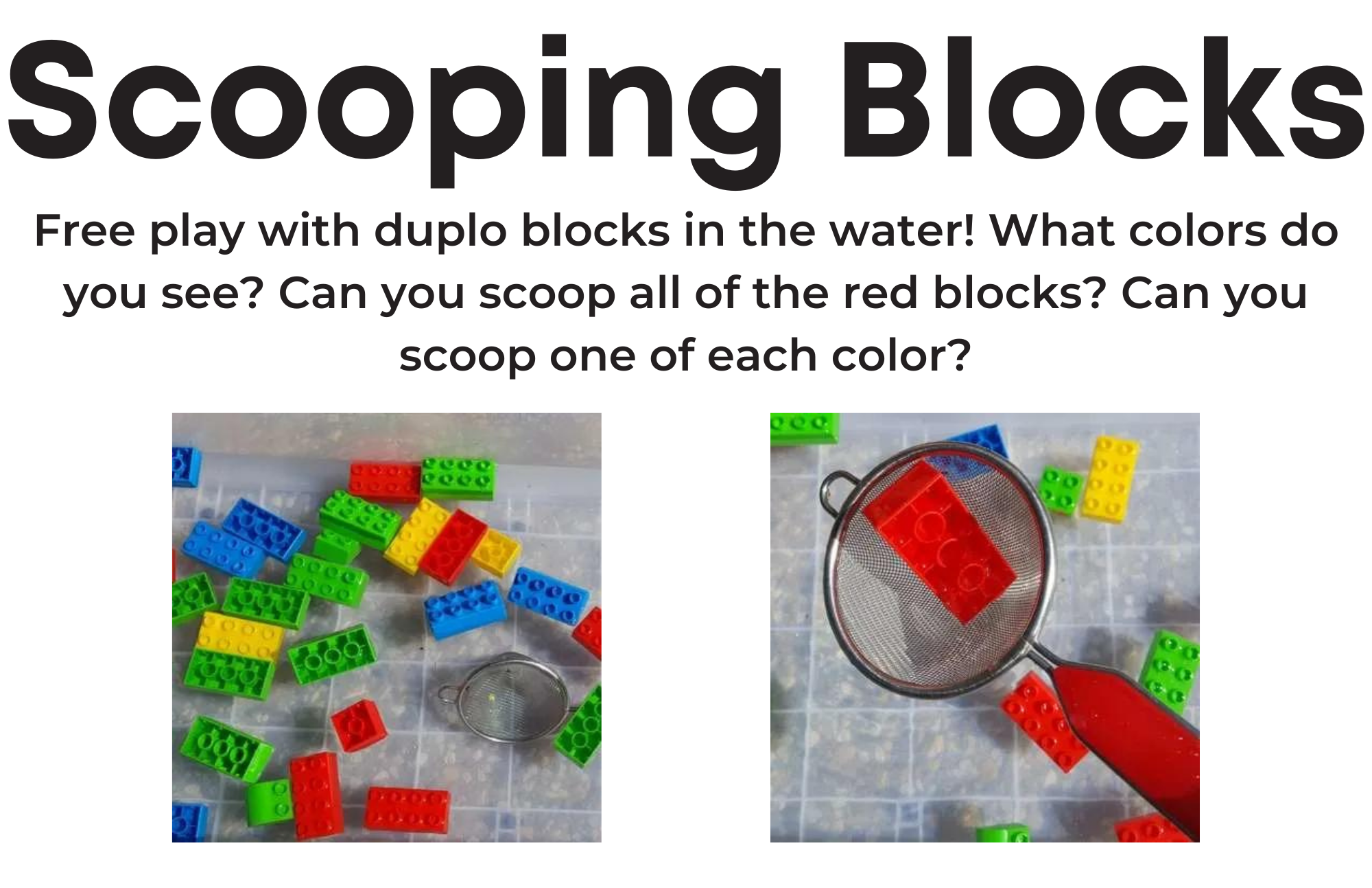
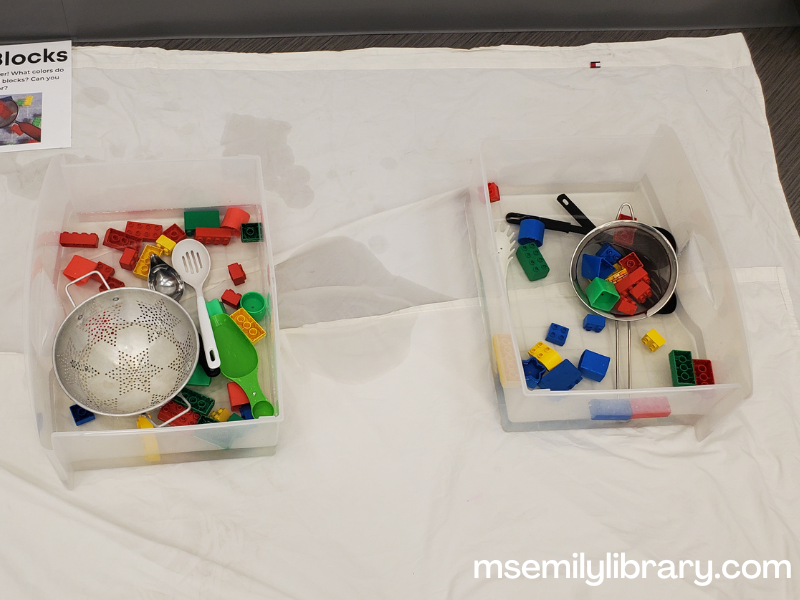
Lego Duplos plus water and scoopers! This one was fun for its obvious purpose, but added bonus: some kids actually took the Duplos out of the water and put them together! We had all the Duplos already, and I added some of the sorting blocks from our baby toys to the mix, as well as ladles, colanders, and sieves from Goodwill. Original idea (and photo on the sign) from My Bored Toddler.

Mystery Water (Week 3)
Another repeat from last year – I originally saw this as on Pinterest as a reel, and was intrigued. Cornstarch and a little food coloring are added to water to turn it murky, and kids can search for items in the water to match up with a finding guide. We had a bunch of colorful plastic cookie cutters in storage that were perfect for this, so I traced them on a separate sheet for the kids to match up. They weren’t as solid and heavy as the original poster’s, so they tended to float a little, unfortunately, but it didn’t really matter. Original idea (and photo on the sign) from bright_little_brains.

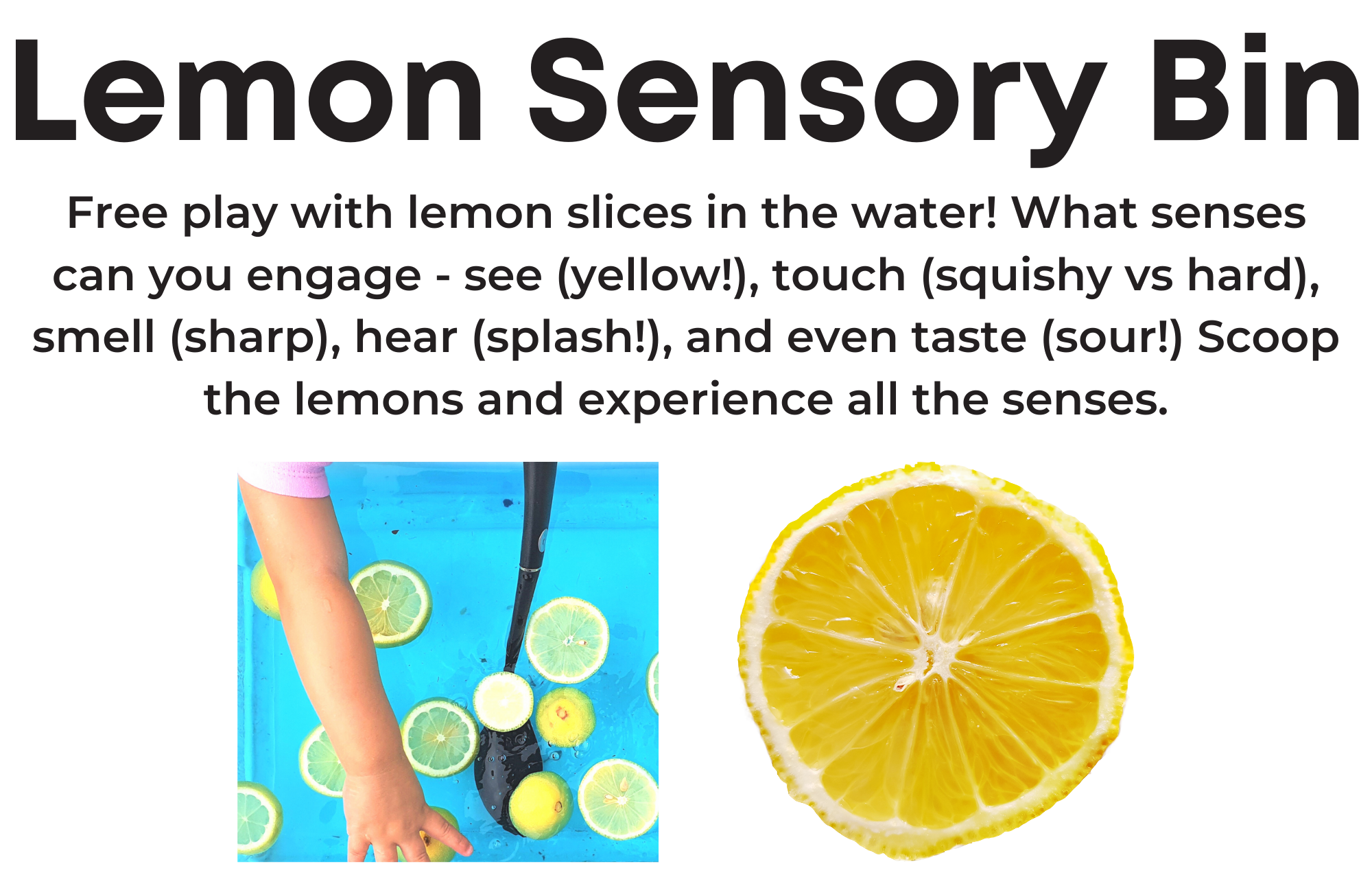
Lemon Sensory Bin (Week 3)
Mm, this was one of my favorite stations! It was super easy and smelled so good. I bought a bag of lemons and divided them among my three sessions. That was maybe 2-3 lemons per day? Cut them up into slices and added them to a bin of water along with ladles. I did announce that there was a lemon bin before breaking for stations just in case there was an allergy issue, but no one had a problem. Original idea (and photo on the sign) from Taming Little Monsters.

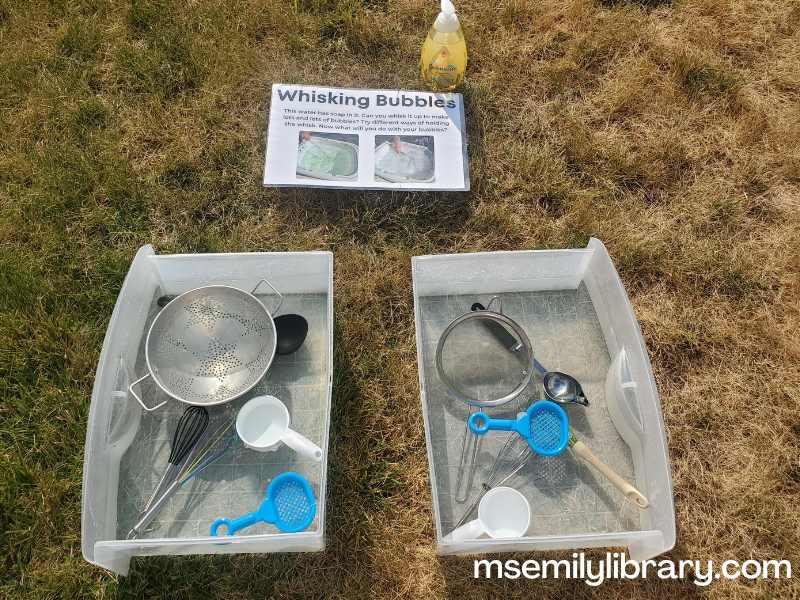
Whisking Bubbles (Week 4)
Kids could whisk up some bubbles and then use colanders and sieves to play with the result at this station. At first I just thought I would get some dishwashing soap, but then I started thinking about soap in eyes and mouths. I ended up buying some body soap formulated for babies (tear-free) and that worked perfectly. I looked for actual baby bubble bath, but couldn’t find it in store, so was a little worried about how sudsy it would get, but it ended up being just fine. And I’m so glad I went that route – I remember one of the babies did a nose-dive into the bin at one point and, indeed, there were no tears! I added the soap at the beginning and left the water undisturbed so that the kids could create all the bubbles themselves. Original idea (and photo on the sign) from The Empowered Educator.

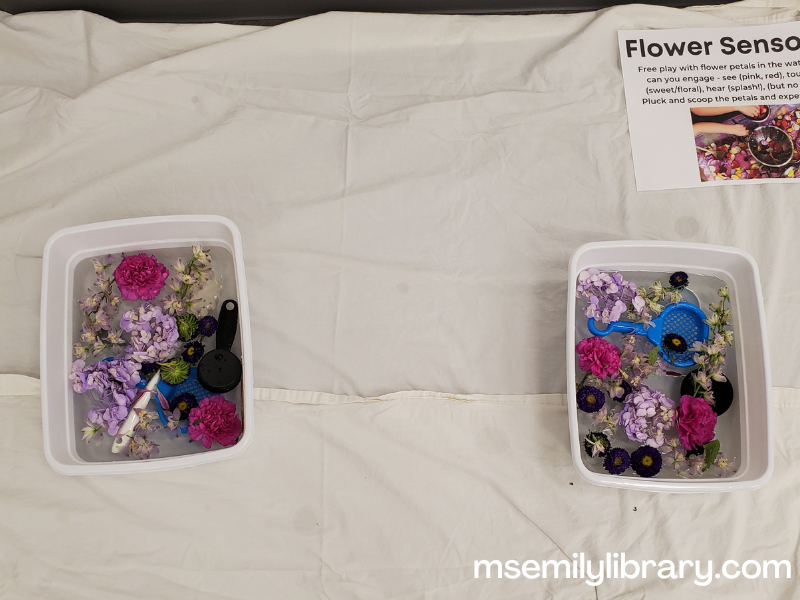
Flower Sensory Bin (Week 5)
I called our local Kroger florist and asked if they would donate flowers that were past their prime, so I was able to put this bin together without the cost of the flowers! It was also interesting to see the variety that was available on the two days I picked them up. One day I got a bouquet with several kinds of flowers that filled my two little bins, and the other day all that was available were colored daisies. Both were appreciated, and grown-ups commented on the pleasant scent and the novelty of the experience. I also got an action shot (with permission from the participants) on this one, since I wanted to include it in my thank you note to the florist. Original idea (and photo on the sign) from Learning and Exploring Through Play.

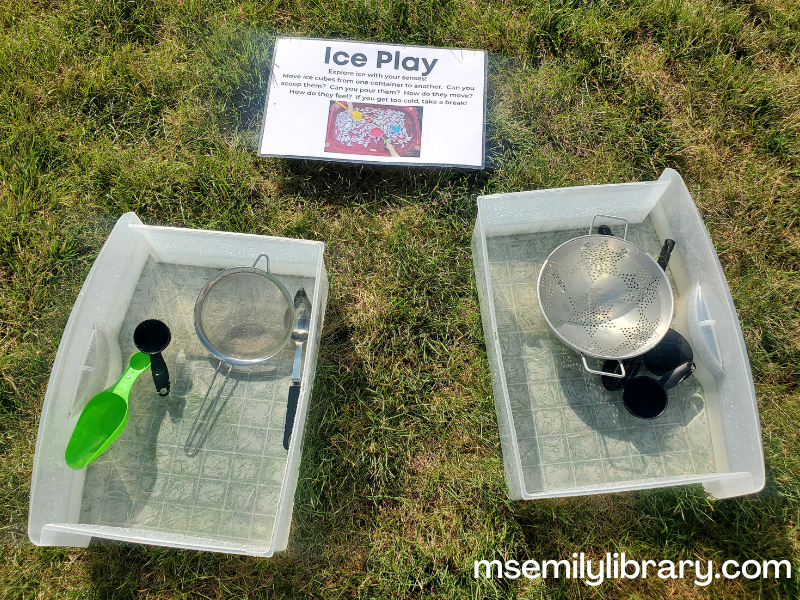
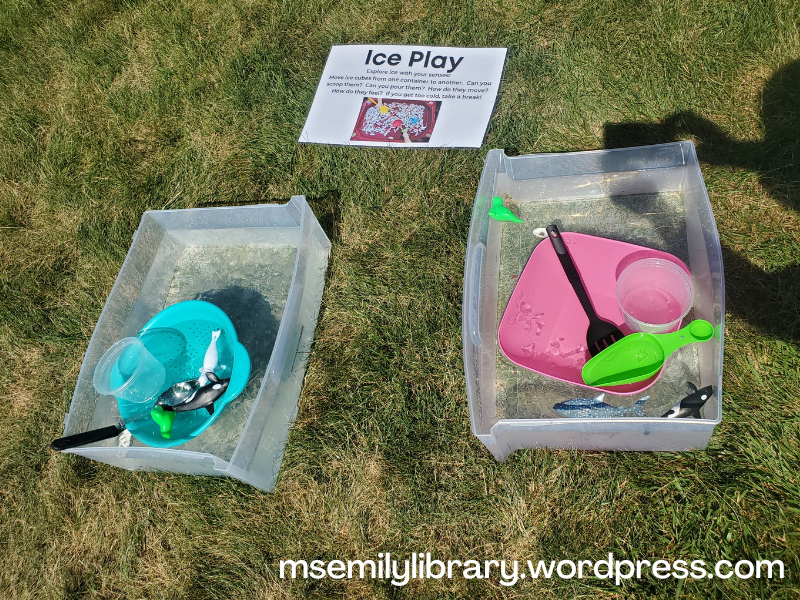
Ice Play (Week 6)
Another repeat from last year. I bought a large bag of ice each morning before my program and kept it in a cooler, adding it to the bins JUST before they were played in (so there’s no ice shown in the photos I took before the program). Ladles, colanders, and sieves were added for handling the ice. It was good weather for it – HOT – so the ice was mostly melted by the end of the station play time, but it was just enough. I reminded everyone to take a break if their fingers started to get too cold. Original idea (and photo on the sign) from Busy Toddler.

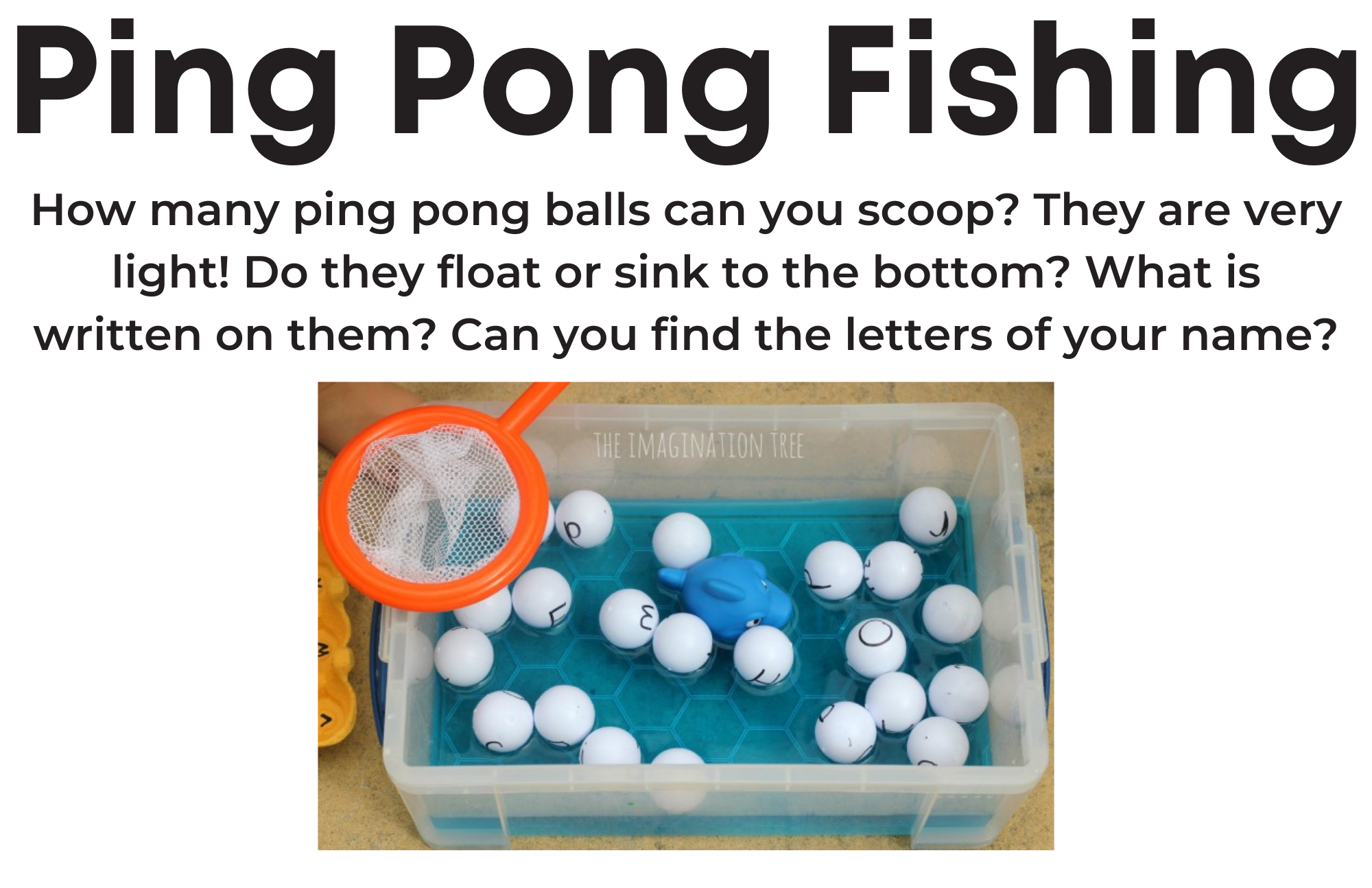
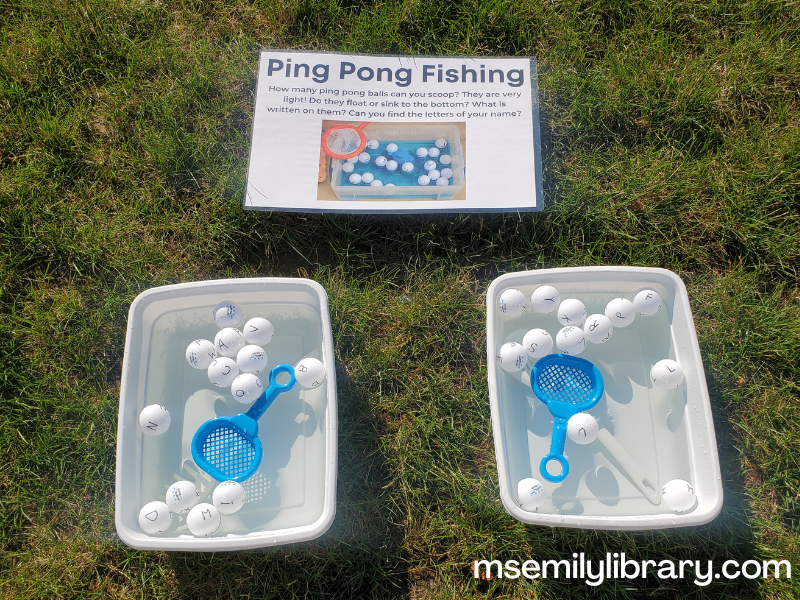
Ping Pong Fishing (Week 6)
I put the alphabet on ping pong balls and added them with scoopers into the bin. Adding the letters to all four sides of 26 balls took the most time! I think I added the housefly balls from the fly swatter slap station the second and third day, but they aren’t pictured. Original idea (and photo on the sign) from the Imagination Tree.

Dry Stations

There were a few families that didn’t want to get wet, so I was sure to offer three dry stations each week as well. Many of these gave practice in sorting various items by color, shape, or texture.

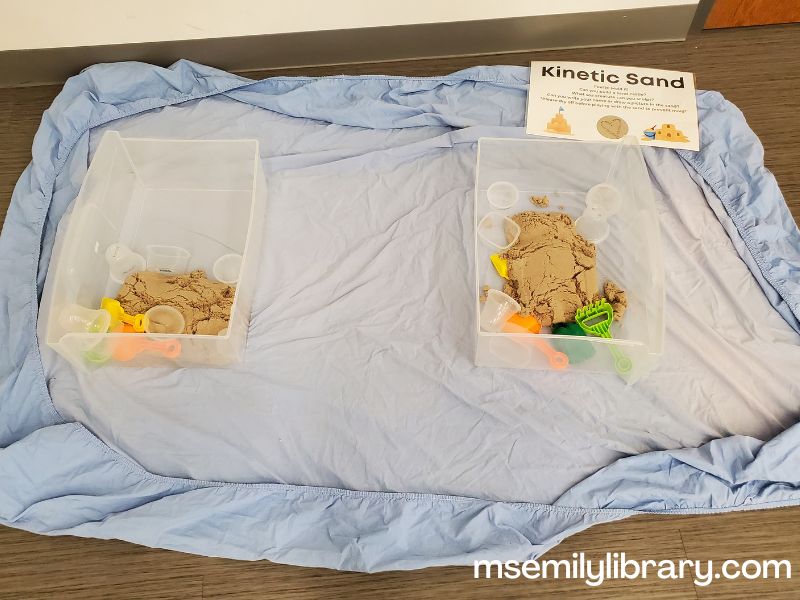
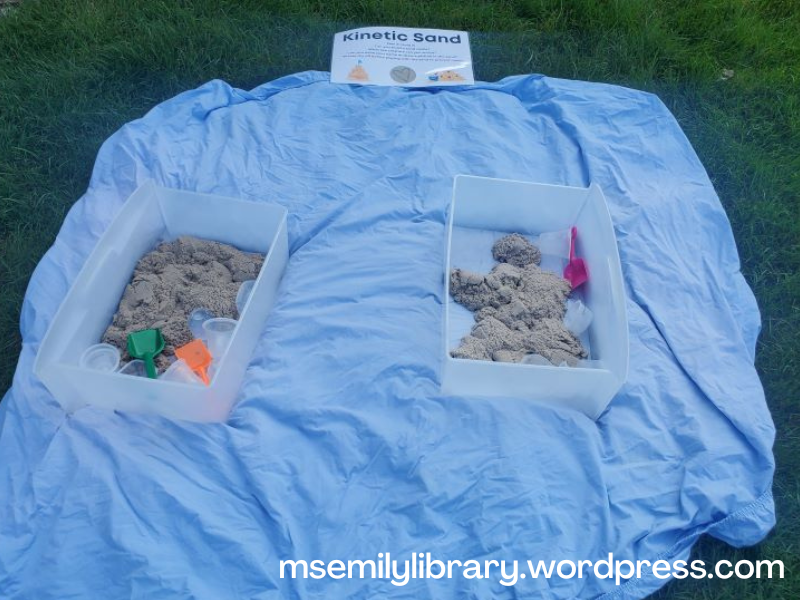
Kinetic Sand (all weeks)
Along with the Pouring Station above, this was the only station that was available all summer long. I had the supplies from last year, which included the kinetic sand itself as well as recycled fruit cup containers that had fun shapes and plastic shovels. I kept a sheet underneath this station to catch any stray sand that escapes the bins. Because the sand is not taste-safe, I do warn the caregivers that if their kiddo is still exploring with their mouth, they may want to skip this station.

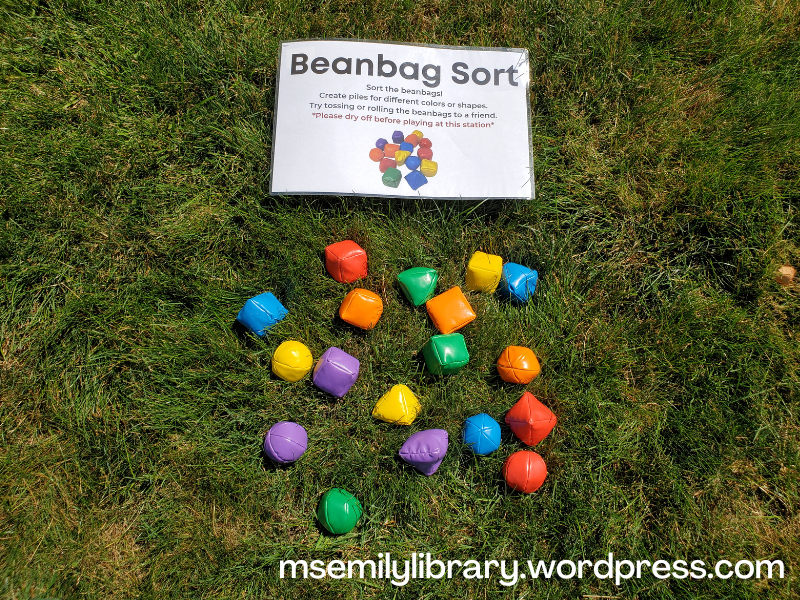
Beanbag Sort (Weeks 1, 4, & 7)
We had these beanbags from Lakeshore Learning that are different colors and shapes. They’re a super easy station where kids can play and sort with them in several ways.

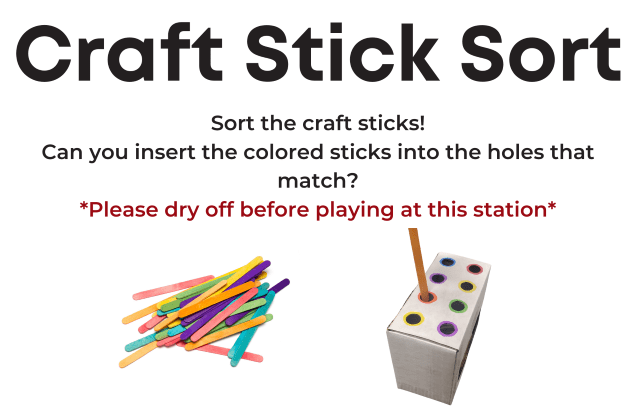
Craft Stick Sort (Weeks 1, 4, & 7)
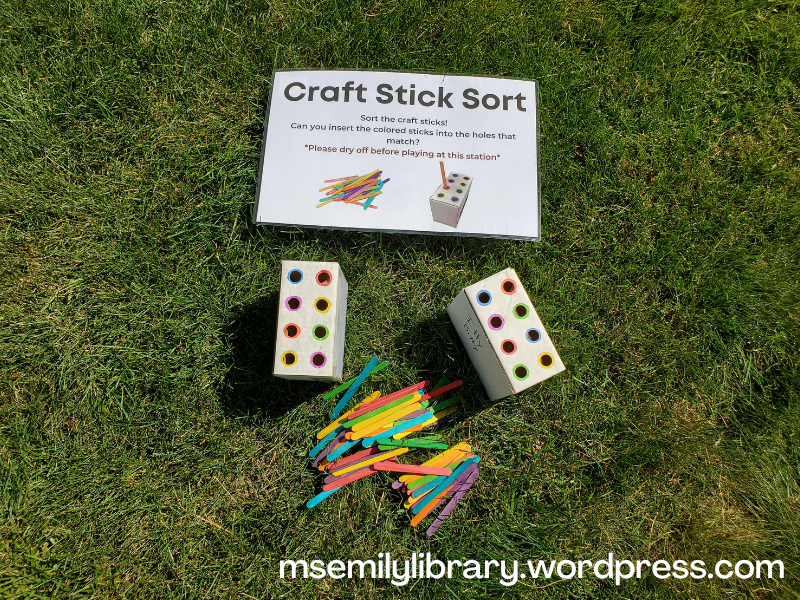
Another repeat from last year that was already “done.” I noticed in my storage bin that I had these boxes of dot painters that have small holes already in the top. I colored a ring around each hole a different rainbow color and added colored craft sticks for a fine motor and color identification station.

Pool Noodle Sort (Weeks 2 & 5)
A new station this year, but one I’ll repeat. Using the pool noodle slices (from Pool Noodle Soup), I taped a dowel rod to four small plastic cones in red, green, yellow, and blue. Kids could then thread the colored noodles on to the cones. Original idea from this Pin (no blog).

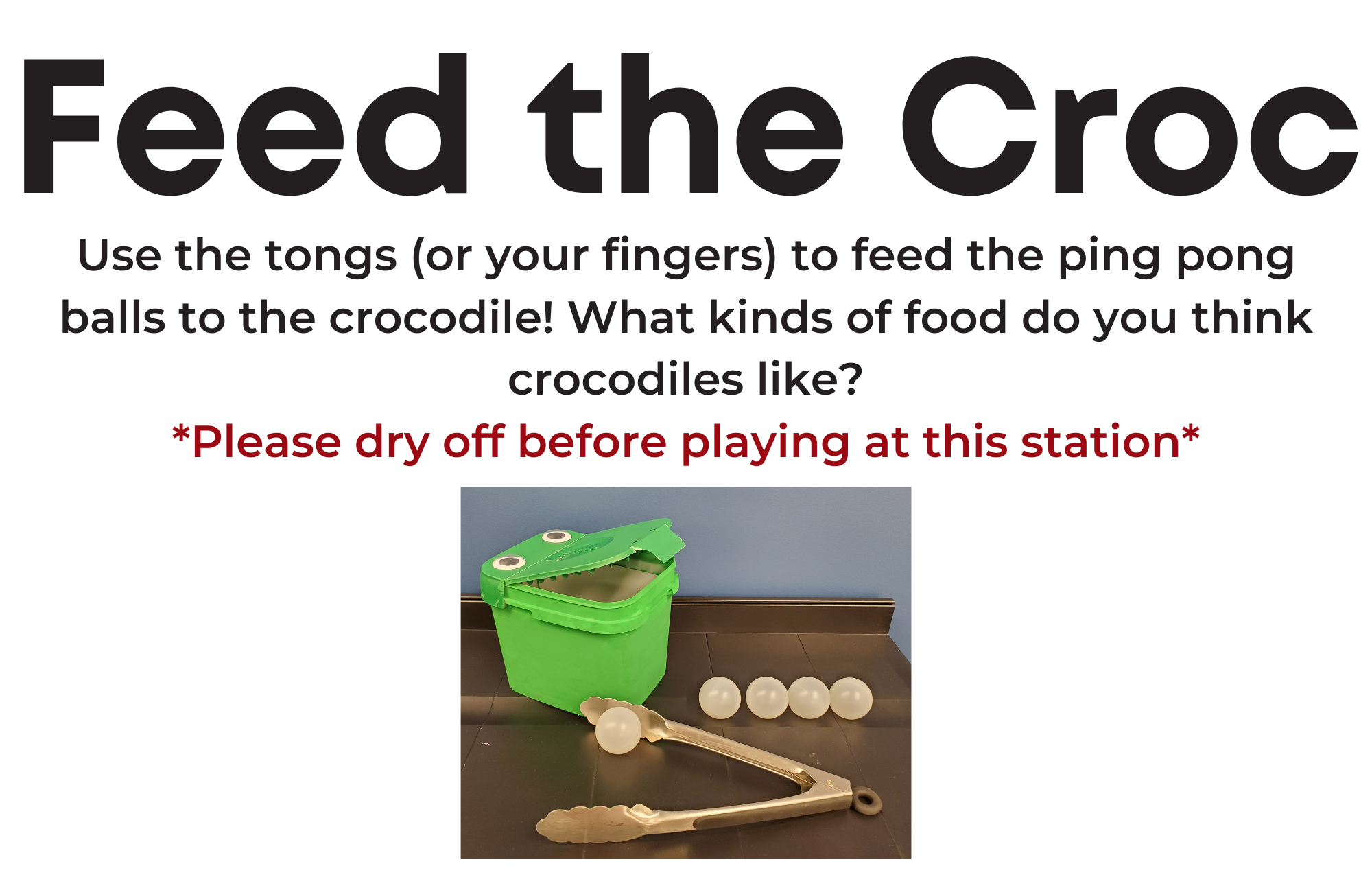
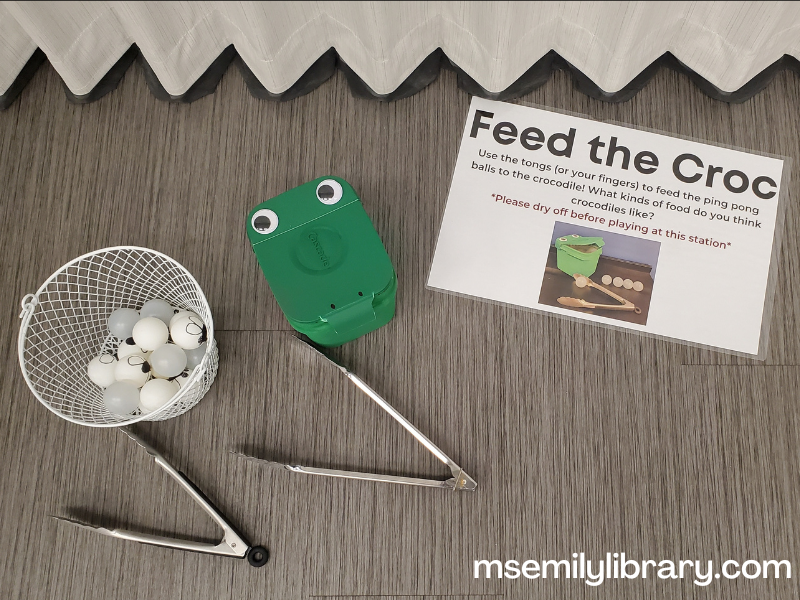
Feed the Croc (Weeks 2 & 5)
Saw this and thought it was very cute, and actually had the container from last year that someone had given to me. I painted it so that the whole thing is green and the label was covered up, added the big googly eyes and made little nostril markings. I found a few metal tongs at Goodwill and added the ping pong balls. Nom, nom, nom! Original idea from Mama OT.

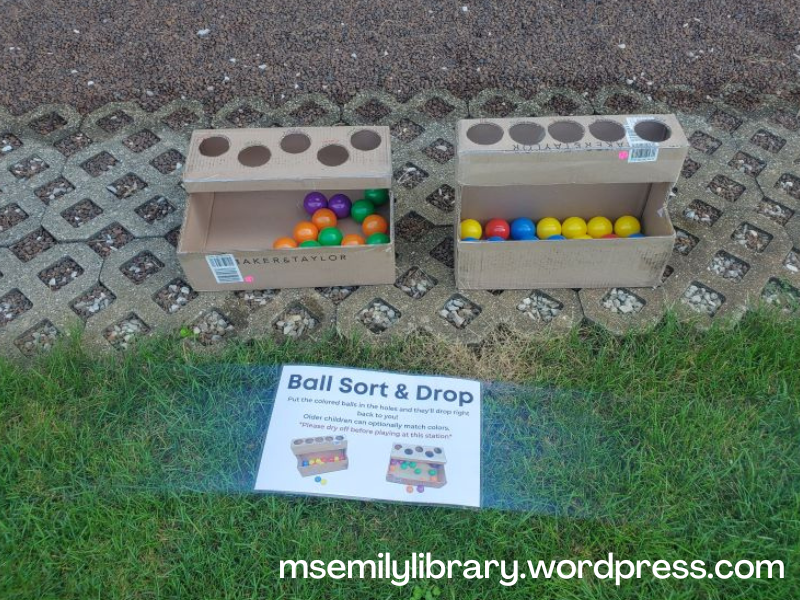
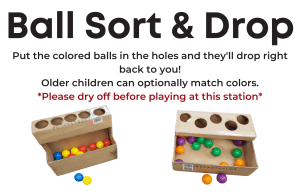
Colored Ball Sort and Drop (Weeks 3 & 6)
Two more repeats from last year. This ball sort and drop was made with Baker & Taylor boxes, but oriented them different ways so one was tall and skinny and one was low and squat. I had purchased ball pit balls and supplied different colors to each box. Photos from last year, which had weird blurs, sorry. Original idea from Taming Little Monsters.

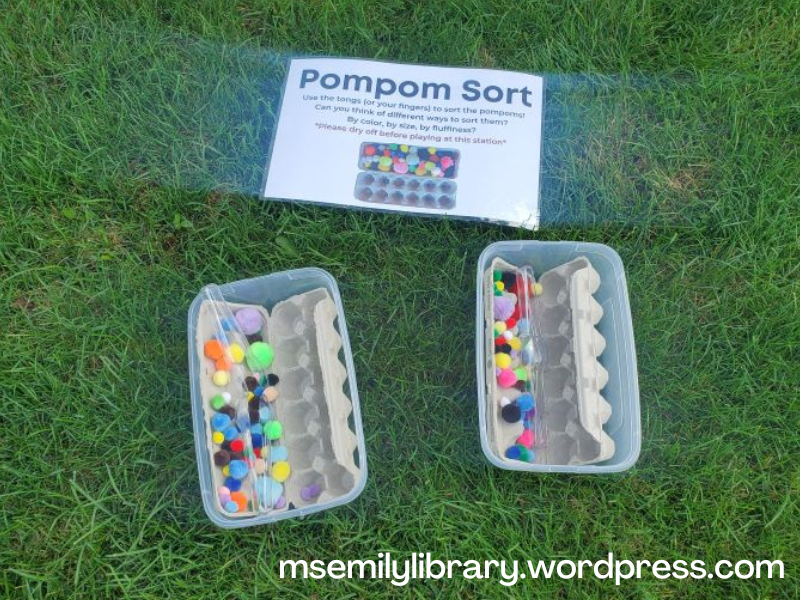
Pompom Sort (Weeks 3 & 6)
A really easy station to put together: I just saved a couple of egg cartons, then poured a handful or two of different colored/sized pompoms into them. The plastic tongs I provided last year were all broken in use, so I bought some metal ice tongs for this year. (And again, weird blur). Original idea from Laughing Kids Learn.

Art Stations

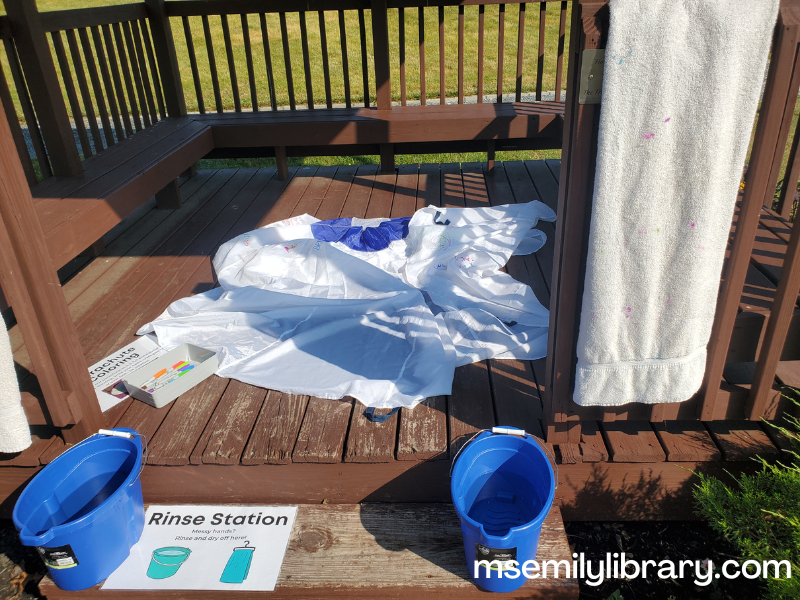
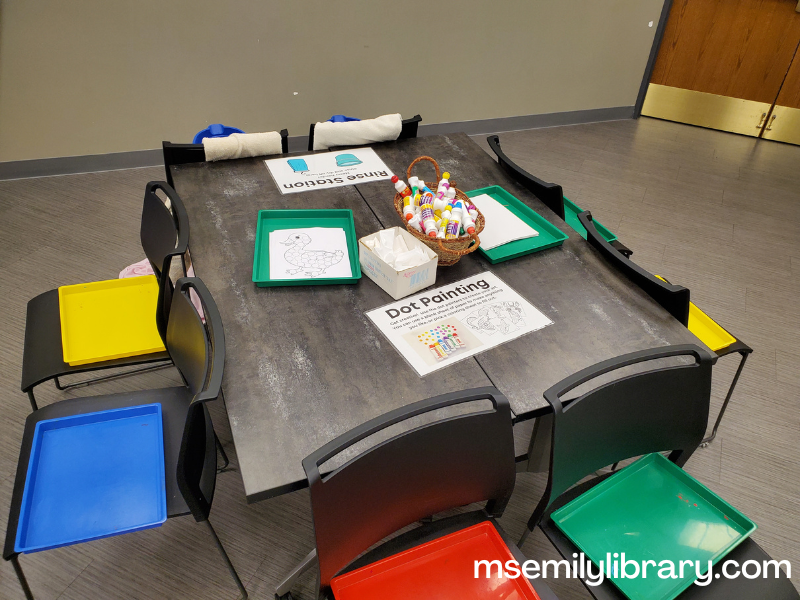
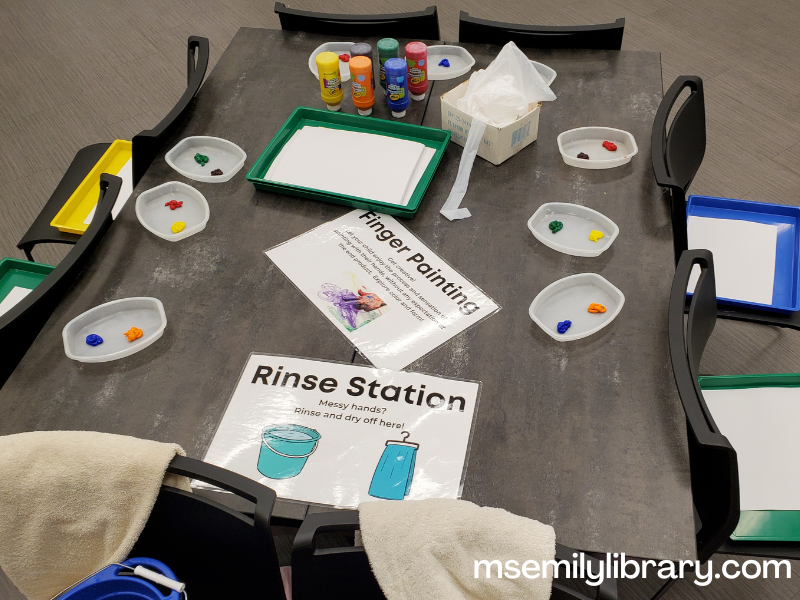
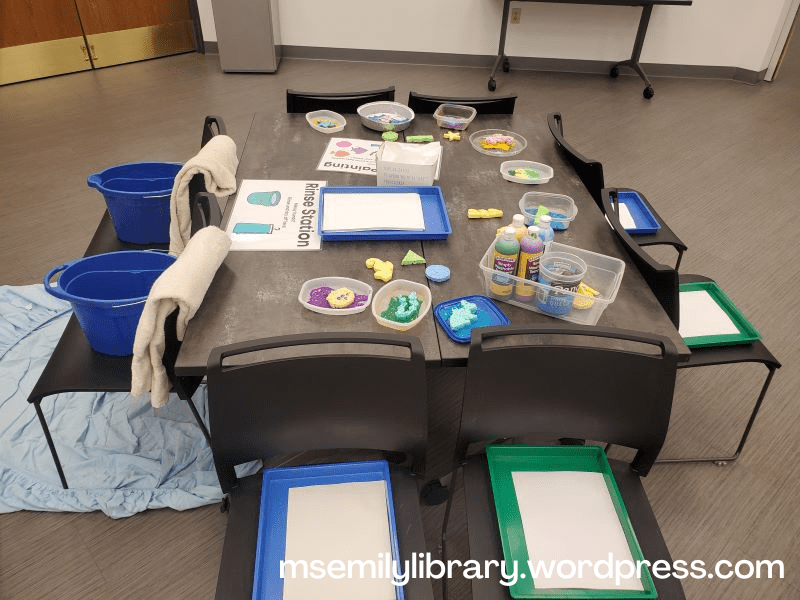
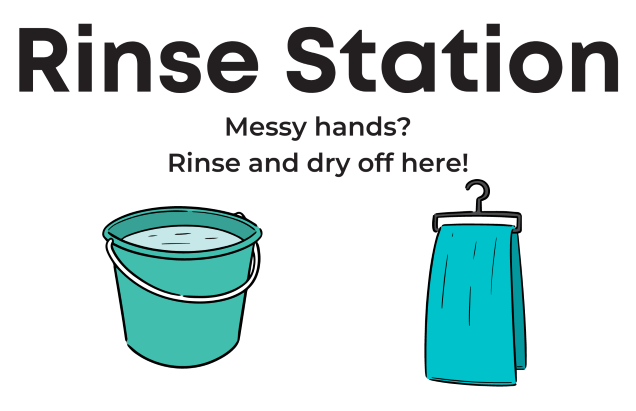
With the exception of Coloring the Parachute, the art stations were all unique, and all were simple process-focused art with different media. To help with mess, I set up a “Rinse Station” near the art every week which consisted of two buckets of water and two old bath towels for washing up as needed.

Rinse Station sign:
"Messy hands? Rinse and dry off here!"

Color the Parachute (all weeks)
My library has an interesting smaller parachute (maybe 8 foot diameter?) that is plain white and was advertised as “decorate it yourself!” When I inherited it, there were a small scattering of names from who knows how long ago and the rest was depressingly empty. This summer I was determined to fill it up. I laid it out each week and set it as a station inside the gazebo, with a small handful of permanent markers. I’m happy to say that it looks MUCH better now, though it could still use a lot more personalization to fill up empty spaces. I offered some different ideas as the weeks went on as to what to add, like a favorite animal or insect. The first time we were indoors I offered it as a station, but cleaning up realized there was permanent marker on our relatively new flooring. To keep my director from going nuts, I decided not to put it out indoors anymore. 🙂 You can see the rinse station in the photo as well.

Shape Prints (Week 1)
Using shape sorter blocks that we already had in our baby toy collection, kids could dip them in paint and stamp the shapes onto white construction paper. I use old recycled Lean Cuisine trays to hold the paint – they are a perfect size. Sadly, I missed getting any pictures of this station! Original idea (and photo on the sign) from Nanny Gunna.

Dot Painting (Week 2)
I originally had a different craft planned for week 2, but it was rainy that week and we were indoors the first two days. Dot painting is very easy and not as messy as slapping paint with flyswatters (see week 6 below), so the switch was made. The library has a supply of dot paint markers and I printed out some animal dot coloring sheets. Simple and still fun. I get a lot of these sheets, including the ones pictured, from The Artisan Life.

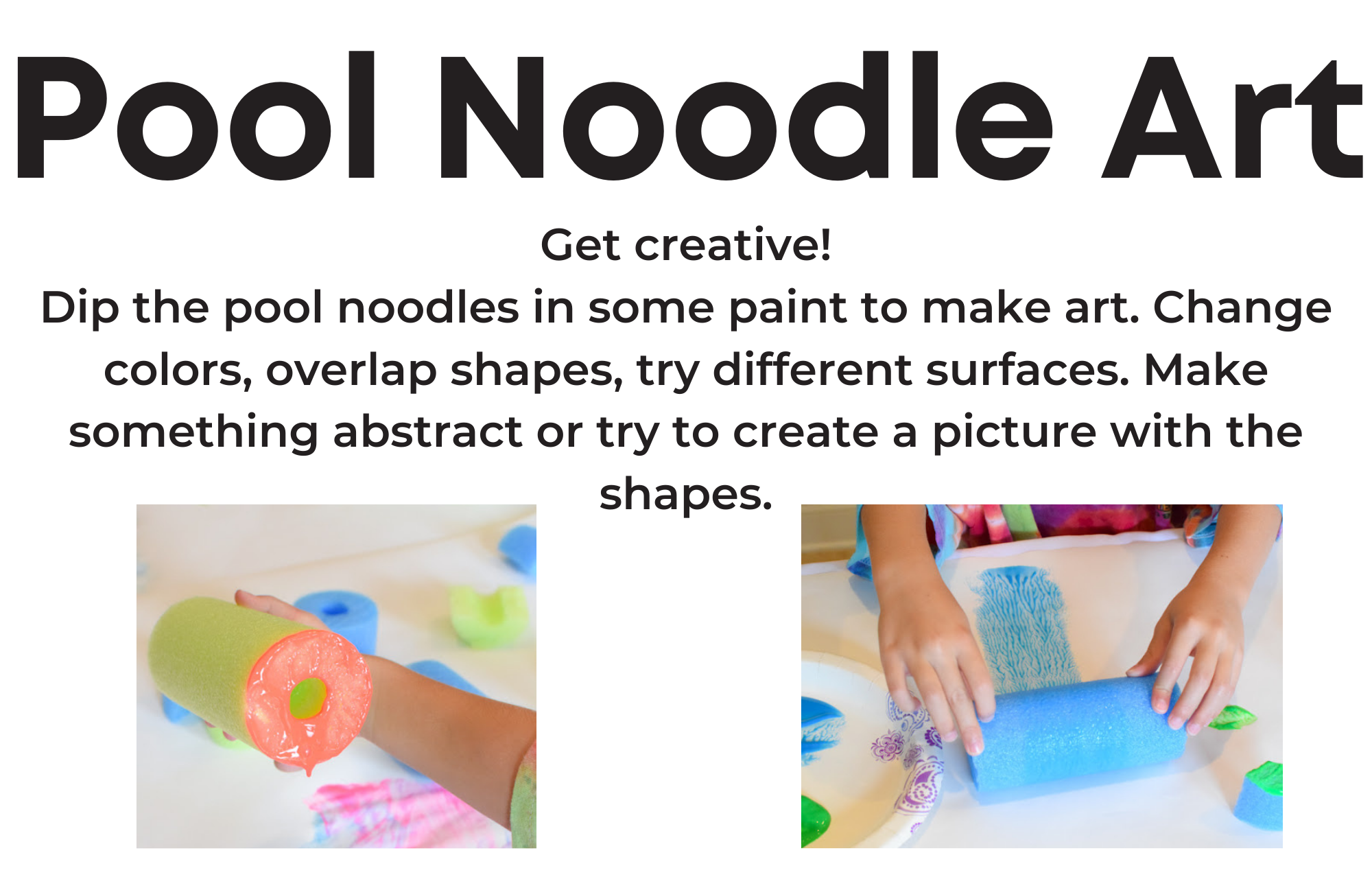
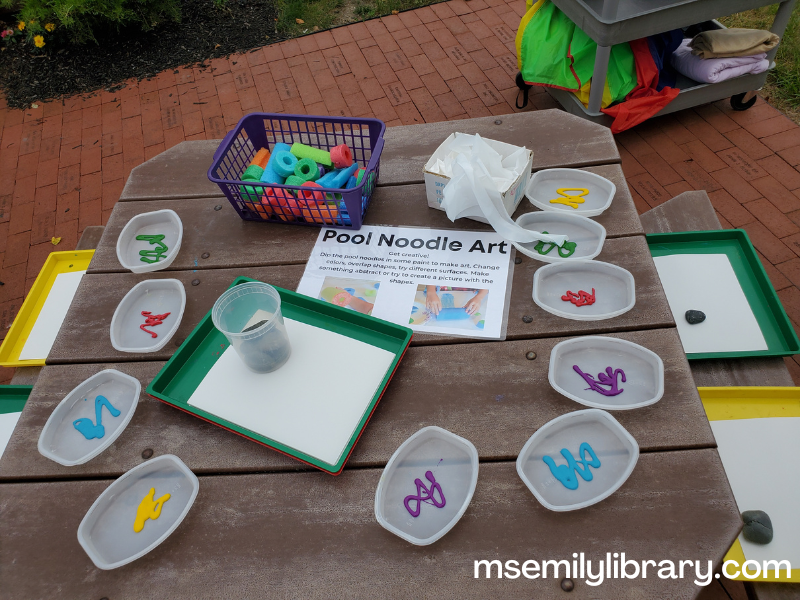
Pool Noodle Art (Week 3)
The pool noodles make another appearance! Trays of tempera paint and white construction paper are available with the noodles for any kind of art a child wishes to make. I had a few extra pieces of noodles that had been split lengthwise as well as sliced, to make half-circle shapes in addition to the full circles. Original idea (and photo on the sign) from What Can We Do With Paper and Glue.

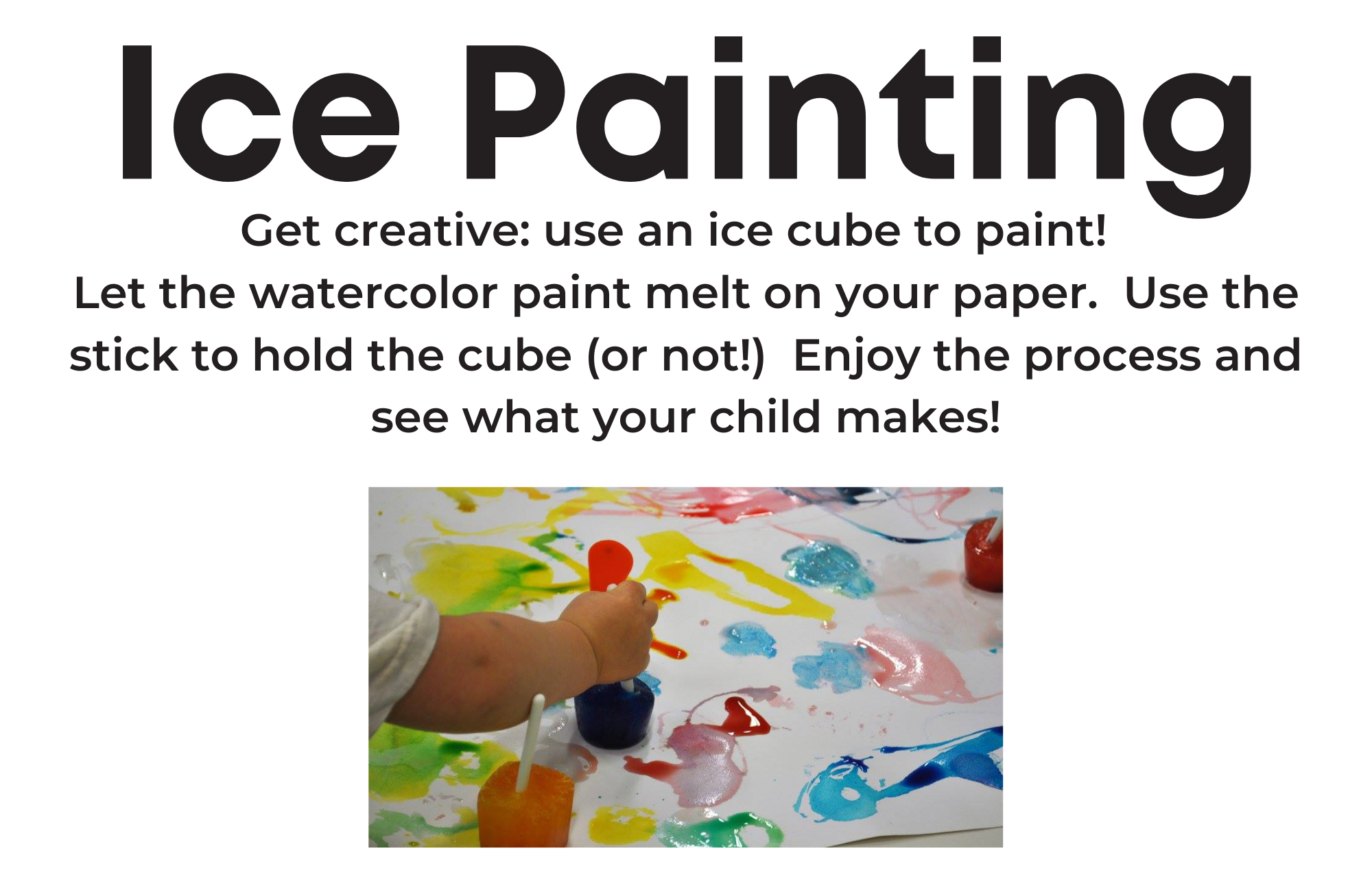
Ice Painting (Week 4)
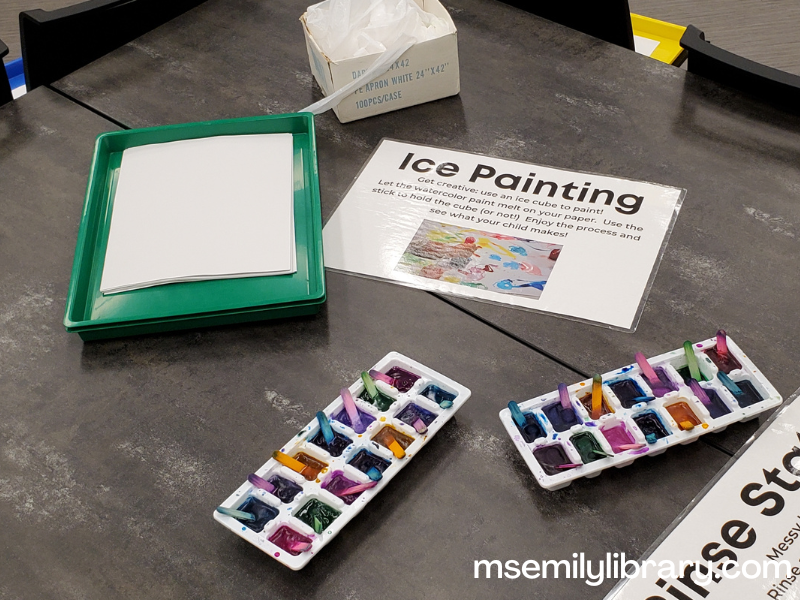
This is honestly very simple, but I always get a lot of comments from grown-ups about how cool it is and how they might be able to do it at home. (I LOVE hearing that they’ll adapt what we do at the library at home!) I add small craft sticks to an ice cube tray and put in a little liquid watercolor paint and fill the rest with water. I think it could easily be done with food coloring if you don’t have liquid watercolors, though. I keep the ice cube trays in a cooler in the shade until we’re ready for stations, then get them out to use. They do melt, but usually there’s a bit of ice left by the end of the program. And my groups were quite tidy, so I was able to just refreeze the trays each day and there was plenty of “paint” available for three sessions. Original idea (and photo on the sign) from ARTventurers.

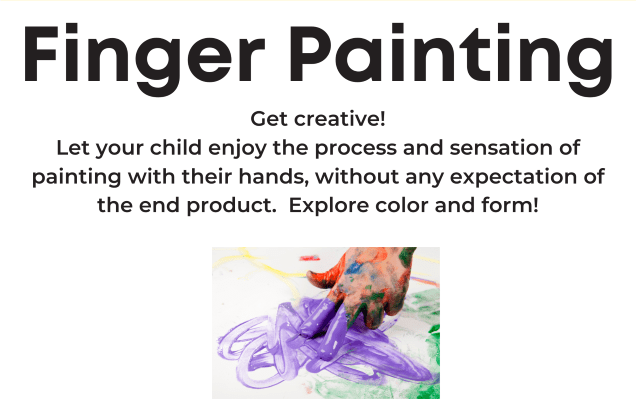
Finger Painting (Week 5)
A classic and super-simple activity – construction paper in our messy trays with finger paints in trays. I actually had several kids who didn’t like the sensory messiness of it, so some of them creatively used the rocks that are there to keep papers from flying away to spread the paint around. I’m not sure of the source of the photo on the sign, I think it’s a stock photo from Canva.

Fly Swatter Art (Week 6)
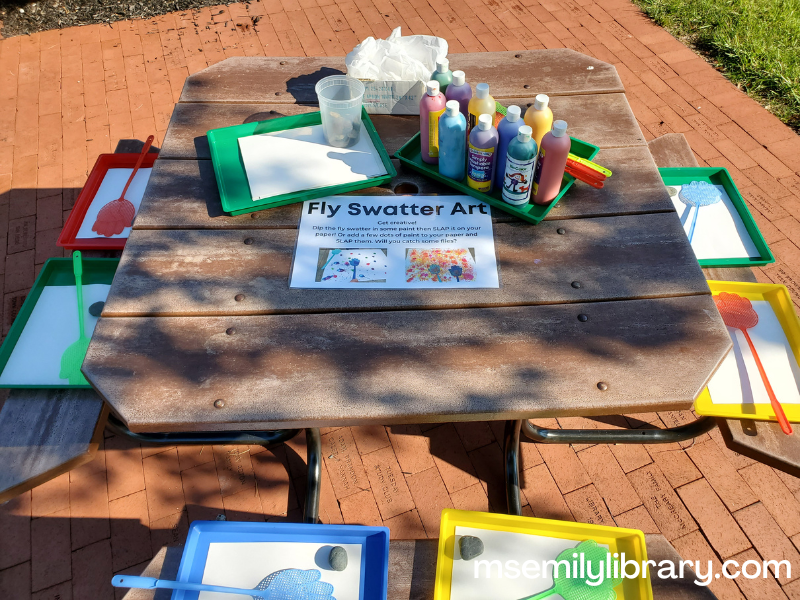
A messy but very fun art project, using (re-using) supplies from other stations. Kids wielded fly swatters to slap at paint, making some very interesting abstract art. I think the best method turned out to be adding some dots of paint to the paper, then letting the kids aim for them, rather than trying to spread paint on the swatter. I’m grateful for good weather all that week, since this is very much an outdoor activity. Original idea (and photo on the sign) from Play Teach Repeat.

Chalk Art (Week 7)
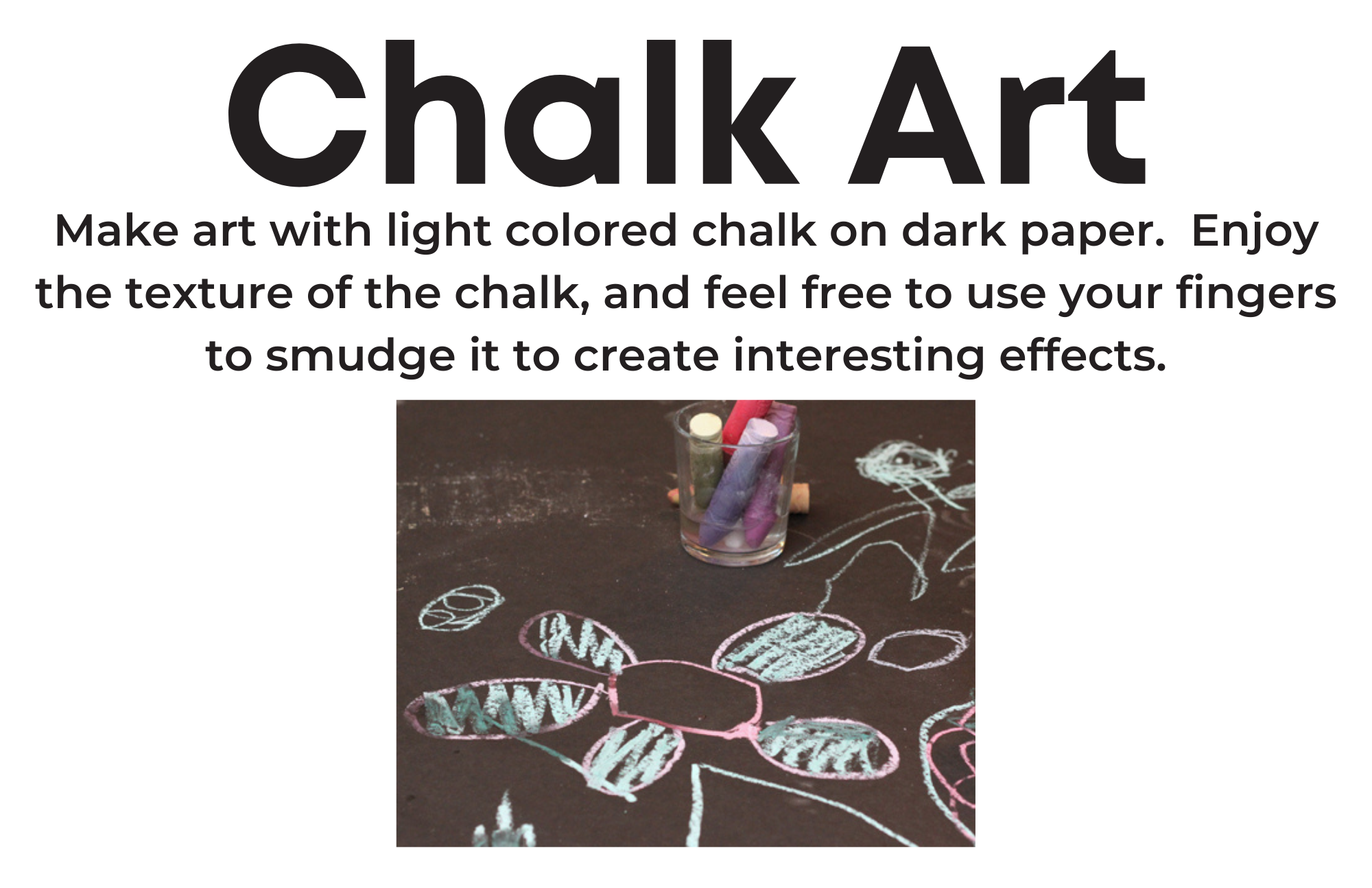
Another very simple process art project, using black construction paper and sidewalk chalk. It was nice to end the summer with an art station that didn’t involve paint – this librarian was very tired by that point!

Wow, thanks for making it to the end of this very long post. I hope you found some good ideas and jumping-off points for out-of-the-box programming!

Summer Storytimes: All Together Now, Part I

Welcome back to the blog! My library’s Summer Reading Program is officially over, and I am deep into planning the fall. Summer is so busy that I take a break from blogging, but it was a great season, and I’d love to share it with you. I implemented all I learned in the last couple of years doing outdoor programming, and I think it was the best yet, despite worse weather and air quality this year (boo.)

Our library generally uses the theme and graphics from the Collaborative Summer Library Program, or CSLP, a national initiative that helps libraries plan summer programming. This year’s theme was “All Together Now,” with an emphasis on kindness and community. I focused on a different aspect of this each week for seven weeks in June and July. My program themes then were Community, We Work Together, Kindness, Family, Animal Helpers, and Helping Hands. More detail on how these were interpreted below. I also simplified the usual age requirements that I normally have for my indoor programs through the rest of the year. (So, instead of a Toddler Time for 1-2 year olds on Mondays and a Teddy Bear time for 2-3.5s on Tuesdays, I offered Family Time for 0-3.5 Monday, Tuesday, and Wednesday.) Siblings are always welcome, and I don’t have a limit to the number of families who can participate, so the programs are open to all.

For each session, we had about 15-20 minutes of storytime rhymes, songs, and a book, then 20 minutes of free play at various sensory stations. We end with bubbles and a goodbye song. Stations are a really great way to promote socializing, practice skills like sharing and being gentle, and allow for unstructured play, which science tells us is so important to learning and development. I added a section of parachute songs weekly, too, which was a treat for everyone. It was easy to do thematically – “A parachute is hard to have fun with by yourself. You need some friends and have to work ‘all together!'”

I also am all about simplicity and repetition over the summer. I have a lot of moving parts, set up and tear down to deal with, so I don’t change a lot in the storytime part and plan everything ahead so I am purely in “execute” mode rather than worrying about planning or learning songs. I changed one song and the book each week, and had a mixture of weekly, rotating, and unique stations. Since so much was the same, I’ll write up the whole summer in two posts: this first one focusing on the storytime half, and the second post focusing on all of the hands-on stations!

And, in addition to being back from hiatus, I finally bit the bullet and bought a domain name and WordPress subscription. Welcome to the ad-free Storytime with Ms. Emily Library experience! Please let me know if anything is wonky or links not working correctly in the transition.

The Plan: Storytime Portion

Welcome Song: Hello, Friends
(tune of Goodnight, Ladies)
Hello, friends! Hello, friends!
Hello, friends, it’s time to say hello!
Hello, [name 1], hello, [name 2]!
Hello, [name 3], it’s time to say hello! (repeat as needed)
(ASL motions: salute for “hello,” then take the index fingers on each hand and you link them together as though they are hugging each other back and forth for “friends”)
Source: Glenside Public Library District

Warm-Up Rhyme: We Wiggle and Stop
(Use the ASL sign for the word “stop” – one hand “chops” across the opposite hand)
We wiggle and we wiggle and we STOP
We wiggle and we wiggle and we wiggle and we wiggle
And we wiggle and we wiggle and we STOP
(We wiggled every week, but then added 2 more motions. Motions we did throughout the summer: jump, twirl, run, splash, hop, swim, stretch, stomp, wave, sway, march, lean, roll [arms,] hug)
Source: Jbrary

Intro: Our summer reading program is “All Together Now” and it is all about how wonderful things can happen when we work together. Short intro to the weekly theme (see below)

Themed Song (see below)

Transition Song: If You’re Ready for a Story
(tune of If You’re Happy and You Know It)
If you’re ready for a story, clap your hands (clap, clap)
If you’re ready for a story, if you’re ready for a story,
If you’re ready for a story, clap your hands (clap, clap)
Source: Miss Keithia (my predecessor)

Themed Book (see below)

Parachute! A parachute is really hard to have fun with all by yourself. We need friends, and we need to work together!

Parachute Song: Let’s Go Riding in an Elevator
Let’s go riding in an elevator, Elevator, elevator (parachute up and down)
Let’s go riding in an elevator, Ride along with me!
First floor, Second floor, Third floor, Fourth floor, Fifth floor… (shake parachute low, and get progressively higher)
And down, down, down, down, down! (lower parachute)
Source: Jbrary

I remind everyone to start rowing very gently, then after the first verse, say, “Oh, the wind is picking up, can we row more firmly?” and before the third verse, “Oh, no, there’s a storm! Row as strongly as you can!”
Parachute Song: Row Your Boat (3 verses)
Row, row, row your boat
Gently/Firmly/Strongly down the stream
Merrily, merrily, merrily, merrily
Life is but a dream
(Wave the parachute gently, then firmly, then wildly!)
Source: traditional

Breathing Break
Whew, all that rowing got me out of breath! I’m ready for a breathing break. Let’s take a big breath in and lift the parachute up, then breathe out and lower it. We’ll repeat a few times.

Most people know the first verse, but the second verse is probably newer and much less well known. It was a fun way to get us “up” from falling down. We did this one twice, walking in one direction and then the other.
Parachute Song: Ring Around the Rosie
(walk in a circle with parachute)
Ring around the rosie,
Pocket full of posies
Ashes, ashes,
We all fall down! (fall and stay seated)

Cows are in the meadow, (crouching by the ‘chute)
Eating buttercups
Thunder, lightning, (shake the parachute)
we all stand up! (stand)
Source: traditional

It actually took a few weeks for the adults to “get” this one. Repetition is good for them, too. 🙂
Parachute Song: Parachute Fly
(tune of Skip to my Lou)
(kids go under the parachute and adults raise and lower)

Up, up, up it goes,
Down, down, down so low
Raise our parachute to the sky
Count to 3 and watch it fly
Spoken:
Up on one…
Down on two…
Up on three…
and FLY! (adults let go and leader pulls ‘chute in to themselves)
Source: Gymboree

Release to Stations
I have eight stations each week, which involve a mixture of dry, wet, and art/creativity stations. We spend about 20 minutes before I ring the bell to call everyone back to the grassy area. We’ll go into further detail on these in the next blog post.

Everybody loves bubbles! The trick to doing bubbles outside, I’m finding, is to figure out which way the wind is blowing and get upwind of your group!
Recorded Bubble Song: Pop, Pop, Pop by Nathalia
From the album “Dream a Little,” available on Spotify

CD album cover for Nathalia's Dream a Little

Goodbye Song: See You Later, Alligator
(tune of Clementine)
See you later, alligator (wave with one hand, then the other)
In a while, crocodile (open and shut arms like a croc’s mouth)
Give a hug, ladybug (hug yourself or a loved one)
Blow a kiss, jellyfish! MWAH! (move hand like a jellyfish then blow a kiss!)
Source: King County Library System

Weekly Themes

Week 1: Friends 6/6, 6/7/23

Intro: Friends are the people who we love to play and hang out with, and who help us out when we need it. I love making new friends!

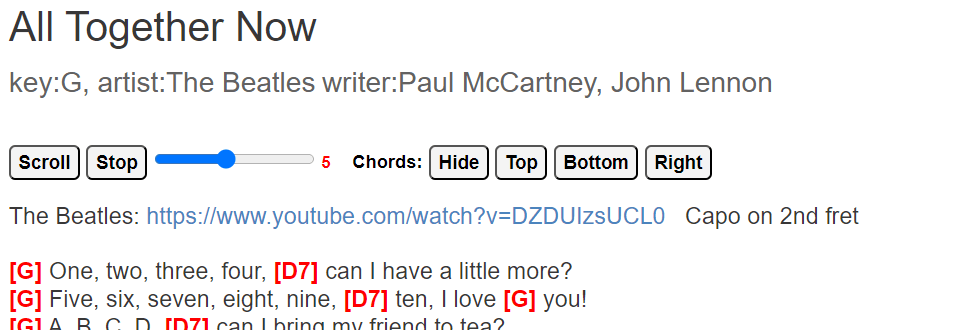
Themed Song: All Together Now I played this one on my ukulele, and asked the group to participate by doing the “response” part of the “all together now” chorus. If you don’t want to sing this one, play the original recording by the Beatles or the cover by Caspar Babypants.
I got the chord sheet from Jim’s Ukulele Songbook. It’s a great resource since he’s got a lot of functionality built into the site and among other things you can change the key of any of the songs and print sheets very easily. I prefer to play and sing this one in the key of G.

Themed Read: Who Has Wiggle Waggle Toes? by Vicky Shiefman & Francesca Chessa This is a story of friends having fun together. Can you join in?

Week 2: Community 6/12, 6/13, 6/14/23

Intro: We live in a community of people, and the people in our community help each other. Some people have jobs that let them help others every day.

I played this one on my ukulele and took suggestions from the group. I prompted them by asking, “who helps us when we’re feeling sick?” if there was a lull.
Themed Song: Community Helpers Song
(tune of Farmer in the Dell)
The teachers teach the kids
Heigh-ho, they help us so
The teachers teach the kids

Choose 3-5 verses!
The firefighters put out the fires….
The crossing guards help us cross…
The librarians find us books….
The dentists check our teeth…
The doctors keep us well…
The farmers grow our food…
The mail carriers deliver the mail…
Custodians keep us clean…

Click for a ukulele songsheet for “Farmer in the Dell”

I encouraged the group to give a cheer for every page to keep interest up.
Themed Read: Cheer: A Book to Celebrate Community by Uncle Ian Aurora & Natalia Moore

Week 3: We Work Together 6/19, 6/20, 6/21/23

Intro: Working together really makes things go smoother.

Instead of the ukulele this week, we did the ASL motions.
Themed Song: The More We Get Together
The more we get together, together, together
The more we get together, The happier we’ll be
For your friends are my friends, and my friends are your friends
The more we get together, The happier we’ll be

The more we read together… (ASL for read)
We’ll read big books and small books
Read short books and tall books…

The more we work together the stronger we’ll be… (ASL for work)
Source: traditional, ASL for verse one

Themed Read: Blocks by Irene Dickson

Week 4: Kindness 6/26, 6/27, 6/28/23

Intro: One important way to work together is to show kindness. Being kind means thinking of others and doing what you can to be a good neighbor.

The root of all kindness, I believe, is love. Here’s a traditional song your grownups might remember from their childhoods!
Themed Song: Skinnamarink
Skinnamarinky-dinky-dink, Skinnamarinky-doo, I love you!
I love you in the morning, and in the afternoon
I love you in the evening, underneath the moon
Skinnamarinky-dinky-dink, Skinnamarinky-doo, I love you!
Source: traditional, motions from Jbrary

Themed Read: How Kind! by Mary Murphy

Week 5: Family 7/3, 7/5/23

Intro: We can start working together with the people who are closest to us – our families! Who are the people in your family?

Here’s a song for all the people in our families – listen carefully! I included some different iterations to try to be as inclusive as possible. To keep things from getting too long, I sometimes combined (grandma and grandpa). Pairing it with a silly action (and telling grown-ups that they count, too) increases the fun.
Themed Song: If You Have a Brother
(tune of Do You Know the Muffin Man)
If you have a brother
A half-brother, a step-brother
If you have a foster-brother
Please stand up!
Repeat with other family members: sister, mommy, daddy, cousin, aunt, uncle, grandpa, grandma, etc. Ask for suggestions!
Pair with other silly actions: raise your hand, stick out your tongue, wiggle your foot, jump up and down, pat your head, etc.

Source: Abby the Librarian (though I changed the tune)

Themed Read: The Family Book by Todd Parr

Week 6: Animal Helpers 7/10, 7/11, 7/12/23

Intro: Does anyone have a pet at home? Did you know that some animals have important jobs, helping their humans? Some animals help humans who need them to get around or keep them safe. Some animals help soothe people who are lonely or need an animal to help them calm down. Today we are celebrating these animal helpers.

I talked briefly about different helper animals and what they do – including miniature horses, who can be used for the visually impaired! Cats and bunnies are generally therapy animals. I used puppets for each, and asked what sound each one made – including the rabbit! “You’re right, rabbits are quiet! But they can be helpful by being snuggly!”
Themed Song: Animal Helpers Song
(tune of The Wheels on the Bus)
The dog helps his owner with a woof, woof, woof
Woof, woof, woof
Woof, woof, woof
The dog helps his owner with a woof woof
All day long!

The cat helps her owner with a meow, meow, meow…
The horse helps their owner with a neigh, neigh, neigh…
The bunny helps her owner with a snuggle, snuggle, snuggle…
Source: adapted from the traditional

So, I kind of realized after planning that this dog was not a working dog but a pet – the vest threw me off. It still seemed like the best option as far as length. If you know a better option, please let me know in the commets!
Themed Read: Best Day Ever! by Marilyn Singer & Leah Nixon

Week 7: Helping Hands 7/17, 7/18, 7/19/23

Intro: Who likes to be a helper? What are some ways you might help at home? Putting toys away, set the table, put laundry in the hamper, play with a younger sibling, etc.

Since we use this tune for our transitional song, which comes right after this one, I saved the “clap” action for that one and went right into it. I also played ukulele for this one!
Themed Song: If You’re Helpful and You Know It
(tune of If You’re Happy and You Know It)
If you’re helpful and you know it, stomp your feet
If you’re helpful and you know it and you really want to show it
If you’re helpful and you know it, stomp your feet

If you’re friendly and you know it, peekaboo…
If you’re thoughtful and you know it, shout hooray…
Then go right into “If you’re ready for a story, clap your hands”
Source: adapted from the traditional

Get a downloadable ukulele songsheet here!

thumbnail for ukulele songsheet

Themed Read: Kindness Makes Us Strong by Sophie Beer

Tune in to the next post to learn more about all the sensory stations – like the Fly Swatter Slap, Pool Noodle Sort, Ping Pong Fishing, Mystery Water, Feed the Croc, and more!

Summer Storytimes: Merbabies Play

The last summer reading storytime, wow. The summer went so quickly this year, probably since it seemed like the library was hopping after two years of interrupted/adjusted service. I’m so pleased with the turnout and response from my storytime families. I heard or overheard someone say every week: “Hey, let’s try this at home!” or “I wouldn’t have thought of this, but we could set this up at home!” That was the most gratifying part. I LOVE being able to spark ideas and inspire families to continue the learning and exploration on their own.

Another great benefit of outdoor storytimes was how welcoming they can be. I occasionally had families stop by who hadn’t registered, and/or had a child who was 4 or 5 (outside my age group), or who were able to bring older siblings. In addition, we didn’t have to worry about masking, and distancing was not a problem since we had lots of space in the outdoor lawn area. For all these situations, I could welcome these families with open arms, with no judgement that they “didn’t do it [registration] right” or worry that they had to find someone else to watch their older kids while they attended storytime with the younger one. These are usual and reasonable limitations when you’re presenting indoors, where space is also limited. But I love having a time of year where I don’t have to turn anyone away.

This week’s theme is “merpeople” and I’m glad that authors, illustrators, and publishers have started being more inclusive with their depictions. I didn’t have to look too far to find masculine presenting merfolk or merfolk of color! I do wish there were more merperson books that were simpler, with less text on the page, but I did some extensive paperclipping to make them work for the youngest group. I also had to do some scouting around to find masculine merkids as coloring pages (see below for links).

For a more in-depth explanation of the structure of this summer’s programs, read the intro to the first session, Ocean Life.

You can find other versions of this theme from 2020 and 2025.

Early Learning Tip: “Down By the Bay” is a great song to exercise your creativity on. What silly rhymes can you and your child come up with together? Learning how to rhyme helps your child listen for and discern between the distinct sounds that make up words.

Welcome Song: Hello, Friends 
(tune of Goodnight, Ladies)
Hello, friends! Hello, friends!
Hello, friends, it’s time to say hello!
Hello, [name 1], hello, [name 2]!
Hello, [name 3], it’s time to say hello! (repeat as needed)
(ASL motions: salute for “hello,” then take the index fingers on each hand and you link them together as though they are hugging each other back and forth for “friends”)
Source: Glenside Public Library District

Warm-Up Rhyme: We Wiggle and Stop (repeated)
(Use the ASL sign for the word “stop” – one hand “chops” across the opposite hand)
We wiggle and we wiggle and we STOP
We wiggle and we wiggle and we wiggle and we wiggle
And we wiggle and we wiggle and we STOP
(This week we also “marched” and, my favorite, “hugged.” I encouraged everyone to find someone to hug, even if it was themselves. I do two new motions in addition to “wiggle” each week to keep it interesting)
Source: Jbrary

Intro to Weekly Theme: Merpeople are legendary creatures that are half human and half fish. It’s fun to imagine what they might be like!

I had a lot of trouble finding a merfolk song that I liked this week. My second runner up was “Did you Ever See a Mermaid,” but I just wasn’t feeling it. I ended up with “Down By the Bay,” and I had fun coming up with lots of ocean-themed verses. I only actually used the merfolk ones, but it’s nice to have some extras in my back pocket for the future! It was also an opportunity to bring my ukulele, which I hadn’t done at all yet this summer.
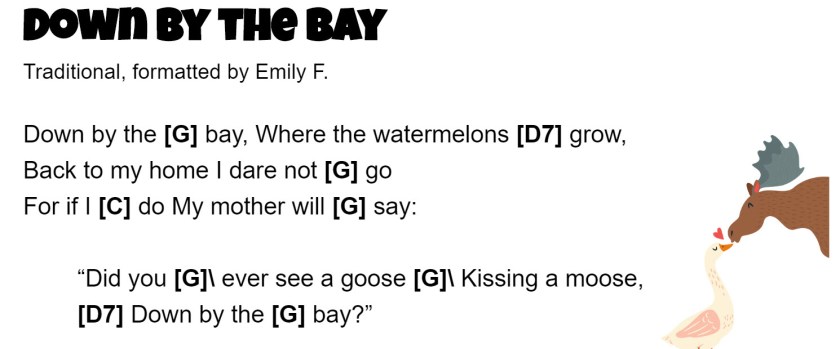
Themed Ukulele Song: Down by the Bay
Down by the bay, where the watermelons grow
Back to my home I dare not go!
For if I do, my mother will say:
“Did you ever see a whale with a polka dot tail?”
Down by the bay!
Additional verses:
… a mermaid swimming in lemonade?
… a merman knitting an afghan?
… a merkid riding a squid?
… a merboy hugging his teddy bear toy?
… a mergirl playing catch with a pearl?
… a crab driving a taxicab?
… a shark eating ice cream in the park?
… a clam competing in a poetry slam?
… a pufferfish surfing on a dish?
… a sea star riding in a car?
… a seahorse playing on a golf course?
… an octopus singing to a platypus?
Did you ever have a time when you couldn’t make a rhyme?
Source: traditional, as popularized by Raffi on the album Singable Songs for the Very Young, all additional verses by Ms. Emily!

Download a ukulele songsheet for Down By the Bay!

Thumbnail of "Down By the Bay" ukulele song sheet

Themed Book:
Goodnight Mermaid by K. J. Oceanak & Allie Ogg
OR
Can I Give You a Squish? by Emily Neilson

I *highly* paperclipped Goodnight Mermaid to make it work for my youngest group. It was just way too long (and if I’m being honest, a little nonsensical, too.) But the pictures are fun and the shortened story is reminiscent of Goodnight Moon, which is a familiar structure. My oldest group did great with Can I Give You a Squish, but when I tried it again the next day with my more mixed group, I skipped several pages when they seemed to be losing interest. I’m learning to be very flexible with books!

I adapted the lyrics only slightly from Jbrary’s pirate themed song to be a little more generic ocean. I also let grownups know this could be a lifting song, but only if they’re feeling ambitious! I invite everyone else to do the up and down motions with me.
Repeated Song: The Ocean Song
(tune of The Elevator Song)
Oh, the ocean is great and the ocean is grand!
There are lots of big ships but very little land
And we sleep down deep in a hammock near the floor
And this is what we do when we go out to shore:

(ready?) We… ride… the…
waves going up, we ride the waves going down
we ride the waves going up, we ride the waves going down
And we turn… a-… round!
Source: Jbrary

After the Ocean Song, I’m invariably out of breath, so it’s time for a breathing break. I’d considered doing ocean wave breathing on the theme, but I decided that Five Finger Breathing is an easy one to teach and for kids to remember, which is my point in doing it.
Breathing Break: Five Finger Breathing
Whew, I could use a breathing break! Let’s get out our five fingers and spread our hands out wide. We’re going to breathe in deeply as we trace our fingers up, pause for just a moment at the top of our finger, then breathe out as we trace down. Ready?

I like to mention that this song was adapted by an occupational therapist as a reminder of ways to self-soothe.
Repeated Movement Song: Big Sea Star
(tune of A Ram Sam Sam)
A big sea star, a big sea star
Little cuddle clam and a big sea star
A big sea star, a big sea star
Little cuddle clam and a big sea star
A pufferfish! A pufferfish!
Little cuddle clam and a big sea star
A pufferfish! A pufferfish!
Little cuddle clam and a big sea star
Source: Jbrary

Release to Stations
I have seven stations each week, which involve a mixture of dry, wet, and an action station. We spend about 20 minutes in free play.

Repeated Stations:
Kinetic Sand (Dry)
I bought some kinetic sand and added it to two plastic bins. In the recycling bin I found some fruit cup containers that had fun shapes and added them plus some plastic shovels. I keep a sheet underneath this station to catch any stray sand that escapes the bins. I didn’t realize until after I planned this station that kinetic sand should not be put in mouths, so I do warn the parents that if their kiddo is still exploring with their mouth, they may want to skip this one.

Kinetic sand station outside - two bins set on a blue sheet, with small plastic containers, plastic shovels, and sand in them

Pouring Station (Wet)
I asked coworkers to collect clean plastic recyclables with wide openings for this station and visited Goodwill for some additional pitchers. We had measuring cups and funnels in our materials, as well as a baby pool, which is the perfect container. I fill the pool with plastic bins and fill them randomly with water from the hose each week. (Also, I must have had some sunscreen on my lens taking pictures outdoors – there’s a weird blur!)

Pouring station, with a faded red baby pool filled with various plastic containers of all shapes and sizes

Rotating Stations:
Pompom Sort (Dry)
A really easy station to put together: I just saved a couple of egg cartons, then poured a handful or two of different colored/sized pompoms into them. Provide some plastic tongs and you’re done. (And again, weird blur)

Pompom Sorting station: two shoebox sized plastic bins hold two natural cardboard egg cartons with various shaped and colored pompoms and plastic tongs.

Colored Ball Sort and Drop (Dry)
This was inspired by a Pinterest post from Taming Little Monsters. I made two, from our ubiquitous Baker & Taylor boxes, but oriented them different ways so one was tall and skinny and one was low and squat.

Ball sort and drop station: two cardboard book boxes hold plastic "ball pit" balls.  Both have holes cut into the top with an open space below for the balls to be retrieved.

Dodge the Seaweed (Action)
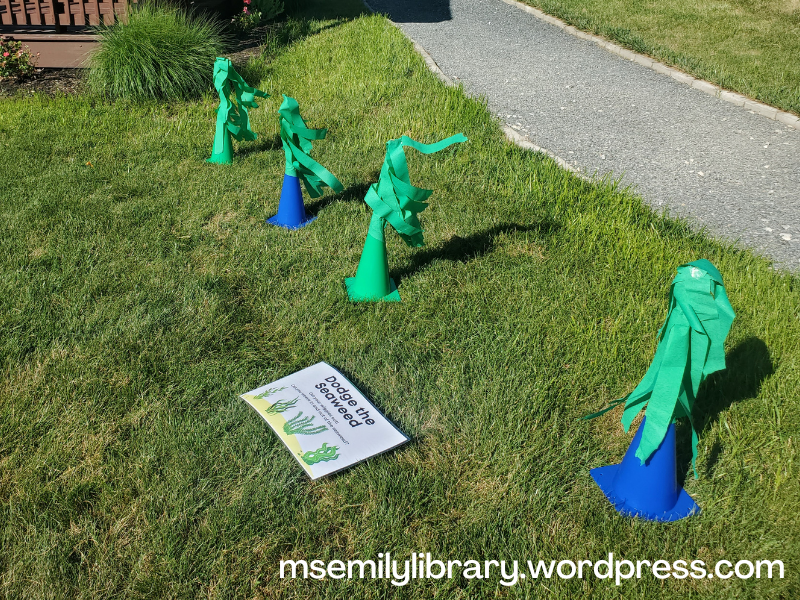
We had some small cones in our action set, so I duct taped a paint stirrer to the tops of them, then haphazardly added green crepe paper to look like seaweed. For the amount of time it took me, I think they look pretty good! I was fully expecting them to get kind of torn up after the first week of use, but they held up. I’m amazed that I didn’t need to repair them once over the summer! 

Dodge the seaweed station, with green and blue cones topped by green crepe paper "seaweed"

Unique Stations: UNIQUE-ISH – I had two other stations planned, but decided to actually repeat two previous stations instead. My other plans were to do a “paint with water” on dry concrete, but the only concrete we have near our storytime area is a sidewalk RIGHT next to the street. It made me nervous to bring everyone that close to speeding cars, so I nixed it. For the art station, I had a vague idea of using pinecones to stamp merfolk tails with paint, then draw in the details, but A) that was a little advanced for my group, and B) I was too tired to think about cleaning up lots of paint at the end of the summer. I went the easy route and redid these instead:

Sponge Play (Wet)
Based on this Pinterest idea from Little Lifelong Learners, I just had sponges in bins of water for little ones to play with. Of course, I have to do some theme stuff, so in addition to simple shapes (sticks, triangles, circles), I cut out some ocean animals as well. These sponges were reused in a sponge painting craft in week two.

Picture of two bins with multicolored sponges in them.  Shapes include seahorses, fish, sea stars, clamshells, dolphins, triangles, sticks, and circles.

Dot Painting (Art/Messy)
So as I was planning this week and thinking about how I’d make the pinecone painting as easy as possible, I got a blog post in my email from The Artisan Life that had mermaid dot painting sheets. Well, let’s just make things easy on myself. Plus, the kids seemed to like doing the dot painters when we did them a couple weeks ago, a and it’s a more “unusual” craft supply that not everyone has at home. BUT – I was a little unhappy that there were no merboys (and that all the mermaids looked kind of the same, with the same kinds of hair.) I did a search for merboy coloring sheets and found this lovely set (which also includes different hair types, yay!) by Simple Everyday Mom. Did you know you can make any coloring sheet into a dot marker sheet? I used Canva, but you could certainly do the same thing in Publisher. Just add .75 inch dots to the sheet on blocks of color (avoiding faces and slender limbs like arms). Easy peasy.

After about 20 minutes exploring stations, I rang the bell to call everyone back to the storytime area. 20 minutes felt like a good time – kids had generally found their way to all the stations and were winding down.

Everybody loves bubbles! The trick to doing bubbles outside, I’m finding, is to figure out which way the wind is blowing and get upwind of your group!
Recorded Bubble Song: Pop, Pop, Pop by Nathalia
From the album “Dream a Little,” available on Spotify

CD cover of Nathalia's "Dream A Little" album.

Goodbye Song: See You Later, Alligator
(tune of Clementine)
See you later, alligator (wave with one hand, then the other)
In a while, crocodile (open and shut arms like a croc’s mouth)
Give a hug, ladybug (hug yourself or a loved one)
Blow a kiss, jellyfish! MWAH! (move hand like a jellyfish then blow a kiss!)
Source: King County Library System

Other books I had available for families to browse (and may work for you on this theme)
The Ocean Calls: A Haenyeo Mermaid Story by Tina Cho & Jess X. Snow
Oona
by Kelly DiPucchio & Raissa Figueroa
Oona and the Shark
by Kelly DiPucchio & Raissa Figueroa
Pearl
by Molly Idle
Julián Is a Mermaid
by Jessica Love
The Little Mermaid
by Jerry Pinkney
Mermaids Fast Asleep
by Robin Riding & Zoe Persico
Mermaid and Me
by Soosh
How to Catch a Mermaid
by Adam Wallace & Andy Elkerton
You Are My Sparkly Mermaid
by Joyce Wan
Mabel: A Mermaid Fable
by Rowboat Watkins

This storytime was presented in-person on 7/18, 7/19, & 7/20/22.

Summer Storytimes: Pirates

Oh, Pirates. You’re so complicated. You did horrible things. You probably (on average) lived a fairly short and brutal life, with lots of disease, injury, and discomfort. But you also seem so freewheeling, wear awesome clothes, say fun phrases in a fun accent, keep amazing pets, and have been romanticized into something almost unrecognizable from your historical form. (Not to mention modern-day pirates, who have so many of the negative features without much of the fun ones).

But who am I to over-analyze!? We got to do the Pirate version of Zoom, Zoom, Zoom (the space version has been a regular and favorite in my regular school-year storytimes) and hunt for gold doubloons hidden in our kinetic sand and mystery water stations. The pirate books are pretty fun, too.

For a more in-depth explanation of the structure of this summer’s programs, read the intro to the first session, Ocean Life.

Early Learning Tip: Books about unusual topics like pirates or dinosaurs are wonderful for building vocabulary! These books use words that aren’t usually said in common conversation, so your child will be hearing lots of new words and phrases. Feel free to explain what new concepts mean – like when pirates say “Shiver me timbers,” they’re comparing a feeling of surprise like being up on the ship’s mast when a wind blows through.

Welcome Song: Hello, Friends 
(tune of Goodnight, Ladies)
Hello, friends! Hello, friends!
Hello, friends, it’s time to say hello!
Hello, [name 1], hello, [name 2]!
Hello, [name 3], it’s time to say hello! (repeat as needed)
(ASL motions: salute for “hello,” then take the index fingers on each hand and you link them together as though they are hugging each other back and forth for “friends”)
Source: Glenside Public Library District

Warm-Up Rhyme: We Wiggle and Stop (repeated)
(Use the ASL sign for the word “stop” – one hand “chops” across the opposite hand)
We wiggle and we wiggle and we STOP
We wiggle and we wiggle and we wiggle and we wiggle
And we wiggle and we wiggle and we STOP
(This week we also “climbed” imaginary pirate ship rigging and “swayed” as if we were up in the crow’s nest – I’ll do two new motions in addition to wiggle each week to keep it interesting)
Source: Jbrary

Intro to Weekly Theme: Arr, mateys! Today’s theme is pirates! Pirates liked to sail the ocean, look for treasure like these special gold coins called “doubloons,” and get into trouble. Does anyone know what a pirate’s favorite letterrrrrr is? (Hopefully a grownup will say “R!”) Oh, ye’d think it’d be “R,” but it’s really the “C” a pirate loves!

As mentioned above, Zoom Zoom Zoom is a song I would repeat almost weekly at indoor programs this spring. We hadn’t done it at all this summer until this week, so there was a lot of excitement from regulars!
Themed Song: Pirate Zoom, Zoom, Zoom
Zoom, zoom, zoom
We’re hunting for doubloons!
Zoom, zoom, zoom
We’re hunting for doubloons!
If you want to take a trip
Climb aboard my pirate ship
Zoom, zoom, zoom
We’re hunting for doubloons
In 5, 4, 3, 2, 1 – AHOY!
Source: Jbrary

Themed Book:
Bubble Bath Pirates by Jarrett J. Krosoczoska
OR
Pirate Jack Gets Dressed by Nancy Raines Day & Allison Black

I adapted the lyrics only slightly from Jbrary’s pirate themed song to be a little more generic ocean. I also let grownups know this could be a lifting song, but only if they’re feeling ambitious! I invite everyone else to do the up and down motions with me.
Repeated Song: The Ocean Song
(tune of The Elevator Song)
Oh, the ocean is great and the ocean is grand!
There are lots of big ships but very little land
And we sleep down deep in a hammock near the floor
And this is what we do when we go out to shore:

(ready?) We… ride… the…
waves going up, we ride the waves going down
we ride the waves going up, we ride the waves going down
And we turn… a-… round!
Source: Jbrary

After the Ocean Song, I’m invariably out of breath, so it’s time for a breathing break. I’d considered doing ocean wave breathing on the theme, but I decided that Five Finger Breathing is an easy one to teach and for kids to remember, which is my point in doing it.
Breathing Break: Five Finger Breathing
Whew, I could use a breathing break! Let’s get out our five fingers and spread our hands out wide. We’re going to breathe in deeply as we trace our fingers up, pause for just a moment at the top of our finger, then breathe out as we trace down. Ready?

I like to mention that this song was adapted by an occupational therapist as a reminder of ways to self-soothe.
Repeated Movement Song: Big Sea Star
(tune of A Ram Sam Sam)
A big sea star, a big sea star
Little cuddle clam and a big sea star
A big sea star, a big sea star
Little cuddle clam and a big sea star
A pufferfish! A pufferfish!
Little cuddle clam and a big sea star
A pufferfish! A pufferfish!
Little cuddle clam and a big sea star
Source: Jbrary

Release to Stations
I have seven stations each week, which involve a mixture of dry, wet, and an action station. We spend about 20 minutes in free play.

Repeated Stations:
Kinetic Sand (Dry)
I bought some kinetic sand and added it to two plastic bins. In the recycling bin I found some fruit cup containers that had fun shapes and added them plus some plastic shovels. I keep a sheet underneath this station to catch any stray sand that escapes the bins. I didn’t realize until after I planned this station that kinetic sand should not be put in mouths, so I do warn the parents that if their kiddo is still exploring with their mouth, they may want to skip this one.

Kinetic sand station outside - two bins set on a blue sheet, with small plastic containers, plastic shovels, and sand in them

Pouring Station (Wet)
I asked coworkers to collect clean plastic recyclables with wide openings for this station and visited Goodwill for some additional pitchers. We had measuring cups and funnels in our materials, as well as a baby pool, which is the perfect container. I fill the pool with plastic bins and fill them randomly with water from the hose each week. (Also, I must have had some sunscreen on my lens taking pictures outdoors – there’s a weird blur!)

Pouring station, with a faded red baby pool filled with various plastic containers of all shapes and sizes

Rotating Stations:
Craft Stick Sort (Dry)
I noticed in my storage bin that I had these boxes of dot painters that have small holes already in the top. I colored a ring around each hole a different rainbow color and added colored craft sticks for a fine motor and color identification station.

Craft stick sort station with small cardboard boxes with eight small holes in each, ringed in color, and a pile of colored craft sticks in front of them

Beanbag Sort (Dry)
We had these beanbags from Lakeshore Learning that are different colors and shapes. They’re a super easy station where kids can play and sort with them in several ways.

Beanbag sort station, with shiny plastic beanbags in cube, sphere, and pyramid shapes in rainbow colors.

Walk the Plank (Action)
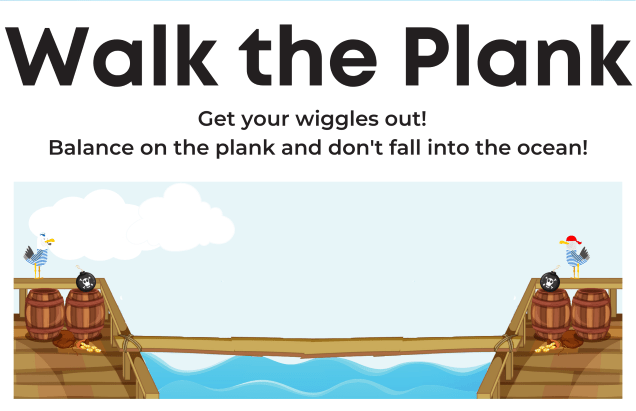
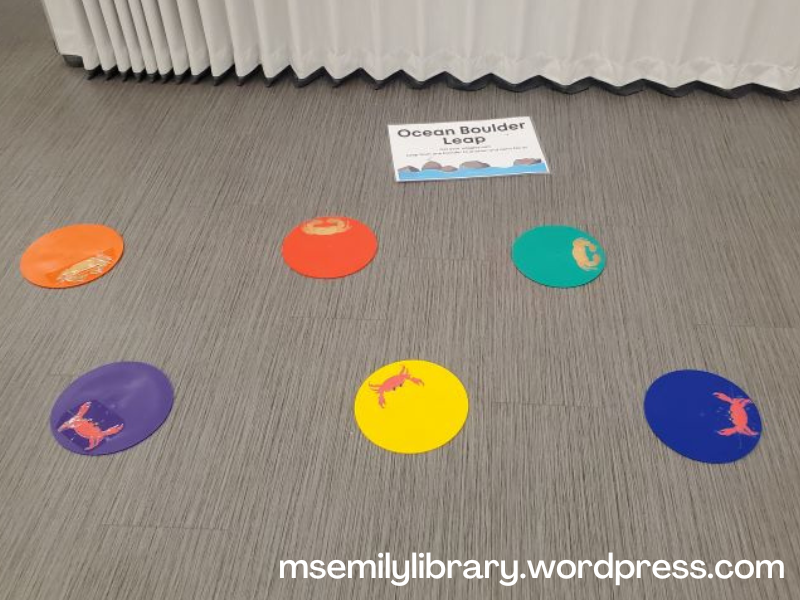
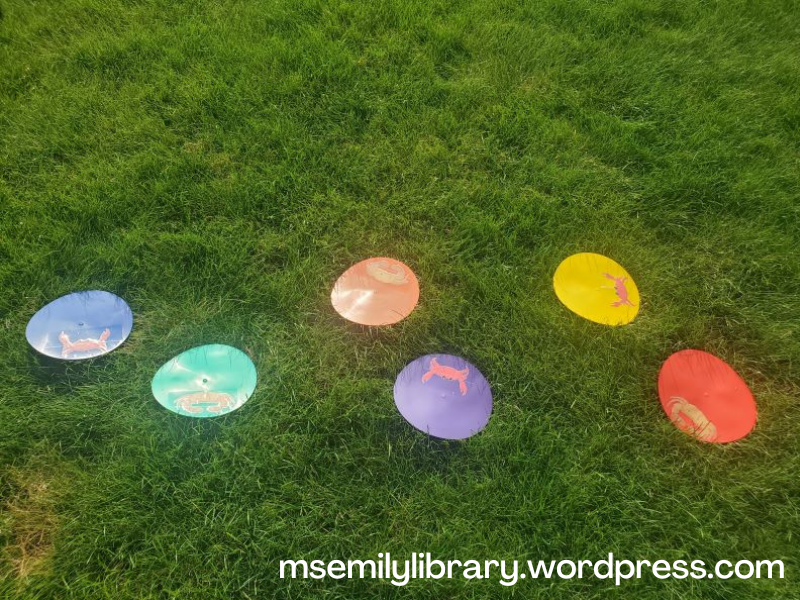
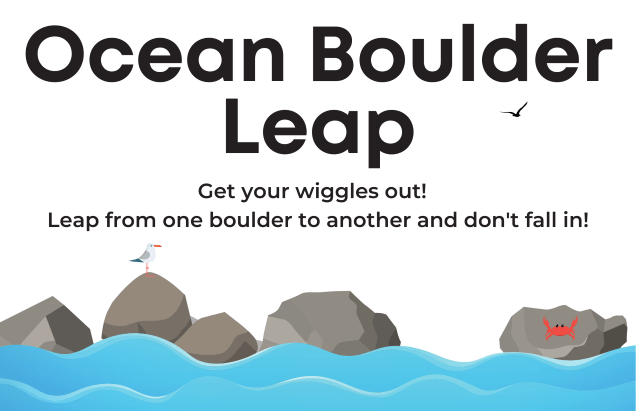
Rather than capital punishment, I framed this walk the plank activity as going between two ships. But the “waters” are definitely shark-infested! I used the rubber dots I had from Ocean Boulder Leap to attach shark fins to, and there is a sturdy rubber balance beam in the same active play set my library has. This one looks cool from across the yard, when the shark fins really look like they’re swimming in the grass!

Unique Stations:
Mystery Water (Wet)
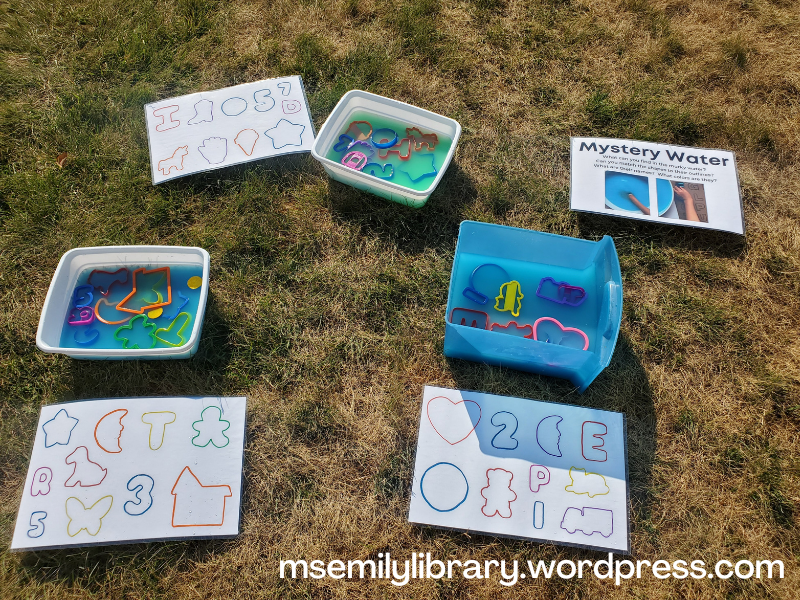
Inspired by this Pinterest pin from bright_little_brains, I used some plastic cookie cutters we had in storage, traced their shapes on a large sheet of paper, and laminated. The water was mixed with a few tablespoons of cornstarch and several drops of food coloring to make the water murky. I also added some of my toy pirate gold to each bin. Unfortunately, the cookie cutters weren’t very heavy and kind of floated to the top, but it wasn’t a disaster and the kids enjoyed the activity anyway.

Three bins are shown with murky green or blue water, in which different brightly colored plastic cookie cutters are floating.  Next to each bin is a laminated sheet with the outline of each cookie cutter.

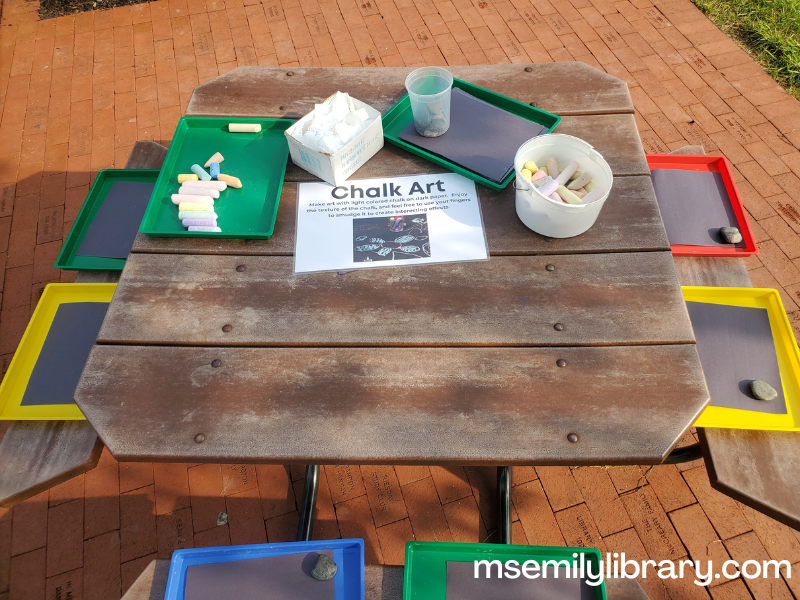
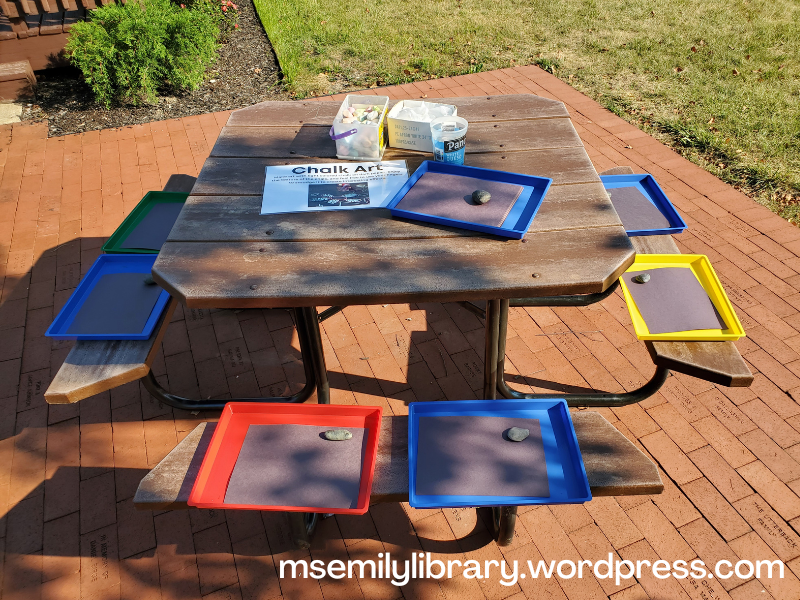
Chalk Art (Art/Messy)
This summer, crafts were all about the process. I tried to mix up some different crafting materials that we had laying around and just let the kids do with them what they would. This week I put out black construction paper and sidewalk chalk for them to draw with.

Art station on a picnic table, with messy trays set on the bench and art supplies on the table.  Includes black paper and sidewalk chalk, as well as a sign explaining the station.

After about 20 minutes exploring stations, I rang the bell to call everyone back to the storytime area. 20 minutes felt like a good time – kids had generally found their way to all the stations and were winding down.

Everybody loves bubbles! The trick to doing bubbles outside, I’m finding, is to figure out which way the wind is blowing and get upwind of your group!
Recorded Bubble Song: Pop, Pop, Pop by Nathalia
From the album “Dream a Little,” available on Spotify

CD cover of Nathalia's "Dream A Little" album.

Goodbye Song: See You Later, Alligator
(tune of Clementine)
See you later, alligator (wave with one hand, then the other)
In a while, crocodile (open and shut arms like a croc’s mouth)
Give a hug, ladybug (hug yourself or a loved one)
Blow a kiss, jellyfish! MWAH! (move hand like a jellyfish then blow a kiss!)
Source: King County Library System

Other books I had available for families to browse (and may work for you on this theme)
On a Pirate Ship
by Sarah Courtauld & Benjie Davies
The Grumpy Pirate
by Corinne Demas, Artemis Roehrig, & Ashlyn Anstee
Pirate’s Perfect Pet
by Beth Ferry & Matthew Myers
Roger, the Jolly Pirate
by Brett Helquist
Pirate Pete
by Kim Kennedy & Doug Kennedy
How I Became a Pirate
by Melinda Long & David Shannon
Give Me Back My Bones!
by Kim Norman & Bob Kolar
Pirates Don’t Go to Kindergarten
by Lisa Robinson & Eda Kaban
Port Side Pirates!
by Oscar Seaworthy & Debbie Harter
Sheep on a Ship
by Nancy Shaw & Margot Apple
The Pirate Jamboree
by Mark Teague
Captain Cat and the Pirate Lunch
by Emma J. Virján

This storytime was presented in-person on 7/11, 7/12, & 7/13/22.

Summer Storytimes: Sharks!

Sharks are beloved by kids, even the littlest, even though they’re known for death and destruction! I had at least one kid dress in some kind of shark attire (hats, shirts, even shoes!) each of my storytime days. So fun when the parents get into the theme, too.

This was the first week that I did a different song and themed book for my littlest age group, Book Babies (0-2), than for my older groups (up to 3.5). The Shark Song seems to require more interaction to enjoy, whereas I suggested that babies and their caregivers “sway” during the majority of Slippery Fish, then do some bounces or tickles for the “Gulp, gulp, gulp” part to let the babies be involved without having to do hand motions. The book I’m a Shark is really great for the 2.5-3.5 crowd, but it feels like it’s just too much for the younger ones, so I went with Swallow the Leader in Book Babies. It’s been really difficult for me to engage the babies in books, especially in the outdoor setting, so this was another instance of me modelling page skipping is okay if your kiddo is losing interest. I wonder if other librarians are having trouble with the book portions of their storytimes. Chime in the comments if you have, or if you’ve been finding good ways to keep kids’ attention.

For a more in-depth explanation of the structure of this summer’s programs, read the intro to the first session, Ocean Life.

Early Learning Tip: Did you notice the colorful fish in Swallow the Leader? They have different colors and shapes, and although none are exactly the same, there are some that are alike.  Seeing patterns and trying to recognize things that are alike and different is fun, but also helps develop mathematical concepts of patterns and relationships. 

Welcome Song: Hello, Friends 
(tune of Goodnight, Ladies)
Hello, friends! Hello, friends!
Hello, friends, it’s time to say hello!
Hello, [name 1], hello, [name 2]!
Hello, [name 3], it’s time to say hello! (repeat as needed)
(ASL motions: salute for “hello,” then take the index fingers on each hand and you link them together as though they are hugging each other back and forth for “friends”)
Source: Glenside Public Library District

Warm-Up Rhyme: We Wiggle and Stop (repeated)
(Use the ASL sign for the word “stop” – one hand “chops” across the opposite hand)
We wiggle and we wiggle and we STOP
We wiggle and we wiggle and we wiggle and we wiggle
And we wiggle and we wiggle and we STOP
(This week we also “stretched” and “stomped” – I’ll do two new motions in addition to wiggle each week to keep it interesting)
Source: Jbrary

Intro to Weekly Theme: Some of the most interesting (and a little scary) animals in the ocean are sharks! Let’s do a song about some sharks doing what they do best – eating fish!

As a self-confessed pedantic, I had to see if this song was true to life. And yes! Google tells me that indeed some jellyfish eat small fish, some octopuses eat jellyfish, mako sharks have been found with octopus in their bellies, and sperm whales have been found with sharks in theirs! (Also, orca whales will attack and eat sharks, too). I feel better about singing this song.
Themed Song for Book Babies: Slippery Fish
Slippery fish, slippery fish, sliding through the water,
Slippery fish, slippery fish, Gulp, Gulp, Gulp!
Oh, no! It’s been eaten by a …

Additional verses:
Jellyfish, jellyfish, squirting through the water…
Octopus, octopus, squiggling in the water…
Mako shark, mako shark, lurking in the water…
Humongous whale, humongous whale, spouting in the water…
… BURP!
(Cover your mouth.) Excuse me!
Source: Jbrary

I took great pleasure in telling the families that we were going to be doing a song about a shark family, but it wasn’t THAT shark family!
Themed Song for Teddy Bears & Family Time: The Shark Song
Oh, there’s a shark, do-do, do-do-do
A baby shark, do-do, do-do-do
Lives in the ocean, do-do, do-do-do
He eats fish, CHOMP-CHOMP, CHOMP, CHOMP!
He’s got a fin, do-do, do-do-do
A dorsal fin, do-do, do-do-do
And that’s the end, do-do, do-do-do
(but that’s not the end! What other kind of shark might there be?)
Mommy, Daddy, Grandma

Source: The Ooey Gooey Lady

Themed book:
I’m a Shark by Bob Shea
OR
Swallow the Leader by Deanna Smith & Kevin Sherry

I adapted the lyrics only slightly from Jbrary’s pirate themed song to be a little more generic ocean. I also let grownups know this could be a lifting song, but only if they’re feeling ambitious! I invite everyone else to do the up and down motions with me.
Repeated Song: The Ocean Song
(tune of The Elevator Song)
Oh, the ocean is great and the ocean is grand!
There are lots of big ships but very little land
And we sleep down deep in a hammock near the floor
And this is what we do when we go out to shore:

(ready?) We… ride… the…
waves going up, we ride the waves going down
we ride the waves going up, we ride the waves going down
And we turn… a-… round!
Source: Jbrary

After the Ocean Song, I’m invariably out of breath, so it’s time for a breathing break. I’d considered doing ocean wave breathing on the theme, but I decided that Five Finger Breathing is an easy one to teach and for kids to remember, which is my point in doing it.
Breathing Break: Five Finger Breathing
Whew, I could use a breathing break! Let’s get out our five fingers and spread our hands out wide. We’re going to breathe in deeply as we trace our fingers up, pause for just a moment at the top of our finger, then breathe out as we trace down. Ready?

I like to mention that this song was adapted by an occupational therapist as a reminder of ways to self-soothe.
Repeated Movement Song: Big Sea Star
(tune of A Ram Sam Sam)
A big sea star, a big sea star
Little cuddle clam and a big sea star
A big sea star, a big sea star
Little cuddle clam and a big sea star
A pufferfish! A pufferfish!
Little cuddle clam and a big sea star
A pufferfish! A pufferfish!
Little cuddle clam and a big sea star
Source: Jbrary

Release to Stations
I have seven stations each week, which involve a mixture of dry, wet, and an action station. We spend about 20 minutes in free play.

Repeated Stations:
Kinetic Sand (Dry)
I bought some kinetic sand and added it to two plastic bins. In the recycling bin I found some fruit cup containers that had fun shapes and added them plus some plastic shovels. I keep a sheet underneath this station to catch any stray sand that escapes the bins. I didn’t realize until after I planned this station that kinetic sand should not be put in mouths, so I do warn the parents that if their kiddo is still exploring with their mouth, they may want to skip this one.

Kinetic sand station outside - two bins set on a blue sheet, with small plastic containers, plastic shovels, and sand in them

Pouring Station (Wet)
I asked coworkers to collect clean plastic recyclables with wide openings for this station and visited Goodwill for some additional pitchers. We had measuring cups and funnels in our materials, as well as a baby pool, which is the perfect container. I fill the pool with plastic bins and fill them randomly with water from the hose each week. (Also, I must have had some sunscreen on my lens taking pictures outdoors – there’s a weird blur!)

Pouring station, with a faded red baby pool filled with various plastic containers of all shapes and sizes

Rotating Stations:
Pompom Sort (Dry)
A really easy station to put together: I just saved a couple of egg cartons, then poured a handful or two of different colored/sized pompoms into them. Provide some plastic tongs and you’re done. (And again, weird blur)

Pompom Sorting station: two shoebox sized plastic bins hold two natural cardboard egg cartons with various shaped and colored pompoms and plastic tongs.

Colored Ball Sort and Drop (Dry)
This was inspired by a Pinterest post from Taming Little Monsters. I made two, from our ubiquitous Baker & Taylor boxes, but oriented them different ways so one was tall and skinny and one was low and squat.

Ball sort and drop station: two cardboard book boxes hold plastic "ball pit" balls.  Both have holes cut into the top with an open space below for the balls to be retrieved.

Walk the Plank (Action)
Rather than capital punishment, I framed this walk the plank activity as going between two ships. But the “waters” are definitely shark-infested! I used the rubber dots I had from Ocean Boulder Leap to attach shark fins to, and there is a sturdy rubber balance beam in the same active play set my library has. This one looks cool from across the yard, when the shark fins really look like they’re swimming in the grass!

Walk the plank sign: "Get your wiggles out!  Balance on the plank and don't fall into the ocean!"  Shows two ship decks with barrels, a small pile of gold, and a cartoony bomb with the jolly roger on them.  A seagull dressed as a sailor and a pirate sits on each deck's rail.

Unique Stations:
Ice Rescue (Wet)
Inspired by this blog post from Teaching Mama, I used the plastic ocean animals previously used with the Animal Washing Station two weeks ago to freeze into some large containers. The first one was a quart sized container, and the second a wide square bowl. With both containers, I realized that the animals would float, so it took some doing to keep them at the bottom of the container. For the quart sized one, the opening was narrow enough that a few medium sized rocks kept the animals down.

Quart sized ice block showing sharks, an orange sea star, and rocks trapped in ice.

However, the wider bowl was much trickier. I ended up freezing them in shallow layers. Of course, the ice didn’t stick to the bowl very well so IT floated to the top when I added some layers, but since it was all one big chunk, adding rocks to the top was easier to keep it down. When it was a lot of little items floating in water, the rocks slipped between them to the bottom. So, trial and error and eventually it worked.

Two ice blocks inside their containers sitting on the grass - one a tall skinny quart sized container, the other a pink square bowl.  Both have rocks and plastic shark fins sticking out of the ice.

I filled the big trays with just an inch or two of water from the hose, then provided the orange pails and squeeze bottles filled with water as hot as I could get it from the tap. By the time we released to stations 20 minutes into the program, the water was warm but not too warm. The kids really worked diligently to get the animals out, and they had fun playing with them once they were released.

Dot Painting (Art/Messy)
In an effort to keep the crafts this summer simple and minimal, I put out our basket of dot painters (that has been sitting lonely on the supply shelf since 2020) and some ocean animal dot coloring sheets from The Artisan Life blog.

After about 20 minutes exploring stations, I rang the bell to call everyone back to the storytime area. 20 minutes felt like a good time – kids had generally found their way to all the stations and were winding down.

Everybody loves bubbles! The trick to doing bubbles outside, I’m finding, is to figure out which way the wind is blowing and get upwind of your group!
Recorded Bubble Song: Pop, Pop, Pop by Nathalia
From the album “Dream a Little,” available on Spotify

CD cover of Nathalia's "Dream A Little" album.

Goodbye Song: See You Later, Alligator
(tune of Clementine)
See you later, alligator (wave with one hand, then the other)
In a while, crocodile (open and shut arms like a croc’s mouth)
Give a hug, ladybug (hug yourself or a loved one)
Blow a kiss, jellyfish! MWAH! (move hand like a jellyfish then blow a kiss!)
Source: King County Library System

My second group wiped out almost all of my books (yay!), so I had to try and find some more for the third group, who ended up not taking any (boo!)
Other books I had available for families to browse (and may work for you on this theme)

Shark Dog! by Ged Adamson
Gilbert the Great
by Jane Clarke & Charles Fuge
Surprising Sharks
by Nicola Davies & James Croft
Misunderstood Shark
by Ame Dyckman & Scott Magoon
Clark the Shark
(series) by Bruce Hale and Guy Francis
Hide!
by Steve Henry
I Am the Shark
by Joan Holub & Laurie Keller
The Shark Who Was Afraid of Everything
by Brian James & Bruce McNally
Sharko and Hippo
by Elliott Kalan & Andrea Tsurumi
Big Shark, Little Shark
(series) by Anna Membrino & Tim Budgen
Dude!
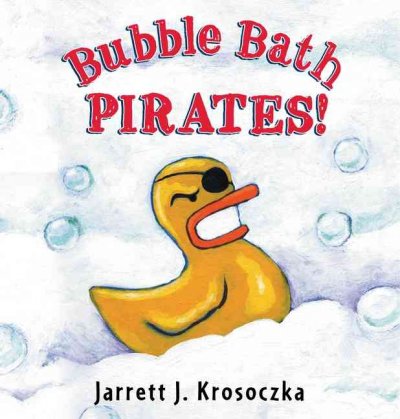
by Aaron Reynolds & Dan Santat
Nugget & Fang
by Tammi Sauer & Michael H. Slack
Chomp: A Shark Romp
by Michael-Paul Terranova
Shark and Lobster’s Amazing Undersea Adventure
by Viviane Schwarz & Joel Stewart
Meet the Shark Family and Friends
by Alexandra West

This storytime was presented in-person on 6/27, 6/28, & 6/29/22.

Summer Storytimes: Arctic & Antarctic

It’s summer, and we all want a little chill, right? What better way than to imagine ourselves in the ice and cold of the earth’s poles, and to play with ice water?

Last summer, I did an outreach to the local parks camp where they chose the themes and I presented a story, song, and craft for it. One of their themes was the Arctic, which I also coopted for one of my regular storytimes. This year, I wanted to revisit that theme (adding the Antarctic) and use it as an excuse to integrate ice play into our summer stations.

I bought an inflatable globe to point out where the Arctic and Antarctic are in relation to us, which was a bonus toy to play with during the unstructured station time. I’m always frustrated when polar bears and penguins get lumped together when they live so far away from each other!

view of my storytime cart, with the speaker, my water, a stack of books (If You Were a Penguin on top) and an inflatable globe showing NASA images of the earth (land, sea, and clouds)
The globe!

This week my two unique stations were ice play and painting with ice. I had a new action station as well – dodge the seaweed!

For a more in-depth explanation of the structure of this summer’s programs, read the intro to the first session, Ocean Life.

Early Literacy Tip: One way of learning is with movement, which is called kinesthetic learning. When we act out what is happening on the pages of a book, it can more concretely connect new vocabulary words with their meanings. When we use meaningful gestures to explain words, we help build your child’s vocabulary.

Welcome Song: Hello, Friends 
(tune of Goodnight, Ladies)
Hello, friends! Hello, friends!
Hello, friends, it’s time to say hello!
Hello, [name 1], hello, [name 2]!
Hello, [name 3], it’s time to say hello! (repeat as needed)
(ASL motions: salute for “hello,” then take the index fingers on each hand and you link them together as though they are hugging each other back and forth for “friends”)
Source: Glenside Public Library District

Warm-Up Rhyme: We Wiggle and Stop (repeated)
(Use the ASL sign for the word “stop” – one hand “chops” across the opposite hand)
We wiggle and we wiggle and we STOP
We wiggle and we wiggle and we wiggle and we wiggle
And we wiggle and we wiggle and we STOP
(This week we also “waddled” like a penguin and used our flippers to “swim” like a walrus – I’ll do two new motions in addition to wiggle each week to keep it interesting)
Source: Jbrary

Intro to Weekly Theme: It’s time to chill! Let’s explore some animals that live in places that are cold. [Show the globe.] Here’s where we live, in Indiana. Way up here is the north pole, or the Arctic. That’s where animals like polar bears, caribou (also known as reindeer), and walruses live. Here’s a silly song about the walrus.

I recently saw Reading Rena’s video of this song, and really liked how she does the ending. I didn’t do different articles of clothes like she did, but that’s a good option. I wanted to keep it to two verses, so I just did “shakes” and “turns.” It is, of course, a perfect song for a scarf or shaker prop, but for these outdoor sessions I’m streamlining.
Themed Song: The Walrus Washes His Winter Coat
Oh, the walrus washes his winter coat (rub hands together)
Down by the wavy ocean (make a waving motion)
He adds some water and he adds some soap (pretend to pour)
and he waits…and he waits…and he waits. (point to wrist)

Then the laundry shakes, shakes, shakes (shake arms)
The laundry shakes and shakes and shakes
The laundry shakes, shakes, shakes
until it’s clean. (repeat)

Additional verses:
The laundry turns … until it’s clean (roll arms)
Last time:
Well, the walrus washed his winter coat
Down by the wavy ocean
He shakes it out (shake out your coats!)
And he hangs it up to dry (hang it on the clothesline!)
And now his coat is clean!
Source: Brytani Fraser via Jbrary and Reading Rena

Now let’s travel all the way to the other end of the earth, the south pole, or Antarctica, where a lot of penguins live!

Themed book:
If You Were a Penguin by Wendell & Florence Minor
OR
Walrus Song by Janet Lawler & Timothy Basil Ering

Obviously to get to to the south pole, we’d need to do a penguin story, but the Walrus Song book is very cool as well. If you stayed in the Arctic, that would be a great choice. If You Were a Penguin was the shortest and most interactive penguin book I could find, which I’m learning is really a requirement for my group.

I adapted the lyrics only slightly from Jbrary’s pirate themed song to be a little more generic ocean. I also let grownups know this could be a lifting song, but only if they’re feeling ambitious! I invite everyone else to do the up and down motions with me.
Repeated Song: The Ocean Song
(tune of The Elevator Song)
Oh, the ocean is great and the ocean is grand!
There are lots of big ships but very little land
And we sleep down deep in a hammock near the floor
And this is what we do when we go out to shore:

(ready?) We… ride… the…
waves going up, we ride the waves going down
we ride the waves going up, we ride the waves going down
And we turn… a-… round!
Source: Jbrary

After the Ocean Song, I’m invariably out of breath, so it’s time for a breathing break. I’d considered doing ocean wave breathing on the theme, but I decided that Five Finger Breathing is an easy one to teach and for kids to remember, which is my point in doing it.
Breathing Break: Five Finger Breathing
Whew, I could use a breathing break! Let’s get out our five fingers and spread our hands out wide. We’re going to breathe in deeply as we trace our fingers up, pause for just a moment at the top of our finger, then breathe out as we trace down. Ready?

I like to mention that this song was adapted by an occupational therapist as a reminder of ways to self-soothe.
Repeated Movement Song: Big Sea Star
(tune of A Ram Sam Sam)
A big sea star, a big sea star
Little cuddle clam and a big sea star
A big sea star, a big sea star
Little cuddle clam and a big sea star
A pufferfish! A pufferfish!
Little cuddle clam and a big sea star
A pufferfish! A pufferfish!
Little cuddle clam and a big sea star
Source: Jbrary

Release to Stations
I have seven stations each week, which involve a mixture of dry, wet, and an action station. We spend about 20 minutes in free play.

Repeated Stations:
Kinetic Sand (Dry)
I bought some kinetic sand and added it to two plastic bins. In the recycling bin I found some fruit cup containers that had fun shapes and added them plus some plastic shovels. I keep a sheet underneath this station to catch any stray sand that escapes the bins. I didn’t realize until after I planned this station that kinetic sand should not be put in mouths, so I do warn the parents that if their kiddo is still exploring with their mouth, they may want to skip this one.

Kinetic sand station outside - two bins set on a blue sheet, with small plastic containers, plastic shovels, and sand in them

Pouring Station (Wet)
I asked coworkers to collect clean plastic recyclables with wide openings for this station and visited Goodwill for some additional pitchers. We had measuring cups and funnels in our materials, as well as a baby pool, which is the perfect container. I fill the pool with plastic bins and fill them randomly with water from the hose each week. (Also, I must have had some sunscreen on my lens taking pictures outdoors – there’s a weird blur!)

Pouring station, with a faded red baby pool filled with various plastic containers of all shapes and sizes

Rotating Stations:
Craft Stick Sort (Dry)
I noticed in my storage bin that I had these boxes of dot painters that have small holes already in the top. I colored a ring around each hole a different rainbow color and added colored craft sticks for a fine motor and color identification station.

Craft stick sort station with small cardboard boxes with eight small holes in each, ringed in color, and a pile of colored craft sticks in front of them

Beanbag Sort (Dry)
We had these beanbags from Lakeshore Learning that are different colors and shapes. They’re a super easy station where kids can play and sort with them in several ways.

Beanbag sort station, with shiny plastic beanbags in cube, sphere, and pyramid shapes in rainbow colors.

Dodge the Seaweed (Action)
We had some small cones in our action set, so I duct taped a paint stirrer to the tops of them, then haphazardly added green crepe paper to look like seaweed. For the amount of time it took me, I think they look pretty good! I was fully expecting them to get kind of torn up after the first week of use, but they held up. That might partly be because it was pretty hot out and I’m not sure a lot of kids were running around, though. 🙂

Dodge the seaweed station, with green and blue cones topped by green crepe paper "seaweed"

Unique Stations:
Ice Play (Wet)
I filled a medium sized bin with water, a bowl or colander, a few plastic animals like orcas, seals, and a whale shark, scoops and slotted spoons. I kept a 20 lb bag of ice in a cooler in the shade nearby, then when we released to stations I emptied the ice into the bins. This was a popular station since it was pretty hot all three days. This picture was taken at the end of the program, so almost all of the ice had melted by that time! Nevertheless, the kids seemed to enjoy scooping and feeling the ice.

Ice play station with two plastic bins half filled with water and ice.  a teal colander is in one and a pink bowl is in another, with various slotted spoons, scoopers, and plastic whales and seals.

Ice Painting (Art/Messy)
Darn, I didn’t get a picture of this. I made the ice “paints” using some liquid watercolor we have, mixed with water in ice cube trays and with one of the mini-craft sticks in each cube for a handle. I made two trays, thinking I might have to make more each day, but they actually lasted me through all three days. I had a second cooler and put some ice in the bottom of it, then put the ice cube trays on top. I got the cooler out when we released to stations and kept the trays in the cooler in between uses. Outside of a few kids wanting to eat them (nontoxic paint, but still yucky), this was fun. Several grownups said how neat an idea it was and asked how I made the cubes (and I let them know that they could probably also use food coloring) and I overheard one say they were going to do this at a birthday party later that summer!

Ice painting sign:
"Get creative: use an ice cube to paint!  Let the watercolor paint melt on your paper.  Use the stick to hold the cube (or not!) Enjoy the process and see what your child makes!

After about 20 minutes exploring stations, I rang the bell to call everyone back to the storytime area. 20 minutes felt like a good time – kids had generally found their way to all the stations and were winding down.

Everybody loves bubbles! The trick to doing bubbles outside, I’m finding, is to figure out which way the wind is blowing and get upwind of your group!
Recorded Bubble Song: Pop, Pop, Pop by Nathalia
From the album “Dream a Little,” available on Spotify

CD cover of Nathalia's "Dream A Little" album.

Goodbye Song: See You Later, Alligator
(tune of Clementine)
See you later, alligator (wave with one hand, then the other)
In a while, crocodile (open and shut arms like a croc’s mouth)
Give a hug, ladybug (hug yourself or a loved one)
Blow a kiss, jellyfish! MWAH! (move hand like a jellyfish then blow a kiss!)
Source: King County Library System

Other books I had available for families to browse (and may work for you on this theme)
Penguin Problems by Jory John & Lane Smith
If Wendell Had a Walrus by Lori Mortensen & Matt Phelan
A Penguin Story by Antoinette Portis
Polar Bear Morning by Lauren Thompson & Stephen Savage
Polar Bear Night by Lauren Thompson & Stephen Savage
Poles Apart by Jeanne Willis & Jarvis
Don’t Be Afraid, Little Pip by Karma Wilson & Jane Chapman
What’s in the Egg, Little Pip? by Karma Wilson & Jane Chapman

This storytime was presented in-person on 6/20, 6/21, & 6/22/22.

Summer Storytimes: At the Beach

Another sub-theme for Summer Reading 2022 Oceans of Possibilities! Going to the beach is one of the most common and enjoyable ways that humans get to experience the ocean, so it seemed like a natural theme. Several of the kids in this week’s programs had been to the beach or would be going later this summer.

This week we were outside on Monday, but had a heat advisory for the Tuesday and Wednesday classes. With the heat index above 90 and the humidity brutal, I moved my outdoor session into our two large meeting rooms. It was another curveball, but I had the rooms booked all summer in case of rain or heat, so I’m glad the space was available. The rooms I used are separated by a collapsible wall, so I opened it only about 5 feet and put my storytime table in front of the opening. We did the storytime portion of the program in one room, then I wheeled my table out of the way so they could get to the stations room. It was a great way to keep their interest from getting distracted by the stations until we were ready to play with them. (Outdoors, I cover the stations with sheets until we release to them. So far I haven’t had any kids peeking, which is nice while it lasts!)

view of the grassy storytime area with the library building in the background, with a cart to the left with a speaker and other supplies, and four sheet-covered stations shown on the ground around the perimeter.

Psst: wanna know a secret? I structured my summer storytimes around the idea for outdoor free play stations, and minimized the planning I’d need to do for the actual storytime part. In fact, I’m changing only two aspects of each storytime from week to week/theme to theme in order to keep myself sane. Repetition is not a bad thing. Kids and grownups are enjoying knowing the repeated songs and what comes next, while I still get to have one song and one book set to the theme. Setting up the stations each week takes a lot of my brain (and muscle) power, so it feels nice to know that I’ve got a handle on the storytime portion and don’t need to worry about it.

For a more in-depth explanation of the structure of this summer’s programs, read the intro to the first session, Ocean Life.

Early Literacy Tip: Sometimes we think in order to read a book to a child, we must read all the words, in order, front to back. But really, there’s lots of ways to experience reading, and young children may not have the attention span to listen to a book all the way through. It’s okay to skip pages, just “read” the pictures, or start and stop as needed. Make it a positive experience, and your child will develop the staying power to eventually listen to a whole book when they’re ready.

I originally debated doing a song with names over summer – would it take too long? Could I get them right? I decided to go with it and I’m so glad I did. The smiles on the kids and caregivers when they hear their name is worth it!
Welcome Song: Hello, Friends 
(tune of Goodnight, Ladies)
Hello, friends! Hello, friends!
Hello, friends, it’s time to say hello!
Hello, [name 1], hello, [name 2]!
Hello, [name 3], it’s time to say hello! (repeat as needed)
(ASL motions: salute for “hello,” then take the index fingers on each hand and you link them together as though they are hugging each other back and forth for “friends”)
Source: Glenside Public Library District

Warm-Up Rhyme: We Wiggle and Stop (repeated)
(Use the ASL sign for the word “stop” – one hand “chops” across the opposite hand)
We wiggle and we wiggle and we STOP
We wiggle and we wiggle and we wiggle and we wiggle
And we wiggle and we wiggle and we STOP
(This week we also “ran” across the sand (in place) and “splashed” – I’ll do two new motions in addition to wiggle each week to keep it interesting)
Source: Jbrary

Intro to Weekly Theme: One way to enjoy the ocean is to go to the beach. Has anyone been? What do you remember? If you have more time to play with a discussion, I loved Jessica’s idea of unpacking a beach tote on her blog.

Themed Song: The Waves on the Beach
(tune of The Wheels on the Bus)
The waves on the beach go in and out (arms swoop back and forth in front of you)
In and out, in and out
The waves on the beach go in and out
All day long!

Additional verses:
The crabs on the beach go pinch, pinch, pinch… (pinch fingers and thumbs together)
The clams on the beach go open and shut… (hands cup together vertically and open/shut on a hinge)
The kids on the beach go splash, splash, splash… (slap hands downward)
Source: adapted from Storytime in the Stacks

Transition Song: If You’re Ready for a Story
(tune of If You’re Happy and You Know It)
If you’re ready for a story, clap your hands (clap, clap)
If you’re ready for a story, if you’re ready for a story,
If you’re ready for a story, clap your hands (clap, clap)
Source: Miss Keithia (my predecessor)

Themed book:
Jules Vs. the Ocean by Jesse Sima
OR
Little Hoo Goes to the Beach by Brenda Ponnay
I used Little Hoo for my baby program, as it is extremely simple (and I even skipped the seaweed pages to shorten it). Jules worked best for my 2-3.5 group, but we were indoors so it was much easier for them to see the pictures, which are brilliant and help tell this story really well. I’ve used books like Hello, Ocean and I also considered My Ocean is Blue, but I’ve been noticing that my group just can’t handle longer picture books. I don’t know if it’s because I’m more used to preschoolers, or if it has something to do with the pandemic, but the little ones just don’t seem interested in books with more than a sentence per page. I’m still figuring this out and experimenting, so it was good to see that Jules worked, at least in the indoor setting.

I adapted the lyrics only slightly from Jbrary’s pirate themed song to be a little more generic ocean. I also let grownups know this could be a lifting song, but only if they’re feeling ambitious! I invite everyone else to do the up and down motions with me.
Repeated Song: The Ocean Song
(tune of The Elevator Song)
Oh, the ocean is great and the ocean is grand!
There are lots of big ships but very little land
And we sleep down deep in a hammock near the floor
And this is what we do when we go out to shore:

(ready?) We… ride… the…
waves going up, we ride the waves going down
we ride the waves going up, we ride the waves going down
And we turn… a-… round!
Source: Jbrary

After the Ocean Song, I’m invariably out of breath, so it’s time for a breathing break. I’d considered doing ocean wave breathing on the theme, but I decided that Five Finger Breathing is an easy one to teach and for kids to remember, which is my point in doing it.
Breathing Break: Five Finger Breathing
Whew, I could use a breathing break! Let’s get out our five fingers and spread our hands out wide. We’re going to breathe in deeply as we trace our fingers up, pause for just a moment at the top of our finger, then breathe out as we trace down. Ready?

I like to mention that this song was adapted by an occupational therapist as a reminder of ways to self-soothe.
Repeated Movement Song: Big Sea Star
(tune of A Ram Sam Sam)
A big sea star, a big sea star
Little cuddle clam and a big sea star
A big sea star, a big sea star
Little cuddle clam and a big sea star
A pufferfish! A pufferfish!
Little cuddle clam and a big sea star
A pufferfish! A pufferfish!
Little cuddle clam and a big sea star
Source: Jbrary

Release to Stations
I have seven stations each week, which involve a mixture of dry, wet, and an action station. This week I was indoors, so used old flannel sheets for under the “wet” stations. They worked pretty well, absorbing spilled water enough that I didn’t have to mop the floor after.

Repeated Stations:
Kinetic Sand (Dry)
I bought some kinetic sand and added it to two plastic bins. In the recycling bin I found some fruit cup containers that had fun shapes and added them plus some plastic shovels. I keep a sheet underneath this station to catch any stray sand that escapes the bins. I didn’t realize until after I planned this station that kinetic sand should not be put in mouths, so I do warn the parents that if their kiddo is still exploring with their mouth, they may want to skip this one.

Pouring Station (Wet)
I asked coworkers to collect clean plastic recyclables with wide openings for this station and visited Goodwill for some additional pitchers. We had measuring cups and funnels in our materials, as well as a baby pool, which is the perfect container. I fill the pool with plastic bins and fill them randomly with water from the hose each week. (Also, I must have had some sunscreen on my lens taking pictures outdoors – there’s a weird blur!)

Rotating Stations:
Pompom Sort (Dry)
A really easy station to put together: I just saved a couple of egg cartons, then poured a handful or two of different colored/sized pompoms into them. Provide some plastic tongs and you’re done. (And again, weird blur on the outdoor one)

Colored Ball Sort and Drop (Dry)
This was inspired by a Pinterest post from Taming Little Monsters. I made two, from our ubiquitous Baker & Taylor boxes, but oriented them different ways so one was tall and skinny and one was low and squat.

Ocean Boulder Leap (Action)
This started out in my head as a lily pad leap, but adapted to the ocean theme. We had the rubber dots from an active play set and I cut out some crab graphics to tape on for flavor.

Unique Stations:
Animal Washing (Wet)
Based on another Pinterest idea from Coffee Cups and Crayons, I bought some plastic ocean animals and stuck them in a bin of dirt. (I had trouble finding dirt at the store that didn’t have fertilizer mixed in with it, so had to get this organic coconut husk dirt, which isn’t as “dirt-y” as real dirt, but it worked.) A second bin was filled with clean water and had toothbrushes and dish brushes in it for washing. I meant to put a little detergent in to make bubbles, but it didn’t happen, and it was fine.

Sponge Painting (Art/Messy)
I reused the ocean animal shaped sponges I made from last week’s sponge play station and put out small trays of tempera paint (recycled Lean Cuisine trays work great). Kids could stamp the shapes onto plain white construction paper in our messy trays for the simple craft. Our rinse station was set up to one side with a couple buckets of water and towels for cleaning up hands. All of my craft stations this summer are simple process-focused art with different media.

sponge painting and rinse station in the indoor setting, with painting supplies set on a square table and two chairs facing outward on each side.  Six chairs hold a messy tray and paper on them, and two hold buckets of water and towels for rinsing.

After about 20 minutes exploring stations, I rang the bell to call everyone back to the storytime area. 20 minutes felt like a good time – kids had generally found their way to all the stations and were winding down.

Everybody loves bubbles! The trick to doing bubbles outside, I’m finding, is to figure out which way the wind is blowing and get upwind of your group!
Recorded Bubble Song: Pop, Pop, Pop by Nathalia
From the album “Dream a Little,” available on Spotify

CD cover of Nathalia's "Dream A Little" album.

Goodbye Song: See You Later, Alligator
(tune of Clementine)
See you later, alligator (wave with one hand, then the other)
In a while, crocodile (open and shut arms like a croc’s mouth)
Give a hug, ladybug (hug yourself or a loved one)
Blow a kiss, jellyfish! MWAH! (move hand like a jellyfish then blow a kiss!)
Source: King County Library System

Table with a display of the books listed below.

Other books I had available for families to browse (and may work for you on this theme)
Surf’s Up by Kwame Alexander & Daniel Miyares
Bea by the Sea by Jo Byatt
This Beach Is Loud! by Samantha Cotterill
At the Beach by Shira Evans
Here Comes Ocean by Meg Fleming & Paola Zakimi
Beach Day! by Patricia Lakin & Scott Nash
My Ocean Is Blue by Darren Lebeuf & Ashley Barron
Noah’s Seal by Layn Marlow
Hum and Swish by Matt Myers
Hello Ocean/Hola mar by Pam Muñoz Ryan & Mark Astrella
What If? by Laura Vaccaro Seeger
A Beach Tail by Karen Lynn Williams & Floyd Cooper
Harry by the Sea by Gene Zion & Margaret Bloy Graham

This storytime was presented in-person on 6/13, 6/14, & 6/15/22.

Summer Storytimes: Ocean Life

We’re back doing outdoor summer programming! I love outdoor programming. It’s novel and fun and just seems more sensory than indoor programs. I started doing outdoor programs in 2013, when our regular indoor summer storytimes always seemed to be full, and we were getting interest from daycares bringing 5-10 kids. That would have wiped out most of one class’s registered openings, so we decided to offer a once a week outdoor class with no registration and no limit to accommodate them. The regular programmers were super busy, so I took that on as the manager. It was my first foray into programming for little ones (previously I’d been the Teen Services Librarian), and I really fell in love with it. Of course, I came back to it after a break when the pandemic hit and the safest way to offer programs was outdoors in 2021.

Oceans of Possibilities logo with two kids riding on a fish, one reading a book and one holding a banner that says "Read More!"

This year we’re all about the CSLP 2022 theme, Oceans of Possibilities. I have a weekly sub-theme and am presenting an outdoor program for the littles three days a week. Monday is Book Babies, for ages 0-2 (which we didn’t have the first week since our big Kick-Off party was Monday). Tuesday is Teddy Bears, ages 2-3.5, and Wednesday is Family Time, for ages 0-3.5. I’m welcoming siblings as well, so we’ve had a few older kids join us, too. The program is basically the same for each age group, but I might adjust my book selection for the older or younger group.

For each session, we’re doing about 15-20 minutes of storytime rhymes, songs, and a book, then there is 20 minutes of free play at our seven sensory stations. We end with bubbles and a goodbye song. I’ve never done stations like this before, so it was a lot of planning (and anxiety – “will this work!?”). My goal is to give kids and grownups some ideas of things they could do at home, plus give the kids (and caregivers) an opportunity to socialize with others. Many of them were born during or right before the pandemic started and have not had a chance at “normal” socialization. They’re very much still learning about sharing, appropriate interactions, friendship. I’m happy to report that stations were a total hit our first week, with lots of “This is such a great idea!” “You’re so well organized!” “I could totally do this at home” comments from caregivers. So gratifying!

Sign that says "Storytime Area.  Gather here at 10 AM for storytime.  We will release to stations during the program. Thank you to grown-ups for keeping stations clear until the time is right!" and the Oceans of Possibilities icon

Our first week is all about Ocean Life – fish, crabs, sea turtles, octopuses, etc. I’d planned a “paint with water” activity as one of the stations, but we had overcast skies and that works best on a hot, sunny day to dry out the concrete, so I switched it with a sponge play activity I’d originally planned for later in the summer.

I’m relying heavily on repetition this year, with only one themed song and a themed book changing each week. Our other songs and rhymes will be repeated, to ground us in consistency. Additionally, two stations are repeated each week, with three others rotating and two additional ones unique each week. I’ll indicate each below.

Early Literacy Tip: My goal is for your children to have positive experiences and thoughts about the library and reading, so if you’re having a rough day or not having fun, it’s completely okay to step away for a bit to calm yourself and come back when you’re ready. If you need to leave early for any reason, that’s fine, too. That goes for reading at home, too. It’s better to take breaks and come back when the mood is right rather than force a child to sit through a book when they’re not enjoying it.

In our winter/spring indoor programs, I’d been doing a song where each child was named in a verse of the song. Due to spacing and distancing concerns, I only had 7 kids then. Now that we’re outside, I’m having 15-20 kids, so this welcome song, which lets me do three names each verse, goes a little faster!
Welcome Song: Hello, Friends (repeated)
(tune of Goodnight, Ladies)
Hello, friends! Hello, friends!
Hello, friends, it’s time to say hello!
Hello, [name 1], hello, [name 2]!
Hello, [name 3], it’s time to say hello! (repeat as needed)
(ASL motions: salute for “hello,” then take the index fingers on each hand and you link them together as though they are hugging each other back and forth for “friends”)
Source: Glenside Public Library District

Warm-Up Rhyme: We Wiggle and Stop (repeated)
(Use the ASL sign for the word “stop” – one hand “chops” across the opposite hand)
We wiggle and we wiggle and we STOP
We wiggle and we wiggle and we wiggle and we wiggle
And we wiggle and we wiggle and we STOP
(This week we also “jumped” and “twirled” – I’ll do two new motions in addition to wiggle each week to keep it interesting)
Source: Jbrary

Intro to Weekly Theme:
Our summer theme this year is “Oceans of Possibilities!” This week we’re looking at what lives in the ocean. Can anyone think of something that lives in the ocean? (hopefully “fish” is mentioned!) Here’s a song about some of those animals!

Every single time I try to sing this melody the way Caspar Babypants does, but it always seems to come out more like Michael Finnigan (the way Jbrary does it). I keep trying!
Themed Song: All the Fish
All the fish are swimming in the water, (hands zig-zag in front of you)
Swimming in the water, swimming in the water
All the fish are swimming in the water,
Bubble, bubble, bubble, POP! (corkscrew fingers up then CLAP)

Additional verses:
All the crabs are snapping in the water… (pinch with hands as pincers)
All the sharks are chomping in the water… (arms snap together vertically like jaws)
Source: adapted from Jbrary, Caspar Babypants, from the album “I Found You”

CD album cover of Caspar Babypants I Found You.

Transition Song: If You’re Ready for a Story
(tune of If You’re Happy and You Know It)
If you’re ready for a story, clap your hands (clap, clap)
If you’re ready for a story, if you’re ready for a story,
If you’re ready for a story, clap your hands (clap, clap)
Source: Miss Keithia (my predecessor)

Themed Book:
Little White Fish by Guido van Genechten
OR
Hooray For Fish by Lucy Cousins
I ended up only doing Little White Fish, but had Hooray for Fish as a backup.

I adapted the lyrics only slightly from Jbrary’s pirate themed song to be a little more generic ocean. I also let grownups know this could be a lifting song, but only if they’re feeling ambitious! I invite everyone else to do the up and down motions with me.
Repeated Song: The Ocean Song
(tune of The Elevator Song)
Oh, the ocean is great and the ocean is grand!
There are lots of big ships but very little land
And we sleep down deep in a hammock near the floor
And this is what we do when we go out to shore:

(ready?) We… ride… the…
waves going up, we ride the waves going down
we ride the waves going up, we ride the waves going down
And we turn… a-… round!
Source: Jbrary

After the Ocean Song, I’m invariably out of breath, so it’s time for a breathing break. I’d considered doing ocean wave breathing on the theme, but I decided that Five Finger Breathing is an easy one to teach and for kids to remember, which is my point in doing it.
Breathing Break: Five Finger Breathing
Whew, I could use a breathing break! Let’s get out our five fingers and spread our hands out wide. We’re going to breathe in deeply as we trace our fingers up, pause for just a moment at the top of our finger, then breathe out as we trace down. Ready?

I like to mention that this song was adapted by an occupational therapist as a reminder of ways to self-soothe.
Repeated Movement Song: Big Sea Star
(tune of A Ram Sam Sam)
A big sea star, a big sea star
Little cuddle clam and a big sea star
A big sea star, a big sea star
Little cuddle clam and a big sea star
A pufferfish! A pufferfish!
Little cuddle clam and a big sea star
A pufferfish! A pufferfish!
Little cuddle clam and a big sea star
Source: Jbrary

Release to Stations
I have seven stations each week, which involve a mixture of dry, wet, and an action station.

Repeated Stations:
Kinetic Sand (Dry)
I bought some kinetic sand and added it to two plastic bins. In the recycling bin I found some fruit cup containers that had fun shapes and added them plus some plastic shovels. I keep a sheet underneath this station to catch any stray sand that escapes the bins. I didn’t realize until after that this one should not be put in mouths, so I do warn the parents that if their kiddo is still exploring with their mouth, they may want to skip this station.

Kinetic Sand sign.
"Feel it! Mold it! Can you build a sand castle? What sea creature can you sculpt? Can you write your name or draw a picture in the sand? Please dry off before playing with the sand to prevent mold."


Pouring Station (Wet)
I asked coworkers to collect clean plastic recyclables with wide openings for this station and visited Goodwill for some additional pitchers. We had measuring cups and funnels in our materials, as well as a baby pool, which is the perfect container. I fill the pool with plastic bins and fill them randomly with water from the hose each week.

Pouring Station Sign:
"Simply pour water from one container to another! Do some containers sound different? Can you guess how much water you need to fill a particular one? Is it easier to pour from a round lip or one with a spout? How many containers have a handle?"

Rotating Stations:
Craft Stick Sort (Dry)
I noticed in my storage bin that I had these boxes of dot painters that have small holes already in the top. I colored a ring around each hole a different rainbow color and added colored craft sticks for a fine motor and color identification station.

Craft Stick Sort sign:
"Sort the craft sticks! Can you insert the colored sticks into the holes that match? Please dry off before playing at this station."


Beanbag Sort (Dry)
We had these beanbags from Lakeshore Learning that are different colors and shapes. They’re a super easy station where kids can play and sort with them in several ways.

Beanbag Sort sign:
"Sort the beanbags! Create piles for different colors or shapes.  Try tossing or rolling the beanbags to a friend. Please dry off before playing at this station."


Ocean Boulder Leap (Action)
This started out in my head as a lily pad leap, but adapted to the ocean theme. We had the rubber dots from an active play set and I cut out some crab graphics to tape on for flavor.

Ocean Boulder Leap sign:
"Get your wiggles out! Leap from one boulder to another and don't fall in!"

Unique Stations:
Sponge Play (Wet)
Based on this Pinterest idea from Little Lifelong Learners, I just had sponges in bins of water for little ones to play with. Of course, I have to do some theme stuff, so in addition to simple shapes (sticks, triangles, circles), I cut out some ocean animals as well. These sponges will be reused in a craft later in the summer. This was the only station I snapped a picture of outdoors – but I’ll be sure to do more pictures in upcoming posts.


Finger Painting (Art/Messy)
I simply put out pieces of paper in our messy trays with finger paints in recycled plastic containers. There was a rinse station nearby with a couple buckets of water and towels for cleaning up hands. All of my craft stations this summer are simple process-focused art with different media.

After about 20 minutes exploring stations, I rang the bell to call everyone back to the storytime area. 20 minutes felt like a good time – kids had generally found their way to all the stations and were winding down.

Everybody loves bubbles! The trick to doing bubbles outside, I’m finding, is to figure out which way the wind is blowing and get upwind of your group!
Recorded Bubble Song: Pop, Pop, Pop by Nathalia
From the album “Dream a Little,” available on Spotify

CD album cover for Nathalia's Dream a Little

Goodbye Song: See You Later, Alligator
(tune of Clementine)
See you later, alligator (wave with one hand, then the other)
In a while, crocodile (open and shut arms like a croc’s mouth)
Give a hug, ladybug (hug yourself or a loved one)
Blow a kiss, jellyfish! MWAH! (move hand like a jellyfish then blow a kiss!)
Source: King County Library System

Sign:
"Books are available to look at here OR take home, in which case they MUST be CHECKED OUT INSIDE the library. Please dry off before looking at books."

Other books I had available for families to browse (and may work for you on this theme)
In the Sea
by David Elliott & Holly Meade
The Old Boat
by Jarrett & Jerome Pumphrey
Secret Seahorse
by Stella Blackstone & Clare Beaton
Ocean Counting
by Janet Lawler & Brian Skerry
Little White Fish Deep Beneath the Sea
by Guido van Genechten
Little White Fish and His Daddy
by Guido van Genechten
Oscar the Octopus
by Matthew Van Fleet
Dolphin Baby!
by Nicola Davies & Brita Granström

This storytime was presented in-person on 6/7/22 & 6/8/22.