Summer Storytimes: All Together Now, Part II

Summer is a great time to break out of the storytime structure I find myself in during the rest of the year. There’s nothing wrong with having structure, of course, but I find it invigorating to mix it up and feel free to try new things and be experimental during a set time of year.

In the summer, I offer outdoor programs for kids ages 0-3.5 and their caregivers. We spend about 15-20 minutes doing songs, rhymes, books, and extension activities, and then take about 20 minutes at free-play sensory stations that engage kids and caregivers to talk, socialize and practice social skills, engage in science and age-appropriate STEM inquiries, flex creative muscles, and have lots of fun, associating the library with positive feelings. This post will detail these stations.

You can read more about the Storytime half of the summer sessions here, Summer Storytimes: All Together Now, Part I.

Each week I had eight stations that families could wander through. There was no requirement that they had to go to each station or change stations at any certain time, or at all. They chose their path and self-regulated. Some stations were available every single week, some rotated, and some were unique and only appeared during one week. They fell into “wet,” “dry,” and “art” categories. I used old sheets to cover the stations so they wouldn’t be too tempting during the storytime portion of the program, and that worked well.

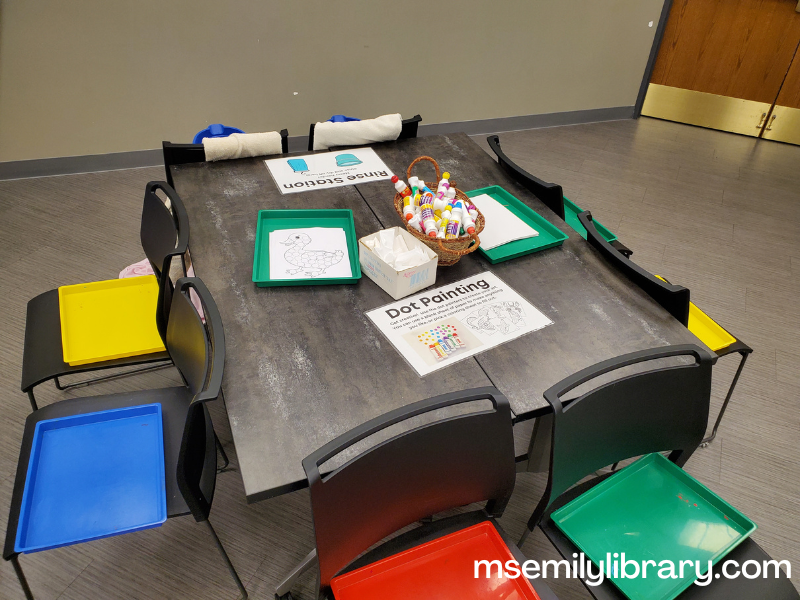
I also had a backup plan for when the weather or air quality was too poor to be outside. This was the summer of the Canadian wildfires, so there were several days that were not rainy, but smoke and particulates in the air made it unsafe to be outside – especially for the very young and for senior citizens (and many of my caregivers are grandparents in that category!) If we weren’t outside, I had reserved our two largest and adjoining meeting rooms, where I was able to set up both an area for stories and songs and the parachute on one side and stations on the other, so thankfully we didn’t miss out on any activities. If I remembered to take pictures indoors and out, I included both below to give a sense of layout.

The Plan: Stations

Wet Stations

This is a big draw – everyone likes playing in water! Outdoors, I used a hose and outdoor water supply to easily fill my tubs with water and could just pour it all out at the end of the session. Indoors, I hauled buckets from our janitor’s closet and possibly filled everything just a little bit less than I would outside. I used old flannel sheets underneath to absorb spills and make them easier to clean up. The meeting room has an emergency exit door that opens to some landscaping so all the water got dumped there at the end.

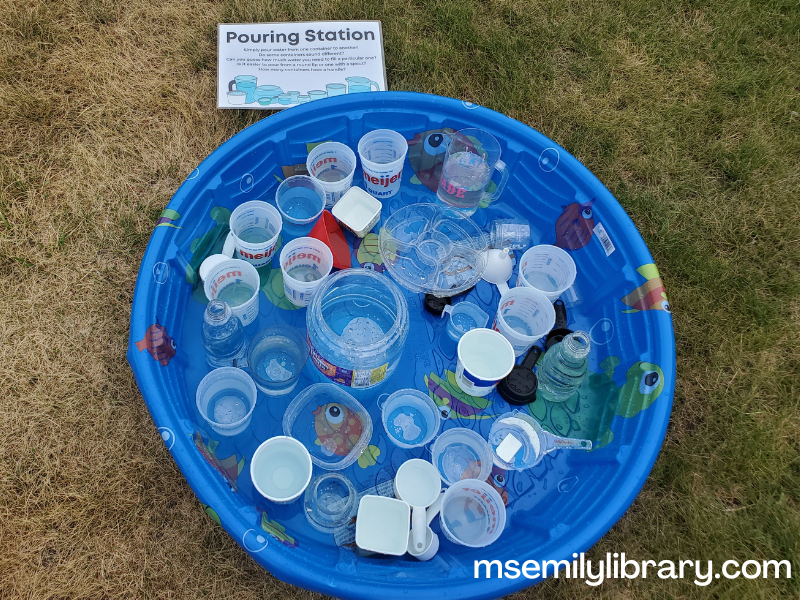
Pouring Station (all weeks)
This is a repeat from last year, so I had all of the materials for this one already. It’s also an easy one to set up, so it’s my anchor wet station: we had it out every week. Last year I asked coworkers to collect clean plastic recyclables with wide openings for this station and visited Goodwill for some additional pitchers. We had measuring cups and funnels in our materials, as well as a baby pool, which is the perfect container. I fill the pool with the plastic bins and fill them randomly with water. Original idea from Busy Toddler.

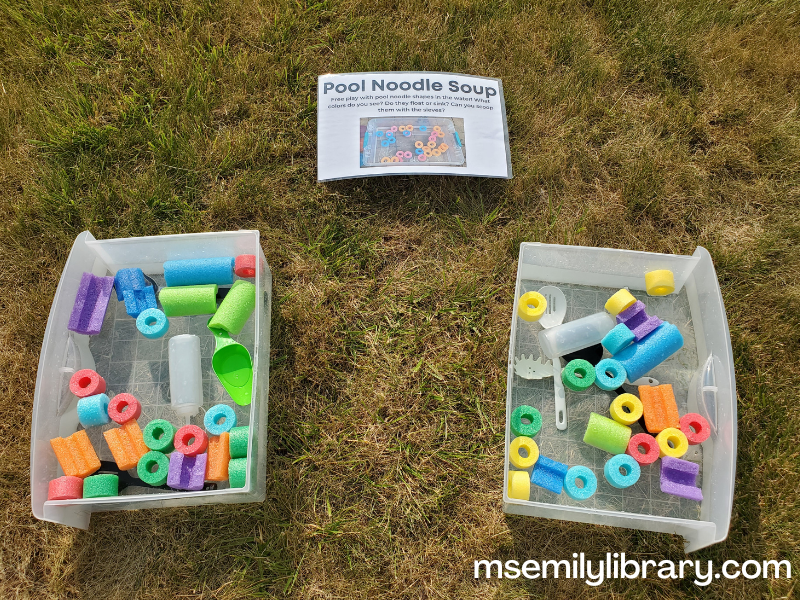
Pool Noodle Soup (Weeks 1 & 4)
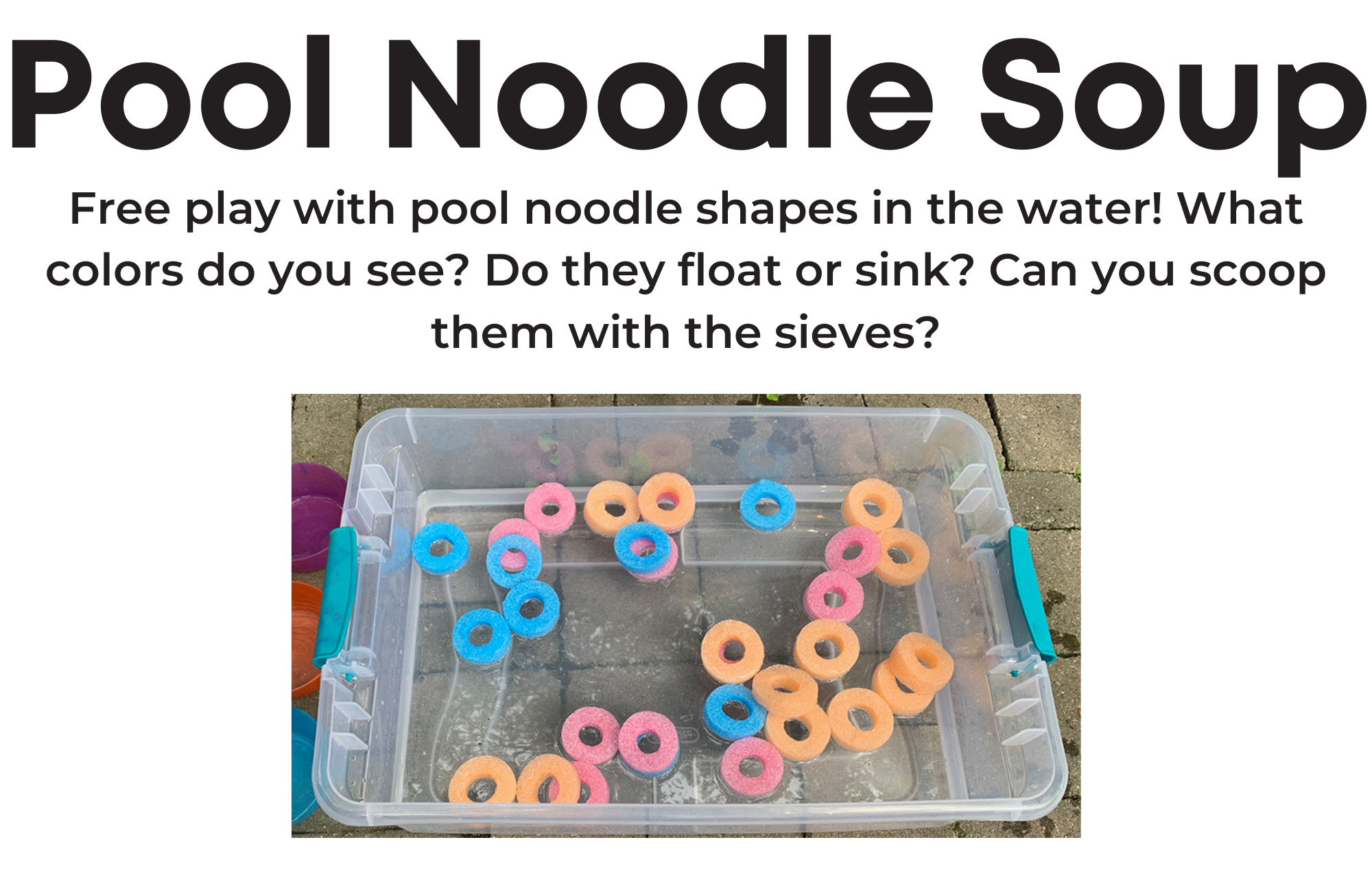
I cut sections of pool noodles and used them in three different ways, starting with this wet station. (You’ll see them below as a dry station and an art supply, too.) I used two drawers from a plastic storage bin as my containers, and added water, the noodles, some ladles and slotted spoons, and some squeeze bottles. Original idea (and photo on the sign) from Happy Toddler Playtime.

Fly Swatter Slap (Weeks 1 & 7)
Again, I maximized my materials by using flyswatters in both wet and dry stations on different weeks. The wet station included the (new, clean) swatters and ping pong balls that I drew flies on. I found the plastic containers at Goodwill and they are a little bit smaller than the drawers used above. The swatters were hand-shaped and different colors. Original idea (and photo on the sign) from My Bored Toddler.

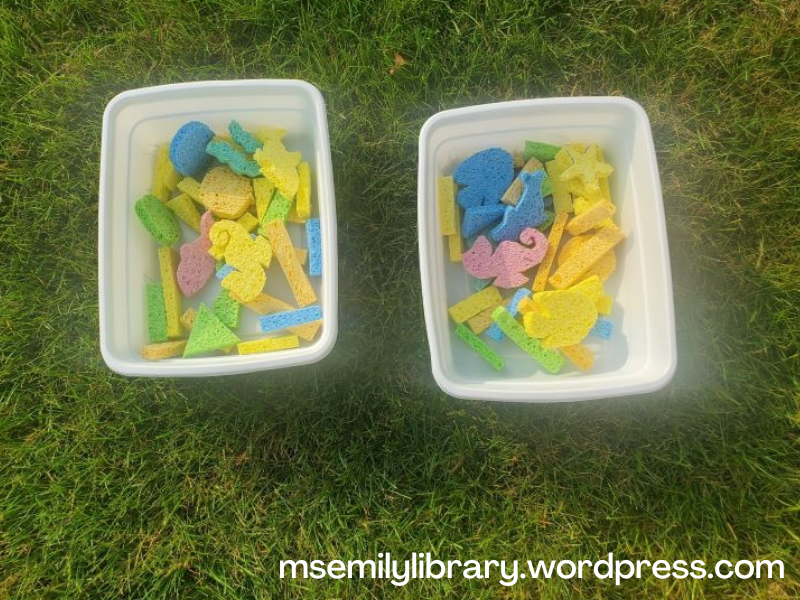
Sponge Play (Weeks 2 & 7)
This was another repeat from last year, but one that’s especially great for the youngest of my age group. When it was out it was usually surrounded by the “baby brigade!” The shapes were ocean animals since last year’s theme was “Oceans of Possibility” but they were just as happy with the simple shapes. Original idea (and photo on the sign) from Little Lifelong Learners.

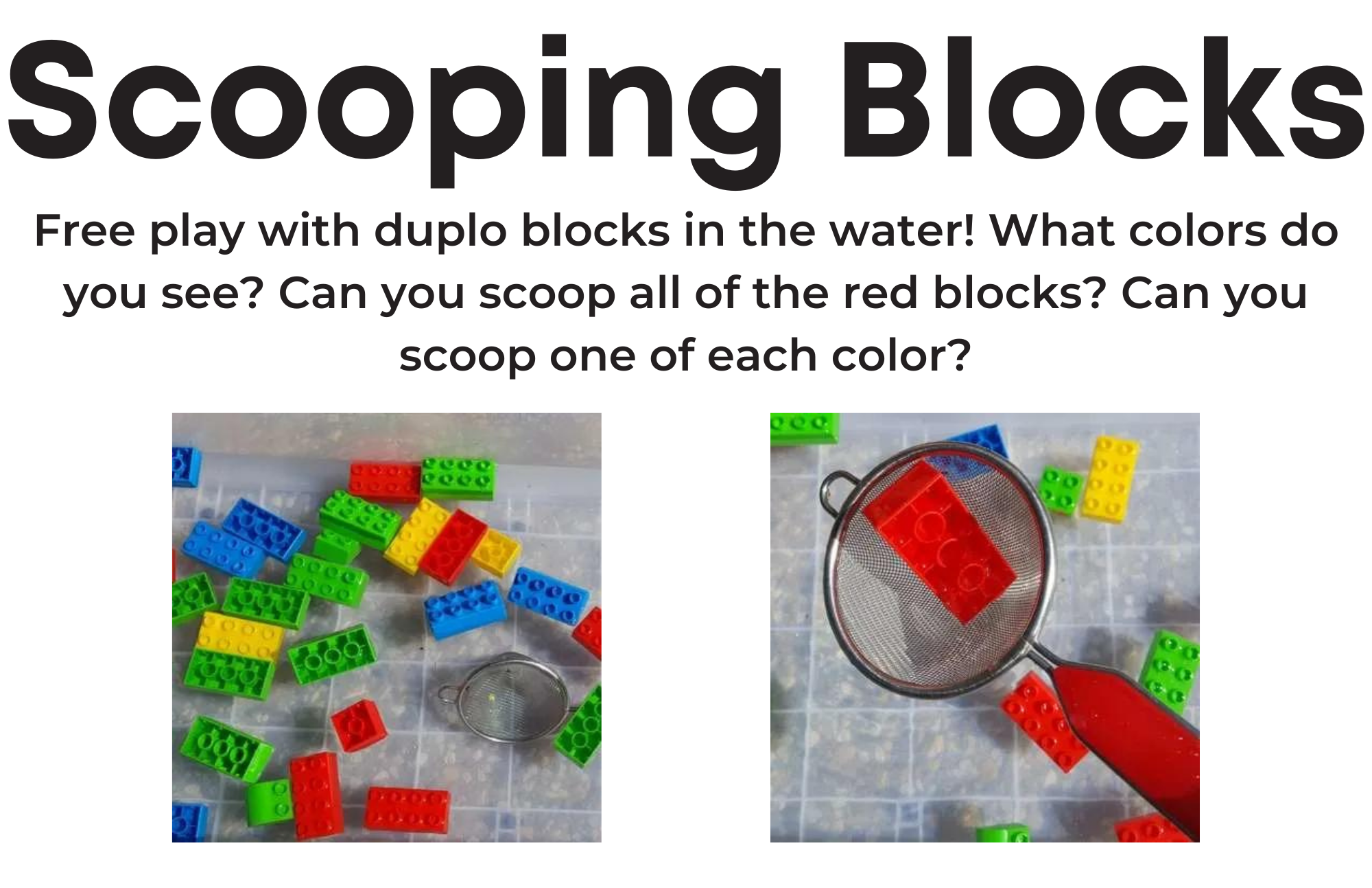
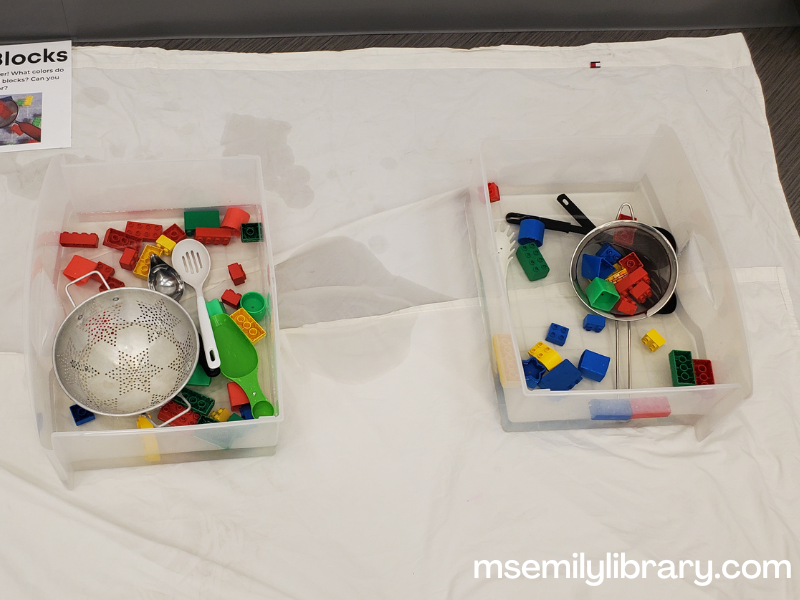
Scooping Blocks (Weeks 2 & 5)
Lego Duplos plus water and scoopers! This one was fun for its obvious purpose, but added bonus: some kids actually took the Duplos out of the water and put them together! We had all the Duplos already, and I added some of the sorting blocks from our baby toys to the mix, as well as ladles, colanders, and sieves from Goodwill. Original idea (and photo on the sign) from My Bored Toddler.

Mystery Water (Week 3)
Another repeat from last year – I originally saw this as on Pinterest as a reel, and was intrigued. Cornstarch and a little food coloring are added to water to turn it murky, and kids can search for items in the water to match up with a finding guide. We had a bunch of colorful plastic cookie cutters in storage that were perfect for this, so I traced them on a separate sheet for the kids to match up. They weren’t as solid and heavy as the original poster’s, so they tended to float a little, unfortunately, but it didn’t really matter. Original idea (and photo on the sign) from bright_little_brains.

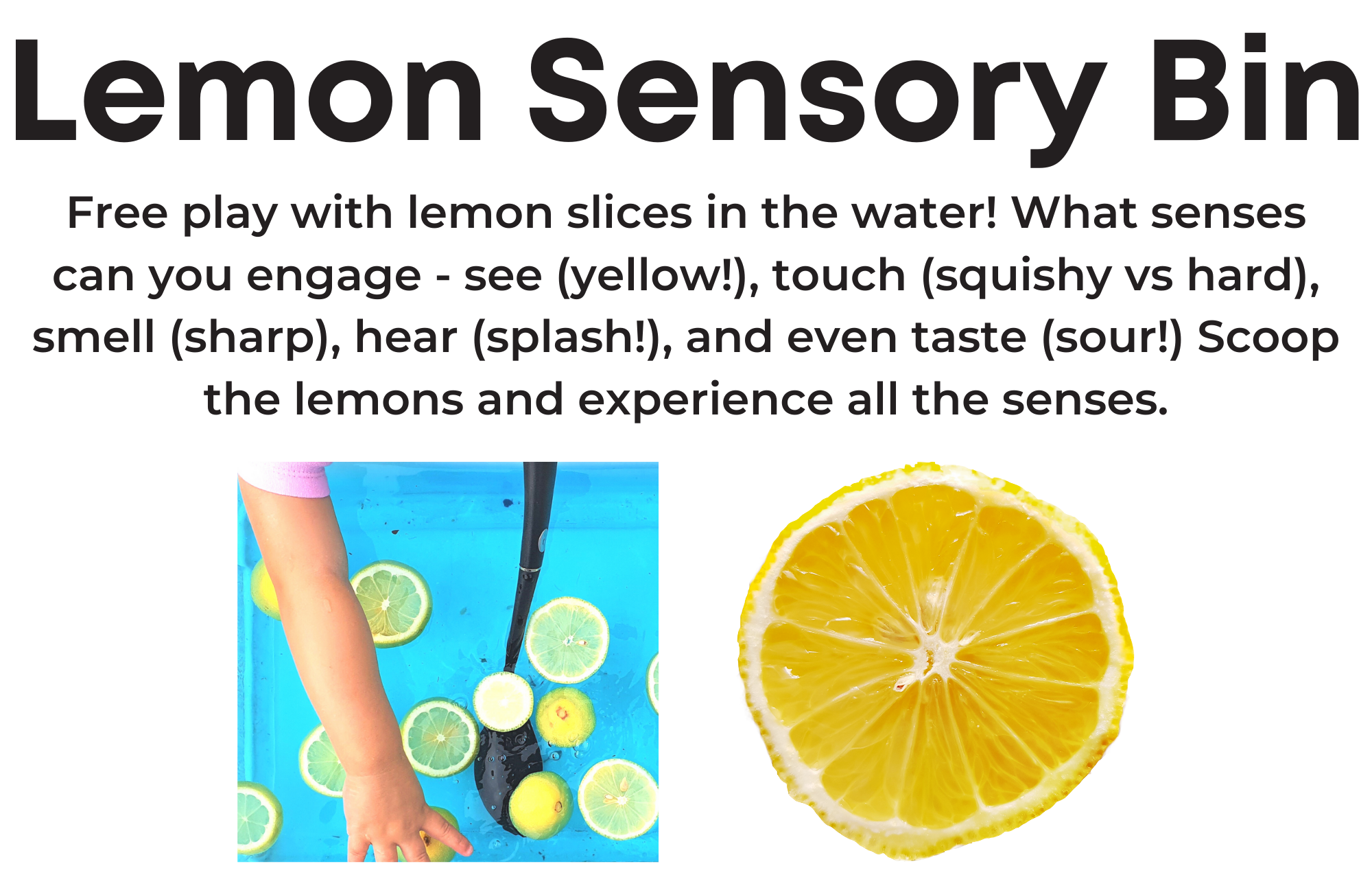
Lemon Sensory Bin (Week 3)
Mm, this was one of my favorite stations! It was super easy and smelled so good. I bought a bag of lemons and divided them among my three sessions. That was maybe 2-3 lemons per day? Cut them up into slices and added them to a bin of water along with ladles. I did announce that there was a lemon bin before breaking for stations just in case there was an allergy issue, but no one had a problem. Original idea (and photo on the sign) from Taming Little Monsters.

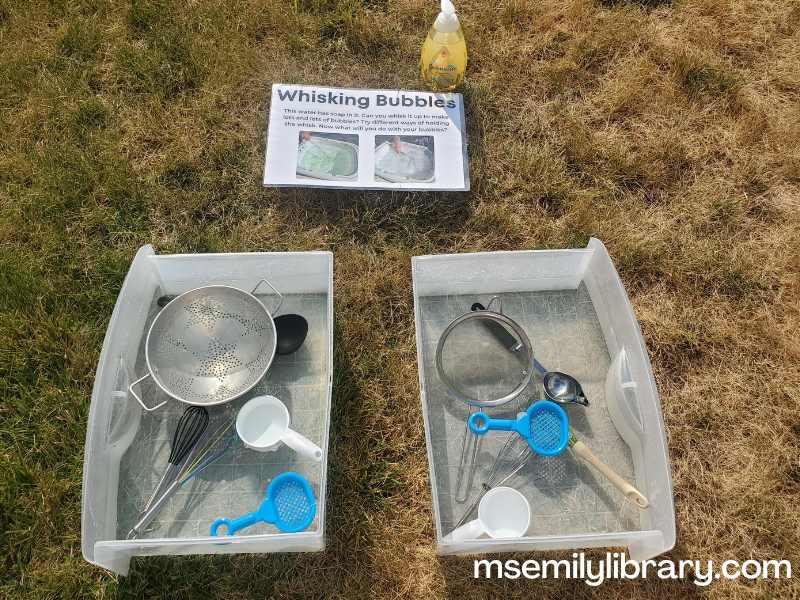
Whisking Bubbles (Week 4)
Kids could whisk up some bubbles and then use colanders and sieves to play with the result at this station. At first I just thought I would get some dishwashing soap, but then I started thinking about soap in eyes and mouths. I ended up buying some body soap formulated for babies (tear-free) and that worked perfectly. I looked for actual baby bubble bath, but couldn’t find it in store, so was a little worried about how sudsy it would get, but it ended up being just fine. And I’m so glad I went that route – I remember one of the babies did a nose-dive into the bin at one point and, indeed, there were no tears! I added the soap at the beginning and left the water undisturbed so that the kids could create all the bubbles themselves. Original idea (and photo on the sign) from The Empowered Educator.

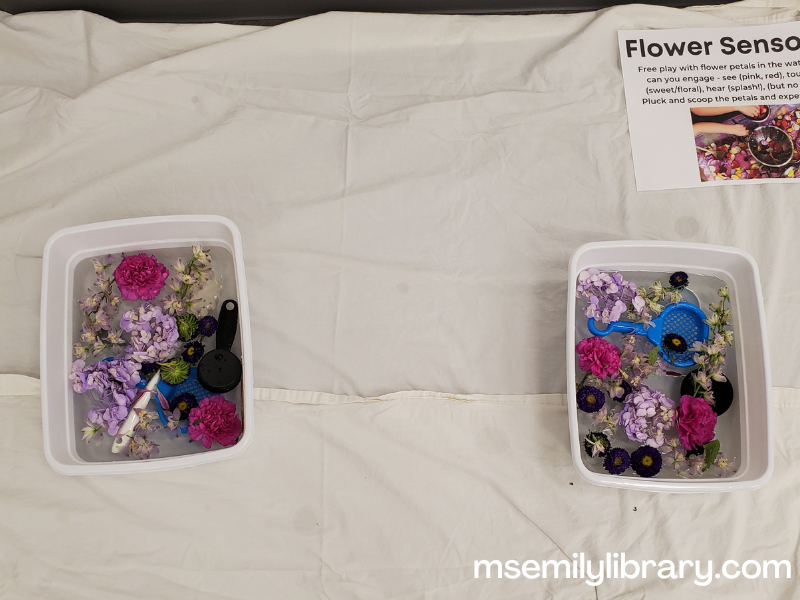
Flower Sensory Bin (Week 5)
I called our local Kroger florist and asked if they would donate flowers that were past their prime, so I was able to put this bin together without the cost of the flowers! It was also interesting to see the variety that was available on the two days I picked them up. One day I got a bouquet with several kinds of flowers that filled my two little bins, and the other day all that was available were colored daisies. Both were appreciated, and grown-ups commented on the pleasant scent and the novelty of the experience. I also got an action shot (with permission from the participants) on this one, since I wanted to include it in my thank you note to the florist. Original idea (and photo on the sign) from Learning and Exploring Through Play.

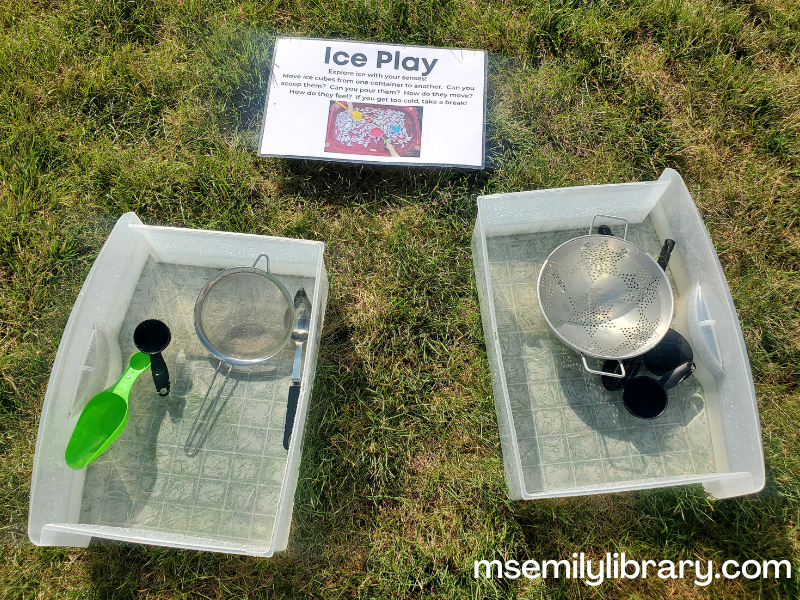
Ice Play (Week 6)
Another repeat from last year. I bought a large bag of ice each morning before my program and kept it in a cooler, adding it to the bins JUST before they were played in (so there’s no ice shown in the photos I took before the program). Ladles, colanders, and sieves were added for handling the ice. It was good weather for it – HOT – so the ice was mostly melted by the end of the station play time, but it was just enough. I reminded everyone to take a break if their fingers started to get too cold. Original idea (and photo on the sign) from Busy Toddler.

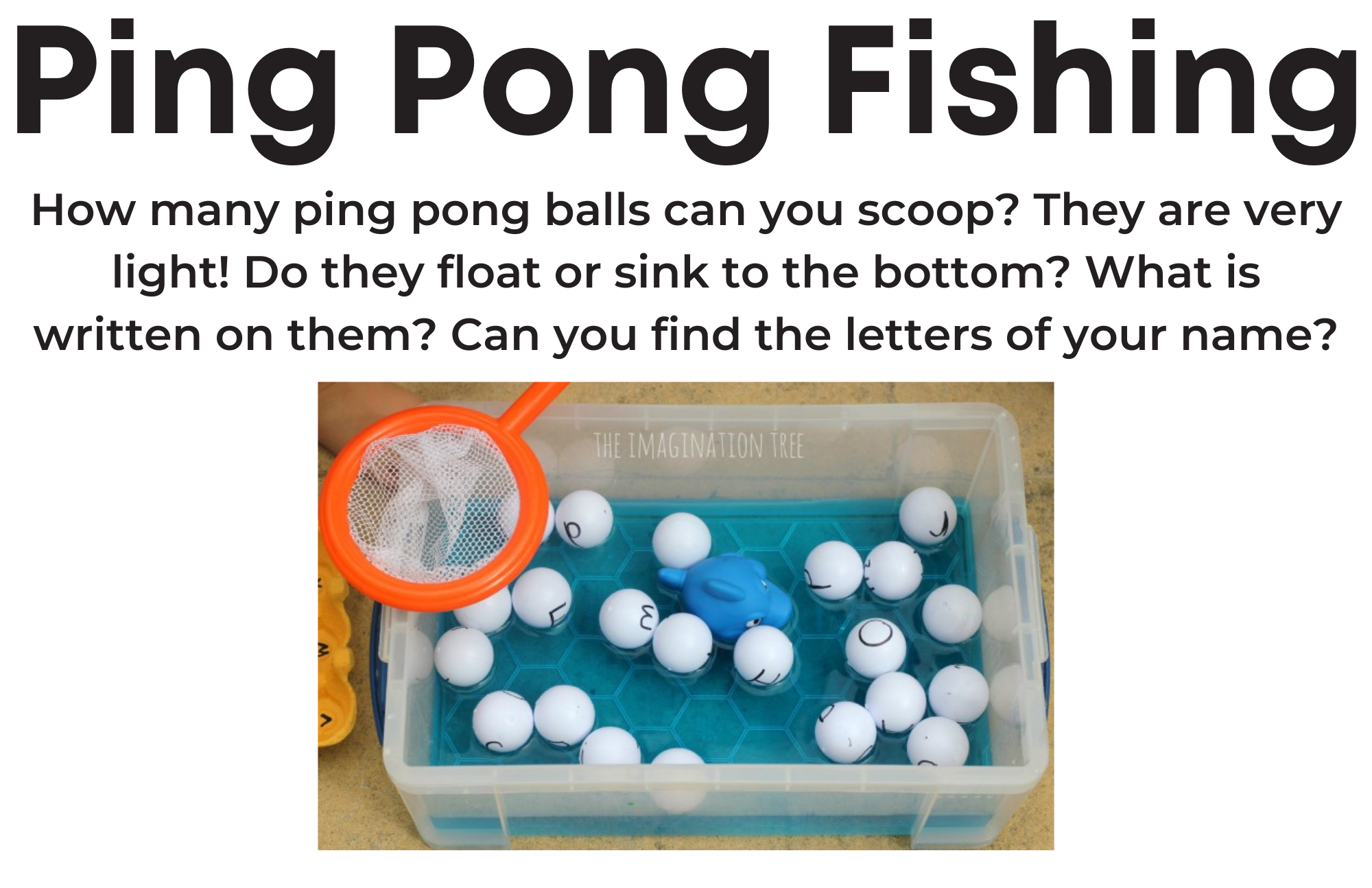
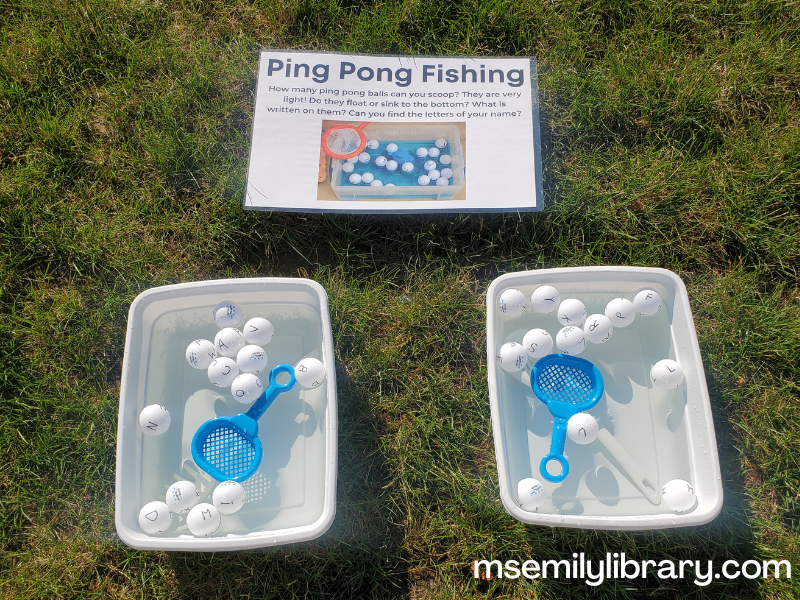
Ping Pong Fishing (Week 6)
I put the alphabet on ping pong balls and added them with scoopers into the bin. Adding the letters to all four sides of 26 balls took the most time! I think I added the housefly balls from the fly swatter slap station the second and third day, but they aren’t pictured. Original idea (and photo on the sign) from the Imagination Tree.

Dry Stations

There were a few families that didn’t want to get wet, so I was sure to offer three dry stations each week as well. Many of these gave practice in sorting various items by color, shape, or texture.

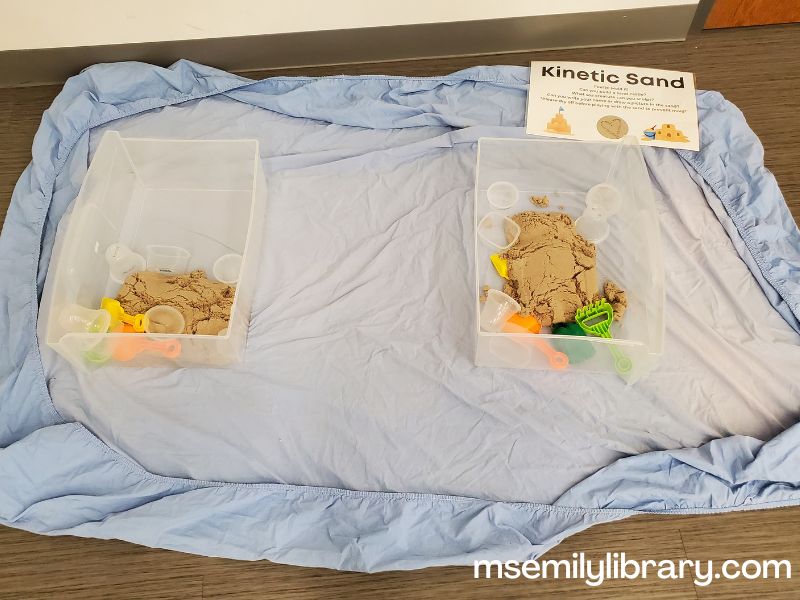
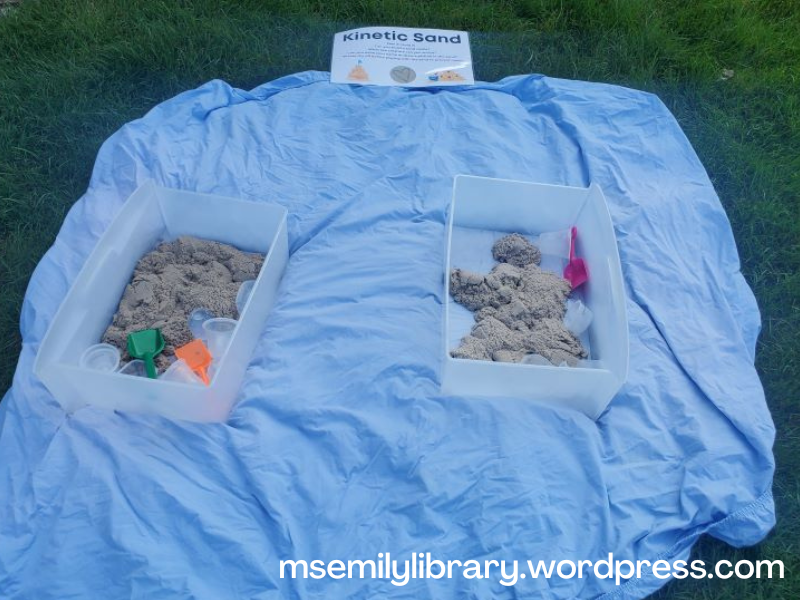
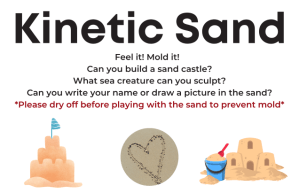
Kinetic Sand (all weeks)
Along with the Pouring Station above, this was the only station that was available all summer long. I had the supplies from last year, which included the kinetic sand itself as well as recycled fruit cup containers that had fun shapes and plastic shovels. I kept a sheet underneath this station to catch any stray sand that escapes the bins. Because the sand is not taste-safe, I do warn the caregivers that if their kiddo is still exploring with their mouth, they may want to skip this station.

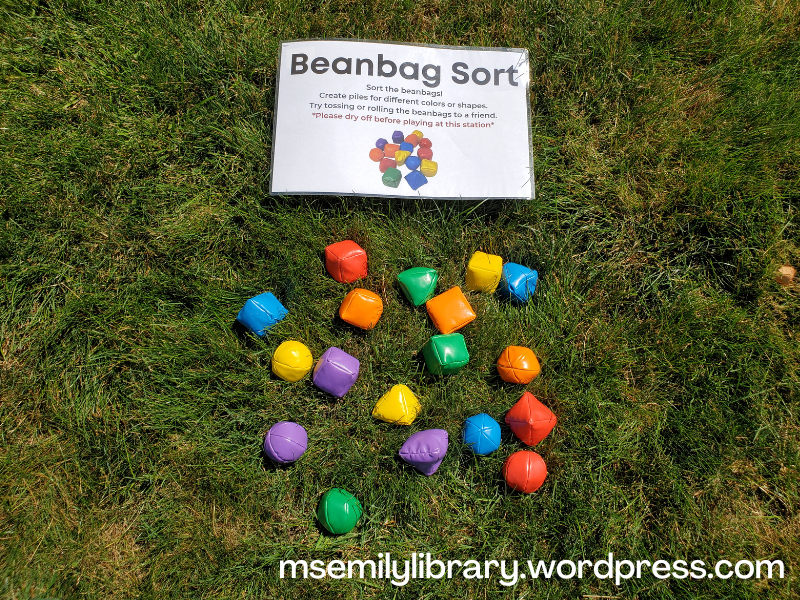
Beanbag Sort (Weeks 1, 4, & 7)
We had these beanbags from Lakeshore Learning that are different colors and shapes. They’re a super easy station where kids can play and sort with them in several ways.

Craft Stick Sort (Weeks 1, 4, & 7)
Another repeat from last year that was already “done.” I noticed in my storage bin that I had these boxes of dot painters that have small holes already in the top. I colored a ring around each hole a different rainbow color and added colored craft sticks for a fine motor and color identification station.

Pool Noodle Sort (Weeks 2 & 5)
A new station this year, but one I’ll repeat. Using the pool noodle slices (from Pool Noodle Soup), I taped a dowel rod to four small plastic cones in red, green, yellow, and blue. Kids could then thread the colored noodles on to the cones. Original idea from this Pin (no blog).

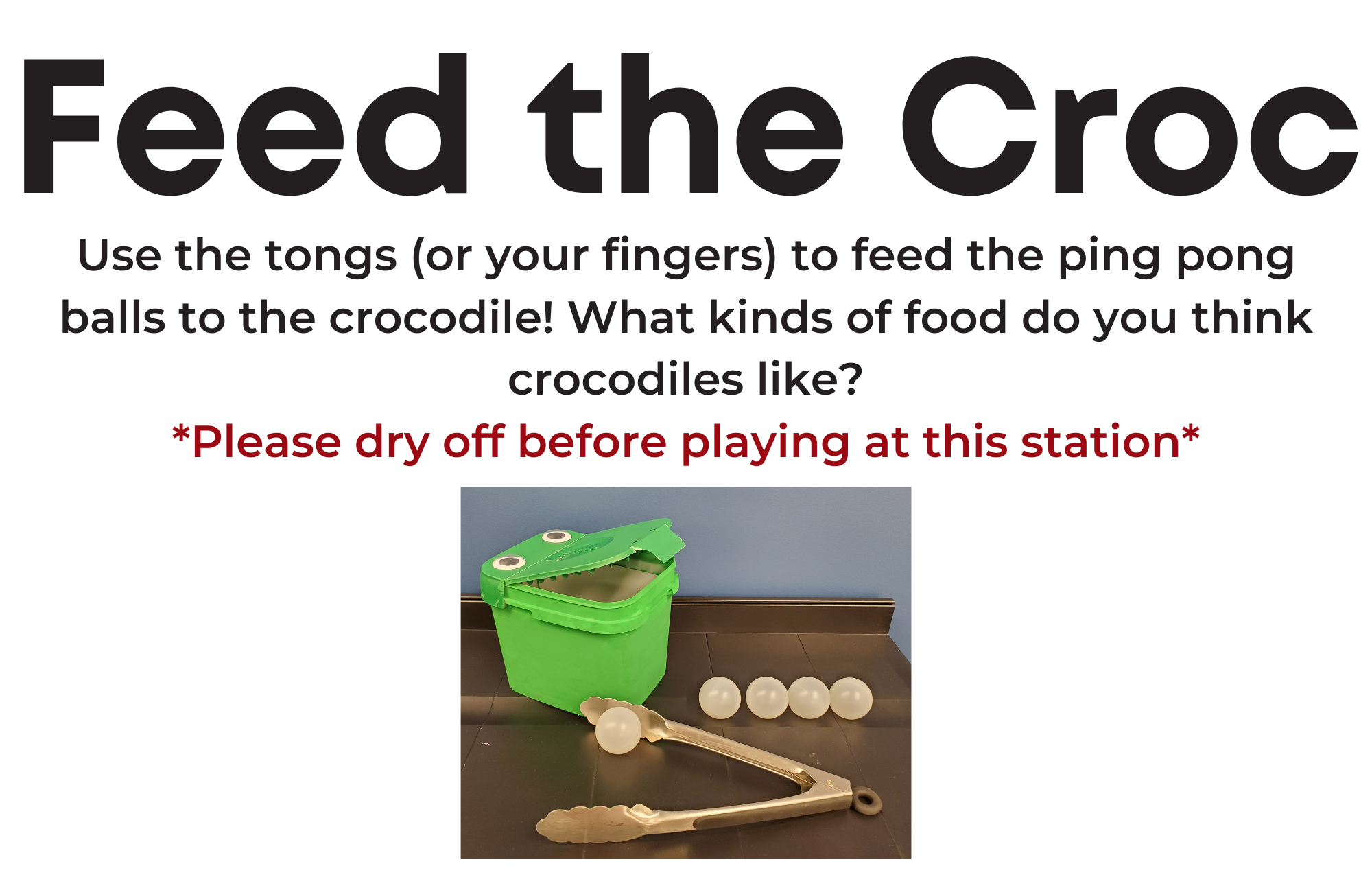
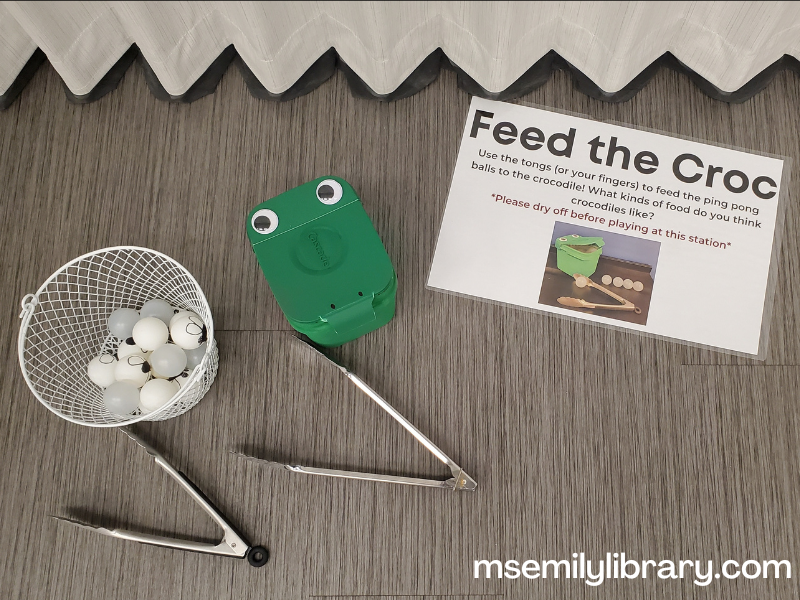
Feed the Croc (Weeks 2 & 5)
Saw this and thought it was very cute, and actually had the container from last year that someone had given to me. I painted it so that the whole thing is green and the label was covered up, added the big googly eyes and made little nostril markings. I found a few metal tongs at Goodwill and added the ping pong balls. Nom, nom, nom! Original idea from Mama OT.

Colored Ball Sort and Drop (Weeks 3 & 6)
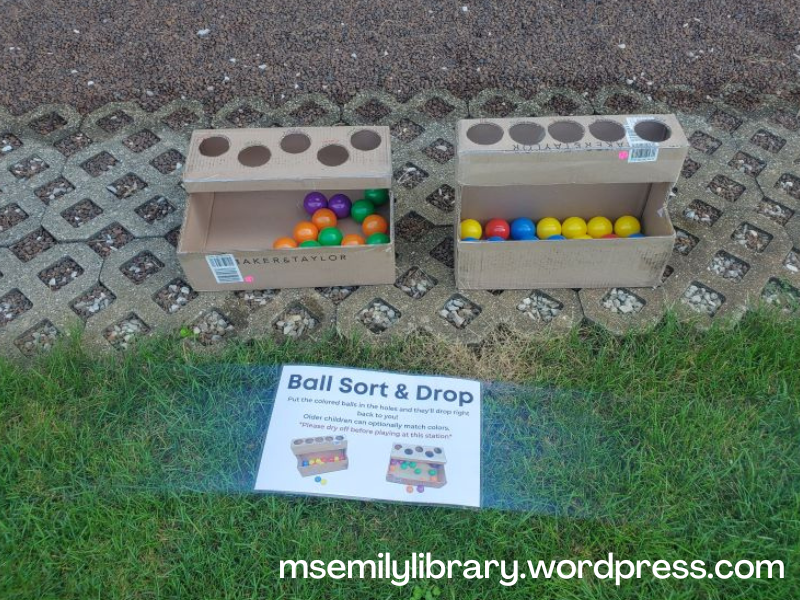
Two more repeats from last year. This ball sort and drop was made with Baker & Taylor boxes, but oriented them different ways so one was tall and skinny and one was low and squat. I had purchased ball pit balls and supplied different colors to each box. Photos from last year, which had weird blurs, sorry. Original idea from Taming Little Monsters.

Pompom Sort (Weeks 3 & 6)
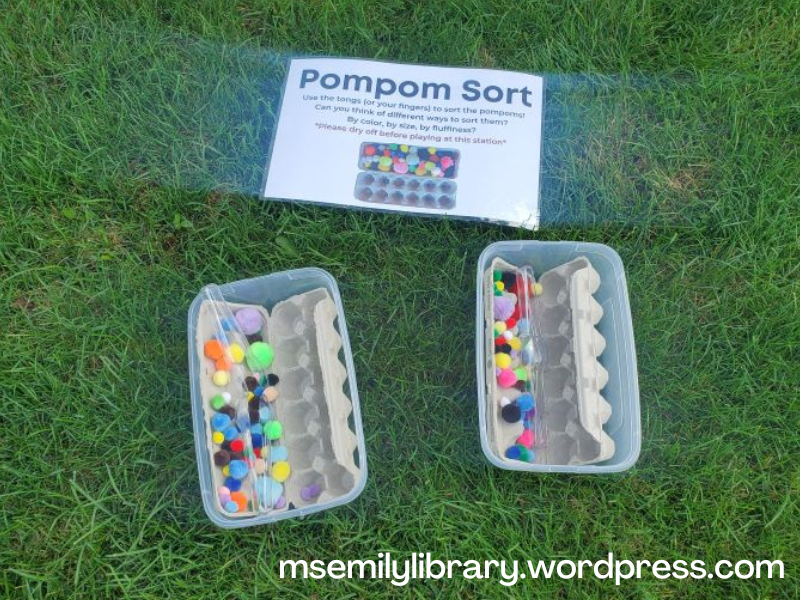
A really easy station to put together: I just saved a couple of egg cartons, then poured a handful or two of different colored/sized pompoms into them. The plastic tongs I provided last year were all broken in use, so I bought some metal ice tongs for this year. (And again, weird blur). Original idea from Laughing Kids Learn.

Art Stations

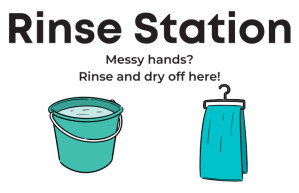
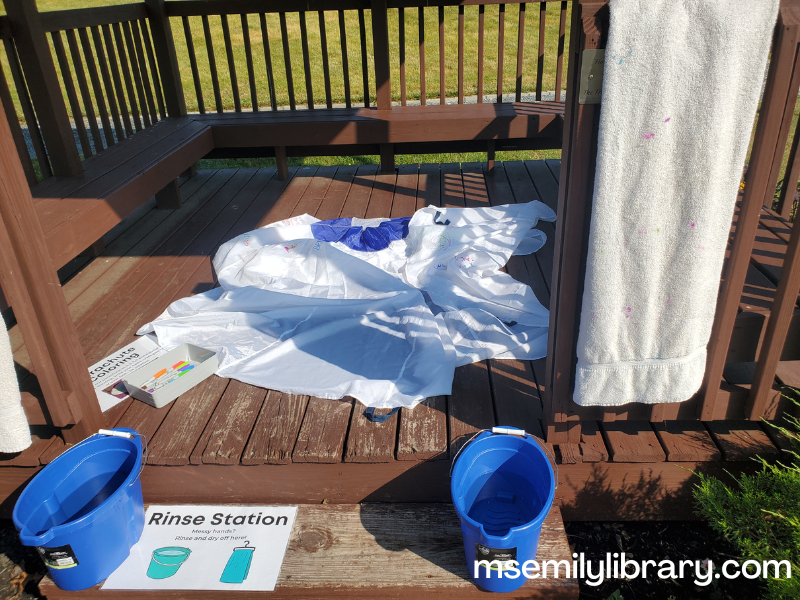
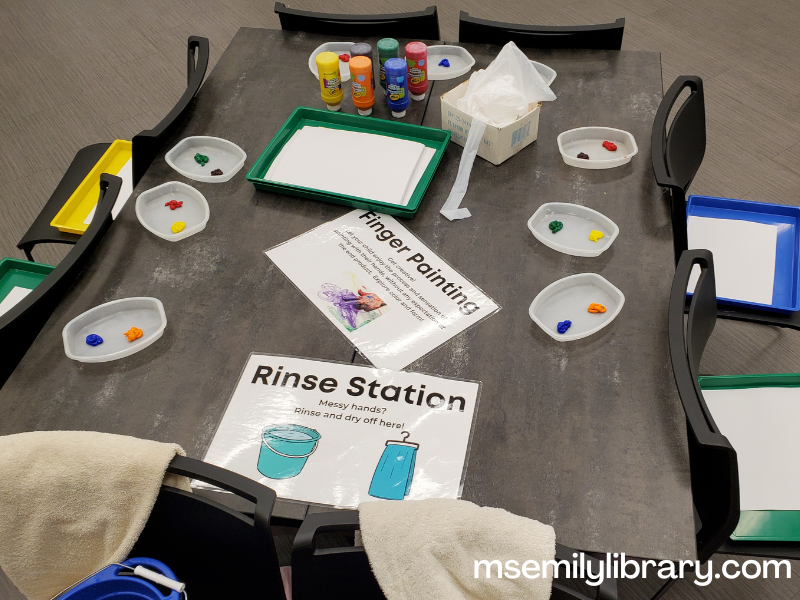
With the exception of Coloring the Parachute, the art stations were all unique, and all were simple process-focused art with different media. To help with mess, I set up a “Rinse Station” near the art every week which consisted of two buckets of water and two old bath towels for washing up as needed.

Rinse Station sign:
"Messy hands? Rinse and dry off here!"

Color the Parachute (all weeks)
My library has an interesting smaller parachute (maybe 8 foot diameter?) that is plain white and was advertised as “decorate it yourself!” When I inherited it, there were a small scattering of names from who knows how long ago and the rest was depressingly empty. This summer I was determined to fill it up. I laid it out each week and set it as a station inside the gazebo, with a small handful of permanent markers. I’m happy to say that it looks MUCH better now, though it could still use a lot more personalization to fill up empty spaces. I offered some different ideas as the weeks went on as to what to add, like a favorite animal or insect. The first time we were indoors I offered it as a station, but cleaning up realized there was permanent marker on our relatively new flooring. To keep my director from going nuts, I decided not to put it out indoors anymore. 🙂 You can see the rinse station in the photo as well.

Shape Prints (Week 1)
Using shape sorter blocks that we already had in our baby toy collection, kids could dip them in paint and stamp the shapes onto white construction paper. I use old recycled Lean Cuisine trays to hold the paint – they are a perfect size. Sadly, I missed getting any pictures of this station! Original idea (and photo on the sign) from Nanny Gunna.

Dot Painting (Week 2)
I originally had a different craft planned for week 2, but it was rainy that week and we were indoors the first two days. Dot painting is very easy and not as messy as slapping paint with flyswatters (see week 6 below), so the switch was made. The library has a supply of dot paint markers and I printed out some animal dot coloring sheets. Simple and still fun. I get a lot of these sheets, including the ones pictured, from The Artisan Life.

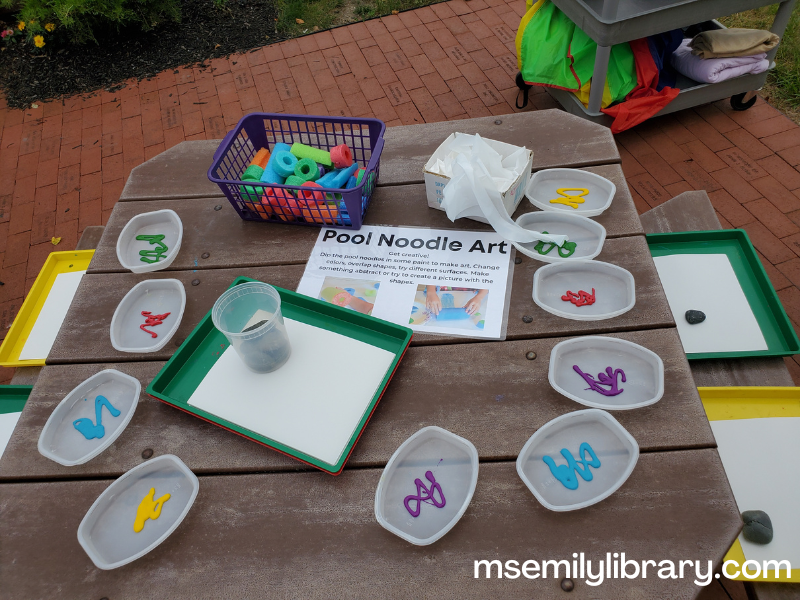
Pool Noodle Art (Week 3)
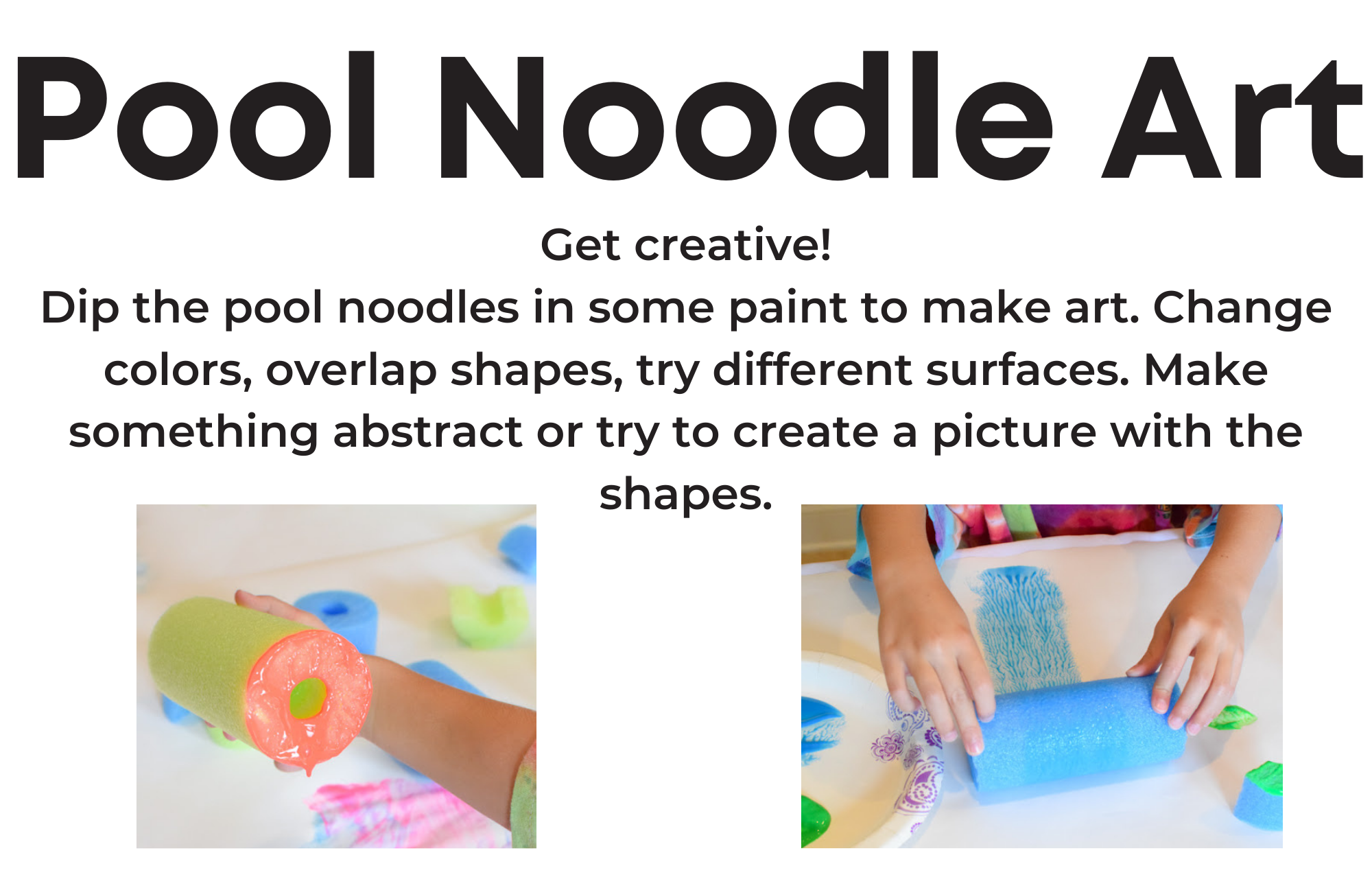
The pool noodles make another appearance! Trays of tempera paint and white construction paper are available with the noodles for any kind of art a child wishes to make. I had a few extra pieces of noodles that had been split lengthwise as well as sliced, to make half-circle shapes in addition to the full circles. Original idea (and photo on the sign) from What Can We Do With Paper and Glue.

Ice Painting (Week 4)
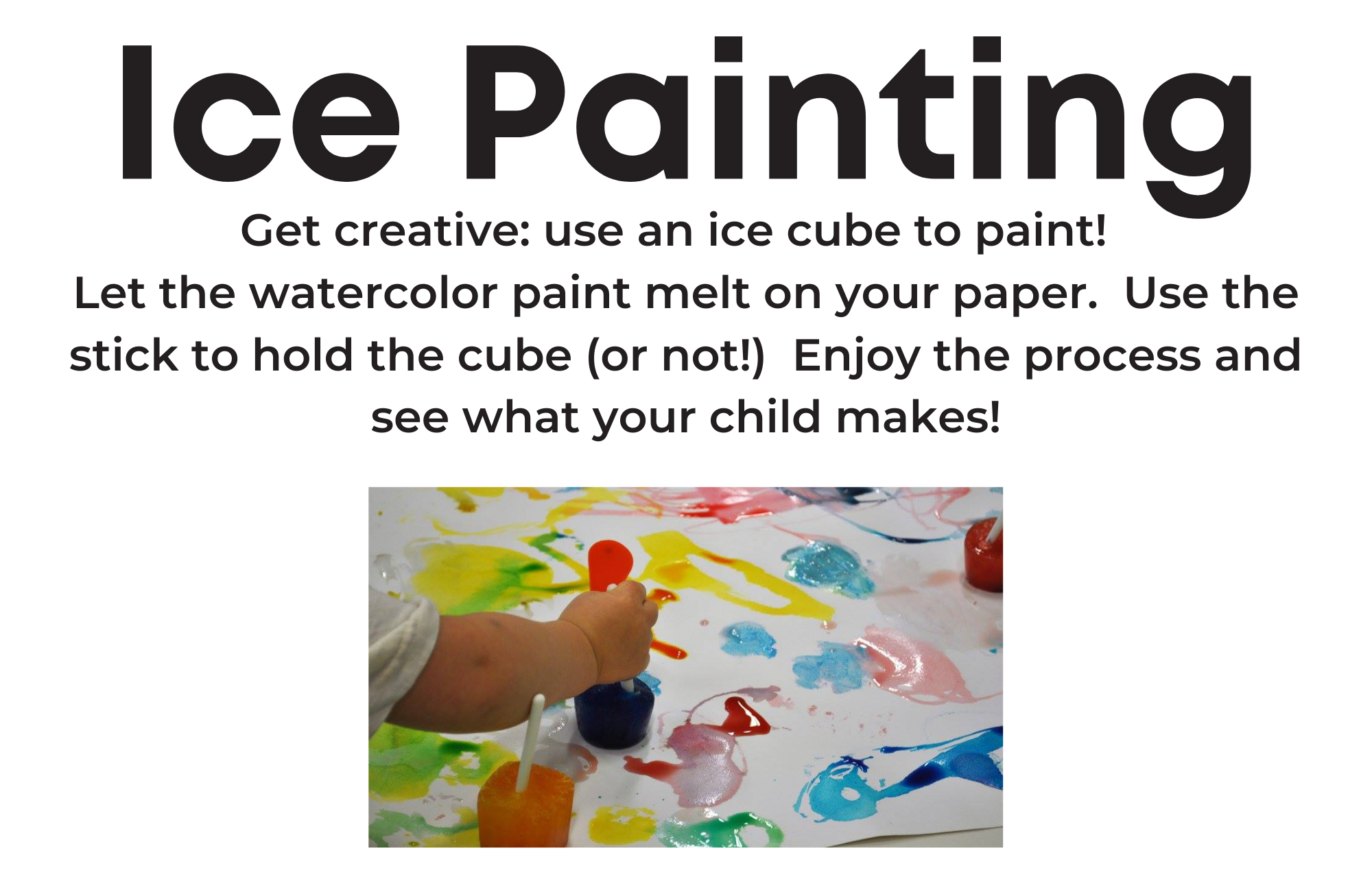
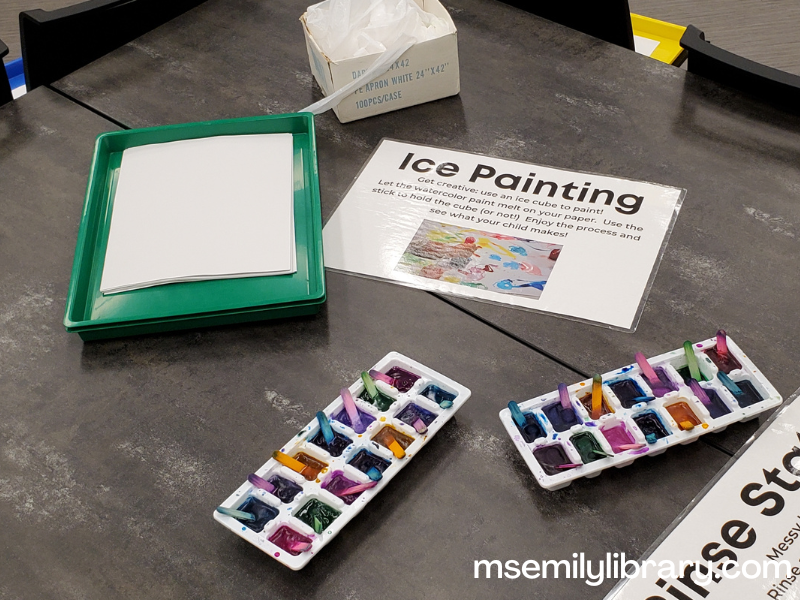
This is honestly very simple, but I always get a lot of comments from grown-ups about how cool it is and how they might be able to do it at home. (I LOVE hearing that they’ll adapt what we do at the library at home!) I add small craft sticks to an ice cube tray and put in a little liquid watercolor paint and fill the rest with water. I think it could easily be done with food coloring if you don’t have liquid watercolors, though. I keep the ice cube trays in a cooler in the shade until we’re ready for stations, then get them out to use. They do melt, but usually there’s a bit of ice left by the end of the program. And my groups were quite tidy, so I was able to just refreeze the trays each day and there was plenty of “paint” available for three sessions. Original idea (and photo on the sign) from ARTventurers.

Finger Painting (Week 5)
A classic and super-simple activity – construction paper in our messy trays with finger paints in trays. I actually had several kids who didn’t like the sensory messiness of it, so some of them creatively used the rocks that are there to keep papers from flying away to spread the paint around. I’m not sure of the source of the photo on the sign, I think it’s a stock photo from Canva.

Fly Swatter Art (Week 6)
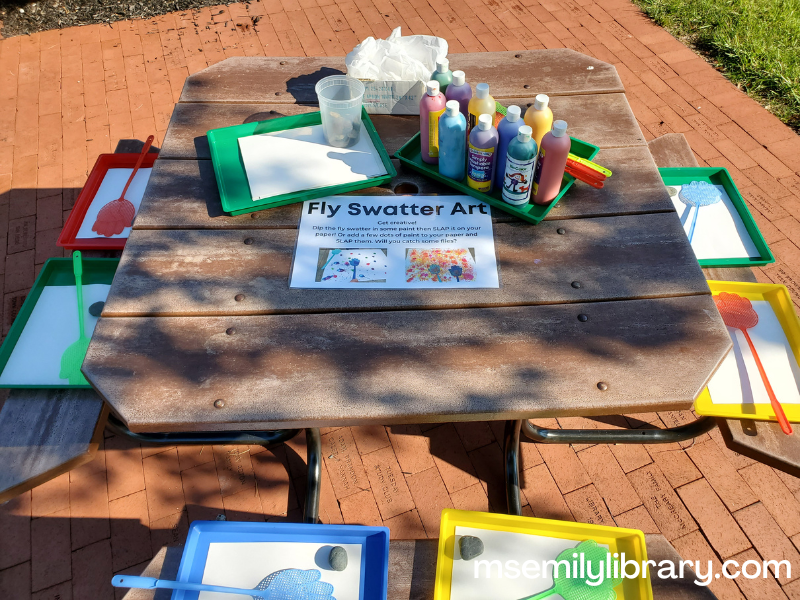
A messy but very fun art project, using (re-using) supplies from other stations. Kids wielded fly swatters to slap at paint, making some very interesting abstract art. I think the best method turned out to be adding some dots of paint to the paper, then letting the kids aim for them, rather than trying to spread paint on the swatter. I’m grateful for good weather all that week, since this is very much an outdoor activity. Original idea (and photo on the sign) from Play Teach Repeat.

Chalk Art (Week 7)
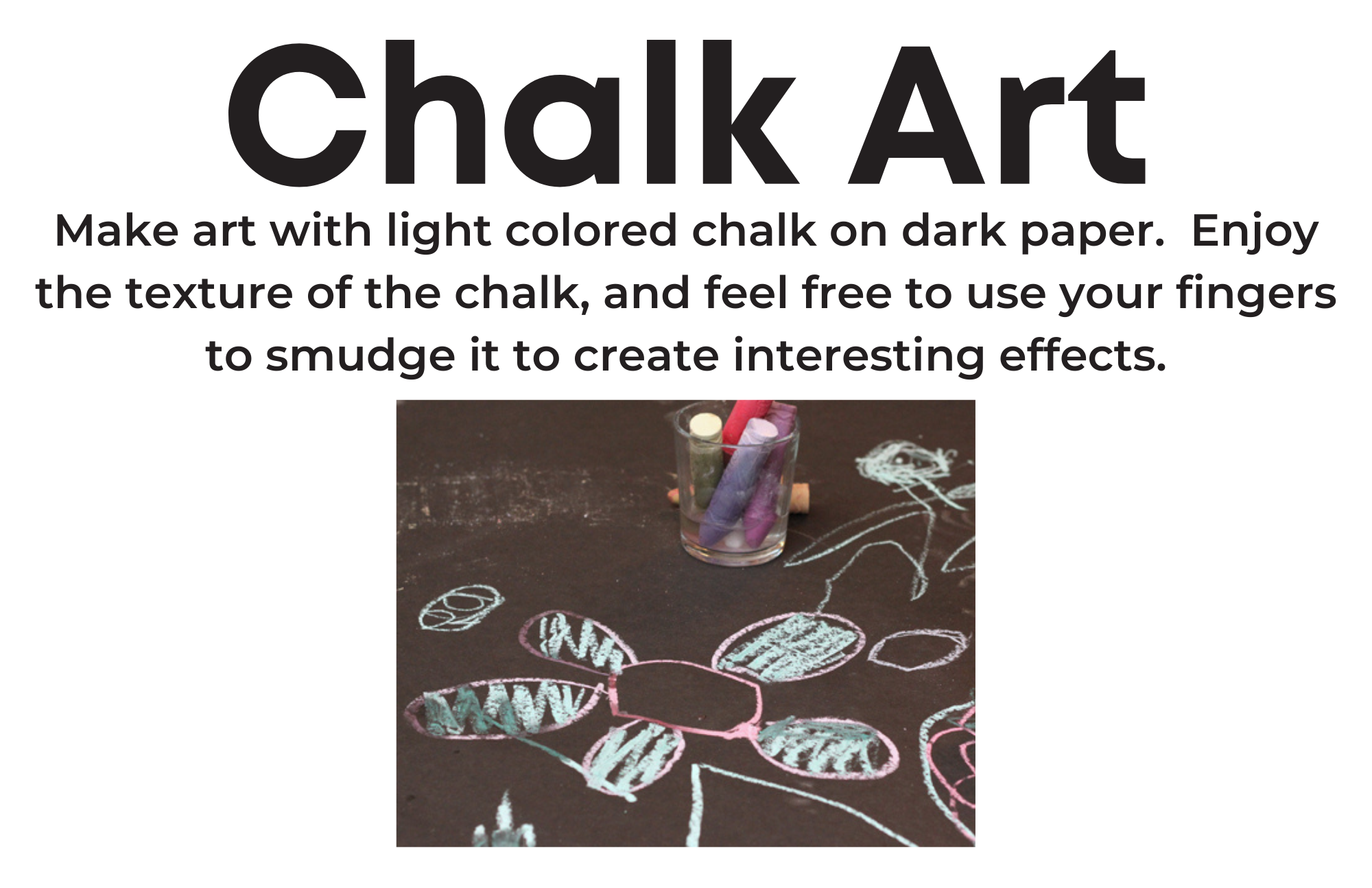
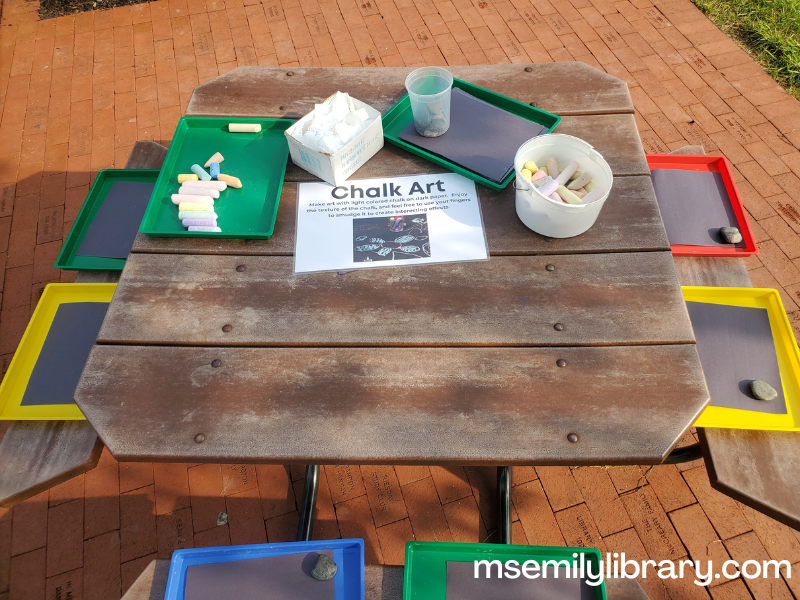
Another very simple process art project, using black construction paper and sidewalk chalk. It was nice to end the summer with an art station that didn’t involve paint – this librarian was very tired by that point!

Wow, thanks for making it to the end of this very long post. I hope you found some good ideas and jumping-off points for out-of-the-box programming!

Storytime: Earth Day

An environmentally-minded storytime for Earth Day or any day! We talked about littering, recycling, planting trees, and using gas-free transportation options – not bad for thirty minutes and a room full of two-year-olds.

Early Literacy Tip: Your recycling bin can become a craft store! Looking for different uses for ordinary items encourages creativity and inventiveness, skills that help children be ready to learn. You may be surprised at the different things that can be made from (clean) plastic containers, cardboard tubes, and other recyclable materials. Your child thrives on your encouragement, but let them be creative and decide what to do with the materials.

Welcome Song: Hello, Friends* (TT) (TB) (FT)**

Warm Up Song: Wake Up, Feet* (TT) (TB) (FT)
This is a repeated song that everyone seems to enjoy. I always begin and end with feet and tummies, but find two other body parts to wiggle in the middle. This week it was arms and chins.

Lifting Rhyme: Toast in the Toaster* (TT) (FT)

Rhyme: This is Big, Big, Big* (FT)

Intro: Saturday, April 22 is Earth Day! That’s a day when we celebrate the amazing place our planet is, and we work to clean up the Earth’s air, water, protect plants and animals, and make the earth a great place to live for generations to come. Here’s a poem by Kelly Roper about what we can do for Earth Day.

After reading this the first time, it felt a little preachy and kind of boring (no motions to do, etc). I decided to skip it for my other sessions.
Poem: In Celebration of Earth Day (TT)
In celebration of Earth Day, Why not plant a tree?
It will produce fresh air, And be a joy for all to see.
In celebration of Earth Day, Go and visit a local park.
Get back in touch with nature,
Its sights and sounds in light and dark.
In celebration of Earth Day Try to be more aware,
Of how your actions affect this world
And devote yourself to its care
Source: by Kelly Roper, via Stratford (CT) Library

Something that a lot of people do to celebrate Earth Day is planting trees. Let’s do that with this rhyme.
Action Rhyme: Be a Seed (TT) (TB) (FT)
Be a seed, small and round (make a fist)
Sprout, sprout, sprout up from the ground (open fingers)
Shake your leaves for all to see (shake hands and body)
Stretch your arms up, you’re a tree! (raise arms high)
Source: Jbrary

Transition: If You’re Ready for a Story* (TT) (TB) (FT)

I really loved this book, and it was pretty perfect for this age group – though I do have a few caveats. I skipped a couple pages both to shorten it and also… I wished the page about eating less meat featured a plate full of vegetables instead of a barnyard scene. C’mon. I also skipped the “Looking after our backyards” page. I don’t know, I could see how that can be environmentally friendly, but there’s also people who “look after their backyards” by applying lots of chemicals and planting non-native plants and so on. The wording could have been more precise, I think. Nevertheless, I did end up using this book for all three sessions!
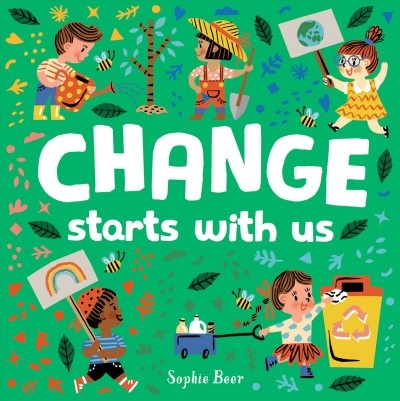
Read: Change Starts With Us by Sophie Beer (TT) (TB) (FT)

book cover for change starts with us

This ended up being a backup book that I didn’t use. It does have beautiful pictures and may be inspirational to keeping the Earth clean and beautiful, but since it wasn’t explicitly about being a good steward of the Earth, it didn’t fit quite as well when I only read one book.
Read: Thank You, Earth by April Pulley Sayre

book cover for thank you earth

Bounce: Bumping Up and Down (TT) (TB) (FT)
Bumping up and down in my little red wagon (bounce)
Bumping up and down in my little red wagon
Won’t you be my darlin’? (lift or tilt)
One wheel’s off and the axle’s broken… (bounce then lean)
(what else can you use to get around without a car? A green bicycle, a blue scooter, your pink sneakers?)
Source: adapted from the traditional

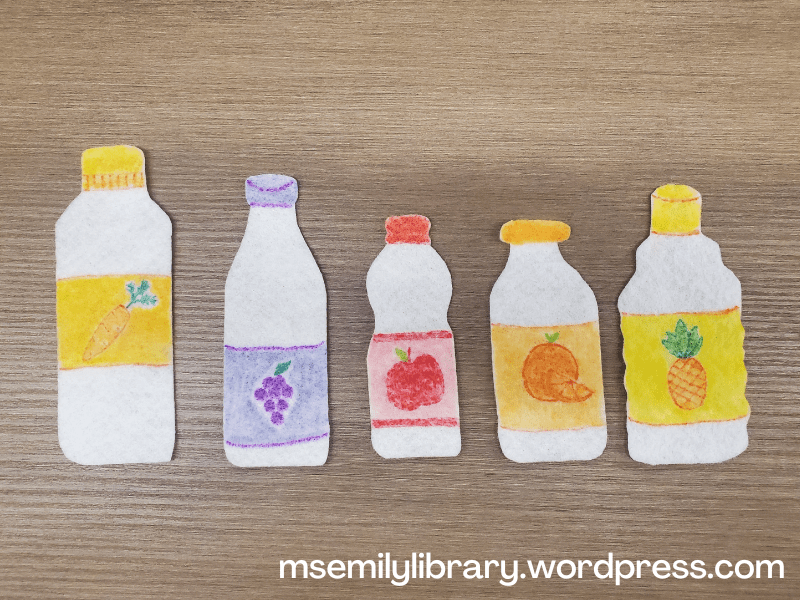
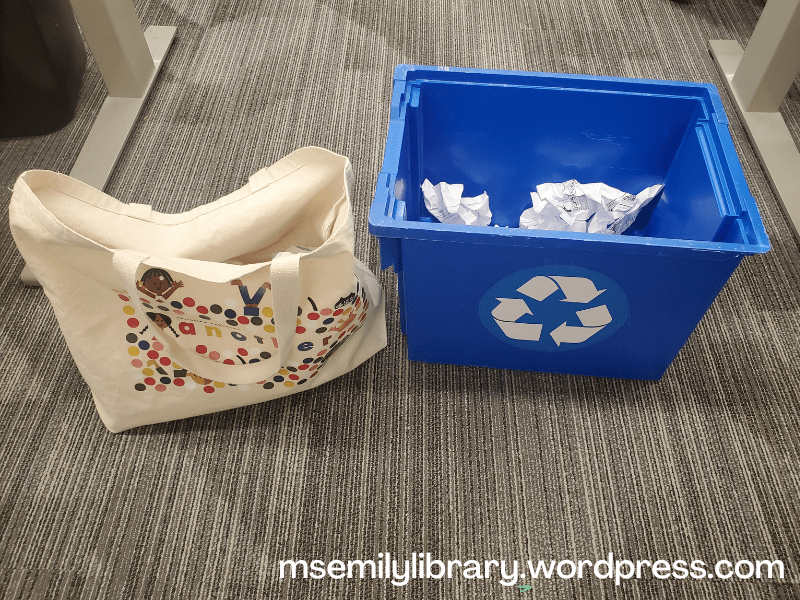
This one was fun. I had made a “recycling bin” from a blue ILL bin and just printed the recycling symbol to tape on the sides. I used it both for this and the “Picking Up Litter” song. The kids loved when I took each bottle and gulped it down. We also talked a little about colors, flavors, and sizes. I used permanent markers to color the labels.
Flannel/Counting Song: Five Bottles of Juice (TT) (TB) (FT)
Five bottles of juice on the wall
Five bottles of juice… Glug, glug, glug!
Put one in the recycling bin
Four bottles of juice on the wall!
(count down)
Source: Jen in the Library

Flannel pieces with five differently-shaped bottles of varying sizes. the first has a picture of a carrot on the label, the second a grape, the third an apple, the fourth an orange, and the fifth a pineapple. The bottle labels match the colors of the fruit and the lids match the labels.

I wasn’t exactly sure how this one would go, but it was a hit. When I started pulling crumpled up paper out of my bag and tossing it on the floor, eyes got wide! The most difficult part for me was remembering the rhyme while walking around and tossing enough trash that everyone would be able to grab some.
Song: Litter Bug (TT) (TB) (FT)
(tune of Itsy Bitsy Spider)
Once there was a litter bug
Who went from town to town
Throwing out his garbage
That landed on the ground
The garbage grew so high
That when he turned around
The litter bug got buried
And could not make a sound! EEK!
Source: Yogibrarian

They LOVED getting to pick up all the trash and put it in the recycling bin. We repeated the song until it was all picked up.
Song: Picking Up Litter (TT) (TB) (FT)
(tune of Paw Paw Patch)
Picking up litter and putting it in the bin
Way down yonder, at the library!
Source: Yogibrarian

a canvas tote bag sits next to a blue recycling bin with a white recycling symbol visible on the side. Crumpled up white paper can be seen inside both.

It’s always great to end with a ukulele song, especially one that has a very familiar and repetitive tune that grownups pretty much know. I have an inflatable ball with a realistic Earth printed on it and I encouraged kids to pass it around to each other. Before they started I asked grownups to help it move along. We only had one instance where it got thrown, so I call that a win.
Song: We’ve Got the Whole World (TT) (TB) (FT)
(tune of He’s Got the Whole World)
We’ve got the whole world, in our hands
We’ve got the whole world in our hands

We’ve got the rivers and the oceans, in our hands…
We’ve got the air all around us, in our hands…
Be kind to plants and animals – in our land…
We’ve got to work together to clean the Earth…
Source: adapted from King County (WA) Library System and DARIA

inflatable beach ball with the earth printed on it. The earth has clouds and the land varies from green to brown. It looks like the Earth from space.

Get a downloadable ukulele songsheet for “We’ve Got the Whole World” here!

Thumbnail for ukulele songsheet

Action Song: Zoom, Zoom, Zoom!* (TT) (TB) (FT)

Craft: Coffee Filter Earth (TB) (FT)
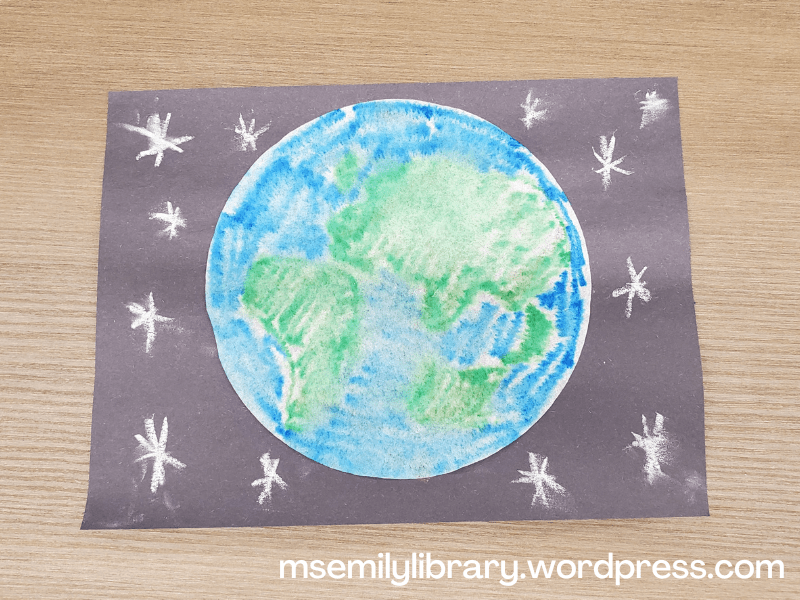
This was a little more involved than my usual crafts, but I think they enjoyed it. We started by using washable markers and coloring a coffee filter blue and green. Then they came up to me, where together we sprayed the filter with water on a plastic messy tray. Then they hung up their filter on yarn I’d strung up to dry. They could then go back and make stars on their black construction paper. We played and did our goodbye songs, and they could glue down their Earth if it was dry at that time.

Craft showing a  blurry blue and green earth glued to a piece of black construction paper. White chalk stars were drawn around the earth.

Play Time
The toddlers have two laundry baskets of baby toys – rattles and cars, sorters and stackers, toy phones and spinners. For the older kids, I have foam blocks, soft food toys, puzzles, and a few other items that are a little more sophisticated than the baby toys. For Family Time, I gauge the overall age of the group and put out what seems right for them. We play for 5-10 minutes at the most, then I ring the bell and ask the kids to help me clean up. I think the clean up bit is good practice for them!

Goodbye Song: See You Later Alligator* (TT) (TB) (FT)

Goodbye Rhyme: Tickle the Stars* (TT) (TB) (FT)

Other books I had available for families to browse (and may work for you on this theme)
The Earth Book – Todd Parr
My Friend Earth – Patricia MacLachlan & Francesca Sanna
Stand Up! Speak Up! – Andrew Joyner
We Are Water Protectors – Carole Lindstrom & Michaela Goade
Milk and Juice – Meredith Crandall Brown
Sea Bear: A Journey for Survival – Lindsay Moore
What a Wonderful World – Bob Thiele, George David Weiss & Tim Hopgood
The Old Boat – Jarrett Pumphrey & Jerome Pumphrey
Lights Out – Marsha Diane Arnold & Susan Reagan

This storytime was presented in-person on 4/17, 4/18, & 4/19/23.

Storytime Handout:

handout with suggested books, rhyme and song lyrics

*Lyrics to these songs can be found on the Repeated Songs & Rhymes page.

**These symbols indicate the program sessions I used the activities for:
(TT) Toddler Time, ages 1-2
(TB) Teddy Bears, ages 2-3.5
(FT) Family Time, ages 0-3.5


Storytime: The Seeds of Spring

Springtime in Indiana is capricious, but thankfully we had some warm days, some rain, and some early blooms to reflect on. Although an ostensibly “springtime” theme, I focused mostly on seeds and plants. I’ve done gardening themes before, and I’ve also done a couple of sessions on bugs (here and here) that might also fit into this theme, if you are looking for more ideas.

Early Literacy Tip: Learning directional words like up, down, above, and below is foundational to learning to write letters. When you use words like these with your child and you gesture to show what you mean, you’re setting them up to learn how to write later on.

Welcome Song: Hello, Friends* (TT) (TB) (FT)**

Warm Up Song: Wake Up, Feet* (TT) (TB) (FT)
This is a repeated song that everyone seems to enjoy. I always begin and end with feet and tummies, but find two other body parts to wiggle in the middle. This week it was fingers and knees.

Lifting Rhyme: Toast in the Toaster* (TT) (FT)

Rhyme: This is Big, Big, Big* (FT)

Intro: This week is the first official day of spring. Every day, the days are getting a little bit longer, the weather changing like the season, but moving toward getting a little warmer, and the little seeds that have been in the ground all winter long are starting to wake up!

As simple as this is, it worked really well for all three groups.
Fingerplay: During the Spring (TT) (TB) (FT)
During the spring, it often showers (flutter fingers down)
Or the sun shines for many hours (form circle with arms)
Both are very good for the flowers! (cup hands, extend arms)
Source: Storytime Katie

Fingerplay: Dig a Little Hole
Dig a little hole, Plant a little seed
Pour a little water, Pull a little weed
Chase a little bug, Heigh-ho, there he goes!
Give a little sunshine, Grow a little rose
Credit: SurLaLune Storytime via Storytime Katie

Transition: If You’re Ready for a Story* (TT) (TB) (FT)

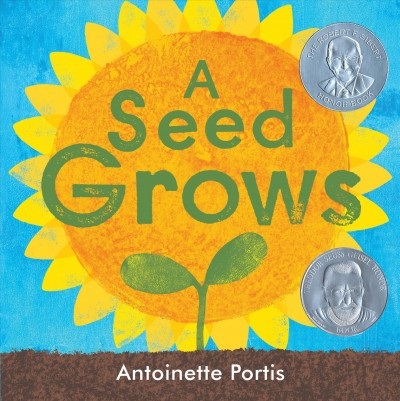
Read: A Seed Grows by Antoinette Portis (TT) (FT)

What a beautiful book this is. I love its playfulness and gentleness.
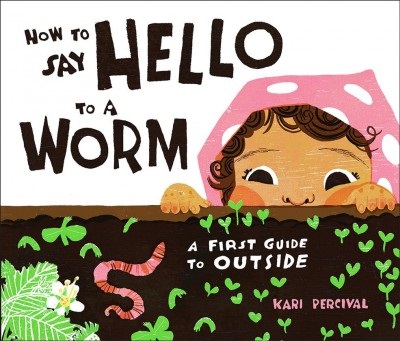
Read: How to Say Hello to a Worm by Kari Percival (TB)

Fingerplay: Five Plump Peas
Five plump peas in a peapod pressed (make a fist and cover with the other hand)
One grew, two grew, and so did all the rest (raise all fingers on first hand one by one)
they grew, & they grew, & they grew, & never stopped (hands get wider and wider)
They grew SO BIG that the peapod… POPPED! (hands spread as wide as possible, then clap!)
Source: Carole Stephens

Rhyme: Be A Seed
Be a seed, small and round
Sprout, sprout, sprout up from the ground.
Shake your leaves for all to see
Stretch your arms up, you’re a tree!
Source: Jbrary

Action Rhyme: A Big Green Leaf (TT) (TB) (FT)
(tune of A Ram Sam Sam)
A big green leaf, a big green leaf (hold hands apart)
Little ladybug (pinch fingers close)
On a big green leaf (x2)

A bumblebee- BZZ! (tickle) A bumblebee- BZZ! (tickle)
And a little ladybug On a big green leaf (x2)
Source: Storytime in the Stacks

Scarf Song: One Bright Scarf (TT) (TB) (FT)
One bright scarf waiting for the wind to blow
Toss it up high, and wave it down low
Wiggle it fast, and wiggle it slow (hide the scarf)
Hey! Where did it go? (bring out) Here it is!
Source: Jbrary

Scarf Rhyme: Here is a Green Leaf (TT) (TB) (FT)
(start by crumpling scarf between both hands)
Here is a green leaf, and here is a green leaf (show thumbs)
and that, you see, makes two
Here is the bud that makes the flower (show a tiny bit of the scarf)
Now watch it bloom for you! (open hands to let scarf expand)
Source: Jbrary

Scarf Rhyme: Little Seed (TB) (FT)
(start by scrunching scarf in one hand)
Little seed in the ground
Sitting oh, so still
Little seed, will you sprout?
YES, I WILL! (pull scarf up out of hand)
Source: Lady Librarian Life

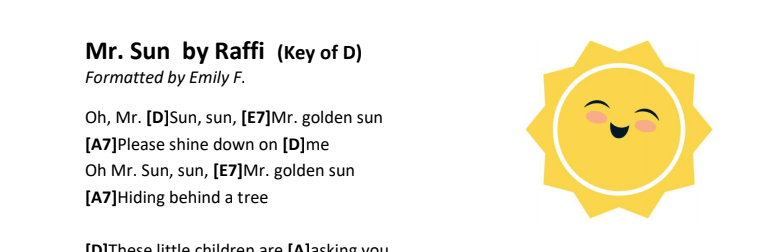
Ukulele Song: Mr. Sun
Oh, Mr. Sun, Sun, Mr. Golden Sun
Please shine down on me
Oh, Mr. Sun, Sun, Mr. Golden Sun
Hiding behind a tree

These little children are asking you
To please come out so we can play with you

Oh, Mr. Sun, Sun, Mr. Golden Sun
Please shine down on me
Source: Raffi (from the album Singable Songs for the Very Young)

Get a downloadable ukulele songsheet for “Mr. Sun” here!

thumbnail of Mr. Sun ukulele songsheet

Action Song: Zoom, Zoom, Zoom!* (TT) (TB) (FT)

Craft: Dot Painted Flowers
Pretty simple. I used two die cuts to make flowers on white construction paper, and provided light blue backing paper, glue sticks, and dot markers.
I’d also read a great article on how radishes are a great veggie for children to grow, since they are very quick to both sprout and mature. I bought a package of radish seeds and gave them out with some simple instructions.

Play Time
The toddlers have two laundry baskets of baby toys – rattles and cars, sorters and stackers, toy phones and spinners. For the older kids, I have foam blocks, soft food toys, puzzles, and a few other items that are a little more sophisticated than the baby toys. For Family Time, I gauge the overall age of the group and put out what seems right for them. We play for 5-10 minutes at the most, then I ring the bell and ask the kids to help me clean up. I think the clean up bit is good practice for them!

Goodbye Song: See You Later Alligator* (TT) (TB) (FT)

Goodbye Rhyme: Tickle the Stars* (TT) (TB) (FT)

Other books I had available for families to browse (and may work for you on this theme)
And Then it’s Spring – Julie Fogliano & Erin E. Stead
If You Plant a Seed –
Kadir Nelson
Flower Garden –
Eve Bunting & Kathryn Hewitt
On a Snow-Melting Day –
Buffy Silverman
A Seed is Sleepy –
Dianna Hutts Aston & Sylvia Long
Emile and the Field –
Kevin Young & Chioma Ebinama
My Garden/Mi Jardín –
Rebecca Emberley
Lola Plants a Garden –
Anna McQuinn & Rosalind Beardshaw
How a Seed Grows –
Helene J. Jordan & Loretta Krupinski
Planting a Rainbow –
Lois Ehlert

This storytime was presented in-person on 3/20, 3/21, & 3/22/23.

Storytime Handout:

*Lyrics to these songs can be found on the Repeated Songs & Rhymes page.

**These symbols indicate the program sessions I used the activities for:
(TT) Toddler Time, ages 1-2
(TB) Teddy Bears, ages 2-3.5
(FT) Family Time, ages 0-3.5
Storytime: Big & Little

Usually the songs and rhymes that I plan for my Toddler Time (ages 1-2) and my Teddy Bear (ages 2-3.5) sessions are very similar, with just two or three different extension activities that differ between the two. Family Time (ages 0-3.5) is usually a judgement call between the two plans based on the ages that show up. However, because of the books I chose to read, the two plans for this storytime were quite different!

I also was in love with the craft for this week – and I got gasps from the crowd when I revealed my sample both days! It was very simple, but made a BIG impact.

Early Literacy Tip: Children love to talk about how “big” they are. While they’re smaller than many people and things they interact with, they find joy in being bigger than younger siblings or a pet. Their learning and understanding of big and small are important for math readiness as it lays the foundation for understanding and comparing sizes. It sets them up to learn the concepts of less vs. more, smaller than vs. larger than, and equal to. Additionally, the frequent use of vocabulary like “large” and “small,” “big” and “little” helps increase your children’s spatial language.

Welcome Song: Hello, Friends* (TT) (TB) (FT)**

Warm Up Song: Wake Up, Feet* (TT) (TB) (FT)
This is a repeated song that everyone seems to enjoy. I always begin and end with feet and tummies, but find two other body parts to wiggle in the middle. This week it was arms and chins.

Lifting Rhyme: Toast in the Toaster* (TT) (FT)

We just had to do this one!
Rhyme: This is Big, Big, Big* (TT) (TB) (FT)

Intro: Let’s talk about size. What is big? [spread arms out!] What is little? [pinch fingers together] Can we practice?

I’ve done this one with bubbles, but not with balls. The flannel is super simple, and we do the rhyme three times, then say I have one more to add, now let’s count, and it makes an even 10.
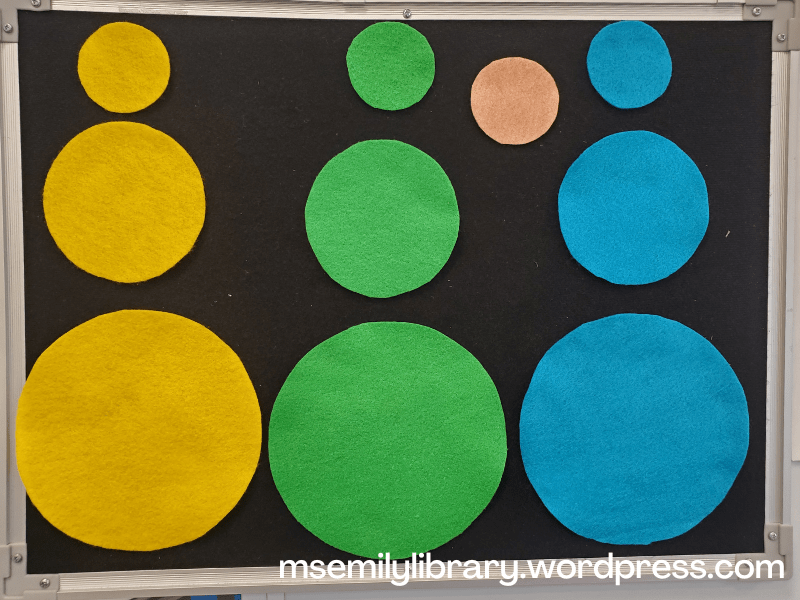
Flannel Rhyme: Little Ball, Big Ball (TT) (TB) (FT)
A little ball (make a circle with your fingers)
A bigger ball (make a larger circle with your hands)
A great big ball I see (make a large circle with your arms)
Can you count the [yellow] balls? 1 – 2 – 3 (make 3 circles again)
Source: Jen in the Library

Flannelboard showing three balls of increasing size in yellow, green, and blue, plus one small pink ball to make ten total.

Transition: If You’re Ready for a Story* (TT) (TB) (FT)

This is a board book, and I *still* skipped some pages for the wiggly toddler time group!
Read: Big Little by Leslie Patricelli (TT)

book cover for Big Little

Classic storytime book. I got some raised eyebrows and nervous titters from grownups when the squid’s tentacles are hanging out of the whale’s mouth, but everyone liked the twist!
Read: I’m the Biggest Thing in the Ocean by Kevin Sherry (TB) (FT)

Book cover for I'm the biggest thing in the ocean

The next four activities were only for Toddler Time, then the next two were just for Teddy Bears and Family Time.

I pointed out that we’re doing a small, medium, and large sized jumping animal to reinforce our theme for this one.
Bounce: Grasshopper (TT)
There was a little grasshopper
Always on the jump
Because they never looked ahead
They always went BUMP! (tilt to side, drop between knees, or lift)
Repeat with bunny, kangaroo
Source: Storytime in the Stacks

Action Rhyme: Tall as a Tree (TT)
Tall as a tree (arms over head)
Wide as a house (arms out to the side)
Thin as a pin (arms straight down by side)
And small as a mouse (crouch low)
Source: Dogeared Storytime

The little Folkmanis mouse finger puppet is the cutest, so it’s always exciting to find a new use for her!
Story Rhyme: Little Mousie Brown (TT)
(Index finger is mouse, opposite arm is candlestick)
Up the tall white candlestick
Went little Mousie Brown
But when she got up to the top
She could not get back down
She called for Mama, “Mama, Mama!”
But Mama was in town
So she called for daddy, “Daddy, Daddy!”
But Daddy wasn’t around
So little Mousie curled right up
And rolled right down!
Source: Jbrary

Photo of Folkmanis finger puppet mouse - brown with a white tummy and beige inner ears, with a beige rope tail.
Mousie Brown is the cutest

Rhythm Rhyme: The Elephant (TT)
(stomp feet rhythmically)
Right foot, left foot see me go
I am grey and big and slow
I come walking down the street
With my trunk and my four big feet
(extend arms in front of face, trumpet like an elephant!)
Source: King County (WA) Library System

We did this one every week last summer as part of the Oceans of Possiblities theme, and it was nice to revisit it.
Action Song: A Big Sea Star (TB) (FT)
(tune of A Ram Sam Sam)
A big sea star, a big sea star (stretch arms & legs out)
Little cuddle clam (hug yourself and get small)
and a big sea star (x2)

A pufferfish! (big breath and blow out)
A pufferfish!
Little cuddle clam and a big sea star (x2)
Source: Jbrary

Action Song: Slippery Fish (TB) (FT)
Slippery fish, slippery fish, sliding through
the water, Slippery fish, slippery fish,
Gulp, Gulp, Gulp! Oh, no!
It’s been eaten by …

A jellyfish, a jellyfish, floating in the water …
An octopus, an octopus, squiggling in the water …
A mako shark, a mako shark, lurking in the water …
Humongous whale, humongous whale, spouting in the water… Gulp, Gulp, Gulp – BURP! Excuse me!
Source: Jbrary

Flannelboard for "Slippery fish." Pictured is a small green and blue fish, a pink jellyfish, a gray and pink octopus, a white and pink tuna fish, a gray shark, and a blue whale
I didn’t use the white and pink “tuna fish” this time

Parachute Intro: Let’s get out our biggest prop, the parachute! Let’s practice by lifting it up and down, shaking fast and slow. (TT) (TB) (FT)

Parachute Song: Very, Very Tall (TT) (TB) (FT)
I’m very, very tall (reach up high)
I’m very, very small (reach down low)
Tall!
Small!
Now I’m a little ball (curl up)
Source: Old Town School of Folk Music, from the album Wiggleworms

I mean, I guess it’s big…
Parachute Song: London Bridge (TT) (TB) (FT)
London bridge is falling down,
Falling down, falling down
London bridge is falling down,
My fair lady.

Build it up with sticks and stones…
Source: traditional

Parachute Song: Parachute Fly
tune of Skip to My Lou
Up, up, up it goes
Down, down, down so low
Raise our parachute to the sky…
Count to 3 and watch it fly!
Spoken:
Up on 1…
Down on 2…
Up on 3, and Fly! (adults release while you gather up the ‘chute)
Source: Gymboree

Action Song: Zoom, Zoom, Zoom!* (TT) (TB) (FT)

Craft: Giant Squid (TB) (FT)
As I said, this was a craft that inspired gasps of delight when revealed, but the elements are really quite simple. I freehand drew a squid’s head on our largest size of blue construction paper (12″ x 18″) and asked a volunteer to trace and cut those out. I also drew large white circles for the eyes and a smile mouth on white construction paper – them being a little wonky really added to the fun look. We had small dark blue stickers for the pupils (black would have worked, too, but I used what I found), and I pre-cut lengths of blue crepe paper streamers for the tentacles. I put out glue sticks, tape, and staplers and let everyone choose what worked well for them, and we ended up with adorable giant squids that in most cases were bigger than the children that made them! I was inspired by a picture I saw on Pinterest from the Share and Remember blog.

Our craft - a blue squid made of construction paper and blue streamers. In full, it measures about 4 feet long

Play Time
The toddlers have two laundry baskets of baby toys – rattles and cars, sorters and stackers, toy phones and spinners. For the older kids, I have foam blocks, soft food toys, puzzles, and a few other items that are a little more sophisticated than the baby toys. For Family Time, I gauge the overall age of the group and put out what seems right for them. We play for 5-10 minutes at the most, then I ring the bell and ask the kids to help me clean up. I think the clean up bit is good practice for them!

Goodbye Song: See You Later Alligator* (TT) (TB) (FT)

Goodbye Rhyme: Tickle the Stars* (TT) (TB) (FT)

Other books I had available for families to browse (and may work for you on this theme)
I’m Not Small – Nina Crews
Tiny Little Fly – Michael Rosen & Kevin Waldron
Who’s the Biggest? – Delphine Chedru
Marta! Big & Small – Jen Arena & Angela Dominguez
Big and Small and In-Between – Carter Higgins & Daniel Miyares
Jump! – Scott M. Fischer
Little Mouse – Alison Murray
You Are (Not) Small – Anna Kang & Christopher Weyant
The Crayola Comparing Sizes Book – Jodie Shepherd
What Will Fit? – Grace Lin
Big and Small with Northwest Coast Native Art – NativeNorthwest.com

This storytime was presented in-person on 3/6, 3/7, & 3/8/23.

Storytime Handout:

Storytime handout with book suggestions, rhyme and song lyrics.

*Lyrics to these songs can be found on the Repeated Songs & Rhymes page.

**These symbols indicate the program sessions I used the activities for:
(TT) Toddler Time, ages 1-2
(TB) Teddy Bears, ages 2-3.5
(FT) Family Time, ages 0-3.5

Storytime: Shadow Tales

Doing a storytime about shadows is fun and exciting. It’s also a bit logistically difficult. I think I’ve seen others do this theme around Groundhog Day, but I hadn’t actually made that connection in my mind when I scheduled this for late February. I’d done this theme once before, pre-pandemic, and at that time I brought in one of those heavy-duty work lights with the halogen bulbs that have lots of scary warning stickers on them. For several of our rhymes and songs, we’re making motions and looking for our shadows to imitate us. Back then, I was able to put that big light toward the back of the room to shine on the group and project our shadows on the front wall, but I had a lot fewer kids attending then, and their grownups were more fastidious about keeping them within arms length. This time around, the only good place to put it was front and center, and I now have a larger and more mobile group. I just didn’t feel comfortable with that setup. I had a desk lamp I was able to use for my shadow theater, but it wasn’t a good fit for the wider room. A coworker let me borrow her ring light, but the light was too diffused to throw much of a shadow. Instead, we made do. I had a few flashlights, and when I lowered the main lights, there were still some can lights on the ceiling that stayed on and we were able to throw some shadows on the floor.

All that to say – it was still totally worthwhile to do, even with all the technical difficulties! Just lowering lights in storytime is fun and exciting, and a shadow made with a handheld flashlight still demonstrates the science, even if not everyone can see their distinct shadow at the same time.

Early Literacy Tip: Sharing nonfiction titles, even in an abbreviated way, helps introduce your child to new concepts, vocabulary, and general knowledge of the world around them. You can look at the pictures and read captions or paraphrase the “big ideas” of a book to create an age-appropriate experience with a factual book on a subject like shadows.

Welcome Song: Hello, Friends* (TT) (TB) (FT)**

Warm Up Song: Wake Up, Feet* (TT) (TB) (FT)
This is a repeated song that everyone seems to enjoy. I always begin and end with feet and tummies, but find two other body parts to wiggle in the middle. This week it was knees and noses.

Lifting Rhyme: Toast in the Toaster* (TT) (FT)

Intro: Today we’re talking about shadows! A shadow is a dark spot that is made when light shines past something solid, like us! Let’s make some shadows on the walls. I’m going to lower the overhead lights and turn on this bright light behind us. Can you see our shadow on the wall? [This ended up being floor!]

I usually use this rhyme as a “filler,” but since it makes some nice big movements, it was a good option to do and see our shadow selves doing as well.
Rhyme: This is Big, Big, Big* (TT) (TB) (FT)

Read: Share individual pages from What Makes Shadow by Clyde Robert Bulla & June Otani. This is where I shared our literacy tip.

Book cover of What Makes a Shadow?

Let’s try this rhyme and see what our shadows do.
Action Rhyme: My Shadow Movements (TT) (TB) (FT)
If I walk, my shadow walks
If I run, my shadow runs
And when I stand still, as you can see
My shadow stands beside me
When I hop, my shadow hops
When I jump, my shadow jumps
And when I sit still, as you can see
My shadow sits beside me
Source: Johnson County (Kansas) Library (link no longer functional)

Transition: If You’re Ready for a Story* (TT) (TB) (FT)

Instead of reading a book here, I performed the story of the Three Billy Goats Gruff using shadow puppets. I just improvised the traditional story on memory, but the novelty of the shadow theater was riveting for the little ones and I highly recommend trying this sometime! I found a puppet and scenery template for this story at this website and increased the size to fit about 11×17 inches, which fit nicely on the box I used. I liked this story because it only had four characters, and only two were “onstage” at one time, so I felt like I could handle that by myself pretty easily. I watched this Hallmark Channel video as a guide to how to make the theater (the side hole for manipulating the puppets is really helpful.) I didn’t make the box look super nice or fancy, but sketched a little theater outline on the outside with the help of a ruler. You can’t actually see it when it’s dark and the play is going on, so you really don’t need to do that. If you do need a script, there are lots of versions out there, in picture book form as well as by searching for “Billy Goats Gruff Script.”
Shadow Theater: The Three Billy Goats Gruff (TT) (TB) (FT)

Let’s try to retell that story with this rhythm rhyme!
We didn’t use rhythm sticks, but patted our laps and did the hand motions option from Jbrary.
Story Rhyme: Billy Goats Trip Trap (TT) (TB) (FT)
Trip, trap, trip, trap, Across the bridge they come
Trip, trap, trip, trap, Crossing one by one
Trip, trap, trip, trap, Baby takes a stroll
Trip, trap, trip, trap, Over the sleeping troll
Trip, trap, trip, trap, Louder taps I hear
Trip, trap, trip, trap, Middle goat is near
Trip, trap, trip, trap, Stomps the biggest goat
Trip, trap, trip, trap, Troll goes in the moat!
Source: Jbrary (see motions there)

Action Rhyme: Shadow, Shadow (TB)
Shadow, shadow turn around
Shadow, shadow touch the ground
Shadow, shadow dance on your toes
Shadow, shadow touch your nose
Shadow, shadow jump up now
Shadow, shadow take a bow
Shadow, shadow stomp your feet
Shadow, shadow take your seat.
Source: Storytimes and More

You can use pretty much any clip art here, I was inspired by Sunflower Storytime (website now unavailable) and Storytimes and More (link below). I found several of the same images they used. I laminated my printout and also a black piece of cardstock, then cut both out together to make the image and the art. Most are fairly easy, and the kids were excited to tell me each object until the last one, the sandwich on the plate, which was a difficult one. I got some good guesses, like a boat, but they laughed to see the actual picture.
Flannelboard Game: Guess That Shadow (TB) (FT)
I’m a shadow, look at me
Guess whose shadow I might be!
Source: Sunflower Storytime and Storytimes and More

Flannelboard for guess that shadow, showing clipart objects and black "shadows" in the exact shape. Includes a tree, house, bird, cupcake, airplane, and sandwich on a plate with a decorative toothpick sticking out of it.

I wanted them to have the opportunity to try puppet theater, so I made some spider puppets (a die cut spider on a craft stick) and we did the Itsy Bitsy Spider, using our opposite arm as the water spout. With all the lighting issues, only my shadow really made it on the wall, but we sang through it twice and I told them this will look amazing on their bedroom wall tonight with their grownup helping with a flashlight. They all loved that they were allowed to take their spiders home.
Fingerplay: The Itsy Bitsy Spider (TT) (TB) (FT)
The itsy bitsy spider went up the water spout
Down came the rain and washed the spider out!
Out came the sun and dried up all the rain
And the itsy bitsy spider went up the spout again
Source: traditional

Spider puppet showing a black spider die cut taped to a craft stick.

I didn’t actually play this for any of the storytime sessions, we just ran too long. But it’s a good one if you do have time.
Ukulele Song: Mr. Sun
Oh, Mr. Sun, Sun, Mr. Golden Sun
Please shine down on me
Oh, Mr. Sun, Sun, Mr. Golden Sun
Hiding behind a tree

These little children are asking you
To please come out so we can play with you

Oh, Mr. Sun, Sun, Mr. Golden Sun
Please shine down on me
Source: Raffi (from the album Singable Songs for the Very Young)

Get a downloadable ukulele songsheet for “Mr. Sun” here!

thumbnail of Mr. Sun ukulele songsheet

Another optional activity, which I didn’t use (or even plan to use), but I did include on my handout, is the classic Sesame Street video of Grover and his Furry Little Shadow.
Video: My Furry Little Shadow
Source: Sesame Street

Action Song: Zoom, Zoom, Zoom!* (TT) (TB) (FT)

Craft: Shadow Tracing (TB) (FT)
I encouraged grownups to use their phone’s flashlight feature or one of my traditional flashlights (I had about four available) to cast a shadow on a piece of paper using one of our farm animal toys or plastic trucks, then the kids could trace the shadow. ALTERNATELY, since I understand that this is on the higher skill spectrum for this age, they could just draw and color whatever they wanted. I had about half and half, so it was good to have both options out there. No original picture for this one, just a borrowed one from the site that inspired the idea, the Dad Lab.

Play Time
The toddlers have two laundry baskets of baby toys – rattles and cars, sorters and stackers, toy phones and spinners. For the older kids, I have foam blocks, soft food toys, puzzles, and a few other items that are a little more sophisticated than the baby toys. For Family Time, I gauge the overall age of the group and put out what seems right for them. We play for 5-10 minutes at the most, then I ring the bell and ask the kids to help me clean up. I think the clean up bit is good practice for them!

Goodbye Song: See You Later Alligator* (TT) (TB) (FT)

Goodbye Rhyme: Tickle the Stars* (TT) (TB) (FT)

Other books I had available for families to browse (and may work for you on this theme)
Shadows – April Pulley Sayre & Harvey Stevenson
The Three Billy Goats Gruff –
Jerry Pinkney
I Love My Shadow –
Hans Wilhelm
Groundhug Day –
Anne Marie Pace & Christopher Denise
Shadow –
Suzy Lee
Groundhog’s Runaway Shadow –
David Biedrzycki
Footprints and Shadows –
Ann Dodd & Henri Sorensen
Maisy Goes Camping –
Lucy Cousins
Moonbear’s Shadow –
Frank Asch
The Night World –
Mordicai Gerstein
Shadows and Reflections –
Tana Hoban

This storytime was presented in-person on 2/20, 2/21, & 2/22/23.

Storytime Handout:

Handout with suggested books rhyme and song lyrics.

*Lyrics to these songs can be found on the Repeated Songs & Rhymes page.

**These symbols indicate the program sessions I used the activities for:
(TT) Toddler Time, ages 1-2
(TB) Teddy Bears, ages 2-3.5
(FT) Family Time, ages 0-3.5