
I did this theme in 2020 when we were doing virtual-only storytimes, and had not repeated it since. It was a fun one to get out and retry with kids in person. I really enjoyed looking through all our library cabinets for musical instruments as well as bringing a selection of percussion instruments from home (including my favorites, the frog rasps and cabasa!) It made for a very noisy but fun time. There are so many great noise books, too! It was difficult to choose which to read. There’s a STEM element in talking about how sound is made and perceived, and also an opportunity to talk a little about the opposites of loud and quiet.
See another version of this theme from 2020.


Early Literacy Tip: Studies show that, without guidance, a 4-year-old will give 95% of their visual attention to a book’s pictures. One way to support early literacy is to help children recognize that print has meaning. When we talk about the words on the page as we read them, children are making the connection between the written word and the meaning of the word. A great place to begin is by pointing out where sounds are written out differently from the other words. adapted from The Early Literacy Kit: A Handbook and Tip Cards by Betsy Diamant-Cohen & Saroj Ghoting
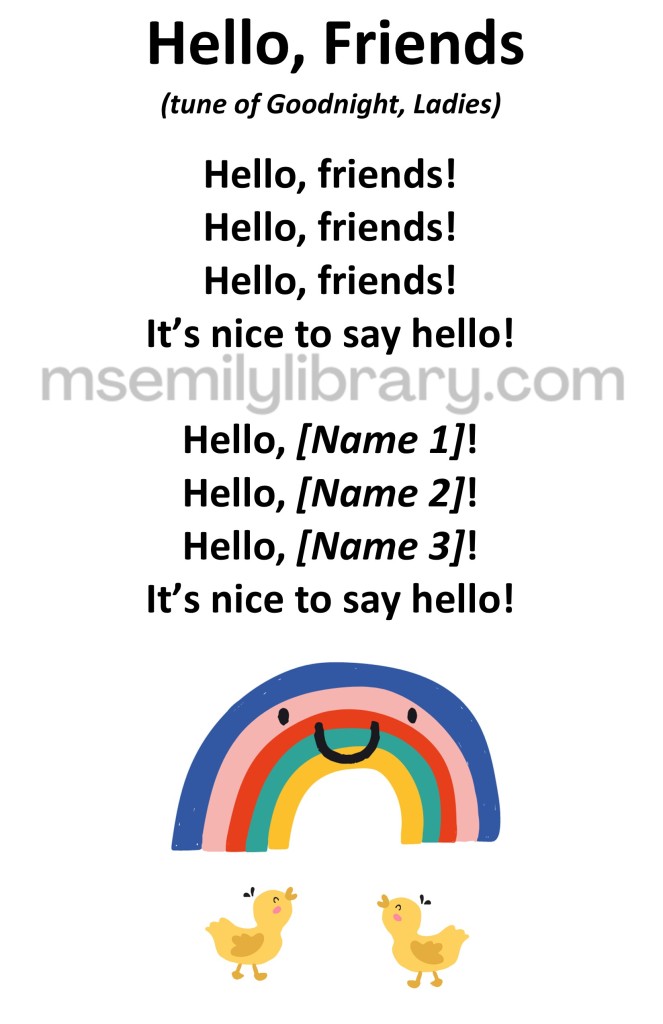
Welcome Song: Hello, Friends* †
Warm Up Song: Wake Up, Feet*
This is a repeated song that everyone seems to enjoy. I always begin and end with feet and tummies, but find two other body parts to wiggle in the middle. I rotate between elbows, cheeks, hips, noses, arms, chins, thighs, heads, shoulders, ears, knees, and fingers.

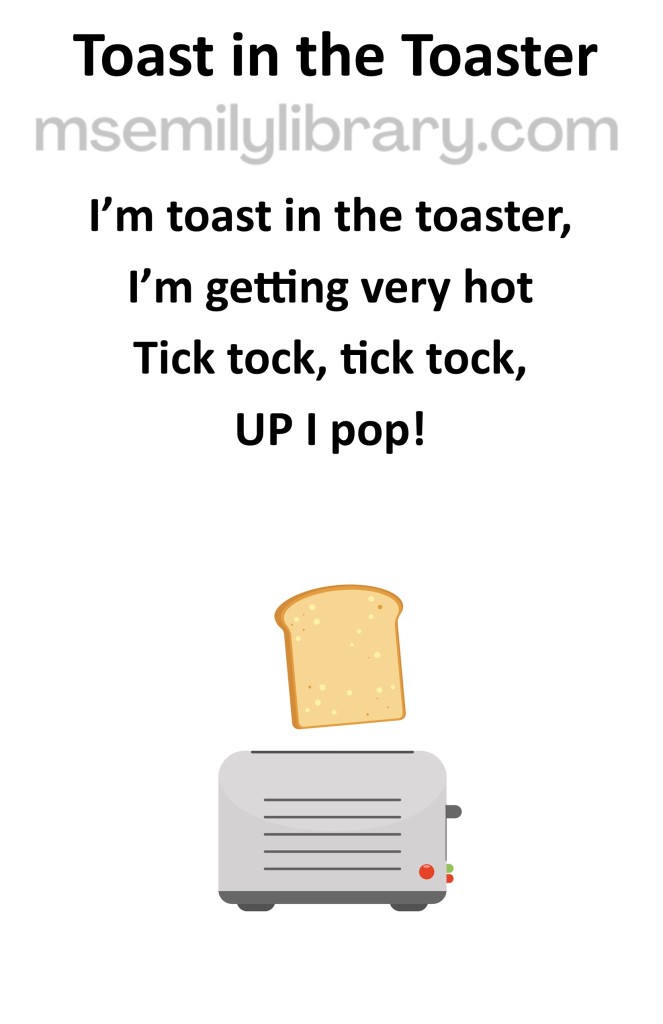
Lifting Rhyme: Toast in the Toaster*
Intro: This is a program where I’m going to need a lot of help. Are you good at being noisy? Oh, thank goodness! I am going to need your help making a lot of noise today, because we’re going to be talking about SOUND! So, let’s all shout: HOORAY together. Louder! Even louder! Now quieter. Now whisper. Great job! When we talk or sing or clap our hands, we’re making sound. What else makes sound? How do we hear sounds? WHY do we hear sounds in our ears?
I showed two page spreads (pgs 12-15) and read snippets about both how our vocal chords work to make sound (touching our throats as we hum and fall silent, and noticing the difference in vibrations) as well as how our ears work to hear sound. I noted that of course we don’t expect little ones to understand all the science right away, but it’s great to explain because we share new vocabulary and concepts and start the seed of understanding.
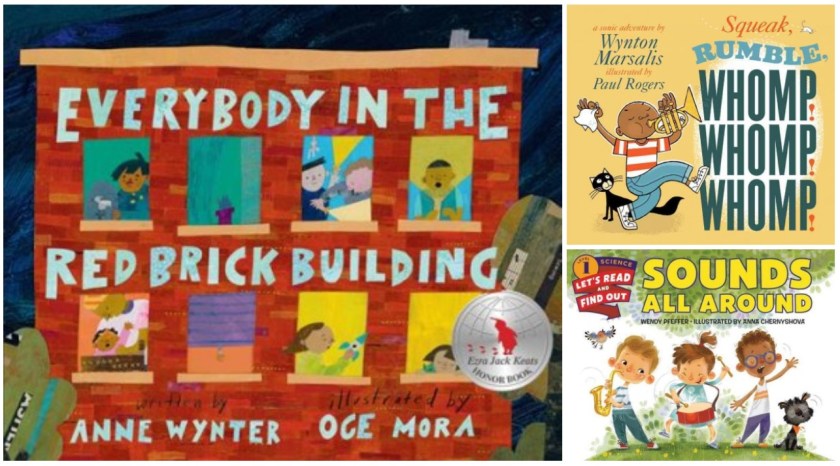
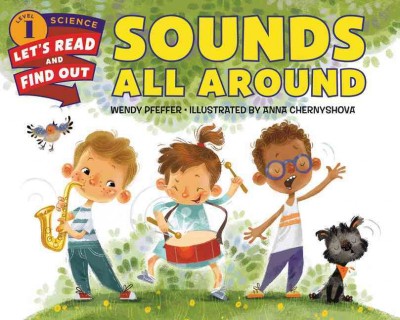
Read: (selection from) Sounds All Around by Wendy Pfeffer & Anna Chernyshova
Sounds can be all kinds of things! Sometimes they are loud, sometimes quiet. This rhyme will challenge you – can you clap without any sound?
When I first saw this rhyme, it made no sense to me, until I realized that the clap and tap were muted. So we practiced clapping and tapping our laps without sound before we started the rhyme and it worked really well!
Action Rhyme: Loud and Quiet
Quietly, quietly not a sound
I’m listening and I’m listening As I look around
No sounds as I nod, No sounds as I clap (mute clap)
No sounds as I tap my hands on my lap (mute tap)
Loudly, loudly, stamp and clap
Loudly, loudly, stamp and clap
Loudly, loudly, stamp and clap
All that noise, well fancy that!
Source: Storytime Katie

Transition: If You’re Ready for a Story*
I love how this story is circular: as the noises wake everyone, we meet all the occupants of the building, then a round of quiet noises lull everyone back to sleep. Plus, Oge Mora’s artwork is superb. I had a thought that this would make a great flannel story, but I didn’t have the time to make it.
Read: Everybody in the Red Brick Building by Anne Wynter & Oge Mora
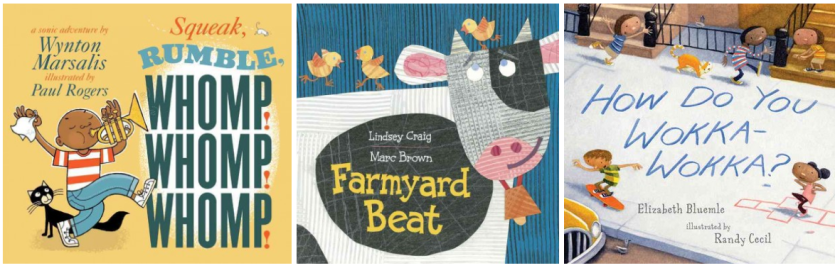
This one is a fun romp through lots of noises – definitely preview it before you start because they aren’t all easy to do! I like how Marsalis groups similar sounds – a squeak could be a screen door, a mouse, or a amateur saxophonist!
Read: Squeak! Rumble! Whomp! Whomp! Whomp! by Wynton Marsalis & Paul Rogers
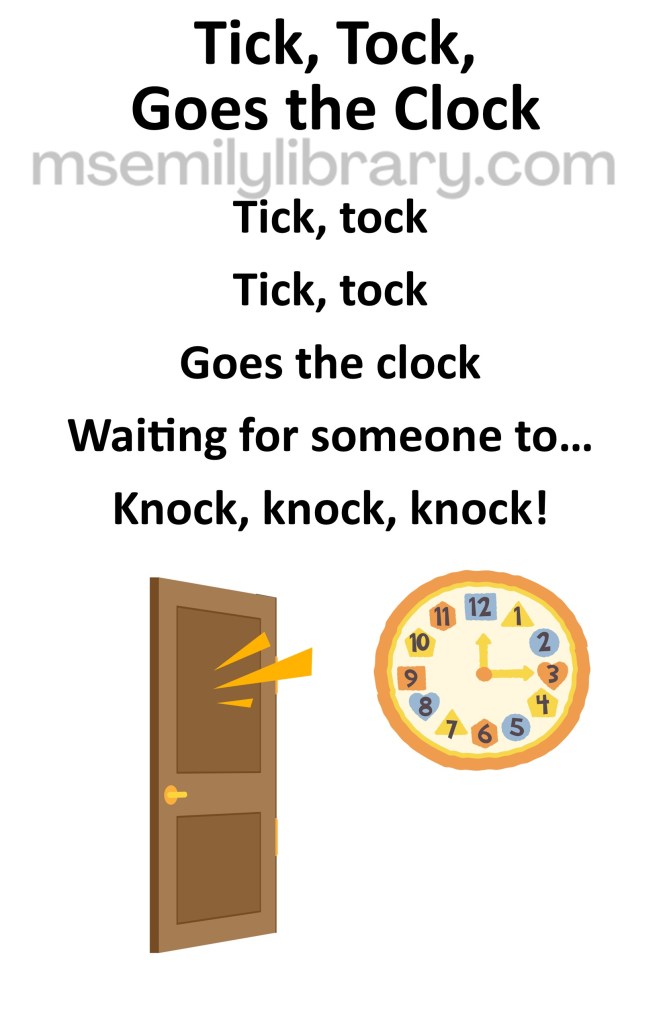
Our next rhyme has some sounds I hope you’ll help me make. The sound of a clock is tick tock! Can you tick tock by patting your lap? And then we hear a knock, knock on a door – can you knock by clapping your hands?
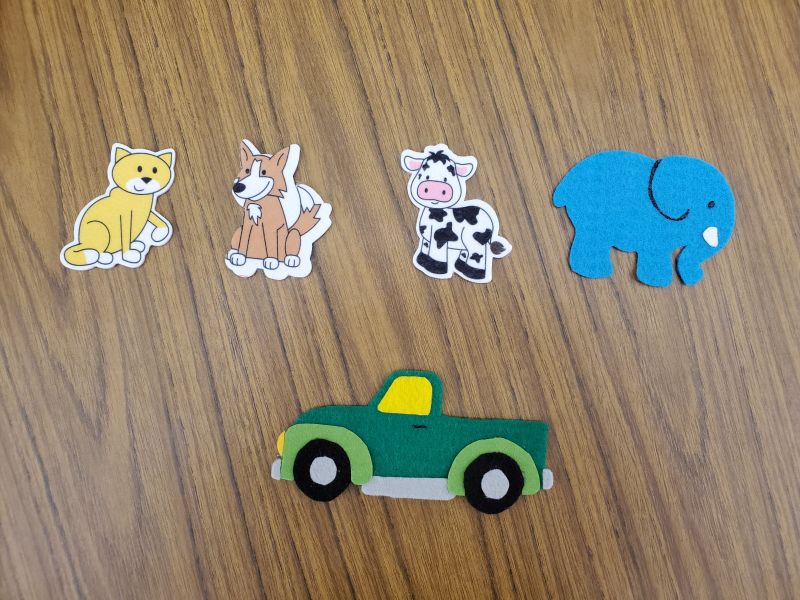
You could do this with flannel animals or puppets like I did. The original used rhythm sticks, but it worked just as well with puppets and making the sounds with our bodies. I used a cow, chicken, frog, bear, and lastly, a mouse! The mouse gave us a segue into the next rhyme.
Puppet Rhyme: Tick Tock Goes the Clock
Tick, tock, tick, tock goes the clock
Waiting for someone to… Knock, knock, knock!
Gasp! Who’s at the door? It’s a… (moo) A cow!
(try with any animal sounds you like)
Source: Jbrary

I did this fingerplay on my left hand with my thumb and on my right hand with the mouse puppet. The first time out popped the mouse, the puppet was flung off of my finger and into the air – but I caught her! Very exciting. I was a little more careful with the popping the second time through.
Oh, that mouse is so cute. But very quiet.
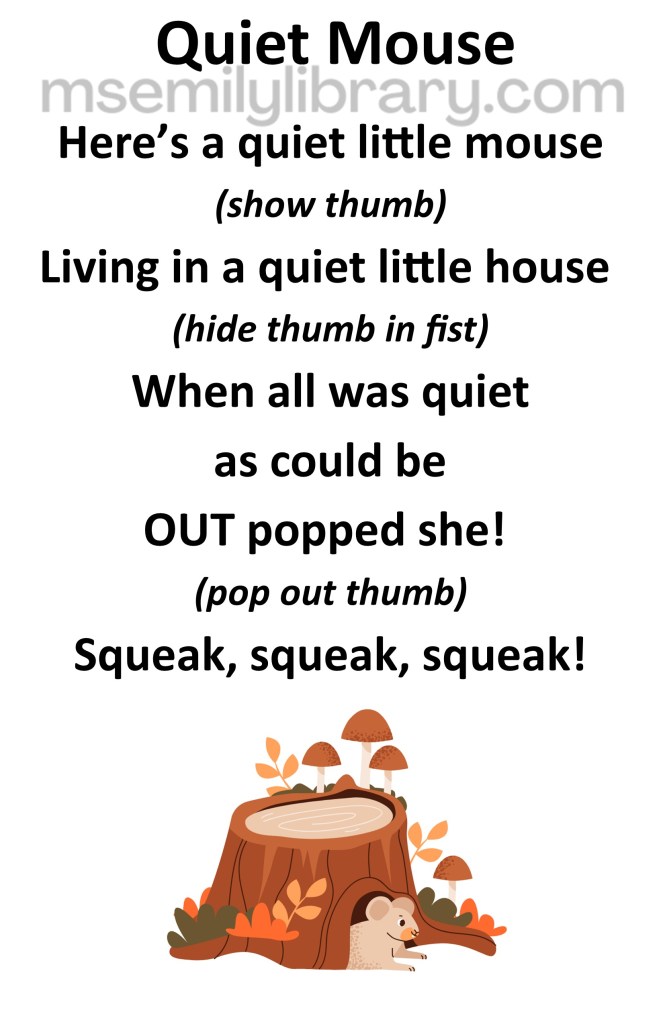
Fingerplay: Quiet Mouse
Here’s a quiet little mouse (show thumb)
Living in a quiet little house (tuck thumb in fist)
When all was quiet as could be
OUT! popped she! (pop out thumb)
Source: King County (WA) Library System
This was a great hit during our Jingle Jam storytime, and seemed like a perfect fit for sounds, too.
One of my favorite ways to make sounds is to make MUSIC!
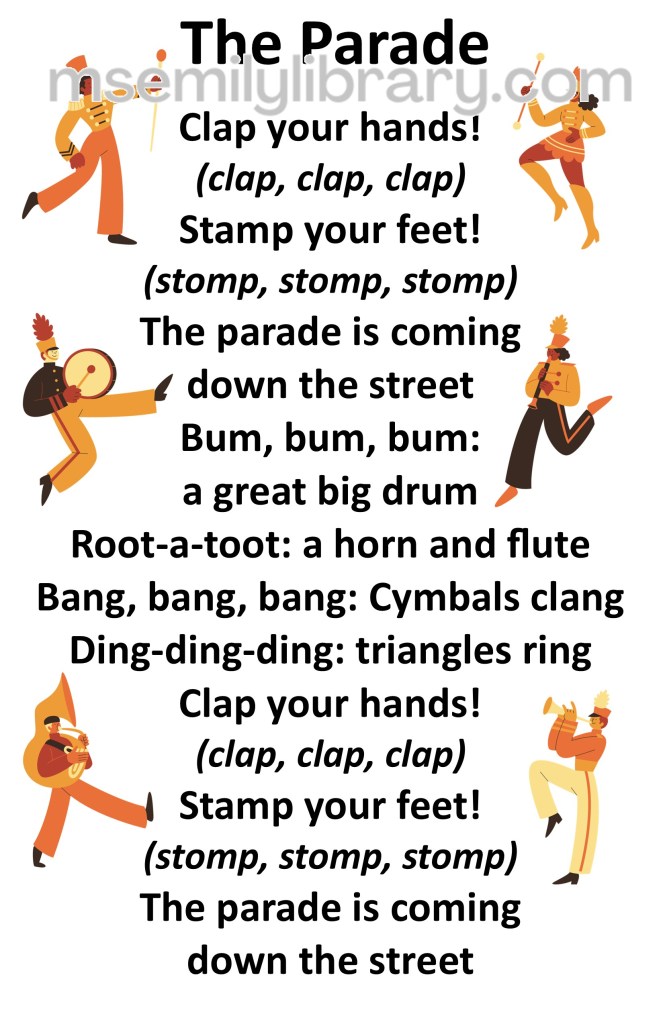
Action Rhyme: The Parade
Clap your hands! (clap, clap, clap)
Stamp your feet! (stomp, stomp, stomp)
The parade is coming down the street
Bum, bum, bum: a great big drum
Root-a-toot: a horn and flute
Bang, bang, bang: Cymbals clang
Ding-ding-ding: triangles ring
Clap your hands! (clap, clap, clap)
Stamp your feet! (stomp, stomp, stomp)
The parade is coming down the street
Source: King County (WA) Library System
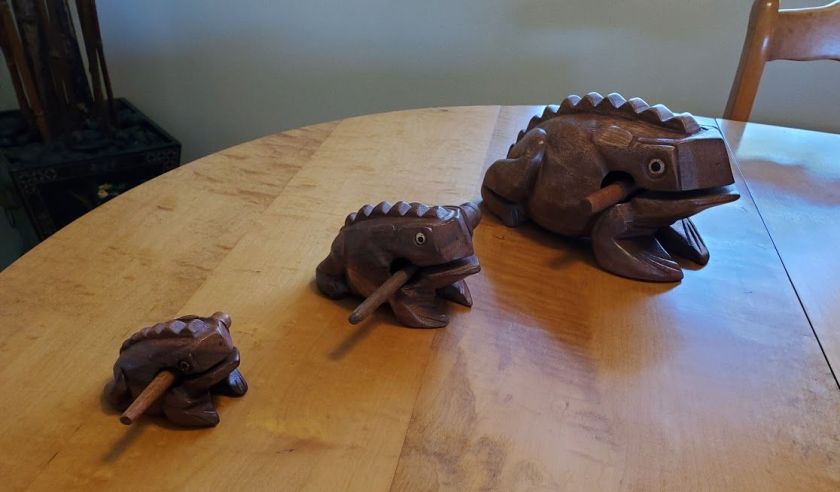
Here’s an instrument that LOOKS like an animal. What does it sound like?
I was kind of amazed, but it was dead silent during this rhyme – everyone was rapt with the frog rasps. I highly recommend them! I decided to do three sounds throughout the song this time – in the past I’d done two for each individual frog and then three on the last verse.
Rhythm Instrument Song: Three Frogs in a Bog
There was a big frog (big sound, big sound, big sound)
Lived in a big bog (big, big, big)
He swam in the water (big, big, big)
Played on a big log (big, big, big)
Big log (big, big, big)
Big bog (big, big, big)
Big frog (big, big, big)
(repeat for middle-sized and little frogs)
And then one day (big sound, middle sound, little sound)
The frogs got together (big, middle, little)
They swam in the water (big, middle, little)
In the bright sunny weather (big, middle, little)
Three frogs (big, middle, little)
Three friends (big, middle, little)
The end! (big, middle, little)
Source: Ada Moreau Demlow

Time to get out our instruments! There are a lot of choices – which will you pick?

Let’s get to know our instruments a bit with this next song.
It was a bit chaotic, but it worked. I changed the original words (shake/shaker) to fit (play/instrument), but I didn’t update the rhyme sheet.
Instrument Song: Can You Play?
(tune of London Bridge)
Can you play along with me?
Along with me, along with me?
Can you play along with me?
Put your instrument on your… knee!
Source: Jbrary

We were way over on time already, so I skipped this one. I think handing out instruments took longer than usual. I was going to choose instruments for the extra verses – egg shake, a drum beat, a triangle tingle, etc.
Instrument Song: Have You Ever Heard a Bell Ring?
(tune of Have You Ever Seen a Lassie?)
Have you ever heard a bell ring, a bell ring, a bell ring?
Have you ever heard a bell ring,
Ding dong, ding, ding, dong
Try with other sounds:
the wind blow, a clock tick, a car horn, an egg shake, a cow moo, etc.
Source: STEM In Libraries

Let’s make some noise!
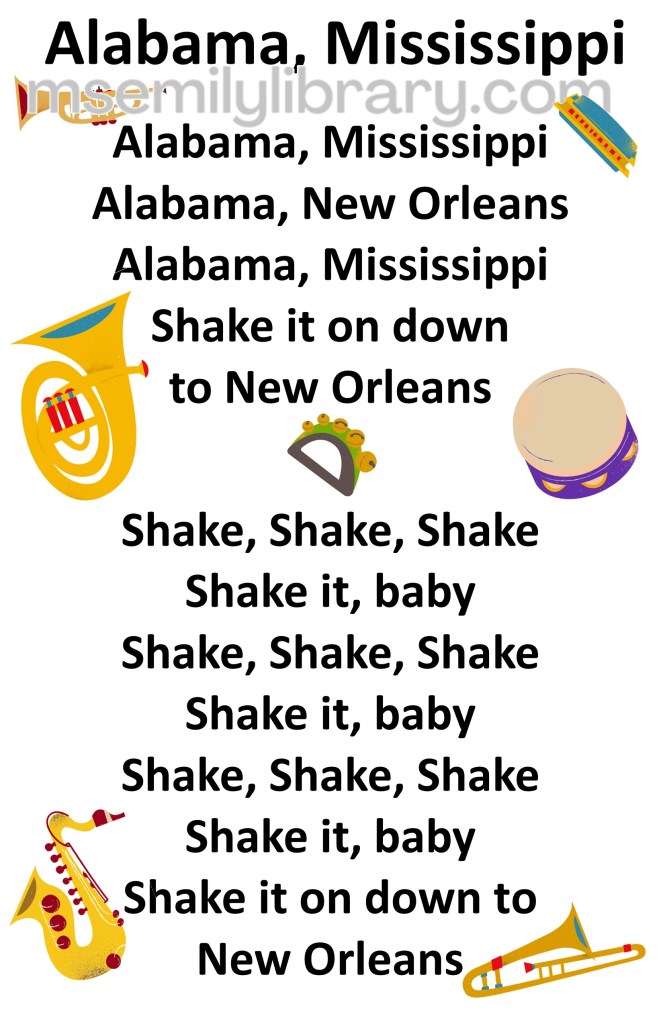
Recorded Song: Alabama, Mississippi
Alabama, Mississippi
Alabama, New Orleans
Alabama, Mississippi
Shake it on down to New Orleans
Shake, Shake, Shake
Shake it, baby
Shake, Shake, Shake
Shake it, baby
Shake, Shake, Shake
Shake it, baby
Shake it on down to New Orleans
Source: from the album Jim Gill Sings the Sneezing Song and Other Contagious Tunes
Action Song: Zoom, Zoom, Zoom!*
Craft: Noisemaker
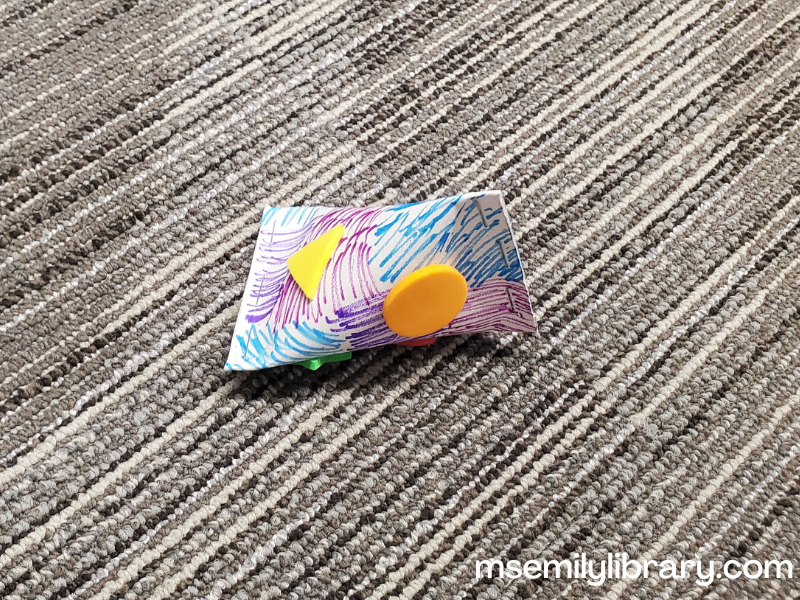
For an easy noisemaker, we decorated toilet paper tubes – I did my sample with regular washable markers, but put out the dot markers day of – they provide easier coverage! I also had foam shape stickers. We filled the tubes with generic cheerios to make the noise and stapled them shut. I made sure to note that it works best if the stapled shut ends are perpendicular to each other, to keep the middle open and prevent the tube from collapsing. I had pre-stapled one end before storytime and provided staplers for caregivers to close them after filling. To make it even easier, you could pre-fill and provide the finished noisemaker to decorate only.
Play Time
I put out a laundry basket of baby toys – rattles and cars, sorters and stackers, toy phones and spinners. For the older toddlers and siblings, we have foam blocks, soft food toys, puzzles, plastic farm animals, and lacing cards and I rotate among a few of these options each session. We play for 5-10 minutes at the most, then I ring the bell and ask the kids to help me clean up. The clean up bit is good practice for them – I often say “it’s hard to say goodbye to toys, so that’s why we practice every storytime!” I think that helps the grown ups who may be embarrassed that their kid is crying or refusing to put a toy away. So much of what we do in storytime is practicing skills, and I don’t expect the kids to “do it right’ every time, or even most times.
Goodbye Song: See You Later Alligator*

Other books I had available for families to browse (and may work for you on this theme)
It’s So Quiet – Sherri Duskey Rinker & Tony Fucile
Let’s Be Bees – Shawn Harris
Noisy Night – Mac Barnett & Brian Biggs
What Does Little Crocodile Say? – Eva Montanari
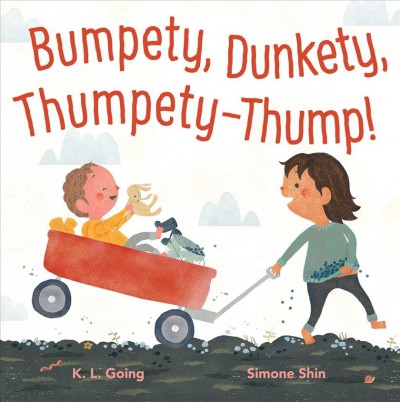
Bumpety, Dunkety, Thumpety-Thump! – KL Going & Simone Shin
Song in the City – Daniel Bernstrom & Jenin Mohammed
Atticus Caticus – Sarah Maizes & Kara Kramer
Rumble & Roar: Sound Around the World – Sue Fliess & Khoa Le
Jazz for Lunch! – Jarrett Dapier & Eugenia Mello
Swish Slosh – Deborah Kerbel & Jacqui Lee
A Perfect Day – Jennifer Yerkes
Listen – Gabi Snyder & Stephanie Graegin
Boom Boom – Sarvinder Naberhaus & Margaret Chodos-Irvine
Quiet Down, Loud Town! – Alastair Heim & Matt Hunt
After the Buzz Comes the Bee – Rachel Isadora & Robie Rogge
This storytime was presented in-person on 11/12/25.
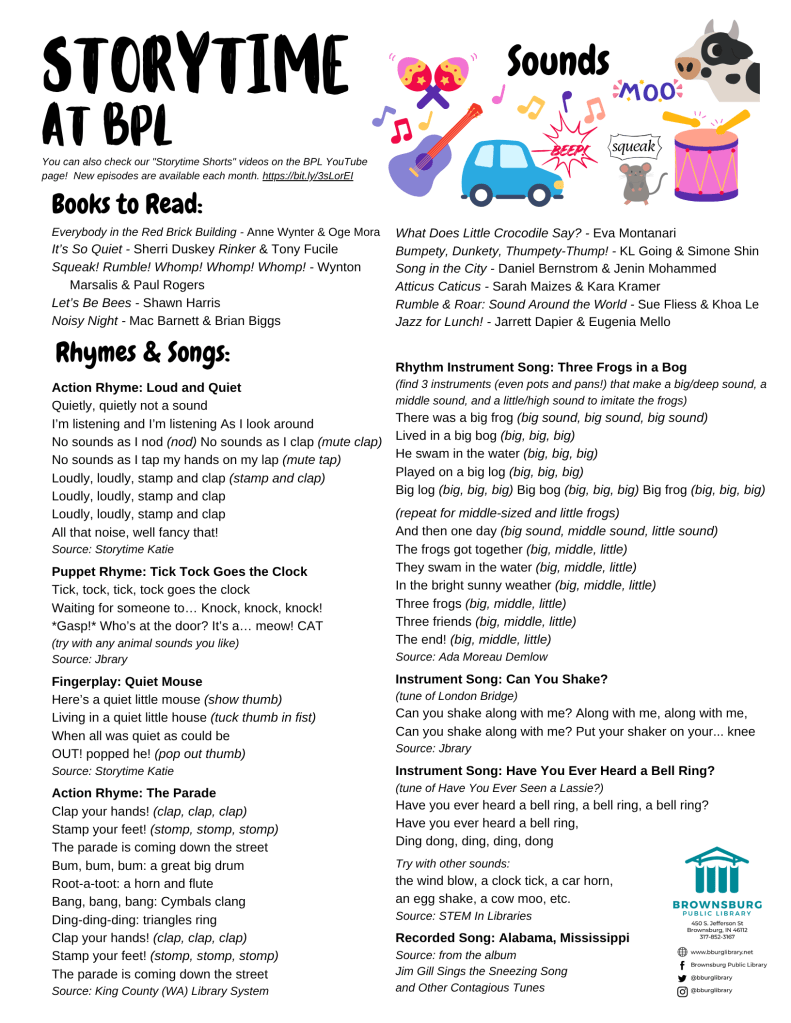
Storytime Handout:
*Lyrics to these songs can be found on the Repeated Songs & Rhymes page.
† Click the image of rhyme/song sheets to download a non-branded PDF





 Storytime with Ms. Emily Library