Summer Storytimes: All Together Now, Part II

Summer is a great time to break out of the storytime structure I find myself in during the rest of the year. There’s nothing wrong with having structure, of course, but I find it invigorating to mix it up and feel free to try new things and be experimental during a set time of year.

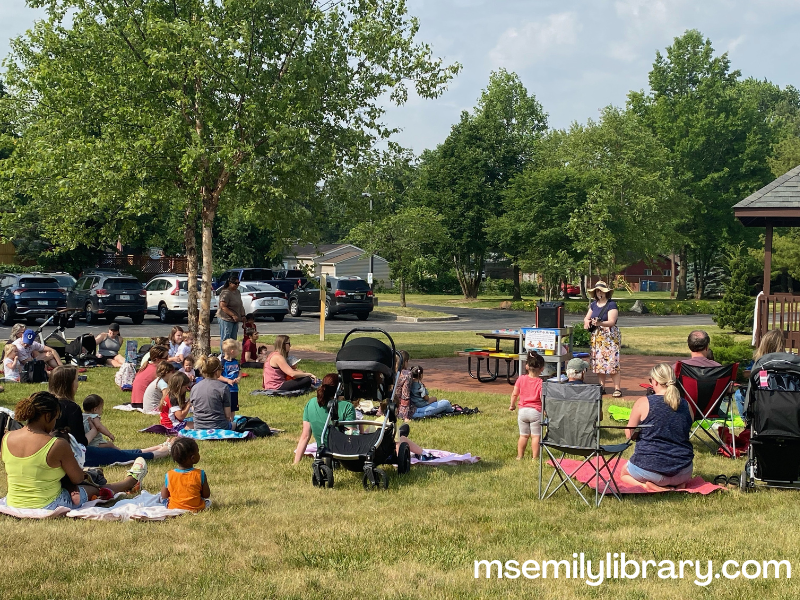
In the summer, I offer outdoor programs for kids ages 0-3.5 and their caregivers. We spend about 15-20 minutes doing songs, rhymes, books, and extension activities, and then take about 20 minutes at free-play sensory stations that engage kids and caregivers to talk, socialize and practice social skills, engage in science and age-appropriate STEM inquiries, flex creative muscles, and have lots of fun, associating the library with positive feelings. This post will detail these stations.
You can read more about the Storytime half of the summer sessions here, Summer Storytimes: All Together Now, Part I.

Each week I had eight stations that families could wander through. There was no requirement that they had to go to each station or change stations at any certain time, or at all. They chose their path and self-regulated. Some stations were available every single week, some rotated, and some were unique and only appeared during one week. They fell into “wet,” “dry,” and “art” categories. I used old sheets to cover the stations so they wouldn’t be too tempting during the storytime portion of the program, and that worked well.

I also had a backup plan for when the weather or air quality was too poor to be outside. This was the summer of the Canadian wildfires, so there were several days that were not rainy, but smoke and particulates in the air made it unsafe to be outside – especially for the very young and for senior citizens (and many of my caregivers are grandparents in that category!) If we weren’t outside, I had reserved our two largest and adjoining meeting rooms, where I was able to set up both an area for stories and songs and the parachute on one side and stations on the other, so thankfully we didn’t miss out on any activities. If I remembered to take pictures indoors and out, I included both below to give a sense of layout.

The Plan: Stations

Wet Stations

This is a big draw – everyone likes playing in water! Outdoors, I used a hose and outdoor water supply to easily fill my tubs with water and could just pour it all out at the end of the session. Indoors, I hauled buckets from our janitor’s closet and possibly filled everything just a little bit less than I would outside. I used old flannel sheets underneath to absorb spills and make them easier to clean up. The meeting room has an emergency exit door that opens to some landscaping so all the water got dumped there at the end.

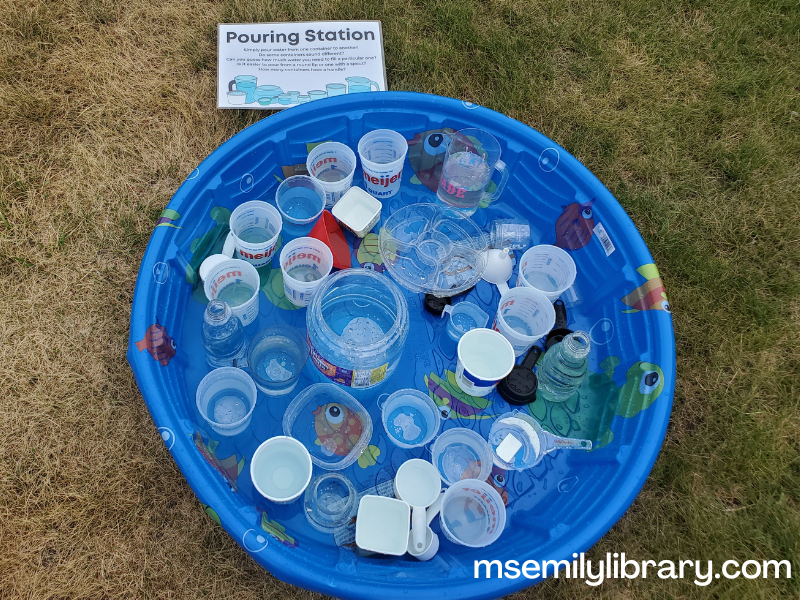
Pouring Station (all weeks)
This is a repeat from last year, so I had all of the materials for this one already. It’s also an easy one to set up, so it’s my anchor wet station: we had it out every week. Last year I asked coworkers to collect clean plastic recyclables with wide openings for this station and visited Goodwill for some additional pitchers. We had measuring cups and funnels in our materials, as well as a baby pool, which is the perfect container. I fill the pool with the plastic bins and fill them randomly with water. Original idea from Busy Toddler.
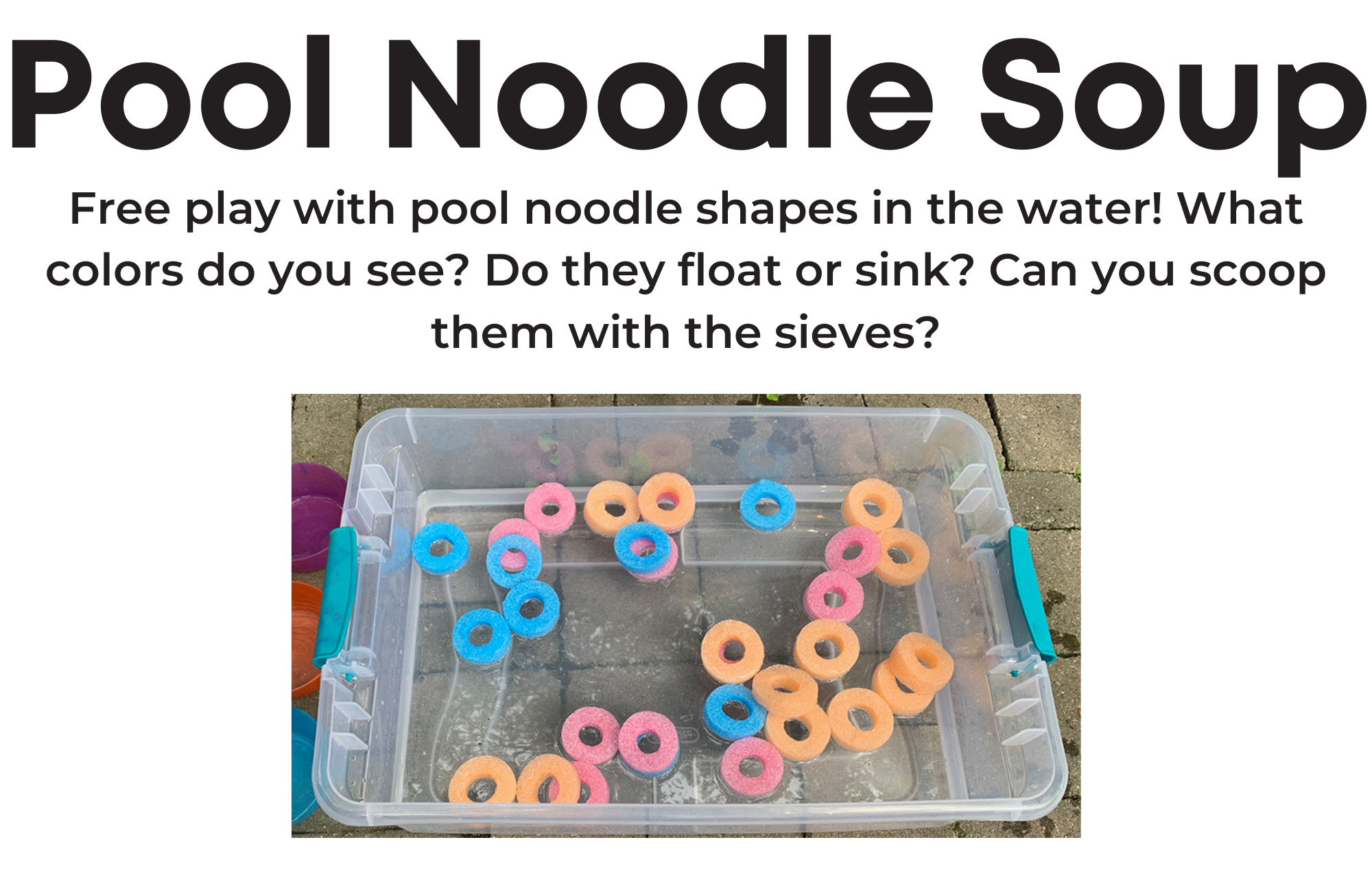
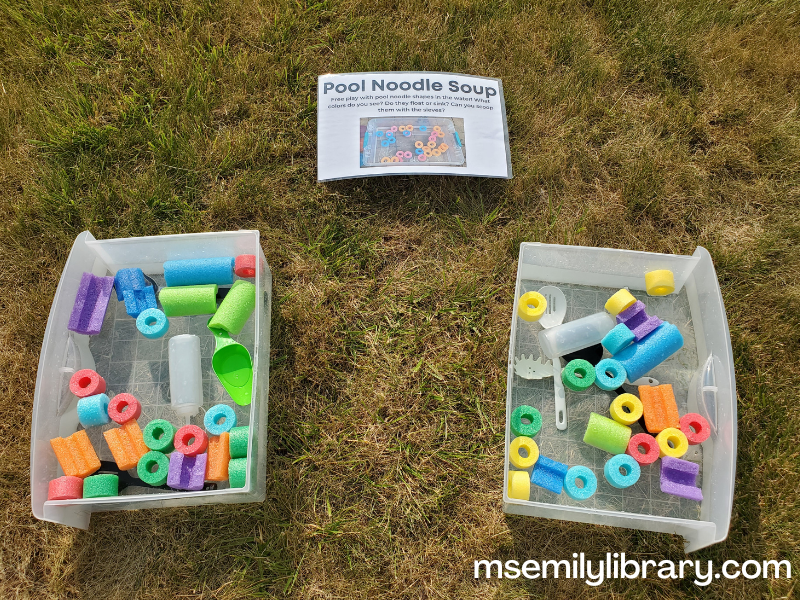
Pool Noodle Soup (Weeks 1 & 4)
I cut sections of pool noodles and used them in three different ways, starting with this wet station. (You’ll see them below as a dry station and an art supply, too.) I used two drawers from a plastic storage bin as my containers, and added water, the noodles, some ladles and slotted spoons, and some squeeze bottles. Original idea (and photo on the sign) from Happy Toddler Playtime.
Fly Swatter Slap (Weeks 1 & 7)
Again, I maximized my materials by using flyswatters in both wet and dry stations on different weeks. The wet station included the (new, clean) swatters and ping pong balls that I drew flies on. I found the plastic containers at Goodwill and they are a little bit smaller than the drawers used above. The swatters were hand-shaped and different colors. Original idea (and photo on the sign) from My Bored Toddler.

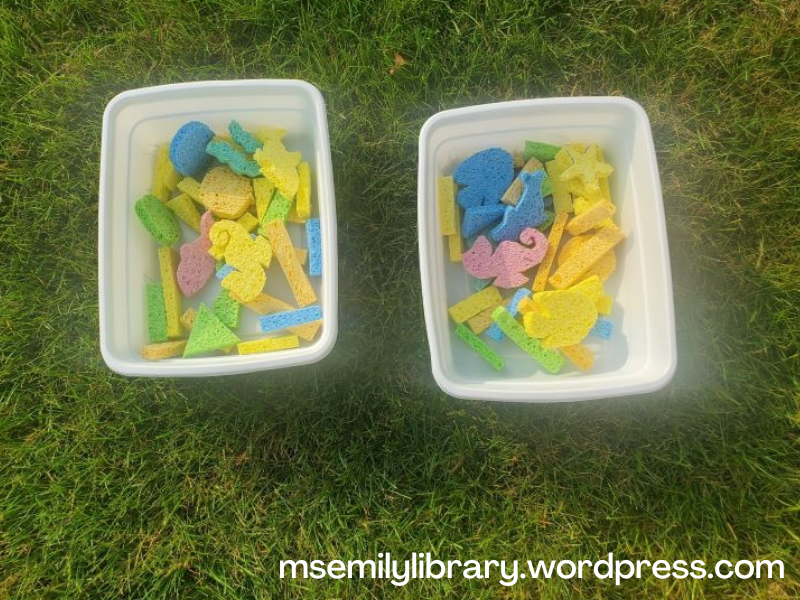
Sponge Play (Weeks 2 & 7)
This was another repeat from last year, but one that’s especially great for the youngest of my age group. When it was out it was usually surrounded by the “baby brigade!” The shapes were ocean animals since last year’s theme was “Oceans of Possibility” but they were just as happy with the simple shapes. Original idea (and photo on the sign) from Little Lifelong Learners.
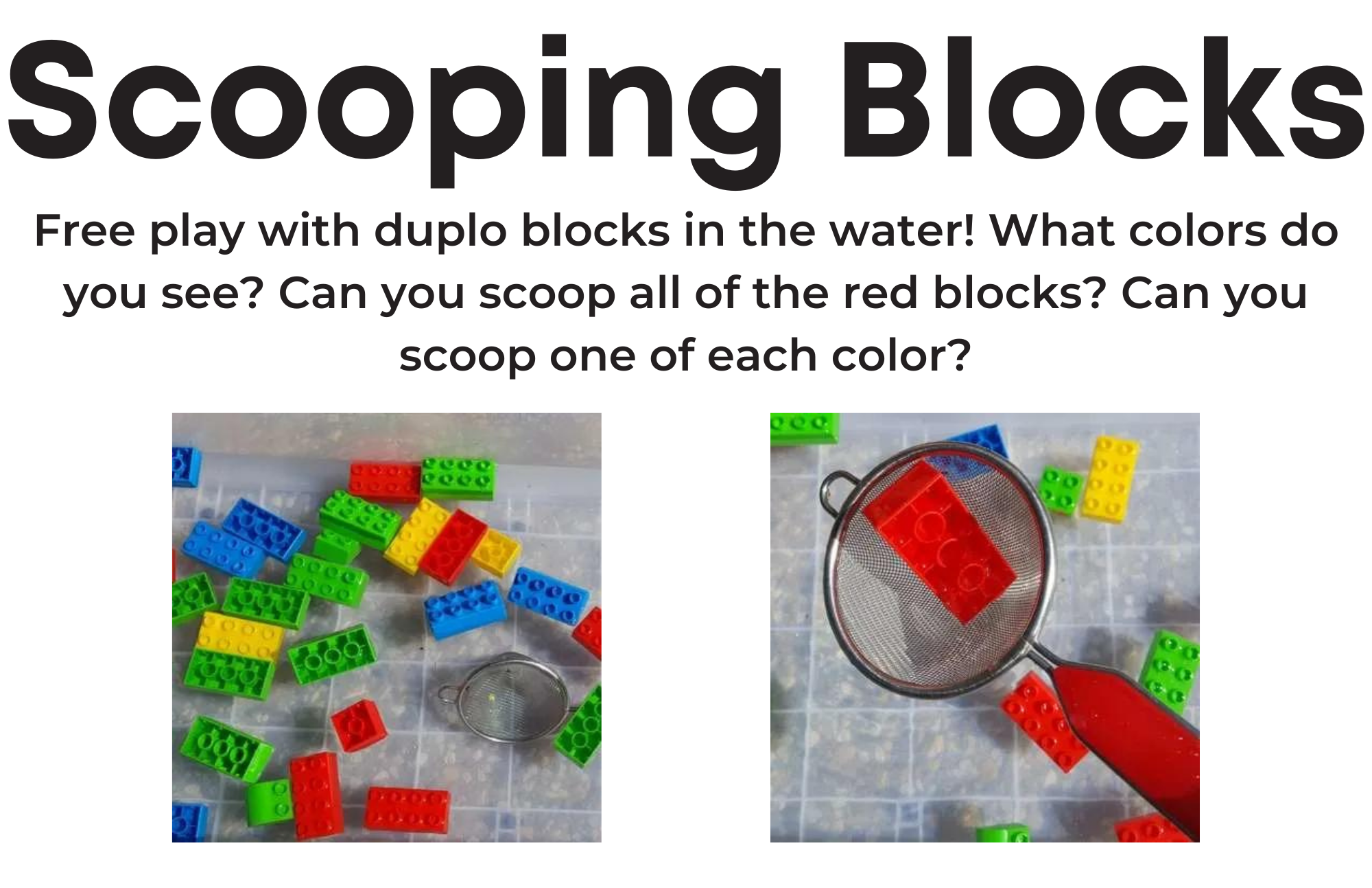
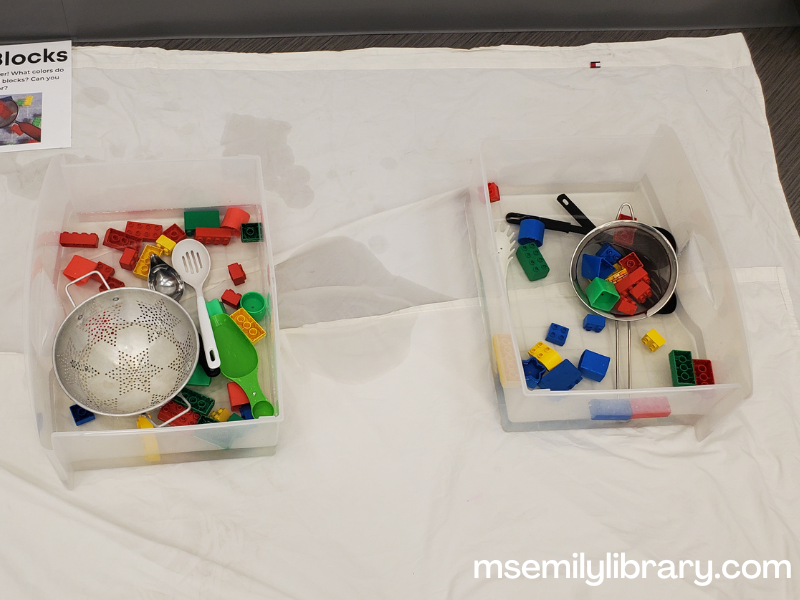
Scooping Blocks (Weeks 2 & 5)
Lego Duplos plus water and scoopers! This one was fun for its obvious purpose, but added bonus: some kids actually took the Duplos out of the water and put them together! We had all the Duplos already, and I added some of the sorting blocks from our baby toys to the mix, as well as ladles, colanders, and sieves from Goodwill. Original idea (and photo on the sign) from My Bored Toddler.
Mystery Water (Week 3)
Another repeat from last year – I originally saw this as on Pinterest as a reel, and was intrigued. Cornstarch and a little food coloring are added to water to turn it murky, and kids can search for items in the water to match up with a finding guide. We had a bunch of colorful plastic cookie cutters in storage that were perfect for this, so I traced them on a separate sheet for the kids to match up. They weren’t as solid and heavy as the original poster’s, so they tended to float a little, unfortunately, but it didn’t really matter. Original idea (and photo on the sign) from bright_little_brains.

Lemon Sensory Bin (Week 3)
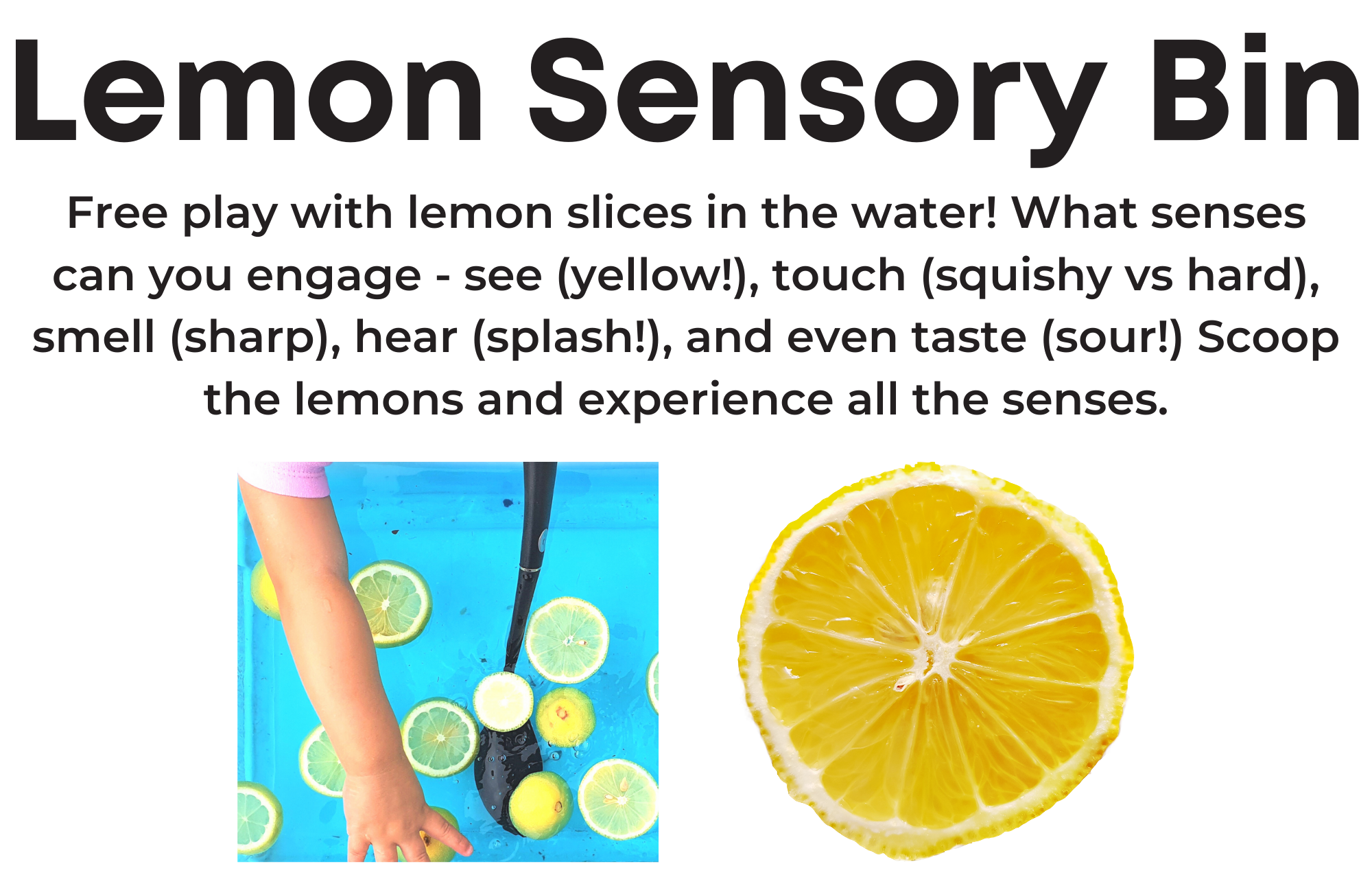
Mm, this was one of my favorite stations! It was super easy and smelled so good. I bought a bag of lemons and divided them among my three sessions. That was maybe 2-3 lemons per day? Cut them up into slices and added them to a bin of water along with ladles. I did announce that there was a lemon bin before breaking for stations just in case there was an allergy issue, but no one had a problem. Original idea (and photo on the sign) from Taming Little Monsters.
Whisking Bubbles (Week 4)
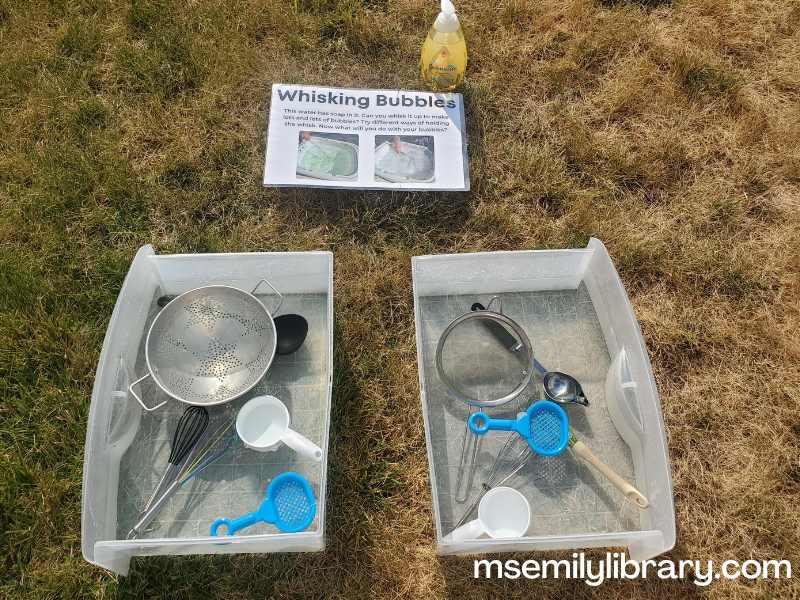
Kids could whisk up some bubbles and then use colanders and sieves to play with the result at this station. At first I just thought I would get some dishwashing soap, but then I started thinking about soap in eyes and mouths. I ended up buying some body soap formulated for babies (tear-free) and that worked perfectly. I looked for actual baby bubble bath, but couldn’t find it in store, so was a little worried about how sudsy it would get, but it ended up being just fine. And I’m so glad I went that route – I remember one of the babies did a nose-dive into the bin at one point and, indeed, there were no tears! I added the soap at the beginning and left the water undisturbed so that the kids could create all the bubbles themselves. Original idea (and photo on the sign) from The Empowered Educator.

Flower Sensory Bin (Week 5)
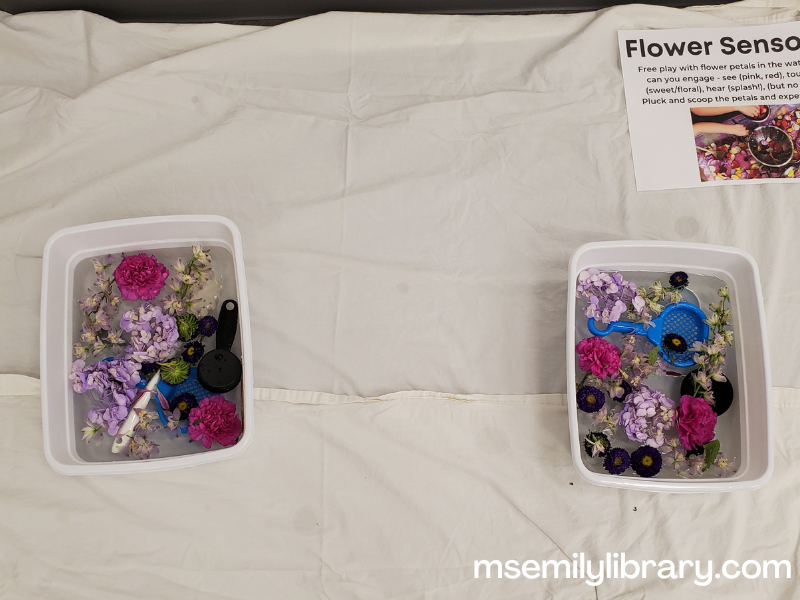
I called our local Kroger florist and asked if they would donate flowers that were past their prime, so I was able to put this bin together without the cost of the flowers! It was also interesting to see the variety that was available on the two days I picked them up. One day I got a bouquet with several kinds of flowers that filled my two little bins, and the other day all that was available were colored daisies. Both were appreciated, and grown-ups commented on the pleasant scent and the novelty of the experience. I also got an action shot (with permission from the participants) on this one, since I wanted to include it in my thank you note to the florist. Original idea (and photo on the sign) from Learning and Exploring Through Play.

Ice Play (Week 6)
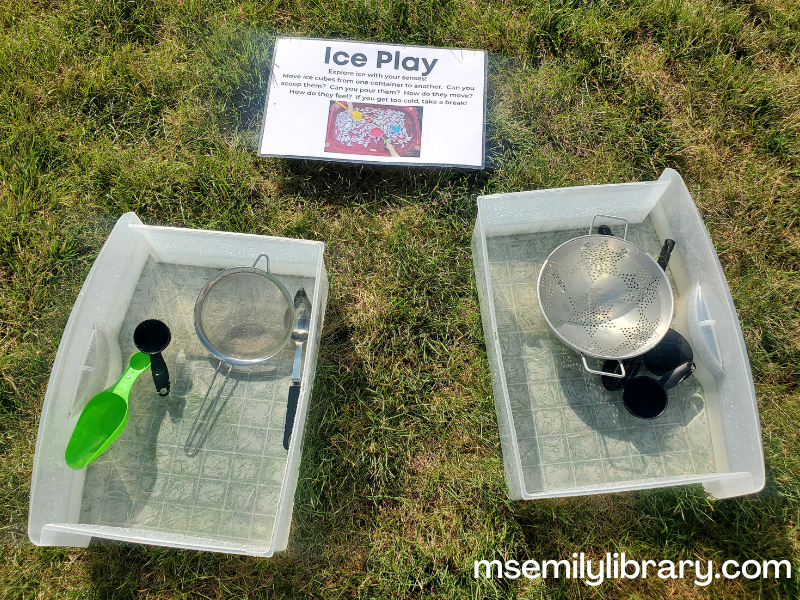
Another repeat from last year. I bought a large bag of ice each morning before my program and kept it in a cooler, adding it to the bins JUST before they were played in (so there’s no ice shown in the photos I took before the program). Ladles, colanders, and sieves were added for handling the ice. It was good weather for it – HOT – so the ice was mostly melted by the end of the station play time, but it was just enough. I reminded everyone to take a break if their fingers started to get too cold. Original idea (and photo on the sign) from Busy Toddler.

Ping Pong Fishing (Week 6)
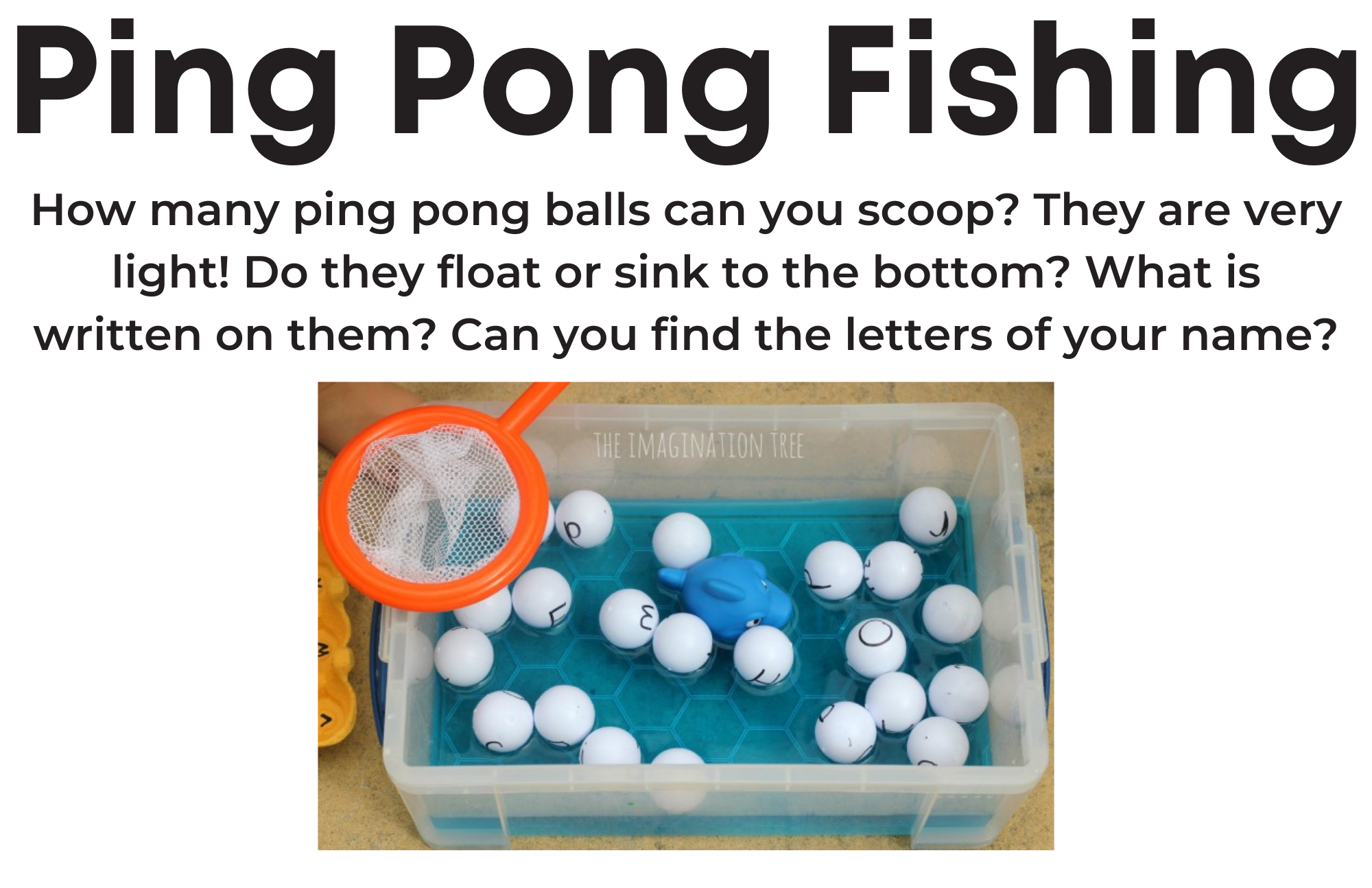
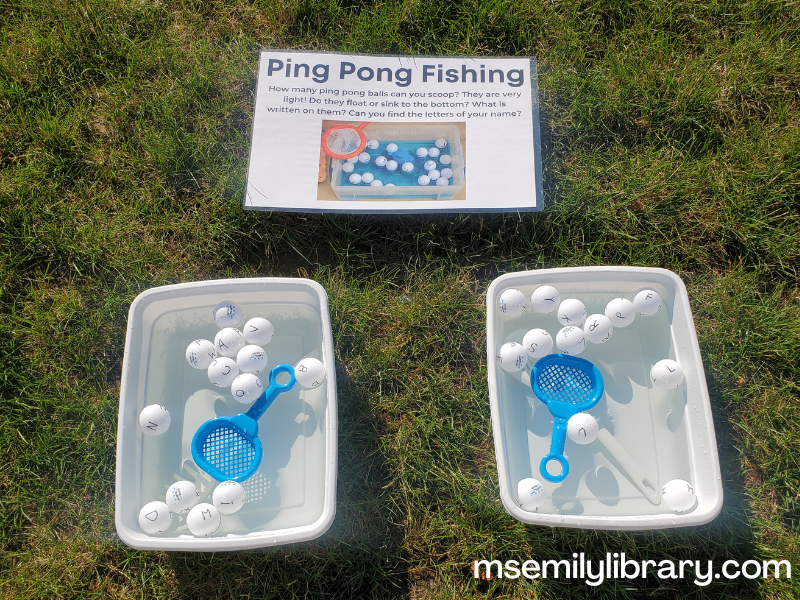
I put the alphabet on ping pong balls and added them with scoopers into the bin. Adding the letters to all four sides of 26 balls took the most time! I think I added the housefly balls from the fly swatter slap station the second and third day, but they aren’t pictured. Original idea (and photo on the sign) from the Imagination Tree.
Dry Stations

There were a few families that didn’t want to get wet, so I was sure to offer three dry stations each week as well. Many of these gave practice in sorting various items by color, shape, or texture.

Kinetic Sand (all weeks)
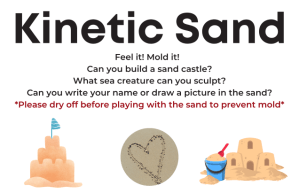
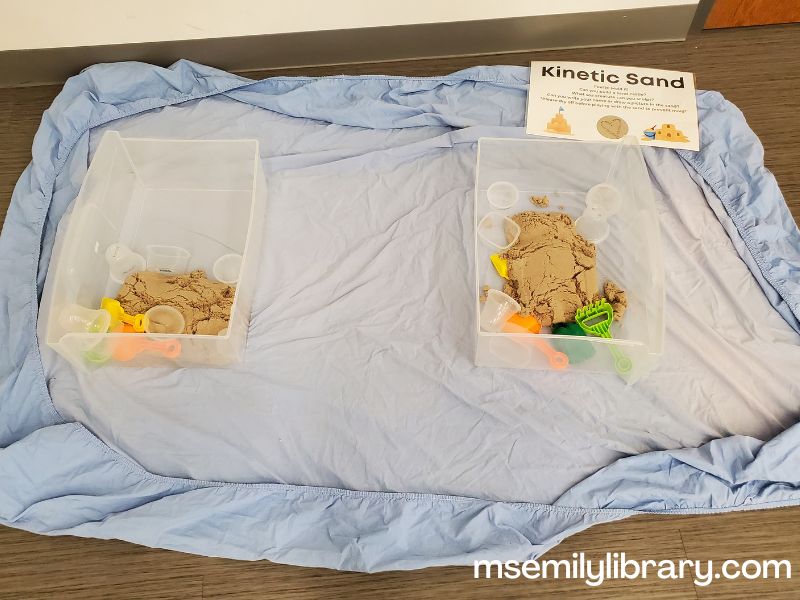
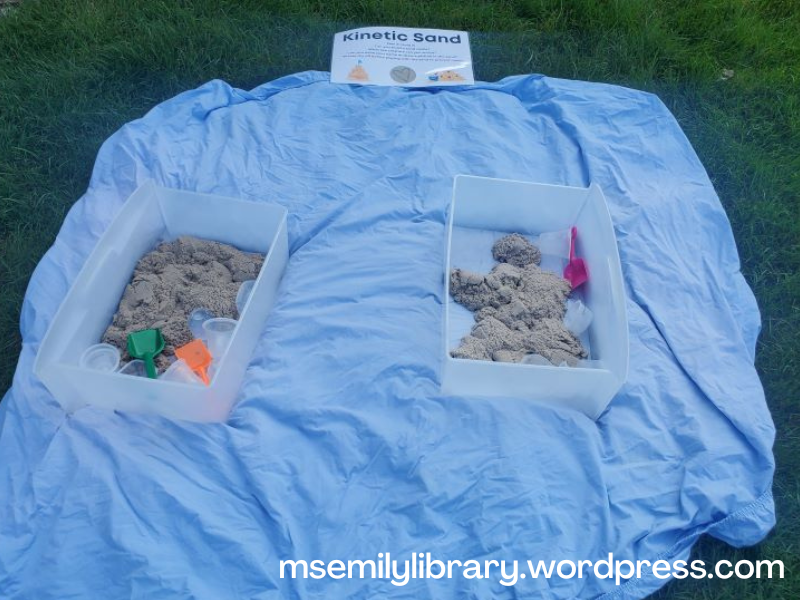
Along with the Pouring Station above, this was the only station that was available all summer long. I had the supplies from last year, which included the kinetic sand itself as well as recycled fruit cup containers that had fun shapes and plastic shovels. I kept a sheet underneath this station to catch any stray sand that escapes the bins. Because the sand is not taste-safe, I do warn the caregivers that if their kiddo is still exploring with their mouth, they may want to skip this station.
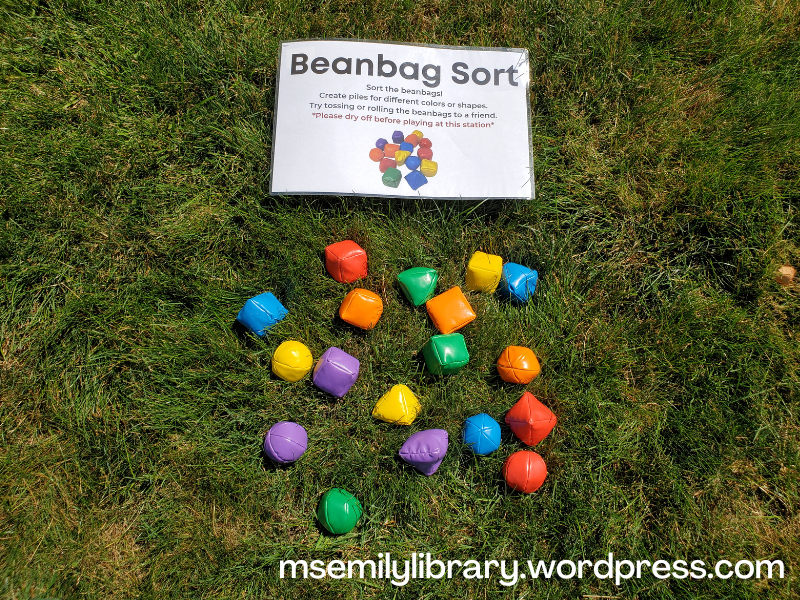
Beanbag Sort (Weeks 1, 4, & 7)
We had these beanbags from Lakeshore Learning that are different colors and shapes. They’re a super easy station where kids can play and sort with them in several ways.

Craft Stick Sort (Weeks 1, 4, & 7)
Another repeat from last year that was already “done.” I noticed in my storage bin that I had these boxes of dot painters that have small holes already in the top. I colored a ring around each hole a different rainbow color and added colored craft sticks for a fine motor and color identification station.

Pool Noodle Sort (Weeks 2 & 5)
A new station this year, but one I’ll repeat. Using the pool noodle slices (from Pool Noodle Soup), I taped a dowel rod to four small plastic cones in red, green, yellow, and blue. Kids could then thread the colored noodles on to the cones. Original idea from this Pin (no blog).

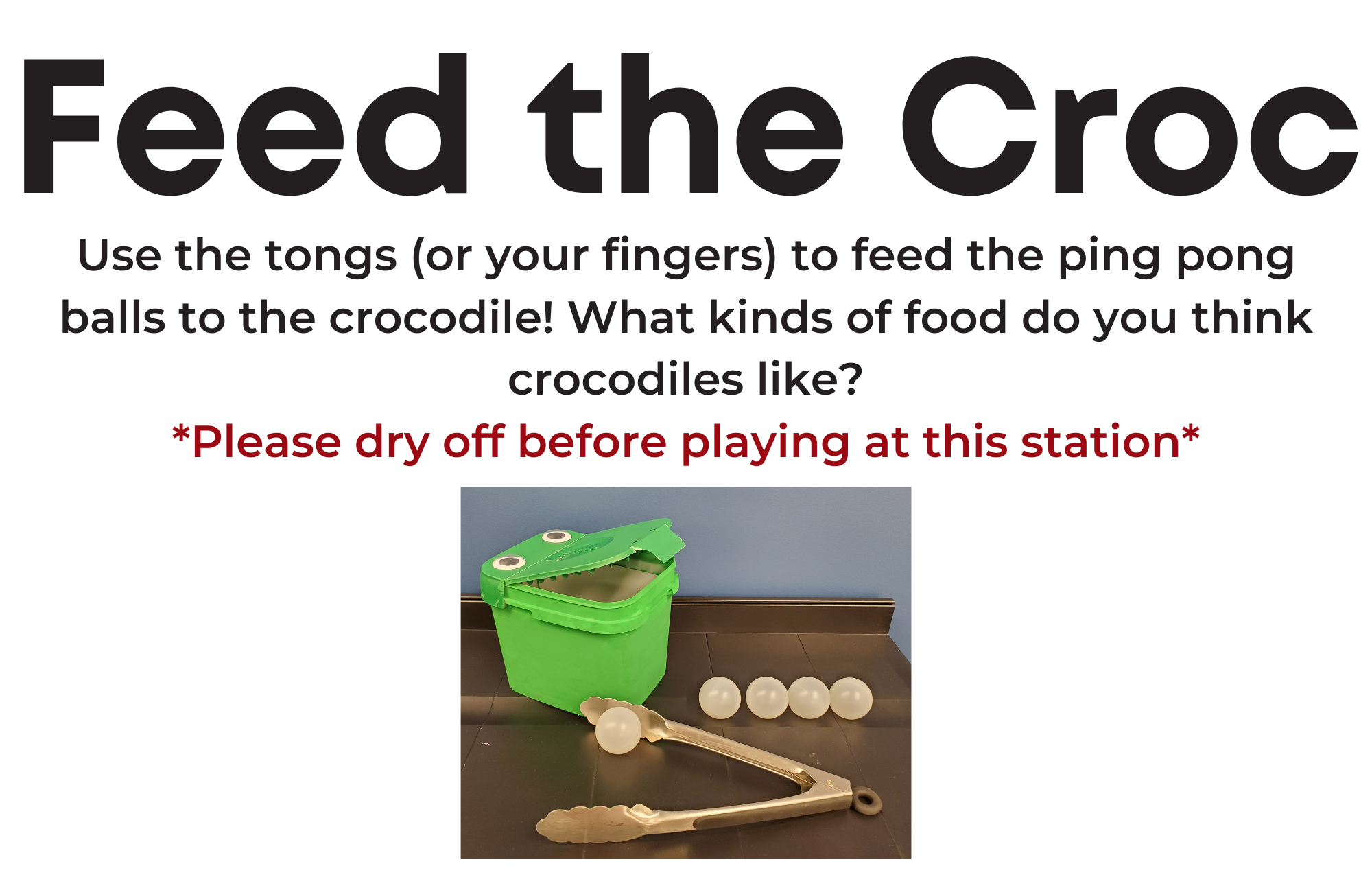
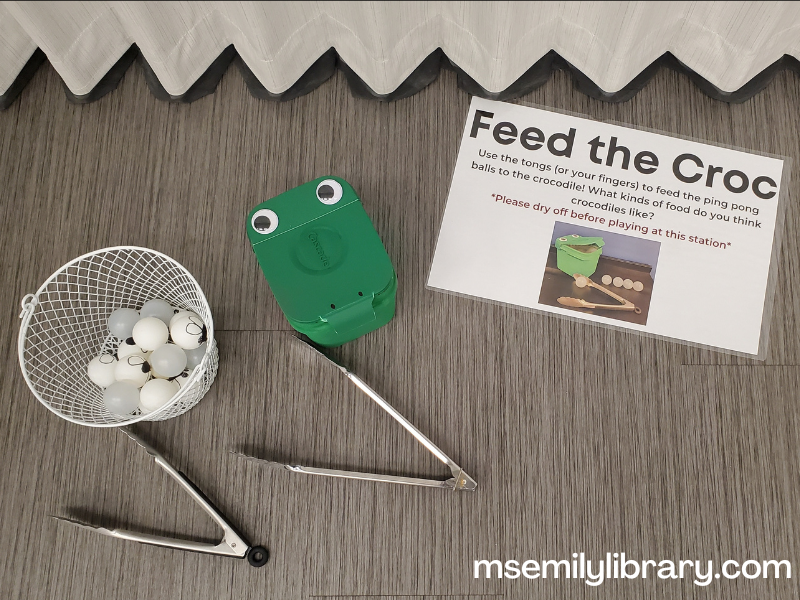
Feed the Croc (Weeks 2 & 5)
Saw this and thought it was very cute, and actually had the container from last year that someone had given to me. I painted it so that the whole thing is green and the label was covered up, added the big googly eyes and made little nostril markings. I found a few metal tongs at Goodwill and added the ping pong balls. Nom, nom, nom! Original idea from Mama OT.
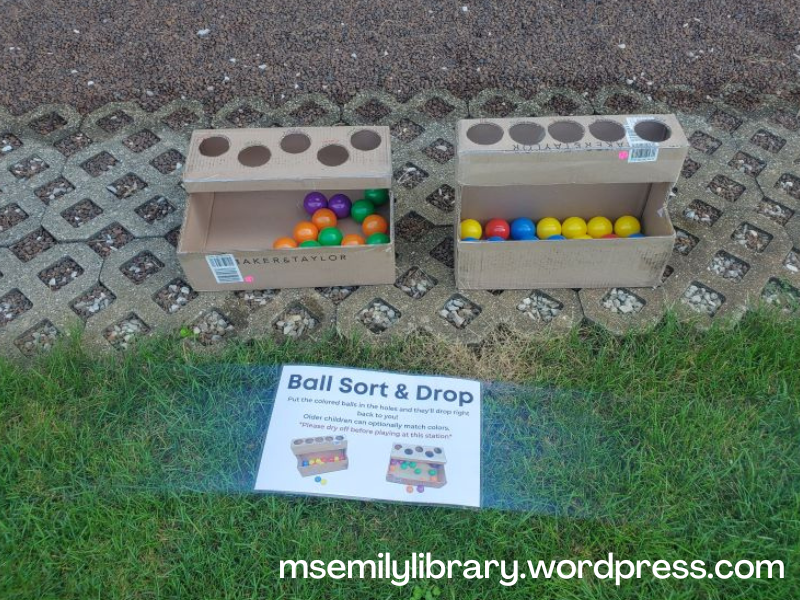
Colored Ball Sort and Drop (Weeks 3 & 6)
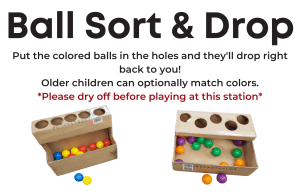
Two more repeats from last year. This ball sort and drop was made with Baker & Taylor boxes, but oriented them different ways so one was tall and skinny and one was low and squat. I had purchased ball pit balls and supplied different colors to each box. Photos from last year, which had weird blurs, sorry. Original idea from Taming Little Monsters.
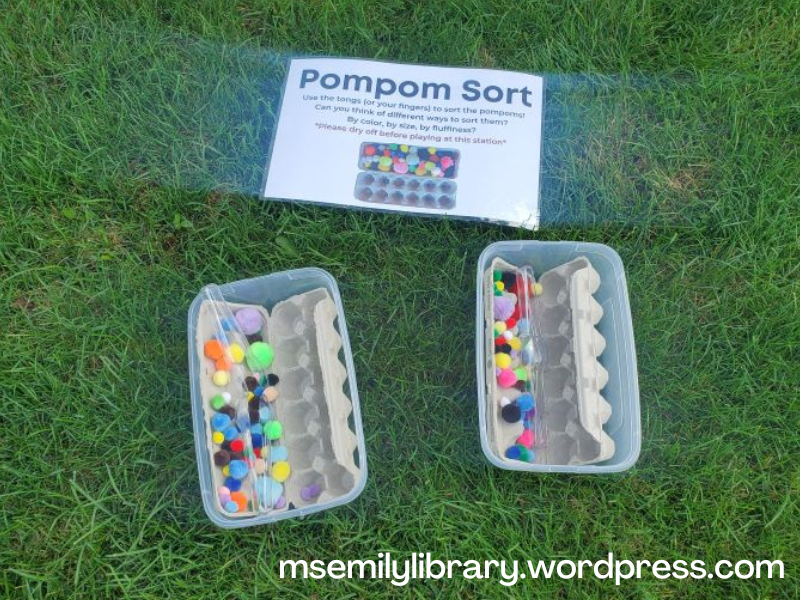
Pompom Sort (Weeks 3 & 6)
A really easy station to put together: I just saved a couple of egg cartons, then poured a handful or two of different colored/sized pompoms into them. The plastic tongs I provided last year were all broken in use, so I bought some metal ice tongs for this year. (And again, weird blur). Original idea from Laughing Kids Learn.
Art Stations

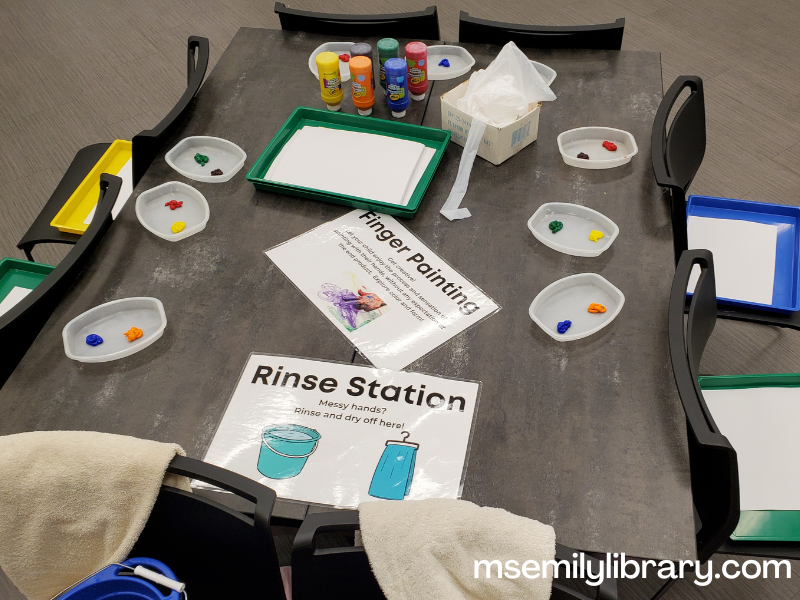
With the exception of Coloring the Parachute, the art stations were all unique, and all were simple process-focused art with different media. To help with mess, I set up a “Rinse Station” near the art every week which consisted of two buckets of water and two old bath towels for washing up as needed.
Rinse Station sign:
"Messy hands? Rinse and dry off here!"

Color the Parachute (all weeks)
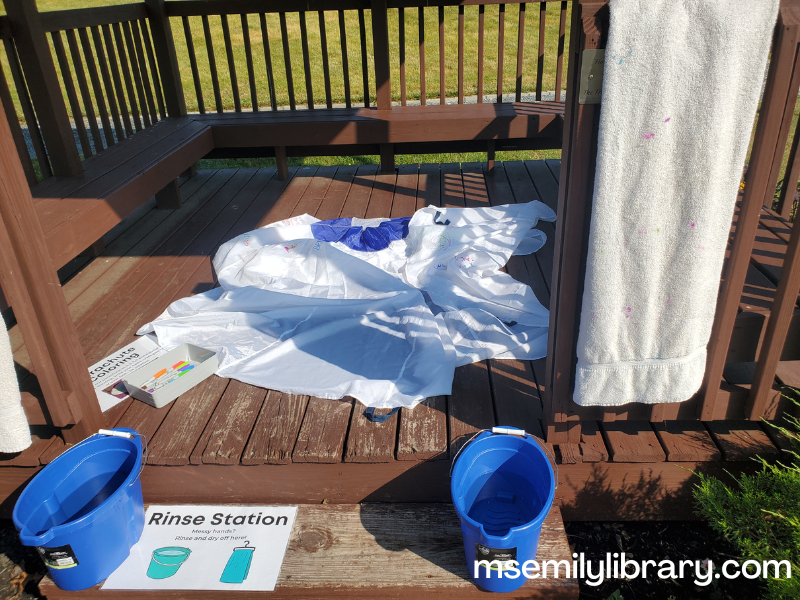
My library has an interesting smaller parachute (maybe 8 foot diameter?) that is plain white and was advertised as “decorate it yourself!” When I inherited it, there were a small scattering of names from who knows how long ago and the rest was depressingly empty. This summer I was determined to fill it up. I laid it out each week and set it as a station inside the gazebo, with a small handful of permanent markers. I’m happy to say that it looks MUCH better now, though it could still use a lot more personalization to fill up empty spaces. I offered some different ideas as the weeks went on as to what to add, like a favorite animal or insect. The first time we were indoors I offered it as a station, but cleaning up realized there was permanent marker on our relatively new flooring. To keep my director from going nuts, I decided not to put it out indoors anymore. 🙂 You can see the rinse station in the photo as well.

Shape Prints (Week 1)
Using shape sorter blocks that we already had in our baby toy collection, kids could dip them in paint and stamp the shapes onto white construction paper. I use old recycled Lean Cuisine trays to hold the paint – they are a perfect size. Sadly, I missed getting any pictures of this station! Original idea (and photo on the sign) from Nanny Gunna.

Dot Painting (Week 2)
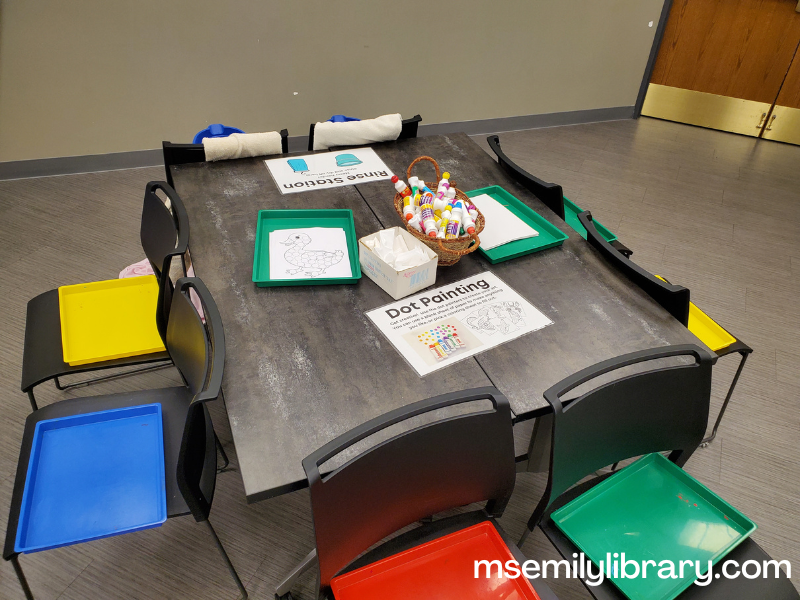
I originally had a different craft planned for week 2, but it was rainy that week and we were indoors the first two days. Dot painting is very easy and not as messy as slapping paint with flyswatters (see week 6 below), so the switch was made. The library has a supply of dot paint markers and I printed out some animal dot coloring sheets. Simple and still fun. I get a lot of these sheets, including the ones pictured, from The Artisan Life.

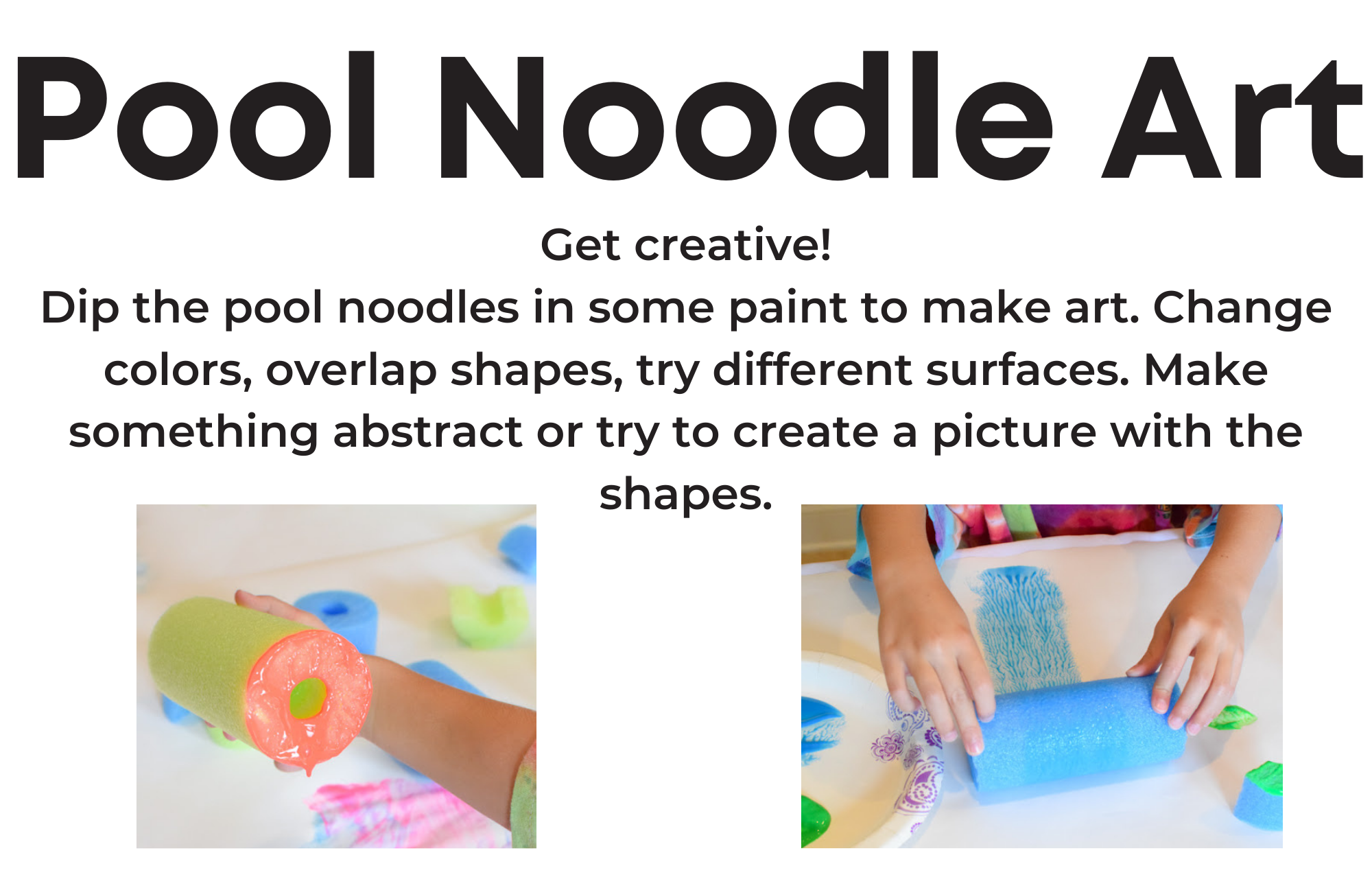
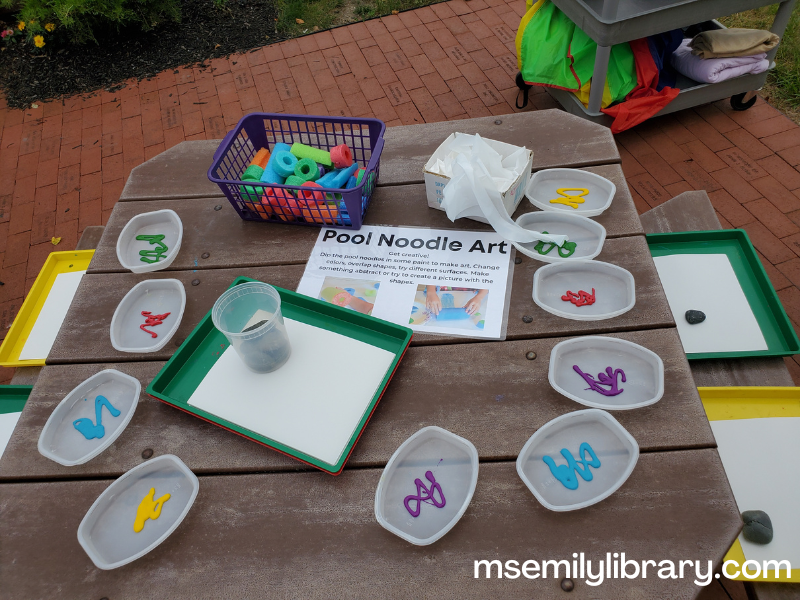
Pool Noodle Art (Week 3)
The pool noodles make another appearance! Trays of tempera paint and white construction paper are available with the noodles for any kind of art a child wishes to make. I had a few extra pieces of noodles that had been split lengthwise as well as sliced, to make half-circle shapes in addition to the full circles. Original idea (and photo on the sign) from What Can We Do With Paper and Glue.
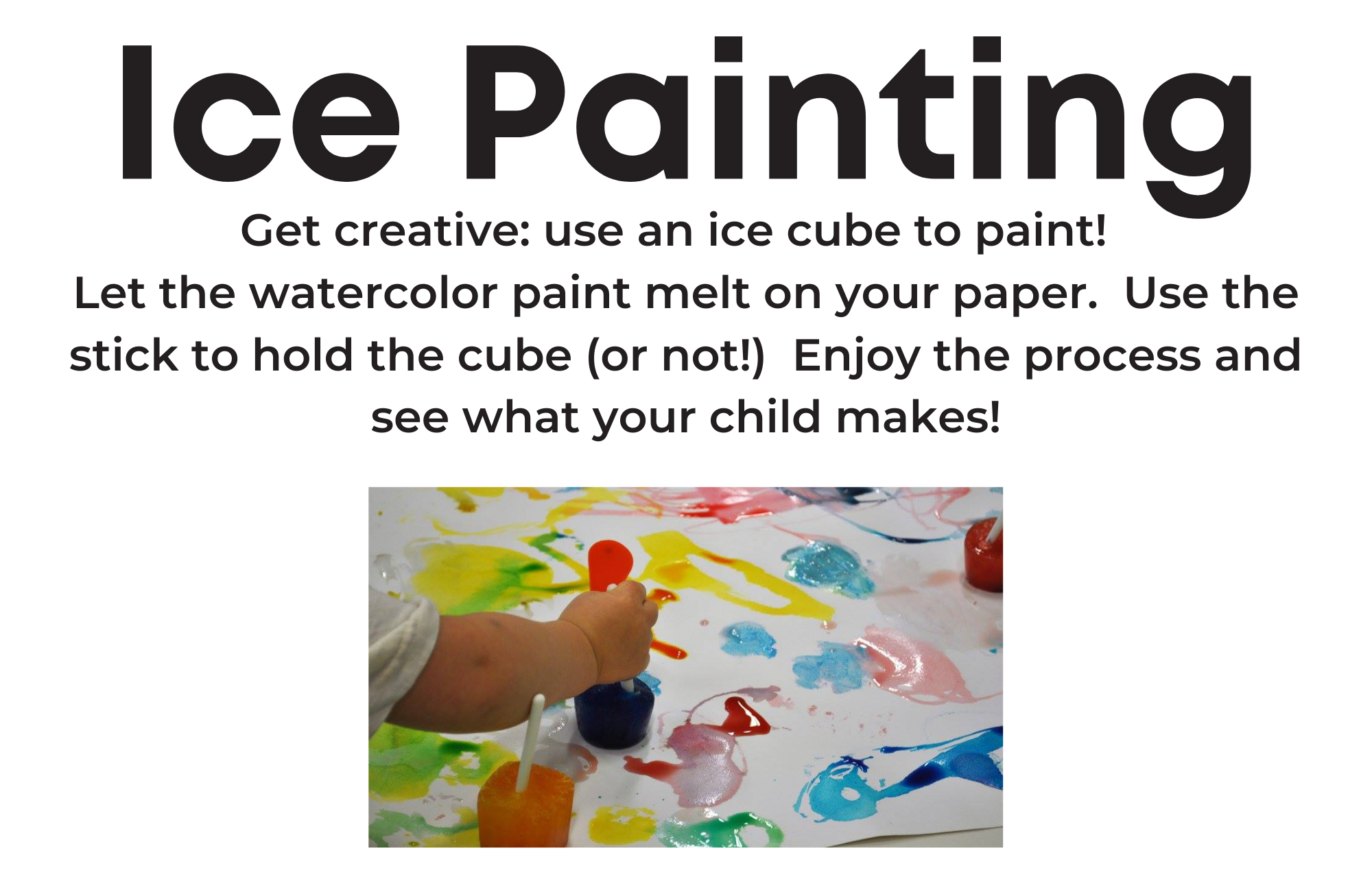
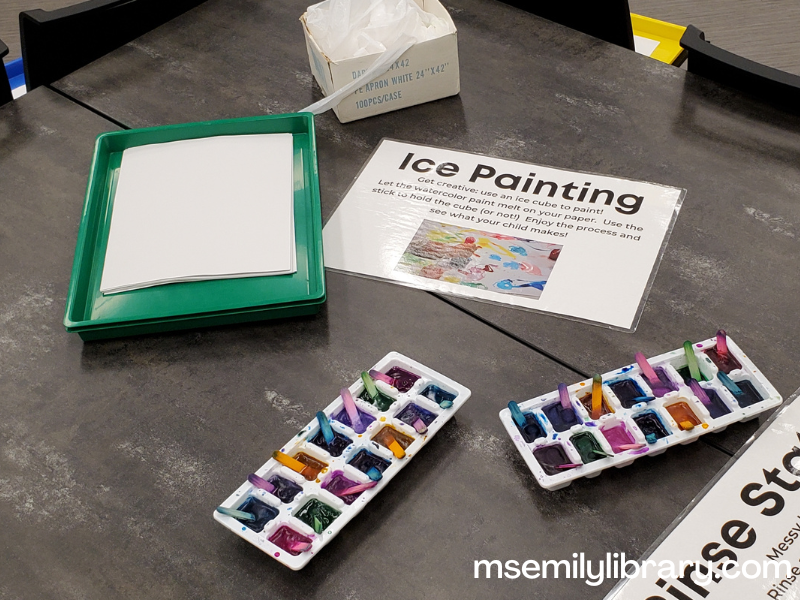
Ice Painting (Week 4)
This is honestly very simple, but I always get a lot of comments from grown-ups about how cool it is and how they might be able to do it at home. (I LOVE hearing that they’ll adapt what we do at the library at home!) I add small craft sticks to an ice cube tray and put in a little liquid watercolor paint and fill the rest with water. I think it could easily be done with food coloring if you don’t have liquid watercolors, though. I keep the ice cube trays in a cooler in the shade until we’re ready for stations, then get them out to use. They do melt, but usually there’s a bit of ice left by the end of the program. And my groups were quite tidy, so I was able to just refreeze the trays each day and there was plenty of “paint” available for three sessions. Original idea (and photo on the sign) from ARTventurers.
Finger Painting (Week 5)
A classic and super-simple activity – construction paper in our messy trays with finger paints in trays. I actually had several kids who didn’t like the sensory messiness of it, so some of them creatively used the rocks that are there to keep papers from flying away to spread the paint around. I’m not sure of the source of the photo on the sign, I think it’s a stock photo from Canva.

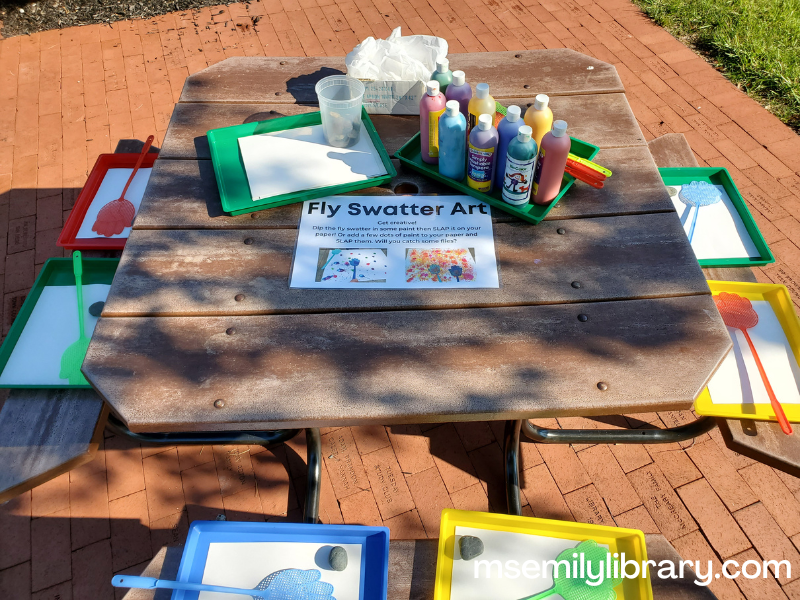
Fly Swatter Art (Week 6)
A messy but very fun art project, using (re-using) supplies from other stations. Kids wielded fly swatters to slap at paint, making some very interesting abstract art. I think the best method turned out to be adding some dots of paint to the paper, then letting the kids aim for them, rather than trying to spread paint on the swatter. I’m grateful for good weather all that week, since this is very much an outdoor activity. Original idea (and photo on the sign) from Play Teach Repeat.

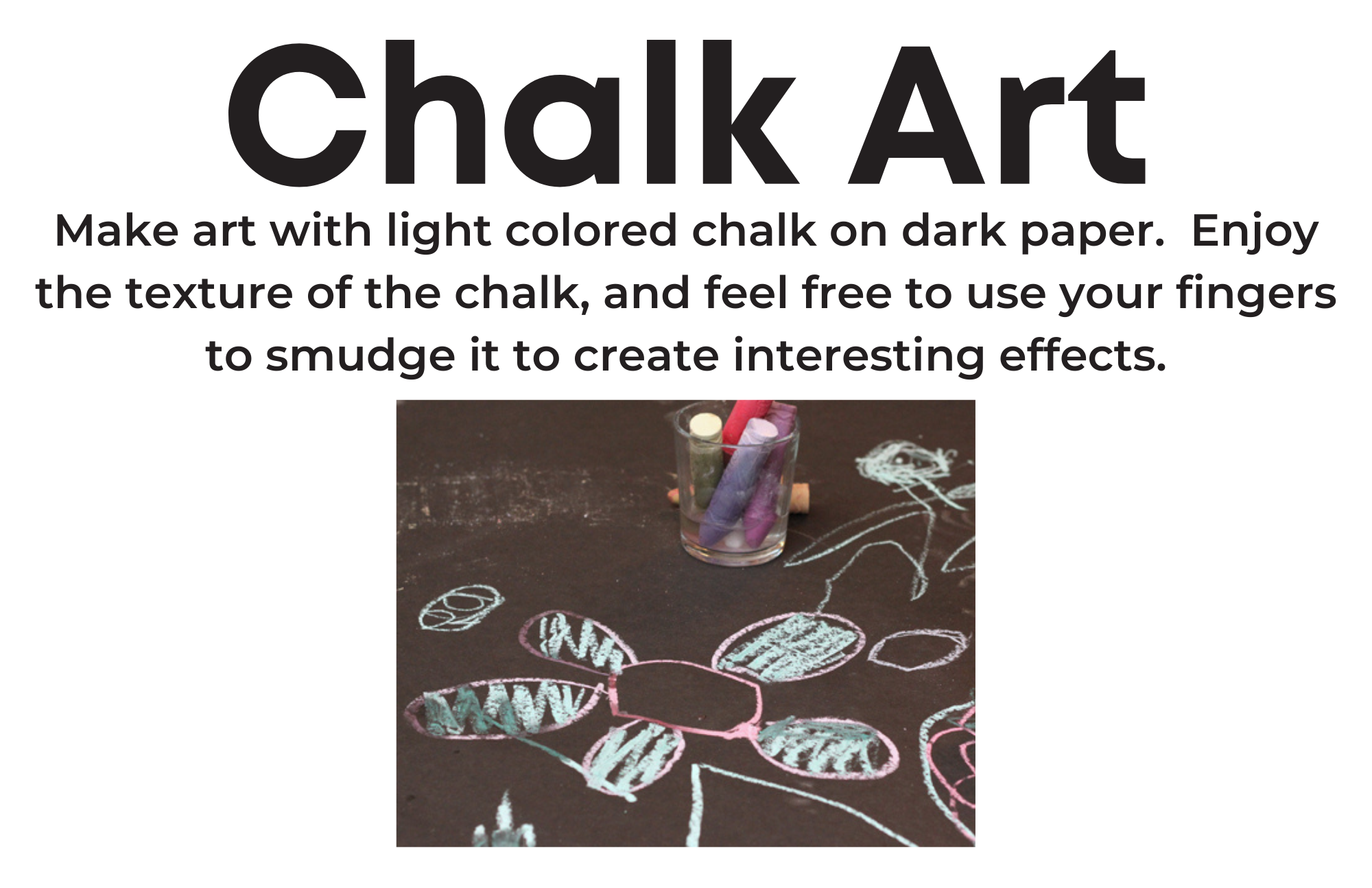
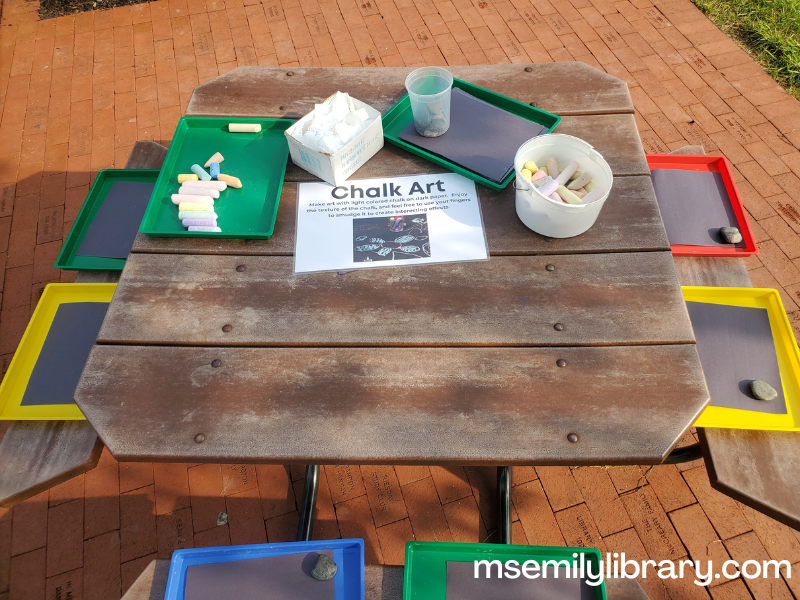
Chalk Art (Week 7)
Another very simple process art project, using black construction paper and sidewalk chalk. It was nice to end the summer with an art station that didn’t involve paint – this librarian was very tired by that point!
Wow, thanks for making it to the end of this very long post. I hope you found some good ideas and jumping-off points for out-of-the-box programming!
Summer Storytimes: All Together Now, Part I

Welcome back to the blog! My library’s Summer Reading Program is officially over, and I am deep into planning the fall. Summer is so busy that I take a break from blogging, but it was a great season, and I’d love to share it with you. I implemented all I learned in the last couple of years doing outdoor programming, and I think it was the best yet, despite worse weather and air quality this year (boo.)

Our library generally uses the theme and graphics from the Collaborative Summer Library Program, or CSLP, a national initiative that helps libraries plan summer programming. This year’s theme was “All Together Now,” with an emphasis on kindness and community. I focused on a different aspect of this each week for seven weeks in June and July. My program themes then were Community, We Work Together, Kindness, Family, Animal Helpers, and Helping Hands. More detail on how these were interpreted below. I also simplified the usual age requirements that I normally have for my indoor programs through the rest of the year. (So, instead of a Toddler Time for 1-2 year olds on Mondays and a Teddy Bear time for 2-3.5s on Tuesdays, I offered Family Time for 0-3.5 Monday, Tuesday, and Wednesday.) Siblings are always welcome, and I don’t have a limit to the number of families who can participate, so the programs are open to all.

For each session, we had about 15-20 minutes of storytime rhymes, songs, and a book, then 20 minutes of free play at various sensory stations. We end with bubbles and a goodbye song. Stations are a really great way to promote socializing, practice skills like sharing and being gentle, and allow for unstructured play, which science tells us is so important to learning and development. I added a section of parachute songs weekly, too, which was a treat for everyone. It was easy to do thematically – “A parachute is hard to have fun with by yourself. You need some friends and have to work ‘all together!'”

I also am all about simplicity and repetition over the summer. I have a lot of moving parts, set up and tear down to deal with, so I don’t change a lot in the storytime part and plan everything ahead so I am purely in “execute” mode rather than worrying about planning or learning songs. I changed one song and the book each week, and had a mixture of weekly, rotating, and unique stations. Since so much was the same, I’ll write up the whole summer in two posts: this first one focusing on the storytime half, and the second post focusing on all of the hands-on stations!

And, in addition to being back from hiatus, I finally bit the bullet and bought a domain name and WordPress subscription. Welcome to the ad-free Storytime with Ms. Emily Library experience! Please let me know if anything is wonky or links not working correctly in the transition.

The Plan: Storytime Portion

Welcome Song: Hello, Friends
(tune of Goodnight, Ladies)
Hello, friends! Hello, friends!
Hello, friends, it’s time to say hello!
Hello, [name 1], hello, [name 2]!
Hello, [name 3], it’s time to say hello! (repeat as needed)
(ASL motions: salute for “hello,” then take the index fingers on each hand and you link them together as though they are hugging each other back and forth for “friends”)
Source: Glenside Public Library District

Warm-Up Rhyme: We Wiggle and Stop
(Use the ASL sign for the word “stop” – one hand “chops” across the opposite hand)
We wiggle and we wiggle and we STOP
We wiggle and we wiggle and we wiggle and we wiggle
And we wiggle and we wiggle and we STOP
(We wiggled every week, but then added 2 more motions. Motions we did throughout the summer: jump, twirl, run, splash, hop, swim, stretch, stomp, wave, sway, march, lean, roll [arms,] hug)
Source: Jbrary

Intro: Our summer reading program is “All Together Now” and it is all about how wonderful things can happen when we work together. Short intro to the weekly theme (see below)

Themed Song (see below)

Transition Song: If You’re Ready for a Story
(tune of If You’re Happy and You Know It)
If you’re ready for a story, clap your hands (clap, clap)
If you’re ready for a story, if you’re ready for a story,
If you’re ready for a story, clap your hands (clap, clap)
Source: Miss Keithia (my predecessor)

Themed Book (see below)

Parachute! A parachute is really hard to have fun with all by yourself. We need friends, and we need to work together!

Parachute Song: Let’s Go Riding in an Elevator
Let’s go riding in an elevator, Elevator, elevator (parachute up and down)
Let’s go riding in an elevator, Ride along with me!
First floor, Second floor, Third floor, Fourth floor, Fifth floor… (shake parachute low, and get progressively higher)
And down, down, down, down, down! (lower parachute)
Source: Jbrary

I remind everyone to start rowing very gently, then after the first verse, say, “Oh, the wind is picking up, can we row more firmly?” and before the third verse, “Oh, no, there’s a storm! Row as strongly as you can!”
Parachute Song: Row Your Boat (3 verses)
Row, row, row your boat
Gently/Firmly/Strongly down the stream
Merrily, merrily, merrily, merrily
Life is but a dream
(Wave the parachute gently, then firmly, then wildly!)
Source: traditional

Breathing Break
Whew, all that rowing got me out of breath! I’m ready for a breathing break. Let’s take a big breath in and lift the parachute up, then breathe out and lower it. We’ll repeat a few times.

Most people know the first verse, but the second verse is probably newer and much less well known. It was a fun way to get us “up” from falling down. We did this one twice, walking in one direction and then the other.
Parachute Song: Ring Around the Rosie
(walk in a circle with parachute)
Ring around the rosie,
Pocket full of posies
Ashes, ashes,
We all fall down! (fall and stay seated)

Cows are in the meadow, (crouching by the ‘chute)
Eating buttercups
Thunder, lightning, (shake the parachute)
we all stand up! (stand)
Source: traditional

It actually took a few weeks for the adults to “get” this one. Repetition is good for them, too. 🙂
Parachute Song: Parachute Fly
(tune of Skip to my Lou)
(kids go under the parachute and adults raise and lower)

Up, up, up it goes,
Down, down, down so low
Raise our parachute to the sky
Count to 3 and watch it fly
Spoken:
Up on one…
Down on two…
Up on three…
and FLY! (adults let go and leader pulls ‘chute in to themselves)
Source: Gymboree

Release to Stations
I have eight stations each week, which involve a mixture of dry, wet, and art/creativity stations. We spend about 20 minutes before I ring the bell to call everyone back to the grassy area. We’ll go into further detail on these in the next blog post.

Everybody loves bubbles! The trick to doing bubbles outside, I’m finding, is to figure out which way the wind is blowing and get upwind of your group!
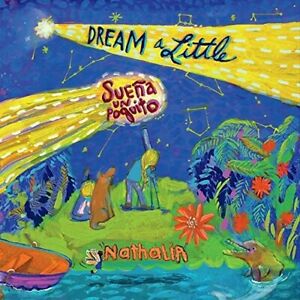
Recorded Bubble Song: Pop, Pop, Pop by Nathalia
From the album “Dream a Little,” available on Spotify

CD album cover for Nathalia's Dream a Little

Goodbye Song: See You Later, Alligator
(tune of Clementine)
See you later, alligator (wave with one hand, then the other)
In a while, crocodile (open and shut arms like a croc’s mouth)
Give a hug, ladybug (hug yourself or a loved one)
Blow a kiss, jellyfish! MWAH! (move hand like a jellyfish then blow a kiss!)
Source: King County Library System

Weekly Themes

Week 1: Friends 6/6, 6/7/23

Intro: Friends are the people who we love to play and hang out with, and who help us out when we need it. I love making new friends!

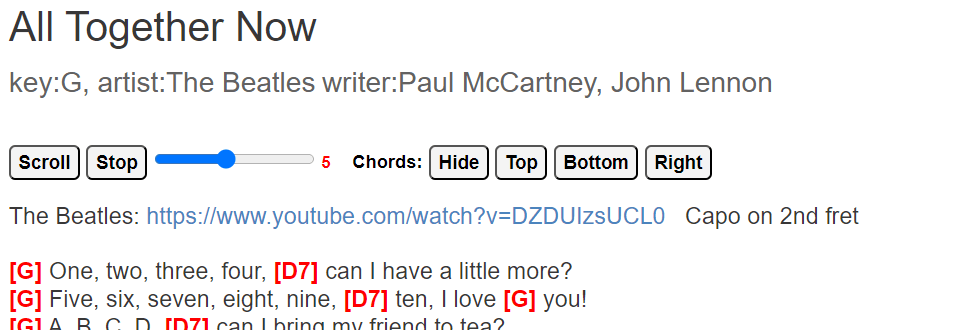
Themed Song: All Together Now I played this one on my ukulele, and asked the group to participate by doing the “response” part of the “all together now” chorus. If you don’t want to sing this one, play the original recording by the Beatles or the cover by Caspar Babypants.
I got the chord sheet from Jim’s Ukulele Songbook. It’s a great resource since he’s got a lot of functionality built into the site and among other things you can change the key of any of the songs and print sheets very easily. I prefer to play and sing this one in the key of G.

Themed Read: Who Has Wiggle Waggle Toes? by Vicky Shiefman & Francesca Chessa This is a story of friends having fun together. Can you join in?

Week 2: Community 6/12, 6/13, 6/14/23

Intro: We live in a community of people, and the people in our community help each other. Some people have jobs that let them help others every day.

I played this one on my ukulele and took suggestions from the group. I prompted them by asking, “who helps us when we’re feeling sick?” if there was a lull.
Themed Song: Community Helpers Song
(tune of Farmer in the Dell)
The teachers teach the kids
Heigh-ho, they help us so
The teachers teach the kids

Choose 3-5 verses!
The firefighters put out the fires….
The crossing guards help us cross…
The librarians find us books….
The dentists check our teeth…
The doctors keep us well…
The farmers grow our food…
The mail carriers deliver the mail…
Custodians keep us clean…

Click for a ukulele songsheet for “Farmer in the Dell”

I encouraged the group to give a cheer for every page to keep interest up.
Themed Read: Cheer: A Book to Celebrate Community by Uncle Ian Aurora & Natalia Moore

Week 3: We Work Together 6/19, 6/20, 6/21/23

Intro: Working together really makes things go smoother.

Instead of the ukulele this week, we did the ASL motions.
Themed Song: The More We Get Together
The more we get together, together, together
The more we get together, The happier we’ll be
For your friends are my friends, and my friends are your friends
The more we get together, The happier we’ll be

The more we read together… (ASL for read)
We’ll read big books and small books
Read short books and tall books…

The more we work together the stronger we’ll be… (ASL for work)
Source: traditional, ASL for verse one

Themed Read: Blocks by Irene Dickson

Week 4: Kindness 6/26, 6/27, 6/28/23

Intro: One important way to work together is to show kindness. Being kind means thinking of others and doing what you can to be a good neighbor.

The root of all kindness, I believe, is love. Here’s a traditional song your grownups might remember from their childhoods!
Themed Song: Skinnamarink
Skinnamarinky-dinky-dink, Skinnamarinky-doo, I love you!
I love you in the morning, and in the afternoon
I love you in the evening, underneath the moon
Skinnamarinky-dinky-dink, Skinnamarinky-doo, I love you!
Source: traditional, motions from Jbrary

Themed Read: How Kind! by Mary Murphy

Week 5: Family 7/3, 7/5/23

Intro: We can start working together with the people who are closest to us – our families! Who are the people in your family?

Here’s a song for all the people in our families – listen carefully! I included some different iterations to try to be as inclusive as possible. To keep things from getting too long, I sometimes combined (grandma and grandpa). Pairing it with a silly action (and telling grown-ups that they count, too) increases the fun.
Themed Song: If You Have a Brother
(tune of Do You Know the Muffin Man)
If you have a brother
A half-brother, a step-brother
If you have a foster-brother
Please stand up!
Repeat with other family members: sister, mommy, daddy, cousin, aunt, uncle, grandpa, grandma, etc. Ask for suggestions!
Pair with other silly actions: raise your hand, stick out your tongue, wiggle your foot, jump up and down, pat your head, etc.

Source: Abby the Librarian (though I changed the tune)

Themed Read: The Family Book by Todd Parr

Week 6: Animal Helpers 7/10, 7/11, 7/12/23

Intro: Does anyone have a pet at home? Did you know that some animals have important jobs, helping their humans? Some animals help humans who need them to get around or keep them safe. Some animals help soothe people who are lonely or need an animal to help them calm down. Today we are celebrating these animal helpers.

I talked briefly about different helper animals and what they do – including miniature horses, who can be used for the visually impaired! Cats and bunnies are generally therapy animals. I used puppets for each, and asked what sound each one made – including the rabbit! “You’re right, rabbits are quiet! But they can be helpful by being snuggly!”
Themed Song: Animal Helpers Song
(tune of The Wheels on the Bus)
The dog helps his owner with a woof, woof, woof
Woof, woof, woof
Woof, woof, woof
The dog helps his owner with a woof woof
All day long!
The cat helps her owner with a meow, meow, meow…
The horse helps their owner with a neigh, neigh, neigh…
The bunny helps her owner with a snuggle, snuggle, snuggle…
Source: adapted from the traditional

So, I kind of realized after planning that this dog was not a working dog but a pet – the vest threw me off. It still seemed like the best option as far as length. If you know a better option, please let me know in the commets!
Themed Read: Best Day Ever! by Marilyn Singer & Leah Nixon

Week 7: Helping Hands 7/17, 7/18, 7/19/23

Intro: Who likes to be a helper? What are some ways you might help at home? Putting toys away, set the table, put laundry in the hamper, play with a younger sibling, etc.

Since we use this tune for our transitional song, which comes right after this one, I saved the “clap” action for that one and went right into it. I also played ukulele for this one!
Themed Song: If You’re Helpful and You Know It
(tune of If You’re Happy and You Know It)
If you’re helpful and you know it, stomp your feet
If you’re helpful and you know it and you really want to show it
If you’re helpful and you know it, stomp your feet

If you’re friendly and you know it, peekaboo…
If you’re thoughtful and you know it, shout hooray…
Then go right into “If you’re ready for a story, clap your hands”
Source: adapted from the traditional

Get a downloadable ukulele songsheet here!

thumbnail for ukulele songsheet

Themed Read: Kindness Makes Us Strong by Sophie Beer

Tune in to the next post to learn more about all the sensory stations – like the Fly Swatter Slap, Pool Noodle Sort, Ping Pong Fishing, Mystery Water, Feed the Croc, and more!

Storytime: Let’s Picnic

One last May storytime to blog!

Going on a Picnic was actually my very first theme for storytimes I did on my own in a brand new position at a new library. I wasn’t blogging at that time, of course. I revisited it last month, updating some of the activities.

Early Literacy Tip: Singing games where we do motions as a group (like “Picnic in the Park”) encourage social responsiveness. These activities also help your child learn to feel comfortable in a group setting. When your child begins school, such positive associations will help them adjust to being part of a class.

Welcome Song: Hello, Friends* (TT) (TB) (FT)**

Warm Up Song: Wake Up, Feet* (TT) (TB) (FT)
This is a repeated song that everyone seems to enjoy. I always begin and end with feet and tummies, but find two other body parts to wiggle in the middle. This week it was knees and fingers.

Lifting Rhyme: Toast in the Toaster* (TT) (FT)

Rhyme: This is Big, Big, Big* (FT)

Intro: As we get closer to summertime, I start thinking about some of the fun things we can do outside. One of those is to have a picnic! A picnic is a meal you eat outside. You might do other things like fly a kite, play ball, even take a nap!
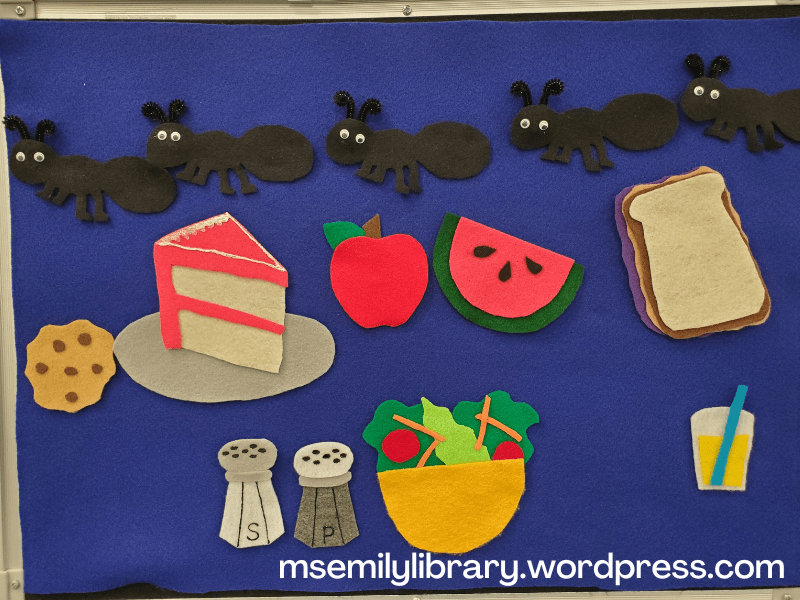
I had a bag of flannel picnic pieces that I made a couple years ago for Five Hungry Ants (below), and Raffi’s song, Going on a Picnic, both of which mention certain foods. I think I added a couple of other items to fill it out. After the first session, I learned to do groups of things, not individual pieces for each verse! “Let’s pack some fruits and vegetables! How about dessert?” It just shortened the song to fit my audience’s attention span. The foods stayed up while we read our book, then the ants came!
Rhythm Rhyme: Pack a Lunch (TT) (TB) (FT)
(slap knees in rhythm to the rhyme)
Going on a picnic
Gotta pack a lunch
What should we bring to
Munch, munch, munch?
Let’s bring….
(how many picnic items can you think of?)

Optional last verse:
Ready for a picnic,
Ready with a lunch,
Now we’re ready to
munch, munch, munch!
Source: King County (WA) Library System

Felt board with various picnic foods, including a peanut butter and jelly sandwich, slice of watermelon, red apple, bowl of salad with carrots and tomatoes, glass of lemonade, slice of cake on a plate, chocolate chip cookie, and salt and pepper shakers.

Transition: If You’re Ready for a Story* (TT) (TB) (FT)

This one was okay. I’m not a huge fan of the Mouse books, but it did feature things I was going to talk about like watermelon and ants.
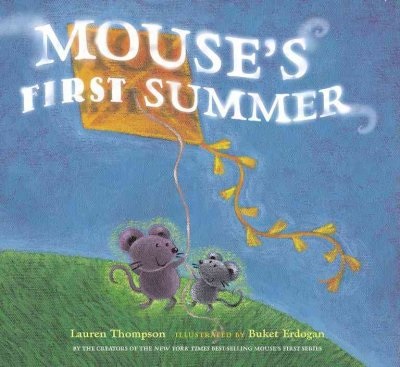
Read: Mouse’s First Summer by Lauren Thompson & Buket Erdogan (TT)

mouse's first summer book cover

This is such a funny and silly book, but also takes a little explaining for the littlest ones to get what’s going on. The adults were chuckling and smiling the whole way through, though, and even the littles seemed to really like the pictures.
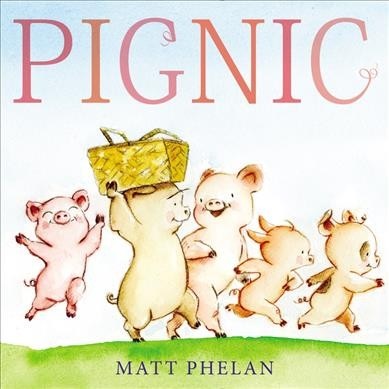
Read: Pignic by Matt Phelan (TB) (FT)

Pignic book cover

For time, I only added four ants. It’s not a bad idea to start your counting songs and rhymes at numbers other than five on occasion. I believe the original source said she tosses the ants behind her after the big sneeze, and that has always gotten a lot of giggles for me. 🙂
We packed our lunch, and now it’s time to eat it! But we’re not the only ones who are hungry. Look who is coming to our picnic!
Counting Rhyme: Five Hungry Ants (TB) (FT)
Five hungry ants, marching in a line
They come upon a picnic, where they could dine
They marched into the salad
They marched into the cake
They marched into the pepper
Oh-uh! That was a mistake! AH-CHOOOOOO! (remove an ant!)
Four hungry ants…
(Continue to count down)
Source: Miss Mary Liberry blog

Same felt board as above, but with five black ants with small googly eyes and pipe cleaner antennae added to the top.

I modified the fruit just slightly from the Jbrary version, but it might be fun to brainstorm fruits and fit them into the structure of the song with your group (probably better with an older group).
Oh, good, the ants are gone! Let’s dig in. One thing that’s tasty at a picnic is a fruit salad!
Action Song: Fruit Salad (TT) (TB) (FT)
(tune of Frère Jacques)
Watermelon, watermelon (big circle with hands)
Strawberry, strawberry (chop with hands on each syllable)
Ba-a-a-a-nana, Ba-a-a-a-nana, (swing arms down, rocking)
Fruit salad, fruit salad! (dance it out!)

Pomegranate, pomegranate (pinch fingers)
Clementine, clementine (hold hands together then open)
Pi-i-i-i-neapple, pi-i-i-i-neapple (peak fingers & move around)
Fruit salad, fruit salad! (dance it out!)
Source: Jbrary

A good one to have in the back pocket, but I didn’t end up using it for time reasons. In the past, I encourage the room to really hit the “Boom Boom Boom” hard – A) because it’s fun and B) because at that point in the song I need a big breath!
Oh, no! The ants are back!
Song: The Ants Go Marching
The ants go marching one by one, hurrah! Hurrah!
The ants go marching one by one,
The little one stops to suck his thumb,
And they all go marching down, to the ground, to get out of the rain.
Boom, Boom, Boom!
(count up)
…two by two, tie his shoe…three by three, climb a tree…four by four, shut the door…five by five, take a dive
Source: traditional

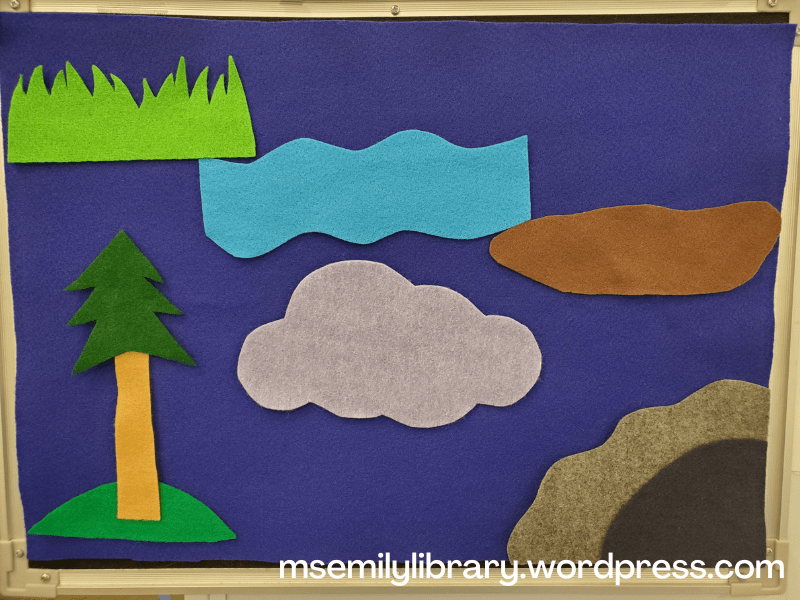
I pretty much did as Michael Rosen does in this video, but encouraged the group to repeat the first four lines as call and response. Once again, as my sessions continued, I shortened to fit our attention. Three obstacles (grass, river, and mud) plus the cave seemed just about right. You can download my reminder sheet here. When we found the bear, I put on my Folkmanis baby bear puppet, which they loved!
It can be fun to play some games when you are on a picnic. Can we pretend to go hunting for a bear?
Retelling/Chant: We’re Going on a Bear Hunt by Michael Rosen & Helen Oxenbury (TT) (TB) (FT)
We’re going on a bear hunt (We’re going on a bear hunt)
We’re gonna catch a big one! (We’re gonna catch a big one!)
What a beautiful day! (What a beautiful day!)
We’re not scared! (We’re not scared!)
Oh, no! GRASS – Long, wavy grass
We can’t go OVER it, We can’t go UNDER it
We have to go THROUGH it
Swish, swish, swish, swish!
Repeat, going through a River, Mud, a Forest, s Storm, a Cave, finding the bear, and then running back through everything to home.
Source: traditional, as performed by Michael Rosen

I saw the first verse on a library blog, and decided to write some more verses to give the whole story of a day at a picnic. It was fun to come up with the rhymes, and figure out some action to go with each one just like She’ll Be Comin’ Round the Mountain.
Ukulele/Action Song: Picnic in the Park (TB) (FT)
(tune of She’ll Be Comin’ Round the Mountain)
Oh, we’ll all go on a picnic in the park (let’s go!) (come here motion)
Oh, we’ll all go on a picnic in the park (let’s go!)
Bring some lunch and bring a ball,
There’ll be so much fun for all
Yes, we’ll all go on a picnic in the park (let’s go!)

Oh, we’ll eat some chips and sandwiches outside (yum, yum)… (rub tummy)
Fruit salad and lemonade
Taste so good out in the shade…

We’ll play a game of tag or hide and seek (ready or not!)… (cup hands around mouth)
Run around, lickety split
I’ll tag you and then you’re it…

Oh, the sky is getting darker, will it rain? (drip drop)… (wiggle fingers down)
Thunder rumbles, then grumbles more
Pack our stuff before it pours…

(slowly)
I’m glad we had a picnic in the park (yawn)… (cover mouth)
We ran around and ate our lunch
Had some fun, all right a bunch…
Source: verse one by Rhyming Reasor (found on the picture of the handout, not in the text of the blog post),
remaining verses are original

Get a downloadable ukulele songsheet for “Picnic in the Park” here!

thumbnail for picnic in the park songsheet

Action Song: Zoom, Zoom, Zoom!* (TT) (TB) (FT)

Craft: Watermelon on a Stick (TB) (FT)
I made a point of letting them know that watermelon is one of my favorite fruits when we added it to the felt board. (Purportedly my word for it as a toddler was “Oh, Boy” since that’s what everybody said when it came out!) So our craft this week was to make paper plate watermelon slices on a stick! Color the plate, fold, and staple (hint – most staplers will staple through a craft stick!) Add some seed shapes and you’re done!

Picture of watermelon craft - paper plate colored pink in the middle and green around the edge, folded in half and stapled to a large craft stick. Black paper seeds are glued on.

Play Time
The toddlers have two laundry baskets of baby toys – rattles and cars, sorters and stackers, toy phones and spinners. For the older kids, I have foam blocks, soft food toys, puzzles, and a few other items that are a little more sophisticated than the baby toys. For Family Time, I gauge the overall age of the group and put out what seems right for them. We play for 5-10 minutes at the most, then I ring the bell and ask the kids to help me clean up. I think the clean up bit is good practice for them!

Goodbye Song: See You Later Alligator* (TT) (TB) (FT)

Goodbye Rhyme: Tickle the Stars* (TT) (TB) (FT)

Other books I had available for families to browse (and may work for you on this theme)
Truck, Truck, Goose! – Tammi Sauer & Zoe Waring
This Is the Way a Baby Rides – Susan Meyers & Hiroe Nakata
Pie Is for Sharing – Stephanie Parsley Ledyard & Jason Chin
Max and Marla Are Having a Picnic – Alexandra Boiger
Click, Clack, Quackity-Quack – Doreen Cronin & Betsy Lewin
The Watermelon Seed – Greg Pizzoli
In Our Backyard Garden – Eileen Spinelli & Marcy Ramsey
I Really Want a Bigger Piece! – Harriet Ziefert & Travis Foster
Bugs! Bugs! Bugs! – Bob Barner

This storytime was presented in-person on 5/15, 5/16, & 5/17/23.

Storytime Handout:

handout with book suggestions, rhyme and song lyrics.

*Lyrics to these songs can be found on the Repeated Songs & Rhymes page.

**These symbols indicate the program sessions I used the activities for:
(TT) Toddler Time, ages 1-2
(TB) Teddy Bears, ages 2-3.5
(FT) Family Time, ages 0-3.5

Storytime: At the Pond

Summer is coming, so I’ve been a little slow with blog posts!

A pond storytime is a lot of fun, since there are lots of extension activities that go along with pond animals – ducks, frogs, fish, turtles, even bugs! I actually had several extra rhymes and songs in reserve that I didn’t end up using in the time we had, but might be good alternate options for you.

Early Literacy Tip: Rhymes can help children look a bit more carefully at the natural world around them. Take the opportunities that rhymes offer to have conversations with your child. The rhyme “There Was a Little Turtle” gives you a chance to talk about turtles – where they live, what they eat, and that some kinds of turtles might bite!

Welcome Song: Hello, Friends* (TT) (TB) (FT)**

Warm Up Song: Wake Up, Feet* (TT) (TB) (FT)
This is a repeated song that everyone seems to enjoy. I always begin and end with feet and tummies, but find two other body parts to wiggle in the middle. This week it was shoulders and ears.

Lifting Rhyme: Toast in the Toaster* (TT) (FT)

Rhyme: This is Big, Big, Big* (FT)

Intro: Today we are talking about a special ecosystem where plants and animals live together – a pond! Can anyone think of something they might find in or near a pond? Fish, ducks, turtles, frogs, mosquitos, water beetles, dragonflies, water lilies, reeds, mud…

This is such a fun rhyme! I’d done it in my Baby program but not for this group. The person who posted it to the Storytime Solidarity Facebook Group didn’t have a source, so if anyone knows where it came from or who wrote it, please let me know!
Bounce/Lift: Fishy, Fishy, Fishy (TT) (FT)
Fishy, fishy, fishy goes swishy, swishy, swishy (bounce)
Flip flop, flip flop, flip flop (rock side to side)
Uuuuup, (lift baby high in air) KERPLOP! (return baby to lap)
Source: Storytime Solidarity

I used my hands to do the motions as if they were duck “flippers,” except for the quacking of the beak.
Action Rhyme: Little Baby Ducklings (TT)
Little baby ducklings- dash, dash, dash
Jumped in the duck pond- splash, splash, splash
When their Mother called them- quack, quack, quack
Little baby ducklings- swam right back
Source: Preschool Express

Transition: If You’re Ready for a Story* (TT) (TB) (FT)

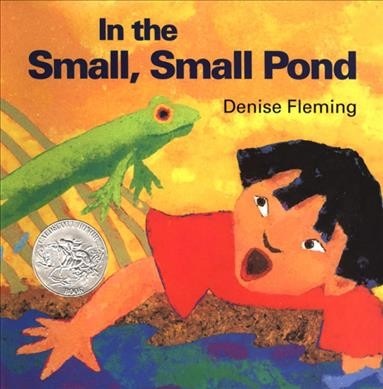
Read: In the Small, Small Pond by Denise Fleming (TT)

Book cover for In the Small Small Pond

What a lovely book. It’s very simple, just various animal and nature noises, but the colored pencil illustrations are exquisite, and the pacing lends itself so well to a group. I ask everyone to make the rain and thunder noises with lap pats and big claps, then we slowly ease back for the end of the book.
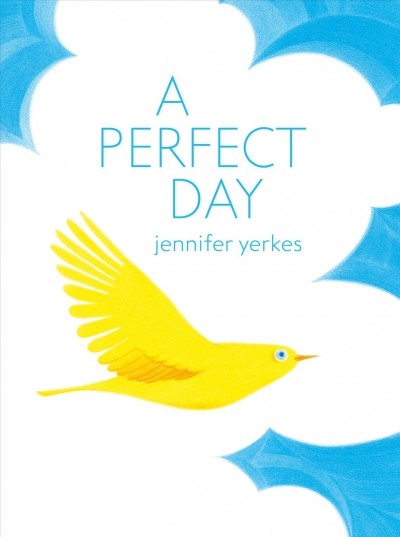
Read: A Perfect Day by Jennifer Yerkes (TB) (FT)

book cover for A Perfect Day

Fingerplay: There Was a Little Turtle (TT) (TB) (FT)
There was a little turtle (make fist)
who lived in a box (cover fist with arm)
he swam in the puddles (fist wiggles like swimming)
he climbed on the rocks (fist climbs up opposite arm)
He snapped at a mosquito, he snapped at a flea (pinch with thumb and fingers at each “snap”)
He snapped at a minnow, he snapped at me!
He caught that mosquito, He caught that flea (clap each “caught”)
He caught that minnow
But he didn’t catch me! (waggle finger)
Source: Jbrary

Song: All the Fish (TT) (TB) (FT)
All the fish are swimming in the water
Swimming in the water, swimming in the water
All the fish are swimming in the water:
Bubble, bubble, bubble, SPLASH!

All the ducks are quacking…
All the frogs are jumping…
All the kids are splashing…
Source: Caspar Babypants (from the album I Found You)

I didn’t end up using this one.
Rhyme: I Caught a Fish
One, two, three, four, five, Once I caught a fish alive
Six, seven, eight, nine, ten, Then I threw it back again
Why did you let it go? Because it bit my finger so
Which finger did it bite? This little finger on my right
Source: traditional

Action Rhyme: A Fat Little Frog (TT) (FT)
A fat little frog came hop, hop, hop!
He jumped on a log with a plop, plop, plop
He sat very still and he rolled his eyes
Then out came his tongue to catch some flies!
Source: King County (WA) Library System

I had a puppet (well, a plastic bath squirter for the fish…) for each verse, which made this one very engaging.
Song: Mmm-ah (TB) (FT)
Mmm-ahh (stick out tongue) went the little green frog one day,
Mmm-ahh went the little green frog
Mmm-ahh went the little green frog one day,
And they all went mmm, mmm, ahh
But… We know frogs go (clap) sha-na-na-na-na (wiggle arms)
Sha-na-na-na-na, Sha-na-na-na-na
We know frogs go sha-na-na-na-na
They don’t go mmm, mmm, ahh!

Bloop, bloop went the little blue fish one day…
But… we know fish go kissy-kissy-kiss
Quack, quack went the yellow duck one day…
But… we know ducks like to shake a tail feather… (shake bottom)
Source: Jbrary, duck verse original

a green frog puppet, a yellow duck puppet, and a small blue plastic fish bath squirter.

Another one that didn’t end up happening. So many great songs for pond animals!
Counting Song: Five Green & Speckled Frogs
Five green and speckled frogs
Sat on a speckled log
Eating the most delicious bugs (yum, yum)
One jumped into the pool
Where it was nice and cool
Then there were four green speckled frogs
(count down)
Credit: traditional

Ukulele Song: Six Little Ducks (TB) (FT)
Six little ducks That I once knew
Fat ones, skinny ones, fair ones, too
But the one little duck
with the feather on his back
He led the others with a quack, quack, quack
A quack, quack, quack, A quack, quack, quack
He led the others With a quack, quack, quack
Source: traditional, as sung by Raffi

Get a downloadable ukulele songsheet for “Six Little Ducks” here!

Six Little Ducks songsheet thumbnail

Action Song: Zoom, Zoom, Zoom!* (TT) (TB) (FT)

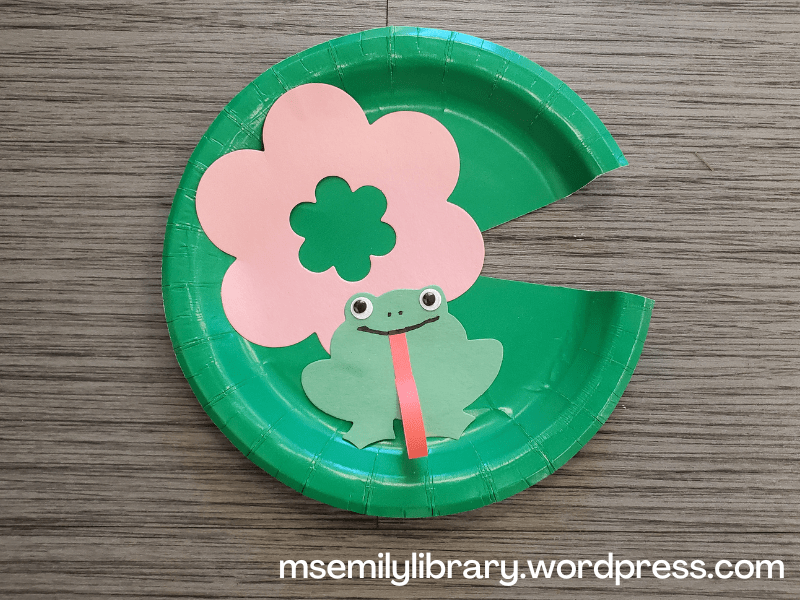
Craft: Lily Pad (TB) (FT)
To make a cute little lily pad, we started with small green paper plates with a small wedge cut out. I provided die-cut frogs and flowers, plus a small strip of red paper curled around a pencil for the frog’s tongue. With googly eyes and some crayon details, they turned out pretty cute.

craft with a green plate with a small wedge cut out, decorated with a pink paper flower and frog with googly eyes and a long curly strip of red paper for a tongue.

Play Time
The toddlers have two laundry baskets of baby toys – rattles and cars, sorters and stackers, toy phones and spinners. For the older kids, I have foam blocks, soft food toys, puzzles, and a few other items that are a little more sophisticated than the baby toys. For Family Time, I gauge the overall age of the group and put out what seems right for them. We play for 5-10 minutes at the most, then I ring the bell and ask the kids to help me clean up. I think the clean up bit is good practice for them!

Goodbye Song: See You Later Alligator* (TT) (TB) (FT)

Goodbye Rhyme: Tickle the Stars* (TT) (TB) (FT)

Other books I had available for families to browse (and may work for you on this theme)
Scoot! – Cathryn Falwell
Ducks Away! – Mem Fox & Judy Horacek
Song of the Water Boatman – Joyce Sidman & Beckie Prange
The Wide-Mouthed Frog – Rex Schneider
Over and Under the Pond – Kate Messner & Christopher Silas Neal
At the Pond – Geraldo Valério
I’m a Duck – Eve Bunting & Will Hillenbrand
At the Pond – David Elliott & Amy Schimler-Safford
Maisy Goes on a Nature Walk – Lucy Cousins

This storytime was presented in-person on 5/8, 5/9, & 5/10/23.

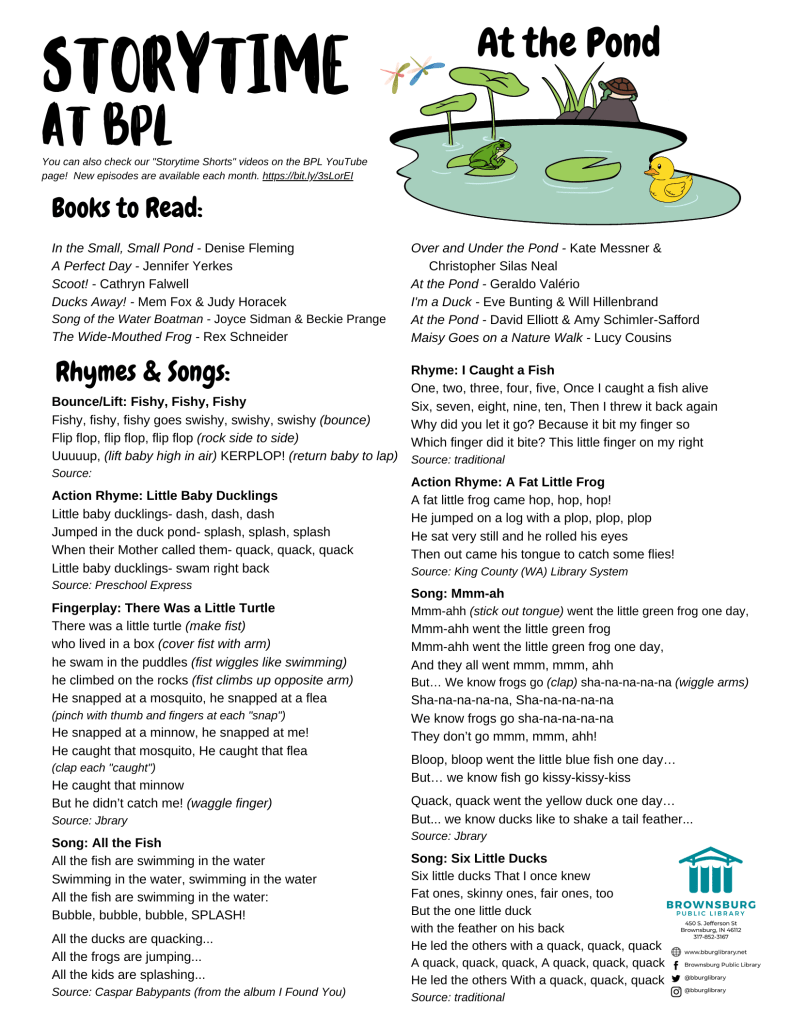
Storytime Handout:

handout with suggested books, rhyme and song lyrics.

*Lyrics to these songs can be found on the Repeated Songs & Rhymes page.

**These symbols indicate the program sessions I used the activities for:
(TT) Toddler Time, ages 1-2
(TB) Teddy Bears, ages 2-3.5
(FT) Family Time, ages 0-3.5

Storytime: Earth Day

An environmentally-minded storytime for Earth Day or any day! We talked about littering, recycling, planting trees, and using gas-free transportation options – not bad for thirty minutes and a room full of two-year-olds.

Early Literacy Tip: Your recycling bin can become a craft store! Looking for different uses for ordinary items encourages creativity and inventiveness, skills that help children be ready to learn. You may be surprised at the different things that can be made from (clean) plastic containers, cardboard tubes, and other recyclable materials. Your child thrives on your encouragement, but let them be creative and decide what to do with the materials.

Welcome Song: Hello, Friends* (TT) (TB) (FT)**

Warm Up Song: Wake Up, Feet* (TT) (TB) (FT)
This is a repeated song that everyone seems to enjoy. I always begin and end with feet and tummies, but find two other body parts to wiggle in the middle. This week it was arms and chins.

Lifting Rhyme: Toast in the Toaster* (TT) (FT)

Rhyme: This is Big, Big, Big* (FT)

Intro: Saturday, April 22 is Earth Day! That’s a day when we celebrate the amazing place our planet is, and we work to clean up the Earth’s air, water, protect plants and animals, and make the earth a great place to live for generations to come. Here’s a poem by Kelly Roper about what we can do for Earth Day.

After reading this the first time, it felt a little preachy and kind of boring (no motions to do, etc). I decided to skip it for my other sessions.
Poem: In Celebration of Earth Day (TT)
In celebration of Earth Day, Why not plant a tree?
It will produce fresh air, And be a joy for all to see.
In celebration of Earth Day, Go and visit a local park.
Get back in touch with nature,
Its sights and sounds in light and dark.
In celebration of Earth Day Try to be more aware,
Of how your actions affect this world
And devote yourself to its care
Source: by Kelly Roper, via Stratford (CT) Library

Something that a lot of people do to celebrate Earth Day is planting trees. Let’s do that with this rhyme.
Action Rhyme: Be a Seed (TT) (TB) (FT)
Be a seed, small and round (make a fist)
Sprout, sprout, sprout up from the ground (open fingers)
Shake your leaves for all to see (shake hands and body)
Stretch your arms up, you’re a tree! (raise arms high)
Source: Jbrary

Transition: If You’re Ready for a Story* (TT) (TB) (FT)

I really loved this book, and it was pretty perfect for this age group – though I do have a few caveats. I skipped a couple pages both to shorten it and also… I wished the page about eating less meat featured a plate full of vegetables instead of a barnyard scene. C’mon. I also skipped the “Looking after our backyards” page. I don’t know, I could see how that can be environmentally friendly, but there’s also people who “look after their backyards” by applying lots of chemicals and planting non-native plants and so on. The wording could have been more precise, I think. Nevertheless, I did end up using this book for all three sessions!
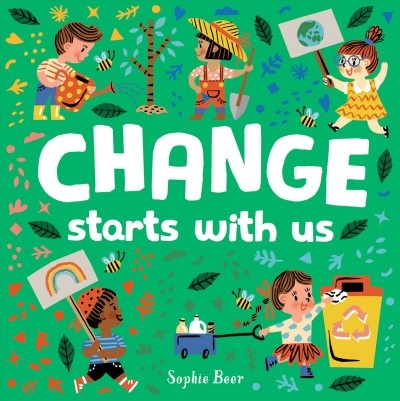
Read: Change Starts With Us by Sophie Beer (TT) (TB) (FT)

book cover for change starts with us

This ended up being a backup book that I didn’t use. It does have beautiful pictures and may be inspirational to keeping the Earth clean and beautiful, but since it wasn’t explicitly about being a good steward of the Earth, it didn’t fit quite as well when I only read one book.
Read: Thank You, Earth by April Pulley Sayre

book cover for thank you earth

Bounce: Bumping Up and Down (TT) (TB) (FT)
Bumping up and down in my little red wagon (bounce)
Bumping up and down in my little red wagon
Won’t you be my darlin’? (lift or tilt)
One wheel’s off and the axle’s broken… (bounce then lean)
(what else can you use to get around without a car? A green bicycle, a blue scooter, your pink sneakers?)
Source: adapted from the traditional

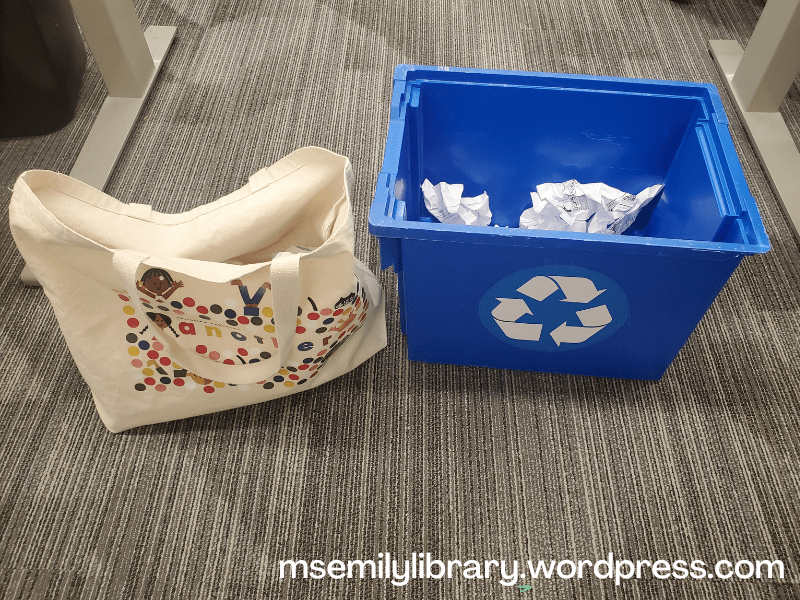
This one was fun. I had made a “recycling bin” from a blue ILL bin and just printed the recycling symbol to tape on the sides. I used it both for this and the “Picking Up Litter” song. The kids loved when I took each bottle and gulped it down. We also talked a little about colors, flavors, and sizes. I used permanent markers to color the labels.
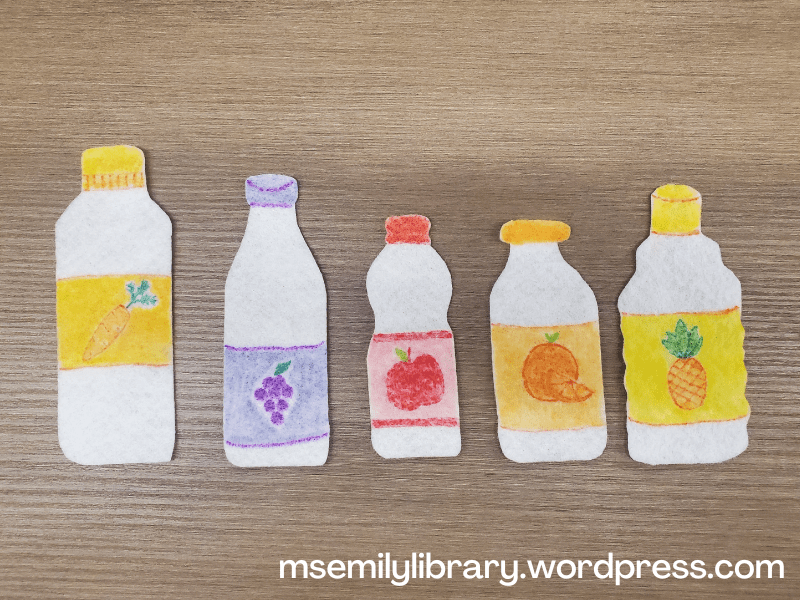
Flannel/Counting Song: Five Bottles of Juice (TT) (TB) (FT)
Five bottles of juice on the wall
Five bottles of juice… Glug, glug, glug!
Put one in the recycling bin
Four bottles of juice on the wall!
(count down)
Source: Jen in the Library

Flannel pieces with five differently-shaped bottles of varying sizes. the first has a picture of a carrot on the label, the second a grape, the third an apple, the fourth an orange, and the fifth a pineapple. The bottle labels match the colors of the fruit and the lids match the labels.

I wasn’t exactly sure how this one would go, but it was a hit. When I started pulling crumpled up paper out of my bag and tossing it on the floor, eyes got wide! The most difficult part for me was remembering the rhyme while walking around and tossing enough trash that everyone would be able to grab some.
Song: Litter Bug (TT) (TB) (FT)
(tune of Itsy Bitsy Spider)
Once there was a litter bug
Who went from town to town
Throwing out his garbage
That landed on the ground
The garbage grew so high
That when he turned around
The litter bug got buried
And could not make a sound! EEK!
Source: Yogibrarian

They LOVED getting to pick up all the trash and put it in the recycling bin. We repeated the song until it was all picked up.
Song: Picking Up Litter (TT) (TB) (FT)
(tune of Paw Paw Patch)
Picking up litter and putting it in the bin
Way down yonder, at the library!
Source: Yogibrarian

a canvas tote bag sits next to a blue recycling bin with a white recycling symbol visible on the side. Crumpled up white paper can be seen inside both.

It’s always great to end with a ukulele song, especially one that has a very familiar and repetitive tune that grownups pretty much know. I have an inflatable ball with a realistic Earth printed on it and I encouraged kids to pass it around to each other. Before they started I asked grownups to help it move along. We only had one instance where it got thrown, so I call that a win.
Song: We’ve Got the Whole World (TT) (TB) (FT)
(tune of He’s Got the Whole World)
We’ve got the whole world, in our hands
We’ve got the whole world in our hands

We’ve got the rivers and the oceans, in our hands…
We’ve got the air all around us, in our hands…
Be kind to plants and animals – in our land…
We’ve got to work together to clean the Earth…
Source: adapted from King County (WA) Library System and DARIA

inflatable beach ball with the earth printed on it. The earth has clouds and the land varies from green to brown. It looks like the Earth from space.

Get a downloadable ukulele songsheet for “We’ve Got the Whole World” here!

Thumbnail for ukulele songsheet

Action Song: Zoom, Zoom, Zoom!* (TT) (TB) (FT)

Craft: Coffee Filter Earth (TB) (FT)
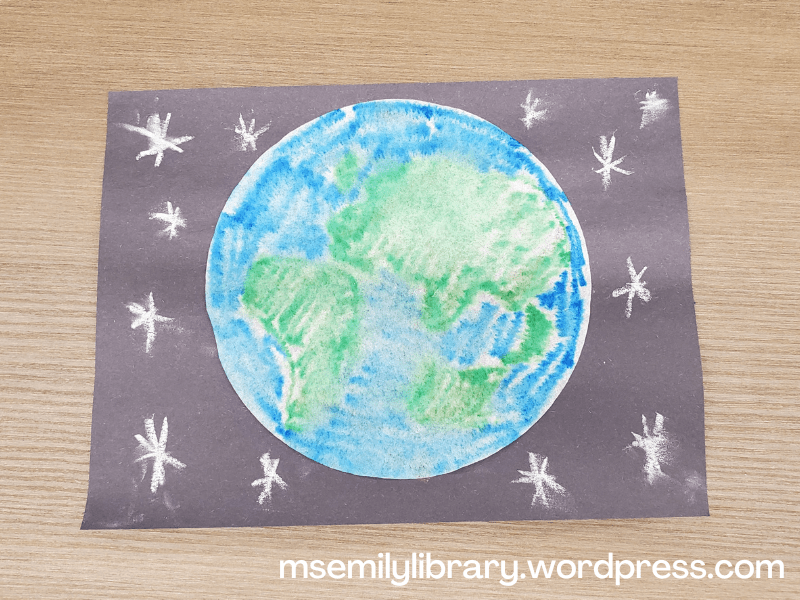
This was a little more involved than my usual crafts, but I think they enjoyed it. We started by using washable markers and coloring a coffee filter blue and green. Then they came up to me, where together we sprayed the filter with water on a plastic messy tray. Then they hung up their filter on yarn I’d strung up to dry. They could then go back and make stars on their black construction paper. We played and did our goodbye songs, and they could glue down their Earth if it was dry at that time.

Craft showing a  blurry blue and green earth glued to a piece of black construction paper. White chalk stars were drawn around the earth.

Play Time
The toddlers have two laundry baskets of baby toys – rattles and cars, sorters and stackers, toy phones and spinners. For the older kids, I have foam blocks, soft food toys, puzzles, and a few other items that are a little more sophisticated than the baby toys. For Family Time, I gauge the overall age of the group and put out what seems right for them. We play for 5-10 minutes at the most, then I ring the bell and ask the kids to help me clean up. I think the clean up bit is good practice for them!

Goodbye Song: See You Later Alligator* (TT) (TB) (FT)

Goodbye Rhyme: Tickle the Stars* (TT) (TB) (FT)

Other books I had available for families to browse (and may work for you on this theme)
The Earth Book – Todd Parr
My Friend Earth – Patricia MacLachlan & Francesca Sanna
Stand Up! Speak Up! – Andrew Joyner
We Are Water Protectors – Carole Lindstrom & Michaela Goade
Milk and Juice – Meredith Crandall Brown
Sea Bear: A Journey for Survival – Lindsay Moore
What a Wonderful World – Bob Thiele, George David Weiss & Tim Hopgood
The Old Boat – Jarrett Pumphrey & Jerome Pumphrey
Lights Out – Marsha Diane Arnold & Susan Reagan

This storytime was presented in-person on 4/17, 4/18, & 4/19/23.

Storytime Handout:

handout with suggested books, rhyme and song lyrics

*Lyrics to these songs can be found on the Repeated Songs & Rhymes page.

**These symbols indicate the program sessions I used the activities for:
(TT) Toddler Time, ages 1-2
(TB) Teddy Bears, ages 2-3.5
(FT) Family Time, ages 0-3.5

Storytime: Bunny Tales

I don’t really do holiday programs, but I think it’s fine to do tangentially related programming around the time of holidays. Bunnies or rabbits are a great choice in the spring, and near Easter we see depictions of rabbits everywhere. Plus they’re cute. The hardest task is choosing a bunny book, since there are so many good options!

Early Literacy Tip: You don’t actually need to read books aloud to your children in order for them to benefit. Simply looking at and talking about the illustrations in books helps children develop appreciation for the visual arts, as well as new vocabulary. Talk about the colors you see – not only the names of the colors, but whether they are bright or pastel, sharp or soft.

Welcome Song: Hello, Friends* (TT) (TB) (FT)**

Warm Up Song: Wake Up, Feet* (TT) (TB) (FT)
This is a repeated song that everyone seems to enjoy. I always begin and end with feet and tummies, but find two other body parts to wiggle in the middle. This week it was hips and noses.

Lifting Rhyme: Toast in the Toaster* (TT) (FT)

Rhyme: This is Big, Big, Big* (FT)

Intro: Who is this? It’s my friend bunny! He wants to say hello! I have two bunny puppets, a pink one and a white one in a hat. I used both!

I found a couple kids in the front and had the bunny puppet tickle their toes on the last line!
Action Rhyme: Rabbit’s Habit (TT) (TB) (FT)
Little rabbit has a habit That is very cute to see!
He wiggles his ears (wiggle, wiggle, wiggle, wiggle!)
He wiggles his nose (wiggle, wiggle, wiggle, wiggle!)
And he… Jumps on down to tickle your toes!
Source: Intellidance

And now for the rabbit in a hat puppet. This friend is shyer, if we’re very quiet, maybe she’ll come out.
Fingerplay: Little Bunny in a Hat (TT) (TB) (FT)
Little bunny in a hat, Sitting so still (index & middle fingers (bunny ears) hidden behind other hand)
Will she come out? Yes she will! (raise fingers)
She looks to the left (turn fingers left)
She looks to the right (turn fingers right)
She looks straight ahead (turn fingers to front)
And pops out of sight (hide behind other hand again)
Source: Jbrary

Photo of a white rabbit in a black top hat puppet, with a paper magic wand beside it.
I took this photo for a magic theme, but I didn’t use the wand this time.

Transition: If You’re Ready for a Story* (TT) (TB) (FT)

The rhyme scheme makes it easy for your audience to help tell the story, filling in the missing color for each page turn.
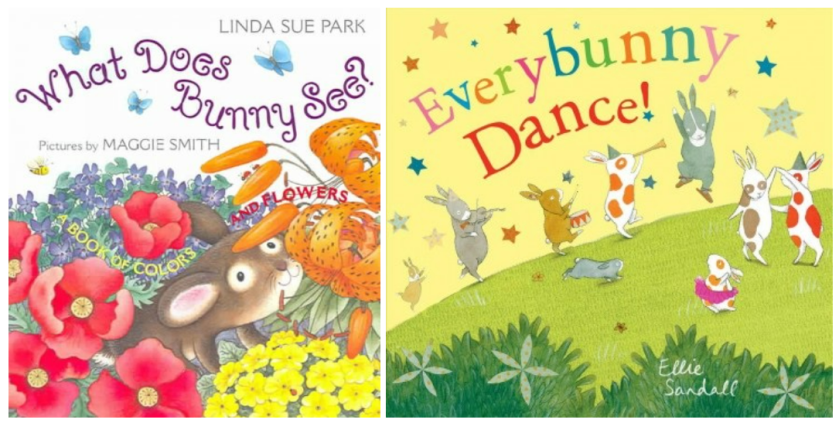
Read: What Does Bunny See? by Linda Sue Park & Maggie Smith (TT) (FT)

book cover for What Does Bunny See?

If you have a very active group, this one is fun – there’s lots of actions to mimic. If you have a very quiet group (which I did this week), it feels a little awkward. :S
Read: Everybunny Dance! by Ellie Sandall (TB)

Book cover for Everybunny Dance

Fingerplay: Here is a Bunny (TT) (TB) (FT)
Here is a bunny with ears so funny (bunny ear fingers, bent)
And here is his hole in the ground (make circle w/ other hand)
At the first sound he hears, he pricks up his ears (extend ears)
And hops in the hole in the ground (fingers jump into the hole)
Source: Storytime Katie

Fingerplay: Bunnies Up! (TT) (TB) (FT)
(index and middle finger make bunny ears)
Bunnies up! Bunnies down!
Hold your bunny & turn around
Bunnies up! Bunnies down!
Put your bunny on the ground
Source: One Little Librarian

This one makes a great transition to the Sleeping Bunnies song.
Counting Rhyme: Come, My Bunnies (TT) (TB) (FT)
“Come my bunnies, It’s time for bed!”
That’s what Mother Bunny said
“But first let’s count you, just to see
If all my bunnies came back to me
Bunny one, Bunny two, Bunny three . . . Oh dear!
Bunny four, Bunny five, Yes, you’re all here!
You’re the cutest little bunnies alive!
Bunny one, two, three, four, five!”
Source: King County (WA) Library System

Action Song: Sleeping Bunnies (TT) (TB) (FT)
(begin with “bunnies” asleep on the floor)
Look at all the bunnies sleeping
’Til it’s nearly noon (point to wrist)
Shall we wake them with a merry tune?
(wave hands like a conductor)
Oh so still… Are they ill?
(dramatic pause, then sing fast and clap!)
Wake up, wake up, wake up little bunnies!
(bunnies get up and hop around!)
Hop little bunnies, Hop, hop, hop
Stop little bunnies, Stop, stop, stop! (FREEZE!)
Source: King County (WA) Library System

I had two backup rhymes that I didn’t end up using.
Action Rhyme: Little Bunny Rabbit
(mime actions)
Little bunny rabbit goes hop hop hop
See how his ears go flop flop flop
See how his eyes go blink blink blink
See how his nose goes twink twink twink
Pet his white coat so soft and furry
Hop hop hop he’s off in a hurry!
Source: North Mankato Taylor Library

Song: I’m a Little Bunny
(tune of I’m a Little Teapot)
I’m a little bunny with a cotton tail
See me hopping down the trail
When I see a carrot – my ears they shake
And then, of course, a bite I take! CRUNCH!
Source: Johnson County (KS) Library

Action Song: Zoom, Zoom, Zoom!* (TT) (TB) (FT)

Craft: Bunny Ears Headband (TB) (FT)
This was a very easy craft. I freehanded two ears on pink cardstock, cut strips of brown paper, and used some pink cotton balls that we had in the craft supply closet to make bunny ear headbands. I put out crayons in case they wanted to do any decorating. They turned out pretty cute!

Picture of the craft, showing a pink cotton ball glued to the back, and two pink ears glued to the front of a brown headband.

Play Time
The toddlers have two laundry baskets of baby toys – rattles and cars, sorters and stackers, toy phones and spinners. For the older kids, I have foam blocks, soft food toys, puzzles, and a few other items that are a little more sophisticated than the baby toys. For Family Time, I gauge the overall age of the group and put out what seems right for them. We play for 5-10 minutes at the most, then I ring the bell and ask the kids to help me clean up. I think the clean up bit is good practice for them!

Goodbye Song: See You Later Alligator* (TT) (TB) (FT)

Goodbye Rhyme: Tickle the Stars* (TT) (TB) (FT)

Other books I had available for families to browse (and may work for you on this theme)
Hat Tricks – Satoshi Kitamura
I Am a Bunny – Ole Risom & Richard Scarry
The Runaway Bunny – Margaret Wise Brown & Clement Hurd
Creepy Carrots – Aaron Reynolds & Peter Brown
Wolfie the Bunny – Ame Dyckman & Zachariah OHora
Bunny in the Middle – Anika A Denise & Christopher Denise
Big Bad Bunny – Franny Billingsley & G Brian Karas
A is for Another Rabbit – Hannah Batsel
One Brown Bunny – Marion Dane Bauer & Ivan Bates
Out of a Jar – Deborah Marcero

This storytime was presented in-person on 4/10, 4/11, & 4/12/23.

Storytime Handout:

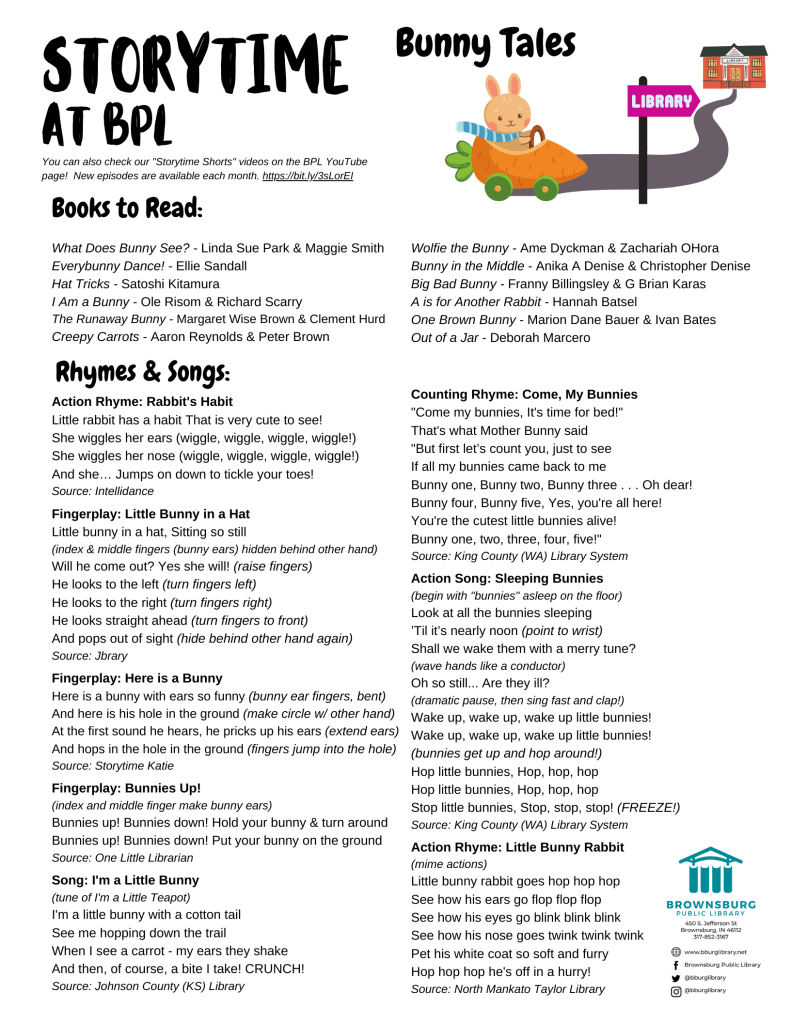
handout with book suggestions, rhyme and song lyrics.

*Lyrics to these songs can be found on the Repeated Songs & Rhymes page.

**These symbols indicate the program sessions I used the activities for:
(TT) Toddler Time, ages 1-2
(TB) Teddy Bears, ages 2-3.5
(FT) Family Time, ages 0-3.5

Storytime: Trains

From the Little Engine to the Little Caboose, trains are a storytime hit. I learned a couple of new-to-me songs in prepping for this week’s storytime, and boy, are they catchy! Be prepared to chugga-chugga and whoo-whoo all the way through your program.

Early Literacy Tip: Toddlers love playing word games — repeating rhymes, singing songs and reciting chants. Rhyming words, even if they are nonsense, help them understand that language is made up of strings and patterns of phonemes, or individual sounds. Being able to hear these in oral language develops skills that help reading written language later.

Welcome Song: Hello, Friends* (TT) (TB) (FT)**

Warm Up Song: Wake Up, Feet* (TT) (TB) (FT)
This is a repeated song that everyone seems to enjoy. I always begin and end with feet and tummies, but find two other body parts to wiggle in the middle. This week it was elbows and cheeks.

Lifting Rhyme: Toast in the Toaster* (TT) (FT)

Rhyme: This is Big, Big, Big* (FT)

Intro: Chugga, chugga, chugga, chugga, CHOO CHOO! The storytime train is pulling into the station! It’s time to celebrate trains!

I bought a wooden train whistle just for this rhyme, and everyone got excited when I gave it a toot – kids and adults alike! It actually was the inspiration for our craft today.
Action Rhyme: Choo Choo Train (TT) (TB) (FT)
Here’s a little choo choo train chugging down the track (chug arms)
Now it’s going forward (chug forward)
Now it’s going back (chug backwards)
Hear the bell ringing (ring a bell), Now the whistle blows (woo!)
What a lot of noise it makes everywhere it goes!
Source: Adventures of a Bookworm

Tickle Rhyme: Down the Track (TT) (FT)
Chugga-chugga Chugga-chugga, Choo-choo!
The train runs down the track (walk fingers up one arm)
Chugga-chugga Chugga-chugga, Choo-choo!
And then it runs right back (walk fingers down)
Source: King County (WA) Library System

Transition: If You’re Ready for a Story* (TT) (TB) (FT)

Numbers, senses, noises, scenery – there’s a lot packed into this simple book.
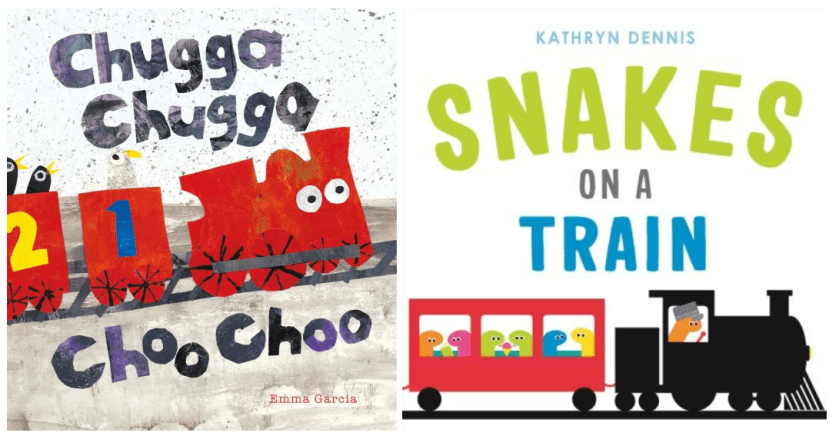
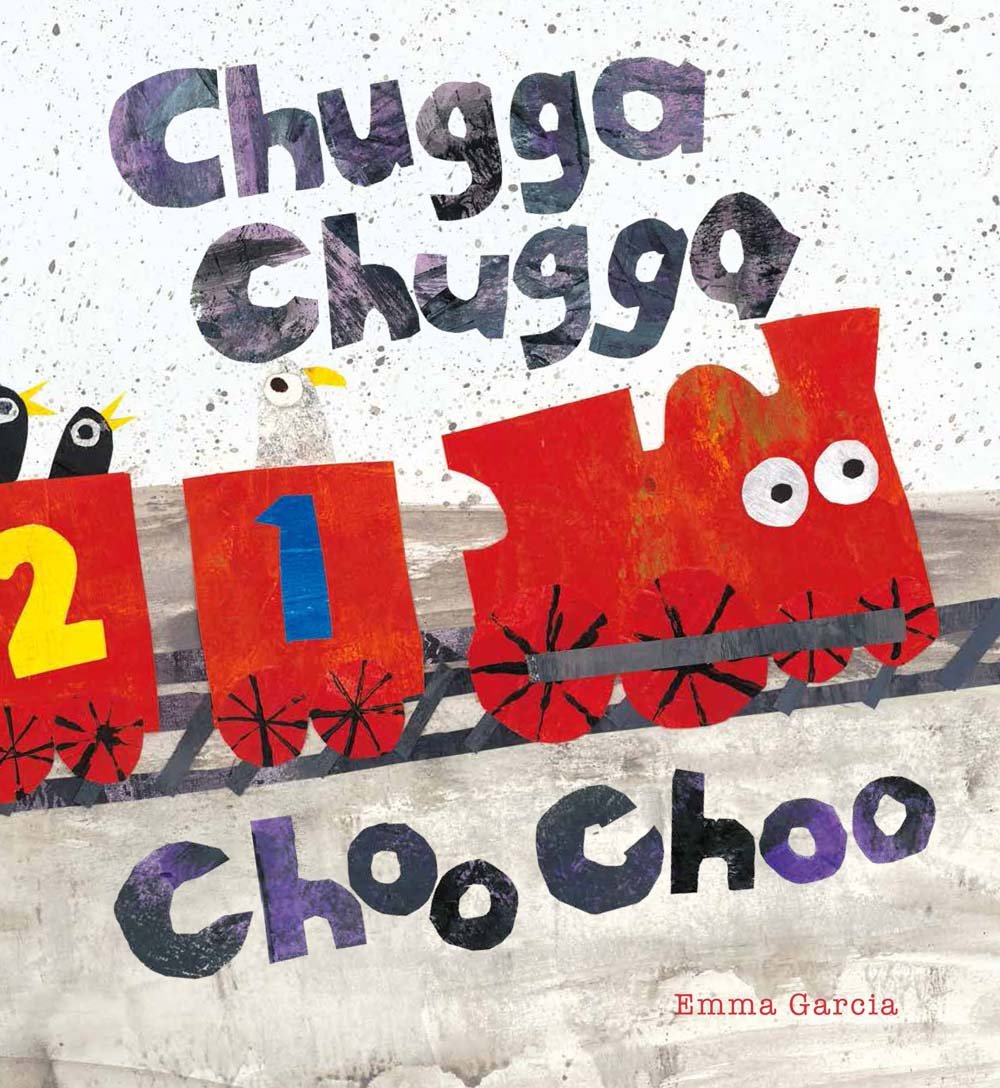
Read: Chugga Chugga Choo Choo by Emma Garcia (TT) (FT)

book cover for chugga chugga choo choo

This one is very visually appealing, but there are times that the rhyme scheme changes or is a little awkward, so be sure to practice ahead of time. I lean in to the hissing and ask the kids to help me.
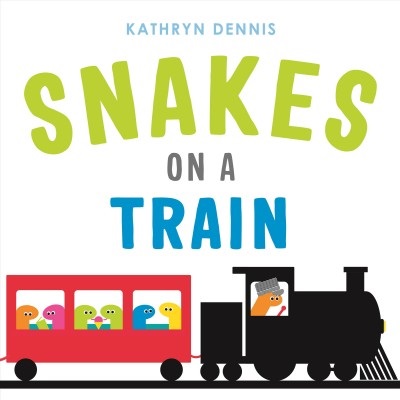
Read: Snakes on a Train by Kathryn Dennis (TB)

book cover for snakes on a train

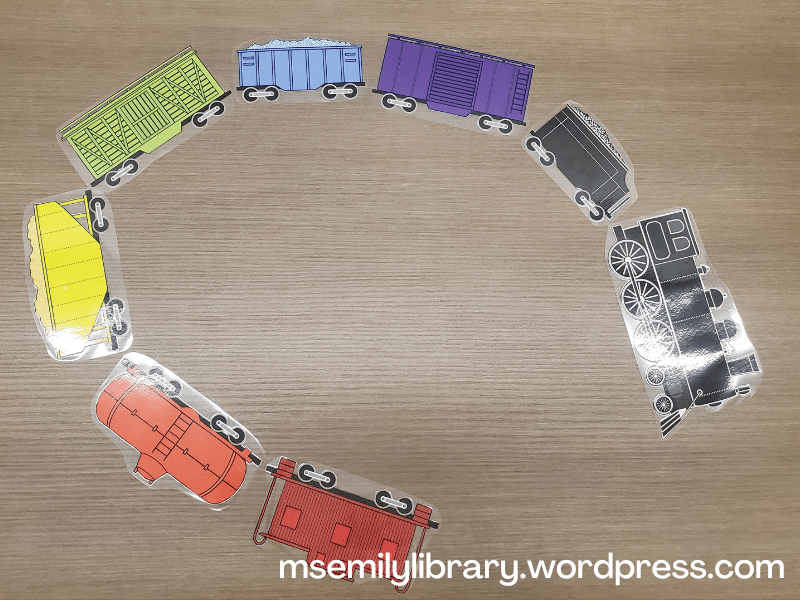
I modified this one slightly to match the train cars from Donald Crews’ Freight Train. I found these beautiful printables from kizclub.com and printed and laminated them for this flannelboard. Of course, it’s super long so it’s hard to take a picture. In my program I ended up just making two parallel lines.
Flannel/Counting Rhyme: Clickety Clack
Clickety-clack, clickety-clack,
Here comes the train on the railroad track!
Clickety-clunn, clickety-clunn, Here comes ENGINE number 1
Clickety-clew, clickety-clew, Here is COAL CAR number 2
Clickety-clee, clickety-clee, Here is BOX CAR number 3
Clickety-clore, clickety-clore, GONDOLA CAR is number 4
Clickety-clive, clickety-clive, Here comes CATTLE CAR number 5
Clickety-clicks, clickety-clicks, HOPPER CAR is number 6
Clickety-cleven, clickety-cleven, Here’s TANK CAR number 7
Clickety-clate, clickety-clate, Little red CABOOSE is number 8!
Clickety-clack, clickety-clack,
There goes the train on the railroad track! Choo-choo! Goodbye!
Source: Storytime Katie

Picture of printed and laminated train flannelboard pieces: Black engine and black coal car, purple boxcar, blue gondola car, green cattle car, yellow hopper, orange tank car, and red caboose

This one actually messed me up – after singing it, I could not get the tune of “Wheels on the Bus” in my head. This happens to me on occasion, where a tune just completely escapes me. Sigh. In any event, this is a really cute song, and I was glad to learn it.
Song: The Little Red Train Going Down the Track (TT)
There’s a little red train going down the track
Look at the wheels go clickety clack

Chorus: And the train wheels are rolling, rolling, rolling, rolling
And the train wheels are rolling, rolling right along

There’s an engine in the front and a caboose in the back
Look at those wheels go clickety clack… (chorus)

The little train goes to the top of the hill,
It goes very slow but it gets there still
It gets to the top and it goes back down
Look at the wheels go around and around (chorus)
Source: Kathy Reid-Naiman via Jbrary

After having trouble the first session with the “Little Red Train” song, I skipped it for the last two sessions and I was able to recall the Wheels on the Bus tune. Whew. Those groups really enjoyed the motions on this one.
Song: The Wheels on the Train (TB) (FT)
The wheels on the train go clickety-clack,
Clickety-clack, clickety-clack
The wheels on the train go clickety-clack,
All along the track

The whistle on the train goes toot, toot, toot…
The conductor on the train says, “All aboard!”…
The people on the train go bounce, bounce, bounce…
The engine on the train goes chug, chug, chug…
Source: Jen in the Library

I remember this one from my childhood, though we didn’t count down then, just sang it with one peanut. For some extra silliness, blow a raspberry after singing “peanut butter.” The video below isn’t the tune I remember, though, it’s more like this one.
Fingerplay: Three Peanuts (TB) (FT)
Three peanuts sat on a railorad track (hold up three fingers)
Their hearts were all a-flutter (flutter hand on chest)
Around the bend came Number 10 (make wide around motion)
Whoo-whooo (pull train whistle cord), Peanut Butter!
(count down)
Source: King County (WA) Library System

This is a barnstormer of a song – it goes fast but is so much fun.
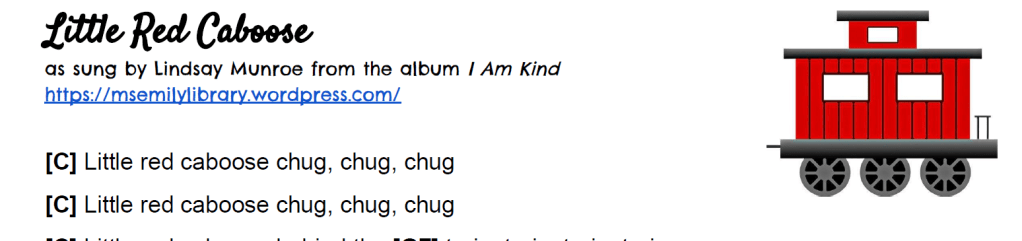
Song: Little Red Caboose (TT) (TB) (FT)
Little red caboose chug, chug, chug,
Little red caboose behind the train, train, train, train
Smokestack on its back, back, back, back
Coming down the track, track, track, track
Little red caboose behind the train, Woo-woo!

Little red caboose chug, chug, chug
Little red caboose chug, chug, chug,
Little red caboose behind the train, train, train, train
Always at the end, end, end, end
Comin’ round the bend, bend, bend, bend
Little red caboose behind the train, Woo-woo!

Always on time, time, time, time
Comin’ down the line, line, line, line
Little red caboose behind the train, train, train
Never running late, late, late, late
Comin’ through the gate, gate, gate, gate
Little red caboose behind the train, Woo-woo!
Source: Lindsay Munroe

Get a downloadable ukulele songsheet for “Little Red Caboose” here!

thumbnail for ukulele songsheet

Action Song: Zoom, Zoom, Zoom!* (TT) (TB) (FT)

Craft: Cardboard Train Whistle
I couldn’t flaunt my train whistle without letting the kids make one of their own! Essentially, we made a simple kazoo using a toilet paper tube, wax paper, and a rubber band. The instructions call for making a small hole somewhere along the exposed edge (i.e. not under the wax paper) which I pre-made. I also pre-cut circles of wax paper. I provided dot markers for decoration, but any paint or markers would work. I tried drawing a train on mine – it was not super successful. An all-over design would likely work better! Lastly, it can be tricky to “play” a kazoo – you can’t blow into it, you have to hum, so we practiced a little when they were done making theirs.

Picture of cardboard tube kazoo, with a circle of waxed paper attached to the top with a rubber band, and a crude picture of a red train engine painted on the side.

Play Time
The toddlers have two laundry baskets of baby toys – rattles and cars, sorters and stackers, toy phones and spinners. For the older kids, I have foam blocks, soft food toys, puzzles, and a few other items that are a little more sophisticated than the baby toys. For Family Time, I gauge the overall age of the group and put out what seems right for them. We play for 5-10 minutes at the most, then I ring the bell and ask the kids to help me clean up. I think the clean up bit is good practice for them!

Goodbye Song: See You Later Alligator* (TT) (TB) (FT)

Goodbye Rhyme: Tickle the Stars* (TT) (TB) (FT)

Other books I had available for families to browse (and may work for you on this theme)
Mr. Complain Takes the Train – Wade Bradford & S. britt
Freight Train – Donald Crews
Listen Up! Train Song – Victoria Allenby
And the Train Goes… – William Bee
I Like Trains – Daisy Hirst
I Can Make a Train Noise – Michael Emberley & Marie-Louise Fitzpatrick
How to Train a Train – Jason Carter Eaton & John Rocco
Choo-Choo School – Amy Krouse Rosenthal & Mike Yamada
I’m Fast! – Kate & Jim McMullan

This storytime was presented in-person on 4/3, 4/4, & 4/5/23.

Storytime Handout:

storytime handout with suggested books, rhyme, and song lyrics.

*Lyrics to these songs can be found on the Repeated Songs & Rhymes page.

**These symbols indicate the program sessions I used the activities for:
(TT) Toddler Time, ages 1-2
(TB) Teddy Bears, ages 2-3.5
(FT) Family Time, ages 0-3.5

New Page – StoryWalk Resources!

You may have noticed a new menu item above, StoryWalk Resources. I recently volunteered with a colleague at my library (also named Emily, incidentally) to take on the responsibility of our two StoryWalk paths. One is at a local park and a second one winds around our building.

A StoryWalk is an idea from librarian Anne Ferguson of Montpelier, VT and has developed with the help of Rachel Senechal, formerly of the Kellogg-Hubbard Library. A picture book is displayed, page spread by page spread, along a walking or nature path. Those walking along the path can read the book as they go. Some parks and libraries buy two copies of the book and cut the pages to display. Others get special permission from the publisher to reproduce the book digitally and print it. Both ways work with copyright law to provide the story to the public legally.

Photo credit Emily Fox

I’ve visited StoryWalks in other communities and have always been impressed by those that incorporate fun questions, prompts for movement, and literacy tips in addition to the pages of the book. It’s an opportunity to model dialogic reading to caregivers, as well as make the experience more engaging and interactive. I knew that I wanted to add these prompts to our signs going forward.

One StoryWalk had already been changed recently, but it was time to update the one at the library. The other Emily and I worked to think about prompts for each page spread of our selected book, A Way With Wild Things by Larissa Theule and Sara Palacios. We tried to cover the Early Literacy Practices promoted by Every Child Ready to Read: Talk, Sing, Read, Play, and Write (we didn’t find a great spot for Write this time, but it’s definitely in the cards for future books). We also gave prompts for movement and some that promoted math and social emotional learning.

We ended up not using all of the prompts we came up with, since this StoryWalk only has 10 posts. Several page spreads were combined (thankfully each post has a pretty big display area.) Figuring out how to print and format all of our prompts was another challenge (how long are they? How wide can they be? What font size is legible?!) All in all, it took some time and effort to get it all together. If you are the “minder” of your StoryWalk, I’m sure you know exactly what I mean.

Organizing page spreads. Photo credit to Emily Fox

I started to wonder – what would make this easier? And how can I maximize the usefulness of the time and work we’ve put in? Wouldn’t it be cool if someone else could use the work I’ve done?

An idea hatched. Surely other librarians are going to the work of writing engaging and enriching prompts for their StoryWalks (I’ve seen them!) Perhaps if we pooled our resources, it would make it easier for everyone going forward. A database of books that work well for StoryWalks, and the additional written materials to go along.

Of course, no one has to use prompts found here verbatim. They can be a jumping off point, an inspiration. Maybe you’ve got ideas for every page in the book except one and are stumped – looking at others’ ideas can fill in. Every community is different and it’s great to cater to yours.

So in launching the webpage there’s only our original document available as of this writing. It looks mighty lonely there. If you have done the work on other books and would be willing to submit them, I’d love to add your contribution. Even if you have different prompts for a book that’s already listed, I’ll take them! Each page spread may soon have a bullet point list of options to choose from.

Happy StoryWalking, everyone!

The two Emilys!

Storytime: The Seeds of Spring

Springtime in Indiana is capricious, but thankfully we had some warm days, some rain, and some early blooms to reflect on. Although an ostensibly “springtime” theme, I focused mostly on seeds and plants. I’ve done gardening themes before, and I’ve also done a couple of sessions on bugs (here and here) that might also fit into this theme, if you are looking for more ideas.

Early Literacy Tip: Learning directional words like up, down, above, and below is foundational to learning to write letters. When you use words like these with your child and you gesture to show what you mean, you’re setting them up to learn how to write later on.

Welcome Song: Hello, Friends* (TT) (TB) (FT)**

Warm Up Song: Wake Up, Feet* (TT) (TB) (FT)
This is a repeated song that everyone seems to enjoy. I always begin and end with feet and tummies, but find two other body parts to wiggle in the middle. This week it was fingers and knees.

Lifting Rhyme: Toast in the Toaster* (TT) (FT)

Rhyme: This is Big, Big, Big* (FT)

Intro: This week is the first official day of spring. Every day, the days are getting a little bit longer, the weather changing like the season, but moving toward getting a little warmer, and the little seeds that have been in the ground all winter long are starting to wake up!

As simple as this is, it worked really well for all three groups.
Fingerplay: During the Spring (TT) (TB) (FT)
During the spring, it often showers (flutter fingers down)
Or the sun shines for many hours (form circle with arms)
Both are very good for the flowers! (cup hands, extend arms)
Source: Storytime Katie

Fingerplay: Dig a Little Hole
Dig a little hole, Plant a little seed
Pour a little water, Pull a little weed
Chase a little bug, Heigh-ho, there he goes!
Give a little sunshine, Grow a little rose
Credit: SurLaLune Storytime via Storytime Katie

Transition: If You’re Ready for a Story* (TT) (TB) (FT)

Read: A Seed Grows by Antoinette Portis (TT) (FT)

What a beautiful book this is. I love its playfulness and gentleness.
Read: How to Say Hello to a Worm by Kari Percival (TB)

Fingerplay: Five Plump Peas
Five plump peas in a peapod pressed (make a fist and cover with the other hand)
One grew, two grew, and so did all the rest (raise all fingers on first hand one by one)
they grew, & they grew, & they grew, & never stopped (hands get wider and wider)
They grew SO BIG that the peapod… POPPED! (hands spread as wide as possible, then clap!)
Source: Carole Stephens

Rhyme: Be A Seed
Be a seed, small and round
Sprout, sprout, sprout up from the ground.
Shake your leaves for all to see
Stretch your arms up, you’re a tree!
Source: Jbrary

Action Rhyme: A Big Green Leaf (TT) (TB) (FT)
(tune of A Ram Sam Sam)
A big green leaf, a big green leaf (hold hands apart)
Little ladybug (pinch fingers close)
On a big green leaf (x2)

A bumblebee- BZZ! (tickle) A bumblebee- BZZ! (tickle)
And a little ladybug On a big green leaf (x2)
Source: Storytime in the Stacks

Scarf Song: One Bright Scarf (TT) (TB) (FT)
One bright scarf waiting for the wind to blow
Toss it up high, and wave it down low
Wiggle it fast, and wiggle it slow (hide the scarf)
Hey! Where did it go? (bring out) Here it is!
Source: Jbrary

Scarf Rhyme: Here is a Green Leaf (TT) (TB) (FT)
(start by crumpling scarf between both hands)
Here is a green leaf, and here is a green leaf (show thumbs)
and that, you see, makes two
Here is the bud that makes the flower (show a tiny bit of the scarf)
Now watch it bloom for you! (open hands to let scarf expand)
Source: Jbrary

Scarf Rhyme: Little Seed (TB) (FT)
(start by scrunching scarf in one hand)
Little seed in the ground
Sitting oh, so still
Little seed, will you sprout?
YES, I WILL! (pull scarf up out of hand)
Source: Lady Librarian Life

Ukulele Song: Mr. Sun
Oh, Mr. Sun, Sun, Mr. Golden Sun
Please shine down on me
Oh, Mr. Sun, Sun, Mr. Golden Sun
Hiding behind a tree

These little children are asking you
To please come out so we can play with you

Oh, Mr. Sun, Sun, Mr. Golden Sun
Please shine down on me
Source: Raffi (from the album Singable Songs for the Very Young)

Get a downloadable ukulele songsheet for “Mr. Sun” here!

thumbnail of Mr. Sun ukulele songsheet

Action Song: Zoom, Zoom, Zoom!* (TT) (TB) (FT)

Craft: Dot Painted Flowers
Pretty simple. I used two die cuts to make flowers on white construction paper, and provided light blue backing paper, glue sticks, and dot markers.
I’d also read a great article on how radishes are a great veggie for children to grow, since they are very quick to both sprout and mature. I bought a package of radish seeds and gave them out with some simple instructions.

Play Time
The toddlers have two laundry baskets of baby toys – rattles and cars, sorters and stackers, toy phones and spinners. For the older kids, I have foam blocks, soft food toys, puzzles, and a few other items that are a little more sophisticated than the baby toys. For Family Time, I gauge the overall age of the group and put out what seems right for them. We play for 5-10 minutes at the most, then I ring the bell and ask the kids to help me clean up. I think the clean up bit is good practice for them!

Goodbye Song: See You Later Alligator* (TT) (TB) (FT)

Goodbye Rhyme: Tickle the Stars* (TT) (TB) (FT)

Other books I had available for families to browse (and may work for you on this theme)
And Then it’s Spring – Julie Fogliano & Erin E. Stead
If You Plant a Seed –
Kadir Nelson
Flower Garden –
Eve Bunting & Kathryn Hewitt
On a Snow-Melting Day –
Buffy Silverman
A Seed is Sleepy –
Dianna Hutts Aston & Sylvia Long
Emile and the Field –
Kevin Young & Chioma Ebinama
My Garden/Mi Jardín –
Rebecca Emberley
Lola Plants a Garden –
Anna McQuinn & Rosalind Beardshaw
How a Seed Grows –
Helene J. Jordan & Loretta Krupinski
Planting a Rainbow –
Lois Ehlert

This storytime was presented in-person on 3/20, 3/21, & 3/22/23.

Storytime Handout:

*Lyrics to these songs can be found on the Repeated Songs & Rhymes page.

**These symbols indicate the program sessions I used the activities for:
(TT) Toddler Time, ages 1-2
(TB) Teddy Bears, ages 2-3.5
(FT) Family Time, ages 0-3.5

Storytime: Pizza

Sometimes I look back through themes I did at my old library. Sometimes they make me hungry! Here’s another in-person redo of a theme I only ever did virtually before.

Our program happened to land on Pi Day (and the day before and after) entirely accidentally. What a perfect tie-in!

Early Literacy Tip: Play gives you and your children lots of opportunities to pretend. As you are playing with your children, make a point of adding in a word or two they may not know, like “kneading” dough or “ladling” sauce. Children will find it easier to remember these words because they are hearing them and using them while being involved in imaginative play.

Welcome Song: Hello, Friends* (TT) (TB) (FT)**

Warm Up Song: Wake Up, Feet* (TT) (TB) (FT)
This is a repeated song that everyone seems to enjoy. I always begin and end with feet and tummies, but find two other body parts to wiggle in the middle. This week it was shoulders and fingers.

Lifting Rhyme: Toast in the Toaster* (TT) (FT)

Rhyme: This is Big, Big, Big* (FT)

Intro: There’s a really important holiday in March, does anyone know what it is? It’s Pi Day! You’ll learn more about Pi the number someday, but today we’re celebrating the very best pie of all, the pizza pie! [this got laughs from the grownups]

I adapted this one to be a little more specific to pizza.
Action Song: I Am Hungry
(tune of Frère Jacques)
I am hungry, I am hungry
Grumble, rumble, Grumble rumble (rub tummy)
I think I’ll eat some pizza, I think I’ll eat some pizza
Yum, yum, yum! Yum, yum, yum! (mime eating)
Source: librionyian

Fingerplay: Pat A Cake Pizza Man
Pat a cake, pat a cake, pizza man
Make me a pizza as fast as you can
Roll it, Toss it, and sprinkle it with cheese
Put in the oven And bake it fast please!
Source: Mansfield/Richland County Public Library (OH)

Transition: If You’re Ready for a Story* (TT) (TB) (FT)

Not everyone acted out everything, but there was lots of kneading the dough and sprinkling of pretend cheese!
Read: Pete’s a Pizza by William Steig (TT) (FT)

Pete's a Pizza book cover

This one didn’t go over as well, perhaps the group was too distracted to really connect the pictures with the very simple text.
Read: Pizza Party! by Grace Maccarone & Emily Arnold McCully (TB)

Pizza Party book cover

Tickle: Pizza Pickle Pumpernickel (TT)
Pizza, pickle, pumpernickel, (bounce)
My little one shall have a tickle! (tickle)
One for your nose, And one for your toes,
And one for your tummy, where the pizza goes!
Source: King County (WA) Library System

I get that the writer of this rhyme didn’t want to repeat colors, but that means we leave out the most popular topping (red pepperoni) and the cheese is orange, which looks a little odd. I think next time I might redo the cheese as white, and make a couple more blobs of it. At first I was kind of dreading making tons and tons of little topping pieces, but realized that I really only need 3 or 4 of each to make the pizza look full, even if that would be terrible coverage on an actual pizza!
Rhyme: Pizza, Pizza, What Do You See? (TT) (FT)
Pizza dough, Pizza dough what do you see?
I see red sauce covering me
Red sauce, Red sauce, what do you see?
I see white mushrooms being added to me
continue with different colored ingredients, such as black olives, brown sausage, green peppers, purple onions, yellow pineapple, red pepperoni, and end with orange white cheese, then:
Orange cheese, orange cheese, what do you see?
I see a yummy pizza that looks good to me.
Yummy pizza, yummy pizza what do you see?
I see hungry children THAT ARE GOING TO EAT ME!
Source: King County (WA) Library System

Flannel pizza with different colored toppings (as mentioned in the lyrics)

Action Rhyme: Pizza Maker, Pizza Maker Turn Around (TT) (TB) (FT)
Pizza maker, pizza maker turn around
Pizza maker, pizza maker touch the ground
Pizza maker, pizza maker give the dough a toss
Pizza maker, pizza maker ladle on the sauce
Pizza maker, pizza maker sprinkle on the cheese
Pizza maker, pizza maker touch your knees
Pizza maker, pizza maker put it in the oven
Pizza maker, pizza maker press the oven button
Pizza maker, pizza maker rub your tummy
Pizza maker, pizza maker eat some pizza! Yummy!
Source: Jen in the Library

Rhythm Sticks Intro: Let’s practice our rhythm sticks. Rest them on our shoulders, tap fast and loud, soft and quiet, rub them together, roll them in a circle (TB)

This is a good warmup for rhythm sticks and gets everyone involved.
Rhythm Stick Song: Count the Beat (TB)
(tune of Wheels on the Bus)
1 2 3 4 5 6 7
8 9 10
8 9 10
1 2 3 4 5 6 7
8… 9… 10!
Source: Sarah French

There are lots of versions of this on YouTube. I especially liked how she went on a walk and saw a cat, dog, bee, and alligator!
Rhythm Sticks Song: The Pizza Song (TB) (FT)
(tune of Skip to My Lou)
Roll, roll, roll the dough,
Roll, roll, roll the dough
Roll, roll, roll the dough,
Roll the dough together! (put both sticks on the ground and roll)

Stir, stir, stir the sauce… (use sticks to stir in a circle)
Spread, spread, spread the sauce… (roll one stick on the ground using 2nd)
Grate, grate, grate the cheese (rub 1 stick down the other)
[Chop some veggies/pepperoni, anything you like]
Chop, chop, chop-chop-chop (tap 1 stick on horizontal 2nd)
[Put it in the oven, set timer, let’s go for a walk!]
Lou, lou, skip to my lou… (swing arms with sticks in them)
[Ding, the timer went off! Our pizza is ready, take it out of the oven. Cut a slice, in a triangle, then eat it]
Source: Harbor Preschool Music YouTube

Flannel/Clapping Song: P-I-Z-Z-A (FT)
(tune of B-I-N-G-O)
There is a treat that’s good to eat and pizza it its name-a
P-I-Z-Z-A! P-I-Z-Z-A! P-I-Z-Z-A!
And pizza is its name-a
(spoken) 
Oh yum! I’m gonna eat one!

There is a treat that’s good to eat and pizza it its name-a
(clap)-I-Z-Z-A! (clap)-I-Z-Z-A! (clap)-I-Z-Z-A!
And pizza is its name-a
(Continue until you are clapping all the letters.)
Credit: Jen in the Library

I used Jen in the Library’s post as a template, but decided to make my pizza slices double-sided, based on the background color of my felt board. The opposite side of the full slice looked like just the pizza crust that was gnawed on, effectively becoming a placeholder for our claps. I like the way it turned out!

We’ve eaten some pizza, now my body is asking for a little movement.
Action Song: Head, Shoulders, Knees, and Toes (TT) (TB) (FT)
(start slow and repeat, speeding up)
Head, shoulders, knees, and toes (knees and toes!)
Eyes and ears and a mouth and nose!
Head, shoulders, knees, and toes (knees and toes!)
Source: traditional

Action Song: Zoom, Zoom, Zoom!* (TT) (TB) (FT)

Craft: Pizza Pretend Play Kit
I gave everyone the option to either glue down their pieces to make an actual craft, or to pick out pieces to put in a little baggie to “make” pizzas at home for their families. The toppings were just foam shapes we had – I cut down much larger pieces into smaller pieces that were either square or triangular or thin strips based on what ingredient they represented. The sauce is a wavy shape of construction paper, and the cheese is short pieces of yarn. Craft idea adapted from Storytime Katie..

Play Time
The toddlers have two laundry baskets of baby toys – rattles and cars, sorters and stackers, toy phones and spinners. For the older kids, I have foam blocks, soft food toys, puzzles, and a few other items that are a little more sophisticated than the baby toys. For Family Time, I gauge the overall age of the group and put out what seems right for them. We play for 5-10 minutes at the most, then I ring the bell and ask the kids to help me clean up. I think the clean up bit is good practice for them!

Goodbye Song: See You Later Alligator* (TT) (TB) (FT)

Goodbye Rhyme: Tickle the Stars* (TT) (TB) (FT)

Other books I had available for families to browse (and may work for you on this theme)
Secret Pizza Party – Adam Rubin & Daniel Salmieri
How to Eat Pizza –
Jon Burgerman
Pizza Day –
Melissa Iwai
Every Night Is Pizza Night –
J. Kenji López-Alt & Gianna Ruggiero
Little Red Hen (Makes a Pizza) –
Philemon Sturges & Amy Walrod
The Pizza That We Made –
Joan Holub & Lynne Cravath
Pizza Pig –
Diana Murray & Maria Karipidou
Little Nino’s Pizzeria –
Karen Barbour
The Princess and the Pizza –
Mary Jane Auch & Herm Auch
Pete the Cat & the Perfect Pizza Party –
Kimberly & James Dean

This storytime was presented in-person on 3/13, 3/14, & 3/15/23.

Storytime Handout:

Handout including suggested books, rhyme and song lyrics.

*Lyrics to these songs can be found on the Repeated Songs & Rhymes page.

**These symbols indicate the program sessions I used the activities for:
(TT) Toddler Time, ages 1-2
(TB) Teddy Bears, ages 2-3.5
(FT) Family Time, ages 0-3.5