
Every so often it’s nice to mix things up a little! This week, I went back to a training I’d attended in 2019 about incorporating STEM into storytimes, created by the Franklin Institute, a science museum in Philadelphia. They put together a packet of material called “Leap into Science” and made it available for free! This focused on plans for a preschool, elementary, and family program that incorporated literacy/storytime with the science of wind. Since then, there have been two other topics, Light & Shadow and Balance. You can find the free materials, including training videos and the full PDF curricula, at http://leap.fi.edu/resources.
In the past, I had presented this to a slightly older audience, more preschool age, as well as a separate program for families with all ages of child, and basically followed the outline in the curriculum for these programs. With my current group of kids up to age 3.5, I simplified, and ran the program as a half-storytime, half-science-station situation. It worked well, and I think my kids enjoyed the novelty and the hands-on elements.


Early Literacy Tip: You can encourage scientific thinking by asking children to observe, ask questions, make predictions, test their ideas, and learn from repeated attempts. These practices strengthen critical thinking skills that are essential in both science and literacy learning. Focusing on the process of science rather than a specific product or outcome frees children and to explore and take risks.
Welcome Song: Hello, Friends* (TT) (TB) (FT)**
Warm Up Song: Wake Up, Feet* (TT) (TB) (FT)
This is a repeated song that everyone seems to enjoy. I always begin and end with feet and tummies, but find two other body parts to wiggle in the middle. This week it was knees & fingers.
Lifting Rhyme: Toast in the Toaster* (TT) (FT)
Rhyme: This is Big, Big, Big* (TB)
Intro: A few years ago I had the opportunity to do a training on incorporating STEM into storytime. The science part of today’s storytime was developed by the Franklin Institute, a science museum in Philadelphia. Our goal today is to have fun exploring the wind and to feel like scientists. So KIDS get to be scientists- explore and ask questions, make predictions, and test and explore possible answers. Caregivers –your job today is to help your scientists. Ask them open ended questions, give them help if they need it, but allow your kiddos to take the lead!
Science Talk: Breeze Vs. Gust (TT) (TB) (FT)
We had a discussion about what they already know about wind, and introduced the vocabulary of “breeze” vs. “gust.”
Have you ever been outside on a windy day?
How did it feel?
What did you see?
Let’s make our own wind! – hold your hand in front of your face and blow into it – 3, 2, 1, GO!
What did you notice? How did it feel?
Who made a soft, gentle wind? What did that feel like? A soft, gentle wind is called a breeze.
Who made a strong, hard wind? What did you notice? A strong, hard wind is called a gust.
Okay, everyone blow a breeze – gentle.
Now everyone blow a gust – strong.
Stand up – let’s see what kind of wind we can make with this. I used a large plastic tub lid to wave a gentle breeze at the group.
How did that feel? What did you see?
Look at clothes and hair as I do it again.
Predicting – if I wave a strong gust toward you, how will it feel different?
Transition: If You’re Ready for a Story* (TT) (TB) (FT)
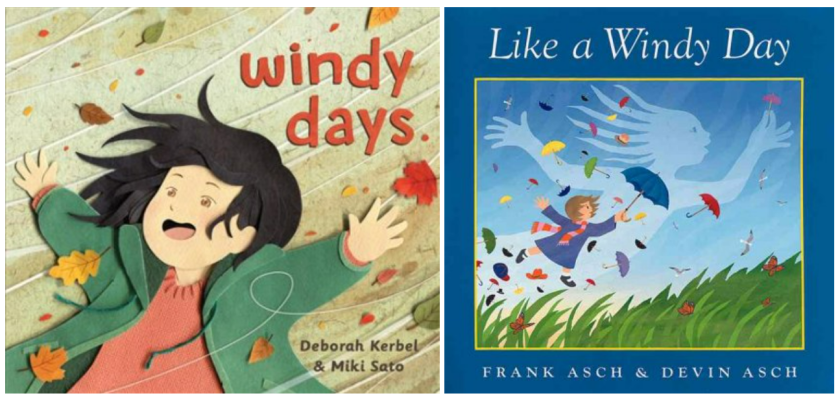
As I introduced both books, I asked if the group could tell it’s supposed to be windy, and what clues on the cover let them know.
Read: Like a Windy Day by Frank Asch & Devin Asch (TT)
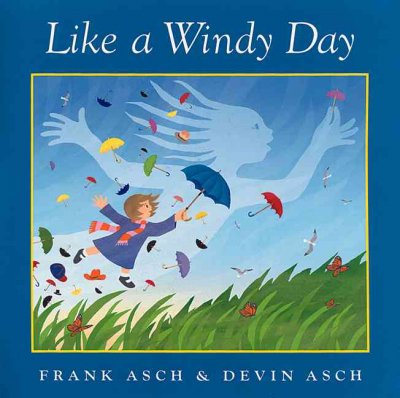
This one is great since it uses the language of breeze and gust. And the illustrations are gorgeous.
Read: Windy Days by Deborah Kerbel & Miki Sato (TB) (FT)

We handed out scarves for our rhymes.
Scarf Rhyme: Wind, Oh Wind (TT) (TB) (FT)
Wind, oh wind, Oh wind I say
What are you blowing away today?
Scarves, scarves, scarves, I say
I am blowing the scarves away, today
What else might the wind blow? Leaves, hats…?
Source: King County (WA) Library System
Scarf Rhyme: Windmills (TT) (TB) (FT)
The wind blows high (wave scarves/hands high)
And the wind blows low (wave scarves low)
Round and round the windmills go (roll arms or wave scarf in a circle)
Sometimes fast, and sometimes slow (roll fast, then slow)
And that is how the wind blows (wave scarf/hands)
Source: Adventures in Storytime
Scarf Rhyme: I See the Wind (TT)
(mime the object with scarves)
I see the wind when the leaves dance by
I see the wind when the clothes wave “Hi!”
I see the wind when the trees bend low
I see the wind when the flags all blow
I see the wind when the kites fly high
I see the wind when the clouds float by
I see the wind when it blows my hair
I see the wind ‘most everywhere!
Source: Mild-Mannered Librarian
Scarf Song: Noisy Wind (TT) (TB) (FT)
(tune of The Farmer in the Dell)
I like the noisy wind, I like the noisy wind
It roars and mutters and shakes the shutters
I like the noisy wind!
I like the noisy wind, I like the noisy wind
It flaps the flag and rustles my bag
I like the noisy wind!
Source: Mild-Mannered Librarian
Science Stations
After doing a few songs and rhymes, we brought our scarves back to put away, and I explained the stations. My Toddler Time group doesn’t usually do a craft, so they had the first three stations only, but Teddy Bears and Family Time also included making wind detectors.
Station 1: Leaf Blower (TT) (TB) (FT)
Fabric leaves, foam leaves, flat paper, and crumpled paper were available to move using a paper fan, a folded fan, squeeze bottles, and fish squirter bath toys. I also provided a yardstick in case they wanted to measure how far their leaves blew.


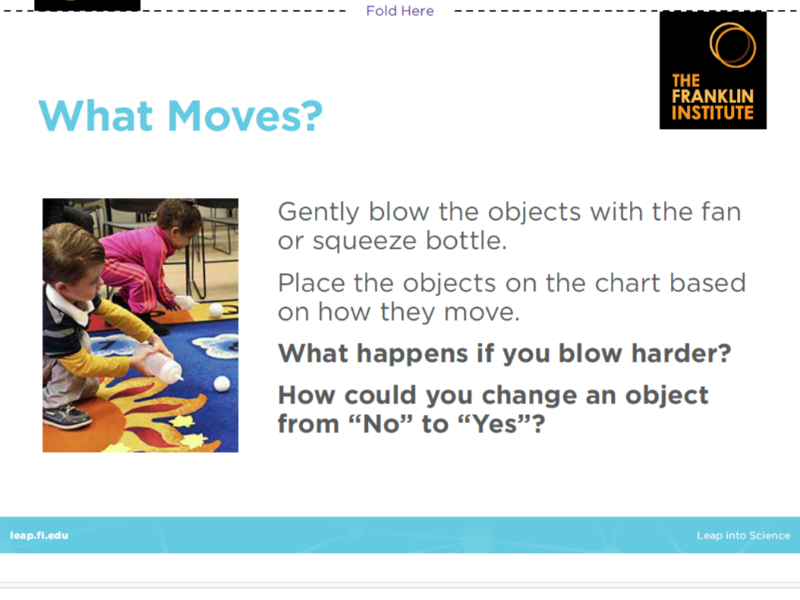
Station 2: What Moves? (TT) (TB) (FT)
Using the same tools (paper fan, folded fan, squeeze bottles and fish squirters), kids could test different objects and sort them into “easy to move” and “hard to move” bins. I collected random objects such as plastic eggs, tissues, pompoms, cotton balls, feathers, and fabric leaves for the “easy to move” items, and rocks, large 2″ buttons, binder clips, plastic turtles, clothespins, little bottles of bubble solution, and trees and signs from our train set for the “hard to move” items.

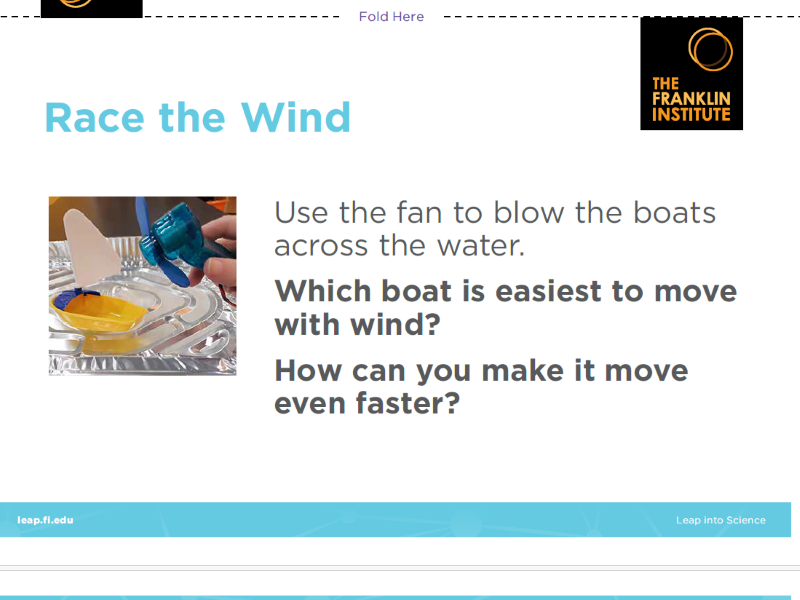
Station 3: Race the Wind (TT) (TB) (FT)
Boats with different kinds of sails float in a plastic tub of water. Handheld battery powered fans were available to test them out (not pictured). This was a science experiment on my part – I originally made boats with household sponges (which I’d seen instructions for online), but unfortunately my boats just instantly absorbed water and sank. I guess there are different densities of sponge and mine just didn’t work. Instead, I used these small plastic yogurt containers that I had a large stash of. After taping the mast and sail to the front, I had to counterbalance them with coins taped to the other side. It was a bit of a nail-biter to figure it all out, but in the end, the boats worked well for our station. Definitely reinforces the fact that programmers need to try it out before putting it out for the kids!

Station 4: Flying Colors (TB) (FT)
This station acted as our craft, and the idea is to make something that detects a breeze and a gust in different ways. The example I made and was featured in the curriculum is a craft stick with a feather, crepe paper streamer, and piece of yarn. The idea being that maybe only the feather will move in a very light breeze, and the heavier yarn may only move in a strong gust. For older kids, I may not have created an example, letting them be creative and test different designs, but our group only had a limited amount of time and I wanted them to leave with a finished wind detector. There was a larger fan with variable speeds available for them to test their creations.


Science Debrief:
How did you move things with wind today?
How did you make a breeze? A gust?
Did anything happen that surprised you?
How did you feel like a scientist today? When did you make a guess about something and test it? Was there a time when you tried something over and over? Did you have fun?
Thank you for doing great work as scientists. In the next few weeks – remember to keep your scientist hats on and notice and observe how objects move in the wind outside or at home.
Action Song: Zoom, Zoom, Zoom!* (TT) (TB) (FT)
Play Time
The toddlers have two laundry baskets of baby toys – rattles and cars, sorters and stackers, toy phones and spinners. For the older kids, I have foam blocks, soft food toys, puzzles, and a few other items that are a little more sophisticated than the baby toys. For Family Time, I gauge the overall age of the group and put out what seems right for them. We play for 5-10 minutes at the most, then I ring the bell and ask the kids to help me clean up. I think the clean up bit is good practice for them!
Goodbye Song: See You Later Alligator* (TT) (TB) (FT)
Goodbye Rhyme: Tickle the Stars* (TT) (TB) (FT)
Other books I had available for families to browse (and may work for you on this theme)
Kite Day – Will Hillenbrand
The Wind Blew – Pat Hutchins
Gusts and Gales – Josepha Sherman & Omarr Wesley
Kate, Who Tamed the Wind – Liz Garton Scanlon & Lee White
I Am the Wind – Michael Karg & Sophie Diao
Wild Is the Wind – Grahame Baker-Smith
Windblown – Édouard Manceau
The Windy Day – G. Brian Karas
Someone Bigger – Jonathan Emmett & Adrian Reynolds
This storytime was presented in-person on 10/9, 10/10, & 10/11/23.
Storytime Handout:

*Lyrics to these songs can be found on the Repeated Songs & Rhymes page.
**These symbols indicate the program sessions I used the activities for:
(TT) Toddler Time, ages 1-2
(TB) Teddy Bears, ages 2-3.5
(FT) Family Time, ages 0-3.5

 Storytime with Ms. Emily Library
One thought on “STEM Storytime: Windy Days”