Storytime: City Life

I am still reusing, revamping, and retooling storytime themes that I first presented at a previous library. I do have a slightly different age group (skewing younger) and my outlines tend to have more extension activities and fewer books, so none have been exactly the same as what came before.

I opened up our “fall” season (August – December) with sessions on City Life and Country Life. There are great books concentrating on both, and I’d noticed some newer and different titles that my old library didn’t have. I also still do a virtual program – “Storytime Shorts” that highlights three extension activities, three books, a craft idea, and an early literacy tip. A previous episode was on transportation and used three of my go-to city rhymes and songs. To offer three fresh ones, I was inspired to write a new rhyme about taxi cabs, patterned after Pat-a-Cake. It isn’t something that comes naturally to me, but it was fun to play around with the words and rhythm and rhyme to find a poem that flows. And it worked well in practice! That was exciting to see the kids giggling while we “roll… and STOP!”
Early Literacy Tip: Rhymes like The Hippopotamus on the City Bus call attention to the fact that “hip” is just one part of the bigger word “hippopotamus.” Also, when we complete the verses for cow, sheep, and snake, we show how familiar animal sounds can be found in other words that we regularly use. Recognizing and playing with the smaller sounds in words is called phonological awareness. Researchers have recognized this as a critical pre-reading skill that helps kids sound out words when they begin to learn how to read.

Welcome Song: Hello, Friends* (TT) (TB) (FT)**

Warm Up Song: Wake Up, Feet* (TT) (TB) (FT)
This is a repeated song that everyone seems to enjoy. I always begin and end with feet and tummies, but find two other body parts to wiggle in the middle. This week it was elbows & cheeks.

Lifting Rhyme: Toast in the Toaster* (TT) (FT)

Rhyme: This is Big, Big, Big* (TB) (FT)

Intro: This week and next week, we’ll be talking about city life and country life. Some of us might know what that’s like, but I live in a place that’s kind of in between a big city and the country, and you might, too. Our town is very solidly “suburban.”

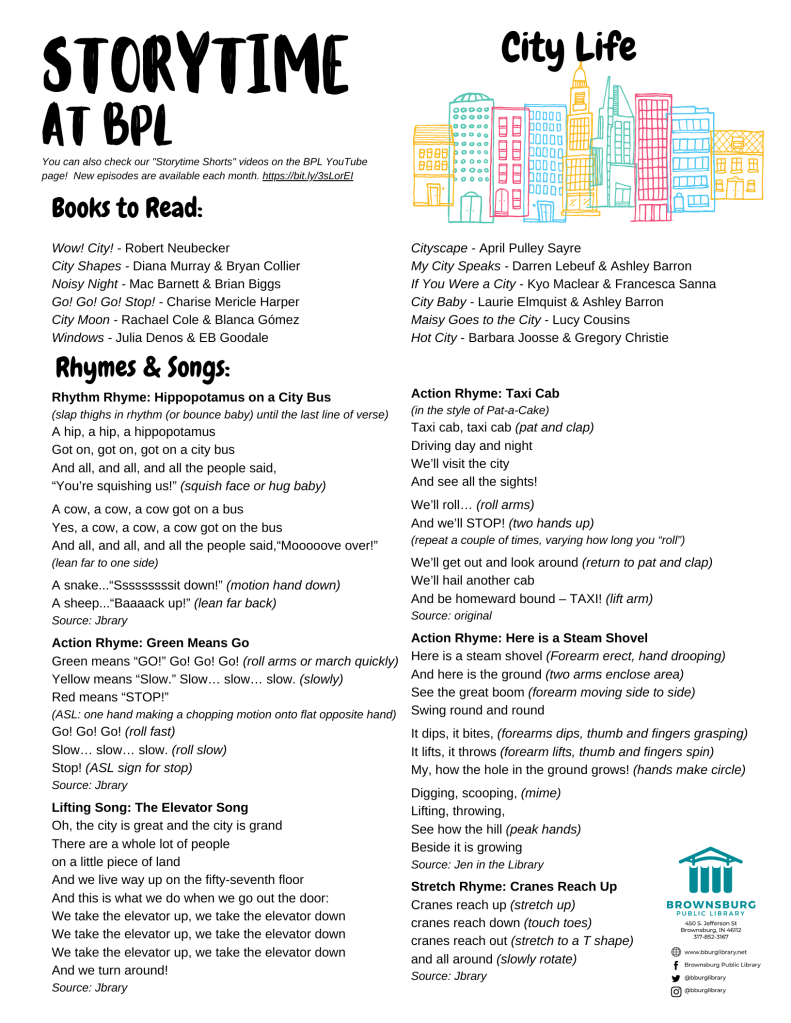
Rhythm Rhyme: Hippopotamus on a City Bus (TT) (TB) (FT)
(slap thighs rhythmically until the last line of each verse)
A hip, a hip, a hippopotamus
Got on, got on, got on a city bus
And all, and all, and all the people said,
“You’re squishing us!” (squish face or hug baby)

Additional verses:
A cow, a cow, a cow got on a bus
Yes, a cow, a cow, a cow got on the bus
And all, and all, and all the people said,“Mooooove over!”
(lean far to one side)
A snake…“Sssssssssit down!” (motion hand down)
A sheep…“Baaaack up!” (lean far back)
Source: Jbrary

Transition: If You’re Ready for a Story* (TT) (TB) (FT)

The text on this one is super simple, and the illustrations really give a lot to look at and talk about. I didn’t show every page, but it is an easy one to skip around.
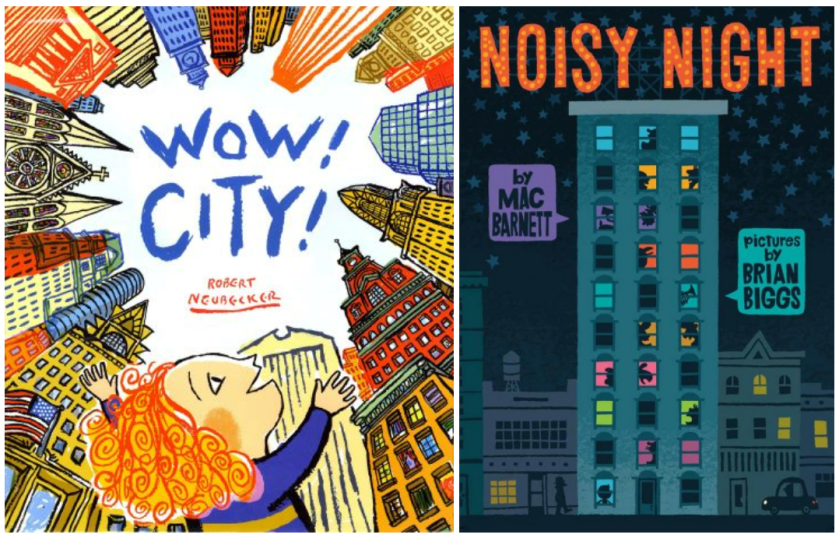
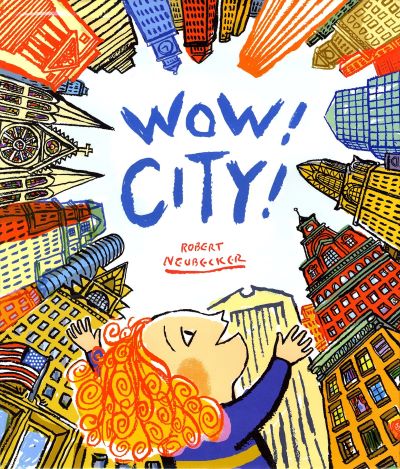
Read: Wow! City! by Robert Neubecker (TT)
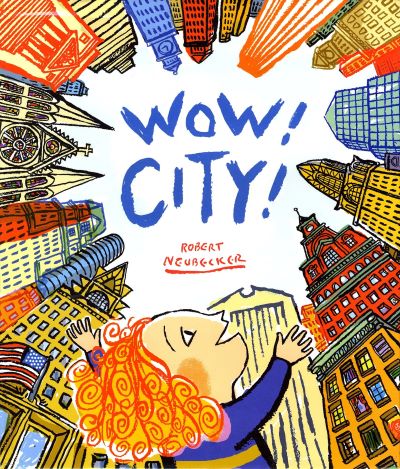
I probably should have done Wow! City! for the Family Time group – they lost interest about halfway through, but they were a younger group.
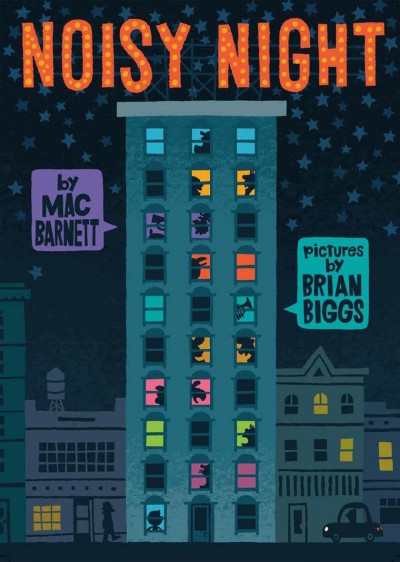
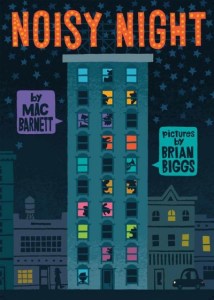
Read: Noisy Night by Mac Barnett & Brian Biggs (TB) (FT)
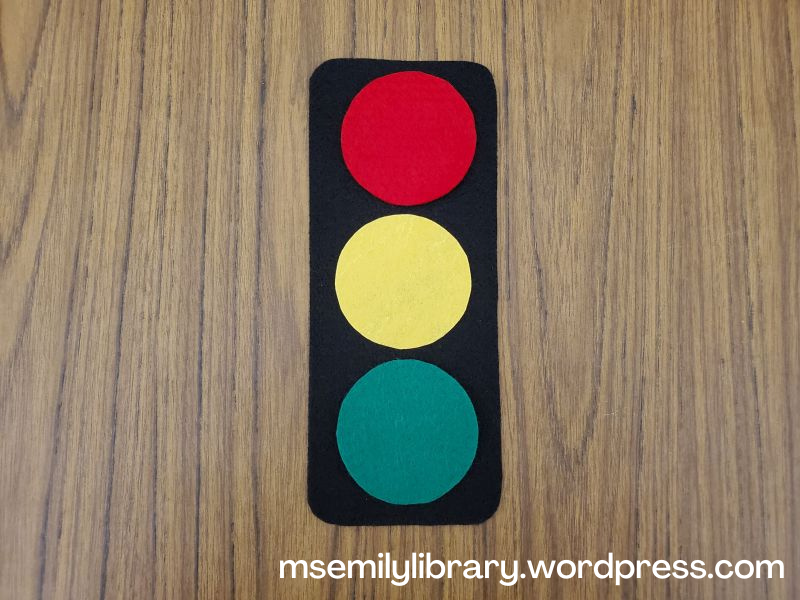
What shapes are these? Black rectangle, green circle, yellow circle, red circle – it’s a stoplight! There are stoplights everywhere, but there are LOTS in a city where there are many vehicles and traffic.
Flannel Rhyme: Green Means Go (TT)
Green means “GO!” Go! Go! Go! (roll arms quickly)
Yellow means “Slow.” Slow… slow… slow. (roll arms slowly)
Red means “STOP!” (ASL sign for stop: one hand making a chopping motion onto flat opposite hand)
Go! Go! Go! (roll fast)
Slow… slow… slow… (roll slow)
STOP! (ASL sign for stop)
Source: Jbrary
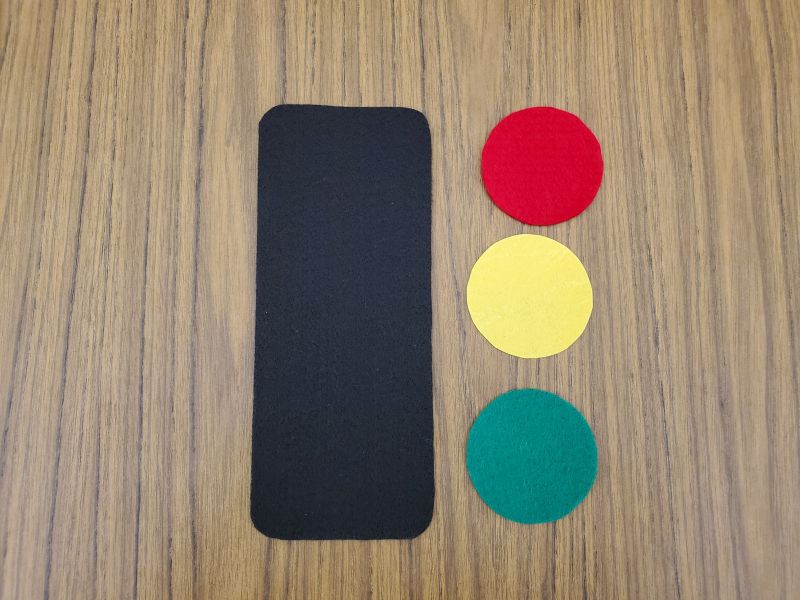
For Toddler Time, I did this song after Cranes Reach Up, but for the other two sessions, it followed directly after the Noisy Night book. Where do people live in the city? Many live in tall apartment buildings. Have you been in a tall building and taken a ride in an elevator?
Lifting Song: The Elevator Song (TT) (TB) (FT)
Oh, the city is great and the city is grand
There are a whole lot of people on a little piece of land
And we live way up on the fifty-seventh floor
And this is what we do when we go out the door:
We take the elevator up, we take the elevator down
And we turn around!
Source: Jbrary

Here’s the new one! We break out of the clap and pat to roll and STOP in traffic for a bit – really vary the length of time to roll for the most fun. Then we return to pat and clap when we reach our sightseeing destination and yell out that “TAXI!” at the end.
If you go visit a city, you might use a taxi cab to get around.
Action Rhyme: Taxi Cab (TT) (TB) (FT)
(in the style of Pat-a-Cake)
Taxi cab, taxi cab driving day and night (pat and clap)
We’ll visit the city and see all the sights!
We’ll roll… (roll arms)
And we’ll STOP! (two hands up)
(repeat a couple of times, varying how long you “roll”)
We’ll get out and look around (return to pat and clap)
We’ll hail another cab and be homeward bound – TAXI! (lift arm)
Source: original

In the city, it’s very busy, and the city is always growing and changing. Sometimes old buildings are torn down and new buildings are constructed. Here’s a stretch about the tall, tall crane that helps build them!
Stretch Rhyme: Cranes Reach Up (TT) (TB) (FT)
Cranes reach up
Cranes reach down
Cranes reach out
And all around
Source: Jbrary

One more construction rhyme.
Action Rhyme: Here is a Steam Shovel (TB)
Here is a steam shovel (Forearm erect, hand drooping)
And here is the ground (two arms enclose area)
See the great boom (forearm moving side to side)
Swing round and round
It dips, it bites, (forearms dips, thumb and fingers grasping)
It lifts, it throws (forearm lifts, thumb and fingers spin)
My, how the hole in the ground grows! (hands make circle)
Digging, scooping, (mime)
Lifting, throwing,
See how the hill (peak hands)
Beside it is growing
Source: Jen in the Library

No matter where you live, everyone likes to go outside and play. Even though cities can be full of buildings and streets, they also have public parks where people can go to enjoy some nature. Let’s sing a song about playing outside.
Ukulele Song: Mr. Sun (TT) (TB) (FT)
Oh, Mr. Sun, Sun, Mr. Golden Sun
Please shine down on me
Oh, Mr. Sun, Sun, Mr. Golden Sun
Hiding behind a tree

These little children are asking you
To please come out so we can play with you

Oh, Mr. Sun, Sun, Mr. Golden Sun
Please shine down on me
Source: Raffi (from the album Singable Songs for the Very Young)

Get a downloadable ukulele songsheet for “Mr. Sun” here!
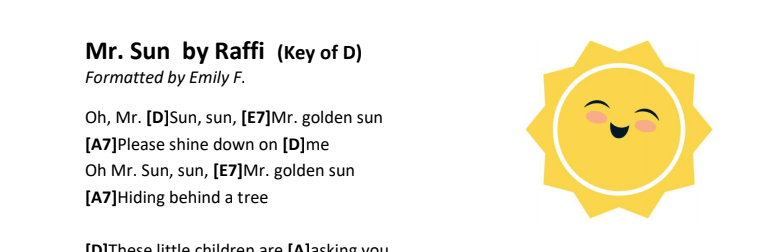
thumbnail of Mr. Sun ukulele songsheet

Action Song: Zoom, Zoom, Zoom!* (TT) (TB) (FT)

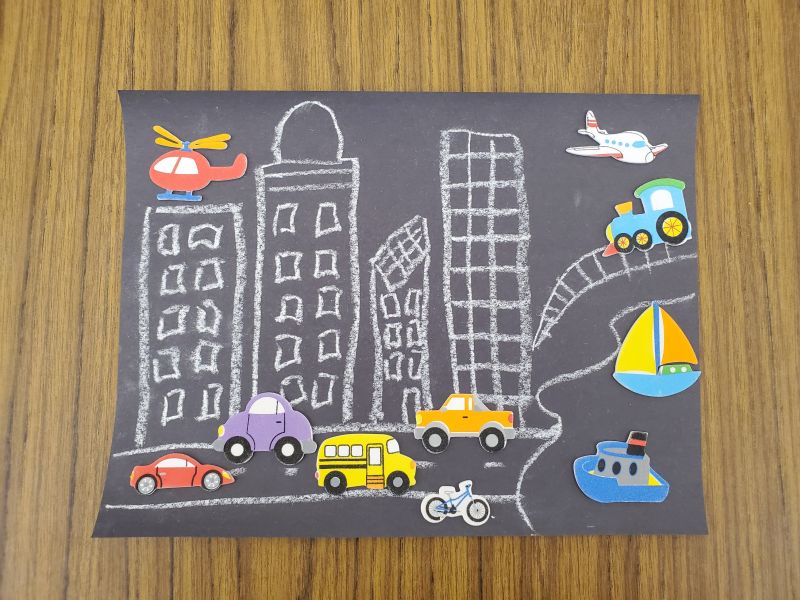
Craft: Cityscape (TB) (FT)
Draw a city with white chalk on black construction paper, then decorate with vehicle foam stickers. I used ALL my stickers on mine!
Source: Sunflower Storytime
Play Time
The toddlers have two laundry baskets of baby toys – rattles and cars, sorters and stackers, toy phones and spinners. For the older kids, I have foam blocks, soft food toys, puzzles, and a few other items that are a little more sophisticated than the baby toys. For Family Time, I gauge the overall age of the group and put out what seems right for them. We play for 5-10 minutes at the most, then I ring the bell and ask the kids to help me clean up. I think the clean up bit is good practice for them!

Goodbye Song: See You Later Alligator* (TT) (TB) (FT)

Goodbye Rhyme: Tickle the Stars* (TT) (TB) (FT)

Other books I had available for families to browse (and may work for you on this theme)
City Shapes – Diana Murray & Bryan Collier
Go! Go! Go! Stop! – Charise Mericle Harper
City Moon – Rachael Cole & Blanca Gómez
Windows – Julia Denos & EB Goodale
Cityscape – April Pulley Sayre
My City Speaks – Darren Lebeuf & Ashley Barron
If You Were a City – Kyo Maclear & Francesca Sanna
City Baby – Laurie Elmquist & Ashley Barron
Maisy Goes to the City – Lucy Cousins
Hot City – Barbara Joosse & Gregory Christie

This storytime was presented in-person on 8/7, 8/8, & 8/9/23.

Storytime Handout:
*Lyrics to these songs can be found on the Repeated Songs & Rhymes page.

**These symbols indicate the program sessions I used the activities for:
(TT) Toddler Time, ages 1-2
(TB) Teddy Bears, ages 2-3.5
(FT) Family Time, ages 0-3.5

Summer Storytimes: All Together Now, Part II

Summer is a great time to break out of the storytime structure I find myself in during the rest of the year. There’s nothing wrong with having structure, of course, but I find it invigorating to mix it up and feel free to try new things and be experimental during a set time of year.

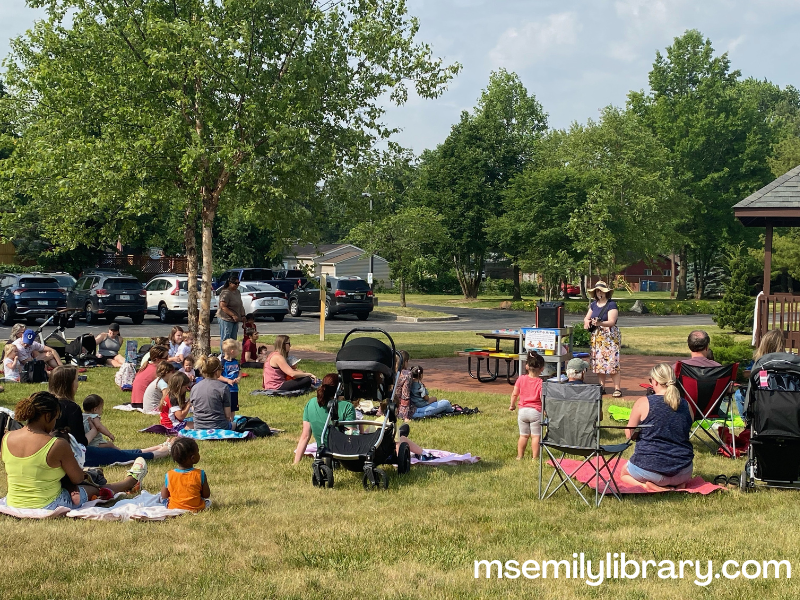
In the summer, I offer outdoor programs for kids ages 0-3.5 and their caregivers. We spend about 15-20 minutes doing songs, rhymes, books, and extension activities, and then take about 20 minutes at free-play sensory stations that engage kids and caregivers to talk, socialize and practice social skills, engage in science and age-appropriate STEM inquiries, flex creative muscles, and have lots of fun, associating the library with positive feelings. This post will detail these stations.
You can read more about the Storytime half of the summer sessions here, Summer Storytimes: All Together Now, Part I.

Each week I had eight stations that families could wander through. There was no requirement that they had to go to each station or change stations at any certain time, or at all. They chose their path and self-regulated. Some stations were available every single week, some rotated, and some were unique and only appeared during one week. They fell into “wet,” “dry,” and “art” categories. I used old sheets to cover the stations so they wouldn’t be too tempting during the storytime portion of the program, and that worked well.

I also had a backup plan for when the weather or air quality was too poor to be outside. This was the summer of the Canadian wildfires, so there were several days that were not rainy, but smoke and particulates in the air made it unsafe to be outside – especially for the very young and for senior citizens (and many of my caregivers are grandparents in that category!) If we weren’t outside, I had reserved our two largest and adjoining meeting rooms, where I was able to set up both an area for stories and songs and the parachute on one side and stations on the other, so thankfully we didn’t miss out on any activities. If I remembered to take pictures indoors and out, I included both below to give a sense of layout.

The Plan: Stations

Wet Stations

This is a big draw – everyone likes playing in water! Outdoors, I used a hose and outdoor water supply to easily fill my tubs with water and could just pour it all out at the end of the session. Indoors, I hauled buckets from our janitor’s closet and possibly filled everything just a little bit less than I would outside. I used old flannel sheets underneath to absorb spills and make them easier to clean up. The meeting room has an emergency exit door that opens to some landscaping so all the water got dumped there at the end.

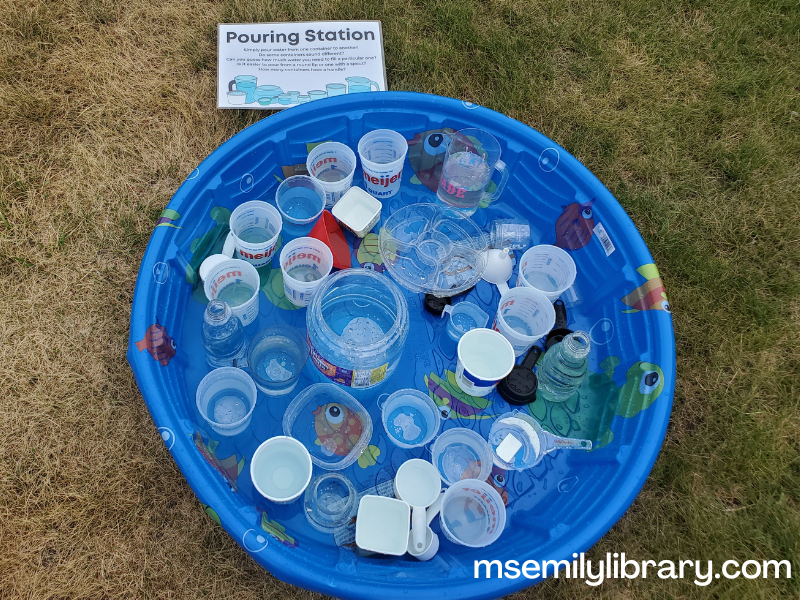
Pouring Station (all weeks)
This is a repeat from last year, so I had all of the materials for this one already. It’s also an easy one to set up, so it’s my anchor wet station: we had it out every week. Last year I asked coworkers to collect clean plastic recyclables with wide openings for this station and visited Goodwill for some additional pitchers. We had measuring cups and funnels in our materials, as well as a baby pool, which is the perfect container. I fill the pool with the plastic bins and fill them randomly with water. Original idea from Busy Toddler.

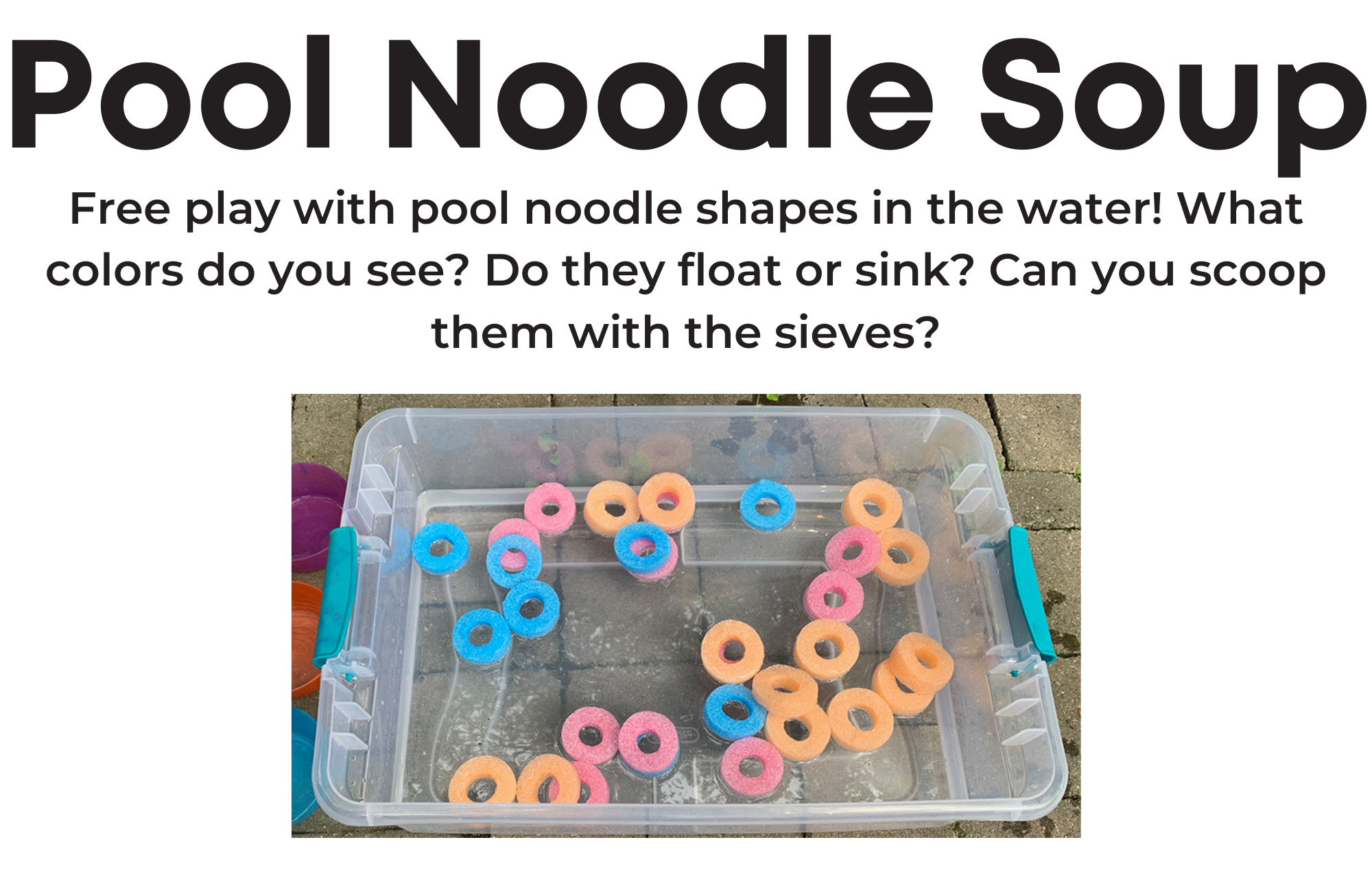
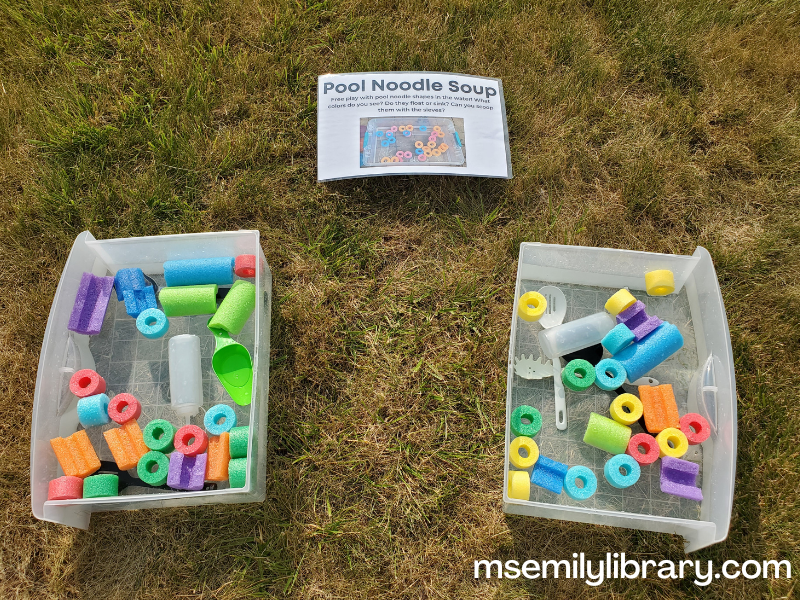
Pool Noodle Soup (Weeks 1 & 4)
I cut sections of pool noodles and used them in three different ways, starting with this wet station. (You’ll see them below as a dry station and an art supply, too.) I used two drawers from a plastic storage bin as my containers, and added water, the noodles, some ladles and slotted spoons, and some squeeze bottles. Original idea (and photo on the sign) from Happy Toddler Playtime.

Fly Swatter Slap (Weeks 1 & 7)
Again, I maximized my materials by using flyswatters in both wet and dry stations on different weeks. The wet station included the (new, clean) swatters and ping pong balls that I drew flies on. I found the plastic containers at Goodwill and they are a little bit smaller than the drawers used above. The swatters were hand-shaped and different colors. Original idea (and photo on the sign) from My Bored Toddler.

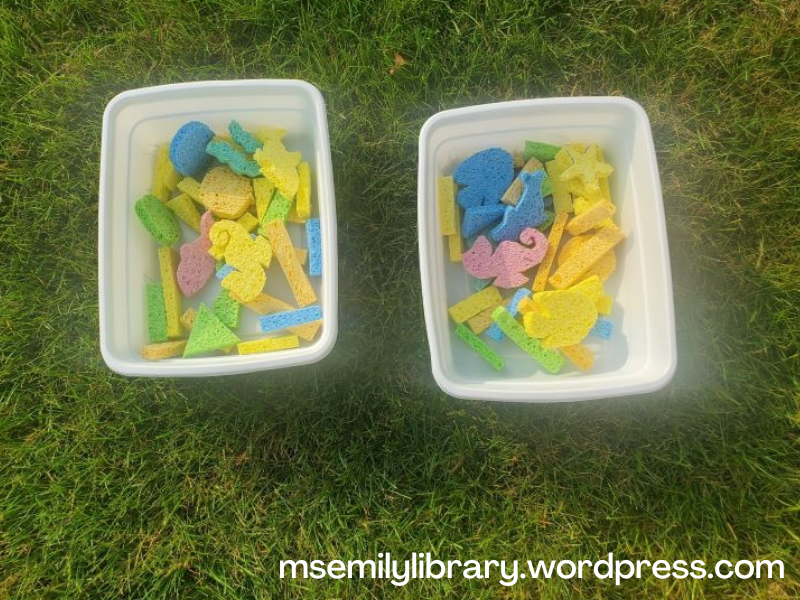
Sponge Play (Weeks 2 & 7)
This was another repeat from last year, but one that’s especially great for the youngest of my age group. When it was out it was usually surrounded by the “baby brigade!” The shapes were ocean animals since last year’s theme was “Oceans of Possibility” but they were just as happy with the simple shapes. Original idea (and photo on the sign) from Little Lifelong Learners.

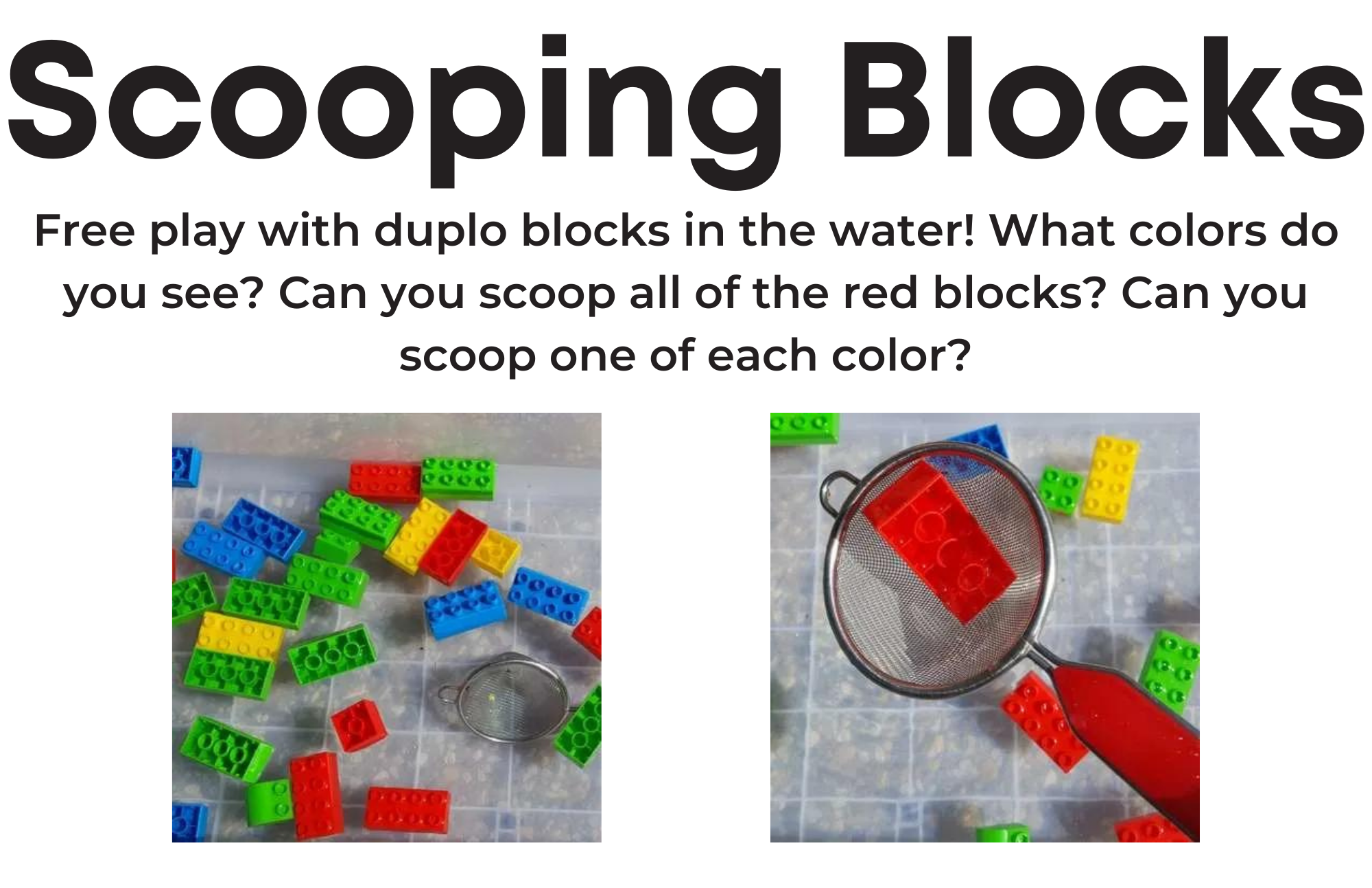
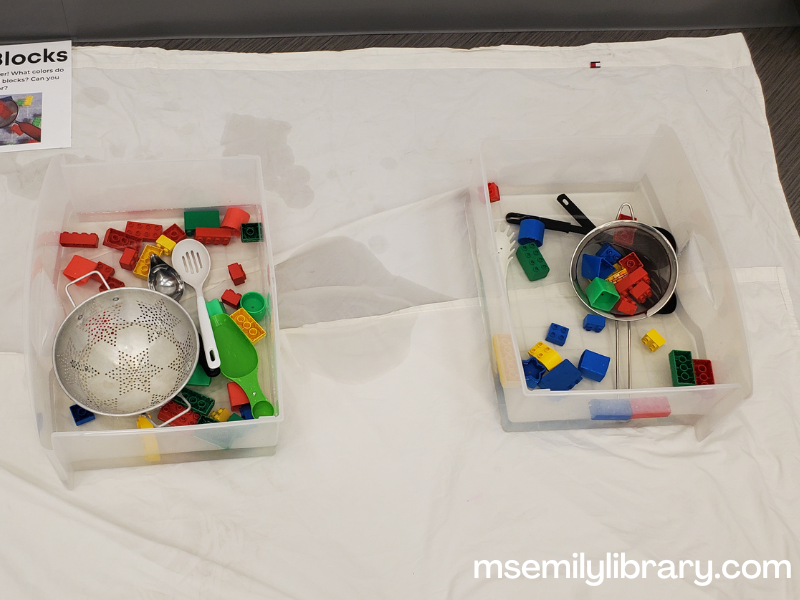
Scooping Blocks (Weeks 2 & 5)
Lego Duplos plus water and scoopers! This one was fun for its obvious purpose, but added bonus: some kids actually took the Duplos out of the water and put them together! We had all the Duplos already, and I added some of the sorting blocks from our baby toys to the mix, as well as ladles, colanders, and sieves from Goodwill. Original idea (and photo on the sign) from My Bored Toddler.

Mystery Water (Week 3)
Another repeat from last year – I originally saw this as on Pinterest as a reel, and was intrigued. Cornstarch and a little food coloring are added to water to turn it murky, and kids can search for items in the water to match up with a finding guide. We had a bunch of colorful plastic cookie cutters in storage that were perfect for this, so I traced them on a separate sheet for the kids to match up. They weren’t as solid and heavy as the original poster’s, so they tended to float a little, unfortunately, but it didn’t really matter. Original idea (and photo on the sign) from bright_little_brains.

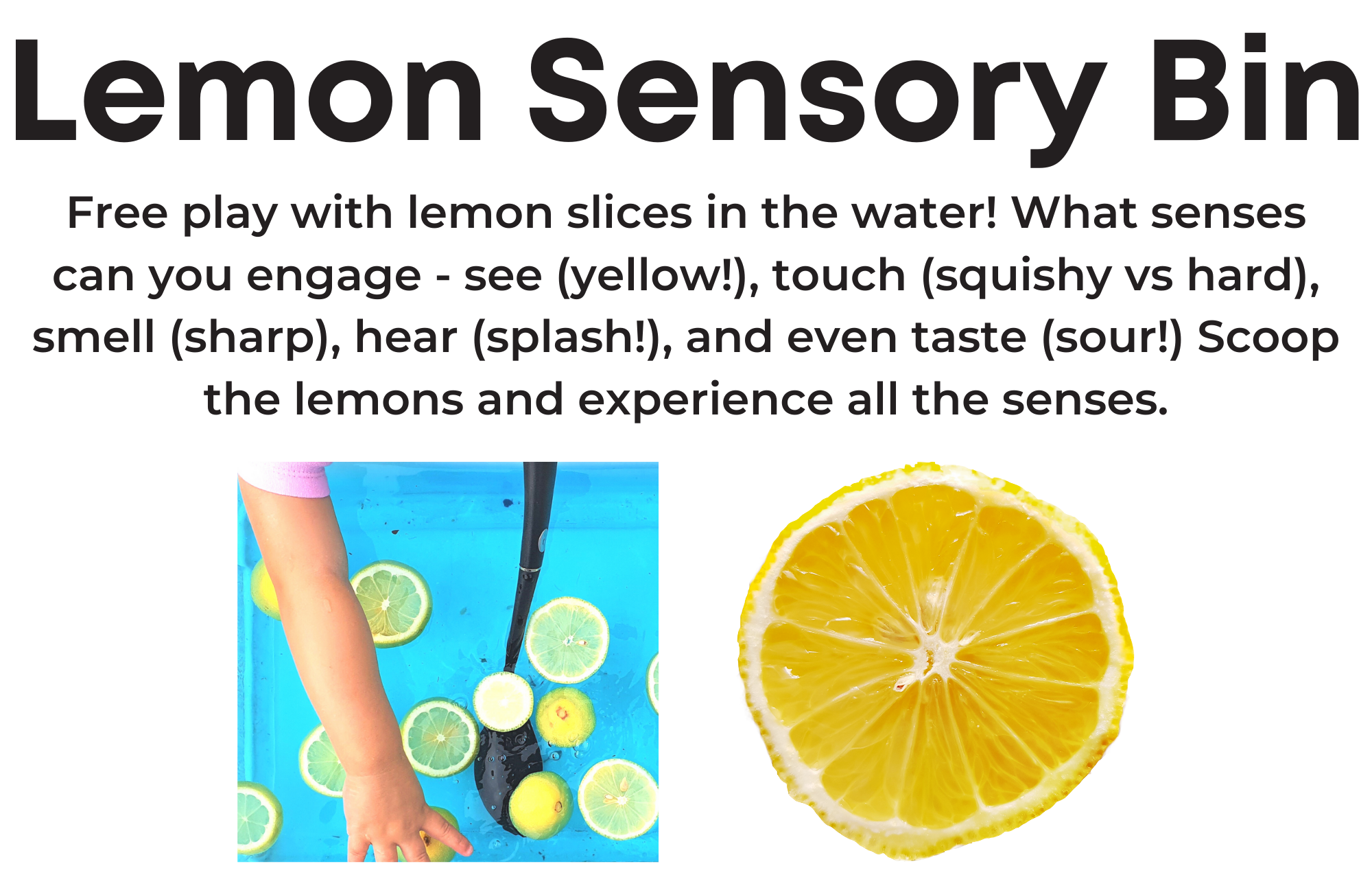
Lemon Sensory Bin (Week 3)
Mm, this was one of my favorite stations! It was super easy and smelled so good. I bought a bag of lemons and divided them among my three sessions. That was maybe 2-3 lemons per day? Cut them up into slices and added them to a bin of water along with ladles. I did announce that there was a lemon bin before breaking for stations just in case there was an allergy issue, but no one had a problem. Original idea (and photo on the sign) from Taming Little Monsters.

Whisking Bubbles (Week 4)
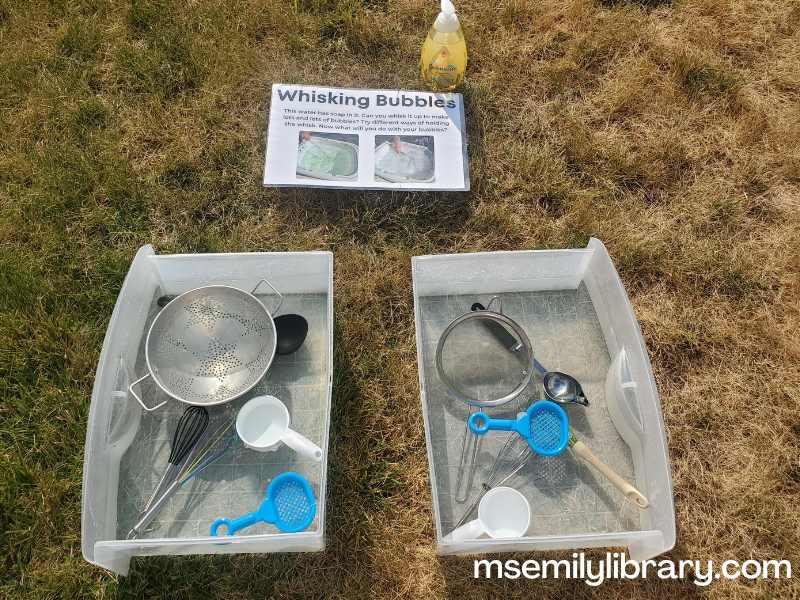
Kids could whisk up some bubbles and then use colanders and sieves to play with the result at this station. At first I just thought I would get some dishwashing soap, but then I started thinking about soap in eyes and mouths. I ended up buying some body soap formulated for babies (tear-free) and that worked perfectly. I looked for actual baby bubble bath, but couldn’t find it in store, so was a little worried about how sudsy it would get, but it ended up being just fine. And I’m so glad I went that route – I remember one of the babies did a nose-dive into the bin at one point and, indeed, there were no tears! I added the soap at the beginning and left the water undisturbed so that the kids could create all the bubbles themselves. Original idea (and photo on the sign) from The Empowered Educator.

Flower Sensory Bin (Week 5)
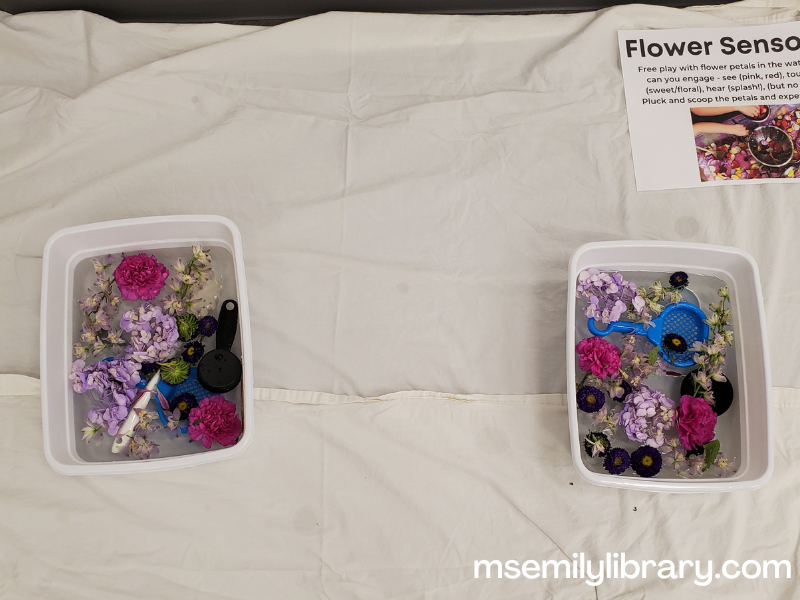
I called our local Kroger florist and asked if they would donate flowers that were past their prime, so I was able to put this bin together without the cost of the flowers! It was also interesting to see the variety that was available on the two days I picked them up. One day I got a bouquet with several kinds of flowers that filled my two little bins, and the other day all that was available were colored daisies. Both were appreciated, and grown-ups commented on the pleasant scent and the novelty of the experience. I also got an action shot (with permission from the participants) on this one, since I wanted to include it in my thank you note to the florist. Original idea (and photo on the sign) from Learning and Exploring Through Play.

Ice Play (Week 6)
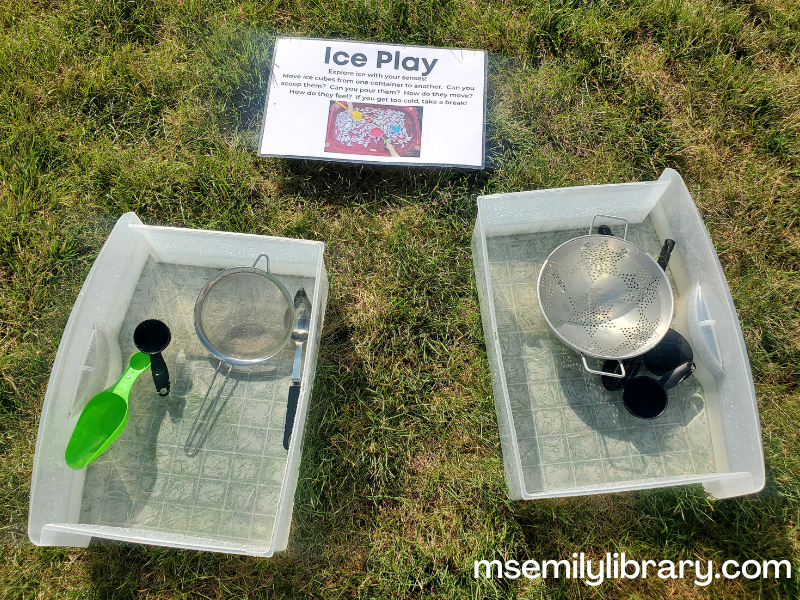
Another repeat from last year. I bought a large bag of ice each morning before my program and kept it in a cooler, adding it to the bins JUST before they were played in (so there’s no ice shown in the photos I took before the program). Ladles, colanders, and sieves were added for handling the ice. It was good weather for it – HOT – so the ice was mostly melted by the end of the station play time, but it was just enough. I reminded everyone to take a break if their fingers started to get too cold. Original idea (and photo on the sign) from Busy Toddler.

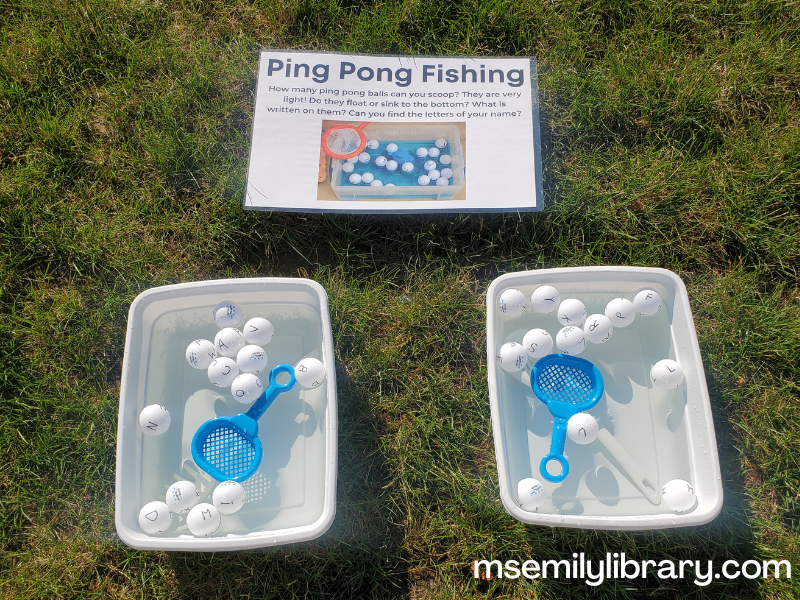
Ping Pong Fishing (Week 6)
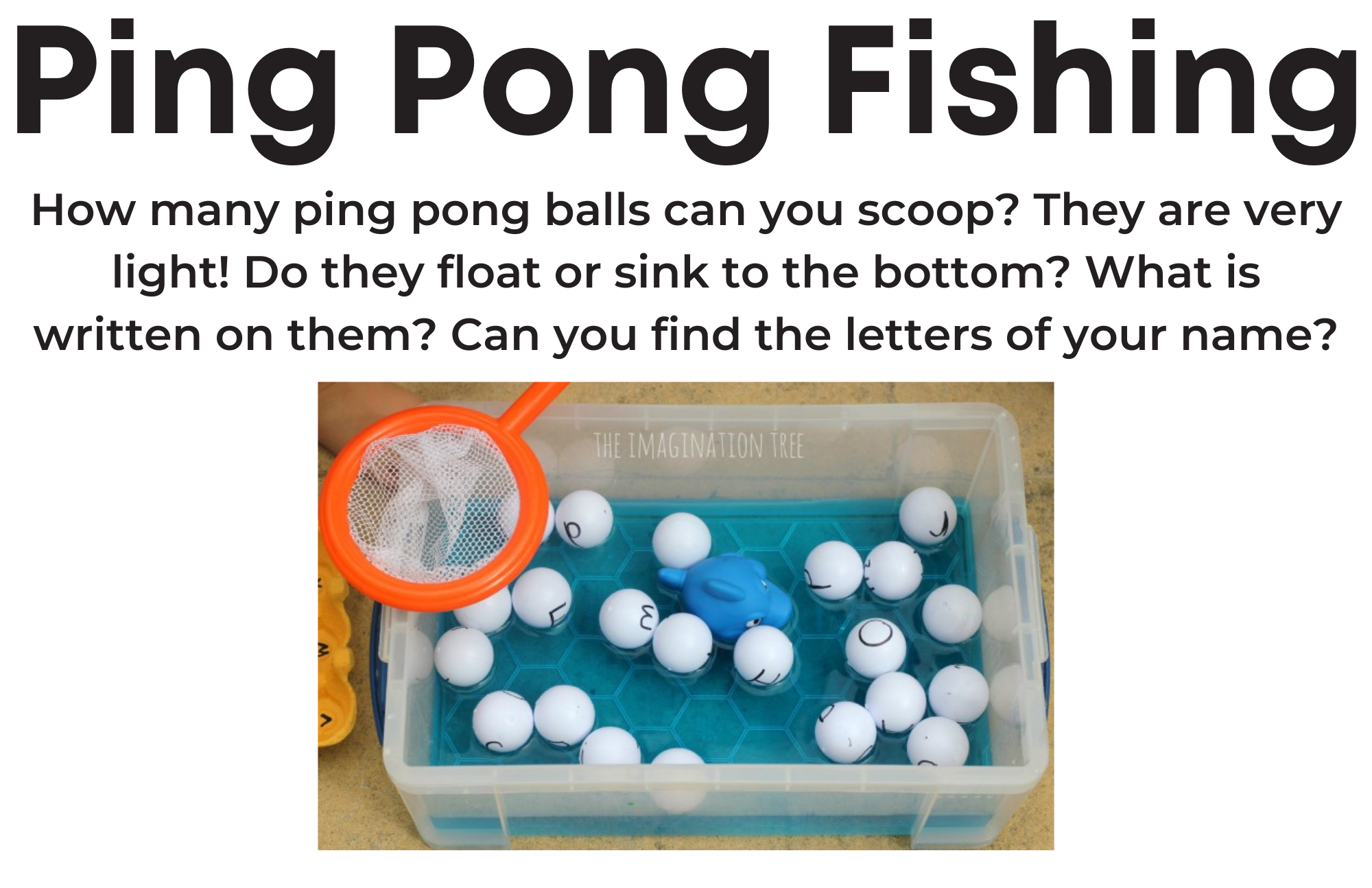
I put the alphabet on ping pong balls and added them with scoopers into the bin. Adding the letters to all four sides of 26 balls took the most time! I think I added the housefly balls from the fly swatter slap station the second and third day, but they aren’t pictured. Original idea (and photo on the sign) from the Imagination Tree.

Dry Stations

There were a few families that didn’t want to get wet, so I was sure to offer three dry stations each week as well. Many of these gave practice in sorting various items by color, shape, or texture.

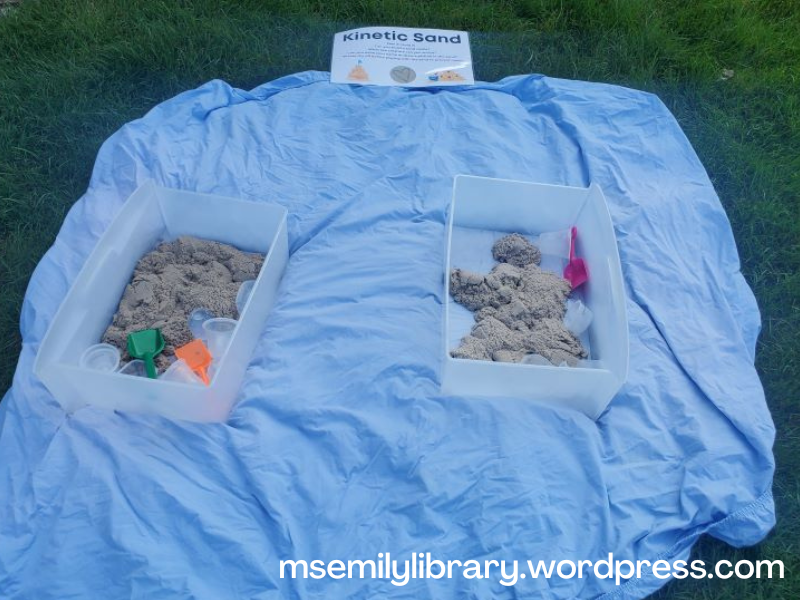
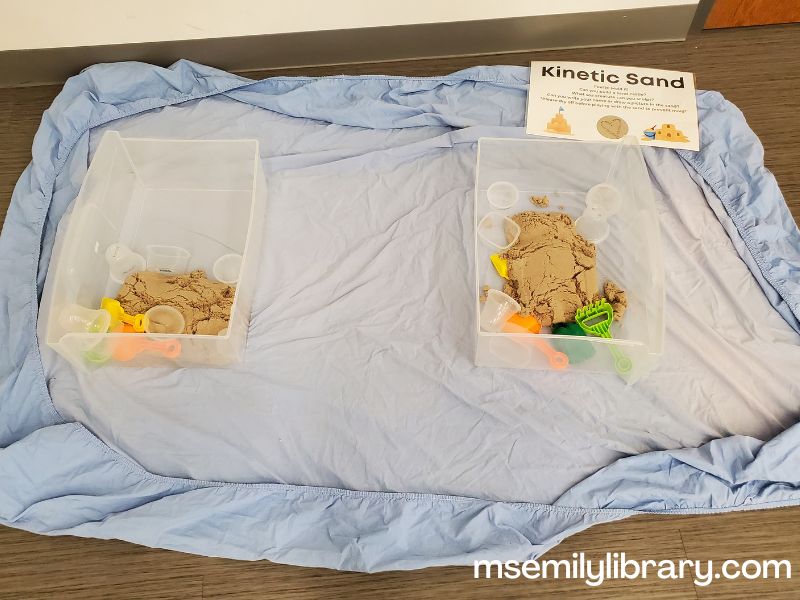
Kinetic Sand (all weeks)
Along with the Pouring Station above, this was the only station that was available all summer long. I had the supplies from last year, which included the kinetic sand itself as well as recycled fruit cup containers that had fun shapes and plastic shovels. I kept a sheet underneath this station to catch any stray sand that escapes the bins. Because the sand is not taste-safe, I do warn the caregivers that if their kiddo is still exploring with their mouth, they may want to skip this station.

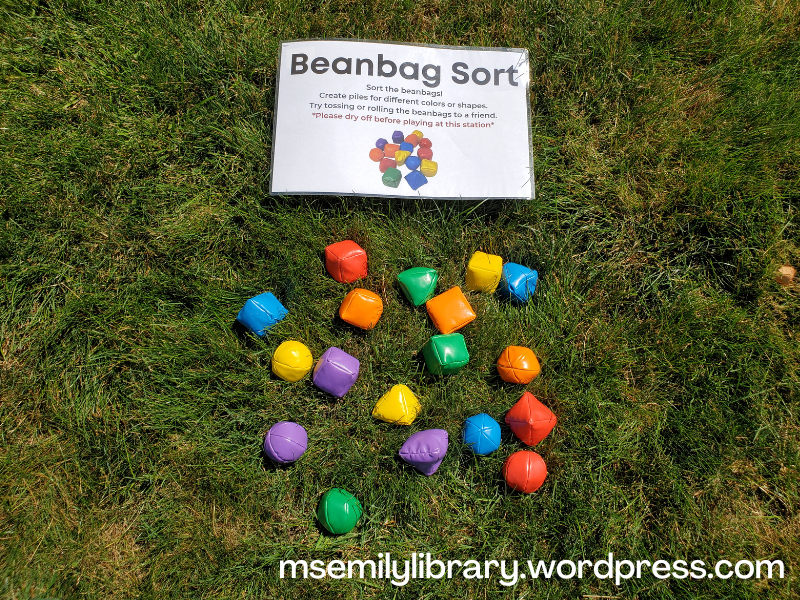
Beanbag Sort (Weeks 1, 4, & 7)
We had these beanbags from Lakeshore Learning that are different colors and shapes. They’re a super easy station where kids can play and sort with them in several ways.

Craft Stick Sort (Weeks 1, 4, & 7)
Another repeat from last year that was already “done.” I noticed in my storage bin that I had these boxes of dot painters that have small holes already in the top. I colored a ring around each hole a different rainbow color and added colored craft sticks for a fine motor and color identification station.

Pool Noodle Sort (Weeks 2 & 5)
A new station this year, but one I’ll repeat. Using the pool noodle slices (from Pool Noodle Soup), I taped a dowel rod to four small plastic cones in red, green, yellow, and blue. Kids could then thread the colored noodles on to the cones. Original idea from this Pin (no blog).

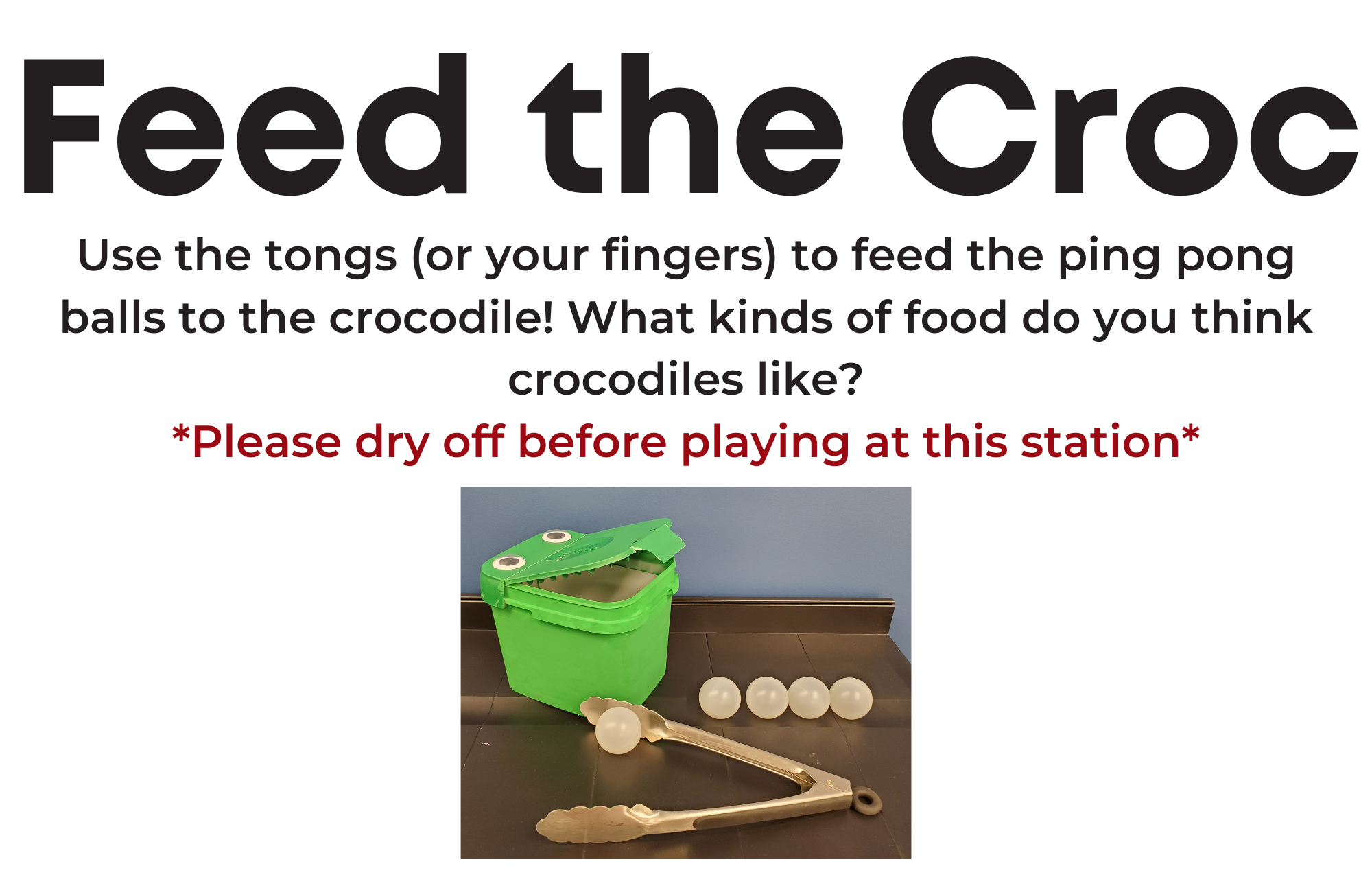
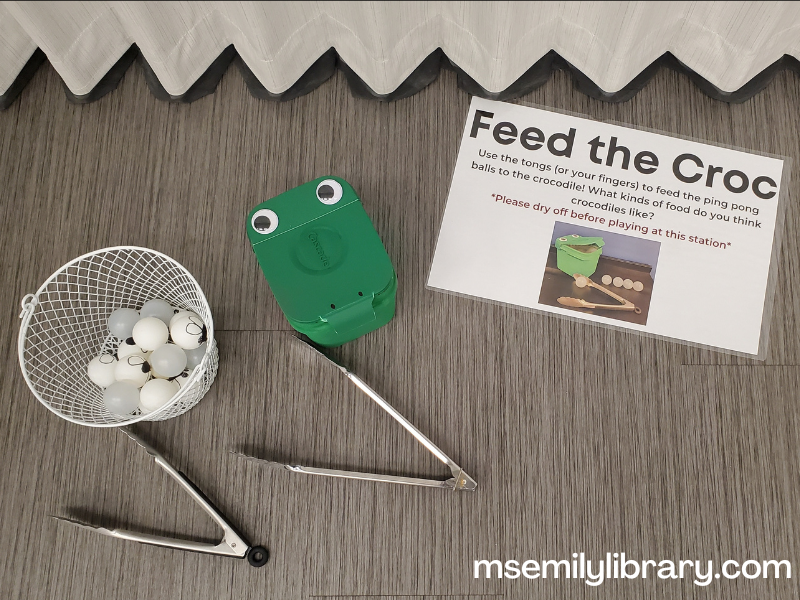
Feed the Croc (Weeks 2 & 5)
Saw this and thought it was very cute, and actually had the container from last year that someone had given to me. I painted it so that the whole thing is green and the label was covered up, added the big googly eyes and made little nostril markings. I found a few metal tongs at Goodwill and added the ping pong balls. Nom, nom, nom! Original idea from Mama OT.

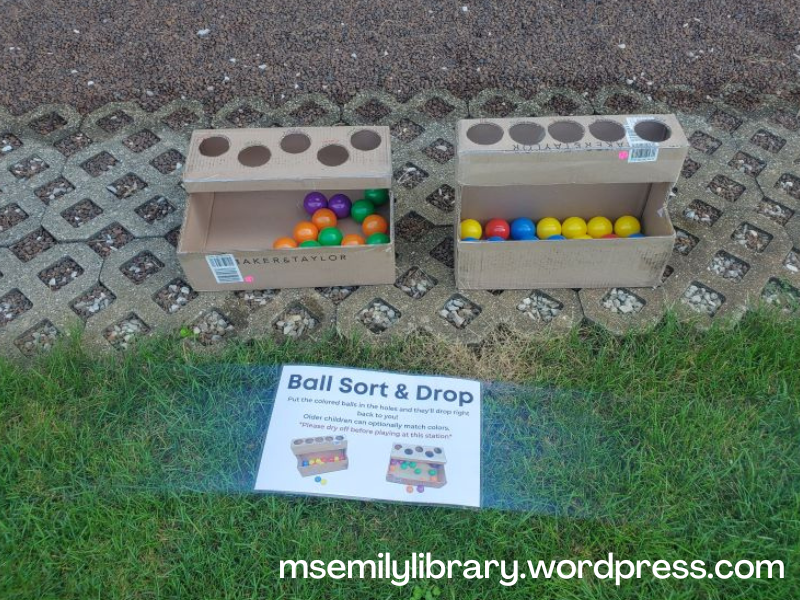
Colored Ball Sort and Drop (Weeks 3 & 6)
Two more repeats from last year. This ball sort and drop was made with Baker & Taylor boxes, but oriented them different ways so one was tall and skinny and one was low and squat. I had purchased ball pit balls and supplied different colors to each box. Photos from last year, which had weird blurs, sorry. Original idea from Taming Little Monsters.

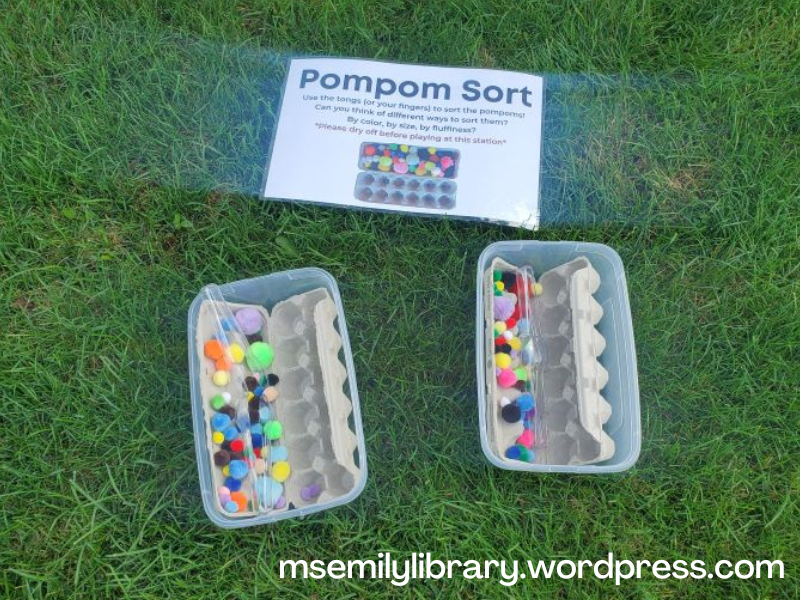
Pompom Sort (Weeks 3 & 6)
A really easy station to put together: I just saved a couple of egg cartons, then poured a handful or two of different colored/sized pompoms into them. The plastic tongs I provided last year were all broken in use, so I bought some metal ice tongs for this year. (And again, weird blur). Original idea from Laughing Kids Learn.

Art Stations

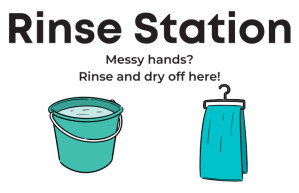
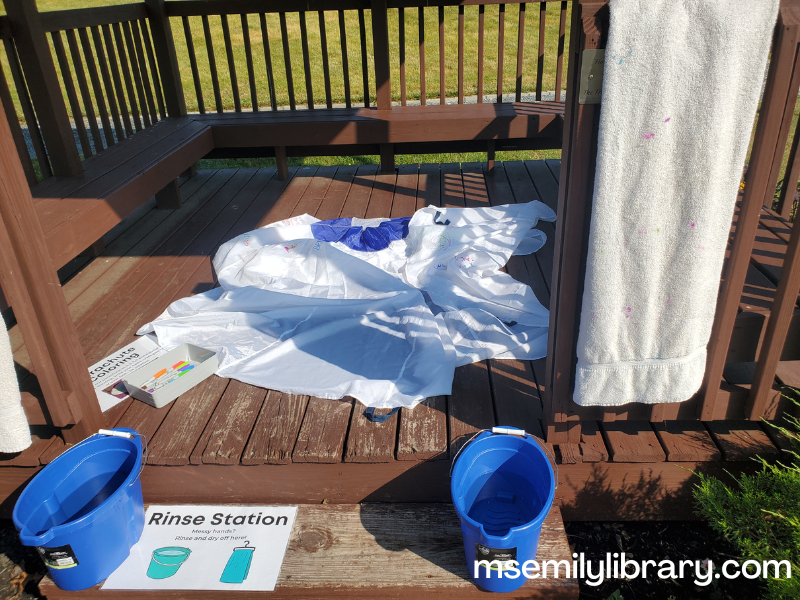
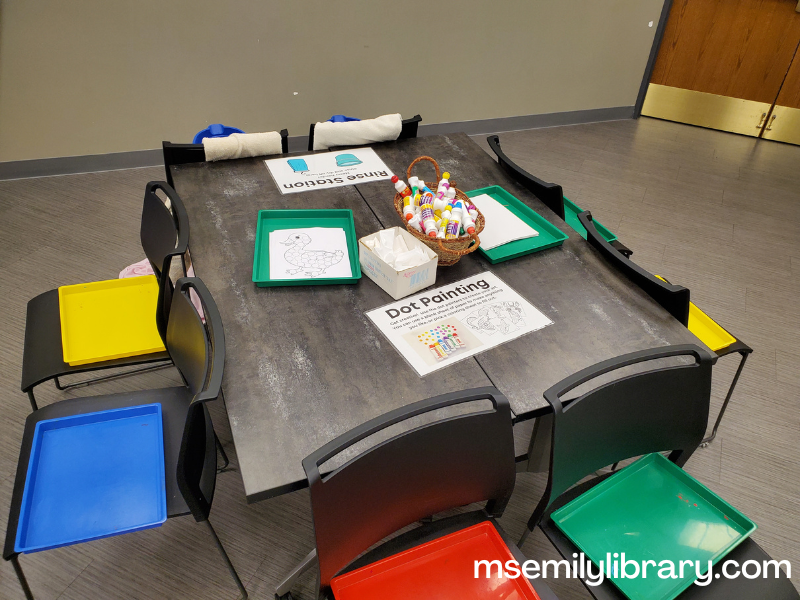
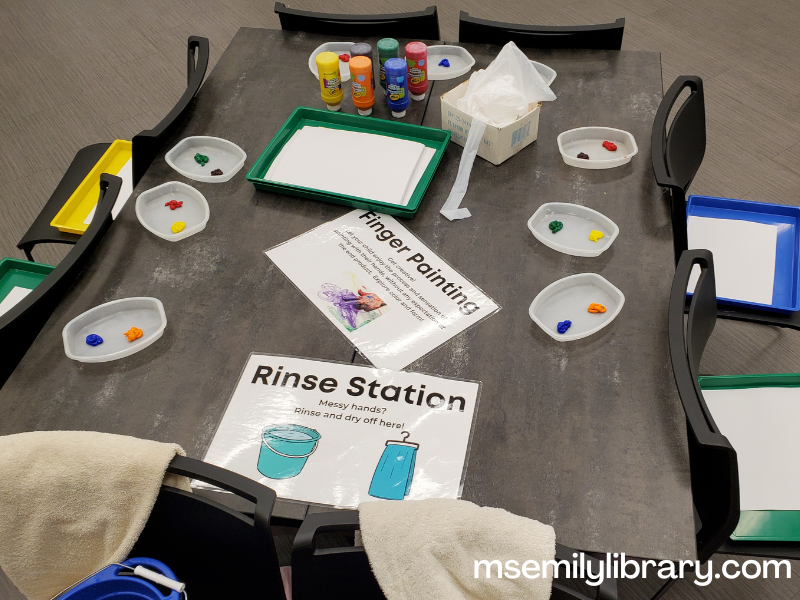
With the exception of Coloring the Parachute, the art stations were all unique, and all were simple process-focused art with different media. To help with mess, I set up a “Rinse Station” near the art every week which consisted of two buckets of water and two old bath towels for washing up as needed.

Rinse Station sign:
"Messy hands? Rinse and dry off here!"

Color the Parachute (all weeks)
My library has an interesting smaller parachute (maybe 8 foot diameter?) that is plain white and was advertised as “decorate it yourself!” When I inherited it, there were a small scattering of names from who knows how long ago and the rest was depressingly empty. This summer I was determined to fill it up. I laid it out each week and set it as a station inside the gazebo, with a small handful of permanent markers. I’m happy to say that it looks MUCH better now, though it could still use a lot more personalization to fill up empty spaces. I offered some different ideas as the weeks went on as to what to add, like a favorite animal or insect. The first time we were indoors I offered it as a station, but cleaning up realized there was permanent marker on our relatively new flooring. To keep my director from going nuts, I decided not to put it out indoors anymore. 🙂 You can see the rinse station in the photo as well.

Shape Prints (Week 1)
Using shape sorter blocks that we already had in our baby toy collection, kids could dip them in paint and stamp the shapes onto white construction paper. I use old recycled Lean Cuisine trays to hold the paint – they are a perfect size. Sadly, I missed getting any pictures of this station! Original idea (and photo on the sign) from Nanny Gunna.

Dot Painting (Week 2)
I originally had a different craft planned for week 2, but it was rainy that week and we were indoors the first two days. Dot painting is very easy and not as messy as slapping paint with flyswatters (see week 6 below), so the switch was made. The library has a supply of dot paint markers and I printed out some animal dot coloring sheets. Simple and still fun. I get a lot of these sheets, including the ones pictured, from The Artisan Life.

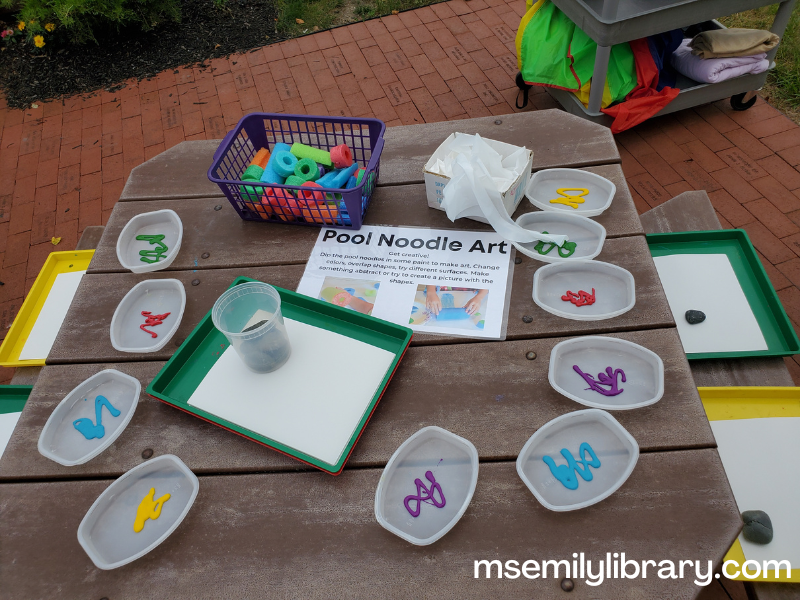
Pool Noodle Art (Week 3)
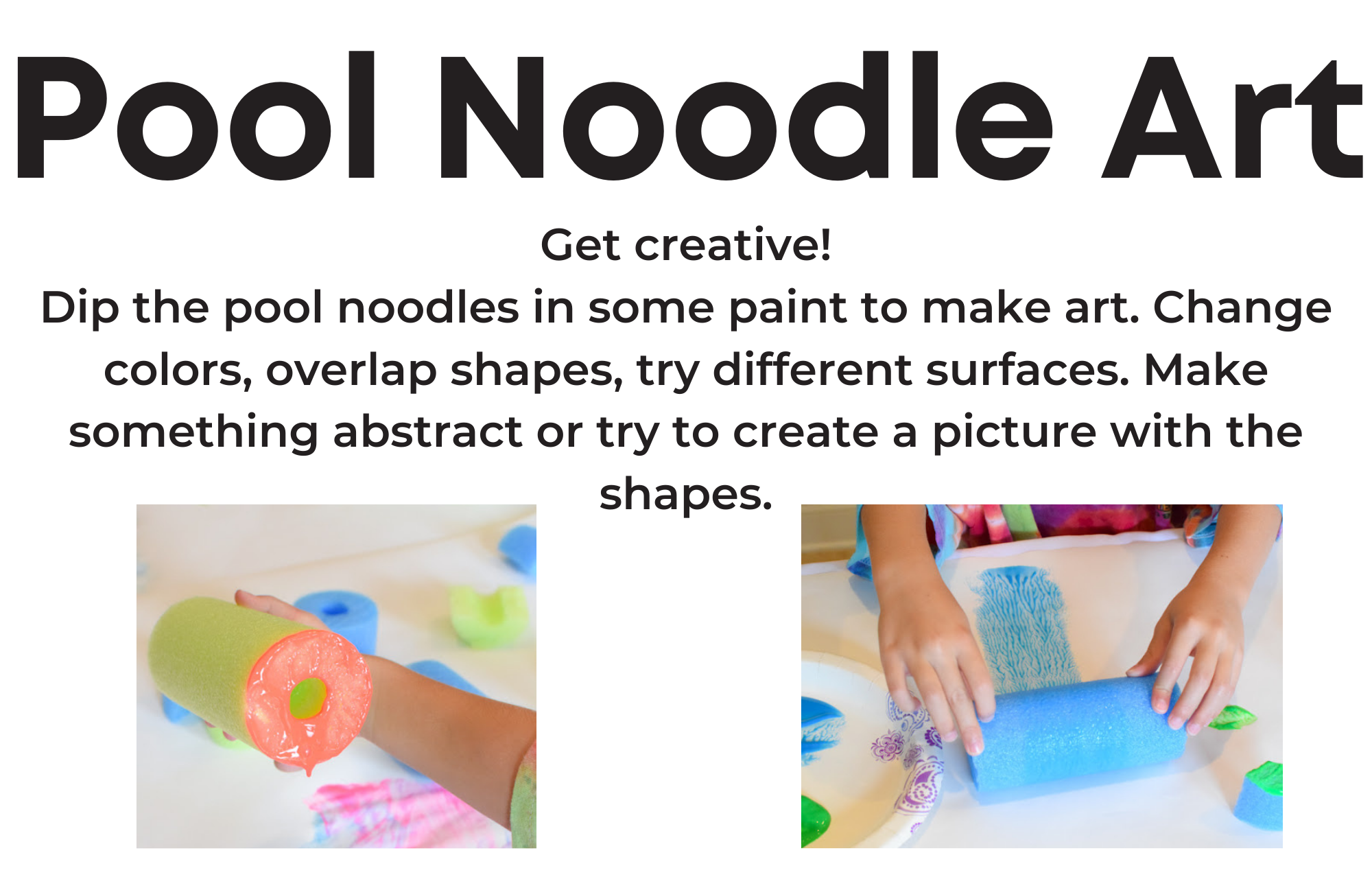
The pool noodles make another appearance! Trays of tempera paint and white construction paper are available with the noodles for any kind of art a child wishes to make. I had a few extra pieces of noodles that had been split lengthwise as well as sliced, to make half-circle shapes in addition to the full circles. Original idea (and photo on the sign) from What Can We Do With Paper and Glue.

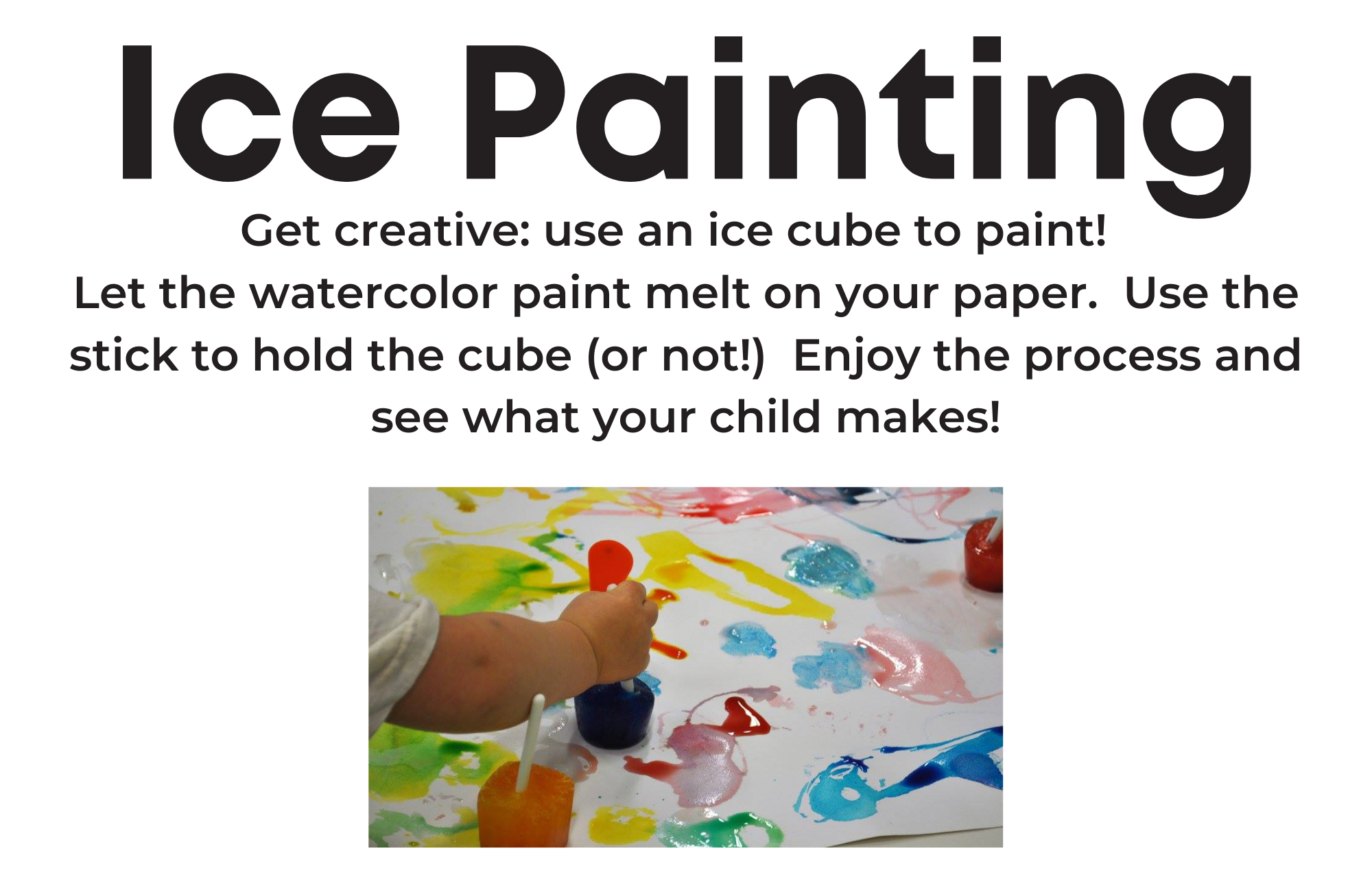
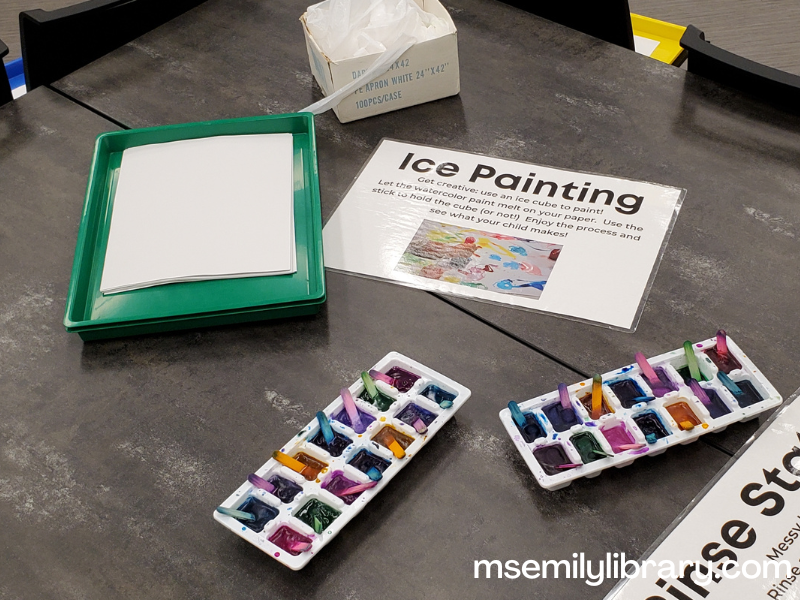
Ice Painting (Week 4)
This is honestly very simple, but I always get a lot of comments from grown-ups about how cool it is and how they might be able to do it at home. (I LOVE hearing that they’ll adapt what we do at the library at home!) I add small craft sticks to an ice cube tray and put in a little liquid watercolor paint and fill the rest with water. I think it could easily be done with food coloring if you don’t have liquid watercolors, though. I keep the ice cube trays in a cooler in the shade until we’re ready for stations, then get them out to use. They do melt, but usually there’s a bit of ice left by the end of the program. And my groups were quite tidy, so I was able to just refreeze the trays each day and there was plenty of “paint” available for three sessions. Original idea (and photo on the sign) from ARTventurers.

Finger Painting (Week 5)
A classic and super-simple activity – construction paper in our messy trays with finger paints in trays. I actually had several kids who didn’t like the sensory messiness of it, so some of them creatively used the rocks that are there to keep papers from flying away to spread the paint around. I’m not sure of the source of the photo on the sign, I think it’s a stock photo from Canva.

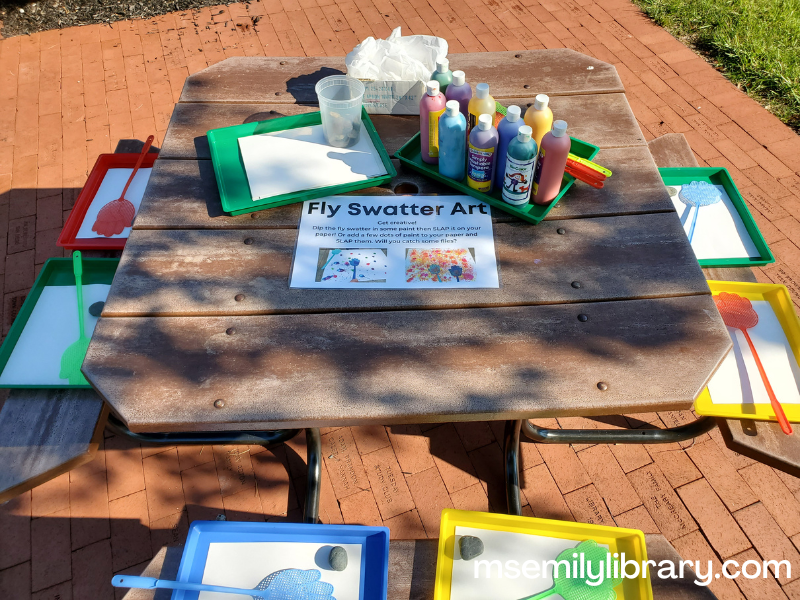
Fly Swatter Art (Week 6)
A messy but very fun art project, using (re-using) supplies from other stations. Kids wielded fly swatters to slap at paint, making some very interesting abstract art. I think the best method turned out to be adding some dots of paint to the paper, then letting the kids aim for them, rather than trying to spread paint on the swatter. I’m grateful for good weather all that week, since this is very much an outdoor activity. Original idea (and photo on the sign) from Play Teach Repeat.

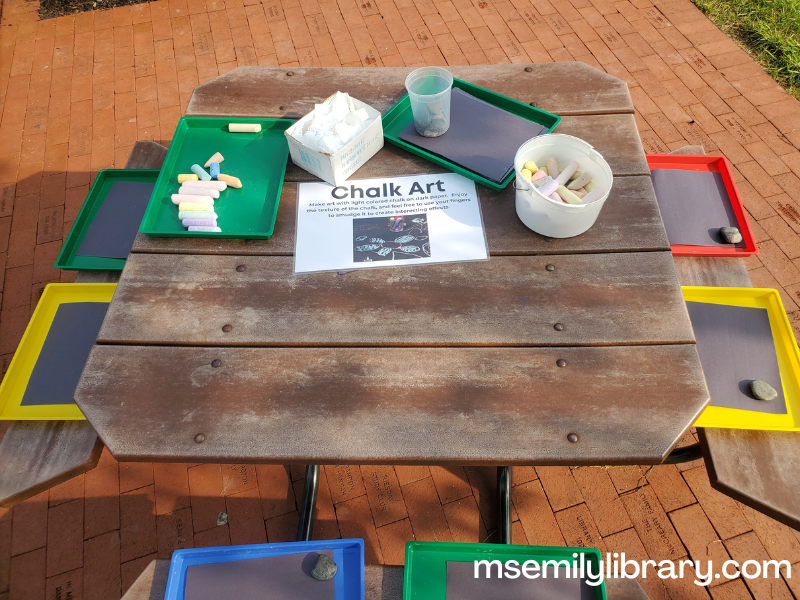
Chalk Art (Week 7)
Another very simple process art project, using black construction paper and sidewalk chalk. It was nice to end the summer with an art station that didn’t involve paint – this librarian was very tired by that point!

Wow, thanks for making it to the end of this very long post. I hope you found some good ideas and jumping-off points for out-of-the-box programming!

Summer Storytimes: All Together Now, Part I

Welcome back to the blog! My library’s Summer Reading Program is officially over, and I am deep into planning the fall. Summer is so busy that I take a break from blogging, but it was a great season, and I’d love to share it with you. I implemented all I learned in the last couple of years doing outdoor programming, and I think it was the best yet, despite worse weather and air quality this year (boo.)

Our library generally uses the theme and graphics from the Collaborative Summer Library Program, or CSLP, a national initiative that helps libraries plan summer programming. This year’s theme was “All Together Now,” with an emphasis on kindness and community. I focused on a different aspect of this each week for seven weeks in June and July. My program themes then were Community, We Work Together, Kindness, Family, Animal Helpers, and Helping Hands. More detail on how these were interpreted below. I also simplified the usual age requirements that I normally have for my indoor programs through the rest of the year. (So, instead of a Toddler Time for 1-2 year olds on Mondays and a Teddy Bear time for 2-3.5s on Tuesdays, I offered Family Time for 0-3.5 Monday, Tuesday, and Wednesday.) Siblings are always welcome, and I don’t have a limit to the number of families who can participate, so the programs are open to all.

For each session, we had about 15-20 minutes of storytime rhymes, songs, and a book, then 20 minutes of free play at various sensory stations. We end with bubbles and a goodbye song. Stations are a really great way to promote socializing, practice skills like sharing and being gentle, and allow for unstructured play, which science tells us is so important to learning and development. I added a section of parachute songs weekly, too, which was a treat for everyone. It was easy to do thematically – “A parachute is hard to have fun with by yourself. You need some friends and have to work ‘all together!'”

I also am all about simplicity and repetition over the summer. I have a lot of moving parts, set up and tear down to deal with, so I don’t change a lot in the storytime part and plan everything ahead so I am purely in “execute” mode rather than worrying about planning or learning songs. I changed one song and the book each week, and had a mixture of weekly, rotating, and unique stations. Since so much was the same, I’ll write up the whole summer in two posts: this first one focusing on the storytime half, and the second post focusing on all of the hands-on stations!

And, in addition to being back from hiatus, I finally bit the bullet and bought a domain name and WordPress subscription. Welcome to the ad-free Storytime with Ms. Emily Library experience! Please let me know if anything is wonky or links not working correctly in the transition.

The Plan: Storytime Portion

Welcome Song: Hello, Friends
(tune of Goodnight, Ladies)
Hello, friends! Hello, friends!
Hello, friends, it’s time to say hello!
Hello, [name 1], hello, [name 2]!
Hello, [name 3], it’s time to say hello! (repeat as needed)
(ASL motions: salute for “hello,” then take the index fingers on each hand and you link them together as though they are hugging each other back and forth for “friends”)
Source: Glenside Public Library District

Warm-Up Rhyme: We Wiggle and Stop
(Use the ASL sign for the word “stop” – one hand “chops” across the opposite hand)
We wiggle and we wiggle and we STOP
We wiggle and we wiggle and we wiggle and we wiggle
And we wiggle and we wiggle and we STOP
(We wiggled every week, but then added 2 more motions. Motions we did throughout the summer: jump, twirl, run, splash, hop, swim, stretch, stomp, wave, sway, march, lean, roll [arms,] hug)
Source: Jbrary

Intro: Our summer reading program is “All Together Now” and it is all about how wonderful things can happen when we work together. Short intro to the weekly theme (see below)

Themed Song (see below)

Transition Song: If You’re Ready for a Story
(tune of If You’re Happy and You Know It)
If you’re ready for a story, clap your hands (clap, clap)
If you’re ready for a story, if you’re ready for a story,
If you’re ready for a story, clap your hands (clap, clap)
Source: Miss Keithia (my predecessor)

Themed Book (see below)

Parachute! A parachute is really hard to have fun with all by yourself. We need friends, and we need to work together!

Parachute Song: Let’s Go Riding in an Elevator
Let’s go riding in an elevator, Elevator, elevator (parachute up and down)
Let’s go riding in an elevator, Ride along with me!
First floor, Second floor, Third floor, Fourth floor, Fifth floor… (shake parachute low, and get progressively higher)
And down, down, down, down, down! (lower parachute)
Source: Jbrary

I remind everyone to start rowing very gently, then after the first verse, say, “Oh, the wind is picking up, can we row more firmly?” and before the third verse, “Oh, no, there’s a storm! Row as strongly as you can!”
Parachute Song: Row Your Boat (3 verses)
Row, row, row your boat
Gently/Firmly/Strongly down the stream
Merrily, merrily, merrily, merrily
Life is but a dream
(Wave the parachute gently, then firmly, then wildly!)
Source: traditional

Breathing Break
Whew, all that rowing got me out of breath! I’m ready for a breathing break. Let’s take a big breath in and lift the parachute up, then breathe out and lower it. We’ll repeat a few times.

Most people know the first verse, but the second verse is probably newer and much less well known. It was a fun way to get us “up” from falling down. We did this one twice, walking in one direction and then the other.
Parachute Song: Ring Around the Rosie
(walk in a circle with parachute)
Ring around the rosie,
Pocket full of posies
Ashes, ashes,
We all fall down! (fall and stay seated)

Cows are in the meadow, (crouching by the ‘chute)
Eating buttercups
Thunder, lightning, (shake the parachute)
we all stand up! (stand)
Source: traditional

It actually took a few weeks for the adults to “get” this one. Repetition is good for them, too. 🙂
Parachute Song: Parachute Fly
(tune of Skip to my Lou)
(kids go under the parachute and adults raise and lower)

Up, up, up it goes,
Down, down, down so low
Raise our parachute to the sky
Count to 3 and watch it fly
Spoken:
Up on one…
Down on two…
Up on three…
and FLY! (adults let go and leader pulls ‘chute in to themselves)
Source: Gymboree

Release to Stations
I have eight stations each week, which involve a mixture of dry, wet, and art/creativity stations. We spend about 20 minutes before I ring the bell to call everyone back to the grassy area. We’ll go into further detail on these in the next blog post.

Everybody loves bubbles! The trick to doing bubbles outside, I’m finding, is to figure out which way the wind is blowing and get upwind of your group!
Recorded Bubble Song: Pop, Pop, Pop by Nathalia
From the album “Dream a Little,” available on Spotify

CD album cover for Nathalia's Dream a Little

Goodbye Song: See You Later, Alligator
(tune of Clementine)
See you later, alligator (wave with one hand, then the other)
In a while, crocodile (open and shut arms like a croc’s mouth)
Give a hug, ladybug (hug yourself or a loved one)
Blow a kiss, jellyfish! MWAH! (move hand like a jellyfish then blow a kiss!)
Source: King County Library System

Weekly Themes

Week 1: Friends 6/6, 6/7/23

Intro: Friends are the people who we love to play and hang out with, and who help us out when we need it. I love making new friends!

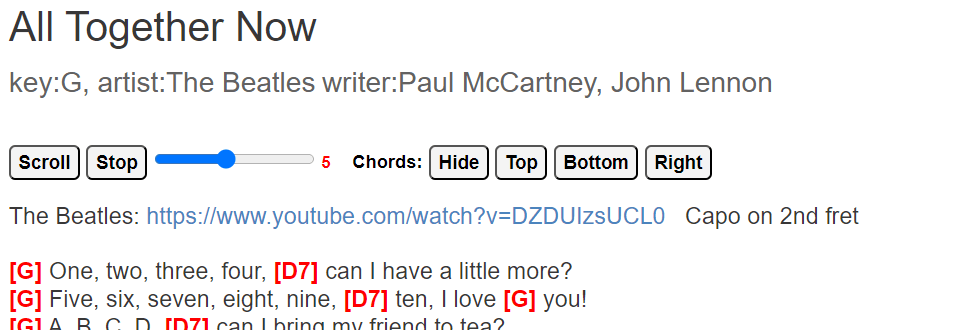
Themed Song: All Together Now I played this one on my ukulele, and asked the group to participate by doing the “response” part of the “all together now” chorus. If you don’t want to sing this one, play the original recording by the Beatles or the cover by Caspar Babypants.
I got the chord sheet from Jim’s Ukulele Songbook. It’s a great resource since he’s got a lot of functionality built into the site and among other things you can change the key of any of the songs and print sheets very easily. I prefer to play and sing this one in the key of G.

Themed Read: Who Has Wiggle Waggle Toes? by Vicky Shiefman & Francesca Chessa This is a story of friends having fun together. Can you join in?

Week 2: Community 6/12, 6/13, 6/14/23

Intro: We live in a community of people, and the people in our community help each other. Some people have jobs that let them help others every day.

I played this one on my ukulele and took suggestions from the group. I prompted them by asking, “who helps us when we’re feeling sick?” if there was a lull.
Themed Song: Community Helpers Song
(tune of Farmer in the Dell)
The teachers teach the kids
Heigh-ho, they help us so
The teachers teach the kids

Choose 3-5 verses!
The firefighters put out the fires….
The crossing guards help us cross…
The librarians find us books….
The dentists check our teeth…
The doctors keep us well…
The farmers grow our food…
The mail carriers deliver the mail…
Custodians keep us clean…

Click for a ukulele songsheet for “Farmer in the Dell”

I encouraged the group to give a cheer for every page to keep interest up.
Themed Read: Cheer: A Book to Celebrate Community by Uncle Ian Aurora & Natalia Moore

Week 3: We Work Together 6/19, 6/20, 6/21/23

Intro: Working together really makes things go smoother.

Instead of the ukulele this week, we did the ASL motions.
Themed Song: The More We Get Together
The more we get together, together, together
The more we get together, The happier we’ll be
For your friends are my friends, and my friends are your friends
The more we get together, The happier we’ll be

The more we read together… (ASL for read)
We’ll read big books and small books
Read short books and tall books…

The more we work together the stronger we’ll be… (ASL for work)
Source: traditional, ASL for verse one

Themed Read: Blocks by Irene Dickson

Week 4: Kindness 6/26, 6/27, 6/28/23

Intro: One important way to work together is to show kindness. Being kind means thinking of others and doing what you can to be a good neighbor.

The root of all kindness, I believe, is love. Here’s a traditional song your grownups might remember from their childhoods!
Themed Song: Skinnamarink
Skinnamarinky-dinky-dink, Skinnamarinky-doo, I love you!
I love you in the morning, and in the afternoon
I love you in the evening, underneath the moon
Skinnamarinky-dinky-dink, Skinnamarinky-doo, I love you!
Source: traditional, motions from Jbrary

Themed Read: How Kind! by Mary Murphy

Week 5: Family 7/3, 7/5/23

Intro: We can start working together with the people who are closest to us – our families! Who are the people in your family?

Here’s a song for all the people in our families – listen carefully! I included some different iterations to try to be as inclusive as possible. To keep things from getting too long, I sometimes combined (grandma and grandpa). Pairing it with a silly action (and telling grown-ups that they count, too) increases the fun.
Themed Song: If You Have a Brother
(tune of Do You Know the Muffin Man)
If you have a brother
A half-brother, a step-brother
If you have a foster-brother
Please stand up!
Repeat with other family members: sister, mommy, daddy, cousin, aunt, uncle, grandpa, grandma, etc. Ask for suggestions!
Pair with other silly actions: raise your hand, stick out your tongue, wiggle your foot, jump up and down, pat your head, etc.

Source: Abby the Librarian (though I changed the tune)

Themed Read: The Family Book by Todd Parr

Week 6: Animal Helpers 7/10, 7/11, 7/12/23

Intro: Does anyone have a pet at home? Did you know that some animals have important jobs, helping their humans? Some animals help humans who need them to get around or keep them safe. Some animals help soothe people who are lonely or need an animal to help them calm down. Today we are celebrating these animal helpers.

I talked briefly about different helper animals and what they do – including miniature horses, who can be used for the visually impaired! Cats and bunnies are generally therapy animals. I used puppets for each, and asked what sound each one made – including the rabbit! “You’re right, rabbits are quiet! But they can be helpful by being snuggly!”
Themed Song: Animal Helpers Song
(tune of The Wheels on the Bus)
The dog helps his owner with a woof, woof, woof
Woof, woof, woof
Woof, woof, woof
The dog helps his owner with a woof woof
All day long!

The cat helps her owner with a meow, meow, meow…
The horse helps their owner with a neigh, neigh, neigh…
The bunny helps her owner with a snuggle, snuggle, snuggle…
Source: adapted from the traditional

So, I kind of realized after planning that this dog was not a working dog but a pet – the vest threw me off. It still seemed like the best option as far as length. If you know a better option, please let me know in the commets!
Themed Read: Best Day Ever! by Marilyn Singer & Leah Nixon

Week 7: Helping Hands 7/17, 7/18, 7/19/23

Intro: Who likes to be a helper? What are some ways you might help at home? Putting toys away, set the table, put laundry in the hamper, play with a younger sibling, etc.

Since we use this tune for our transitional song, which comes right after this one, I saved the “clap” action for that one and went right into it. I also played ukulele for this one!
Themed Song: If You’re Helpful and You Know It
(tune of If You’re Happy and You Know It)
If you’re helpful and you know it, stomp your feet
If you’re helpful and you know it and you really want to show it
If you’re helpful and you know it, stomp your feet

If you’re friendly and you know it, peekaboo…
If you’re thoughtful and you know it, shout hooray…
Then go right into “If you’re ready for a story, clap your hands”
Source: adapted from the traditional

Get a downloadable ukulele songsheet here!

thumbnail for ukulele songsheet

Themed Read: Kindness Makes Us Strong by Sophie Beer

Tune in to the next post to learn more about all the sensory stations – like the Fly Swatter Slap, Pool Noodle Sort, Ping Pong Fishing, Mystery Water, Feed the Croc, and more!